A census, a bunch of Hebrew names… seems difficult right?! More so in English, it’s easier in Hebrew, and the names have so much meaning! 🙂 When I first lived in Israel and learned Hebrew, names were difficult… Achinoam, Yonatan, Shaked! Hebrew names have meaning seen in the letters themselves, unlike English, so that makes it easier! It’s surprising how many adults I meet in America that don’t know what their name means. In the Israeli hospitals where our children were born NO ONE ever asked what the new baby’s name was! The baby was identified by the mother’s first name and her mother and father. Then later named within 30 days after they were born according to their personality/character. They don’t measure the length of the baby either so as to not stretch it out after being curled up inside the womb.
Moses wasn’t allowed to lead these new people into the Promised Land. So he asked that God pick a new leader over the people. “Let the LORD, the God of the spirits of all flesh, appoint a man over the congregation who shall go out before them and come in before them, who shall lead them out and bring them in, that the congregation of the LORD may not be as sheep that have no shepherd.” (27:16,17)
The LORD chose Joshua, “a man in whom is the Spirit.”(27:18) Interestingly, the Hebrew name of Joshua is basically Jesus/Yeshua. They have the same meaning, the LORD saves. Like Joshua was chosen by God to lead the Israelites into the Promised Land, so Yeshua was chosen by God to lead all people into the Promised Kingdom to those who trust in him. Both were chosen to shepherd and lead the people.
“I am the good shepherd. The good shepherd lays down his life for the sheep.” John 10:11
-Stephanie Schlegel
REFLECTION QUESTIONS
1. What does your name mean?! Have you seen any special connections in your name over your life span?
2. How can calling someone a bad name be hurtful? What effect does it have on people to call them a good name?!
3. What are we known for? Isn’t it a great compliment of Joshua that he was filled with the Spirit? May we be filled with the fullness of God and walk in His Spirit like Joshua did.
So things are not going well for the Israelites. In yesterday’s reading, we see that distrust in God led to the destruction of many and the curse of roaming around the desert – which would eventually lead to the death of everyone over 20 years old when they grumbled against the Lord. In today’s reading, God first curses the people by demanding offerings brought in fractions. Frankly, I would have found this worse than being stuck in the desert. 2/10, ⅓, 3/10, ¼ , WOW! This would definitely be a sacrifice of praise for me!
Now you would think that having seen God’s miracles and blessings, people would accept Moses as their human leader and do what was required of them. But in Numbers 16, a man named Korah, a Levite, decides he’s had enough. I don’t know if he blames Moses for the things that have gone wrong on this journey or he just liked picking fights with those in leadership. But long story short, God decides He’s not even going to mess around and swallows Korah, along with his cronies who sided with him and all their households and all that they owned.
In Numbers 17 God uses the familiar rod (the same rod He turned into a snake, sent a few plagues and split the Red Sea) to prove that Moses and Aaron are the leaders He anointed. God had Moses collect a rod from each of the 12 tribes of Israel, and write the name of each tribe on the rods, Aaron representing the Levites. He would then cause one to bloom and the one that blooms was the rightful leader. I don’t think it’s a spoiler to tell you which one bloomed… to the point of producing almonds! I would think that seeing the ground opening up and swallowing a lot of people who had been complaining against Moses and Aaron would have been enough for me to keep my thoughts to myself. However, apparently, there was still some complaining but after the budding of the rod, no one questioned Aaron’s position after that, Yeah…I kind of think that’s weird too!
Today’s reading ends with, “Behold, we parish, we are dying, we are all dying! Everyone who comes near the tabernacle of the LORD, must die. Are we to perish completely?” Cheery. Even cheerier… WE are all dying. The people of Israel (at that moment) finally realized they were one mistake away from death. They needed a savior. WE need a savior. I am so grateful this is not the end of the story.
-Maria Knowlton
Reflection Questions
What was Korah’s (and those who aligned with him) sin, or sins?
How did Moses handle this rebellion?
How do you tell who God has chosen as Christian leaders?
The first time I ever set up a tent without my husband was when I took my just about to be 10 year old son to Cub Scout camp. Unfortunately, both of us were a little too short to reach all the parts we needed to secure the tent. BUT! Luckily, another parent came over and helped us out. He also gave us some tips about tent camping. However, he forgot one small detail, or maybe he thought it was common sense. He didn’t mention that we should sweep the ground before setting up the tent so there would be no rocks underneath. The first night was very uncomfortable (the next few nights we were so exhausted that we didn’t care)!
I suspect that the people of Israel were getting pretty good at setting up tents by the end of Numbers 10. This chapter lays out the order in which the tribes of Israel were to move when God would lift the cloud. It is interesting to note that Moses asks his brother-in-law for assistance since he was from around those parts. My Bible footnote states that “Divine guidance does not exclude using human help.” I think that could apply to so many areas of our life! God often puts just the right person into our lives at just the right time to carry out His will!
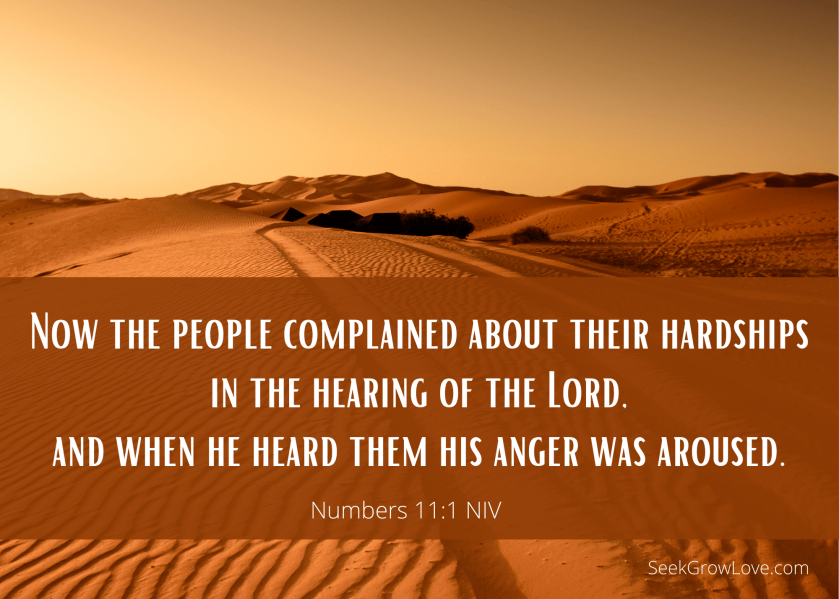
But sometimes the people in our lives can bring us down. In chapters 11 and 12, we find that the people are complaining, a lot, so much that some of them want to go back to Egypt! I don’t know for sure but I think it’s reasonable to guess that it probably started with a few people and soon others followed. Of course, this caused God to get a bit aggravated, sending fire and plagues against those who complained. Even Miriam, Moses’s sister, got a plague of her own, developing an acute case of leprosy. Fortunately for her, God forgave her and healed her.
Today’s reading really reminds me that while God does send people into our lives to better us and for His glory, there are those who will pull us away from God. When deciding who is who, look at the overall life of the person. What does their life look like? What does their relationship with God look like? If they are a mess and far from God, I guess you could learn what NOT to do! However, we would be wise to listen to the ones who will lead us in the ways of the LORD (and will remind you to sweep before setting up a tent)!
-Maria Knowlton
Reflection Questions
Does your circle of influencers include more helpful people who will help lead you in the way of the Lord, or more complainers who will arouse the Lord’s anger? Who specifically do you know who could be beneficial to spend more time with?
What would others say about you? Are you more known for your complaining or for leading in the way of the Lord?
When you do complain, what are you more likely to be complaining about? and to whom? Would there be a better use of your time and words?
At the end of Exodus, after the Tabernacle has been finally built, God’s glory comes to rest in it, but Moses is unable to enter (Exodus 40:35). However, at the beginning of the next book, Numbers, Moses is speaking with God in the Tabernacle (Numbers 1:1). This middle book, Leviticus, is the explanation about what is necessary to come into God’s presence and enjoy His fellowship. Since God is so holy and separate from us, there are things that we are expected to do in order to come into His presence. Thankfully, out of His love, mercy, and desire to be with us, God provided a way for us to come before Him, both for the Israelites back then and for Christians today.
Immediately in Leviticus 1 and 2, we find descriptions of different animal sacrifices and what is necessary to perform certain rituals in God’s presence. Since we don’t have a Tabernacle or Temple to worship in, and we don’t perform animal sacrifices anymore, how is this really relevant for us?
In Leviticus 1:4, we are told that these animals are dying in the place of the person who is offering it to God. The truth of these sacrifices is simple: sin is serious and deserves death. Whenever you do something that is contrary to God’s laws, both minor and major, it is offensive to the One who gave you life in the first place, and we deserve death for it. The mantra of our age that “everyone is naturally good in their own way” is simply not true; we are all broken, sinful, and corrupt human beings in need of God’s saving grace. For the Israelites back then, the answer to the problem was an animal sacrifice to cover their offense against God; for us today, it is the one sacrifice of Jesus Christ that is sufficient.
The New Testament continues the teaching that sin is serious, offensive to God, and deserves death: “For the wages of sin is death…” (Romans 6:23a) We cannot forget the seriousness of our situation, because when we do, we lose the power of the gospel. The good news for us is that we don’t have to die for the things that we did; Jesus died in our place, like the animal sacrifices in Leviticus. “… but the free gift of God is eternal life through Christ Jesus our Lord.” (Romans 6:23b) The sacrifice of Jesus was sufficient to cover over every sin that we have ever committed or will commit (Hebrews 10:10). We need to thank God for providing a way out of our sinfulness, both in Leviticus and today through Jesus Christ. Through this sacrifice, we can enter the presence of God and enjoy fellowship with our heavenly Father (Hebrews 4:16).
-Talon Paul
(Originally posted February 15, 2021 for SeekGrowLove)
Reflection Questions
What were the duties or responsibilities of the Israelites to come before God to be forgiven? What are the duties or responsibilities of the Christians to come before God to be forgiven?
How many times do you find the phrase ‘without defect’ or blemish? Why was that important to God for the Israelites? How does that apply to Jesus as sacrifice?
As Christians we can bring (living) offerings and sacrifices to God, not to earn salvation and forgiveness, but to thank God and show we live for Him and He has first place. What would you like to offer/sacrifice to God and how can you do it?
After Moses destroys the idol he gets another opportunity to be in the presence of God (another 40 days on Mount Sinai). He actually was able to see the glory of God pass by.
And we see God’s description by his own account.
“The Lord, the Lord, the compassionate and gracious God, slow to anger, abounding in love and faithfulness,maintaining love to thousands, and forgiving wickedness, rebellion and sin. Yet he does not leave the guilty unpunished; he punishes the children and their children for the sin of the parents to the third and fourth generation.” (Exodus 34:6,7)
But what stuck out to me is how Moses changed after being in the presence of God. His face was so radiant it scared the others.
It’s easier than we might think for people to know where we’ve been or what we’ve been doing.
Many can tell you of my interest in chocolate. It started at a young age. My parents tell me a story of when I was little and I snuck a piece of cake. My face was full of chocolate icing. I was approached about if I took a piece of cake and I straight faced lied – “I did not take the cake”. Despite my insistence, my parents knew where I had been and what I was up to.
Maybe it’s the icing on your face, the ticket-stub that falls out of your pocket, maybe it’s your extensive knowledge of a certain sport, or your church name printed on your shirt, but there are clues that tell others where you have been, who you were with, or what you’ve been up to.
Over time people notice deeper things as well. Because the truth is, whether we are aware of it or not, what and who we spend our time with changes us. Whatever you spend your time looking at, meditating on, and thinking about is what you will slowly, but surely, become. And people pick up on it.
So let me ask the question, “What have you been doing?”
“Who or what has left a mark on you?”
“What do you reflect in your character?”
And more specifically, if it is easier than we might think for people to tell where we’ve been, would anyone think you’ve been with God?
Do you show signs of having been in contact with him and his Word?
John Wincapaw
(originally posted for SeekGrowLove on February 10, 2020)
Reflection Questions
Go back and spend a little more time with John’s 5 questions at the end of his devotion. Which question is hardest to answer?
What evidence have you seen in others that they have been with God? Do you think others see this same thing – or something else – in you?
God tells Moses He will do wonderful things with His covenant people but warns them of making covenants with the people of the land they are going to (Exodus 34:10-16). Does this still apply today? What would it look like today? What are the signs you have seen in yourself when you get too close to the world?
This week my husband is attending a four day technology conference where attendees are being introduced to the absolute newest innovations in the world of technology. They get to hear keynote speakers who are the experts in their field. He is loving exploring all the new and improved gadgets and gizmos. He also made sure he left a little extra wiggle room in his suitcase to bring home some conference souvenirs from the show floor exhibits.
As we’ve been reading in Exodus these last few days, it struck me that Moses was experiencing a somewhat similar event. With a few important differences of course. Moses’ conference wasn’t 4 days but 40. His wasn’t in Spain or Florida, but on Mount Sinai. His conference souvenir was much more impressive (and heavy) than anything Jason has come home with. And, the topic of Moses’ conference wasn’t technology but worship.
I think if you asked most people what Moses was doing on Mount Sinai, if they had any idea at all, they might say God was giving him the Ten Commandments on stone tablets. And they wouldn’t be wrong, as we see that did occur in the final verse of Exodus 31, which is part of our Bible reading today. However, there is much much more to the story. First of all, one should have asked – which visit to Mount Sinai – because it appears there could have been up to 7 or 8 trips up and down the mountain for Moses. (Similarly, if you asked me how many times Jason has been to technology conferences, I lost count a long time ago.) But, this was definitely a special place and Moses and God spent some special time together on this mountain.
It is interesting that this particular 40 day worship conference began way back at the tail end of Exodus 24 “Moses entered the cloud and went up on the mountain. And Moses was on the mountain forty days and forty nights.” (Ex 24:18 ESV) Thus begins 7 detailed chapters (Exodus 25-31) in which Moses tells us exactly what was really going on on Mount Sinai for 40 days and nights. And it really wasn’t about the law and the Ten Commandments, this time. In fact, these were given back in Exodus 20-23 (just 4 chapters for the giving of the law, though we will get to some more soon in Leviticus). Also, in Exodus 24 Moses had written down God’s rules for living. He read them to the people and they agreed that they would obey.
Next, God was moving on to the next BIG thing – How will you WORSHIP me? If you’ve been following along this week in Exodus you’ve read over and over again, “The Lord said to Moses…”, and “You shall make…”. And then you’ve read many, many detailed directions on how God wanted the people to make a tabernacle where they would meet and worship God. Contributions, curtains, ark of the covenant, bread table, golden lampstand, bronze altar, outer court, lamp oil, the priests’ clothing and consecration, incense altar, census tax, bronze basin, anointing oil, incense…no wonder it took 40 days! I wonder if Moses had to pass a written test at the end so God was sure He remembered the perfect incense recipe and the dimensions of the curtains. Maybe Moses took notes and made sketches which would become the rough draft of Exodus 25-31.
It’s important to remember these were not just suggestions given for one possible way they could create a space for God to dwell with them. These were precise directions from the Creative Maker of the Universe. The All-Knowing Keynote Speaker at this Worship Conference knew what He wanted and why. There was only one right way to do it God’s way. Perhaps He was giving them valuable experience in doing things God’s way. Thankfully, He was making it known, every detail, so they wouldn’t have to guess and get it wrong over and over again. Also, as we see if Exodus 31 He was not only giving this information to Moses, but He was also giving His Spirit and ability, intelligence and knowledge to others who would lead the work of crafting. They didn’t have to figure it out on their own! They could follow the God-given directions and God would provide the skills and abilities and knowledge and Spirit they needed! But, what if Moses or Bezalel or Oholiab (the gifted craftsmen) or the people decided green and yellow yarn would be much brighter and cheerier than blue, purple and scarlet? What happens when we disregard God’s directions and decide to do it our own way instead?
One example is given in Exodus 32. Just as I have my biggest technology emergencies when my tech expert is at the technology conference, when Moses is at the worship conference, the Israelites experience a very big worship emergency. They not only try changing the color of the yarn, they change their god. Fearing what has happened to Moses (apparently they didn’t get the advertisement that this worship conference would last 40 days), they take matters into their own hands and decide it’s time to make a new god to lead them. It sounds so ridiculous – but perhaps if we are honest we have sometime also gotten tired of waiting on God, and fearing the worst, took action in the wrong direction. Unfortunately, Aaron followed along with their ideas, maybe scared of the people, maybe eager to get his chance to be in charge?
At Moses’ 40 day Worship Conference he got to receive first hand from the Lord the unveiling of all the latest and greatest features of how God wanted the Israelites to prepare to worship the Almighty. How can you attend a worship conference with God today? What does He want to reveal to you about how to worship Him?
-Marcia Railton
Reflection Questions
Why do you think God gave Moses so many specific directions for how the Israelites were to worship Him? Do you think there is a connection between His rules for how we live and how we worship?
I don’t think there is just one type of music God wants to be worshiped with, or just one color of carpet God wants to see in every church, but what are some worship rules you think God wants us to remember when we worship Him today?
What can we learn from Moses about Christian leadership? And from Bezalel and Oholiab? And from Aaron?
Have you ever created a new god to worship and follow when you became fearful or impatient. How do we guard against falling into the golden calf trap?
A number of years ago I led one of my churches through the 21 day Complaint Free Challenge. The challenge was to go for 21 days in a row without complaining. We each were given a purple wristband to wear throughout the challenge. You were to wear the wristband on the same wrist for 21 straight days. If you caught yourself complaining, then you had to switch your wristband to the opposite hand and start your 21 day challenge again. Some of the studies I read said that it takes most people about a year to go 21 consecutive days without complaining. I forget how many months it took me to get to that point.
What was the purpose? To help people break the habit of complaining. For many people complaining is simply a bad habit. Will Bowen, who invented the 21 Day No Complaining Challenge says that most people complain for one of 5 reasons using the acronym G.R.I.P.E.
Get Attention
Remove Responsibility
Inspire Envy
Power
Excuse Poor Performance
When we habitually complain to get attention, to remove responsibility (shift the blame), inspire envy, exert power or excuse our poor performance, we dig a behavioral rut and complaining becomes our default response to just about any situation. That’s a sinful habit from which we need to repent.
In order to break the bad habit, like any bad habit, one must counter the undesired behavior with more desirable behavior. The goal of the complaint free world experiment was to improve the world by reducing the amount of complaining that goes on. During that process I became aware of just how often I did complain. I don’t like hearing other people complain all of the time, I don’t think anyone does. Parents don’t like to hear their kids complain all of the time. Spouses don’t like to hear their husbands/wives complain all of the time. Children don’t like to hear their parents complain all of the time. Students don’t like to hear their teachers complain, and teachers, I’m sure don’t like to listen to their students complain. Churches don’t enjoy hearing their pastor complain all of the time and pastors don’t like hearing church members complain a lot the time. And guess what…even God gets fed up with human beings complaining all of the time.
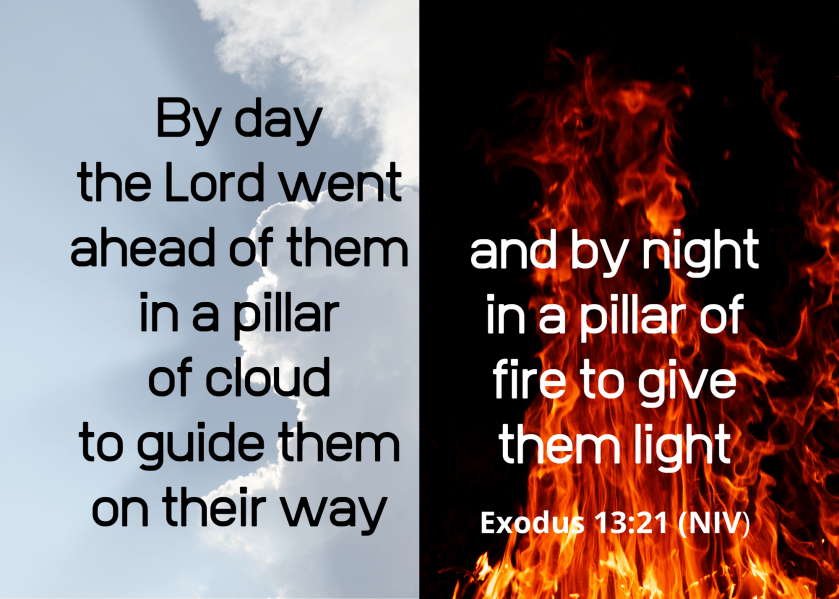
In today’s reading, God has been busy taking care of Israel. He led them out of slavery to the Egyptians by performing ten amazing signs. When Israel was being chased down by Pharaoh’s army and looked like they were doomed for destruction, God miraculously parted the waters and brought them through on dry land. God led them by cloud during the day and fire during the night. God was taking them on a journey to a land that he was going to give them. God was doing nothing but good for them.
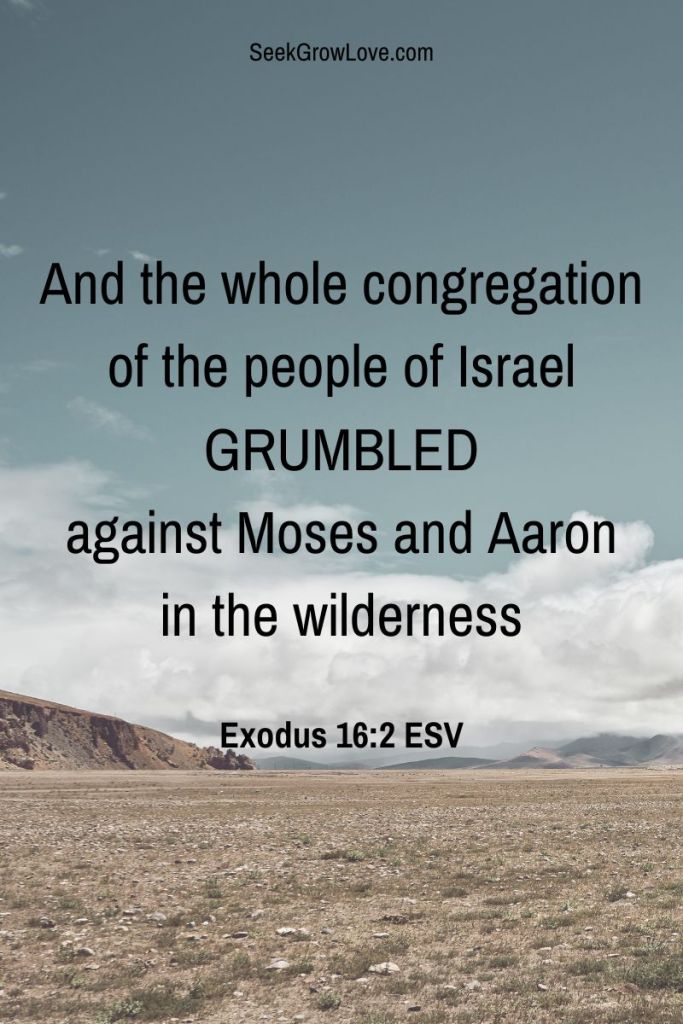
And how did God’s people respond to all of this goodness? They complained. We’re thirsty… we’re hungry. They sounded like a bunch of whiney kids on a long trip. If you’ve gone on a long trip, the experience is very different for the parents up front and the children in the back. Think about a family going on vacation. The parents are the ones preparing for the trip. Mom’s doing the laundry, packing everyone’s clothes, preparing snacks, arranging for neighbors to come and feed the animals and water the plants. Dad is making sure the car is running well, changing the oil, getting the mail stopped, gassing up the car, checking the route to make sure there are no road closures. The parents buy the tickets for wherever they are going, pay for the meals along the way, pay for the hotel rooms, make sure the kids have stuff to do in the car/van/suv. And what do the kids do? They complain: I’m hot… I’m bored… I’m hungry…I’m thirsty… I have to pee… sister’s looking… brother hit me… and are we there yet? I had 11 children and I know what I’m talking about here.
Imagine Moses… and God. They are moving roughly 2 million men, women and children across the wilderness toward the promise land. There are no McDonalds on the journey. There are no Holiday Inns with an indoor pool. There are no air conditioned SUVs with built in blue ray players and no iPhones or Nintendo Switches to keep them occupied. They are tired, they are hot, they are thirsty and hungry, and they are complaining… a lot!
If I’d been Moses or the Lord I would have been tempted to say “Ya’ll be quiet or we’re turning around and going back!” Fortunately the Lord, and Moses, have more patience and grace than I ever had:
Exodus 16:6 So Moses and Aaron said to all the Israelites, “In the evening you will know that it was the Lord who brought you out of Egypt, 7 and in the morning you will see the glory of the Lord, because he has heard your grumbling against him. Who are we, that you should grumble against us?” 8 Moses also said, “You will know that it was the Lord when he gives you meat to eat in the evening and all the bread you want in the morning, because he has heard your grumbling against him. Who are we? You are not grumbling against us, but against the Lord.” 9 Then Moses told Aaron, “Say to the entire Israelite community, ‘Come before the Lord, for he has heard your grumbling.’” 10 While Aaron was speaking to the whole Israelite community, they looked toward the desert, and there was the glory of the Lord appearing in the cloud. 11 The Lord said to Moses, 12 “I have heard the grumbling of the Israelites. Tell them, ‘At twilight you will eat meat, and in the morning you will be filled with bread. Then you will know that I am the Lord your God.’”
God heard their grumbling and he gave them quail and manna to eat. There it was, as much as they wanted. They were able to eat their fill. And after that they never complained again. Well, that’s not true…. before long they were complaining about being thirsty too.
What God should have done was give each of them a purpose wristband to remind them not to complain. It would take them a few more lessons before they quit complaining.
I’m sure God does get tired of hearing our complaining… but he still loves us and he even gives us ways to complain in the Bible. Many of the Psalms are called Psalms of complaint and/or Psalms of lament. Jesus himself, while he was on the cross prayed one of those Psalms of complaint/lament, Psalm 22 which begins: “My God, my God why have you forsaken me?” When we are suffering real pain, real sorrow, real trials, God wants us to turn those into heart felt prayer and we should. God is able to handle our complaints and do something about them. At the same time, too often our complaining comes from a place of ingratitude. The ungrateful complaining that fails to acknowledge and appreciate God’s blessings needs to stop; legitimate complaining for true hurt in faith is something God is ready and able to hear and respond to for his glory and our blessing.
Jeff Fletcher
(originally posted on February 4, 2020 for SeekGrowLove.com)
Reflection Questions
What could the Israelites have said instead?
What happens when you are around people who are complaining? What positive message could you share with a complainer?
Try it out just for today – how long can you go without complaining and grumbling? What could you say instead every time you catch yourself (almost) complaining? How long do you think it would take you to go 21 days without complaining? Will you take the 21 Day Challenge?
In our devotion yesterday Jeff Fletcher was describing the Dark Night of the Soul when it seems like God is distant. Certainly being enslaved for 400 years in a foreign land could have that effect. I wonder if even through all those years of painful toil if many or some Hebrew parents were still faithfully telling their children of the God of Abraham, Isaac and Jacob who had promised Abraham that his descendants would come out of that land of slavery after 400 years with great possessions and God’s judgment upon their former masters (Genesis 15:13). Was anyone still counting the years in anticipation? Were they talking to God about how He would show up? Were they watching to see how God might be acting on their behalf day after day while in slavery? I don’t know. But I hope so. In our reading today, there can be no doubt, God is at work and He shows up in some major ways – and also in some small surprising ways, too – but always faithful.
I will assume that you already have some knowledge of these events from Exodus 13-15. So, you already know of the amazing way God chose to lead the Israelites on their journey out of Egypt – with a pillar of cloud by day and a pillar of fire by night – spectacular! And you already know of God’s strong east wind that split the Red Sea with a wall of water on their right and a wall of water on their left as His cherished people crossed on dry land – astounding!
So, today I will focus on two of the smaller things – wheels and logs.
I don’t know about you – but I take great delight (maybe a little too much) in the picture of God at work in Exodus 14:25. Here the great God of the universe who has been directing the winds to create great mountains of water is watching from the pillar of fire/cloud which He specifically moved from in front of the Israelites where it had been guiding to the rear where it was protecting. So this great all-powerful God of the universe reaches down from on high to clog the chariot wheels of the advancing Egyptians who want to take back their slaves. Is there an adversary chasing you who wants to make you or someone you know a slave again? God is good at protecting His children, sometimes in ways I wouldn’t even think of. In big and small ways. God so loved the world. But we know everyone is not going to listen and play on His side. Some will play the role of adversary, but do not fear, our God knows how to clog their chariot wheels. Oh, and, make sure you are playing on the right team because the God who clogged their wheels also sent the mountainous walls of water crashing down on the Egpytians and none survived. His judgment is right and sure and coming at God’s perfect time not ours. And the whole world will know He is the Lord.
The second little example of God at work even in small ways in His big plans comes at the end of our reading today. The Egyptians are no longer a problem. Now, thirst is. They have traveled three days and have not found water. And when they finally reach water at Marah, they find the water is bitter, not just unpleasant to drink but likely unhealthy and perhaps deadly as well. The people grumble, Moses cries out to the Lord, and the Lord answers by showing Moses a log.
Thanks, God. This will help – if we want a campfire or need to start building a log cabin. But we really need water now. The Bible doesn’t record that Moses questioned God, but I might have. I love the partnership between Moses and God. God could’ve fixed the problem any way He wanted to. And if He wanted to sweeten the water with a log He could have easily picked up the right log and thrown it in himself – after all we just saw Him displace how many gallons of water and clog chariot wheels without any help from human hands. But more to His “normal” working – He shows Moses which log – and Moses simply steps up, pitches it in the water and God makes the waters sweet and healthy and life-giving.
Today, whether God is displacing the sea for you to walk through on dry land or clogging some chariot wheels to protect you, or showing you which log He wants you to pick up to sweeten your bitter surroundings – follow Him. He is at work, in big and small ways, guiding and protecting and sustaining.
-Marcia Railton
Reflection Questions
What inspiring words did Moses have for the people at the edge of the Red Sea in Exodus 14:13 & 14? Which phrase do you need to hear today? What words does the Lord God have for Moses in Exodus 14:15? Where do you think God is calling you to go forward?
Exodus 15 includes the first recorded hymn of the Hebrew people. If you were to create a hymn or worship song praising God for who He is and what He has done for you what would you include?
Where do you see God at work – in big and small ways? Like Moses picking up the log God showed him – what might God be showing you to do to change bitter to sweet and help sustain the weary, thirsty children of God?
As we go through life, there are times when it seems like God is very active and involved in our day to day lives and we sense God’s love, nearness and active interest in our lives. However, if we are honest, there are other times when life seems to just move along and God doesn’t seem to be saying much or doing much on our behalf. The technical term for this awareness of God’s absence is called “the dark night of the soul.” Many growing Christians have and do experience times of God’s apparent absence in our lives.
As we read through the Bible it becomes apparent that there are times when God gets actively involved with His people. God was there in creation, making the earth, making the plants and trees, making the animals, making Adam from dirt and Eve from Adam’s rib. God was there in Eden talking openly and directly with Adam and Eve. God was there asking Cain about his brother Abel. But then we don’t hear much from God. We know that people like Enoch “walked with God”, but we’re told very little about what God is up to for hundreds of years, as the population of earth increases and also the sin of humanity increases. There is a long period of God’s apparent absence from history until the days of Noah when God appears to Noah and tells him to build the Ark because a flood is coming.
After the flood there appears to be more years of silence, until the Tower of Babel gets built and God comes down and confuses people’s language. Then there is more silence from God until he calls Abraham. And so on and so on…There are intermittent times where God is active and involved and times when God seems silent throughout the book of Genesis.
At the end of Genesis God saves Abraham’s family from famine by bringing them down to Egypt. At first, all is well as Joseph, Abraham’s great grandson is the second most powerful man in all of Egypt. But Joseph eventually dies, and he is no longer able to protect his family from the powerful Pharaoh, and eventually the descendants of Abraham are enslaved by the Egyptians. This lasts for a period of roughly 400 years. During that 400 years it seems that God is once again silent.
During that time Israel is growing from a few hundred people, to millions of people. Millions of men, woman and children living in bondage in a foreign land. Perhaps stories about God and their ancestors Abraham, Isaac and Jacob were passed along by word of mouth, but we might imagine that so many years of silence may have left the nation of Israel in a permanent Dark Night of the Soul. But then… out of the darkness and silence, Moses is born and becomes a member of the Egyptian royal family. God is at work, but he’s not quite ready to make himself fully known to Israel. Moses kills an Egyptian and flees to the wilderness and it seems that the darkness continues and the voice of God remains silent…until God appears to Moses in the burning bush and tells him to go back to Egypt.
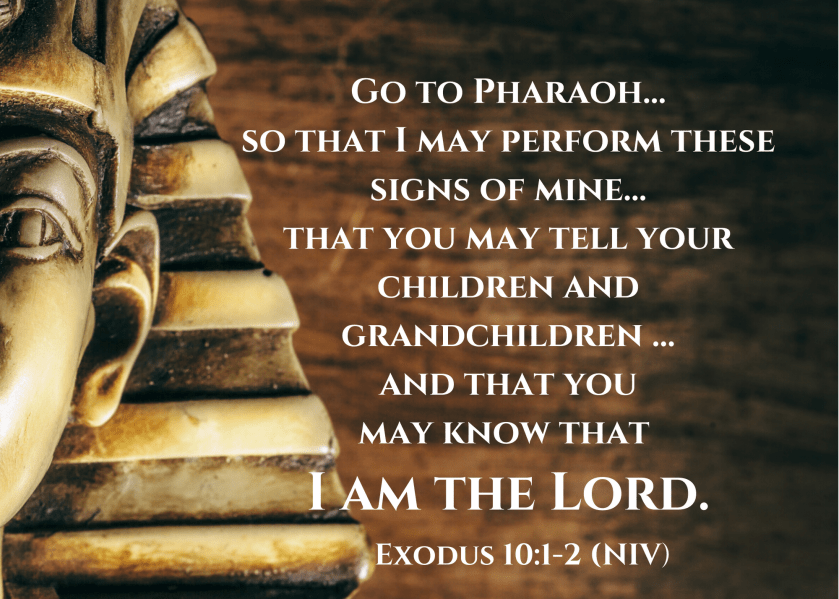
In Exodus 10-12 the time has come for God to make himself known to His people… and to Egypt. Exodus 10:1-2 – “Then the Lord said to Moses, “Go to Pharaoh, for I have hardened his heart and the hearts of his officials so that I may perform these signs of mine among them that you may tell your children and grandchildren how I dealt harshly with the Egyptians and how I performed my signs among them, and that you may know that I am the Lord.”
Here, God tells Moses that He’s about to make his presence known in a powerful way. God’s about to show up, the darkness is ending, the silence is over. And show up He does! God shows up in a profound and powerful display of his power and might. Bear in mind, Egypt was, at the time, the most powerful empire in the whole world. Pharaoh was the most powerful person in the whole world. Pharaoh had been exerting his power in a ruthless way over God’s chosen people for hundreds of years. Lord Acton once said “Absolute power corrupts absolutely.” In the United States we live under a Constitutional system that intentionally balances power among three different branches of government- Executive, Legislative and Judicial. This is to prevent any one person from having too much or absolute power. These lessons were learned after observing thousands of years of kingdoms. Pharaohs and other absolute monarchs have historically used their power in destructive and unjust ways. And with such unmatched power comes hubris.
The Poet Percy Bysshe Shelly captures the hubris in his powerful poem Ozymandias:
I met a traveller from an antique land,
Who said—“Two vast and trunkless legs of stone
Stand in the desert. . . . Near them, on the sand,
Half sunk a shattered visage lies, whose frown,
And wrinkled lip, and sneer of cold command,
Tell that its sculptor well those passions read
Which yet survive, stamped on these lifeless things,
The hand that mocked them, and the heart that fed;
And on the pedestal, these words appear:
My name is Ozymandias, King of Kings;
Look on my Works, ye Mighty, and despair!
Nothing beside remains. Round the decay
Of that colossal Wreck, boundless and bare
The lone and level sands stretch far away.”
Pharaoh, like Ozymandias in the poem, was filled with hubris over his unmatched power. He believed himself to be king of kings. He needed to be taught a lesson in humility by the true King of Kings. God showed up. Ten plagues later and all of Egypt was brought to their knees. Meanwhile, the people of God began to see first hand just how great and powerful their King, the true God, YHWH really was. That story has been told for thousands of years, and today, the people of Israel continue to sit down and eat bread without yeast and drink wine and remember the Passover and how powerful their God really is.
Sometimes, God seems to be silent, but make no mistake, God is still there and God is still powerful and in the end, God will show himself to be greater than all human opposition. May you know the true God.
Jeff Fletcher
(originally posted for SeekGrowLove on February 2, 2020 – Thank you, Jeff!)
Reflection Questions
Have you ever felt like you were in a dark night of the soul? How would you describe this time? How might God describe this time? Is there anything you found helpful during this time?
How do you think the Israelites were feeling as they: made bricks without straw, encountered the first 9 plagues, asked their Egyptian neighbors for jewelry – and received, selected a lamb, killed it, put the lamb’s blood on their doorframe, experienced the distinction God made between Israel and Egypt?
What lesson was Pharaoh learning in Exodus 10-12? What were the Israelites learning? What are you learning about man and about God?
Oh Dear Lord, please be with my mouth and teach me what I shall speak! Because my mouth is not eloquent.
Sometimes it is downright rude. Sometimes it lies. Sometimes it gets angry. Sometimes it hurts people.
Oh Dear Lord, please be with my mouth and teach me what I shall speak! Sometimes it stays shut when it should open to speak your words. Sometimes it forgets to give you praise. Sometimes it prefers to be grouchy or selfish instead of thankful.
Oh Dear Lord, please be with my mouth and teach me what I shall speak! Sometimes it doesn’t speak up for the oppressed. Sometimes it misses opportunities to spread joy and hope and your love. Sometimes…
Oh Dear Lord, please be with my mouth and teach me what I shall speak!
In Exodus 3 & 4 Moses is giving God lots of reasons (excuses) why He should pick someone else for the job of delivering God’s first-born child (the Israelites) out of slavery in Egypt.
I am nobody special
I don’t even know your name
The elders won’t believe me
I am not eloquent
Somebody else can do it better
God has answers for it all. I love the Lord’s words in Exodus 4:12 (ESV): “Now therefore go, and I will be with your mouth and teach you what you shall speak.” What a beautiful promise! Yet, Moses still pleaded with Him to just send someone else! God got angry at that one. How many times does this child of God need to be reassured that his God is bigger than any fear that comes with doing His Work. The maker of your mouth can teach you how to use it – when you step up and GO where He wants you to GO! Did you notice that little two letter word at the start of God’s promise to be with Moses’ mouth and to teach him what to say? You’ll never know what words God is waiting to teach you to say if you say no and don’t go.
God graciously compromised with Moses and rather than sending someone else instead of Moses, He sent someone else to go along with Moses, his brother Aaron who was not ‘coincidentally’ coming out to the wilderness to meet Moses.
Maybe it’s time I spend less time on my excuses and instead say YES, step out and GO and trust God to do what He says He will do – be with my mouth and teach me what I shall speak!
-Marcia Railton
Reflection Questions
What excuses have you tried giving God for not stepping out to do a job He wants you to do? How do they stand up to your GREAT BIG GOD?
How can you be someone’s Aaron and come alongside him/her to do a job for God that perhaps neither of you would feel you could do “on your own”? Though, you are of course never “on your own” when you are doing the Lord’s work!? What are some other instances that God used the buddy system and what were some advantages to having a partner?
So – the big question is – where does God want you to go? If you aren’t sure yet, be praying. And then, thank Him for being with your mouth and teaching you what you shall speak.







 Seek Grow Love