“Jesus is Better” Continued

OLD TESTAMENT: Isaiah 22-24

POETRY: Song of Songs 2

NEW TESTAMENT: Hebrews 8

“Jesus is better” talk continued…

Jesus is a better high priest because the Lord set it up, not man. He was chosen. The Lord (Yahweh) chose Jesus to be high priest of his New Covenant due to his loving obedience, as opposed to being appointed by men after their predecessor in lineage died (like in the Levitical priesthood). Jesus’s place as high priest is in heaven itself, not on earth as it was under the law of Moses, where there could only be a mere copy of the sanctuary.

Jesus wasn’t in the priestly line of Levi, he was in the line of Judah – whose line was chosen to be the king-ly line (after Saul (Benjamin’s line) screwed up and another (David) was found who chose God). It was after this chosen man (David) set his heart on choosing God that God swore his oath regarding the new priesthood that was to come in Psalm 110:4. God was going to make his new forever priest one who chose him, after the order of Melchizedek (chosen to be both king and priest; no lineage that made him so). And through him (the new high priest Jesus), he made a New Covenant with people who chose him from their hearts and had God’s laws in their minds.

The Old Covenant promised Israel that they would be God’s people – a kingdom of priests and a holy nation among all the inhabitants of the earth (Exodus 19:6). To serve God in this way, they had to know God’s will in how to live rightly, or at least better than how the rest of the world had been living (and hurting each other). God gave them laws to help them become holy, for their own good and the good of the world. But not all of them were faithful to uphold their end of the deal.

Although God chose them, some didn’t choose God back based on their actions. The law was not in their hearts. If it was, they would have trained themselves to distinguish between good and evil (to stop the evil and do good). They didn’t, hence, the need for a new covenant made with chosen people, through a perfect high priest.

The New Covenant through Jesus is written on the minds and hearts of God’s chosen people. To be chosen means that God chooses us because we choose God. We choose God by obeying him from the heart because we know that he loves us and sets up his commandments for our good, and for the good of the world through us. He’s a good father who establishes our ways for us so that it will be well with not only us, but those whom we affect by following God. We are the people who want that. We want it so badly, that we train for it. 

I understand that God set up the Old Covenant for the people’s own good – because they needed it to live well in their time – to be the people that God wanted them to be for their own good, to affect the lives of those around them positively as God’s holy people. But they didn’t want it (based on their behavior). God says of them, “For they did not continue in My covenant, And I did not care for them, says the Lord.” We know that God cared for his firstborn son Israel. He showed them mercy time and time again. But eventually, their continuously evil actions caused God to cease from his pleading with them to be faithful – until the better man Jesus inaugurated the better covenant based on his faithfulness.  

In this better covenant, all will know God, because they are people who choose to know him. In this better covenant, God will be merciful to them, because they will choose to repent. In this better covenant, God will not remember their sins, because they will choose to ask for forgiveness and do better, in the name of their high priest Jesus, because God’s laws are in their minds and written on their hearts (because they chose to put God’s laws in their minds, and on their hearts for their own good, and for the good of those around them). Don’t let Calvin persuade you otherwise.

There is usually a good reason people are chosen. They aren’t generally going to be randomly selected when it comes to matters of importance. And if they were chosen, they generally have to maintain the qualities that got them chosen in the first place to remain chosen. Throughout our bible history, some did, some didn’t. When God chooses someone, it almost always has to do with that someone choosing him. If God is choosing you, I pray you choose him back.

-Juliet Taylor

Reflection Questions:

1. Do you think God cared for the Children of Israel, even though he’s quoted from an Old Testament statement that he did not (Hebrews 8:9)?

2. Do you think God puts his laws into our minds and writes them on our hearts under the New Covenant (which would take away our autonomy) or do you think action on our part is involved?

3. Hebrews 9:13 says, “When He said, “A new covenant,” He has made the first obsolete. But whatever is becoming obsolete and growing old is ready to disappear. What does obsolete mean here?

The Law of Love

OLD TESTAMENT: ISAIAH 8-9

POETRY: PSALM 63

NEW TESTAMENT: HEBREWS 8

I believe that many readers of these devotions are currently students, while for some of you your school days are long in the past. Well, please adjust your memory as necessary and imagine the following situation: you’ve written a research paper with a required word count, and you run out of things to say (at least in the amount of time you gave yourself to write it). Your imagination is tapped. The letter of the law tells you the requirement, but you just can’t get your brain to produce any more useful ideas on the subject. What might you do? Perhaps you make one of your quotations longer to get the paper to reach the limit. If you were being a bit more cautious you might find spots to put in two or three shorter quotations so that your teacher won’t think that was what you did, instead of having one long quotation. 

Well Hebrews is the New Testament book which depends the most on quotations, it has the most quotations and draws on them steadily to make its points about God’s intentions. Much of its argument about high priests uses Psalm 110 (which is itself the most quoted text in the New Testament, with Psalm 110:1 the most quoted individual verse in the Bible). And starting in Hebrews 8:8 we have the longest quotation in the New Testament, but I guarantee that it isn’t there for padding. For one thing the average length of a Greek letter at the time was only 90 words – more philosophical letters ran to 250 words. But even the short book of Philemon is 355 words. The book of Hebrews is nearly 5,000 words. Padding was not required. This information may be treated only as trivia, or we may think about why Hebrews depended so much on the Old Testament, as foundation for what it tells us. Consider the possibility that for some Christians this was one of the first “New Testament” works they had contact with – they may have known stories of Jesus by word of mouth, but their Bible may have been almost entirely the Old Testament, and this letter was attempting to guide how they viewed it by careful argument. On the off chance that you have been skipping over the quotations all this time because you assume they don’t add anything to the main story, do please read today’s text in full (and you probably should go back over the earlier ones too).

Hebrews 8:1 begins by restating some facts about Jesus: that he became our high priest and is at God’s right hand. Hebrews seven had discussed these facts, but alongside many other issues, now the author (who you may recall I choose to call Herb, for simplicity) refocuses our attention on these core points from Psalm 110:1, 4. Going from that foundation verse two makes the additional point that in heaven Jesus ministers in “the sanctuary,” that is “the true tabernacle” or sacred tent, pitched by God rather than man. Moses was given very specific instructions about what the tabernacle on earth should be like, and he was told that the tabernacle reflected the greater reality which exists in heaven. Several of the Psalms also refer to the heavens as a tent set up by God. The comparison might not seem as smooth if it were drawn between the heavens and the Temple which Solomon spent years building in Jerusalem, but the book of Hebrews doesn’t discuss the Temple worship, it emphasizes the worship that took place in the wilderness.

Having brought his audience back to first principles, Herb says in the next few verses some things that will be expanded on in chapters nine and ten. That doesn’t mean he is saying things that his audience wasn’t aware of. For example, in 8:3 he says that it is necessary for Jesus to have “something to offer” as a high priest. Herb says this only a few verses after having stated in 7:27 that Jesus “offered himself.” I think this fact was familiar to everyone involved in Christianity. But Herb is walking his readers through his argument, making the case he set out to make. 

The quote beginning in Hebrews 8:8, from Jeremiah 31:31-34, will also be part of the discussion in the next two chapters of the book. It shows that during the time of the first covenant a need was stated – by God – for an improvement in the relationship of God and the people. All along the way God recognized needs and took steps to fill them. The same God brought about the first covenant and the second covenant. It was not some error in the first that resulted in the second, God planned for the developments that took place. While Jeremiah 31:31-34 says that the time is coming when no one would need to teach anyone the Laws (v. 10) it does not say that the content provided in the Law would be changing. Jeremiah simply said a new way was coming for God’s law to be given to God’s people, and that a way will come for sins to be forgiven. But we know that these changes involved more, and that the content of what people are meant to take in has changed between the first and second covenants. The law of love is a simpler message than the hundreds of laws contained in Leviticus, and through the Holy Spirit what God desires will be written “on our hearts” (v. 10). There is a different kind of relationship possible with God now than before.

Jesus said, in the Sermon on the Mount, that he did not come “to abolish the Law” but to “fulfill” the Law (Matthew 5:17). Perhaps some scholar of the Law could have anticipated that for the Law, which no one had ever successfully kept, to be fulfilled might be just what was required to bring change. Maybe Jesus’ words would have disturbed that scholar. Then again, a scholar of the Law who could anticipate such matters may also have foreseen that this was in God’s plan. Ultimately it was the ministry of Jesus at the true tabernacle, in heaven, which allowed the first covenant to be obsolete and disappear.

Lord, thank you for writing your will on my heart to let me understand you better. I don’t understand you as well now as I someday will be able to, but I am glad to know you more than I once did. It is good to love you, and to feel your love. Merciful Lord, help us to offer your mercy in your great strength. Amen. 

Reflection Questions

  1. We might sometimes think of the second covenant as very different from the first, but both covenants come from the God who took the people “by the hand to lead them out of the land of Egypt” (v. 9) – God loved and cared for the people of the first covenant, it is God who was rejected. What does the history of Israel show us about how God handles human rejection? 
  2. It seems likely that the first audience of the book of Hebrews knew the Old Testament better than most of us do, which may have helped them to understand the book of Hebrews better than we do. When you run into an Old Testament quotation you do not understand well, do you try to follow up on its context in the Old Testament?
  3. How do you see the “law of love,” for God and neighbor, as differing from the law expressed in the first covenant? Is the issue that people are being freed from ceremonial issues? Are Christians being given more trust and leeway?

sgl23bibleplanDOWNLOAD

Jew vs. Gentile

Old Testament: 2 Samuel 1 & 2

Poetry: Proverbs 17

New Testament: Acts 11

We pick it back up in Acts with chapters 10 and 11 that tell a story and then the retelling of the same story. These chapters play an integral part in the big picture of God’s plan.  It’s the beginning of the fulfillment of the part of the New Covenant that extends God’s promises to the Gentiles. It was a turning point for the early church because it recorded the moment that Gentiles were officially accepted as children of God. Peter was given a vision that all food was clean because it was made by God. This represents the changes from the Old Covenant to the New Covenant. Therefore, the Jewish Christians are no longer under the same laws that was presented to the Israelites in the Old Covenant. Now, the church could include the uncircumcised and non-Mosaic law followers. Additionally, we see the Gentiles receiving the gift of the Holy Spirit and the different gifts that come with God’s power. Now, God-fearing Gentiles no longer have to be excluded on the basis of not being circumcised or under the law. This message from God was aimed to unite those who followed God and believed in Jesus. This allowed the Jewish Christians and the Gentiles who feared God and professed Jesus as their Messiah to be united together under the New Covenant.

This was such an important message because the Jews prided themselves on being an exclusive group that looked down on those who were uncircumcised and not under the Mosaic law. Romans 3 addresses this issue that the Jews struggled with. Paul comes to the conclusion that both Jews and Gentiles are sinful and equally in need of a Savior. This concept should have greatly humbled the Jews because of how they perceived their status as God’s chosen people. They elevated themselves and compared their ‘righteousness’ to the wickedness of the world. What they didn’t fully comprehend was that God holds those who know more about Him to higher standards. God presented his people with the Mosaic law and a contract in Deuteronomy 28 that is full of blessings and curses that God would distribute depending on how the Israelites obeyed God. The final and worst curse was being exiled to a foreign nation. And from this side of history, we know that the Israelites were in fact sent into exile because of the faithlessness of Israel, and worse even, the unfaithfulness of Judah. The ten northern tribes of Israel were exiled in 722 B.C. by Assyria and the southern two tribes of Judah were exiled in 586 B.C. by Babylon.

Even during the exile though, God was still working for the good of Israel. His prophet Jeremiah prophesied about the future hope of a New Covenant. Jeremiah 31:31 says, “ ‘The days are coming’, declares the LORD, ‘when I will make a new covenant with the people of Israel and with the people of Judah. It will not be like the covenant I made with their ancestors when I took them by the hand to lead them out of Egypt, because they broke my covenant, though I was a husband to them’, declares the LORD. ‘This is the covenant I will make with the people of Israel after that time,’ declares the LORD. ‘I will put my law in their minds and write it on their hearts. I will be their God, and they will be my people.” This clearly shows that the New Covenant was intended for the Jewish people first. God desires hearts that are devoted to Him. The Jews broke the first covenant with their disobedience and worship of idols. So, God created the plan of sending Jesus to establish a New Covenant by dying on the cross. But the Jews rejected this Messiah that God sent. As a result, this New Covenant focused more on the heart of the recipient. It was based on loving God and accepting Jesus as Christ instead of following the Mosaic law. Therefore, the Gentiles who loved God and accepted Jesus as the Messiah automatically became equals to the Jewish Christians. God cares much more about the heart than he does about statuses.

The complete unification of God’s people will ultimately be fulfilled in the Kingdom when all nations, tongues, and tribes will be represented. Revelation 5:9 says, “And they sang a new song, saying, ‘You are worthy to take the scroll and to open its seals, because you were slain, and with your blood you purchased for God persons from every tribe and language and people and nation. You have made them to be a kingdom and priests to serve our God.’ ”

Peter was chosen for the task of preaching to the Gentiles and convincing the Jews that God had included the Gentiles in his promises. He sums it up in chapter 10:34 by saying, “I now realize how true it is that God does not show favoritism but accepts from every nation the one who fears him and does what is right.”

The big theological lesson from these chapters is that God desires all people to be in His Kingdom, so He extends his love and grace to the Gentiles. His desire all along was that Israel would be witnesses of God to the world and would bring the nations to Him. But the Israelites found out early on that it was very difficult to bring others to God when you are not following God wholeheartedly yourselves. This did not keep them from repeating the same mistakes. This does not mean that the church or the Gentiles replaced Israel. Instead, these two chapters present the extension of the New Covenant to the Gentiles even though it is still offered to any Jew who would accept Jesus.

Through studying the relationship between the Jews and the Gentiles in regard to the New Covenant, we can see that both are still offered the blessings and promises of the New Covenant. The Jews were not pushed out of the New Covenant at the inclusion of the Gentiles. Thankfully, God has enough blessings to give to all those who love and follow Him wholeheartedly and believe in His Son.

-Makayla Railton

Reflection Questions

  1. How would this vision from God change the whole structure of the early church?
  2. How do these chapters help us put the rest of the Bible in perspective?

Out with the Old, In with the New

2 Corinthians 3

2 Corinthians 3 9

This short chapter packs a punch while explaining the differences between the Old and New Covenants.  Any visual learners out there?  I like to SEE things; it helps me make connections better than just listening or reading. So here’s a little chart comparing the Old and New Covenants as taught by Paul in 2 Corinthians 3, verses 6-18.

Old Covenant

New Covenant

Verse

·      Of the letter (law)

·      Letter kills

·      Of the Spirit

·      Spirit gives life

Vs. 6
·      Brought death

·      Engraved in letters on stone

·      Came with glory

·      Israelites couldn’t look at the face of Moses (because he had been with God)

  Vs. 7
  ·      Even more glorious Vs. 8
·      Condemns men

·      Glorious

·      Much more glorious

·      Brings righteousness

Vs. 9
·      Was glorious

·      No glory now in comparison with (new) surpassing glory

  Vs. 10
·      Fading away

·      Came with glory

·      Much greater glory

·      Lasts

Vs. 11
  ·      We have hope

·      We are very bold

Vs. 12
·      Moses put a veil over his face to keep Israelites from gazing at it (radiance of being with God) ·      We are not like Moses Vs. 13
·      Their minds were made dull

·      Veil remains when old covenant read

·      Veil has not been removed

·      Only in Christ is veil taken away Vs. 14
·      Even to this day when Moses is read, a veil covers their hearts.   (Don’t see Jesus)   Vs. 15
  ·      Whenever anyone turns to the Lord, veil is taken away Vs. 16
  ·      The Lord is the Spirit

·      Where the Spirit of the Lord is, there is freedom

Vs. 17
  ·      We have unveiled faces

·      All reflect the Lord’s glory

·      Being transformed into his likeness with ever-increasing glory which comes from the Lord who is the Spirit

Vs. 18

I am reminded of a great free theme week of devotions this year by Jay Laurent on the Presence of God from February 3-9, 2019 (the New Covenant comes on the scene on February 7 https://grow16biblereading.wordpress.com/2019/02/page/2/).  Throughout the week Jay showed how God was revealing a plan to bring His presence to the people.  And, his plan grew and grew in greatness and glory.  From the very beginning, with creation, his plan was good (and even “very good”).  But it didn’t stop there!  God gave the law – the Old Covenant – to show people what was required to draw close to Him.  Only trouble is, humanity couldn’t get it right.  Everyone was guilty as a lawbreaker and deserved death.  Problem – because in death they were not drawn to God, but they were dead.  Solution – something or someone to remove the sin and show the power of resurrection.   Enter – Jesus!   The New Covenant!  The opportunity for sins to be erased.  Righteousness was in reach – and with it restoration with the Father.  And, that’s not all – Jesus would also bring the opportunity for resurrection and eternal life with God in the Coming Kingdom.  This is the miracle of God’s plan of life with Him that just keeps growing more and more glorious!


Thankful for the New!  Looking forward to the Newest!
Marcia Railton


Jesus is Greater than . . .

Matthew 17

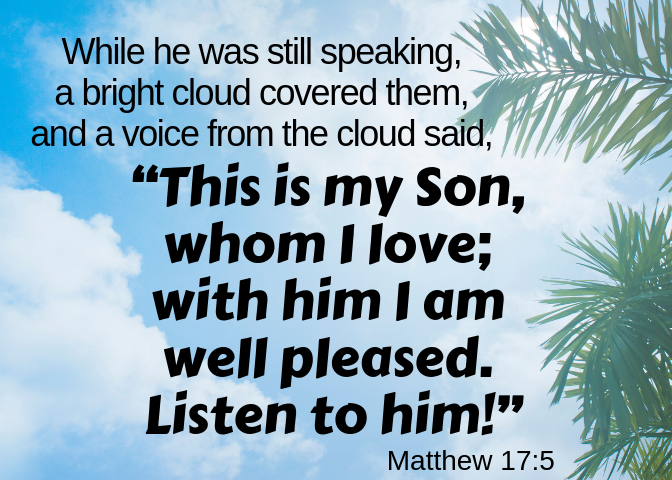
matthew 17 5

In Matthew 17:1-9, Jesus takes his closest disciples, Peter, James, and John, up to a mountain privately. During this time, God was about to do something that they would never forget. As they stood talking to each other and to Jesus, all of a sudden Jesus’ appearance changed and started shining like the sun! If that wasn’t enough, the disciples saw Moses and Elijah standing there talking with Jesus! What in the world is going on, they must have been saying.


This vision that the disciples saw has many truths within it that are significant for us to know. The first is that they got to see a glimpse of what the Kingdom of God is going to be like. In Daniel 12:2-3, we learn that after the resurrection, the righteous are going to “shine” like the sun and the stars. That is exactly why Jesus appeared to be shining before them; they were seeing a little bit further into the future to what it will be like after the resurrection.


Moses and Elijah are significant because they represent the whole Old Covenant; Moses represented the Torah (or Law) and Elijah represented the prophets. Although these were incredible figures in Judaism, when God spoke during this vision, he didn’t address them; he only spoke in favor of Jesus by saying “This is my dearly loved Son, who brings me great joy. Listen to him.” (Matt. 17:5 NLT) This vision was making a point: Jesus is greater than both Moses and Elijah, and therefore, greater than the entire Old Covenant!


Why should this matter to you? Well, if Jesus is greater than even Moses and Elijah, he is greater than whatever you are facing in your life. Any struggle that you may suffer from, whether it’s at school, work, home, or even within yourself, Jesus is greater. The best part is that he is willing to step into your life and help you, if you are willing to call on him. So, no matter what difficulties you are facing, Jesus is there and is greater; I encourage you today to call for his help. He loves you and wants the best for you; allow him to change your life.


-Talon Paul

New and Improved!

Hebrews 8

Hebrews 8_10

Today we get to look at a short chapter that is pretty packed!  I really enjoy how this chapter is laid out; it makes it easy to pick out what is being said. As a college student, I love when authors give you a heads up by saying, “Here’s the main point!”.  It’s like they are pointing flashing arrows at key concepts that will be on the test later.  Not that there is necessarily going to be a written exam at the end of this book… but we are definitely expected to know what is going on here!  Verse 1 and 2 clues us in as to what the author is trying to get at.  We have a high priest sitting at the right hand of God serving in a heavenly sanctuary that wasn’t built by humans.  He’s there!

As we move on to verse 5 we see that the current tabernacle at that time was built specifically to mirror the one in heaven.  I found that tidbit really interesting!  I’m someone who tends to gloss over the verses that are just measurements and descriptions of structures… I find them pretty boring to be honest.  BUT, how cool is it that the tabernacle Moses was to build had all of those specific measurements for a real purpose, besides just structural stability?  It gave me a little bit of a boost to read through all of those seemingly unimportant building directions we find throughout Scripture!

Verse 6 and on is somewhat of a comparison and contrast between the old covenant and the new.  First, we see that the new covenant is made superior and is established on better promises (vs 6).  In verses 7 and 8 we see that a new covenant was deemed necessary by God because he found fault in the first and wanted to establish one between both the people of Israel and Judah.  The next verse I think would’ve been a little tough to swallow as an Israelite.  Here the author is writing about how the Israelites did not remain faithful to God’s first covenant and because of that, He turned away from them.  Thankfully the chapter doesn’t end there and continues on to describe how amazing the new covenant will be!

In the last few verses we are told that we will be God’s people, that all will know the LORD, and that we will be forgiven of our sins!  Verse 12 says that God will remember our sins no more and that our wickedness is forgiven.  Praise God for a second chance! (Truthfully more like third, fourth, fifth, one millionth….) To end the chapter verse 13 restates that the old covenant is done, gone, obsolete.  We are living under a new covenant that offers us a clean slate.

Today I encourage you to take advantage of your clean slate, let your sins of yesterday be dissolved and obsolete like the old covenant, and press forward with the reminder that your sins have been forgiven through Jesus Christ.  What are you going to do today with that grace?

-Sarah Blanchard