
Closed Doors

Old Testament: Leviticus 24 & 25

Poetry: Job 2

New Testament: Acts 16

Have you ever gotten your fingers pinched, or crushed in a door? Ouch. That stings. Have you ever watched as someone walked (or ran) right into a closed door, falling backwards? I watch a lot of preschoolers – it’s a regular thing. Some handle it well, and dust themselves off as they go on, sometimes even laughing. Others need to take some time on the floor (and sometimes in my arms) to get over the shock and pain.

Have you ever been excitedly making plans of how your day, your trip or your life would go – only to find closed or closing doors. Maybe your fingers gets pinched in the process, or maybe your whole body and spirit are totally knocked out from a closing opportunity you were planning on and excitedly anticipating?

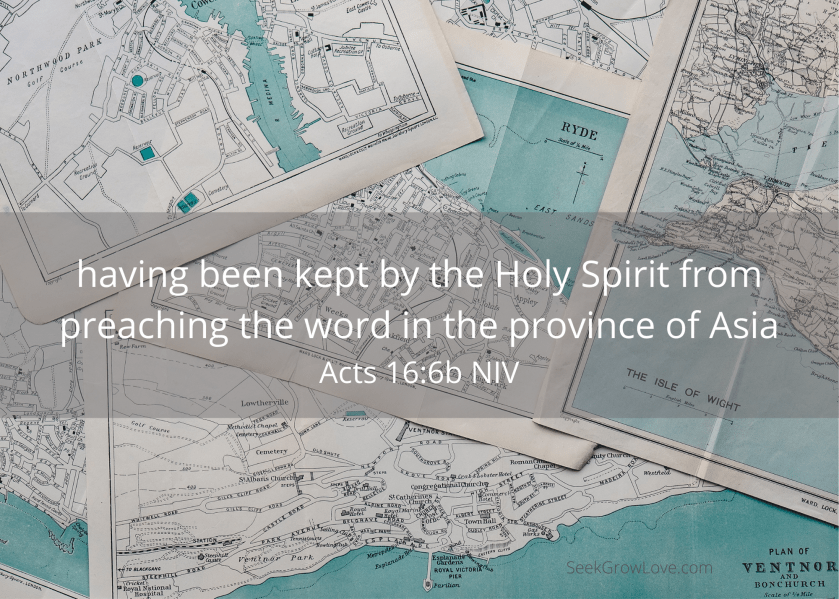
There are a lot of closed and closing doors in Acts 16. Paul and his companions (including Silas and Timothy at this point) were at the beginning of Paul’s second missionary journey. It is helpful to look at a map as you read Acts 16:6-10 to see what is really going on with Paul’s travel plans. (I also found William Schlegel’s Satellite Bible Atlas handy). Verse 6 says the Holy Spirit kept them from preaching the word in the province (not continent) of Asia. This indicates that they had wanted to, were planning on, and would have taken the gospel message to the province of Asia. That sounds like a very good thing! But, Asia became a closed door – because of the Holy Spirit. The map shows that the province of Asia would have been to their west as they were traveling. The very next verse says that at the border of Mysia (indicating that they did indeed continue traveling after their first way was blocked), “they tried to enter Bithynia, but the Spirit of Jesus would not allow them to” (Acts 16:7 NIV). Bithynia would be to their east. Closed door, again! Can’t go west, then, further down the road they can’t go east.

It would be interesting to know what these closed doors looked like. Maybe government red tape and passport issues that prevented travel to certain areas. Maybe a prophecy or just plain “bad feeling” about proceeding in the intended direction. Maybe advice from others regarding weather or disasters or unrest ahead. Maybe we will know one day what their closed doors were. Probably you can see what your closed doors are. What has kept you from the day, the trip or the life you envisioned? Maybe you have become discouraged because of all the things you were planning on doing, that aren’t working out right now as you had planned. If so, keep reading Acts.

It’s easy to ask, “What’s up, God? Don’t you want these on-fire evangelists to carry your word to the world?” How many closed doors are we supposed to come across and still keep going? It is so easy to let road blocks and closed doors defeat us, but Paul kept traveling, wherever he could. Can’t go to Asia, can’t go to Bithynia, let’s try heading to Troas. He was rewarded with a vision of a man from Macedonia calling out for help. The Bible tells us, when Paul received the vision, “We got ready at once to leave for Macedonia, concluding that God had called us to preach the gospel to them.”

So off to Macedonia they went. And what adventures – and lots of open doors – awaited them in Macedonia! There were new churches and hearts God was preparing in Philippi and Thessalonica and Berea (all cities of Macedonia). But God had planned that they would hear the message from Paul and his companions. He just needed to get Paul to them. If God had allowed Paul to enter Asia or Bithynia when they had wanted to, Lydia and the Philippian jailer and so many others would have been left waiting.

God’s plans were better than Paul’s . God’s plans are better than ours. His open doors are the best. His closed doors are closed for a reason – and that is okay – even good – even when it pinches a bit or throws us to the ground for a spell. Get up and try another door. Keep traveling and testing doors. The one He wants you to go through will indeed open. And behind THAT door are adventures and blessings that He has prepared for you – and people that He has prepared for you to carry the good news to. Don’t miss out on finding the open doors because you are sulking at the closed ones.

(Note on Holy Spirit and the Spirit of Jesus: both of these spirits were blocking Paul’s way at different times. I think it is not saying these are the same – but they did have the same purpose which was to get Paul to where God wanted him by keeping Paul from going other places, at least for now (later he would travel to Asia and work with the people who God had prepared at that time). Just as God and His Son are two side by side in heaven right now, they are active in the same spiritual battle for saving lives by sending their spirits to guide, empower, and close and open doors. It’s kind of like getting two superheroes on your side instead of just one.)

-Marcia Railton

Reflection Questions:

  1. Do you sometimes tell yourself that your plans are better than God’s? How can you trust Him more?
  2. What doors have been closed that you were anticipating traveling through? How did you handle it?
  3. What doors have been opened that you hadn’t been anticipating or planning? What blessings would you have missed out on if you had taken the closed door route instead?

Which Will You Be?

Isaiah 21-22 and Colossians 4

Today we are going to look at two different groups of God’s people: those in Jerusalem at the time of Isaiah’s writing and those in Colosse at the time of Paul’s writing. Which will you be?

In many of the previous chapters of the book of Isaiah we read about God’s coming judgments on Israel and Judah’s neighbors and sometimes her enemies. It’s not all bad reading what disasters are coming to your wicked neighbors. Yay, God! Go get em! Show em who’s boss! But, it gets downright personal in chapter 22 as the prophecies of judgment and doom now center on Jerusalem, God’s Holy City. What did they do to deserve this? Well, much. Other scriptures tell of Jerusalem’s idol worship and shedding of innocent blood and even sacrificing their own children. But specifically in Isaiah 22 we are told of their pride and arrogance, their celebrations and their disregard for God. When they saw danger on the horizon they did everything in their own power to protect themselves, including tearing down houses to strengthen the wall and building reservoirs. “But, you did not look to the One who made it, or have regard for the One who planned it long ago” (Isaiah 22:11 NIV). What would have changed if they had only called out to God for help?

God was waiting for His people to seek Him, to turn to Him, to cry out to Him, to confess and mourn and repent. But, instead, they were too busy. Busy with their preparations to save themselves. Busy with their sins. Busy with their celebrations and feasting and misplaced joy. Busy in their “town full of commotion…city of tumult and revelry.” (Isaiah 22:2 NIV).

They had abandoned God first. He was still calling out to them on that day (Isaiah 22:12). But, they were busy. They drowned out the sound of God’s voice with their sinful busy-ness and celebrations. So, His holy and righteous judgement was coming.

Contrast this tragic picture with what we read in Colossians 4 as Paul is closing out his letter to the church in Colosse with his final instructions and greetings. He urges the church, “Devote yourselves to prayer, being watchful and thankful” (Colossians 4:2 NIV). And, while he’s got the people praying – he says pray for me, too. Paul requests prayers for open doors (not to physically get out of house arrests, but open doors to reach more people), for opportunities to proclaim Christ and for clear communication in his ministry. And further on, I love his description of Epaphras, “a servant of Jesus Christ…He is always wrestling in prayer for you, that you may stand firm in all the will of God, mature and and fully assured” (Colossians 4:12 NIV). These people are busy, too – in prayer – in seeking God and in ministry . They are praying for their spiritual leaders and churches and those who will hear God’s message, and asking for prayer. Rather than ignoring God and drowning out His voice, they are seeking God regularly and whole-heartedly, coming to Him in prayer, always desiring to do more for Him and His Son.

Which group are you more like today?

Do you have see any similarities between yourself and God’s people in Jerusalem? Are you surrounded with so much commotion that you miss God’s voice calling out to you? Is he asking you to mourn when you are busy celebrating and feasting? Are you so caught up in your self-preservation preparations that you have neglected to call out to God? Do you rely on yourself instead of on God? When you see trouble coming do you invest time in creating a longer to-do list, throw a party, or fall to your knees before God? What would be different in your life and in your community if you called on Him in prayer instead of trying to do it your own way?

Do you see any similarities between yourself and God’s people in Colosse? Are you devoted to prayer, being watchful and thankful? Are you praying for open doors – not to get ahead or out of a jam – but to advance God’s gospel message? Are you busy praying for your Christian brothers and sisters and leaders and missionaries? Are you asking others to pray for your ministry? What would it look like if you spent time today wrestling in prayer?

Praying for you today – to Stand Firm in God’s Will, mature and fully assured

-Marcia Railton

Read or listen to today’s Bible reading plan passages at BibleGateway here – Isaiah 21-22 and Colossians 4

5 Point Checklist

1 Corinthians 16

1 Corinthians 16 13 14


At first this chapter seems to be a hodge-podge mixture of final instructions and greetings regarding several people we don’t know in a church we’ve never been to.  And yet, could Paul really just as well have been writing to us regarding our church?  Where would he insert your name today?  Let’s see what we find…


Paul begins by instructing the Corinthians to each be setting aside a weekly gift offering (in accordance with their income) on the first day of the week (not just giving some left-overs at the end of the week – if there was anything left).  This money would then be collected when Paul arrived and sent with responsible men to the church in Jerusalem which was experiencing great poverty and famine as well as persecution.  Generous, scheduled/weekly, repeated giving to help the Christian brothers and sisters in need.  Are we called to do any less?   How are you and your Christian community giving to support a church in need?  I think immediately of the needs in Malawi and Mozambique which have been hit so hard with recent cyclones and flooding resulting in the loss of crops, homes, churches and lives.  http://www.lhicog.com/images/Africa_Disaster_Relief.pdf.


I was struck with the reason Paul said he was going to stay in Ephesus until Pentecost: “For a wide door for effective service has opened for me, and there are many adversaries.” (1 Corinthians 16:9).  How exciting to have a WIDE door for EFFECTIVE service OPENED for ME!  Have you been testing doors to see which ones will open – even a crack?  I am quite sure Paul hadn’t been sitting on his couch watching Netflix when suddenly a door opened wide for him.  It often takes time, sacrifice, trials, perseverance, and ordering priorities to seek and find the open doors.  And when that door did open wide – it was still far from easy – in fact he found he had many adversaries!  But, rather than high-tailing it out of there and looking for an easier way – he was scheduling his priorities to stay where he was for that time because he saw how he could be used by God for effective service.  Would I recognize the open door?  Am I testing doors?  Am I not scared away at the possibility of gaining a few adversaries?  Let’s pray today (and daily) for “wide doors for effective service” to be opened for each of us – even if it comes with some adversaries.  And then – for the courage and wisdom to advance through the door.


Paul leaves a concise 5 point checklist for the church – of any century (vs. 13 & 14).

  1. Be on your guard

Watch for spiritual dangers – they are sneaky, real, powerful and deadly.  Apathy, busy-ness, worldliness, sin, a different gospel, and pride (to name just a few) can easily creep in when you aren’t standing guard against them.

  1. Stand firm in the faith

Remain steadfast in what matters most – your faith will be attacked (by others, by the enemy, by trials).  Keep it the priority.  Don’t be swayed.  Believe in God and the truth He gives.

  1. Be courageous

Troubles will come – be courageous – keep following God into the battle.  Gain courage knowing you are dressed for success with the Armor of God.

  1. Be strong

It will be hard– be disciplined in your spiritual training which will grow your spiritual muscle power.  Rely on His strength knowing you can’t do it alone. Stay connected to your church – there is strength in numbers.

  1. Do everything in love

In the midst of the spiritual battle, don’t grow cold-hearted – love, every time.  What does real love look like?  Self-sacrifice, giving, do onto others, sharing truth and the saving message of salvation, and love even when they haven’t earned it. (Refresh your love checklist with 1 Corinthians 13 again.)


These two short verses (Be on your guard; stand firm in the faith; be courageous; be strong. Do everything in love – 1 Corinthians 16:13,14) would be great to post on your bathroom mirror to see every morning as you prepare for the day.  Examine yourself daily – not just your hair, teeth and physical appearance.  How are you looking spiritually?  What do others see when they look at you?  What grades would you earn for your watchfulness, steadfastness, courage, strength and love of the day before?    What will courage look like today?  What spiritual dangers are lurking around the corner?   Who is God putting in your life to love in a special way?  Pray for these qualities in yourself and others, surround yourself with those developing and demonstrating these attributes so you can mutually encourage (and sometimes even admonish) one another.


Be the church Paul longed to see.


It’s not easy – but it’s always worth it.  (Refresh your resurrection recall with 1 Corinthians 15).


There are so many other great nuggets in this chapter.  Take the time to read it today and see where Paul would have put your name.


Praying for God’s Church,

Marcia Railton