Spirit Led to Do God’s Will

Acts 13-14 

Devotion by Juliet Taylor (Tennessee)

Acts chapters 13 and 14 are about the people of God continuing to do what Christ followers are supposed to do; to be led by the spirit to do God’s will.  

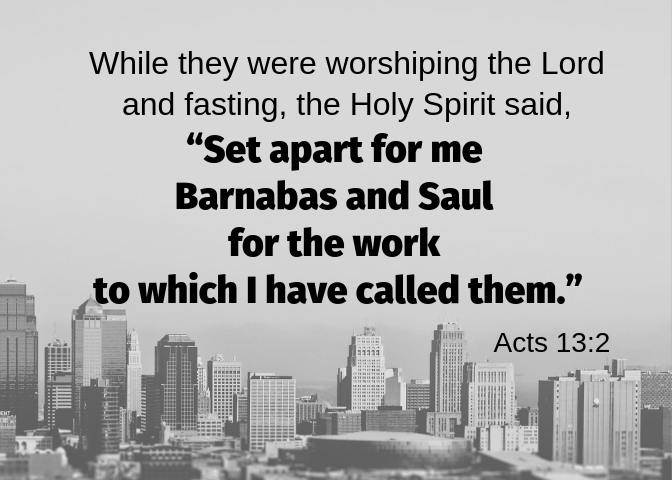
The prophets and teachers in Antioch were ministering to the Lord and fasting. Because of this, they were given revelation by the spirit to “set apart for me Barnabas and Saul for the work to which I have called them.” They confirmed this revelation by fasting and praying. They then laid hands on Barnabas and Saul and sent them on their way to do the Lord’s bidding.  

They started their proclamation of the word of God in the synagogues of the Jews and spread the word of God throughout the whole island. The proconsul (similar to a governor) wanted to hear the word but his magician/false prophet companion opposed the word, attempting to keep the proconsul from the faith.  

Paul, full of the holy spirit, rebuked the false prophet saying, “you who are full of all deceit and fraud, you son of the devil, you enemy of all righteousness, will you not cease to make crooked the straight ways of the Lord? 11 Now, behold, the hand of the Lord is upon you, and you will be blind and not see the sun for a time.”  

The consequence for opposing the spreading of the word to the leader of the region was blindness for a time! The proconsul believed after witnessing this miracle, but it was the teaching of the Lord that had him amazed. 

They continued their journey to Pisidian Antioch and on the Sabbath day, they were given the floor to preach the Gospel to the Jews in the synagogue. Read Paul’s words carefully, as the preaching of the gospel seems to highlight different aspects of it depending on Paul’s audience.   

To the Jews, he begins with God’s choosing of their fathers to be his people and ends with the good news of the fulfillment of the promise to their fathers, by raising Jesus from the dead so that he wouldn’t undergo decay. And because of this fulfillment, through Jesus, forgiveness of sins is proclaimed. And through Jesus, everyone who believes is freed from all things, which they could not be freed from through the Law of Moses.  

The response to this was to beg them to return the next Sabbath day to preach about these things. When they did, an even bigger audience gathered to hear the word. But when the Jews saw the crowds, they became jealous and tried to persecute them. Take note that this may happen when you’re doing God’s will. Be prepared and do what the early Christians who did better did; pray, fast, preach, keep seeking the Lord’s guidance to do God’s will.  

To them Paul and Barnabas said, “It was necessary that the word of God be spoken to you first; since you repudiate it and judge yourselves unworthy of eternal life, behold, we are turning to the Gentiles. 47 For so the Lord has commanded us, 

‘I have placed You as a light for the Gentiles, 
That You may [ab]bring salvation to the end of the earth.’” 

I take note that these words were first spoken in the Old Testament, prophesying about Jesus. Here, the same words are applied to Paul and Barnabas. We should become comfortable understanding that this happens a lot in the Bible. It helps to cut through confusion. 

The Gentiles responded to this by rejoicing and glorifying the word of the Lord and it was spread throughout the whole region. But the jealous Jews incited the prominent women and men to persecute Paul and Barnabas and drove them out of the district.  

The disciples shook off the dust of their feet and went to another city, continually filled with joy and with the Holy Spirit. 

In the next region, both Jews and Greeks heard the word and believed. And as it happened in other cities, unbelieving Jews caused trouble. Here they “stirred up the minds of the Gentiles and embittered them against the brothers.” Instead of dusting off their feet and moving on, they relied on the Lord to speak boldly, remaining there for a long time. Here they were granted signs and wonders to be performed by their hands.    

It’s interesting to note, that even though we know they were filled with the Holy Spirit to do God’s will, here the Lord granted them the ability to do signs and wonders, indicating to me that just having the Holy Spirit doesn’t mean we can do signs and wonders whenever we think we should. It is for when the Lord has need of it.  

Some believed, some did not. Some persecuted them. When they tried to kill them (by stoning), they moved on to another region to preach the gospel.   

While preaching the gospel in the next place, Paul saw that a disabled man had faith to be made well so he healed him. Because of this, the Gentiles called Paul and Barnabas gods and attempted to make sacrifices to them. They tore their clothing and Paul preached the gospel, beginning with parts of the gospel that they could relate to from their culture. Paul told them that there was only one God, the God who created the heavens and earth, and everything in them, and that they must turn from their other gods to the one true God.  

He said that God permitted all the nations to go their own ways; yet he did not leave himself without witness, in that he did good and gave you rains from the heaven and fruitful seasons, satisfying your hearts with food and gladness. Even so, it was hard for those stuck in their tradition to refrain from offering sacrifices to them.   

Again, the Jews became jealous. They stoned Paul nearly to death and dragged him out of the city. He got up and went to another city to preach, continuing God’s work. He made many disciples. He was able to revisit a church to encourage them to keep the faith, saying that “through many tribulations we must enter the kingdom of God.” They ended back in Antioch and remained there awhile, reporting on what joyous events happened. They were primarily excited about the new revelation, how God had opened the door of faith to the Gentiles.  

REFLECTION QUESTIONS 

Fasting and praying seem to be great starters for hearing from the Lord so that you can be led by him in the spirit. Have you heard from the Lord after fasting and praying? 

When Paul preached the Gospel to the Jews, he talked about the fulfillment of the promise to their fathers, which was in raising Jesus from the dead so that he wouldn’t undergo decay. And because of this fulfillment, through Jesus, forgiveness of sins is proclaimed. And through Jesus, everyone who believes is freed from all things, which they could not be freed from through the Law of Moses. Gentiles weren’t freed from the Law of Moses because they weren’t a part of that covenant with God. What did Jesus accomplish on the cross for Jews vs. both Jew and Gentile? 

I love how Paul talks to the Gentiles about God’s goodness as a witness to them, even when they didn’t know him. How can we relate things like this to our friends who don’t know God? 

Jealousy seems to be a primary driver of opposition to the word. How can we guard our hearts from becoming jealous of others preaching what they believe to be true who may be gaining followers? 

Unstoppable Courage

Acts 14

May 2

Paul and Barnabas continue on their first missionary trip in Acts 14. They continue on land through modern day Turkey making stops in various cities through the region. Paul’s first missionary journey goes through the island of Cyprus and then goes to Turkey. Paul returns the same way that he came except he bypasses a stop at Cyprus on his way home. 

In Iconium an attempt was made by some Gentiles and Jews to stone Paul and Barnabas, they fled for Lystra and this is where their lives start to get interesting. Paul and Barnabas are hailed as gods because they heal a crippled man. After Paul addresses them with a beautiful statement about the general revelation of God to the Gentiles in v.17, the people who had attempted to stone him in Iconium find him in Lystra.

The Jews from Iconium find Paul and drag him out of the city and stone him. We can’t really completely understand what it is like to be stoned while trying to preach the gospel. The experience of being hit with stones on your body and head from many people until they think there is no way you are alive is unfathomable for us. The purpose of a stoning was to kill a person. It is completely a miracle by the grace and love of God that Paul survived this attack.

Paul’s friends come to him. We must assume that this is hours after Paul is stoned and left for dead because if the Jews had seen his friends Paul’s friends probably would have been stoned. Paul endures this stoning more than likely by himself.

Paul’s legend grows here. After his friends gather around Paul he goes back into the city, where all the danger would have been. If you get beaten so badly that people think you are dead it would take a few days(probably weeks) to recover. The next day Paul goes to another city to preach the gospel. We see in this incident Paul living out Philippians 4.13 “I can do all things through him who strengthens me.” Paul demonstrates an enormous strength just continuing on the next day.

Paul’s example of strength and boldness didn’t stop here. Paul after preaching in Derbe returns to the city he was just stoned outside of to encourage those disciples. Then he goes to the city where the people who stoned him lived and strengthened the disciples there. Paul’s lack of regard for his own safety is by all measures of today reckless. Paul demonstrated that he found more value in strengthening his disciples than in his own safety. Paul believed that he could do and make it through whatever lies ahead because God’s spirit was strengthening him.

The first thing to take away from Paul in these incidents is Paul did not stop. I think too many people walk around setting artificial limits on themselves. We don’t face our problems thinking I have Christ in me and God’s spirit strengthening me. When problems arise my first thought is maybe I should take a break. There is power available in God’s spirit that lives within us (Acts 1.8).

The second take away from Paul in Acts 14 is courage. I think Paul’s courage came from his death to himself. Paul’s motto was to live is Christ and death is gain. When death is viewed as gain and you lack fear of it, being courageous is much simpler. For Paul’s own words on this subject read Philippians 1.18-26.

-Daniel Wall

Questions for Reflection and Discussion

  1. What limiter are you putting on yourself that God didn’t put there?
  2. Are you depending upon God’s spirit working in you for strength in your life?
  3. In what areas of your life are you living for yourself and therefore lack courage?
  4. Do you believe Paul was made of the same dust of the ground that you are?

Passion for God’s Word

Acts 13-14

Today, we pick back up with Paul, and we have yet to mention his main companion that shows up in chapters 13 and 14 – Barnabas.  Barnabas means “Son of Encouragement”, as he was an encourager to those around him.  Barnabas travelled with Paul frequently when Paul would go to a different region to share the gospel message.  They mostly got along great and accomplished a lot, but they did reach a disagreement down the road.  Barnabas wanted to take his cousin, Mark, with them during one of their missionary journeys, but Paul did not since Mark abandoned them on a previous trip.  We are getting ahead of ourselves a bit here though, so let’s rewind to chapter 13.

            In chapter 13 of Acts, Paul and Barnabas set sail and visited a couple of places, most notably Cyprus and Antioch.  It was at these different locations that they took advantage of their opportunity to share God’s message with others.  It’s important to note that some places that they traveled to the gospel message already was presented and spread a bit, as they weren’t the only ones around spreading this gospel message.  However, they were certainly instrumental in furthering the spread.

            In verses 16-41 of chapter 13, Paul delivers a message to the people on the Sabbath.  At the conclusion of this message that he presented, “the people begged that these things might be told them the next Sabbath,” (Acts 13:42).  From a preacher’s perspective, this would be a dream come true!  The people were so eager to hear the gospel message that they BEGGED!  They didn’t just ask or hope or want, but they BEGGED to hear the gospel message.  When was the last time that you were so eager to hear God’s message being shared?  For most of us, it probably has been a while.  Somehow, someway we need to find that passion again for God’s Word.  Pray to God today, that he would fill your heart with a passion and desire to dig deeper into His Word.  That would be a great place to start.

            We fast forward a week from Paul’s message in verses 16-41, and we arrive at the next Sabbath in verse 44.  Verse 44 reads, “The next Sabbath almost the whole city gathered to hear the word of the Lord,” (Acts 13:44).  How awesome would that be?!  The week prior, the people begged to hear more of God’s word being spoken, as they had so much excitement.  It is evident that they didn’t contain their excitement to themselves.  Apparently, their passion for God’s Word drove them to share with their friends and family about the word of God that they just listened to.

            It’s a general notion that word of mouth is the best mode of advertisement.  The group who listened to Paul’s first message did a great job of advertising to others by word of mouth.  This proved to be extremely effective, as almost the whole city showed up the following week.  This serves as a good reminder for us to advertise God’s Word by word of mouth with our friends and family.  When was the last time that you shared a bit of God’s Word with someone who is not an active believer?

            Paul continued to gain a following in the different locations that he traveled to.  On the other hand, though, his adversaries were continuing to grow.  In chapter 14, Paul was stoned nearly to death for his faith and his part in spreading the gospel message.  My mind cannot stop thinking about the differences in how the early Christians were persecuted versus how we are persecuted (or the lack thereof) today in America.  I’m grateful that we don’t have to experience some of the trials and tribulations that the likes of Paul went through.  However, I can only imagine how much more serious we would take our faith if we had to physically risk our lives in order to share the gospel message with others.  Something for you to ponder.

            We continue to see the great works of some of the heroes of our faith in Acts.  I hope that these great heroes, such as Paul and Barnabas, serve as an encouragement and lesson for all of us.  God bless.

-Kyle McClain

Today’s Bible passage can be read or listened to at BibleGateway here – Acts 13-14.

Tomorrow we will read James 1-5.

One Mind

acts 15 25

Acts 15  –  Conflict is Inevitable

Life would be SO much easier (for me) if everyone always agreed with me.

BUT – I am not always right.

AND – conflict is inevitable.


Acts 15 is about a whole lot of conflict.

First, the Jewish Christians thought the new Gentile (non-Jewish) Christians needed to follow the whole law of Moses – and prove it with circumcision. However, the Gentile Christians felt their faith in Christ – proven by baptism, not circumcision – provided salvation rather than the old law.  And, the church in Antioch where Paul and Barnabas were teaching and preaching was being torn apart by the division.  Sometimes conflict does that.


But, here we get to see some great steps for conflict resolution.


  • Go to find wise counsel. Look for spiritually mature and trustworthy individuals.  In this case Paul and Barnabas were sent with a delegation to the Jerusalem church elders 300 miles away (a trip that may have taken them approximately 15 days if they were able to cover 20 miles per day – sometimes conflict resolution takes some time – but it is worth it).
  • Everybody gets to share their side of the argument. And even through “much debate” (vs. 7), we see order and respect – standing to speak and not speaking out of turn.   And, during the debate – lots of listening (rather than merely preparing your rebuttal).
  • After everyone has had their say – listen to the leadership (in this case, James the brother of Jesus – vs 13) and be prepared to peacefully abide by their decisions.
  • And don’t forget to go to God’s Word! James shares words of the Prophet which clearly say that it is God’s desire that all mankind will seek Him and that there will be Gentiles called by His name.  Using this and the evidence that had been shared of how God had been working amongst the uncircumcised but believing Gentiles, James gives his judgment – no circumcision is needed, but Gentiles must follow some basic rules to be set apart to God and holy.
  • Share the findings with those impacted by the decision – aiming for peacefully being of one mind. A letter is written and members of the Jewish church are sent back with the Antioch delegation to share the letter with the body of believers caught in this conflict.


The Antioch church received the letter and delegation and “rejoiced” and were “strengthened” and were at peace.  Conflict resolution at its best!  Unfortunately, we know this issue will come up again throughout the New Testament as other churches grapple with the change.  Old traditions die hard for the Jewish believers.  So too, we must be careful to be tuned into God’s will rather than traditions or merely what “I want” or “I think” or has always been done this way.  Search out what God thinks on the subject.  Aim for becoming of one mind – centered on God’s mind – not yours.


Just as peace is reigning once again in Antioch, a new conflict transpires!  But, this time it’s a very personal one – and between our two heroes – Paul and Barnabas!  Even great heroes of the faith don’t always see eye to eye.  Barnabas – always the encourager – wants to take Mark on the next missionary journey.  Paul – perhaps more “task oriented” – remembers that Mark left them in the middle of the last journey and doesn’t want to give him a second chance.  “And there occurred such a sharp disagreement that they separated from one another” (Acts 15:39).  It could have easily become an opportunity to grow sour and bitter toward one another, or even God’s work – allowing bad feelings to fester.  However, sometimes a decision to peacefully disagree and get on with God’s work – even if it results in parting ways at least temporarily – can actually deepen relationships and be a useful thing.  In this case, the missionary efforts were doubled since Barnabas went in one direction with Mark to teach and preach and Paul chose Silas and went in another direction to preach and teach.  Differences remained – but both were still actively spreading God’s Word.  And, what fun to later read (Colossians 4:10) that Paul would find Mark to also be very useful in ministry.


Life would be so much easier (for me) if everyone always agreed with me.

BUT – I am not always right,

AND – easy isn’t always better.

When we use Biblical models and Godly wisdom to face the conflict, we can grow through the conflict and come out stronger, wiser, and more in line with what God has designed us to be – either as a church, a marriage, a friendship or an individual.  Face your conflict – with much prayer, Bible searching and wisdom and Godly counsel.


-Marcia Railton