Jeremiah’s heart was broken over the ungodliness and wickedness he witnessed among God’s people. As noted in 23:11, the priests and prophets were particularly godless. Their wickedness was so immense that God compared them to Sodom and Gomorrah. The prophets were not speaking inspired words, but rather what came to their own minds. I can’t help but wonder if these prophets told the people simply what they wanted to hear. In other words, they were good old fashioned con artists. My mind immediately went to the concept of today’s prosperity gospel and how preachers like Joel Osteen tickle the ears of the people with assurances that God wants you to be wealthy. Or there are even pastors who justify, minimize or normalize sins that are clearly spoken against in God’s word. God issues a clear warning in Jeremiah 23:16-17 about not listening to those who are sharing their own ideas as opposed to God’s inspired word.
16 This is what the Lord Almighty says:
“Do not listen to what the prophets are prophesying to you; they fill you with false hopes. They speak visions from their own minds, not from the mouth of the Lord.
Someone who is truly sharing the word of God will compel people to repent of their sins and turn toward God. Be wary of anyone who always tells you just what you want to hear.
22
But if they had stood in my council,
they would have proclaimed my words to my people
and would have turned them from their evil ways
and from their evil deeds.
To whom are you listening? If those people are making you feel complacent with your sin, encouraging you to follow after ungodly things or not make the kingdom of God a priority, then you know that they are leading you astray and that will have dire consequences if continued.
32 Indeed, I am against those who prophesy false dreams,” declares the Lord.
“They tell them and lead my people astray with their reckless lies, yet I did not send or appoint them. They do not benefit these people in the least,” declares the Lord.
– Kristy Cisneros
Reflection Questions
How do you discern what is a godly message and what did not come from Him?
When have you seen people chasing after a message that did not come from God?
To whom are you listening?
How can your words better align with God’s message? What would God have you say, and to whom?
Peter draws to attention the fact that in the history of Israel, false prophets arose among the people and the same thing will happen in the church age… False teachers will arise, so we must be on the watch. If many will follow, we must be watchful and call out these false teachers as to prevent as many people as we can from falling into these destructive teachings. In thinking of what modern teachings this applies to we could put “Word of Faith” or “Prosperity” teachings into this category. We could also think about the many “liberal” denominations that reject the sexual ethics of scripture and the “evangelical” teachers that often seem to conflate (at least in the way I see it) being a Christian with voting for a particular political party. We need to make sure that we stand in the word and do not allow ourselves to be deceived and exploited, but also we must stand in the gap (Ezekiel 22) and do what we can to keep others from being deceived and exploited.
Peter then delves into ideas concerning judgment and preservation of righteous people standing up in the midst of wickedness. If God will rescue Noah and Lot, will he not also rescue some of us from perishing in this present age of wickedness? Of course, God does not keep all of his people from perishing (for reasons that are known to him and not us… i.e. Stephen and many of Jesus’ disciples), but he does in many instances deliver his people out of dire straits. Not only will he in many instances rescue us, but those who stand in wickedness stand in punishment. While we may not see the unrighteous handled in ways that we desire, we must recognize that God deals in his own ways (Isaiah 55:8-9). Peter then writes of the ways of deceivers and references Balaam (see Numbers 22 to begin his story) as he is pointing out many of the traits of these wicked opponents of God.
Peter states that those who depart from the corruption of the world and come to Jesus, but then depart from him and return to deception are worse off than they were at first. Can we wrap our minds around that? It’s better to have never known Jesus than to come into that saving knowledge and then depart from him. That makes it all the more important for us to keep in Christian community and to have people who can speak truth into our lives when we stumble and fall short in our pursuit of righteous living. The self-deception that comes from a lack of self-control is more than just a minor issue, it can cost us everything (abundance now, but more importantly, that abundance that we can embrace in the coming Kingdom).
We just got a new puppy about a month ago, so when I read Peter’s reference to a dog returning to its vomit, it gives me an all too clear visual of what that means. Our dog ate a couple of our children’s socks and had a miserable night (gagging constantly) and then when my wife took him out in the morning he proceeded to puke them up (it was Sunday morning, so in the rush of things getting ready to leave for church, the socks remained on the ground). When I took the dog out after several hours in the kennel, what did he do? He went right for one of the socks and tried to eat it (I got rid of it this time). Later that day (or the next), he got lucky(?) and ate the second sock… I’ll spare you the details of the next morning… The socks were bad for my puppy (he got lucky all things considered), but that did not stop him from going after them. Sin can be the same way for us, even though things are bad for us (and even when we absolutely recognize this), we often return to it (or at the very least are enticed by it) which makes it ever more important that we stay vigilant (constant vigilance!) in abiding in our lord Jesus, because without his advocacy and without the helper that he will send, i.e. the spirit of God, his father) , we are done for.
-J.J. Fletcher
Reflection:
1. What do I need to be most on the guard for? What types of deception might entice me to neglect my faith in Jesus and his kingdom message?
2. Why do the promises of false teachers often sound so sweet? Do they play around with scripture and make it sound like it is saying something that it is not? What can we do to limit the voices of deception that are lurking not only in the shadows, but out in the limelight?
Over 100 years ago Eleanor Porter wrote the children’s novel, Pollyanna. I like the version Disney did in the 1960’s starring Haley Mills as Pollyanna Whittier, a young girl, the daughter of missionary parents who both died. She moved to a new town to live with her rich but stern Aunt Polly (Fun Fact, in the Disney Movie Aunt Polly is played by Jane Wyman, an actress who was President Ronald Reagan’s first wife- I have a lot of trivial information in my head, sorry).
Pollyanna’s minister/missionary father had taught Pollyanna to play the “glad game” as a way of coping with life’s challenges. Essentially, she learned that no matter what happens, you should always look on the bright side. Essentially, it’s a way of life that is exceedingly optimistic in every situation. Throughout the story Pollyanna met neighbors in challenging situations and preached her gospel of positivity and as a result changed lives and made her town a much more positive place to live.
In a particularly memorable scene Pollyanna brought her positivity message to the local pastor who, at her dour Aunt Polly’s behest, had been giving his congregation a steady diet of fire and brimstone, anti-positivity. Pollyanna encouraged him to notice and begin preaching the “glad texts” of the Bible. He, listened to her counsel, changed his preaching to become more positive, and everyone in the Church became much happier. There’s more to the story, but that’s the part that is relevant to our conversation.
During the last 30 years there has been a revolution in psychology. In the past, psychologists and counselors focused on psychological pathology, all the things that are wrong: anxiety, depression, shame, anger, addiction, poor relationships etc… From Freud onwards psychiatrists were trained to dig into a person’s past to find the cause of their neurotic thoughts and behaviors. But positive psychology introduced the benefits of focusing on positive thoughts and behaviors like gratitude, hope and other glad things. This corresponds historically with a more positive oriented approach to preaching. Many pastors traded in fire and brimstone sermons warning people against sin and judgement for more positive messages. Norman Vincent Peale, founder of Guidepost magazine, wrote “The Power of Positive Thinking.” Robert Schuller, famous TV preacher of the 70’s-90’s, preached a gospel of positive thinking. Many preachers began preaching a prosperity gospel. Joel Osteen is popular today because of Norman Vincent Peale and Robert Schuller and others like them.
So the question at hand is, which is more biblical, the hellfire and brimstone preacher who speaks against sin and calls people to repent, or the positive thinking pastor who focuses on preaching all of the “glad texts” in the Bible and ignores icky verses that talk about sin and judgment? I think the answer is both, or better yet, neither.
I like the old expression that says that the preacher’s job is to “comfort the afflicted and to afflict the comfortable.” Solomon said it pretty well in Ecclesiastes 3- there’s a time and a season for everything. Sometimes preachers need to say hard things and issue dire warnings to their hearers. Sometimes preachers need to give words of comfort and encouragement. Jesus gives examples of this. Sometimes Jesus got angry and called his listeners, a.k.a. the Pharisees, a “brood of vipers”. Another time Jesus told a woman caught in adultery that he did not condemn her, while telling her also to not sin anymore. Jesus showed that one can be both firm and compassionate as they speak for God.
Today’s reading in Jeremiah 7-8 has a clear absence of the “happy texts” that Pollyanna was so fond of noticing:
“This is what the Lord Almighty, the God of Israel, says: Reform your ways and your actions, and I will let you live in this place. Do not trust in deceptive words and say, ‘This is the temple of the Lord, the temple of the Lord, the temple of the Lord!’ If you really change your ways and your actions and deal with each other justly, if you do not oppress the foreigner, the fatherless or the widow and do not shed innocent blood in this place, and if you do not follow other gods to your own harm, then I will let you live in this place, in the land I gave your ancestors for ever and ever. But look, you are trusting in deceptive words that are worthless.”
“‘Will you steal and murder, commit adultery and perjury,burn incense to Baal and follow other gods you have not known, and then come and stand before me in this house, which bears my Name, and say, ‘We are safe’—safe to do all these detestable things? Has this house, which bears my Name, become a den of robbers to you? But I have been watching! declares the Lord.” -Jeremiah 7:3-11.
God criticized their priests:
“They dress the wound of my people as though it were not serious. ‘Peace, peace,’ they say, when there is no peace.”- Jeremiah 8:11
I love Pollyanna and her innocent joyful optimism. We all need a good dose of Pollyanna to get us through hard times. But at the same time, we need to balance that with a good dose of reality and hard truth as well. We need to hear how important it is to be grateful and have hope, we need to hear how forgiving and merciful God is. And… we need to be reminded that God absolutely hates certain things and is going to bring an end to sinful actions and that those who do not repent and turn away from pursuing a life in rebellion against God will face judgment. Some of the priests in the time of Jeremiah were giving false assurance to the people. They were wrongly assuring them that because they were God’s chosen people who worshipped at the right place, the temple, and came from the right family, descendants of Abraham through his son Isaac, that it really didn’t matter how they lived their lives, they were okay with God. They were giving false hope and false assurance. “They dress the wound of my people as though it were not serious. ‘Peace, peace,’ they say, when there is no peace.” –Jeremiah 8:11.
Part of my ministry is in the hospital. Sometimes people who are in the hospital are sick and will probably get better. Sometimes people who are in the hospital are sick and will probably NOT get better. Sometimes the doctor has to tell people hard things like, “if you don’t quit your… smoking, drinking, injecting heroin, allowing your diabetes to go uncontrolled, etc… you will probably die sooner than later.” Do people like hearing those things? Nope. But if the doctor simply said to them- “You’ll be fine, just keep doing what you’re doing” that would be malpractice. Doctors need to tell people the truth. So do pastors. So do all Christians.
So as you read through your Bible, I hope you will notice all of the “glad texts” like today’s Psalm 97:1 “The Lord reigns, let the earth be glad”.
And also pay attention to the “not so glad texts” like “So beware, the days are coming, declares the Lord, when people will no longer call it Topheth or the Valley of Ben Hinnom, but the Valley of Slaughter, for they will bury the dead in Topheth until there is no more room. Then the carcasses of this people will become food for the birds and the wild animals, and there will be no one to frighten them away. I will bring an end to the sounds of joy and gladness and to the voices of bride and bridegroom in the towns of Judah and the streets of Jerusalem, for the land will become desolate.”-Jeremiah 7:32-34
Thank you for reading both the glad and not so glad texts of the Bible with me this week. I hope that God will use all of it to help you grow as a faithful disciple of Jesus.
Jeff Fletcher
You can read or listen to today’s Bible reading passages at BibleGateway.com here – Jeremiah 7-8 and Psalm 96-98
On any given Sunday morning, I can flip on my television and find a number of ministers promising me riches, wealth, and prosperity if I only have faith. They usually then want me to practice that faith by making an offering to their ministry – “give us $5 so that God can return it to you one hundred fold.” These promises do indeed sound promising, but this prosperity gospel is not the message that our Lord came preaching.
Just like we can twist the words of Jeremiah 29:11 and John 10:10 to fit this perspective, we can also turn to Proverbs to try to find a God who rewards those who are faithful with riches, wealth, and health. But our interpretation of the Proverbs would be just as tortured if we tried to find its truth in the shallow waters of the prosperity gospel.
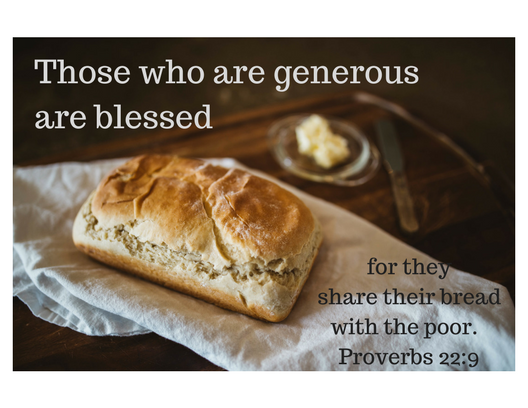
Rather, let’s use the Scriptures themselves to better understand the “riches and honor and life” that is promised for those who love the Lord like we find in Proverbs 22:4. Just a few verses later, we find the clarification that we need. It is the “generous” who are (hashtag) blessed.
The wealth of the Gospel of Christ lies not in storing up material wealth or riches or fame, but in sharing the material goodness that we have been given with those who don’t have them. We are blessed with lives of richness, honor, and life abundant when we give away the riches we have so that those with neither riches nor basic needs can be filled as well.
To close with a parable of Jesus, there was a man whose harvest was larger than his barn could store. He decided to build a larger barn to store his crop. However, that night he died and all his wealth was lost. I think that the point of this parable isn’t that we shouldn’t plan ahead or have large barns, but rather that when we have more than we need, we should share it instead of store it up for ourselves.
We can find life, wealth, and riches only when we are generous and give the very things we think we need to hoard.




 Seek Grow Love