
Deuteronomy 3-4
Psalm 24
Mark 9
–Devotion by Aaron Winner (SC)
Many people know I love to write. I hope that is apparent as you read through my devotions when I have the opportunity to share with Seek Grow Love. Additionally, I love science and history. Having taught both of these subjects, I love the story that each tells about creation and humanity. A fact that fewer know is that I’m pretty good at math and love Excel with extensive formulas—in fact, that was my job at one point: building elaborate spreadsheets to compute cubic feet, pricing, man hours, and profitability. Consequently, I know that a single piece of punctuation or an added numeral can set off a chain of poor computations that completely miss the mark.
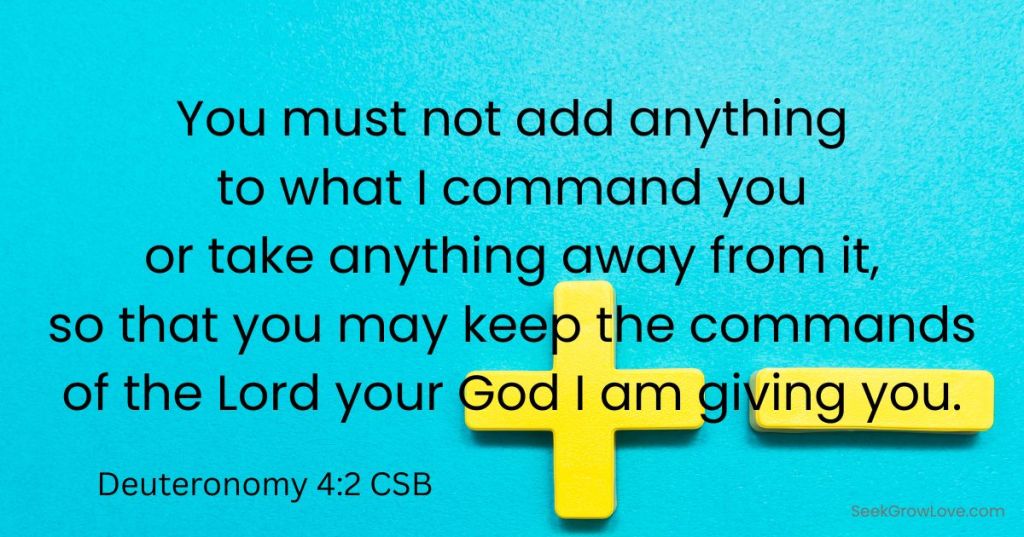
“You must not add anything to what I command you or take anything away from it, but keep the commands of the Lord your God.” — Deuteronomy 4:2
Moses reminds the people of Israel of this principle long before spreadsheets. Do not add anything to the commands of God. Do not take anything away from them. Keep them. Jesus gives us a similar warning in the Revelation to John—addition and subtraction have a direct impact on judgment (Revelation 22:18–19). Let me say this clearly: God’s Word is not a suggestion. To knowingly misinterpret it or treat it without the greatest care—molding it to fit our preferences, our culture, or our experience—is to lose sight of God.
More often than not, we fall into the temptation not to change the Word itself, but to reshape its practice. We ignore what is divisive or costly and choose to emphasize what is comfortable and easier to manage. In the age of preference, our faith is on the line. Instead of forming our lives around God’s discernible commands, we cling to standards set by ourselves or the world. These can become idols—hedged assurances of our ego, stature, time, wealth, or sacrifice.
Who is the one who ascends the hill of the Lord? Whether it is David as he brings the Ark of the Covenant to Zion or the disciples witnessing the transfiguration of Jesus, the question remains (Psalm 24:3–4; Mark 9:2–7). The call is not based on effort alone. You cannot add to or subtract from your efforts to receive lesser or fuller reward as an inheritor of the Kingdom of Heaven. Because of this, purity is a whole, never a part. It is not achieved through addition or protected through subtraction, but through alignment with what God has already spoken.
Apart from the warning of Jesus—that judgment follows when we distort His Word—we will naturally drift. When we add, we place burdens, red tape, and elevation onto a grace that was freely given, though it still calls for obedience. When we subtract, we remove what is essential, lowering the standard and risking a faith that cannot hold. In trying to soften truth, avoid conflict, or live without conviction, we find ourselves living in tension—or worse, in the comfort of denial and ignorance.
The truth is this: God does not ask more than we can bear, but He also does not ask any less. The formula is not complicated, but the math is not easy. An errant doctrine is not the solution to humanity’s problem of sin. We may come to God through wandering, in our watching, or as a witness—but we are never called to customize the truth.
Reflection Questions
Consider these questions as you read today and place your obedience before the Lord:
Where have I added expectations for myself or others that God has never given?
Where have I subtracted or omitted truths that feel too difficult to hold?
Where is God inviting me to search His Word more deeply—and to truly listen?
Prayer
Dear God,
I praise you for being a righteous and holy God. There is none other. All your words are true and right. Thank you for the gift of the Bible where You reveal yourself and all truth, goodness, and the way to salvation. Help me see any errors I have committed in adding to or subtracting from Your perfect Word. May I stand alone on Your words which give life, never seeking to conform Your Word to my way, but always, always, always, changing and molding myself to reflect You and Your Son. May Your Spirit guide me in all things!
In Jesus’ Name I pray,
Amen






 Seek Grow Love