
Old Testament: Deuteronomy 9 & 10
Poetry: Job 32
New Testament: Mark 16
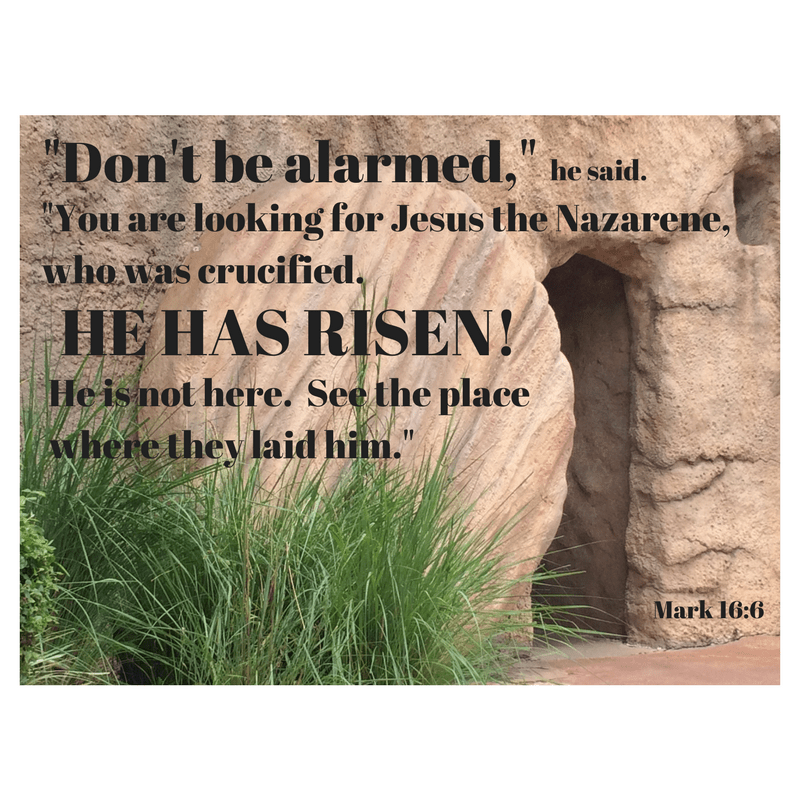
Looking at Mark 15 allowed us to consider what Jesus suffered, and why. But the dawn has come, and now we can eagerly seek the news that our savior is raised to life. That transition from death to life is as simple for us as turning a page in our Bibles. Most Christians cannot approach Mark 16 without being aware of what should come next, which may always have been the case. Mark may not have written his Gospel primarily to tell people about Jesus, but to remind and encourage believers in their faith. We might imagine the text being read aloud in a group setting.
We can envision the early listeners to this passage trying to put themselves in the places of Mary Magdalene, James’ mother Mary, and Salome. Certainly they understood what brought those women to the tomb: love, and mourning, and the wish to offer Jesus what support was possible by caring for his body. But from hindsight it was also clear that the tomb would be found open and empty – what a wonderful surprise for the mourners!
And so as the account was read the listeners waited to hear of the women’s overcoming joy at learning about Jesus’ new life. It was not to be. Rather the three were left trembling, astonished, and afraid. And upon exiting the tomb they say nothing. (We know that ultimately more happened – particularly in the case of Mary Magdalene – but that is where the text stops.)
Your Bible version, whatever version you are reading, probably does not cut off after verse 8. Perhaps it offers a footnote discussing what scholars think about the verses that follow (they doubt that the verses are legitimate). In fact different manuscripts contain four endings for the Gospel of Mark – aside from the version that simply cuts off after verse 8. That variety of endings not only shows us that some people were disappointed with the ending they had received, and tried to “fix” the issue, but it also demonstrates that the version which cuts off at verse 8 is from a pretty early date (so if there is a “real” ending of Mark lost due to damage that happened a long time ago).
The way Mark 16 ends at verse 8 has been compared to how the book of Jonah ends. After God reprimands Jonah we never learn Jonah’s response. In Mark there may be a similar tone of leaving issues hanging at 6:52.
So, let’s consider the possibilities. Mark may have intended to have a somewhat jarring ending to spur his audience to think about their own situations – each of them had the knowledge of Jesus’ resurrection (and had received sufficient time to get over the shock about it), so would they be silent, or would they proclaim it? Perhaps the closing line of Mark’s book was intended to open a discussion, an interactive lesson plan which is so old we have lost the details for it.
Or it may be that Mark was unconcerned about how the ending of his book came across, because the middle of his book already set up all the promises that were needed regarding Jesus’ new life, they just need to be believed. Having arrived at the end of Mark’s gospel, we certainly have not arrived at the end of Jesus’ story. To quote from Donald H. Juel, who discussed this idea,
There is every reason to believe that the rest of his promises will be fulfilled: James and John will drink from the cup; the disciples will give testimony; the gospel will be preached to all the Gentiles. Jesus will be enthroned at God’s right hand and will one day come with the clouds of heaven so that ‘all will see’ and will send his angels to gather the elect from the four winds.
(Mark, in the Augsburg Commentary on the New Testament series.) The trust that these promises will be fulfilled is not based on human effort, and neither is the end of the story. “The story is not over and will not be until Jesus returns.” (Juel).
Knowing if one of these possibilities about Mark is correct is not the most important thing. We know that Jesus is alive. Both of these ways of viewing Mark’s book can be useful ways for us to think about our relationship with our living savior, and to better prepare ourselves to continue serving him. We sometimes approach Resurrection Sunday as a time to think about our own future lives, but there is much to be done in the meantime to be prepared, and to invite others.
Dear God, on this Resurrection Sunday help me recommit my heart to you and to your son Jesus, the Christ, my savior. Allow me to examine myself through the guidance of your Spirit and to determine both what I need to set aside and what I need to take up for the improvement of my service. You offered me a new life, a resurrection into immortality. Please help me be more responsible in how I live this life, so I can relay your wisdom to those around me. Make me a witness of your grace and mercy and love. In the blessed name of your son Jesus I pray these things, Amen.
-Daniel Smead
Reflection Questions
- Do you find it strange for a Gospel not to include an appearance of the resurrected Jesus?
- Might Mark have stopped where he did because he saw the alternative as a much longer book (perhaps with part of what we know as Acts)?
- Over 500 believers saw Jesus alive in his resurrected state (1 Corinthians 15:6), but most have needed to wait to see Jesus, and are blessed for having believed without seeing (John 20:29). What affect do you think it would have had on the church if Jesus had been taken up to heaven without appearing to anyone?

 Seek Grow Love