Moses, representing the law, was very much a great man and leader. He led the Israelites out of slavery in Egypt, through the wilderness, and eventually right up to the promised land. He saw it, but was himself denied entrance because of his own failure to perfectly obey God. This illustrates the weakness of the law, which in reality is the weakness of all people who are absolutely incapable of perfect obedience to that law. No one can enter God’s rest, the promised land, the kingdom of God on their own merit.
Joshua, who’s name means “The LORD saves” succeeded Moses and did in fact lead the Israelites into the promised land. Fast forward to Gabriel’s announcement to Mary that she was to give birth to a son. He told her his name would be Jesus, which is the Greek version of Joshua. When an angel appeared to Joseph in a dream, he explained the significance behind Jesus’ name. It was “because he will save his people from their sins!” Joshua was a type, or picture of Jesus, leading the Israelites into the promised land.
Psalm 32, written by a repentant King David, is a beautiful reminder of the weight of guilt, the necessity of confession, the blessing of forgiveness, and the joy of being right with the LORD! Read here the first two verses, and the last, but be sure to read the entire short Psalm. “Blessed is he whose transgressions are forgiven, whose sins are covered. Blessed is the man whose sin the LORD does not count against him and in whose spirit is no deceit!”“Rejoice in the LORD and be glad you righteous; sing, all you who are upright in heart!” (Psalm 32:1,2 & 11)
Now we come to Mark 16. We’ve been reading about the last supper, prayer in the Garden of Gethsemane, Judas’ betrayal, Jesus’ arrest, his trial, Peter’s denial, Jesus’ crucifixion, death, and burial. Mark’s climax to all this is his short, sweet, and factual report of the resurrection of Jesus from the dead! It was early Sunday morning when three women went to Jesus’ tomb, taking spices to anoint his body. The Jewish community neither then nor now practice embalming. The women evidently had no idea Joseph of Arimathea and Nicodemus had already treated Jesus’ body with 75 pounds of myrrh and aloes. Nor did they even hope or suspect that he might be resurrected from the dead! Who would have thought?
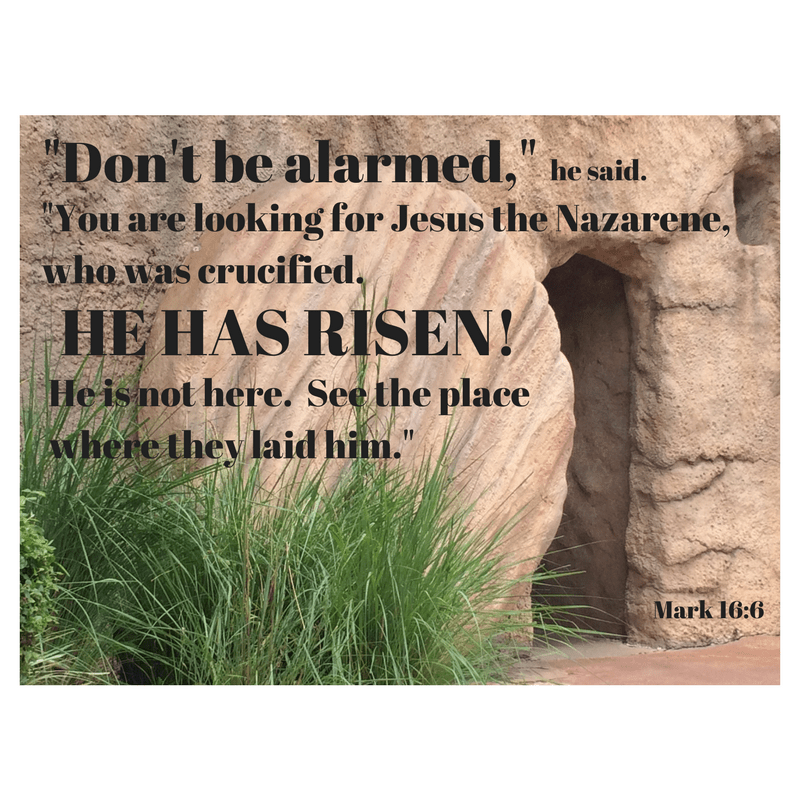
“He has risen! He is not here!” Those were the words of the angel who was seated in the tomb. What a shock! What an announcement! It seemed too good to be true! In fact, Mark’s version tells us they ran away, fearful, and told no one! “He has risen! He is not here!” According to the Apostle Paul, our hope rises and falls on the resurrection of Jesus from the dead. Paul states clearly that this truth is one of the several things one must believe in order to be saved. “He has risen! He is not here!”
Reflection Questions
Are you solid in your conviction that Jesus was raised from the dead, that he is alive, at the right hand of God? Is your lifestyle a testimony to that conviction?
Is there any sense in which you’ve dozed off when you should have been watching? Betrayed Jesus, as did Judas? That you’ve denied him, as did Peter? That you’ve doubted, as did Thomas?
Are you clear in understanding that you will not enter the kingdom of God on your own merit? That it is only through the resurrected Jesus that you have hope?
Have you experienced the weight of guilt, the necessity of confession, the blessing of forgiveness, and the joy of being right with the LORD?
Prayer
Heavenly Father, thank you so much for your love, your plan from the very beginning to cover our sin, and for Jesus whom you sacrificed on the cross. You allowed him to become sin, so that we might become righteous. Thank you for raising him to live again, to live forever, the firstfruits of eternal life. Thank you for wanting me in your kingdom, and for making a way for it to happen. Help me to make you proud. Help me to live like Jesus. In his name I pray. Amen.
Here’s where you respond aloud: “He is risen INDEED!”
PS It’s fine to say that phrase throughout the year, not only on a specific Sunday when we celebrate Jesus’ resurrection. This is the best news in all of history! Sure, every religion’s leader has died or will one day die. But Jesus? He died and was raised back to life eternal! Now THAT is the real deal and something to celebrate!
I could end right here on such good news! … But I have a few more verses I want to point out.
* Matthew 28:6 – “He is not here, because he has been raised – just like he said!”
I used to read this verse in an excited tone, but now I imagine it in a slightly-annoyed, “per my previous email” tone. Have you ever had to mitigate the frustrations of people who are upset with you for something that was clearly stated, but you still have to remain professional? Like when you very clearly texted that you needed to cancel a meeting because you would be out of town – and the person acknowledged that they received the information – but they still checked in at the assumed meeting time annoyed that you were not present for the meeting, and everything in you wanted to just use the pointer finger emoji so they would refer to the previous text about your planned absence, but instead you assumed the blame and simply apologized that you’re still traveling and promised you’ll see them next week? Ok, maybe that was a too-specific run-on example, but that is how my human nature envisions the attitude of the angel in this situation. So it’s a good thing I’m not the translator for this text, because I would probably write this verse as, “GUYS! He is not here, because God raised him back to life, just like he said a gazillion times! Weren’t you paying attention?”
Everything happened just as Jesus said it wouldand as numerous prophecies had stated – his death, burial, and resurrection – and yet people still were surprised when he showed up alive. Maybe it was because they were too close to the situation and still felt the trauma of seeing their best friend and leader brutally murdered. Maybe it didn’t play out the way they had envisioned or hoped. Maybe they questioned whether or not they’d heard correctly. For some reason or another, maybe they really weren’t expecting the tomb to be empty.
* Matthew 28:20 – “Therefore, go and make disciples of all nations… and surely I will be with you always…”
This eternal hope is for ALL nations, everyone!
Most likely, the Jewish people would have assumed the Messiah to be only for them, or at least not for the whole world. But Jesus came to bring life to all people who would choose to follow him, not just the descendants of Israel. In this passage, called The Great Commission, Jesus gives the charge to carry on his mission for all time to the ends of the earth. I believe that the “go and make disciples” command still applies to us too. We can make disciples right where we are: in our own jobs, school, communities, homes, and cities.
I’ve always found great comfort in his promise to be with us always. Sometimes, this world seems so hopeless, but we have assurance that we are never truly alone! Praise God that Gentiles are welcome in the Kingdom, too!
Reflections:
How do you think you would have reacted if you had found the tomb empty?
In what ways might God be calling you to actively make disciples? Pray that He would send people into your life to disciple – and you would faithfully disciple them.
Looking at Mark 15 allowed us to consider what Jesus suffered, and why. But the dawn has come, and now we can eagerly seek the news that our savior is raised to life. That transition from death to life is as simple for us as turning a page in our Bibles. Most Christians cannot approach Mark 16 without being aware of what should come next, which may always have been the case. Mark may not have written his Gospel primarily to tell people about Jesus, but to remind and encourage believers in their faith. We might imagine the text being read aloud in a group setting.
We can envision the early listeners to this passage trying to put themselves in the places of Mary Magdalene, James’ mother Mary, and Salome. Certainly they understood what brought those women to the tomb: love, and mourning, and the wish to offer Jesus what support was possible by caring for his body. But from hindsight it was also clear that the tomb would be found open and empty – what a wonderful surprise for the mourners!
And so as the account was read the listeners waited to hear of the women’s overcoming joy at learning about Jesus’ new life. It was not to be. Rather the three were left trembling, astonished, and afraid. And upon exiting the tomb they say nothing. (We know that ultimately more happened – particularly in the case of Mary Magdalene – but that is where the text stops.)
Your Bible version, whatever version you are reading, probably does not cut off after verse 8. Perhaps it offers a footnote discussing what scholars think about the verses that follow (they doubt that the verses are legitimate). In fact different manuscripts contain four endings for the Gospel of Mark – aside from the version that simply cuts off after verse 8. That variety of endings not only shows us that some people were disappointed with the ending they had received, and tried to “fix” the issue, but it also demonstrates that the version which cuts off at verse 8 is from a pretty early date (so if there is a “real” ending of Mark lost due to damage that happened a long time ago).
The way Mark 16 ends at verse 8 has been compared to how the book of Jonah ends. After God reprimands Jonah we never learn Jonah’s response. In Mark there may be a similar tone of leaving issues hanging at 6:52.
So, let’s consider the possibilities. Mark may have intended to have a somewhat jarring ending to spur his audience to think about their own situations – each of them had the knowledge of Jesus’ resurrection (and had received sufficient time to get over the shock about it), so would they be silent, or would they proclaim it? Perhaps the closing line of Mark’s book was intended to open a discussion, an interactive lesson plan which is so old we have lost the details for it.
Or it may be that Mark was unconcerned about how the ending of his book came across, because the middle of his book already set up all the promises that were needed regarding Jesus’ new life, they just need to be believed. Having arrived at the end of Mark’s gospel, we certainly have not arrived at the end of Jesus’ story. To quote from Donald H. Juel, who discussed this idea,
There is every reason to believe that the rest of his promises will be fulfilled: James and John will drink from the cup; the disciples will give testimony; the gospel will be preached to all the Gentiles. Jesus will be enthroned at God’s right hand and will one day come with the clouds of heaven so that ‘all will see’ and will send his angels to gather the elect from the four winds.
(Mark, in the Augsburg Commentary on the New Testament series.) The trust that these promises will be fulfilled is not based on human effort, and neither is the end of the story. “The story is not over and will not be until Jesus returns.” (Juel).
Knowing if one of these possibilities about Mark is correct is not the most important thing. We know that Jesus is alive. Both of these ways of viewing Mark’s book can be useful ways for us to think about our relationship with our living savior, and to better prepare ourselves to continue serving him. We sometimes approach Resurrection Sunday as a time to think about our own future lives, but there is much to be done in the meantime to be prepared, and to invite others.
Dear God, on this Resurrection Sunday help me recommit my heart to you and to your son Jesus, the Christ, my savior. Allow me to examine myself through the guidance of your Spirit and to determine both what I need to set aside and what I need to take up for the improvement of my service. You offered me a new life, a resurrection into immortality. Please help me be more responsible in how I live this life, so I can relay your wisdom to those around me. Make me a witness of your grace and mercy and love. In the blessed name of your son Jesus I pray these things, Amen.
-Daniel Smead
Reflection Questions
Do you find it strange for a Gospel not to include an appearance of the resurrected Jesus?
Might Mark have stopped where he did because he saw the alternative as a much longer book (perhaps with part of what we know as Acts)?
Over 500 believers saw Jesus alive in his resurrected state (1 Corinthians 15:6), but most have needed to wait to see Jesus, and are blessed for having believed without seeing (John 20:29). What affect do you think it would have had on the church if Jesus had been taken up to heaven without appearing to anyone?
After numerous chapters devoted to preparing for the death and subsequent sacrifice of Christ, we finally reach the glorious reward of the Resurrection! Mark chapter 16, compared to the other gospels, is quite sparse in descriptive details of the Resurrection and Ascension of Jesus. However, what it does depict breathes a message of hope and love for the future of the church, as well as a final instruction.
When Mary and Mary were given the message to tell the remaining disciples that Christ had risen, the disciples couldn’t believe it. “When they heard that Jesus was alive and that she had seen him, they did not believe it.” Mark 16:11. In fact, it seems like one of the things the disciples are best at is not believing something until they see it. They did not have faith that the thing they had been listening to Jesus predict for the past several years would come to fruition. Don’t worry because Jesus rebuked them for not believing when he found them again. Do you struggle to believe what Jesus has promised us? Sometimes it’s difficult to imagine a world where we all get along, where there is no longer pain. But without faith, we will never see this world; not because it won’t exist, but because we lack the faith to see it. Have faith!
The final message Jesus gives the disciples is to “Go into all the world and preach the good news to all creation. Whoever believes and is baptized will be saved, but whoever does not believe will be condemned.” Mark 16:15. That is our grand mission! What are you doing today to increase the Kingdom of God? Some of us are not called to verbally preach the word, and some of us are blessed with such a gift. But not being good at public speaking is no excuse to not spread the word.
Actions can speak significantly louder than words. In fact, that’s often the best way to spread the word; by living it out. To speak the message of Christ with empty words whilst living a life completely contrary is almost worse than to have never spoken a word at all. It is by watching the lives of those who follow Christ that we will be living examples of the love he provides us. In your joy, in your struggles, in your sadness, and in your blessings, praise God that you have been given this life to live. Focus on becoming the people that God has instructed us to become and devote your successes to Him. Live your life with the purpose of praising and worshipping Him, and He will reward you. As Christ commands it, do not simply speak the word; live it. Amen
-Mason Kiel
AND
2 witnesses are better than one! Today we have TWO writers for you – so below is your second devotion on Mark 16. Thank you Mason AND Jeff for writing for today. Keep sharing the good good news! Jesus is Alive!
Have you ever been a witness who was called on to testify in court? I have. It was an interesting experience. I had seen a crime committed, I reported it to the police, the criminal was arrested, I was asked to give a written statement to the police and I was later called on to testify at their trial. I will say that when you witness something that causes excitement, gets your heart pounding, and puts you in “fight or flight” mode, it affects your thinking and perspective. Everything seemed to be going faster than it really was. Normally it’s more believable when several people give their eyewitness testimony. Of course, no two witnesses agree on every detail. Each person sees different things from different vantage points. Each person remembers different details. Each person recalls the sequence of events in a slightly different order. These variations in detail are actually normal and good. If every witness testified exactly the same details in the same way the lawyers for the other side would be arguing that they were unreliable because they obviously got together and rehearsed their testimony, which is a big no-no.
When people read the Gospel accounts of Jesus they are seeing the story of Jesus unfold through the eyes of a variety of different witnesses. The Spirit of God is the inspiration behind each of the writers, but God works through human beings and through different witnesses. So it should come as no surprise when we read the four Gospels, Matthew, Mark, Luke, and John, and also the writings of Paul, Peter, James, and others, that while they are telling basically the same story, they do so from different perspectives. The Gospel writers are either reporting what they themselves witnessed or what other eyewitnesses reported to them. They tell the same story with different perspectives and often emphasize different parts of the story or place the events of the story in slightly different orders in keeping with the overall theme of their account. Each story has different audiences in mind, different themes, and is not carbon copies of each other.
One very important rule that is repeated throughout the Bible is that there must be a minimum of two or three witnesses. (See Deuteronomy 19:15, Matthew 18:16, John 8:17, and several other passages). We’ve already noted that there are four Gospel accounts in the New Testament which fulfill that important principle.
It is also interesting to note the background of who is qualified to be a witness. Jewish law has a list of different types of people who are not permitted to be called as witnesses: “women, slaves, minors, lunatics, the deaf, the blind, the wicked, the contemptible, relatives, and the interested parties (Yad, Edut 9:1).” https://www.jewishvirtuallibrary.org/witness . The Talmud, which is a Jewish Commentary from ancient times gives more details about who the “wicked” are who cannot testify. At one point in ancient Jewish history, shepherds were included in the list of people disqualified from witnessing. “As a class, shepherds acquired a bad reputation as being lawless, dishonest, and unreliable, above all because of their habit of trespassing on other people’s lands to graze their flocks.” https://www.churchtimes.co.uk/articles/2015/20-february/regulars/out-of-the-question/shepherds-character-reference.
Here’s what I find very interesting: two categories of people who were not permitted to act as witnesses were shepherds and women. I’m not interested in debating the fairness of those exclusions, but simply note that at the time of Jesus’ birth, life, and death, some of the people who were not accepted as reliable witnesses were shepherds and women. Why is this important? Consider, who were the first eyewitnesses who heard the angelic announcement about the birth of Jesus? Luke says it was “Shepherds living out in the fields keeping watch over their flocks at night” (Luke 2:8). It was to these “unreliable witness” shepherds that the angels appeared. And it was these unreliable witness shepherds who went and reported to Mary and Joseph all that they had seen and then went out and “spread the word” about all that they had seen. (Luke 2:17)
Now, maybe that was just a fluke… but maybe not. In today’s reading, Mark 16, we fast forward to just after the death of Jesus. Who is it who first go to the tomb after Jesus died? Once again, it was to “unreliable witnesses” – this time it was women. To whom did the angel appear announcing that Christ had risen? “Unreliable witness” women. Maybe it wasn’t a fluke after all. Maybe it’s a part of God’s deliberate plan to choose people to be witnesses of these important saving acts of God, which the world normally rejects. Does God choose to reveal His great acts of saving to the lowly people the world rejects? It seems He does. In fact, now that you know to look for it, pay attention when you read the Gospels and notice how many times the witnesses God uses come from the ranks of the supposed “unreliable witnesses.” How many times does God use women, or tax collectors (another category of unreliable witness) or slaves, the blind, the deaf, or just plain sinners to be His witnesses? You’ll find that from beginning to end, the Gospel is filled with “unreliable witnesses” who turn out to be very reliable. And in a giant flip-flop of societal expectations, it is the lawyers and religious professionals from the reliable witness class who are the ones who bring false charges against Jesus.
But the real question that each of us needs to ask ourselves today is, am I a reliable witness for Jesus? Am I willing to tell the truth about what I have seen, heard, and known firsthand about Jesus in my own life? Am I willing to tell “the truth, the whole truth, and nothing but the truth” about Jesus?
-Jeff Fletcher
Questions for Discussion:
Why do you think God chose “unreliable witnesses” to be the witnesses to Jesus’ birth and resurrection and other key events?
When was the last time you told someone else “witnessed” what you have seen, heard, or experienced about Jesus?