His Eyelids Test the Sons of Men

Leviticus 14-15

*Psalm 11

Matthew 24

Devotion by Jeremy Martin (TN)

            Today, as you are reading this devotional, it’s my birthday which is a little ironic because as I am writing this particular devotion a week before it is released, it’s on the anniversary of my death day (2/14, see my devotional on 2/5/26 for details).  It’s an interesting contrast when you consider it.  I am alive by the grace of God.  Today when I woke up, my wife asked me (as she normally does when she wakes up) “How are you today?”  My response was, as it normally is, “I am alive!  I’m wonderful, I should be dead but I’m alive.  God is good.”. 

            If you think about it, we should all share that same sentiment: God is good, we exist at all because of His goodness and mercy, we are alive simply because He wills it.  There are things you don’t even know about that God probably did to ensure that you woke up today, opened your eyes, and breathed.  There are times in your life that you might have died, whether you are aware of them or not, when God saved you and let you live up until right now, today.  What a blessing! Sometimes we take that for granted, please take my advice: don’t.  Life is precious, and if you are reading this, it’s a gift that God gave you directly because He wanted to.  Be grateful.  This too shall pass, enjoy it now.

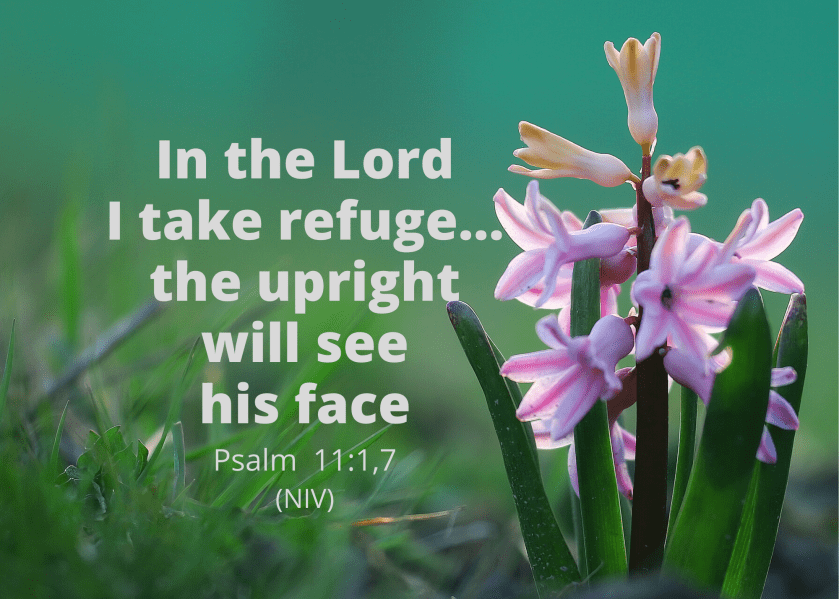
            Today we’re going to discuss something weird.  It might even be considered controversial and a little disturbing by some, but we’ll draw our conclusions from scripture.  We’re going in for a deep dive today, are you ready?  Listen: I know that it’s a lot more time consuming, but it will really help your understanding if you look up all of the verses listed today, as we’ll be going to quite a few other scriptures to get a “holistic” understanding.  They’ll all be in bold font.  Our focus today will be Ps 11, read that in it’s entirety, and then let’s consider Ps 11:4 specifically, which says “Yahweh is in His holy temply; Yahweh’s throne is in heaven; His eyes behold, His eyelids test the sons of men.” (LSB). 

            We all know and understand the “His eyes behold” portion, and know that God sees mankind and gauges our actions (As proof texts read the following and don’t take my word for it:  Ps 33:13-15, Ps 14:2, 2 Chronicles 16:9, Prov 15:3, Zech 4:10, Hebrews 13:2, Mal 3:16) it’s a constant theme throughout scripture.  God Himself, or His agents, are observing our actions constantly.  How else could He rightly judge?  The whole earth is His, and everything in it (Ps 24:1).  But what does it mean to say “His eyelids test the sons of men”?

            Jesus explains in Matt 5:28 that if you sin in your heart, it’s still a sin.  James 1:14-15 explains that our hidden desires, when fed, lead to sin and then death.  Wrong thinking leads to wrong doing.  I can’t speak for you, but I can speak for myself personally and say that even when I have done no physical sin, I constantly struggle internally to be holy.  I sin in my heart constantly, and I’m really trying not to.  Whether pride, or lust, or envy, or greed.  YOU can’t see it, but it’s there, and I’m painfully aware it’s there because for the last couple years I’ve been trying to purify my heart and follow Jesus in every way.  Here’s the thing, though: God sees it (1 Sam 16:7), because His eyelids test the sons of men.

            Q: How, though?  A: In your sleep.  Have you ever been asleep and had a dream that you recalled briefly upon waking that involved a moral dilemma, or course of actions that you had to choose between?  That was what I call a “dream test”.  God tests your heart, almost constantly, many times in dreams or “visions in the night”.  Not only that though, but He instructs us as well.  You very seldom recall it, but once you start paying attention, you’ll notice more of it.  Sound crazy?  Check these scriptures out : Job 33: 14-18, Ps 7:9, Ps 16:7, Ps 17:3, Ps 139:1-4, Is 26:9, Jer 17:10, Matt 1:20, Acts 18:9-10, Rev 2:23.    My point is this: you can clearly see, through scripture (and scripture cannot be broken) that God not only tests us but instructs us in our sleep.  In dreams, in visions of the night.

**As a sidenote Job 33 is my favorite chapter in the bible because it is MY story, and the story of God’s grace and mercy: it was written for and about me.  It’s also where I discovered this concept.  See Job 33:14-30 if you’re interested.

            I think it’s important at this point to note that even if we have a revealing dream, we must always test the spirits to make sure they are from God (1 John 4:1).   Since we are engaged in a spiritual war (Eph 6:12) it is absolutely plausible and probable that your enemy may test you as well, or try to divert you.  For an example of this read Job 4:12-21 very carefully, consider the source, and recall that later Eliphaz is chastised by God because “you have not spoken of Me what is right” (Job 42:7).  This stuff is a little scary, but remember that Yahweh God is “Most High”, and protects us fiercely as a loving Father (Zech 2:8, 2 Thess 3:3).

            Your creator, He who formed your heart, knows your heart…better even than you yourself do.  This is why David asks God to reveal to him his hidden faults and cleanse them in Ps 19:12; David understands that God knows him better than he knows himself.  We are called to not just act right, but to be right.  Even in our hearts, where we think no one else can see, because GOD SEES.  This is the most challenging thing, for me, because I’ve found that if you’ve immersed yourself in the world you begin to think in worldly terms and it’s hard to change your perspective.  We have to be born again (John 3:3, keep your finger here), to repent (change course) and be born of the spirit (John 3:5).  THIS IS A REQUIREMENT TO ENTER THE KINGDOM OF GOD, not an optional career path as a Christian (John 3:7 ok, you can move your finger now).

            God is trying to teach us, He is testing us and helping us pass the future tests by giving us instruction and direction when we are sleeping.  Sometimes, if we listen closely, He will instruct us when we’re awake (Is 30:21, Ps 32:8).  He also speaks to us every time we read the scriptures.  The problem isn’t that God isn’t speaking to us, the problem is that (particularly among the distractions of this evil age) we’re not listening hard enough.  So what can we do to listen to God better?  Well, funny you should ask…

PRACTICAL STEPS TO ACTIVELY LISTEN TO GOD:

  1. Pray before you sleep, ask God to speak to you.
  2. Read scripture right before you go to sleep to prepare your heart and your head to listen
  3. Keep a journal by your bed to write down dreams or messages (Trust me.)
  4. Expect it: God has been and will continue trying to speak to you.  LISTEN.

Reflection Questions

  1. How many times a day do you hear the voice of God?
  2. How many times a day do you actively seek to hear the voice of God?
  3. Do you think there’s a correlation between those two, and how can you increase both?
  4. Have you ever had a dream and knew that it was from God immediately when you woke up?
  5. If answer to the question above is “yes”, did you journal it to remind yourself? (Please consider doing so, if you don’t already).

PRAYER

Father God, Creator and Sustainer of all things, please instruct me.  Teach me, Lord.  Open my ears that I might hear, and open my eyes that I might see.  Help me to do your will, to be humble before you, and place You in the rightful spot on the throne of my heart.  Grant me wisdom in equal portions to the mercy You grant me daily.  Be my shelter, Father, and protect me in this evil time.  Please forgive me when I fall short in my heart, and lead me along the path that enters Your kingdom.  I thank You and I praise You, in Jesus’ name, Amen.

Love Covers

Proverbs 10-12

I was looking through the Proverbs in today’s reading, trying to decide what to focus on. There are just so many good ones! Proverbs is one of my favorite books, and as I meditate on different verses that hold meaning to me, I like to add artwork to them. When I look through my Bible, I’ve noticed that the ones I have marked up the most seem to have a common theme: they all have to do with how we treat others. 

I wish that was more of a focus in the world. The internet is full of comment sections heaped with insults and negativity. I’m forever grateful that my kids are homeschooled with a smaller group of Christians because my heart breaks at the stories of bullying. Videos abound of people being cruel to others in stores, on sidewalks, in restaurants, even at home with their families. Even in our churches, people can be unkind. 

The book of wisdom has a lot to say on how we treat those around us. Being kind, honest, and dependable is not only godly, but wise and leads to many benefits. 

Verse 11:10 tells us how others feel about those who are righteous and those who are wicked. Proverbs 11:13 warns against gossip, 17 teaches us that kindness to others benefits us, 22 talks about how we should be modest around others, and verses 24-26 give us the benefits of being generous. Chapter 12 speaks on how our own poor words to others can destroy us in verse 6. Verse 10 is actually about how we treat animals. Verse 16 talks about overlooking insults and not becoming immediately annoyed with others, and 25 tells us one of the benefits of using kind words. 

But I think my favorite verse about how we should interact with others is 10:12. “Hatred stirs up conflict, but love covers over all wrongs.” There are many types of people in this world, and we are bound to clash. I only have three children in my house, and they definitely don’t always get along. They don’t hate one another at all, but they sure do have some conflict. However, they also love each other. So, unless they are having a particularly bad, rotten kind of day, they aren’t purposely going out of their way to create issues. 

I don’t think many of us reading this are likely to have a lot of hatred in our hearts. I’d like to think that most people don’t. So I feel like the most important part of this verse is actually the second half. I also think it’s the most difficult. Love covers over all wrongs. Have you ever tried to love someone who has really wronged you? It’s not easy. But how much better would the world be if we covered up the wrongs done to us with love and forgiveness? 

Society would say that this type of reaction would make you a doormat or a pushover. This is a lie. Nothing takes more strength than loving those who harm you. That kind of strength comes from God. He allowed his only son to die for a lot of people who held no love for him or others. His love is that deep. Christ was willing to die for those who hated him. His love was that deep. 

As you read through the Proverbs, seeking out wisdom, I hope you see the wisdom in this: actively loving those who wrong you will make your life, and the world itself, better. My prayer for you is that you will practice treating others with patience and kindness, and that those you interact with will do the same. I pray that you see the wisdom in covering wrong with love. 

-Jenn Haynes

Reflection Questions: 

What verses speak to you today in these passages? Where is God trying to place wisdom into your life so that your path is easier? 

Think about some of your interactions with others lately. What were the best ones? How can you go and bless others the way that you were blessed? What were the worst ones? Was your reaction one of love? How can you forgive the offences and react with love? 

Sunday – May 23, 2021

2 Samuel 21-22, Acts 20

In today’s Old Testament reading, 2 Samuel 21-22, we see David, a victorious king and man broken by sin, dealing with the legacies of previous leaders of Israel and the political unrest they left behind. In addition to this, we see fall out with the Canaanite peoples, who had remained in the promised land for a thousand years after Joshua and the Israelites were told to conquer it. The last few chapters of 2 Samuel function as an appendix; they list stories that occurred during David’s reign, in non-chronological order. 

In 2 Samuel 21, we find a brutal story that involves betrayal, sacrifice, and tragedy.  Earlier in David’s reign, there was a famine that lasted 3 years. David responds to this famine, recognizing it as discipline from God, by going to God in prayer. The reason God gave for the famine is because of Saul’s, the previous king, slaying of the Gibeonites – a people the Israelites had made a treaty with (Josh. 9:15-20). David goes to rectify the situation, and so the Gibeonites ask for seven of Saul’s male descendents to punish for Saul’s decisions. 

The seven descendents were handed over and killed. Heartbreakingly, Rizpah, the mother of two of the sons, goes to the place where her sons were killed and protected their bodies from the elements and birds from April to October. four months of a day-in-day-out vigil, through heat, cold, rain, and sun. Finally, David heard about what Rizpah had done, her love and dedication to her sons, and because of her actions, he decided to honor the memories of Saul and Jonathan – and Rizpah’s sons – by burying them in their family’s tomb. After all of this, the famine stops in the land. 

This story is hard to read, but it shows an important truth: Our legacy is determined by the small, everyday actions of our lives. Those small everyday actions build up into something that can make a profound impact on the lives of those that come after us. 

Because of Saul’s actions and his failure to consistently follow the law, he devastated the lives of both the Gibeonites and his own family. His legacy left a ripple effect of destruction that led to a famine in the entire land of Israel. That legacy of destruction was only stopped when another woman consistently showed love instead of violence, for both her sons and for God. Because of her actions, God answered the prayer for the land. 

What type of legacy are you building? How are you daily and consistently building up a legacy that honors God and provides hope and help to those around you?

~ Cayce Fletcher

Read or listen to today’s Bible reading at Biblegateway.com: Job 1-2 and 2 Corinthians 2 .

Standing in the Gap

Ezekiel 22-23

Ezekiel 22 30 NIV sgl


Within chapter 22 of Ezekiel we see different messages that God is trying to send to us through His prophet that are about Judah and Jerusalem.  We see all the ways that they sinned and that God is going to punish them because of their sins.


“‘This is what the Sovereign Lord says: You city that brings on herself doom by shedding blood in her midst and defiles herself by making idols,  you have become guilty because of the blood you have shed and have become defiled by the idols you have made.” (Ezekiel 22:3,4)


In many ways our society does these same things.  The violence against minorities and the bloodshed in our streets in recent times has gotten to the point where many cannot take it any longer, and it is starting to rip our society apart.  The continued war against the unborn has cooled down compared to decades past, but continues to claim hundreds of thousands of innocent lives per year.


Our society also excels at creating new idols and finding things to worship besides God.  We have gotten so good at it that we dedicate whole tv shows to it.  Covid has helped to highlight some of the idols in our lives.  If the loss of a season of football or the delay of a tv show has you devastated, then that might be an idol for you.


In the day of Ezekiel God looked through the land for a person who could intercede for Israel before him, like Moses did when God saw the Israelites making the calf to worship and wanted to wipe them out.  Sadly this time God did not find such a person, Ezekiel was only there to record God’s word and pass it on to the people, so God’s judgement was poured out on the people when the Babylonians invaded.


 “I looked for someone among them who would build up the wall and stand before me in the gap on behalf of the land so I would not have to destroy it, but I found no one. So I will pour out my wrath on them and consume them with my fiery anger, bringing down on their own heads all they have done, declares the Sovereign Lord.” (Ezekiel 22:30-31)


All of the Israelites welcomed sin into their lives and did not try to fight it, and in many ways our society today welcomes sin and chases after it.  If we follow their example and do not fight against sin then we will end up on the wrong side of things when God again pours out his wrath on the earth because of the overwhelming sin and corruption on earth. This is a call to action for us to stand firm on the battlements, even if we are alone, and fight against idolatry and evil, so that when Jesus returns he will find some righteous people left.

Chris and Katie-Beth Mattison


Today’s Bible reading passage can be read or listened to at the Biblegateway site by clicking here – Ezekiel 22-23

Tomorrow’s reading will be Ezekiel 24-27 as we continue on our 2020 Chronological Bible Reading Plan

Avoid Sin, Rejoice in Justice

Revelation 18

Revelation 18 4 NIV
 
Yesterday our focus was on the identity of this Babylon the Great. Today our focus is on the destruction of Babylon. 
Babylon (Rome and other anti-God systems of the world) falls. The beast and the heads turn against her and devour her in the end of chapter 17. The nations, kings, and merchants of the world weep over the fallen city. They will no longer have the power, authority, or wealth she provided to them, and they are sorrowful for their loss, not really her destruction. All this happens in “one hour”, or an instantaneously short time. She will be brought low, but heaven is told to rejoice. 
What do we learn from this chapter? Those nations and systems that oppose God (like Babylon and Rome) will not last forever. Revelation shows us that God will bring them down. But what are we called to DO with that information? Two actions seem to be demanded of us in Revelation 18. In verse 4, the people of God are called to “come out of her”. Did this mean literally pack your bags and move? Maybe. But it most definitely meant to not participate in her sin. Don’t act like the ones who don’t know God in Babylon. Today, that is still the case. In the words of Jesus, we are in the world (that is, the world apart from God), and have not been taken out of it. We do business with those who don’t know God, we work with them, and go to school with them, and even try to love them. But we don’t act like them, we don’t participate in the sins the world, we are not “of” the world. So firstly, we must behave in such a way that we are more like Christ than our neighbors, more like Jesus than the Joneses. (Compare to John 15:19, 17:15)
Secondly, we are called to rejoice over the judgement of God. Many times the justice and severity of God makes me sad. I want all people to be saved and God wants that too! (1 Tim. 2:4) In the case of Babylon the Great, though, we are talking about a city that drank the blood of saints, and persecutes the people of God. Rejoice that God will not allow that to continue. God will not sit idly by forever, ignoring the cries of his people. There will come a day when justice will be poured out on to the heads of those who righteously deserve it. In the way that Babylon “paid” (by torturing, tormenting, murdering), that is the way she will be “paid”, the author says in 18:6. Wickedness will be eradicated, and only righteousness will remain. Praise God!
 
Avoid Sin, Rejoice in Justice. This is the calling of Revelation 18 upon the believer.
Jake Ballard

Sweet or Sour?

Proverbs 15

Proverbs 15 28 NIV

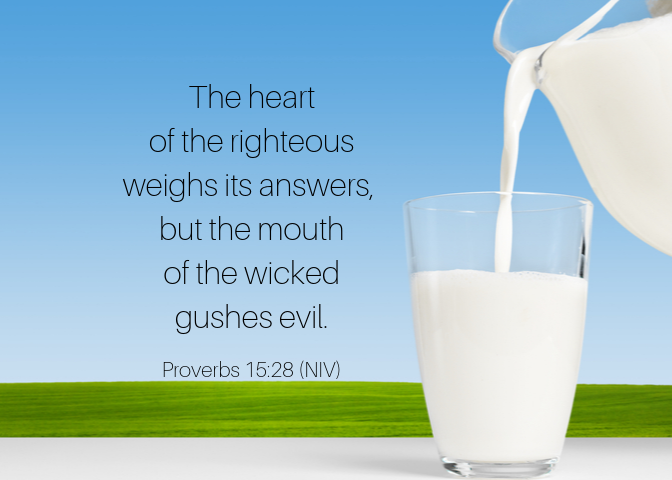
I love milk. I drink a lot of it, and the refrigerator on the hospital floor where I work is always stocked with the little 1/2 pint cartons like you get at school. Unfortunately, the fridge is often over stocked and the expiration dates are past due. I go through and throw out the old milk when I have time. But one night there were several cartons that were just a “little bit” expired (like at midnight) so I took them to have with my lunch. My coworkers warned me! “Don’t drink it!” they said. But I’ve done this before and the milk was fine (I think you know where this is going). The first little carton was good. So I took a big chug from the second…. and couldn’t run to the sink fast enough… the milk was sour, bitter, slightly chunky…. disgusting!!! Even after brushing my teeth, it took awhile to get that taste out of my mouth.

And so it is with our words. In Psalms 15, we read over and over about our words, lips, and mouth.  Verses 1, 2, 4, 7, 23, and 28 speak to how we use these things either for righteousness or destruction. We know those parts of us are not acting on their own. In Matthew 12:34, Christ states that “out of the overflow of the heart, the mouth speaks.”

According to Proverbs 15, the person who spurns discipline, correction, and mentorship has a heart and mind full of anger, jealousy, and malice. The words from that person will be destructive, bitter, foolish, and wounding. What is pouring from the heart and out of the mouth is as stinky as sour milk.

Conversely, the person who heeds discipline, wise counsel, and knowledge will bring forth words that are constructive, calming, healing, and wise. What is pouring from the heart and out of the mouth is as refreshing as someone chewing Orbit Sweet Mint gum.

So I’m going to avoid drinking expired milk from now on. I will also avoid behaviors that will turn my words sour. I will seek out behaviors that turn my words sweet; Scriptural study, prayer, and fellowship with the family of God. And I’m also going to keep gum in my purse at all times.

😉

Maria Knowlton

Don’t Slip to the Default

Proverbs 11

Proverbs 11 3 NASB

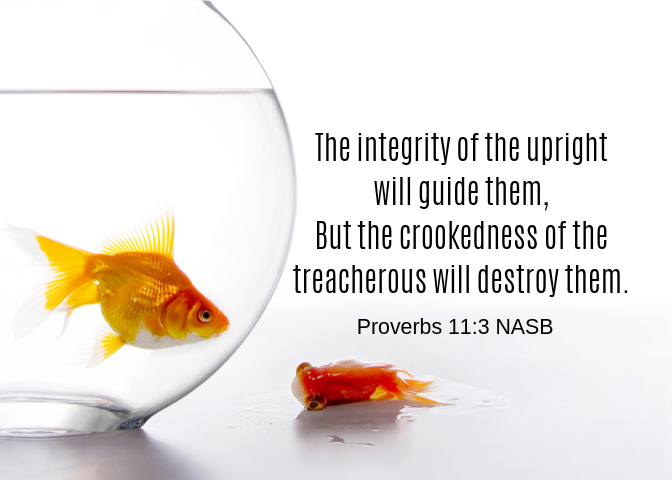
Today is another comparison between the righteous and the wicked.  This time most of the comparisons are about outcomes.  Although it may already be clear, there is a relationship between wisdom and righteousness.  There is also a relationship between fools and the wicked.  Because of temptation always trying to lead us astray, fools turn towards wickedness, but it takes seeking wisdom to be righteous.

Verse 3 through 6 say:

The integrity of the upright will guide them,
But the crookedness of the treacherous will destroy them.
Riches do not profit in the day of wrath,
But righteousness delivers from death.
The righteousness of the blameless will smooth his way,
But the wicked will fall by his own wickedness.
The righteousness of the upright will deliver them,
But the treacherous will be caught by their own greed

We see that the upright or righteous person will be delivered from death.  The fool or wicked person will be destroyed.  The money, possessions or whatever else they have gained from their crooked ways cannot save them.  We see people who have gained wealth and power from all kinds of things that are not pleasing to God.   We see people that appear to have it made who are not seeking God’s wisdom.  We see righteous people who are seeking God’s wisdom go through struggles.  However, It is made very clear that no matter what people gain from their wicked ways, in the end it will catch up with them and they will be destroyed.  In the end, the righteous ones will be delivered.

Another example from this chapter is verses 24-26

24 There is one who scatters, and yet increases all the more,
And there is one who withholds what is justly due, and yet it results only in want.
25 The generous man will be prosperous,
And he who waters will himself be watered.
26 He who withholds grain, the people will curse him,
But blessing will be on the head of him who sells it.

There are people who teach that this is specifically talking about wealth in the current time.  They say that if you give away $10.00, you will get $100.00 in return.  I don’t think that is accurate, and I don’t think it is even a great blessing compared to all the blessings that God does give us.  However, the generous man is the one who is doing what God wants, which makes it a wise decision.  The generous will be blessed.  The miser who withholds everything for himself will be cursed.  I think some of this comes in everyday life.  If someone who is generous and helpful has a problem, often people will help that person.  However, when someone who is greedy and never helps anyone else has a problem, people are unlikely to help that person.

Verses 29 and 30 say:

He who troubles his own house will inherit wind,
And the foolish will be servant to the wisehearted.
30 The fruit of the righteous is a tree of life,
And he who is wise wins souls.

The outcome of seeking Godly wisdom and following in God’s righteousness is life for themselves and for the souls they win.  We have to choose daily to seek after wisdom.  If we make no choice, foolishness and ultimately destruction are the default choice.

Andrew Hamilton

Watch Your Words

Proverbs 10

Proverbs 10 8

This chapter contrasts the righteous person versus the wicked person.  There are so many things that could be written about, and I started to pick and choose a few to write about.  As I read the chapter a few times, I was struck by how many times the mouth, or what we say was mentioned.

Blessings are on the head of the righteous,
But the mouth of the wicked conceals violence

The wise of heart will receive commands,
But a babbling fool will be ruined.

11 The mouth of the righteous is a fountain of life,
But the mouth of the wicked conceals violence.

13 On the lips of the discerning, wisdom is found,
But a rod is for the back of him who lacks understanding.
14 Wise men store up knowledge,
But with the mouth of the foolish, ruin is at hand.

18 He who conceals hatred has lying lips,
And he who spreads slander is a fool.
19 When there are many words, transgression is unavoidable,
But he who restrains his lips is wise.
20 The tongue of the righteous is as choice silver,
The heart of the wicked is worth little.
21 The lips of the righteous feed many,
But fools die for lack of understanding.

31 The mouth of the righteous flows with wisdom,
But the perverted tongue will be cut out.
32 The lips of the righteous bring forth what is acceptable,
But the mouth of the wicked what is perverted.

These are some of the verses, but maybe not all.  We can often see a lot about ourselves (and others) by what is said or not said.  Listen to what comes out of your mouth.  Are you listening, or receiving commands, or are you babbling and therefore unable to hear the instruction?  Are you choosing when to talk and when to refrain?  Are you speaking righteousness?  It is often hard to control what we say but doing this is a sign of wisdom and righteousness.

This topic is something that shows up several other places in proverbs, as well as other places in the Bible.  I think of James 1:19.

This you know, my beloved brethren. But everyone must be quick to hear, slow to speak and slow to anger;

We often speak without thinking or think about what we should say instead of listening to the other person.  Then, what comes out of our mouth is either not appropriate or not helpful.  We often don’t like silence, so we say something just to have noise, even if it is not useful.

I encourage you to pay attention to what you are saying, and when you are talking.  Take time to listen.  Take time to gain from what others are saying.  Take time to allow silence to occur.  Our words are a good indicator of whether we are seeing wisdom or being fools.

Andrew Hamilton

A Word for the Fools

Proverbs 8

Proverbs 8 35 NIV

This chapter is very poetic and filled with a personification of wisdom.  It is used to draw people in and make the writing more personal, and to have greater impact.  I think this is a way of showing how important Godly wisdom is, and how important it should be to each of us.  The idea that wisdom is calling out at the entrance of the city so that we can each hear “her” is an interesting idea.  Obviously, wisdom is a virtue that we should aspire to, not a being.  However, it is so important, and so beneficial to each of us, something that God desires each of us to have, it is as if wisdom is crying out to us, and we need to listen.

If wisdom is something that we aspire to, why do we need this chapter showing all the strengths of wisdom?  Why do we need to hear wisdom calling out to us?  Why do we need to be told again to heed instruction?  This has already been stated multiple times in the first 7 chapters of proverbs.

Verses 4 and 5 say:

To you, O men, I call,
And my voice is to the sons of men.
“O naive ones, understand prudence;
And, O fools, understand wisdom.

Maybe this isn’t for all of us.  We are all “men” (or people) and sons (or children) of men, but verse 5 specifically talks to naïve ones and fools?  So, maybe this is just for people who aren’t getting it yet.  But, maybe if we are thinking it is just for the naïve or fools, we are being naïve and foolish.

Verses 7 and 8 say:

“For my mouth will utter truth;
And wickedness is an abomination to my lips.
“All the utterances of my mouth are in righteousness;
There is nothing crooked or perverted in them.

When I look at this, I have to admit that not everything I say is done in righteousness.  I say things out of anger at times.  I say things at times when I should jut keep my mouth shut.  So, I still need help with wisdom.

I can read through this chapter and point out things in nearly every verse that shows how important wisdom is.  We obviously need to be reminded of this often, based on how often it is written about.  I encourage you to read through this and pick out each of these items.   The end of the chapter summarizes why we should do this:

“Now therefore, O sons, listen to me,
For blessed are they who keep my ways.
33 “Heed instruction and be wise,
And do not neglect it.
34 “Blessed is the man who listens to me,
Watching daily at my gates,
Waiting at my doorposts.
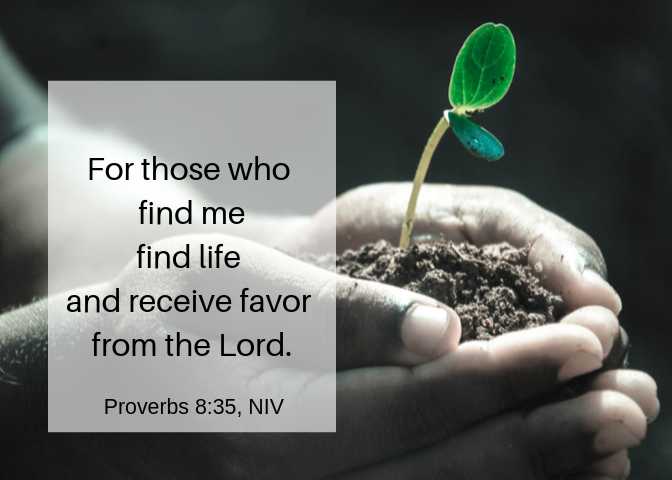
35 “For he who finds me finds life
And obtains favor from the Lord.
36 “But he who sins against me injures himself;
All those who hate me love death.”

Wisdom comes from God and will only be gained when following God.  This will lead to eternal life.  If we turn away from wisdom, we are turning away from God, and that leads to death.

Andrew Hamilton

Dark Ways

October 2 – Proverbs 2 (& surrounding chapters)

Proverbs 2 12 13 NIV

Let’s continue to look at Proverbs 1-4.  Today we are going to focus in on the sections dealing with avoiding sin and living a righteous life.

Proverbs 1:10-19 issues a warning about hanging out with the wrong crowd.  “My son, if sinners entice you, Do not consent.”  (Proverbs 1:10) It is critical to quickly and firmly resist even the smallest temptation.  Immoral people are often not satisfied with just doing bad things on their own, but they will instead often try to persuade others to join in their wrongdoing.  But Proverbs warns, “My son, do not walk in the way with them (sinners).  Keep your feet from their path, For their feet run to evil, And they hasten to shed blood.”  (Proverbs 1:15-16) The wise will not give into negative peer pressure, but they will quickly flee from temptation and those doing wrong.  It is dangerous thinking to believe that you can associate with habitual sinners, but not be affected yourself.  Verses 18 and 19 then explain that those that set out to do evil will ultimately harm themselves.  “But they lie in wait for their own blood; They ambush their own lives.  So are the ways of everyone who gains by violence; It takes away the life of its possessors.”

In chapter two Solomon continues to stress that a wise person will resist evil.

12 Wisdom will save you from the ways of wicked men,
from men whose words are perverse,
13 who have left the straight paths
to walk in dark ways,
14 who delight in doing wrong
and rejoice in the perverseness of evil,
15 whose paths are crooked
and who are devious in their ways.

However, it is not enough to just avoid sin, but it is important to go beyond that, and treat others with goodness and generosity.

27 Do not withhold good from those to whom it is due,
when it is in your power to act.
28 Do not say to your neighbor,
“Come back tomorrow and I’ll give it to you”—
when you already have it with you. (Proverbs 3:27-28)

In chapter four a stark comparison is given between the righteous and the wicked.

18 The path of the righteous is like the morning sun,
shining ever brighter till the full light of day.
19 But the way of the wicked is like deep darkness;
they do not know what makes them stumble. (Proverbs 4:18-19)

How important to realize that with every choice we make, we are choosing to either live in the light or the darkness.

Then Solomon ends chapter four with some straightforward advice about how to keep choosing to live in the light.

20 My son, pay attention to what I say;
turn your ear to my words.
21 Do not let them out of your sight,
keep them within your heart;
22 for they are life to those who find them
and health to one’s whole body.
23 Above all else, guard your heart,
for everything you do flows from it.
24 Keep your mouth free of perversity;
keep corrupt talk far from your lips.
25 Let your eyes look straight ahead;
fix your gaze directly before you.
26 Give careful thought to the paths for your feet
and be steadfast in all your ways.
27 Do not turn to the right or the left;
keep your foot from evil.

We must read the word of God, not only looking on it, but keeping it in our heart, or following through and acting on it.  We have to guard our heart and mind, always being vigilant of our thoughts, actions and priorities. We must be careful of what we say.  We must keep our eyes focused on God and his plans for our lives.  And finally, we must make sure that we are always moving in the right direction, drawing closer to God, and never turning away from him.

Jill McClain