Justice vs. Mercy

Matthew 25-26

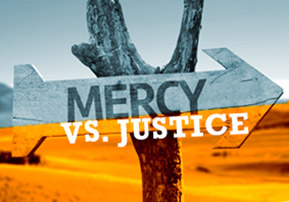
mercy vs justice

Saturday, May 6

Which is more important in God’s eyes, justice or mercy?  That might be a difficult question to answer, but let me give it a try.

First let’s talk about justice.  There are many examples of God’s justice in today’s reading.  In the parable of the ten virgins, those who were not ready for the return of Christ were told by Jesus that he did not know them.  They were receiving justice for the lives they lived.  In the parable of the talents, the man who did not use the talents that were given to him was sent to the place where there shall be weeping and gnashing of teeth.  Justice was on display again.  In Matthew 25:31-46, those that did not help the needy were sentenced to eternal punishment.  Justice served.  Judas betrayed Jesus and Jesus said it would have been better for Judas if he had not been born.  That was a warning that justice was on its way.  There was no mercy shown in any of these instances, only justice.

In Matthew 26, Jesus is arrested and his death on the cross is imminent.  We know why Jesus needed to die – to pay the debt for our sins.  The wages of sin is death so we all deserve to die since we have all sinned.  But think about this for a minute.  Couldn’t there have been a different way to make it right?  Jesus even prayed that prayer three times.  He didn’t want to die and he was hoping there was a different way to handle this.  God is in charge of everything so certainly he could have come up with an alternative solution to this problem.  Maybe if we sincerely repented for our sins, God could have shown us mercy and wiped our slates clean without anyone having to die.  Or maybe if we showed Him that we loved Him he could have overlooked our sins.  There had to be a different way.  Why did someone have to die?  The reason someone had to die is because of justice.  God is such a just God that He could not ignore justice.  It is very clear to me that God believes justice must always occur.

So where does that leave mercy?  Let’s go back to the death of Jesus.  Jesus was God’s own son.  He was also without sin.  There has only been one person on this earth in the history of mankind that did not deserve death, and that was Jesus.  God watched his only son be tortured and killed on the cross for something he did not do.  I can’t even imagine how painful it would be to watch one of my children suffer and die for something they did not do.  Yet God allowed it to happen, even though He could have stepped in and rescued him at any time.  Why would He just watch and do nothing?  It was because of His immense love for each of us.  He let His own son die for our sins so that we would not have to.  I believe that is the greatest act of mercy that has ever taken place.

So the answer to justice vs. mercy is “both”.  God will make sure justice occurs 100% of the time and He is on record as committing the most merciful act in history.

-Rick McClain

(Photo Credit http://www.breslev.co.il/articles/breslev/rebbe_nachmans_wisdom/mercy_vs__justice.aspx?id=26842&language=english)

He’s Serious

Matthew 18-20

matt 18

Wednesday, May 3

I think most people think of Jesus as a mild-mannered, humble, loving person.  They believe he is full of mercy and mostly thinks kind thoughts about people.  I think all of these things are true about Jesus, but there is another side to Jesus that I think many overlook.  He can get really ticked off, especially when it comes to sin.  He hates sin!  In Matthew 18 alone he has this to say:

  • If anyone causes a child who believes in him to stumble, it would be better for them to have a heavy millstone hung around their neck and be drowned in the sea.
  • If your hand or foot causes you to stumble, it is better to cut it off than to be cast into the eternal fire.
  • If your eye causes you to stumble, it is better to pluck it out.
  • If a brother sins, go and reprove him. If he doesn’t listen take one or two more with you to talk to him.  If he still doesn’t listen, tell the whole church.
  • He told a parable about a man who would not forgive a debt so the master was so angry that he handed him over to torturers until he would pay the debt. He then said his Father will do the same to you if you don’t forgive your brother.

Millstones around necks to drown people, cutting off hands and feet, plucking out eyes, telling the whole church that someone refuses to stop sinning, and handing people over to torturers if they don’t forgive tells me one thing.  He’s serious!  He’s not messing around.  Sin really makes him upset.  So my advice to you is:  Don’t sin.

I chose to write devotions for the book of Matthew because I knew it would be easy to find something to write about.  Matthew is loaded with nuggets to help you in life, but that has become my challenge to narrow down what to write about.  I can’t pass up this little nugget in Matthew 19:9.  It is about a subject that there is much disagreement about, but I believe this verse should not be ignored.  Jesus said, “whoever divorces his wife, except for immorality, and marries another woman commits adultery.”  We can debate what is meant by immorality or if this applies to someone who doesn’t want a divorce, but it seems pretty clear to me that you shouldn’t divorce your spouse and get remarried, unless your spouse has committed immorality (likely sexual immorality).  I know some will say you can’t base the whole argument on a single verse and there is more to the story, but I would warn you that you better make sure this verse fits with your view on divorce and remarriage.

Another little nugget I want to mention has to do with children in the kingdom.  I have struggled to understand if children who are not baptized will be in the kingdom.  In fact, what happens to children who died at a young age, including those who were aborted?  What about the children who are young when Jesus returns?  Do they have a chance?  How will their salvation be decided?  I can’t say I have the answers to these questions, but Matthew 19:14 gives me some hope for their eternal wellbeing.  Jesus said, “Let the children alone, and do not hinder them from coming to me; for the kingdom of heaven belongs to such as these.”  It sounds to me like there will be some children making it into the kingdom.

I won’t spend a lot of time on my last nugget (I’m pretty sure I already lost Mackenzie), but it is such a key concept that it needs to be mentioned.  The last will be first, and the first will be last.  Similarly, Jesus did not come to be served, but to serve.  I am not going to spend a lot of time explaining this to you because it is so simple to understand.  Ditch the selfishness.  Start living for God and others.  Be honest with yourself and ask yourself this question, “Who am I living for?”

-Rick McClain

(Photo Credit: http://indulgy.com/post/znFZhGDqr2/matthew)

New Favorite Verse

Matthew 15-17

matthew-15-19-202

Tuesday, May 2

So…my daughter, Mackenzie, informed me that if my devotional is more than a few paragraphs long, it is likely she will not have the perseverance to read it all.  Therefore, I am going to need to jump right in to the part for my kids.  I always told my children that one of my favorite verses was Ephesians 6:1, “Children, obey your parents in the Lord, for this is right.”  But now looking at that verse a little more closely, I don’t think it has the same impact as the new verse I found.  Matthew 15:4 says, “For God said, “Honor your father and mother, and, he who speaks evil of father or mother, let him be put to death.””  I think this could have been more influential in their younger years.

In Matthew 15, the Pharisees were annoying Jesus as usual.  They said to Jesus (in a high-pitched whiny complaining voice), “your disciples didn’t wash their hands before they ate.”  Jesus explained that everything that goes into the mouth passes into the stomach and gets pooped out (Rick’s Non-Standard Version).  Furthermore, the things that proceed out of the mouth come from the heart, and these defile man (evil thoughts, murders, adulteries, fornications, thefts, false witness, and slanders).  Therefore, you can try to control what comes out of your mouth, but a better idea is to “get your heart right” since that is where your words come from.  So how do you get your heart right?  The simple answer is to become unselfish.  I am convinced that every sin comes from selfishness.  We steal because we want something.  We lie to try to protect ourselves or get something we want.  We have sex outside of marriage because it feels good.  Go ahead; try to think of a sin that doesn’t have to do with our selfishness.

I am about to lose Mackenzie so I want to make this final point quickly.  Jesus summed this all up really well in Matthew 16:24-25.  He said that if you wish to come after him, you need to deny yourself and take up his cross and follow him.  He went on to say that whoever wishes to save their life shall lose it; but whoever loses their life for his sake shall find it.  You need to become unselfish if you want to save your life for an eternity.  You need to get your heart right and live your life for God and others, not yourself.  And to bring this full circle, if you get your heart right, good things will come out of your mouth about your parents and we won’t have to put you to death.

-Rick McClain


Do You Get It?

Malachi 1-4

Malachi

Wednesday, April 26

Have you ever tried reasoning with someone who just doesn’t get it? After reading Malachi that’s exactly how I felt. At this point the temple is built and the Israelites are settled back into their traditions and way of life. They are now waiting for the prophecies of their Messiah to be fulfilled. But with this wait and settling in came the return of sin, doubt and once again a disconnection and separation from God.

The Israelites began to sacrifice improper animals, they were withholding tithes, they were marrying outsiders, they weren’t obeying and honoring the covenant they had with God. With all this corruption going on they refused to see themselves as the problem. Instead they put the blame on God questioning his very love for them (Malachi 1:2) . Almost desperately God points the finger back at them, reminding them of his great love and his promise of a messiah. He urges them to take responsibility for their actions and remember to obey the covenant they have with Him.

I found it interesting that the last book of the Old Testament left me with a feeling of desperation. You felt the need for the Messiah and I almost couldn’t wait for him to come, then I realized: wait, Jesus did come! Today we have a new covenant with God, one that is fulfilled by grace through Jesus Christ.


I hope you get it.


-Elleigh Dylewski


God of Mercy. God of Justice.

Ezekiel 17-19

ezekiel

Thursday, March 23

God used the King of Babylon, Nebuchadnezzar to enact His judgment against Israel.  He carried off King Jehoiachin and 10,000 nobles to Babylon and installed Zedekiah to act as his vice regent or king in Jerusalem.  The prophet Jeremiah warned Israel that this was God’s judgment and that the exiles would not return from Babylon until the people repented.  But the people didn’t listen and false prophets gave Israel false hope that Babylon might soon fall.  So Zedekiah broke his treaty with Nebuchadnezzar and made an alliance with Egypt.   This led to a revolt against Babylon.  Nebuchadnezzar crushed the revolt.   Eventually, Jerusalem fell to Nebuchadnezzar and King Zedekiah and family were carried back to Babylon where they faced Nebuchadnezzar’s wrath.  Zedekiah had his eyes put out and his sons were executed.  Israel did not repent quickly nor easily, and because of her stubborn disobedience they continued to suffer.

In Ezekiel 17 God chose to use the allegory of an eagle plucking up the top of a cedar and then replanting it to depict His judgment against his people and to remind them of his power to build and His power to destroy.

In Ezekiel 18 God gives a very clear teaching to His people on the nature of sin, righteousness, judgement, repentance and forgiveness.  Each person is responsible for their own actions.  Parents are not held responsible by God for the sins of their children, and children are not held responsible by God for the sins of their parents.  Each person is responsible for their own behavior.  In the same way, you don’t get credit for your parents good behavior if you do bad.  Each person is responsible for their own sin and will be judged accordingly.

There is good news imbedded in Ezekiel 18.  God doesn’t take any pleasure in seeing wicked people die.  God wants to see people who do evil turn away from their evil.  God wants everyone to repent.  If an evil person repents, God will not punish them.  If a righteous person turns evil, they will be punished for their evil behavior.  God is a God of both mercy and justice.  He will punish unrepentant evildoers and he will forgive and restore those who repent of their evil.  This chapter is best summarized in the final three verses:  30 “Therefore, you Israelites, I will judge each of you according to your own ways, declares the Sovereign Lord. Repent! Turn away from all your offenses; then sin will not be your downfall. 31 Rid yourselves of all the offenses you have committed, and get a new heart and a new spirit. Why will you die, people of Israel? 32 For I take no pleasure in the death of anyone, declares the Sovereign Lord. Repent and live!


In Ezekiel 19, there is a lament for the end of the Messianic dynasty that came from David.  Since the time of David, his descendants, beginning with Solomon reigned as Kings over Israel.  But that has been brought to an end.  There were no more descendants of David serving as the Lord’s anointed over Israel.  Of course, we have the benefit of hindsight.  We live on this side of the New Testament.  After several hundred years of NOT having a descendent of David as King of Israel, one was finally born in Bethlehem and his name is Jesus.  One day, Jesus will sit upon the throne and rule over not only Israel, but all the earth.  In the meantime, we have a choice, we can turn away from our sins and turn to God, or we can face the judgment.  Jesus Christ is God’s provision for our salvation.  We go to him to get a new heart and a new spirit.

-Jeff Fletcher

Your Sins Hurt Others

Jeremiah 15 – 17

jeremiah-17_7

Friday, March 3

Chapters 15-17 deal with the pain others feel for Judah’s continuous betrayal.  God feels sadness when we sin.  Jeremiah is frustrated and hurt (physically and emotionally) by this sin.  Our sins trap us (just like the enemies of Judah) and change us (16:10-13)
Sin has a deep hold on us.  But in chapter 17 Jeremiah reminds us that we can repent.
Repentance is explained in Jeremiah 17:5-8.  The difference in being blessed or being left with nothing is determined by our trust.
Do you trust God?
Do you believe that He will take care of you and that His way is better than your way?
Sometimes we feel like we can’t come back from our sin but God knows you can if you trust in Him.
Do you want barrenness (vs. 5,6) or blessing (vs.7,8)?
-Andy Cisneros
(Photo Credit: http://www.godswordimages.com/wallpaper/hope/jeremiah-17-7/)

Attacked

Jeremiah 12 – 14

jer-14

Thursday, March 2

Have you ever been attacked?  Jeremiah has been attacked by the enemy, his own people and his own family.  When that happens we often want to attack back or we want to change them, but God says only he can change someone (13:23).  But in chapter 14 God reminds us that we should recognize not only our own sin but the responsibility we have for it.  Too many times we try to change others but we don’t ask God to change us.
What responsibility do you take for the sin you have in your life?
Do you blame others? (14:13)
What do you think when God tells Jeremiah not to pray for the sparing of Judah? (14:10-12)
-Andy Cisneros
(Photo credit: http://w3ace.com/stardust/scripture/verse/Jeremiah_14:20)

Called and Committed

Jeremiah 1-3

je2

Sunday, February 26

Israel started off well with the LORD, but her early devotion puttered as she turned to other gods. In today’s passage the LORD lays a charge against Israel. Despite their hopeful beginnings Israel turned away from Him. The warning for us in this is not to let our early love for God grow cold.

Jeremiah has been called by the LORD at an early age in Chapter 1.

“Before I formed you in the womb I knew you”.

What has God called you to do?


In chapter 2 he is given the message he must preach.

2 The word of the LORD came to me, saying, 2 “Go and proclaim in the hearing of Jerusalem, This is what the LORD says,

“I remember the devotion of your youth, your love as a bride, how you followed me in the wilderness, in a land not sown.

3 Israel was holy to the LORD, the firstfruits of his harvest. All who ate of it incurred guilt; disaster came upon them, declares the LORD.” (Jer 2.1-3)

‘The devotion of your youth’, ‘Your love as a bride’. The history of the relationship between the LORD and Israel starts off with the pleasant honeymoon period. An early time of following the LORD in the wilderness, perhaps on the way to Sinai.

However with the shift in gender, Israel is addressed as a female to start then male at the end, comes a shift in how their marriage has turned south. A substantial part of the remainder of the passage describes how their relationship soured after a good start.

4 Hear the word of God, O house of Jacob, and all the clans of the house of Israel. 5 This is what the LORD says:

“What wrong did your fathers find in me that they went so far from me, and went after worthlessness, and became worthless?

6 They did not say, ‘Where is the LORD who brought us up from the land of Egypt, who led us in the wilderness, in a land of deserts and pits, in a land of drought and deep darkness, in a land that none passes through, where no man dwells?’

7 And I brought you into a plentiful land to enjoy its fruits and its good things. But when you came in, you defiled my land and made my heritage an abomination.

8 The priests did not say, ‘Where is the LORD?’ Those who handle the law did not know me; the shepherds transgressed against me; the prophets prophesied by Baal and went after things that do not profit. (Jer 2.4-8)


The message has turned into a series of charges and complaints the LORD has directed at Israel. Israel turned away from God after all the good He had done for them.

They went after the worthless and became worthless themselves. What do you pursue in life?

The LORD keeps stating they did not ask where he was. They did not seek him out even after all he had done for them in leading them through the wilderness, bringing them in to the promised land and providing for them.

All levels of their society had turned away from the LORD. None knew him including the priests, the shepherds and the prophets. They sought other religions.

9 “Therefore I still contend with you, declares the LORD, and with your children’s children I will contend.

10 For cross to the coasts of Cyprus and see, or send to Kedar and examine with care; see if there has been such a thing.

11 Has a nation changed its gods, even though they are no gods? But my people have changed their glory for that which does not profit.

12 Be appalled, O heavens, at this; be shocked, be utterly desolate, declares the LORD,

13 for my people have committed two evils: they have forsaken me, the fountain of living waters, and hewed out cisterns for themselves, broken cisterns that can hold no water. (Jer 2.9-13)

The LORD promises he will contend with Israel and their children for several generations because of how they have rejected him.

‘Has a nation changed its gods, even though they are no gods?’ The LORD charges Israel with apostasy. They have abandoned him for false gods. The Baals.

What do you glory in? What is your glory?


The glory of Israel is the LORD himself.But they have exchanged their glory for worthless images (Rom 1.23). Images and false gods that can do nothing for them. That serve no practical purpose.

14 “Is Israel a slave? Is he a homeborn servant? Why then has he become a prey?

15 The lions have roared against him; they have roared loudly. They have made his land a waste; his cities are in ruins, without inhabitant.

16 Moreover, the men of Memphis and Tahpanhes have shaved the crown of your head.

17 Have you not brought this upon yourself by forsaking the LORD your God, when he led you in the way?

18 And now what do you gain by going to Egypt to drink the waters of the Nile? Or what do you gain by going to Assyria to drink the waters of the Euphrates?

19 Your evil will mock you, and your apostasy will reprove you. Know and see that it is evil and bitter for you to forsake the LORD your God; the fear of me is not in you, declares the Lord GOD of hosts. (Jer 2.14-19)

Israel, once protected by the LORD, has now became the target of more powerful nations. They brought this upon themselves because they abandoned the LORD.

Sin becomes their own punishment. God hands them over into it.

20 “For long ago I broke your yoke and burst your bonds; but you said, ‘I will not serve.’ Yes, on every high hill and under every green tree you bowed down like a harlot.

21 Yet I planted you a choice vine, wholly of pure seed. How then have you turned degenerate and become a wild vine?

22 Though you wash yourself with lye and use much soap, the stain of your guilt is still before me, declares the Lord GOD.

23 How can you say, ‘I am not unclean, I have not gone after the Baals’? Look at your way in the valley; know what you have done— a restless young camel running here and there,

24 a wild donkey used to the wilderness, in her heat sniffing the wind! Who can restrain her lust? None who seek her need weary themselves; in her month they will find her.

25 Keep your feet from going unshod and your throat from thirst. But you said, ‘It is hopeless, for I have loved foreigners, and after them I will go.’ (Jer 2.20-25)

The LORD delivered Israel from slavery in Egypt. Now they have turned to other gods and refuse to worship the one true God.

The LORD planted them a ‘choice vine’. But they have become ‘degenerate’ and ‘wild’. The people of Israel try to wash themselves, but their washing is not one of the heart. They are not truly repentant. Consequently the ‘stain of their guilt is still before the LORD’.

How does one become truly clean and free of guilt before the LORD?


Some in Israel have attempted to deny God’s charge of going after the Baals. The LORD has seen their lust for the other gods. Wandering around seeking gods other than the LORD.

26 “As a thief is shamed when caught, so the house of Israel shall be shamed: they, their kings, their officials, their priests, and their prophets,

27 who say to a tree, ‘You are my father,’ and to a stone, ‘You gave me birth.’ For they have turned their back to me, and not their face. But in the time of their trouble they say, ‘Arise and save us!’

28 But where are your gods that you made for yourself? Let them arise, if they can save you, in your time of trouble; for as many as your cities are your gods, O Judah. (Jer 2.26-28)

Israel has been caught out in her apostasy. The LORD has given them birth, he is their true father and creator. But they have turned their backs on him.

The LORD mocks them – ‘But where are your gods that you made for yourself? Let them arise, if they can save you, in your time of trouble.‘

The point is that the gods they have chosen over the LORD can do nothing. They cannot save. Only the LORD can save them and they have abandoned him.

29  “Why do you fight with me? You have all transgressed against me, declares the LORD.

30 In vain have I struck your children; they took no correction; your own sword devoured your prophets like a hungry lion.

31 And you, O generation, behold the word of the LORD. Have I been a wilderness to Israel, or a land of thick darkness? Why then do my people say, ‘We are free, we will come no more to you’?

32 Can a virgin forget her ornaments, or a bride her attire? Yet my people have forgotten me days without number. (Jer 2.29-32)

Despite all this the people ‘contend’ with the LORD and charge him with wrong because they are being besieged by stronger nations. They have no argument. The LORD is righteous and they are guilty.

Israel, the LORD’s bride, has forgotten the husband of her youth for a long time.

33 “How well you direct your course to seek love! So that even to wicked women you have taught your ways.

34 Also on your skirts is found the lifeblood of the guiltless poor; you did not find them breaking in. Yet in spite of all these things

35 you say, ‘I am innocent; surely his anger has turned from me.’ Behold, I will bring you to judgment for saying, ‘I have not sinned.’

36 How much you go about, changing your way! You shall be put to shame by Egypt as you were put to shame by Assyria.

37 From it too you will come away with your hands on your head, for the LORD has rejected those in whom you trust, and you will not prosper by them. (Jer 2.33-37)

The LORD lists a number of the other sins. They teach women to be adulteress’ and they spill the blood of the poor. Despite all this they do not acknowledge their guilt. They say they have not sinned.

If you have sin in your life, don’t deny it. Confess it before the LORD and ask for forgiveness.

The LORD predicts they will be put to shame by Egypt and Assyria: their allies they trusted to protect them. Even under their protection they will be conquered and led away with the hands on their heads.

What is God trying to tell you through Jeremiah?  Is their sin that has kept you away from God?  Are you chasing after the wrong things?

God has called you but are you committed?

-Andy Cisneros

Andy Cisneros pastors at Timberland Bible Church in northern Indiana.  A graduate of Atlanta Bible College, he is also very active with missions, The UP Project, FUEL and Family Camp and any way he can serve others.  He loves sharing home and ministry with his lovely wife and their two talented kids.

(Photo Credit: http://biblia.com/bible/esv/Jer%202.13

Write a Check

Job 35-38

job-375-e1444237761843

Thursday, December 22

Growing up and being the youngest of four, I went with my mom a lot of places.  One of the places I most accompanied her was the grocery store.  Candy was a rarity in my family (except for holidays), so when I reached the checkout and saw the limitless amounts awaiting there, I would start asking if I could have some.  On occasion, I would get my wish granted.  On other occasions, my mom would say, “I’m sorry, but we don’t have the money for that.” I would quickly appeal by telling my mother, “You can just write a check, then.” “It doesn’t work like that,” she would respond.


My logic: I want candy: Mom has checks: I get candy.


Reality: I want candy; Mom has checks: money in bank account: I get candy


For 37 Chapters, Job has been trying to make sense of what is happening.  He has been to hell and back, but has remained faithful.  He sees his situation, and he sees God, and he wants God to “write a check”.


His logic: God is love:  He has the power to take this away:  I will not suffer


Reality: God is love: He has the power to take this away: Every act of a holy and loving God is to bring me into His kingdom: I will not suffer (Rom 8:28)


God’s plan is eternal.  It is wrought in creation and sanctified with the blood of Jesus Christ.  It is fashioned from His desire that all men should be saved, and none should perish (2 Pet 3:9). A glimpse into the depths of God’s plan begins in His rebuttal to Job:


“Where were you when I laid the earth’s foundation? Tell me, if you understand.  Who marked off its dimensions? Surely you know!  Who stretched a measuring line across it?  On what were its footings set, or who laid its cornerstone (WOW – Eph 2:20; Psa 118:22) while the morning stars sang together and all the angels shouted for joy?” – Job 38:4-7

Suffering, pain, and death are the direct and indirect results of sin, not part of God’s design.  Does God save us from suffering?  Yes, eternally and sometimes temporarily, but we should never forget he offers comfort, peace, hope, love, and joy in the midst of every circumstance. Every action God takes is not to save a fleeting life, but to give an eternal one.  While there is nothing wrong with asking God to “write a check”, keep close to your heart the plan which he has made and paid.

-Aaron Winner

Winning the Battle, but Losing the War

2 Chronicles 23-25

2-chron-25

Wednesday, November 30

I am enjoying the trailers for Rogue One, the soon-to-be-released film that chronicles the rise of the rebel alliance, setting the stage for Star Wars movies four through six. The search for the rightful ruler lies behind many such stories.


We see the same throughout Judah’s history. In today’s reading alone, we read of four different regime changes. The first is the best, as God’s priests serve as warriors defending the rightful king and overthrowing the usurping daughter of Ahab.


Stuart (1987) writes that the Chronicler likes to show immediate retribution for sin amongst God’s people, and we see that several times in today’s passage. One really sad event begins with King Amaziah trusting God and winning a battle against great odds, but then returning home to set up the defeated kingdom’s idols for Israel to worship. God’s prophet rightly asks him, “Why have you resorted to a people’s gods who could not deliver their own people from your hand?” (2 Chron. 25:15). Before long, Judah was overthrown by Israel.


Does life work like that today? How quickly do we experience the consequences of bad behavior?Sometimes it happens very quickly, but not always. The Apostle Paul warns us, “The sins of some people are conspicuous and precede them to judgment, while the sins of others follow them there. So also good works are conspicuous; and even when they are not, they cannot remain hidden.” (1 Timothy 5:24-25).


We must remember, however, that our life as Christians is not simply a matter of good things happening when we are good and bad things happening when we are bad. We are called into a life better than anything we read about in the Old Covenant because now we have entered into a wonderful new relationship with God because of what Jesus has done for us. We must not be dominated by the cycle of good and bad behavior that occurs in almost everyone, and instead live in faith that God loves us and enables us to live out our lives through the power of his Holy Spirit that dwells within us.

-Greg Demmitt

Douglas Stuart, Hosea–Jonah, WBC 31; Accordance electronic ed. (Grand Rapids: Zondervan, 1987), 262.