
Religion that is Worthless

OLD TESTAMENT: Isaiah 38-40

POETRY: Psalm 107

*NEW TESTAMENT: `James 1:19-27

Have you ever spoken without thinking and hurt someone as a result?  Maybe you have seen this object lesson before, but think of a tube of toothpaste.  It is really easy to squeeze the toothpaste out (my kids are happy to do so in excess if they make it to the counter before me).  But once it is out, it is incredibly difficult, time consuming, and messy to get that toothpaste back in.  Once you speak, you can’t take your words back.  You can apologize, but that doesn’t change the fact of what you said.

How quickly do you become angry?  I like verse 20 which gives us a reason why we should be slow to become angry – “for man’s anger does not bring about the righteous life that God desires.”

It is easy to get angry, to speak rudely, to interrupt others’ speech.  But these things do not help us to live the life God wants us to.  It might make us feel better for a second to have an outburst, but usually, we feel worse afterwards and it has done nothing to improve our lives.

But how do we go about avoiding this temptation that is easy to slide into?

“get rid of all moral filth and the evil that is so prevalent and humbly accept the word planted in you, which can save you.”

In a small group I was a part of in the spring, there was an idea that kept coming up from discussing the sermons – if you aren’t producing good fruit in your life, take a look – are you letting sin have a hold in your life?  We have to be constantly on the lookout for where sin seeps in and push it out in order that our fruit can show.

Verse 22 – “Do not merely listen to the word and so deceive yourselves.  Do what it says[!]”  You have to act.  It is great to go to church, listen to sermons, classes, read the Bible on your own, etc.  All great things.  But if all you do is listen, it isn’t going to make a difference.  You need to actively push the sin out of your life and pursue the good.

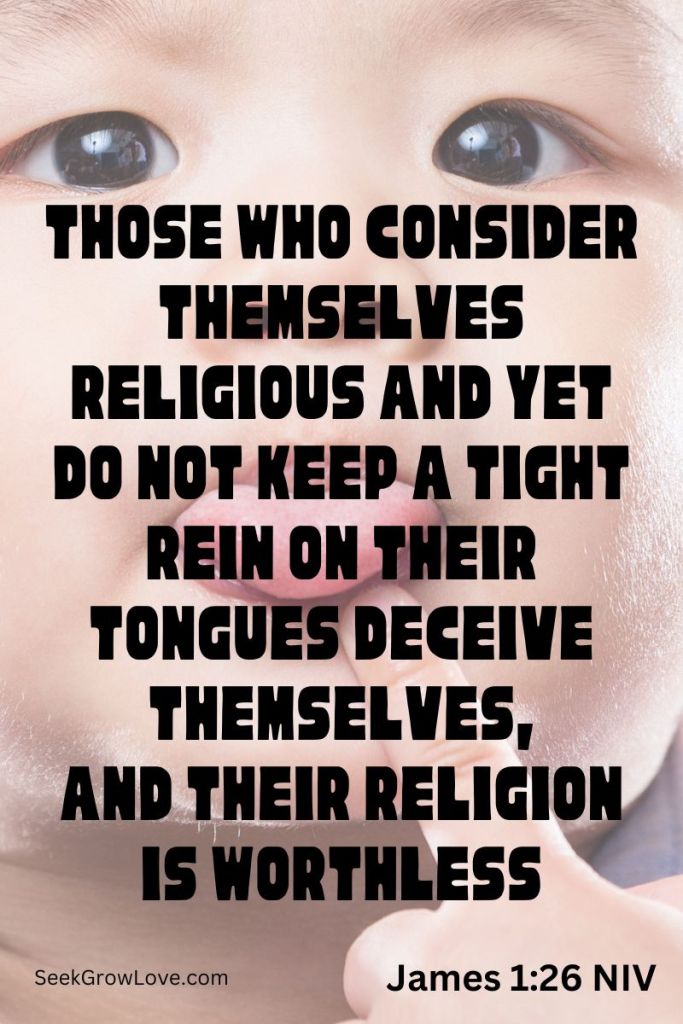
To circle back to the beginning of this section, here is what James writes in verse 26 “If anyone considers himself religious and yet does not keep a tight reign on his tongue, he deceives himself and his religion is worthless.” 

That is strong language!  Do you thing about your words having such an impact as to make your religion worthless if you do not control your tongue?

Think about your speech – do you need to work on controlling what you say?  Is there speech you need to ask for forgiveness for?  Is there speech you need to forgive someone else for?  What moral filth do you need to get rid of in your life in order to be able to accept God’s word?

Silence has value.  In the words of Thumper “if ya can’t say something nice, don’t say nothing at all.”

~Stephanie Fletcher

Reflection Questions

  1. Do you thing about your words having such an impact as to make your religion worthless if you do not control your tongue? When might you have questioned someone else’s religion because of what they said? When was the worth of your own religion decreased due to what you said?
  2. Think about your speech – do you need to work on controlling what you say?  Is there speech you need to ask for forgiveness for?  Is there speech you need to forgive someone else for? 
  3. What moral filth do you need to get rid of in your life in order to be able to accept God’s word?

Numbers 23-24, Luke 2

We’ve seen Israel’s unfaithfulness to God because of their lack of ability to trust God over the previous chapters. Even so, God still provides for the Israelites. He still shows up for them and helps them to overcome their obstacles, the battles that they face. In Numbers 21, Israel faces the Amorites, one of the desert peoples who tried to stand up against them. They defeated them and the surrounding peoples and dwelt in their cities with the help of God. 

After living in the land of the Amorites, they left that area and traveled to Moab, whose king was Balak. Balak was terrified of the Israelites, because of their previous victories and phoned help in the form of Balaam, a diviner from a land 400 miles away from Moab. Balak the Moabite wanted Balaam the diviner to put a curse on the Israelite people, and so Balaam traveled to meet Balak (despite God’s repeated warnings). Numbers 23-24 details the oracles that Balaam gives about the Israelite people. In each oracle, Balaam speaks exactly what God wants him to. Even though Balak asked for a curse, Balaam is not able to give one. Instead, he speaks truth, blessings, and good promises about the Israelites based on God’s faithfulness to them.  In fact, Balak gets so fed up with Balaam’s oracles that he summons him in Numbers 24:10-11 and tells him to go home without a reward! Balaam responds by saying, “Didn’t I tell you? If Balak were to give me his house full of silver and gold, I could not go against the Lord’s command, to do anything good or bad of my own will? I will say what the Lord says” (Numb. 24:13). The Spirit of God allowed Balaam to proclaim God’s truth. He proclaimed the good deeds God had done for the Israelites, and he proclaimed words that spoke blessings for the people. 

Interestingly, in Luke 2, we also read of proclamations and oracles. However, these proclamations are given by a very different kind of being on a very different occasion. In Luke 2, we read about the birth of Jesus. This account includes the shepherds greeted by the heavenly host who praised God after they sent the shepherds on the way to baby Jesus. These angels proclaim “good news of great joy that will be for all people: Today a Savior, who is Messiah the Lord, was born for you in the city of David” (Luke 2:10-11). The angels proclaimed the greatness of God. And, they proclaimed the good things that God was going to bring to his people, the Christ. 

We may not have a diviner proclaiming God’s promises to us. We may not have a heavenly host appear to us. But, we do have God’s word. In his word, we have proclamation after proclamation of the good things that God is giving us. We have promise after promise of what a life as a believer will lead to. When you are facing difficult times, where the end seems unclear and your feet feel unsteady, trust in the proclamations of God. What is he proclaiming over you today?

~ Cayce Fletcher

Read or listen to today’s Bible reading at Biblegateway.com: Job 1-2 and 2 Corinthians 2 .

Worship God with your Speech

1 Thess 5 18

Free theme week: Worship
Chapter reading for the day: I Thessalonians 5

The most obvious way people communicate is through speech. Much like thinking,
because we talk so much, and it is such an integral part of our life experience we often
don’t think about what we say. We live in an age where being heard is more important
than the quality and validity of what is being said. When it comes to speech and talking
do you worship God? Is your tongue obedient to Jesus? Jesus often only presents two
options when it comes to examining your life. You’re either on the broad road that leads
to death or you’re on the narrow road that leads to life. You’re either a good tree that
produces good fruit or you’re an evil tree that produces evil fruit. You either serve God
or wealth. You either hear the words of Jesus and don’t act on them or you hear the
words of Jesus and act on them. Ask yourself,  “Do the words I speak honor God and
Jesus or do they not?”
God and Jesus care about what comes out of your mouth. What you say has power and
consequences. Because of this truth the Bible has a lot to say about words and speech
conduct:
“An evil man is ensnared by the transgression of his lips, but the righteous will escape
from trouble” – Proverbs 12.13
“The one who guards his mouth preserves his life; the one who opens wide his lips
comes to ruin” – Proverbs 13.2
“Death and life are in the power of the tongue, and those who love it will eat its fruit” –
Proverbs 18.21
“You brood of vipers, how can you being evil, speak what is good? For the mouth
speaks out of that which fills the heart…But I tell you that every careless word that
people speak, they shall give an accounting for it in the day of judgement. For by your
words you will be justified, and by your words you will be condemned” – Matthew
12.34,35,36
“Let no unwholesome word proceed from your mouth, but only such a word as is good
for edification according to the need of the moment…” – Ephesians 4.29
“There must be no filthiness and silly talk or coarse jesting, which are not fitting, but
rather giving of thanks.” – Ephesians 5.4
“In everything give thanks; for this is the will of God for you in Christ Jesus” – I
Thessalonians 5.18
“No one can tame the tongue; it is a restless evil and full of deadly poison. With it we
bless the Lord and Father and with it we curse men…from the same mouth come
blessing and cursing, my brethren, these thing ought not to be this way” – James 3.8-9
We can see that the Bible teaches about speech in different ways. Sometimes the
Bible teaches using wisdom and starts with the point that the tongue is powerful and
wisdom should be used when speaking. Jesus teaches us that what we say we will beheld accountable to. And the Bible teaches about positive and negative speech. We
should abstain from “unwholesome” words that don’t edify or encourage others. This
could be constant negative speaking, sarcasm, curse words, unnecessary criticism, etc.
Whereas we are urged to be grateful in our speech and speak life and uplift others.
Jesus says that out of the heart the mouth speaks. What does your speech say about your
heart condition? Do your words worship God or do your words sound like the world?
God wants all of you including your speech. Glorify God with your words. Speak life and
not death.
-Jacob Rohrer