A Refreshing Answer

Proverbs 24 – Wednesday

Proverbs 24:23-26 

23     These also are sayings of the wise:
Partiality in judging is not good.
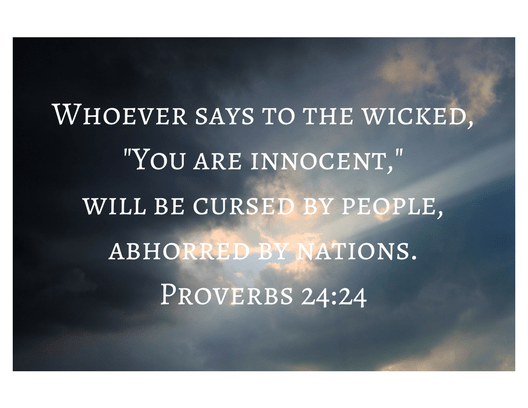
24 Whoever says to the wicked, “You are innocent,”
   will be cursed by peoples, abhorred by nations;
25 but those who rebuke the wicked will have delight,
   and a good blessing will come upon them.
26 One who gives an honest answer
   gives a kiss on the lips.


I grew up with my father telling me “Honesty is always the best policy.”  As I’ve grown, I have to admit that there have been many times in my life when I have tested the wisdom of that saying.  And I’m apparently not alone.  In a study done by the University of Massachusetts, 60% of American adults cannot have 10 minutes of conversation without stepping into some sort of lie.  I find that number both astounding and unfortunately relatable.
Proverbs 24-24

A blatant lie is easy to spot.  Calling those who are clearly wicked and have done evil “innocent” is something that we can uncover with even the smallest pursuit of truth.  But I don’t think 60% of people are taking their conversations that far within 10 minutes.  Instead, I think it has a lot more to do with our desire/need to want to impress those around us (at least I know that it is for me a lot of the time).  So I don’t make up some story whole-cloth.  I pull at the story here a little or there a bit to make it more grandiose or impressive.


Here’s the kicker though, whenever we start to do that our stories actually become less believable and others start to hold us in lower regard than if we were truthful in the first place.  As humans, we have incredibly intuitive brains that can sense when things don’t quite add up.  This is why an honest answer is like a kiss on the lips.  Not romantic, but refreshing and life-giving.


See, I’m married and if I’m exhausted or frustrated, my wife can give me a small kiss (even just a peck) and I can start to feel better.  Not because a kiss is magic but because it reminds me of what is most important in life.  We may experience the same thing when we kiss our family goodbye or give our closest friends an earnest hug.  An honest answer is refreshing and shows us what is really going on – we are engaging in relationship with those around us.

-Graysen Pack
Caring for the Poor

Proverbs 23  (Tuesday)

Prov 23-10-11


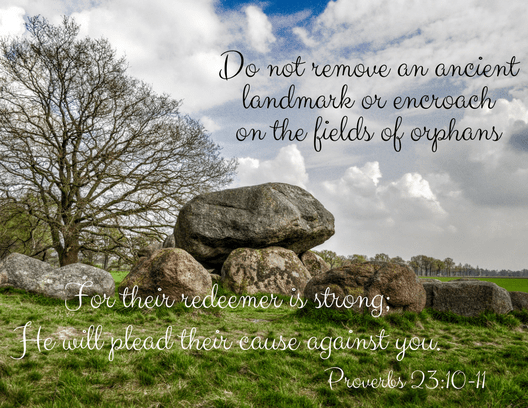
There are two strong images that emerge in this proverb.  The first is that of moving a landmark so that it encroaches on “the field of orphans” (Proverbs 23:10).  This is most likely a reference to the Israelite practice of leaving the corners of a field for the poor to glean from (Lev. 19:9-10; Deut. 24:19-21).  This institutionalized care for those in need meant that farmers would always leave part of their field unpicked.


Just like surveyors today, the properties of each person would have been laid out by various markings: large rocks, stakes, or a cairn (pile of rocks).  While there wasn’t a board or city commission the farmers could check against, a greedy farmer could slowly move a marker year after year to make their own plot larger while taking from their neighbor – or in this case, shrinking the portion of their field that is left for the poor.  Human greed to take from those who already have so little is nothing new today.  So, this proverb is a warning that if we try to steal from the orphaned and poor, we have their redeemer to answer to — God.


The second image comes in verse 11 and is connected to the story of Ruth.  It is the role of the “redeemer.”  In the Hebrew, this is the word Gaal or Gaw’al (spellings vary).  We might more accurately translate it as a “kinsman redeemer” like Boaz is in Ruth.  This is the person whose responsibility it is to care for family members who don’t have a means to protect themselves.  And God will not only protect them, but plead their case against us if are the ones threatening the little that they have.


Our God is one who jealously guards His children, even more so those who have no protector themselves.  As the people of God, this Proverb reminds us that God is one who stands as the kinsman redeemer of the poor and that it is our responsibility as part of his family to take up their cause as well.

–Graysen Pack

The Prosperity Gospel vs. Giving Generously

Proverbs 22 – Monday

Prov 22-9

Proverbs 22:4 & 9

The reward for humility and fear of the Lord

   is riches and honor and life…

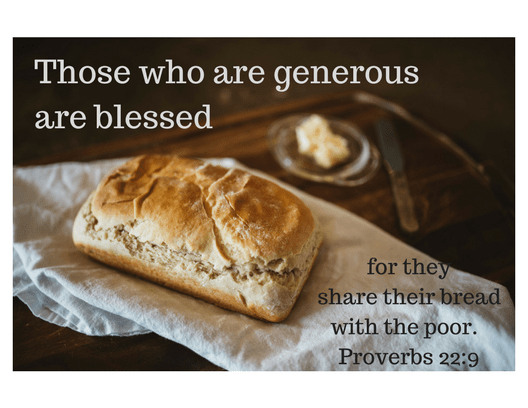
Those who are generous are blessed,

   for they share their bread with the poor.


On any given Sunday morning, I can flip on my television and find a number of ministers promising me riches, wealth, and prosperity if I only have faith.  They usually then want me to practice that faith by making an offering to their ministry – “give us $5 so that God can return it to you one hundred fold.”  These promises do indeed sound promising, but this prosperity gospel is not the message that our Lord came preaching.


Just like we can twist the words of Jeremiah 29:11 and John 10:10 to fit this perspective, we can also turn to Proverbs to try to find a God who rewards those who are faithful with riches, wealth, and health.  But our interpretation of the Proverbs would be just as tortured if we tried to find its truth in the shallow waters of the prosperity gospel.  


Rather, let’s use the Scriptures themselves to better understand the “riches and honor and life” that is promised for those who love the Lord like we find in Proverbs 22:4.  Just a few verses later, we find the clarification that we need.  It is the “generous” who are (hashtag) blessed.


The wealth of the Gospel of Christ lies not in storing up material wealth or riches or fame, but in sharing the material goodness that we have been given with those who don’t have them.  We are blessed with lives of richness, honor, and life abundant when we give away the riches we have so that those with neither riches nor basic needs can be filled as well.


To close with a parable of Jesus, there was a man whose harvest was larger than his barn could store.  He decided to build a larger barn to store his crop.  However, that night he died and all his wealth was lost.  I think that the point of this parable isn’t that we shouldn’t plan ahead or have large barns, but rather that when we have more than we need, we should share it instead of store it up for ourselves.


We can find life, wealth, and riches only when we are generous and give the very things we think we need to hoard.

-Graysen Pack


2500 Years Later

Sunday Intro by Graysen Pack

God's Word RemainsLiving & Active

As we continue our readings in Proverbs (Chapters 22-26 this week), we are going to be leaving a collection of sayings by Solomon that contrast the wise and the foolish.  We’ll then move into a new section of Proverbs, the sayings of the Wise.  These proverbs, unlike previous ones, aren’t written down by Solomon directly but put down to paper by the servants of King Hezekiah years later.


This reveals one of the defining characteristics of Wisdom literature as it’s found in Scripture: it is a product of the dynamic tension that ancient people faced in their day to day lives.  These are sayings that were passed down for generations from the time of Solomon to the days of Hezekiah and then put to paper.  Unlike some portions of the Hebrew Bible, the Wisdom literature found in Psalms, Proverbs, Song of Solomon, Job, and Ecclesiastes are intrinsically shaped by the ways that the Jews of ancient Israel were trying to understand the role of faith in their daily actions.


This is what makes these scriptures deep, meaningful, and particularly relevant to the struggles we still face today.  So, as we explore the Proverbs this week, I encourage you to not see them as a detached set of sayings from a time long gone, but as markers laid out by individuals of faith who found themselves in older variations of the exact same challenges we encounter in our own lives some 2500 years later.

Paper Mache Proverbs

Saturday Weekly Recap with Rebecca Dauksas

paper mache

As we continued through the Proverbs we compared it to the craft of Paper Mache as we add the layers of principles into our lives and saturate every piece of our hearts with God’s Spirit. Maybe, seeing so many parables makes you think of a large jigsaw puzzle. So many pieces! Yet the beauty of God’s scriptures are how they fit and go together.  Proverb upon proverb, principle upon principle, parable upon parable, …forming us into God’s wise children. Lets continue to gain wisdom as we move into Proverbs 22.

How Much Do Your Motives Weigh?

Proverbs 21

proverbs 21-2

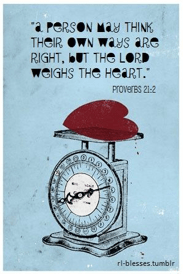
A person may think their own ways are right, but the Lord weighs the heart. Proverbs 21:2

Proverbs 21 focuses on “why we do what we do” or motives. It is hard to determine another’s motives because sometimes we don’t even understand why we are doing something. Our motives are the goal or object of our actions or something that causes a person to act in a certain way or do a certain thing. We should be comforted by the fact that the LORD weighs the heart.  God not only sees what we do, but he understands why we do it.  He understands who we are inside and out.  We can be happy about this because not only does He know what we are like, but He will help us become who we should be.  As Ezekiel 11:19-20 states, “I will give them an undivided heart and put a new spirit in them; I will remove from them their heart of stone and give them a heart of flesh. Then they will follow my decrees and be careful to keep my laws. They will be my people, and I will be their God.”

So God not only looks at the heart (1 Sam. 16:7), but when we are open to Him He makes our hearts as they should be.  Verse 1 explains that in the Lord’s hand the king’s heart is a stream of water that he channels toward all who please him. Anyone that has watched an irrigation ditch being dug truly pictures this. The water rushes through bringing much needed water to the crops.  In the same way, we succeed by placing our hearts in the LORD’s hand.  God gives us pure hearts so we can do good with pure motives.  We allow Him to use us to do His work and we will be rewarded beyond our sacrifice. Of course, that reward may only be given in the Kingdom of God.  As verse 21 states, “Whoever pursues righteousness and love finds life, prosperity and honor.”  So now is the time to get ready for the ways that our lives can honor and serve our God. The final verse of Proverbs 21 tells us, “The horse is made ready for the day of battle, but victory rests with the Lord.”  So it is our responsibility to prepare for the ways in which we can serve the LORD. Under God’s direction, we will get our horse ready.  But we can be sure that victory rests with the LORD.

-Rebecca Dauksas


Integrity!

Proverbs 20

prov 20-17 (1)

We read previously that honest scales and balances belong to the Lord so we understand that God wants us to possess fairness, honesty and integrity.  Proverbs 20 shows us the importance of being honest with everyone around us in our daily lives.  For instance, in verse 23 we are told that the Lord detests differing weights, and dishonest scales do not please him. Dishonest scales refers to the loaded scales a merchant might use in order to cheat customers. Those who cheat others think that their actions will not be discovered and they will have benefited from what they did. Unfortunately, Statistic Brain estimates that $270,000,000,000 is lost annually by the U.S. Treasury due to unreported income. Maybe they cheat because they just don’t think they will be caught.  After all, this same report states that 79% of people think it is morally wrong to cheat on their taxes.

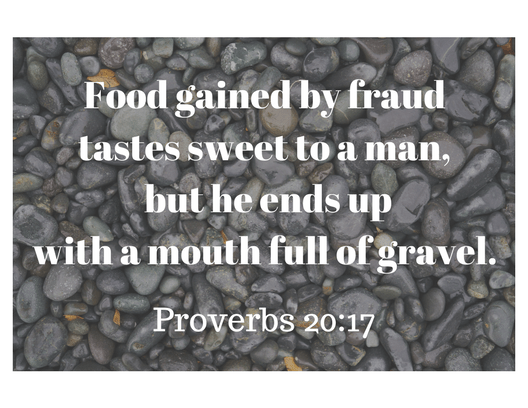
But as Christians we value what God thinks of us.  We want His approval.  As verse 17 explains “Food gained by fraud tastes sweet, but one ends up with a mouth full of gravel.”  Sometimes, it is tough to do the right thing, but we should always take the moral high ground.  After all, integrity can be described as doing the right thing when no one is watching. And as Children of God, we know God is not only watching, but helping us by “directing our steps”(v.24).

Something to think about. What is verse 1 saying about the abuse of alcohol leading the unwise astray? How could this affect someone’s integrity or honesty?

By Rebecca Dauksas

Check Your Seed


Proverbs 19

prov 19 3

Wednesday

A person’s own folly (foolishness) leads to their ruin, yet their heart rages against the Lord. Proverbs 19:3

When I was in college I remember sitting by a young lady who just loved Professional Wrestling. You know the form of athletic performance art with theatrical events and lots of shouting, not the sport of wrestling.  She could tell you in great detail about the striking attacks, holds, throws and acrobatic maneuvers that she had witnessed while attending the recent matches. One day while she was telling me about what had happened last night during the wrestling match we received our graded science papers.  That is when I saw her completely change.  She had received a failing grade and she was furious. She became so angry at the teacher.  She said things about him under her breath and in her mind he could do “nothing right” during that semester. Her reaction is still vivid in my mind.  She began hating this professor because he had given her a grade that indicated her level of knowledge on the material. She completely removed herself from the equation. She put all the blame on the professor, but did not see that her lack of interest and absence from study was the cause of her grade.

Today we are exploring Proverbs 19.  Verse 3 reminds us that oftentimes we are the ones deciding how our lives will go.  God has created the world with governing principles and laws that manage the earth. Human beings are given free will so there is cause and effect from our actions. We might think of it as sowing and reaping. As Galatians teaches us, “Do not be deceived: God cannot be mocked. A man reaps what he sows.” (6:7) Rewards or negative consequences are the result of our actions.  I think this statement says it best: If you don’t like the harvest you are reaping, check the seed you are sowing.

There are repercussions of our actions, but we want God to rescue us from the pain and consequences of our bad decisions. Many times we must experience the real pain to move us to the point where we desire to make lasting change.

Now there are many troubles that we will encounter in this fallen world and many of them we have no control over, but the advice of Proverbs is addressing the areas of our life that we can control. God is on our side and He wants us to make the best decisions. He provides correction through the scripture and if we want to be wise (and avoid a lot of pain and drama) we should follow it. Listen to advice and accept discipline, and at the end you will be counted among the wise (verse 20).

By Rebecca Dauksas


What a Powerful Tongue You Have!

Tuesday

prov 18 21

Today’s reading is Proverbs 18.

The tongue has the power of life and death, and those who love it will eat its fruit. Proverbs 18:21

Have you ever thought about your words bringing life to someone else? Yet, we see this throughout the scriptures. God uses human beings to communicate who He is. God used human beings to speak and record His commandments and instructions. The Jews were entrusted with the very words of God (Romans 3:2).

Sometimes we may not realize how important our words can be. We certainly don’t want our conversations to make us gossips, quarrelsome, and fools (We don’t want our mouths to invite a beating.) But, as the children of God, it goes beyond avoiding bad conversations and sharing God’s message. God has entrusted us with the Gospel Message.  Good News of who He is, Good News of His Son Christ Jesus and Good News of the Coming Kingdom. We are given the opportunity to communicate that message so we can connect others to God through His Son.  God entrusted Jesus with the message that everyone needs to hear.

Christ said to his disciples in John 6:67-68, “You do not want to leave too, do you?” Jesus asked the Twelve. Simon Peter answered him, “Lord, to whom shall we go? You have the words of eternal life.”

We sometimes forget that our study of the scriptures is important because we are receiving a message from God, a message that we can share with others.  I want to make sure that I get the message straight and the story right because this message “has the power of life”.

By Rebecca Dauksas

(Photo Credit: http://puttingonthenew.com/2013/11/10/proverbs-1821/)

Who is God in Your Life?

Monday

By Rebecca Dauksas

Today North America will be in the direct path of a total solar eclipse, which happens when the Moon completely covers the Sun. In the U.S., the path of the total eclipse will extend from Oregon to South Carolina.  The scriptures are filled with illustrations of the contrast between darkness and light. Proverbs chapter 4 verses 18 & 19 states, “The path of the righteous is like the morning sun, shining ever brighter till the full light of day. But the way of the wicked is like deep darkness; they do not know what makes them stumble.”

How blessed we are to have God’s scriptures to train us in righteousness! They light our way by giving us insight and understanding. For instance, Proverbs 17 is filled with advice on how our conduct can help us manage healthy relationships.  Notice that verse one states, “Better a dry crust with peace and quiet than a house full of feasting, with strife.” We might say, “We would rather enjoy a dry piece of toast with peace and quiet than a delicious 7-course meal with anger, arguments and conflict.”  This statement made me think about how good it is when we can enjoy being a part of a peaceful household.  It might also help us consider how we treat our family members. Do we try to get along with our family? Do we stir up conflict and start arguments?  Making our relationship with God our first priority can help us see God’s wisdom in every relationship.

prov 17 9

Proverbs 17:9 states, “Whoever would foster love covers over an offense, but whoever repeats the matter separates close friends.” When we apply this verse to existing healthy relationships, we see that if we want to foster love, when we are sometimes offended, we should forgive and move on. Which agrees with what we are told about love in the New Testament book of 1 Corinthians 13, the Love Chapter.  “Love keeps no record of wrongs.”  Of course, there are offenses that have to be brought into the open and dealt with, but in this case imagine that a friend or loved one says something that is unkind.  Our tendency may be to tell others, “You won’t believe what she said to me!”  Instead, we can choose to foster love by not gossiping about those unkind words. We can decide that we will not continue to bring it up when our tempers flare. We can choose to overlook it and let it go.

Notice the relationships mentioned in Chapter 17-parent, child, friend, brother, etc.

The way we relate to others gives us the opportunity to show who God is in our lives.