

1 Corinthians 1-4
Devotion by Emilee (Ross) Christian
When Marcia initially asked me to write the devotions for this week, I briefly glanced at what the daily passages would be. When I saw some Corinthians, I remember thinking, Cool, I like Corinthians – it’s got some good stuff like the love chapter and resurrection chapter. Oh golly, did I underestimate the book of 1 Corinthians. I mean, I know Paul wrote some “hard to understand” things (2 Peter 3:16 NLT). I just didn’t realize, until today, I would have to write a response to some of these things.
Teaching, wisdom, and humility are some overarching themes in today’s text from 1 Corinthians chapters 1-4. Upon my first read through, I was stumped, and really wishing someone smarter than me had these chapters. I longed to search through my old notes from Bible college to see what my professor had to say. I have all my old notes – and Bob Jones, if you’re reading this, I have my handouts organized by theme in TWO collapsible file portfolios. 🙂 Unfortunately, everything is labeled somewhere in a box that has yet to be unearthed since my getting married and moving from Nebraska to Missouri. It then occurred to me I could spend hours diving deeper into the complexity of these four chapters with the aid of the internet. Seeing as it was 2pm Wednesday afternoon, Marcia needs my devotion tonight, and I’ve got a Thanksgiving Bible Study dinner at 5:30, I decided that wasn’t the way to go. So, I got out my interlinear Greek New Testament and started reading again, this time briefly summarizing the main ideas as I went. What I came up with was the Emilee Christian Simplified Version of 1 Corinthians 1-4. Doing this helped me better understand what Paul meant. I will share with you what I came up with, in hopes it does the same for you. This may be more informal than what you are used to reading – bear with me, please!
1:1-3: Paul and Sosthenes are writing a letter to the Corinthian church.
1:4-9: Speaking as Paul: I thank God for you. God loves you. God wants to use your church.
1:10-17: I hear you’ve been fighting – knock it off!
1:18-20: Earthly wisdom has no power against the cross.
1:21-31: God likes to use the weak and unexpected things of this world to further show His power. Side note – I particularly like this section and immediately thought of these four seemingly unexpected things God has used: a manger, shepherds, fishermen, and women as first witnesses to the resurrection.
2:1-5: When I came to you, I spoke in plain simple terms so you would understand that Gospel message.
2:6-11: I use more complex language while speaking to spiritually mature believers. This is different from worldly wisdom. Perhaps people were accusing Paul of using worldly ideas to explain the Gospel and this is his defense.
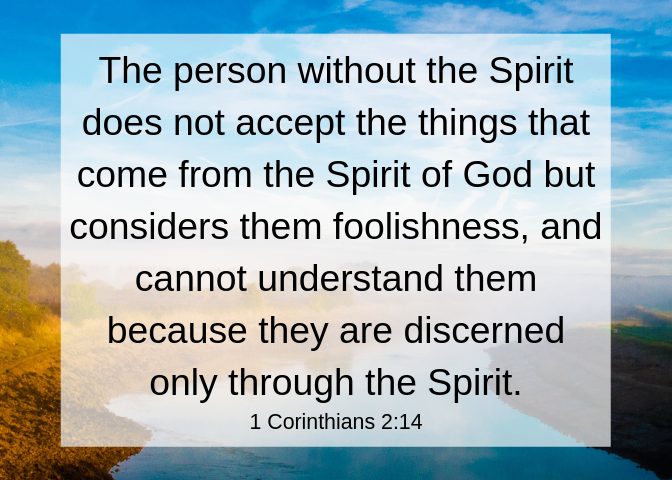
2:12-15: I’m talking about spiritual matters that do not make sense to those attempting to understand with worldly wisdom.
3: 1-3: Remember when I came to you I simplified things. I am still having to simplify things because your arguing and disagreeing is preventing you from understanding more complex spiritual thought.
3: 4-9: Summarizes what they’ve been arguing about. Explains that it doesn’t matter who brought you to the faith in Christ, what’s important is that you now have faith in Christ.
3:10-15: Christ is the foundation of our faith. Anyone may build upon this foundation by spreading the Good News. God’s judgment will reveal if one has done a good or bad job at expanding the foundation. We mere humans don’t need to burden ourselves with making those judgments.
3:16-17: The Church is God’s holy temple so behave and be holy – get your act together Corinthians!
3:18: Sounds like Paul saying he hopes the proud get knocked down a few pegs so they will in turn learn true wisdom.
3:19-20: Again there is a difference between God’s wisdom and the world’s understanding.
3:21-22: Don’t be boastful, don’t be prideful – all things belong to Christ who belongs to God.
4:1-5: It’s God’s place to judge.
4:6-7: So quit arguing about who is better – it’s not your job, it’s God’s.
4:8-13: Seriously, quit bickering over us Apostles! It’s rough enough out here spreading the Gospel we don’t need to deal with your infighting, too.
4:14: I’m not trying to shame you in saying these things, but you need to be disciplined because you are acting like children.
4:15-16: I feel responsible for your faith because I was the one who first told you about Christ – so I’ve got a right to call you out when you’re acting like children. Shape up. Do better.
4:17: I’m sending Timothy to help you.
4:18-21: I hear you want me to come visit, but is that what you really want? Because if I came to visit you now I would be mad and disappointed. Get your act together so that when I do come, we can have a good visit.
Food for Thought: I have to wonder if writing in lengthy complex statements was sort of Paul’s point. In trying to put spiritual things into the context and words of men, it seemed to me to make less sense. Is that a part of Paul’s argument? Perhaps Paul is demonstrating that to have complete understanding of God is foolish and what we should seek is to have faith.
Reflection Questions
- What are some examples of what the world says is wise that God says is foolishness? When have you found yourself switching over from worldly wisdom to Godly wisdom?
- If Paul came to your church, or wrote a letter to you, what might he say?
- What arguments have you allowed to come between you and your brothers and sisters at church? What can you do to fix the problem?
 Seek Grow Love