Hold Firmly

Hebrews Chapter Four

Hebrews 4_14

There is a belief in the Christian world that some hold to called “once saved, always saved.”  Basically this means that if you come to a saving relationship with God and Christ, then you can never lose your ticket to eternal salvation.  This can be a dangerous perspective because it enables Christians to become complacent with where they are at if they believe they can never lose their salvation.  Worse yet, it can lead people to a life of sin and destruction if they do not take seriously the consequences of sin.  Verse six of Hebrews chapter four discusses this doctrine of once saved, always saved a bit by stating, “Since therefore it remains for some to enter it, and those who formerly received the good news failed to enter because of disobedience.”  The author is stating that some who receive the good news/gospel fail to enter rest because of their disobedience.  They initially accepted the promises of the gospel, but they failed to enter because of their disobedience.  In other words, they were once considered saved when they accepted and received the gospel, but they lost it when they disobeyed.  This verse suggests that maybe the doctrine of once saved, always saved is not founded in the Bible.

This should provide a wakeup call for us!  We need to take the sin in our lives very seriously.  We are to be sanctified and set apart from this world, so let’s act like it!  Let’s not become complacent and degrade the consequences of sin.  God hates sin.  The hardening of our hearts can lead us to sin, and again the author warns us of hardening our hearts in verse seven.  We should take this warning seriously since the author has repeated it three times in chapters three and four.

The concept of rest is repeated a lot in this chapter.  What exactly is the author referring to when he is talking about rest?  Let’s take a look at what this rest is described as in chapters three and four:

  1. Israelites unable to enter God’s rest because of their disobedience and unbelief (3:18-19)
  2. The promises of entering God’s rest still stand (4:1)
  3. We who believe enter the rest (4:3)
  4. God swore that some will not enter his rest (4:3,5)
  5. God rested on the seventh day (4:4)
  6. Remains a Sabbath rest for the people of God (4:9)
  7. Whoever enters God’s rest also rests from his works (4:10)
  8. Strive to enter the rest (4:11)

Here’s what I get from all of this.  God offered the Israelites during the exodus a chance to rest, but they were not able to enter God’s rest because they were disobedient.  The author then compares the rest that was offered to the Israelites to the coming Kingdom.  I come to this conclusion because the promises of entering God’s rest still stand.  There is still a chance to enter God’s rest.  However, not everyone will attain that rest, only the people of God.  In fact God swore that not everyone will enter his rest.  If we are disobedient and unbelieving, then we will not enter God’s rest.  However, if we are a people after God’s own heart, then we surely will enter God’s beloved rest in the coming Kingdom.  Hallelujah! Praise God! Amen!  Therefore, continue to strive toward the Kingdom and bring as many people with you as possible because one day you will enter God’s rest in the Kingdom.

Chapter four ends with talk of Jesus being the great high priest.  We truly do have a great high priest in Jesus.  One of the awesome things about Jesus being our high priest is that he is able to sympathize with us.  Jesus was tempted just like we are, but fortunately he did not sin.  He knows what we go through when we are faced with trials and temptations.  He is no stranger to struggle and suffering.  We can seek refuge in our high priest when we face these temptations because he is able to sympathize with us and plead our case to our Heavenly Father, YHWH.  Jesus being tempted is also more great proof against the trinity.  James 1:13 states, “God cannot be tempted with evil.”  If Jesus were God as well, then James and the author of Hebrews would be contradicting one another.  It cannot be possible for the word of God to contradict itself.  Jesus can’t be tempted, and never have been tempted at the same time.  It doesn’t work that way.  It logically does not make sense.  Jesus was indeed tempted like us, and being our high priest, he is able to sympathize and help us.

To close out today’s devotion, I want to point out Hebrews 4:12, “For the word of God is living and active, sharper than any two-edged sword, piercing to the division of soul and of spirit of joints and of marrow, and discerning the thoughts and intentions of the heart.”  I hope you have gotten benefit from reading these posts.  However, if you don’t get anything else, I want you to know and fully understand that the word of God is living and active.  We are beyond blessed to have the Bible today.  If it weren’t for God’s supervision, there would be no stinking way that we should have it because of the numerous attempts to rid the world of the Bible.  The Bible has only flourished though.  It is truly a divine miracle that we all have access to a Bible, God’s word.  I want to encourage you to keep up the awesome work in delving into God’s word through these devotions.  You are truly doing a great deed.  Keep up the awesome work, and truly believe in your heart that these words are living and active.

-Kyle McClain
HARD Hearts

Hebrews Chapter Three

Hebrews 3_15

Similar to chapter one, chapter three starts with Jesus being compared to someone else.  In chapter one, we saw Jesus being compared to both the angels and prophets.  The author raised Jesus above the angels and prophets.  In chapter three, the author compares Jesus to Moses.  Moses, above anyone else, was absolutely adored by the Jews.  He was the one, under God’s provision and guidance, who led Israel out of Egypt and delivered the law to them.  Moses is a central piece of the Old Testament.  The comparison between Moses and Jesus would have helped the Jewish Christians gain or keep their affection for Jesus.  Not only is Jesus compared to Moses, their hero, but Jesus’s given more glory than Moses by the author.

In verses three through six, we see a beautiful illustration by the author about a house.  There are four parts to this illustration: God built the house, Moses is the servant for the house, Jesus is the ruler of the house, and we are the house.  This illustration helps show how Jesus is counted more worthy than Moses.  We are God’s beloved creation.  Moses served the Israelites when he led them out of slavery and delivered the law to them.  He was a phenomenal help to them.  Christ is also a great help to us, but not only that, he is the ruler of us.

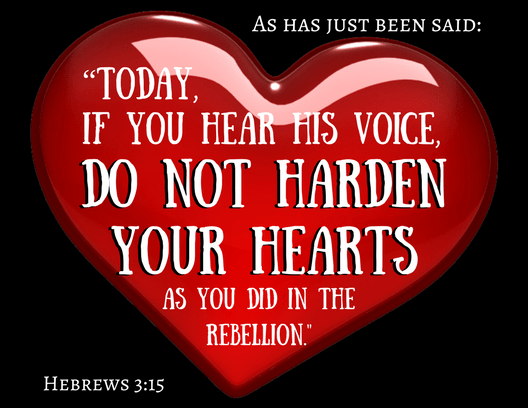
Verses seven and eight read, “Therefore, as the Holy Spirit says, ‘Today, if you hear his voice, do not harden your hearts as in the rebellion, on the day of testing in the wilderness.’”  First thing I want to point out is that the Holy Spirit is talking.  In verses nine through eleven, the Holy Spirit talks in first person as well using pronouns me, my, and I.  It is interesting to see that the Holy Spirit is talking here and talks in the first person.  It is something to mull over.  What I want to highlight though is the focus to not harden your heart.  This is repeated in verse fifteen.  The author must be trying to make a strong point that we are to not harden our hearts.  The Israelites who Moses led out of Egypt hardened their hearts, and they rebelled against God when God continually provided for them.  It was because of their hardened hearts that they did not obey God, and they had unbelief.  This caused their generation to not enter the rest in the Promised Land.  The author of Hebrews is urging us to learn from the Israelites, as they hardened their hearts.  If we harden our hearts, then we too will not be able to enter God’s rest.

The chapter ends at an awkward break, as the talk about rest continues into chapter four.  Personally I don’t understand the purpose of the chapter break between chapters three and four.  It’s important to note that the chapter and verse breaks were not included in the original writing.  Therefore, the author of Hebrews did not intend for people to stop reading at this section.  Therefore, you should stick around for tomorrow, as we continue the talk on God’s rest.

Have a great day!

Sincerely,

Kyle McClain

A Powerful and Caring Savior

Hebrews Chapter Two

death was arrested

Let’s jump right into chapter two of Hebrews.  I want to start off in verse four.  Verse four states that “while God also bore witness by signs and wonders and various miracles and by gifts of the Holy Spirit distributed according to his will.”  God can witness to us in a number of ways.  God is constantly working in and around us.  He is constantly witnessing to the world that he is LORD of all.  We have to keep our eyes and ears open to what God is doing both in and around our lives.

To continue, we again see the theme of Jesus being glorified.  God has placed “everything in subjection to him, he left nothing outside his control.”  That is some high praise.  God has placed everything in subjection to Jesus.  With the Church of God being so strong on the oneness of God, sometimes we may fail to give Jesus enough credit in trying to distinguish him from God.  Hebrews is full of great passages that glorify Jesus.  What is important to note is that when Jesus is glorified, God is glorified in him.  We see this in John 13:31, as it states, “Now is the Son of Man glorified, and God is glorified in him.”  On the other hand, Jesus wasn’t always glorified.  Verses 7 and 9 state that Jesus was made lower than the angels.  This is great proof that Jesus is not coequal with God or God himself.  Although Jesus gets a lot of high praise in the book of Hebrews, it is still evident that he is not equal with God.

If we jump ahead to verse fourteen, we see that through Jesus’ death on the cross “he might destroy the one who has the power of death, that is, the devil.”  This reminds me of the song Death was Arrested.  The final verse of Death was Arrested reads as followed:

Our Savior displayed on a criminal’s cross

Darkness rejoiced as though heaven had lost

But then Jesus arose with our freedom in hand

That’s when death was arrested and my life began

Now you can think of this verse every time you sing this verse in Death was Arrested.  It’s beautiful how the death of our Lord and Savior ends up being the sign of victory through his resurrection.  One could not write that any better than what took place about 2,000 years ago.

We have been talking (well I have been talking) a lot about how Hebrews glorifies Jesus.  It is awesome to hear of these great things about Jesus, and also hear things such as “he helps the offspring of Abraham,” (Heb 2:16), and “For because he himself has suffered when tempted, he is able to help those who are being tempted,” (Heb 2:18).  The same Jesus that is ascribed to have so much power and authority in Hebrews, is also described as helping us out!  We have a Lord and Savior who is powerful and caring at the same time.  He helps us out, as Galatians 3:29 points out that we being Christians are Abraham’s offspring.  Let this encourage you as you go along the rest of your days.

Sincerely,

Kyle McClain


At the Majesty’s Right Hand

Hebrews 1 3

Hebrews Chapter One

Hello all! Today we will be covering the first chapter of Hebrews.  For those of you who suffer from short-term memory loss or haven’t read the post yesterday, one of the main purposes of Hebrews was to reassure the Jewish Christians that Jesus is necessary.  We see this purpose played out in chapter one, as the author describes the importance and glory of Jesus in chapter one.

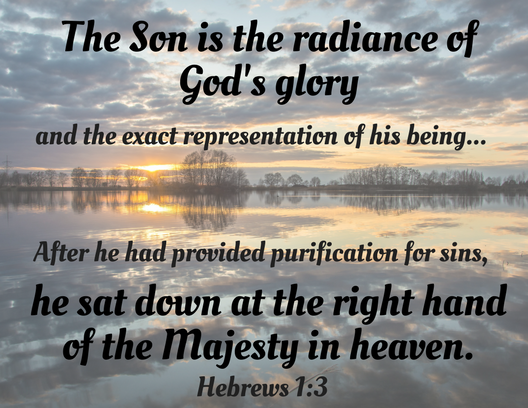
To start off the book and chapter, the author compares Jesus to the prophets of the Old Testament.  The Jews loved and adored the prophets of the Old Testament, and they viewed their words very sacredly.  Therefore, it makes total sense that the author would begin by comparing Jesus to the same prophets that the Jews love.  Not only does he compare Jesus to the prophets, but he raises Jesus above the prophets by saying he was “appointed the heir of all things.”  The prophets are crucial to both us and the Jews, but Jesus is even more important.  Jesus is described as being the “radiance of the glory of God and the exact imprint of his nature.”  That’s some pretty high praise.  This should begin to reassure the Jewish Christians of the importance and necessity of Jesus Christ.

The author doesn’t only compare and raise Jesus above the prophets, but he does it to the angels as well.  In verse 5, the author rhetorically asks “For to which of the angels did God ever say, ‘You are my Son, today I have begotten you’?”  The answer to that question is none of them.  No angel is God’s son.  This verse is detrimental to the Jehovah’s Witnesses because they hold the belief that Jesus is the archangel Michael.  We know though that Jesus is the Son of God.  Therefore, sorry Jehovah’s Witnesses, but no angel, including the archangel Michael, is God’s son.

We continue along in the chapter, and verse eight reads, “But of the Son he says, ‘Your throne, O God, is forever and ever.”  Hold up.  Wait a minute.  Put a little SAY WHAT?!  The Church of God is so strong on the doctrine that God is one, and Jesus is the Son of God, not God the Son.  Do we have it wrong though?  Upon first look, it appears Jesus is God.  Let’s take a deeper look at this then.

First off first, this is quoted from Psalm 45.  Psalm 45 is about a king, not God.  This isn’t trying to dictate any sign of deity, rather a sign of authority.  For surely the Psalm writer of Psalm 45 wasn’t trying to give the king any form of deity.  Furthermore, verse nine states, “therefore God, your God, has anointed you.”  First, God doesn’t need anointed.  If Jesus were God, then he wouldn’t need to be anointed.  Second, the king in Psalm 45 that has the word “God” ascribed to him has a God.  God can’t have a God.  There is no higher being than God.  Jesus can’t be God and have a God.  Therefore, we can read verses eight and nine, as attributing authority to Jesus, not Jesus actually being God.

Another tidbit to point out, the ESV uses the phrase, “But of the Son he says,” in verse eight.  However, a more accurate interpretation of the Greek reads, “with respect to the Son.”  This is important in verses 10-12, as those verses aren’t talking about Jesus.  It is in respect to the Son, Jesus.  Verses 10-12 talk about the magnificence of YHWH.  The author of Hebrews does this because in verse thirteen, he quotes Psalm 110:1 (the most quoted Old Testament scripture in the New Testament).  By glorifying God in verses 10-12, the author is also glorifying Jesus because Jesus has the sole privilege of sitting at God’s right hand.  Jesus is sitting at the right hand of the Creator of the heavens and the earth!  That’s a huge privilege to have, and that privilege is held by Jesus and Jesus alone.

The final verse of Hebrews chapter one is quite possibly my favorite.  It reads, “Are they (the angels) not all ministering spirits sent out to serve for the sake of those who are to inherit salvation?”  The angels are sent out to serve for the sake of those who are to inherit salvation.  Uh, hello!  That’s us!  We are the ones who are to inherit salvation.  The angels are sent out to minister to you!  Isn’t that awesome?!

The author of Hebrews reassured the Jewish Christians of the importance of Jesus.  The author also encouraged them by stating the angels are sent to minister to them!  Again, I hope this passage can impact you in the same manner that it would have for the Jewish Christians, “for the word of God is living and active,” (Just a teaser for Thursday’s reading).

I hope you all had a grand Sunday and have a great Monday!

In Christian love,

Kyle McClain

Fun fact of the day: the first four verses of Hebrews is one long sentence in Greek.  Wow!


To Encourage Your Faith

Introduction to Hebrews

Hebrews 1 5b

This next week I, Kyle McClain, will be accompanying  you in reading the first six chapters of Hebrews, and the beloved Sarah Blanchard will close out the book of Hebrews the following week.  I am currently attending the Atlanta Bible College, and I will be graduating with my bachelor’s degree in pastoral ministry this semester.  I hope you enjoy this week’s study of Hebrews, and I hope it positively impacts your life.

The book of Hebrews is found in the non-Pauline epistles section (Hebrews-Jude).  Many consider the book of Hebrews to be an epistle/letter.  However, it lacks all the normal marks of a New Testament letter.  If you look at the other letters/epistles from the New Testament, they identify the author and recipients, contain a formal greeting, and offer a prayer or thanksgiving.  However, Hebrews does not include any of these.  It could better be termed as an exhortation or sermon than a letter.  You can perceive Hebrews as one big sermon series; the chapters all flow together as one.  It is a stream of consciousness; it’s one flowing word of encouragement.

There are many discussions and debates as to who the author of Hebrews is.  There’s a plethora of different theories of who it could be: Paul, Apollos, Priscilla, a random follower of Paul, etc., and there’s a reason for that.  It’s because there is no clear indication in the book or church history as to who the author of Hebrews is.  It is ok not to know who wrote the book of Hebrews.  What’s important is that whatever was written was inspired by YHWH.  With that said, we do know that the author was Jewish, very well schooled in the Old Testament and Jewish philosophy, and knew Timothy.  There also seems to be a specific audience that the author wrote this for.  The audience is a group of wavering Jewish Christians.  These Jewish Christians were not confident in their faith and at times doubted the need for Christ.

Now let’s take a minute and step in the shoes of these Jewish Christians.  Ever since the time of Abraham, the Jews were looking forward for their Messiah.  For 2,000 years many came and professed to be the Messiah, but they all died and their followers soon died thereafter.  Then after 2,000 years of waiting another man by the name of “Jesus” claims to be the Messiah.  His story was different, as we all know, from the other false messiahs.  Hindsight, it is very clear to us that Jesus is the Messiah.  However, it was a very hotly debated topic back then as to if Jesus was the true Messiah.  It was not a popular belief among the Jewish population to believe Jesus was the true Messiah.  However, those Jews who did were scrutinized from their Jewish families, friends, and community.  All the people that these Jewish Christians knew, loved, and cared for despised and judged them.  Their lives were turned upside down.

It’s easy to point our fingers at these Jewish Christians and discredit them for their lack of faith in Jesus at times, but they were truly going through a lot.  The writer of Hebrews had a select group of Jewish Christians in mind who were wavering, and the author wrote Hebrews to encourage them and reassure them of the need for Jesus.  I hope that as we go along through the book of Hebrews that you too may be encouraged and reassured of the need for Jesus.

In Christian Love,

Kyle McClain

Imitate What is Good

3 John

3 John 11a

Some people have virtually the same accent their entire lives, simply based on where they grew up. Others, like me, pick up accents faster than they can say the word “time.”

Right now, I am living in the South with people from Georgia, Indiana, Canada, Michigan, New York, and Ohio – to name a few. Needless to say, my accent gets confused a lot. The moment when I say time, house, and you guys in one sentence and it comes out in a Southern, Canadian, Michigander accent you know that it can be a little much sometimes.

The same goes for us as individuals. Jim Rohn said, “You are the average of the five people you spend the most time with.” Like my crazy conglomerate of accents, we all are influenced by the people we spend the most time with.

Have you ever noticed how you start talking like the people around you? How you pick up their behaviors? How you start saying those little phrases? You are imitating the people you spend time with – without even noticing you are doing so! This can be a great thing or a terrible thing.

If you hang out with people who always are making poor decisions, chances are you’ll eventually join in. On the other hand, if you hang out with people who are following God to the best of their abilities, chances are you will start changing as well.

Be purposeful in imitating what is good and in avoiding evil things.

Spend the most time with the people you want to be like, and imitate what is good.

– Madison Cisler

Walk in Love

2 John

pb marriage

“And wuv, twue wuv, will fowwow you foweva… “ – The Princess Bride (Shout out to my fellow Princess Bride fans!)


Wouldn’t it be great if true love would just follow us forever, like the impressive clergyman said in The Princess Bride? I mean, love would be so pure and effortless. That’d be wonderful!


Relationships are a lot of work. It does not matter if it’s between you and a friend, a significant other, a parent, a sibling, or even someone you may not be too fond of. These relationships can feel like sunshine and roses. But in every relationship, there will be some conflicts that rise, fights that break out, and anger that ensues.


It happens.


When those moments occur, we need to be prepared. Love is a decision and a commitment. We need to decide to walk in love, rather than expecting love to follow us. Because most of the time, love won’t.


Let me explain.


Some say that love is just a passing emotion. Love is weak. Love is a cop out for conflict resolutions. Love is just a feeling that should be stuffed deep inside. Love is only for your significant other. Love cannot be given to people who hate you.


Those beliefs could not be more incorrect. Because, if you don’t walk in love, you walk out of love, out of relationships, and out of God’s plan for your life. That is a dangerous path to walk, my friends.


So walk in love. Make the commitment to love intentionally. Yes, relationships will be frustrating, and sometimes you will want to just throw some punches – physically and/or emotionally. Although it is hard work, walking in love is God’s command.


That’s easier said than done. Because to walk in love you must do the following things (and more!):


Forgive those who harm you. Encourage. Apologize. Express gratitude. Smile. Be Patient. Serve. Have compassion. Listen.


Walking in love is not just a feeling; it’s a decision, an action, and a major commitment. Are you up to the challenge?


– Madison Cisler

2 John 6a

Genuine Prayer

1 John 5

1 John 5_15


Hello, my friends!

Isn’t it strange to think this greeting that was written at 8:30am on the 31st of January got to you sometime today – or even later?

That is how communication works between people sometimes: it takes time, it’s not immediate, but it’s likely to reach you eventually. Some people won’t even receive my special salutation, because they did not read the devotion today. And that’s ok.

In fact, if I yelled as loud as I could right now, you will still not be able to hear me.

HELLO, MY FRIENDS!!

Did you hear me? No? Shocking. You’re human, therefore you could not. Let me try something else…

Hi, God.

Guess what? He heard me. You know what is even better? He can hear you too. Our prayers don’t take time to reach Him. They are delivered immediately, and they will never be lost in the mail. God hears you.

Therefore, when you pray, pray genuinely.  Don’t hold back. You can trust that God is listening. God loves you so dearly that He wants you to pour out your heart to Him. He wants to hear all about your day, the ups and downs, concerns, visions, everything. Lay it all at His feet, because He can take it. To top it all off, He never gets tired of listening.

To be honest, sometimes it feels like God can’t hear our prayers. Sometimes it feels like God isn’t present in our lives. Sometimes it feels like God won’t care about us, let alone what our deepest desires are. But those are just feelings. God does hear. He is present. And He certainly cares.

Therefore, pray genuinely – even when if feels like God can’t hear you, even when life is perfect, and even when everything seems to be falling apart. People may not always be there for you, and they certainly won’t always hear you. But God will always hear your prayers. So pray like you mean it.

– Madison Cisler