Seeker Sensitive?

1 Corinthians 14

i Corinthians 14 25

Any Princess Bride fans out there?  There’s a scene in the movie where one character keeps using a word and another character says to him, “You keep using that word.  I do not think it means what you think it means.”

There’s a lot of talk about whether churches should make their services more ‘seeker sensitive’ or ‘seeker friendly’.  Believe it or not, Paul actually addresses this issue in 1 Corinthians chapter 14.  And I believe his view is a resounding ‘YES’ to the question of seeker friendly churches.

However, I think our definition of seeker sensitive and Paul’s definition are vastly different.

Typically, a seeker friendly church service does anything possible to avoid causing guests to feel uncomfortable.  We want them to come back, after all.

Here’s what Paul thought,

“If an unbeliever or someone who does not understand comes in…he will be convinced by all that he is a sinner and will be judged…So he will fall down and worship God, exclaiming, ‘God is really among you!’” (1 Corinthians 14:24-25)

Understand that this teaching comes in a section of Paul’s letter in which he’s digging in to exactly how the Corinthian church should ‘do’ church services.  He talks about speaking in tongues, sharing prophecies, and what an orderly service might look like.  While specifics of church services may have changed over the years, I believe the principles that Paul is teaching remain true.

I’ve heard the opinion that in order to be more seeker friendly, churches should not mention the names of God or Jesus.  The Bible may be referenced, but only generally because giving verse references may cause outsiders to feel…well, like outsiders.

How can God convict someone that they are a ‘sinner and will be judged’ if we aren’t clearly and boldly preaching the Bible?

Churches should be the most loving, welcoming, friendly places in a community.  But there should be no doubt when entering that one is in a Christian environment, surrounded by people who live their lives by the instruction of God’s word.

Wouldn’t it be cool if we could master the art of boldly yet kindly speaking truth?  Maybe if we did, we’d have more visitors fall down and worship God, exclaiming, “God is really among you!”

-Susan Landry



Ahhhh, Love

1 Corinthians 13

1 corinthians 13 4

I Corinthians 13.  The ‘love’ chapter.  Has any passage of Scripture been read at more weddings?

Let me ask you, what’s the difference between the wedding and the marriage?  We typically spend years planning and orchestrating one to be perfect and we waltz into the other without a thought and expect it to go off without a hitch.  And that’s sad.

It’s sad that this passage that so eloquently captures what real love should be is relegated to a romantic poem.

This description of love is raw.  It is get your hands dirty, give up your ‘rights’, lay down what you want, doesn’t feel good kind of real.

Patient

Kind

Trusting

Humble

Not rude

Not selfish

Not angry

Doesn’t bring up past wrongs

Protective

Never gives up

Who wouldn’t want to be married to THAT person?!  Right?  But being that person, well, that’s a big ask.

I think it’s great if you want to read this passage at your wedding.  (Pro tip if you do: Rehearse)  But remember to take the time to dig in to each one of these descriptors that Paul gives us.  You know which ones are hardest for you.

Think about how many hours you put into wedding planning.  Does your marriage deserve any less?

Check out this post that includes some helpful resources for building a strong marriage as well as advice from a number of married couples that have stood the test of time:  https://thesparrowshome.com/marriage-resources-advice/


-Susan Landry


But how do I know what my Spiritual Gift is?

1 Corinthians 12

1 Cor 12 27

Do you ever think God sits up in heaven, listening to us, and just smacks his forehead?  I do.

Think about this:  He is so amazingly gracious and wonderful that He supernaturally equips believers with gifts to make life better for all of us.  But instead of doing that…we sit around and take Spiritual gift inventories.

Head smack.

1 Corinthians 12: 4-7

There are different kinds of gifts, but the same Spirit.  There are different kinds of service, but the same Lord.  There are different kinds of working, but the same God works all of them in all men.  Now to each one the manifestation of the Spirit is given for the common good.

Want to know how God has gifted you?  Here’s the super-complicated, algorithm-created, surefire way to find out.  Ready?

Try stuff.

Ta-da!

Seriously.  Try stuff.  See what fills your bucket.  What makes you light up.  What energizes, instead of drains you?

All believers are called to serve in lots of ways.  We’re all expected to demonstrate some amount of wisdom, knowledge, faith and discernment.  We are all supposed to serve through giving, helping, teaching, and working.

While I can serve by mowing the lawn or doing dishes, I don’t feel particularly pumped after doing so.  But my friend Cheryl does.  Serving others in these ways invigorates her and motivates her to do more.

Cheryl will step in and lead a class if needed, but she doesn’t love it.  I love (insert many hearts here) it.  Teaching fills my bucket, it drains hers.

So put down the Spiritual gift inventory and start doing.  Ask God to help you find your sweet spot.  I’ll bet He won’t say no.

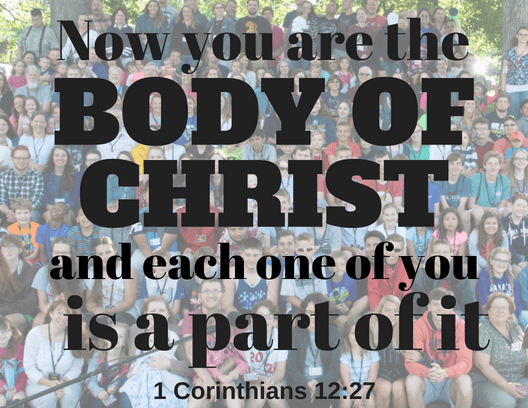
“you are the body of Christ, and each one of you is a part of it.”


-Susan Landry

Baby Spit-Up – Really?

1 Corinthians 11

1 Corinthians 11 26

Transubstantiation.  It’s a big word that means the belief that when communion bread and wine are taken, they literally become the body and blood of Christ.  The Catholic church holds this view.

A friend of mine was sharing a story recently of a visit to a Catholic church in which he discussed this with the priest.  The priest explained how it was because of this belief that the Catholic church began the tradition of priests placing the communion wafers directly into the mouths of parishioners.

You see, if the bread literally is the body of Christ, how awful if it were to fall and break on the floor.  The lay people of the church did not want to bear this responsibility.  They felt more secure in only having priests handle such a precious treasure.  And thus began this now common tradition.

My friend went on to share how he had asked the priest how this played out when they administer the tiny morsel of communion bread to babies upon baptism.  What if the baby spits the bread up?

The priest has to eat it.

Yup.  Let’s just leave that there and read a couple of verses from our chapter in Corinthians.

1 Corinthians 11: 27-28

Therefore, whoever eats the bread or drinks the cup of the Lord in an unworthy manner will be guilty of sinning against the body and blood of the Lord.  A man ought to examine himself before he eats of the bread and drinks of the cup.

Have you ever felt that taking communion can become rote?  Something you do without really thinking?

Clearly God cares that we take this exercise seriously.  But can we agree that we should find a happy medium between mindlessly consuming the bread and the cup and having to eat baby spit-up?

What this passage encourages me to do, and I encourage you to do, is to be mindful during the communion service.  How?

  • Always always always take a moment to pray and examine your heart before the Great God of the universe.
  • Humble yourself.
  • Be quiet.
  • Look around your church and ask God how you can build unity among the body (this instruction from Paul comes, after all, in a section of his letter instructing the Corinthian church on getting along at church).
  • Think about the fact that the last time Jesus participated in this it was the night before he died for you. Maybe thank him for that.
  • Realize that the next time Jesus participates in this he will have come again. Wow!  Maybe ask him how you can get ready for that.


-Susan Landry

Remember the Snakes

1 Corinthians 10

1 corinthians 10 10

Even though chapter 10 of 1 Corinthians is titled by Bible editors as ‘Warnings from Israel’s History’, I still didn’t expect the likes of this:

We should not test the Lord, as some of them did – and were killed by snakes. (verse 9)

Not getting eaten by snakes sounds like an outcome I’d like.  Don’t test the Lord–check.

But let’s take a minute here, what does that mean—don’t test the Lord?  In Malachi 3:10 God invites the people to test him and see if He’s faithful in what He’s promised.  Must be a different kind of testing.

What Paul is referring to here is recorded in Numbers 21:4-6.  The events took place while the Israelites were wandering in the desert.  We’re told that the people grew impatient and complained.

“Why did you…”

“We don’t have…”

“And we don’t like the food.”

So, like any good parent, God sent snakes.  hahaha   Seriously, though, he got their attention and the rest of the people repented.  Definitely good parenting.

Paul gives another example of the kind of testing that we’re not to do when he goes on to say,

And do not grumble, as some of them did – and were killed by the destroying angel. (verse 10)

Grumbling.  Complaining.  Apparently God doesn’t like these things.

Paul goes on to tell us why he’s bringing these examples up:

These things happened to them as examples and were written down as warnings for us… (verse 11)

The people of Israel had seen far larger acts of God than most of us can claim.  They had walked through a sea and eaten bread that appeared spontaneously.  And yet they questioned God’s care for them.  We can look at that and shake our heads at how fickle they were.  But how different are we?

Because we don’t have a map of the future, it can be frustrating to not see things lining up or happening as we think they should.  It can also become easy to question God’s care for us.

“Why did you…”

“I don’t have…”

“And I don’t like…”

Please remember today that God is big enough to handle our questions.  He invites us to test Him so we can be assured of His faithfulness.  But be intentional to catch yourself if you start to feel that God owes you something and is not coming through the way that He ought.

Remember the snakes.


-Susan Landry

Go! Fight! Win!

1 Corinthians 9

Do you not know that in a race all the runners run, but only one gets the prize_ Run in such a way as to get the prize.

Do you not know that in a race all the runners run, but only one gets the prize?  Run in such a way as to get the prize. (1 Corinthians 9: 24)

Being competitive is sometimes presented in a negative light.  Probably because competition can bring out the ‘jerk’ in people.  That’s too bad, because in his letter to the Corinthians, Paul is telling them (and us) to lean into that competitive spirit.

Paul is using this as an analogy, by the way, he’s not telling us that we are in competition with other believers.  He uses two phrases that I hope will inspire you as you run your race.

“strict training”

Athletes preparing for a big competition don’t eat whatever they want and binge Netflix all day.  What do they do instead?  They do things that will help them succeed in their goal.  (Winning!)  Paul’s goal, and ours, is “a crown that will last forever.”

How do we train for eternal life?

The word obey comes to mind.  In order to obey we need to really know Scripture.  If we want to hear the words “Well done, good and faithful servant,” we need to know what the Master expects of us.  And we need to do it, even when it’s hard.  Just like the athlete in training gets off the couch and goes to practice, even when he’s tired, we need to obey even when it doesn’t make sense to our human sensibilities.

“do not run aimlessly”

If you’ve ever been to a kid’s sporting event, you know that there are players that do not have their head in the game.  They are wandering around the field, chatting with friends, maybe even picking flowers in the grass.  Adorable.

Not so adorable when it’s adults in an Olympic competition and not cute when we’re talking about forever.

So many of us say that we are sharing our faith by they way that we live our lives.  But how much of that is a cop-out because we’re not comfortable evangelizing?  If we are actively sharing our faith through our life, we will be intentional in planning ways to do it.  We won’t just be going about our life, wandering aimlessly along.

I encourage you today to make a training plan.  How are you getting ready for Christ’s return?  I also encourage you to make a game plan.  How are you looking for ways to share your faith with those around you?

-Susan Landry


Knowledge Puffs Up, But Love Builds Up

1 Corinthians 8

Those who think they know something do not yet know as they ought to know.

Would it surprise you to know that in a discussion about issues that people disagree on, Paul would bring up the subject of pride?  The Corinthians disagreed on a lot, what to eat, how to worship, what was moral behavior, and more.  Paul kind of leads with this in chapter one (1:10) saying that he ‘appealed to them’ to get rid of the divisions and live in unity with one another.

Now here, in chapter 8, Paul is in the middle of working through one of their many dividing issues.  But instead of focusing on the issue, I’d like to hone in on some wisdom that Paul shares about unity in the body.

“Knowledge puffs up, but love builds up”

We shouldn’t be mistaken.  Paul is not saying that knowledge itself is bad, or that the desire to pursue knowledge is in itself prideful.  He’s not suggesting that we should pursue love instead of pursuing knowledge.  Not at all.  It seems that what Paul is concerned with is what that knowledge does in us and how we share that knowledge.

Do you like to be the smartest person in the room.  That’s pride.

Do you use your tone of voice to make people feel dumb because they don’t know what you do.  That’s pride.

And here’s an important thing to note… we’ll only really know that we are building up (or edifying) with our knowledge by how others respond.  Edifying is not something we can claim.

“I hereby edify you!”

Nope.  Not how it works.

If you think that you are sharing your knowledge with love, it will be evident by the unity that you are helping to create.  When Scripture calls us to be peacemakers (Matt. 5:9, James 3:18) it implies actively building peace and unity.  Being a peacemaker is more than just not shooting anyone.  A peacemaker makes peace as opposed to division, they edify and build up those around them.

Picture a person filled with knowledge who you just love to be around because of the way they make you want to know more, to be better, simply because of the kindness and grace with which they speak.  Their whole demeanor draws you to them.  Sounds a lot like Jesus, if you ask me.  It also sounds like the kind of person Paul is calling us to be.


-Susan Landry


What Counts

1 Corinthians 7

Keeping God’s commands is what counts.

I hope you have enjoyed working through 1 Corinthians this week.  I’m going to finish with chapter 7 today.


Up until now Paul has been telling them about all of the changes that they need to make.  He has told them to set aside the worldly wisdom, and the associated status that comes with gaining it, for God’s wisdom.  He has told them to seek purity because they are members of the Body of Christ, and they cannot do things anymore just because their conscience says it isn’t bad, they need to listen to the Holy Spirit.   He has also instructed them to seek unity in the Body of Christ instead of handling their issues in the courts in order to “win” the argument. Several times in these instructions Paul has shifted tone between one of condemnation and rebuke, to one of conciliation and support.  Again here in chapter 7 Paul is lightening the blow from all of the changes he has asked of them in these previous chapters.


Paul does not want to overwhelm them with the changes he is asking for, so in chapter 7 he clarifies about the things that he is not asking them to change, but they may have thought he wanted them to change.  They do not need to get a divorce if they are married to an unbeliever, but are to do everything in their power to maintain a healthy relationship. If they are a slave then they do not need to attain freedom, although if they can that is nice, but it is not required. Contrary to what some of the Jews in the early Church were saying they do not need to be circumcised. Paul understands that these life changes would be a roadblock to some new believers and that they are not what God really wants, he says “Keeping God’s commands is what counts.”  God wants them to change their hearts. And maybe some of the life changes would be wise, but those things can come later as you grow in God’s wisdom. The most important thing to work on is obeying God’s commands and following the leading of the Holy Spirit.


Thanks again for reading along.  I hope some of this has helped you.

Until next time,

Chris Mattison

Disunity – Defeated Already

1 Corinthians 6

1 Corinthians 6 7

Today we will be taking a look at 1 Corinthians 6


In chapter 5 Paul taught that it is not right for those in the Church to judge those who are not in the Church because they are not held to the same standards that we have ascribed to.  Similarly in chapter 6 Paul says that it is not right for those outside of the Church to be making judgements on arguments between those in the Church. If we have Christ’s love in us and if we are living according to his wisdom as Paul teaches we should, then we should be able to have reconciliation with our brothers and sisters in Christ without having to go to court. It is understandable that we will have disagreements in the Church, and feelings will get hurt, but Christ forgave the men who crucified him while he was still hanging on the cross.  If he can do that then we can forgive the people in our Church. It is a shame on the Church when we cannot be reconciled to each other. When that happens Paul says in verse seven that “you have been completely defeated already”. We know from Ephesians 6:12 that this fight that we are in is against “the spiritual forces of evil in the heavenly realms” and for that reason we need to put on the full armor of God. But if we cannot unite as the Body of Christ then there is no point, we have already lost the battle.


One of Paul’s main goals in his letter to the Corinthians was to bring unity.  Many of the situations in Corinth Paul was asking one of the sides to give in graciously, even though they were not wrong, in order to bring peace.  Later in chapter 6 verse 7 it says “Why not rather be wronged? Why not rather be cheated?” We should seek unity in the Body over being right, or having justice.  Jesus’ death was the greatest injustice in the world, and we are called to take up our crosses and follow him, we should not be surprised if we have to endure some injustice along the way.


Yours in peace

Chris Mattison

To Judge or Not to Judge

1 Corinthians 5

1 Corinthians 5 12

We are going to take a look today at 1 Corinthians 5.

Paul has talked a lot up until now about how immature and unwise the Corinthians are, and we start to see here what he is talking about.  There is some really weird sexual immorality going on in the church at Corinth, and they were bragging about it. Paul is very critical of this and tells them “I have already passed judgment in the name of our Lord Jesus on the one who has been doing this”.  Because they have accepted Jesus they should have his wisdom and the Holy Spirit guiding their lives and they should know that these things are wrong, and therefore have no excuse in allowing this to go on.

“What business is it of mine to judge those outside the church? Are you not to judge those inside?  God will judge those outside. “Expel the wicked person from among you.”’ 1 Corinthians 5:12-13

Paul clarifies though, that he is not judging their culture, which finds this practice acceptable, but he can judge them because they have committed themselves to a higher standard and are falling short.  Many Christians today need to be reminded of this. We need to hold other Christians to the standard that Christ has set. It may make us uncomfortable, but if we see sin in the Church it is our responsibility to help fix it.  Confronting people is not easy, but if we love them then we will want them to be right with God.

On the other side we cannot judge the sins of non-believers because they have not committed themselves to Christ, and they do not understand that what they do is sinful.  It is not our place to judge the sin in the world, but it is our job to spread the good news that Jesus died for our sins, and then we can let the Holy Spirit convict that person of their sin, and hope that they make the right decision.  If we start by judging them for their sins we will only push them away, and that will not help the Kingdom to grow. We can see a widespread rejection of Christianity in our culture today partly because of a cultural backlash towards Christians that openly judge non-Christians.  So let us remember that our message is one of life and hope, not judgement and condemnation.


Thanks for reading,

Chris Mattison