You Don’t Have to Pretend with God

Psalm 77

Monday, July 11, 2022

            I remember as a kid we had about a 30 minute drive to Church every Sunday.  Now, you put 2 adults and 3 kids in a car for a half hour and there’s bound to be some excitement, maybe even some conflict.  Somebody is going to say or do something to annoy someone else and that kind of stuff is contagious so that by the time we get to Church everyone’s cross with each other and in a bad mood.  But it always amazed me that when we got out of the car and walked into church people smile and we smiled back, how are you?  I’m fine, how are you.  It was like someone flipped a switch and we instantly turned off all of the bad feelings.  Was it really that easy?  Of course not.  We just stuffed the bad feelings back inside and pretended it was okay. 

            Human beings learn to do that a lot.  We hide our pain and gloss it over with fake smiles and civility.  Now, there’s a certain amount of this that is necessary.  If you work at Chick Fil A and you had a fight with your boyfriend before your shift started, the Jones family doesn’t want to buy your drama along with their chicken sandwich so you learn to tough it out, smile and at the end of the order respond, “My pleasure.”  But you can’t hide those bad feelings forever.  Everyone needs someone that they can go to and share their hurt and sadness and tears.  Ideally, church should be a place where we can do that, where we can find grace even on our worst days.  I realize that not all churches feel like safe spaces to share our painful emotions so some keep on pretending.

            The Bible reminds us over and over again that we don’t have to pretend with God.  The Psalms are an example of how open God is to receiving all of our feelings.  There are Psalms of joy and thanksgiving, “Let everything that has breath praise the Lord”!  There are also songs of complaint, “My God, My God, Why have you forsaken me?”  The Bible says that we should rejoice with those who rejoice and weep with those who weep.  God wouldn’t ask us to do something that He is not willing to do.  God is willing to share both our joyful moments and painful experiences.  God wants us to feel freedom to bring everything to him.  When you pray God wants you to bring your whole self to him, the parts that love and celebrate, and the parts that hurt and complain.  In fact, there is one type of prayer that is specifically about bringing our pain to God.  It’s called a prayer or a psalm of lament.

            Psalm 77 is a psalm of lament.  Take a minute to read Psalm 77 if you haven’t already.  There’s no warm up here- there’s no “Dear Lord, you are holy, great and glorious.  Dear Lord, on this day we thank thee for all they bountiful gifts and we ask thee to bless us…. Etc…”   Instead he jumps right in with essentially “God my life sucks right now and I keep telling you about it and I’m not getting anywhere.  Have you forgotten me God?”  That’s a prayer of lament.  There’s no pretense here.  God, things are terrible, I feel awful and it doesn’t feel like you even care.” 

            As you read Psalm 77 you might notice that the whole first half of the Psalm is just full of complaining.  It’s like the prayer brings all of these painful feels to God and gives a big emotion dump.  And then between vs. 9 and 10 I feel there’s kind of a pause… we got all of the pain and anger out on the table.

            Just as an aside, did you know that the practice of writing down a painful or traumatic memory can aid in the process of healing that trauma?  Something about the practice of writing actually moves the trauma from a part of your brain that has trouble letting go, to another part that is more able to deal with it.  Could it be that the very process of writing down his prayer of lament to God helped his brain begin the process of healing?

            In the second half of the Psalm he is able to think and remember differently.  He is able to recall all of the ways in the past that God has done miracles and healing and turned sadness into joy and darkness into light and death into life.  It’s a totally different feeling from the first half of the prayer.  The complaints have given way to praises.  The despair  has given way to hope.  The painful and traumatic memories have fallen away and revealed a powerful and compassionate God who can and will make all things right if we continue to trust and pour out our hearts to him.

            So next time you’re carrying a lot of pain and hurt, you might have to suck it up and sell someone their chicken sandwich and smile about it, but then when you have the space and the time, bring that pain to God in prayer and allow him to heal and transform your heart.

-Jeff Fletcher

Reflection Questions:

  1.  When you are hurting and need to tell someone how you are really feeling, who is your go-to person?
  2. When  was the last time you brought a painful feeling to God in a prayer of lament? 
  3. If you’ve never felt safe or comfortable bringing pain or complaint to God, bring that fear to God and ask God to help you explore what might be keeping you from feeling free to be open and honest with all of your feelings.

Guilt and Shame

Psalm 51

Sunday, July 10, 2022  

Do you remember the first time you disobeyed your parents or did something that you knew was wrong?  Chances are you felt guilty and ashamed.  Those are two different things. 

Let’s imagine that your Mom made fresh chocolate chip cookies.  After they cooled a bit she gave you two cookies and a glass of cold milk.  It was delicious!  Then, after she wiped the excess chocolate off of your hands and chin and nose she put the rest of the cookies in the cookie jar and she told you, “The rest of the cookies are for your Sunday School Class.  There’s enough for each person to have 2 cookies, but don’t you take any more or there won’t be enough.”  She goes about her activities, but all you can think about is the cookies.  They were so delicious and you’d like to have some more, but your Mom said “no more”.  When Mom’s not looking you go and grab another cookie and shove it down your throat as fast as you can before she sees.  You go back to coloring.  Your mom comes back in the room, looks at your face and says, “did you eat another cookie after I told you not to?”  You say “no, mommy”.  Then she asks “then why is there chocolate all over you face and fingers again?”

You’ve been busted.  If you’re like most people you’re feeling two things: guilt and shame.  You feel guilty because you did something wrong, you disobeyed your mom and stole the cookies after she told you not to and then you lied to her about it.  You also may feel shame.  “I’m a bad boy or a bad girl, I never listen to mommy, mommy’s going to hate me now and when the kids in my class hear what I did they’re gonna hate me too, and so will my teacher and so will the pastor when he finds out, and maybe even God will hate me.”

When we feel guilt we feel bad about something we have done (or sometimes what we didn’t do that we should have.)  When we feel shame we feel that there is something wrong with us.   I’m broken, I’m damaged, I’m bad, I’m evil.  Guilt and shame are both powerful and shattering emotions.  Is there any remedy for them?

Psalm 51 was written by King David.  I recently attended a musical about David at the Sight and Sound Theater.  It showed David’s life from the time he was a little shepherd boy until his death as King of Israel.  David was a great man, a man after God’s own heart.  Most of the Psalms in the Bible were written by David.  David killed the giant Philistine Goliath with stones and a sling.  David was good, but he was not perfect.  One of the worst things David ever did was commit adultery with his neighbor’s wife while his neighbor was off fighting in battle in David’s army.  David got his neighbor’ wife pregnant and then tried to cover up his sin.  In trying to cover up one sin David committed an even greater sin and had her innocent husband killed in battle.  It was an act of great treachery.  David succeeded in covering up  his sin so that no one else (he thought)  knew about it and then he took his neighbor’s wife to be his own.

David was later confronted by the prophet Nathan who revealed  his sinful act.  But even before his sin was revealed, David was not at peace.  His heart was mired in guilt and shame.  In the midst of his guilt and shame David cried out to God to be set free.  Psalm 51 is one of the prayers he prayed to God.  Take time to read through Psalm 51.  Imagine this powerful king in anguish before God.  He is so overcome by guilt and shame, that he had sinned and that he was a sinner, a wretched, broken man.  What David feared most was being alienated from God, from the joy of knowing God’s saving love and the power of having God’s spirit.

David knows that if he can be set free from his feelings of guilt and shame, the joy of God will come back to him and he will be able to powerfully declare God’s grace and mercy to other people who are also trapped in their guilt and shame.

Lots of people today are trapped in guilt for what they have done and shame for who they are.  So much of the evil we see going on in our world every day is born out of people trying to escape the bad feelings of guilt and shame. Rising rates of suicide and deaths from opioids, increased murder and sexual violence, the rage and confusion that so many feel all can be traced to feelings of guilt and shame and attempts to cover up or self-medicate the pain away. 

There is a better way.  David knew that true healing for his guilt and feelings of shame would only come from God.  Only God could bring real joy to His heart.  The same is true for all of us.  Jesus, who was both David’s descendant and the true son of God provides the only lasting solution to guilt and shame.  When Jesus went onto the cross he took upon himself the burden of our guilt for sins we committed and our feelings of worthlessness for having committed those sins.  In their place we are forgiven of those sins and discover our true identities, we are also children of God made in God’s image.

I John 1:8-9 says: “If we claim to be without sin, we deceive ourselves and the truth is not in us. If we confess our sins, he is faithful and just and will forgive us our sins and purify us from all unrighteousness.”

Chances are, after you told your Mom that you really did eat the cookie and said that you were sorry, she wiped your face, gave you a big hug and said “I love you, don’t do it again” and you felt a lot better.  Love covers over a multitude of sins.

-Jeff Fletcher

Reflection Questions:

  1.  Which do you find more painful- Guilt- I did something wrong, or Shame-There’s something wrong with me, I’m worthless?
  2. What are some of the ways we try to hide our guilt and shame?  Why do they often make things even worse?
  3. Is there still some guilt and shame hiding in your heart?  What is preventing you from going to God, confessing it to him and letting  him clean you up and give you a hug?

The 23rd Psalm

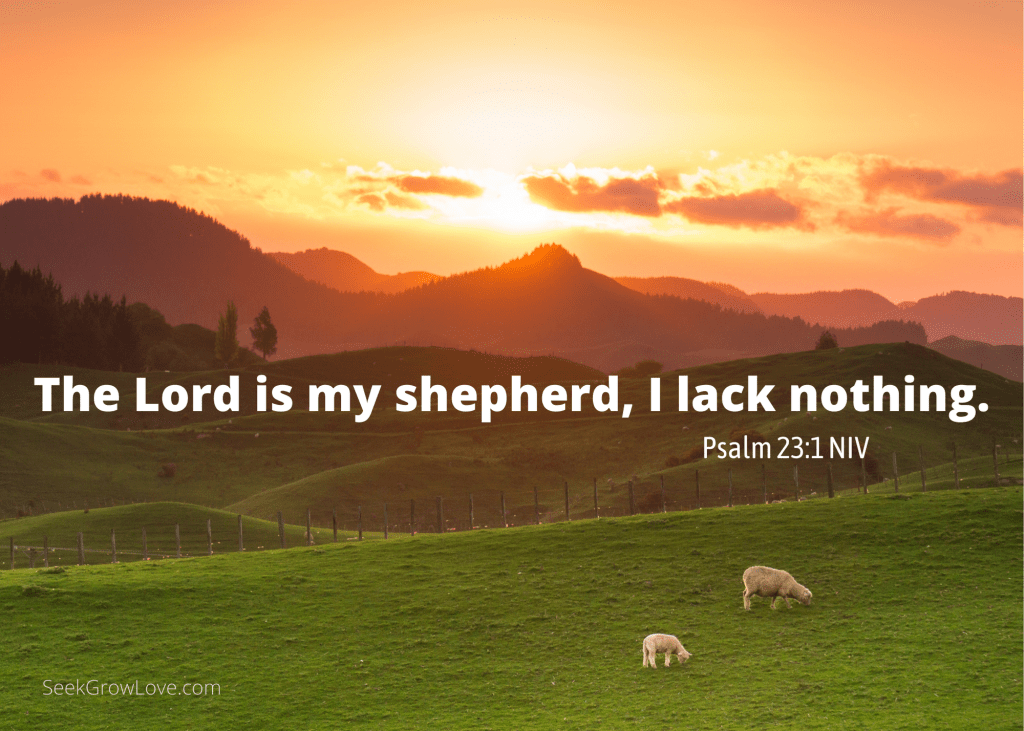
Psalm 23

Saturday, July 9, 2022

What comes to your mind when I say “The 23rd Psalm?”  Perhaps you know that it is the most famous of all the Psalms, or even the most well-known chapter of the Bible.  You might think, “Ahhh, the Shepherd Psalm.”  Maybe you remember its author, David, and that he was a shepherd boy.  Or, perhaps you know that Psalm 23 is identified as a Messianic Psalm, picturing Jesus as the Good Shepherd.  These thoughts are all reasonable when considering Psalm 23.  But here are my thoughts when the words “The 23rd Psalm” are said to me. 

I remember a little 4-year-old girl attending the Church of God Illinois State Conference Bible School in Oregon, Illinois in the summer of 1956.  During our lessons that week, the children in attendance were challenged to memorize Psalm 23.  The little girl thought she could memorize it just as well as her older brother, and she was determined to do so.  At the end of the week, each child was asked if he/she wanted to go in front of the gathered students, and recite this beautiful Psalm.  The little girl was shy, but went up in front, by her teacher, and proudly recited the Psalm.  There were a few missed words, but she finished well, and was applauded for her efforts.  She was so proud to receive a ribbon with a “Shepherd and sheep” seal upon it, as an acknowledgement of her accomplishment.  She kept that ribbon for years!

As I (the little girl, as you probably guessed) grew older, I would occasionally recite the psalm to myself.  Years later as an adult, I realized I couldn’t recite it anymore.  I was disappointed in myself.  I made an effort to re-memorize the Psalm, and now it is a part of me.

If you are sad, recite the 23rd Psalm.  Are you stressed, weary, needing direction?  Quote Psalm 23.  Is everything swirling about you, are the burdens weighing too heavily on your shoulders, is hope fast disappearing before you?  Say the 23rd Psalm to yourself.  It offers comfort, strength, and encouragement every time. 

As you say the words, picture yourself as a sheep, lovingly cared for by Jesus, our Good Shepherd.  He leads you to green pastures for grazing, quiet waters for a refreshing drink, and guides you THROUGH dangerous territory, “the valley of the shadow of death.”  He draws you close with his staff, and he rubs oil in any wounds you might have.  What reassurance and love the Shepherd gives his sheep.

As Jesus states in John 10:27, “My sheep hear my voice, and I know them, and they follow me.”

The 23rd Psalm’s words are a treasure to all who read or recite them, providing immeasurable solace in the midst of life’s challenges and troubles. 

The opening sentence actually sums it up.  “The Lord is my shepherd; I shall not want.”

-Paula Kirkpatrick

Questions for Reflection

  1.  When you hear the words, “The 23rd Psalm”, what comes to your mind?
  2. What scriptures provide comfort and peace to you?

Even on My Hardest Day

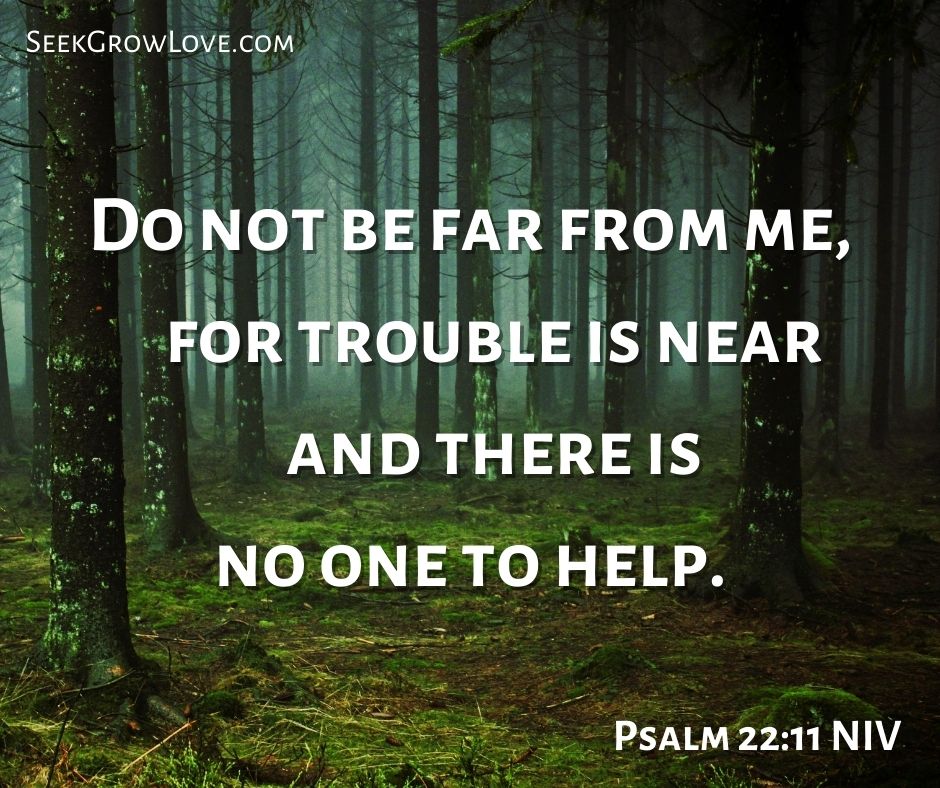
Psalm 22

Friday, July 9, 2022

Ever have a bad day? Maybe there were relationship troubles. Maybe a conflict or difficult day at work. Maybe all the little things just added up to having a no fun day. I know I’ve had days like that. But, when I read Psalm 22, I realized maybe my days aren’t that bad.

I’ve never been poured out like water with all my bones out of joint. There have never been lions and bulls all around me. ALL the people that saw me didn’t mock me and hurl insults at me. I have never been encircled by a pack of villains that pieced my hands and feet. Now, granted, the lions and dogs and bulls are metaphors for the enemies, but I wouldn’t describe the boy in kindergarten who told me I couldn’t cut well, or the girl who pushed me on the playground, as bulls or lions.

According to the notes in my study Bible, this psalm is the most quoted psalm in the New Testament. And, it fits Jesus’ circumstances, hence Jesus quoting the first part of it while on the cross. He was tortured and tormented for things he didn’t deserve, and I’m sure it hurt more than rude kids on the playground.

This psalm goes on, with David mentioning many hardships, but he doesn’t just ask God to magically fix his circumstances instantly. Instead, the end of the psalm talks about praising the LORD. That’s pretty impressive, and I think it should be a goal of mine, to take hard situations and continue to praise God and tell others about Him.

I’m going to use this psalm as a reminder of the no pain, no hardships time of the Kingdom. And to go about my days, whether difficult or seemingly easy, praising God and knowing that it’ll just get better in the Kingdom, because of what Jesus did for us and the plan God has for us.

-Moriah Railton

Application Questions

  1. Looking at Psalm 22 what descriptions do you find of the pain and agony Jesus endured while carrying your sins to the cross? Why do you think God chose this way to draw you close to Him?
  2. Why do you think Jesus quoted this Psalm on the cross?
  3. How can you focus on praising God even on the hard days?

No Words

Like God’s Words

Psalm 19

Thursday, July 7, 2022

Have you ever heard the phrase, “There are no words?”  Perhaps you used it in response to receiving a wonderful gift, when you couldn’t find the appropriate words to express your appreciation.  Conversely, maybe something tragic has happened, your heart is broken, and “there are no words” to express the magnitude of your grief. 

In verses 1-6 of Psalm 19, God reveals Himself in the glorious heavens and celestial bodies.  God’s greatness is proclaimed without a single sound—“NO WORDS.”  The amazing beauty of the skies—unique cloud formations, streaming sun escaping the clouds, indescribable sunrises and sunsets, breathtaking rainbows—boldly declare the majesty of God each day.  Searching for God?  Go outside and look up.  “There are no words.”

BUT, if you NEED words to find God, the second part of Psalm 19 is your answer.  In Psalm 19, God reveals Himself first in nature, (verses 1-6) and then in the Scriptures.  Verses 7-11 give us a perfect progression of what God’s Word, HIS WORDS, can do in our lives. 

“The law of the Lord is perfect, converting the soul.”  (7a) God’s Word gives us everything necessary for salvation.  His law, his commandments, revealed God’s holiness and our sin.  Paul wrote in Romans 10:4, “For Christ is the end of the law for righteousness to everyone who believes.”

“The testimony of the law is sure, (steadfast, trustworthy), making wise the simple.” (7b)  We can put our trust in God’s testimony—it will hold us up.  The “simple” are those open-minded to instruction.  James 1:5 says, “If any of you lacks wisdom let him ask of God, who gives to all men generously, and without reproach, and it will be given him.” 

“The statutes (precepts) of the law are right, rejoicing the heart.”  (8a) God’s Word is just and righteous.  As we understand more and grow in wisdom of God through His Word, it brings joy and gratitude.  Consider Hezekiah, king of Judah, who honored God by repairing the house of the Lord and called the people to consecrate themselves and gather to worship.  Greater understanding produced tremendous joy in the people.  II Chronicles 30: 21, 23 says, “The sons of Israel present in Jerusalem celebrated the Feast of Unleavened Bread for seven days with great joy, and the Levites and the priests were praising the Lord day after day with loud instruments to the Lord.  Then the whole assembly decided to celebrate the feast another seven days, so they celebrated the seven days with joy.”

“The commandment of the Lord is pure, enlightening the eyes.”  (8b) Purity of God’s Word gives us new vision for this life and the one to come.  Matt. 5:8 says, “Blessed are the pure in heart, for they shall see God.”  And consider Ephesians 5:8, “for you were once darkness, but now you are light in the Lord; walk as children of light.” 

“The fear of the Lord is clean, enduring forever.” (9a) Why is the Word of God called “the fear of the Lord?”  When God reveals His will, it is awesome!  God’s will is fearsome because of our sin, and when we are confronted with it, we realize how unrighteous we are. 

Consider Josiah, the boy who became king of Judah when he was eight years old.  Though II Kings tells us he did right in the sight of the Lord, when he was 26, a high priest found a book of the law in the house of the Lord and a scribe read it in the presence of the King.  “When the king heard the words of the Book of the Law, he tore his clothes.”  II Kings 22:11.   

Josiah realized that his people were not following God’s laws, and idol worship had crept into the land.  Josiah instituted reforms that destroyed the idols.  “Before him there was no king like him who turned to the Lord with all his heart, all his soul, and all his might, in conformity to all the Law of Moses; nor did any like him arise after him.”  II Kings 23:25

“The judgments of the Lord are true; they are righteous altogether. (9b) We can depend on God’s judgments.  They are true, trustworthy, and righteous, as Josiah discovered, as we can discover in John 3:16. “For God so loved the world, that He gave His only Son, so that everyone who believes in Him will not perish, but have eternal life.”  Our future is secure, eternal life, because the judgments of the Lord are true. 

Have you FOUND God as you meditate on His Word?  Have you FOUND God as you gaze at the heavens?  He is in plain view, accessible, desiring to be part of our lives, each and every day.  No AUDIBLE WORDS are needed.  But if you would like to respond to His glorious presence in the skies and in His Word, speak out loud the last verse of Psalm 19, as your humble prayer.

“May these words of my mouth and this meditation of my heart
    be pleasing in your sight,
    Lord, my Rock and my Redeemer.”  Psalm 19:14

-Paula Kirkpatrick

Questions for Reflection and Application

  1.  What part of God’s creation moves you to say, “There are no words?” 
  2. Think about Josiah.  The Bible tells us he did right in the sight of the Lord at a very young age, and yet at age 26, he realized how much he and his people needed to improve.  Does Josiah’s story help you realize how much we need to keep growing and learning from the Lord?  (It helps me realize it.) 

The Peoples Plot

Psalm 2

Wednesday, July 6, 2022

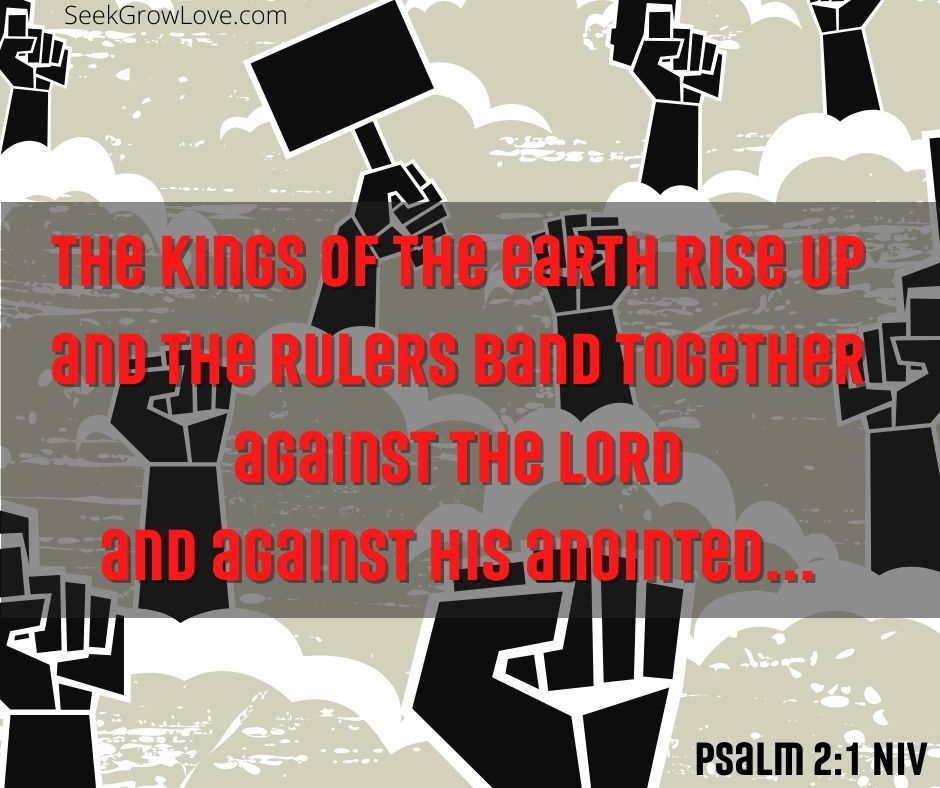
A desire for fame, power, or wealth has led numerous nations, peoples, kings, and rulers to disregard God’s word, and commit evil acts. These acts are questioned by the author of Psalm 2, likely David. He asks, “Why do the nations conspire and the peoples plot in vain?” (Psalm 2:1). Further, the “kings of the earth” and “rulers” are against not only God, but against “His anointed” as well (Psalm 2:2). Those that God anoints, ultimately and most significantly referring to Jesus, share a common desire and goal with God, so those that go against God’s anointed ones go against God Himself. 

David continues the Psalm by describing how pointless it is for the earthly rulers to act against God. Back in verse one he mentions how the plotting is in vain, so the people are constantly unsuccessful in overthrowing God’s plans. David suggests that God even laughs at them for trying (Psalm 2:4), as He is omnipotent and already had a plan for a new king. God’s plan involved David as King and his eventual descendants. He promised to David that “[his] house and [his] kingdom will endure forever before [God]; [his] throne will be established forever” (2 Samuel 7:16). David paraphrases this prophecy in verses 6-9 of Jesus coming as a descendant of David to rule over the world. There will be a time when evil is destroyed, and God and Jesus will reign forever in the Kingdom of God. 

Most of the rest of the chapter is a warning to kings, rulers, and leaders to follow God and those he anoints: specifically, Jesus, the Son of God. Following God requires dedicated service to God and His Son. David uses the phrase “Serve the LORD with fear” (Psalm 2:11), which could be interpreted as genuine service to God with knowledge of His amazing power, mercy, and grace, and not simply an action to check off a list. The idea of serving God is modified to include serving and following God’s Son who would come after David.

The chapter ends with a reflection of the beginning of Psalm 1. The book of Psalms begins by stating “Blessed is the one who does not walk in step with the wicked or stand in the way that sinners take or sit in the company of mockers, but whose delight is in the law of the LORD and who meditates on His law day and night” (Psalm 1:1-2). Psalm 2 questions the logic of the nations and kings that don’t follow God, but rewards those that do follow God by explaining that “Blessed are all who take refuge in Him” (Psalm 2:12). 

Psalm 2 was written mainly as a reminder for the people in the time of David to follow God and “take refuge in Him” (Psalm 2:12), but it has many applications to other people. For example, in Acts 4, believers quoted the first two verses of Psalm 2 after Peter and John were told by the Sanhedrin to not “speak or teach at all in the name of Jesus” (Acts 4:18). They recognized that those in charge of the Sanhedrin were going against God’s word, and Peter and John decided to continue following God’s way. They, and all the believers with them, prayed for God to “consider their threats and enable [God’s] servants to speak [God’s] word with great boldness”, in addition to prayers for healing and miracles (Acts 4:29-30). God quickly responded to their prayer and “the place where they were meeting was shaken. And they were all filled with the Holy Spirit and spoke the word of God boldly” (Acts 4:31). God gave them the courage and strength to continue serving Him, even with threats against them. 

In today’s society, there are some who “conspire”, “plot in vain”, “rise up”, and “band together against the LORD and against His anointed” (Psalm 2:1-2), but it is still possible to remain faithful to God. Prayer can help to develop a relationship with God and “take refuge in Him” (Psalm 2:12). Those that do will be blessed and the nations will be the inheritance received according to Psalm 2:8. Similar wording is used in Revelation 2:26-27 when Jesus states that, “To the one who is victorious and does my will to the end, I will give authority over the nations – that one ‘will rule them with an iron scepter and will dash them to pieces like pottery’” (Revelation 2:26-27). Following God and Jesus throughout persecution while others are rebelling against God will result in a blessing in the Kingdom of God of eternal life ruling under God and Jesus after evil has been destroyed.  

-Josiah Railton

Reflection Questions

  1. At whom or what do you think God may currently be laughing – scoffing at their actions? (In other words, what in today’s world is evil, rising against God? And is God scared?)
  2. How will you serve the Lord with fear amongst those who rise up against the Lord?
  3. How will the story end?

Planted by the Water

Psalm 1

Tuesday, July 5, 2022

When I was young, we often sang this song during our Sunday School opening. 

“Jesus is my Savior I shall not be moved
In His love and favor I shall not be moved
Just like a tree that’s planted by the waters Lord
I shall not be moved.

I shall not be I shall not be moved
Just like a tree that’s planted by the waters Lord
I shall not be moved”   (John T. Benson, Mrs. James A. Pate, Words -1950 New Spring)

When I was researching the song, I found this verse which lines up better with the writer’s words in Psalm 1. 

“Glory hallelujah, I shall not be moved.

Anchored in Jehovah, I shall not be moved.

Just like a tree that’s planted by the waters Lord
I shall not be moved.”  (Alfred Henry Ackley, Lyndell Leatherman; Words, Public Domain)

What a wonderful visual and reminder to stand firm in God.

Psalm 1 is a contrast between a Godly man and a wicked man.  The Godly man isn’t walking, standing, or sitting with the wicked.  Instead, he is delighting and meditating in God’s law, God’s Word.  The presence of God’s Word in his life is like a tree firmly planted by streams of water. 

Have you ever seen such a tree?  It is usually bending toward the water, and often you can see the large, exposed roots.  It gets constant nourishment, constant life-giving water because of its proximity to the water.  The tree is fruitful, the leaves don’t wither.  This is the picture of a man rooted in the Lord and immersed continually in His Word.

The last three verses of the Psalm picture a completely different person, a wicked person.

Have you ever seen chaff blowing in the wind?  Chaff is the dry, scaly protective casing of seeds or other plant material.  In Hector, Minnesota where we lived for many years, there was (and still is) a celebration called Corn Chaff Days.  It was an appropriate name, because corn chaff often blew from the large grain elevators all over the streets and sidewalks of this little farming community.  It scattered everywhere, and eventually disappeared with the strong winds, lost forever.  Just like the wicked man. 

Two scenes in God’s creation

  • Strong, firmly rooted tree by the waters
  • Blowing, dusty chaff, cast off and receiving no nourishment

Two men presented

  • Godly man who does not STAND in the paths of sinners
  • Wicked man who does not STAND in the judgment

The choice is ours. 

“But if serving the Lord seems undesirable to you, then choose for yourselves this day whom you will serve.  As for me and my household, we will serve the Lord.”  Joshua 24:15a,d

-Paula Kirkpatrick

Reflection Questions

  1.  What contrasts in nature remind you of the Godly man and the wicked man?
  2. What can you do in your own life to root yourself deeper in God’s Word?

God’s Answers and Timing

Job 38

Monday, July 4, 2022

It is no secret that we come to times in our lives where all we want are answers. All we want is for God to bring us some incredible miracle and clash of thunder and then, BOOM! Everything makes sense. God is full of miracles. They may not always be what we were expecting or at the time we expected them, but they are incredible just the same.

Job 38:1 says,

Then the Lord answered Job from the whirlwind. He said: Who is this that obscures my counsel with ignorant words? Get ready to answer me like a man; when I question you, you will inform me.

This is Job’s first-time hearing God speak to him. After all he has been through, and all the struggles, Gods first words are not what you would expect. God’s answers reflect the point he is making to Job, that we cannot demand answers from God, BUT he is also letting Job know that he is still there, and he is listening. The times when God is silent are the worst times to us. But something to remember is that, even though he is silent doesn’t mean he isn’t there. He is watching and waiting to show us his grand plan.

Sometimes all we need in life is to understand, that there are no great answers for our situations, but that God has a plan in every situation we face that is for our ultimate good. As God continues to speak in Job 38, we see God asking Job tons of questions that no one could possibly answer, and we aren’t meant to answer them. We are meant to simply sit back and trust that God knows the answers and he has our life in his hands.

            Job 38:12 goes on to say,

            “Have you ever in your life commanded the morning, or assigned the dawn its place so it may seize the edges of the earth and shake the wicked out of it?”

God is using the morning as an example to explain to Job and us, that we are not in control of the things that will happen. We are to trust him and his timing for the answers or outcomes we are seeking. Sometimes it is the waiting that grows our faith the most because we have a moment to sit and wait for the next door to open. We can sit peacefully with God.

-Hannah Eldred

Reflection Questions

  1. Is there a place in your life where you are begging God to speak? What is it, and how can you let go?
  2. What does God questioning Job mean to you? Could you imagine the Lord speaking to you that way?
  3. What does a time of waiting mean to you? What are you waiting for in your life? How can you grow closer to God in this time of waiting?

He Cursed the Day of His Birth

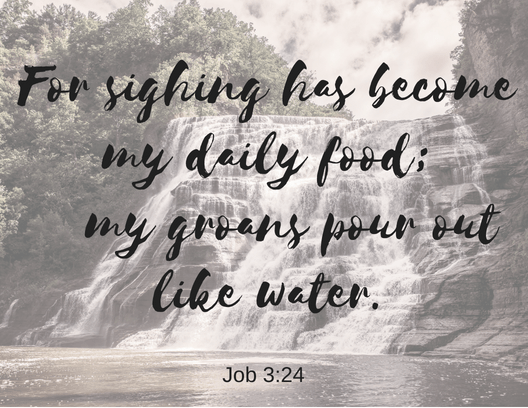
Job 3

Sunday, July 3, 2022

Today’s is a devotion I wish someone else was writing. It is over a chapter that is too dark, too deep, too depressing.

That is the start of the first devotion I wrote on Job 3. The one I spent a couple hours writing this morning before my computer ate the rest of it. So, now I get to write a second one. Maybe God has more to teach me about Job 3. Dear God, help me learn what you want me to learn – and put it into action.

I loved Hannah Deane’s devotions on Job 1 & 2 (as well as the rest of her devotions this past week on 2 Corinthians). If you missed them, I encourage you to go back and read them. Yesterday she pointed out that in chapter 2, Job’s grieving wife who had also lost so much, encouraged Job to just curse God and die. One can only endure so much, right? When is it time to give up on God? Job’s wife thought Job should be there already. But good old Job called it foolish talk. If you accept good from God, be prepared to accept some trouble, too, he said. Then his friends came and sat with him in silence for 7 days.

In chapter 3, Job speaks. And, it is difficult to listen to. Is he finally ready to curse God and die, as his wife had counseled him? No – not exactly. But there is no denying the pain and agony he is in. Rather than cursing God though, he curses the day he was born.

I have no recollection of the day I was born, but I have some pretty fond memories of the three days my children were born and put into my waiting arms. And it breaks my heart that one would become so depressed and despondent that they would wish their day of birth had never been. I have never been at this dark point Job was.

I also can’t help but think of the pro-abortion claims that for a certain amount of hardship (financial, physical, relational, or emotional), it would be better for a child to never have the chance at life. If we only had this ONE single chapter of Job to consider, it might seem that Job would agree.

It can not be denied. Hardships and loss come with life. No life has been lived without, no matter how spectacular the parents or timing or circumstances or inception. Hardship began with the serpent in the garden. And it will continue until the new heaven and new earth comes in the clouds, and God will live with His people and will wipe every tear from their eye and there will be no more mourning or crying or pain or death. (Revelation 21:1-4). What a beautiful hope for the future. But, we aren’t there yet. So, we must be prepared in this life for some trouble ourselves. And, we must consider how we can encourage, comfort and sit with those in deep pain and agony. And, while we are at it – how can we speak with compassion and wisdom to the would-be mom who is scared of the loss in her own life as well as the amount of hardship that a baby would meet in life? Job knows what it is like to be overcome by grief and raw emotion – for a time. That is where he is in Job 3, though he does not take his own life or the life of another.

Job doesn’t end with chapter 3. He has many more chapters of grief, sorrow and questioning God. There is not a quick and easy answer for pain. He will hear many half-truths from his friends who have a distorted view of God and His justice. And, then, he will get the opportunity to hear from God Himself. And, of course there are the blessings that Job receives in the end. Unfortunately, we don’t have enough days in the year to read each chapter one by one. In this year’s reading plan we will include just one more day tomorrow for Job before moving along to Psalms. But I encourage you to take some more time digging into Job. While Job continues to question God in his grief, he never gives up on God. I think we would do well to realize we don’t have to understand God in order to continue to trust Him.

-Marcia Railton

Questions for Reflection and Discussion

  1. We are often uncomfortable with people who are in deep pain and agony. It can be difficult to be around people who are cursing the day they were born (at least for me). How can we bring comfort and wisdom to their deep hurt?
  2. What advice and counsel do you think Job of Job chapter 38-42 would give to Job of Job chapter 3? What might he say to the man in despair contemplating taking his own life, or the woman considering an abortion?
  3. How can you trust God even when you don’t understand Him?

Yellow Skittles and Suffering

Job 2

Saturday, July 2, 2022

Do you like skittles? It seems like everyone has a favorite color and a color they dislike. For me, I dislike the yellow ones. If someone were to give me a pack of skittles, I would simply pick out the yellow ones and eat the colors that I do like. Life, however, is not like this. We cannot pick and choose what we like and don’t like. Our lives are not as simple as pulling weeds out of a garden.

In this chapter of the book of Job we find him in the aftermath of losing everything. To make matters worse, Job is now being afflicted with painful boils. Destroying everything in Job’s possession did not persuade him to curse the name of God, so Satan has now turned to physical attacks.

            Even Job’s wife believes that Job should give up. His wife has also lost everything. The children whom she carried in her womb are dead. The life she knew- gone. She was in great turmoil as well. Her grief causes her to go out to her husband, who is sitting among the ashes, and plainly tell him to curse God for the calamity that has befallen them. And then she says that Job should die. For all that Job has endured certainly there is no reason to continue. No reason to attempt treating himself for boils, which is what he is attempting during this conversation.

            Job’s response is a great reminder. He says in verse 10, “Shall we indeed accept good from God and not accept adversity?”

            Such an attitude can be extremely difficult to cultivate in times of such pain. Even Job’s friends, when they first see him in this chapter, weep at the sight of him. Even amongst his pain Job refuses to curse God. Job was unable to cherry pick what was happening in his life. It was out of his power to dispose of his yellow skittles in life.

            It is impossible for us too. We are not promised a perfect life in this fallen world. As a result of the fall of man and sin entering the world, we live in a corrupt world where bad things happen. We are given many good skittles, but that does not mean we will never have taste of a yellow one. But we have hope that one day if we put our trust in God that we will taste eternal life. Every tear and pain from this fallen world will be wiped away and what was imperfect will be made perfect.

            So, until that day comes, let us trust God and know that the taste in our mouth that the yellow skittle leaves is not forever. Remember Job’s words, “Shall we indeed accept good from God and not accept adversity?”

-Hannah Deane

Questions for Reflection and Discussion

  1. What have been the yellow Skittles in your life? How did you respond to them? More like Job did? Or his wife? The next time you encounter a great trial or suffering how would you like to envision you will respond? What could you do now to prepare for this response?
  2. What good have you accepted from God? Thank Him for them!
  3. How does keeping an eternal perspective give you strength and hope through the difficulties?