The Mighty Almighty

Job 35-37

In this section today Elihu stops chastising Job and his friends and begins the transition to the next section by speaking for God. He begins to put a God-view perspective on all that has happened to Job and all that has been said.  He is still wresting with the question which is “how does man relate to a Just and Righteous God”.  Elihu absolutely schools us in the mind set we should have about the God that has created the heavens and the earth and all that is therein.  Read with me and we will learn of God’s great position, works, and power.

Job 35:4-8(NLT) “I will answer you
and all your friends, too.
5 Look up into the sky,
and see the clouds high above you.
6 If you sin, how does that affect God?
Even if you sin again and again,
what effect will it have on him?
7 If you are good, is this some great gift to him?
What could you possibly give him?
8 No, your sins affect only people like yourself,
and your good deeds also affect only humans.

Shows us what our works really are in our relationship with God compared to our trust in His Word.

Job 36:1-6(NLT)  Elihu continued speaking:
2 “Let me go on, and I will show you the truth.
For I have not finished defending God!
3 I will present profound arguments
for the righteousness of my Creator.
4 I am telling you nothing but the truth,
for I am a man of great knowledge.
5 “God is mighty, but he does not despise anyone!
He is mighty in both power and understanding.
6 He does not let the wicked live
but gives justice to the afflicted.

God wishes for all to be saved and come to a knowledge of the truth of His Word.

Job 36:22-24(NLT) “Look, God is all-powerful.
Who is a teacher like him?
23 No one can tell him what to do,
or say to him, ‘You have done wrong.’
24 Instead, glorify his mighty works,
singing songs of praise.

So we can only praise the name of the LORD our God.

Job 37:19-24(NLT) “So teach the rest of us what to say to God.
We are too ignorant to make our own arguments.
20 Should God be notified that I want to speak?
Can people even speak when they are confused?
21 We cannot look at the sun,
for it shines brightly in the sky
when the wind clears away the clouds.
22 So also, golden splendor comes from the mountain of God.
He is clothed in dazzling splendor.
23 We cannot imagine the power of the Almighty;
but even though he is just and righteous,
he does not destroy us.
24 No wonder people everywhere fear him.
All who are wise show him reverence.”

-Tom Siderius

Questions for Reflection:

Has this section changed your thinking about how to approach our God?

Will this change how you tell others about how to approach God?

Does evil in the world stop God from being truly just and righteous? Why?

God is >

Job 32-34

Now in these next 6 chapters we have a new character that changes the whole narrative.  His name is Elihu, and he has not been mentioned so far in the book.  He is by his own admission a younger man than the others and so has waited to speak.  The presence of his speeches in the center of narrative gives us a true focus of the book of Job.  It then transitions the book from the negative message of the first 31 chapters to positive of the last 7 chapters. 

Elihu is a wise beyond his years speaker and proceeds to speak I believe as inspired words from God.  He brings a true God perspective first to the arguments of Job, then to the replies of the comforters.  Finally he speaks from God the perspective that we should have.  This prepares us to hear from God Himself in the next section. 

Job 32:1-10(NLT) Elihu Responds to Job’s Friends

Job’s three friends refused to reply further to him because he kept insisting on his innocence.
2 Then Elihu son of Barakel the Buzite, of the clan of Ram, became angry. He was angry because Job refused to admit that he had sinned and that God was right in punishing him. 3 He was also angry with Job’s three friends, for they made God appear to be wrong by their inability to answer Job’s arguments. 4 Elihu had waited for the others to speak to Job because they were older than he. 5 But when he saw that they had no further reply, he spoke out angrily. 6 Elihu son of Barakel the Buzite said,
“I am young and you are old,
so I held back from telling you what I think.
7 I thought, ‘Those who are older should speak,
for wisdom comes with age.’
8 But there is a spirit within people,
the breath of the Almighty within them,
that makes them intelligent.
9 Sometimes the elders are not wise.
Sometimes the aged do not understand justice.
10 So listen to me,
and let me tell you what I think.

Job 32:17-20(NLT) No, I will say my piece.
I will speak my mind.
18 For I am full of pent-up words,
and the spirit within me urges me on.
19 I am like a cask of wine without a vent,
like a new wineskin ready to burst!
20 I must speak to find relief,
so let me give my answers.

See how I think he is speaking by the prophetic spirit of God within Elihu?

Job 33:8-13(NLT) “You have spoken in my hearing,
and I have heard your very words.
9 You said, ‘I am pure; I am without sin;
I am innocent; I have no guilt.
10 God is picking a quarrel with me,
and he considers me his enemy.
11 He puts my feet in the stocks
and watches my every move.’
12 “But you are wrong, and I will show you why.
For God is greater than any human being.
13 So why are you bringing a charge against him?
Why say he does not respond to people’s complaints

Elihu in one sentence destroys all of Job’s arguments “God is greater than any human being”.

Job 34:7-15(NLT) “Tell me, has there ever been a man like Job,
with his thirst for irreverent talk?
8 He chooses evil people as companions.
He spends his time with wicked men.
9 He has even said, ‘Why waste time
trying to please God?’
10 “Listen to me, you who have understanding.
Everyone knows that God doesn’t sin!
The Almighty can do no wrong.
11 He repays people according to their deeds.
He treats people as they deserve.
12 Truly, God will not do wrong.
The Almighty will not twist justice.
13 Did someone else put the world in his care?
Who set the whole world in place?
14 If God were to take back his spirit
and withdraw his breath,
15 all life would cease,
and humanity would turn again to dust.

For all Job’s accusations of God Elihu says that God is righteous and can do no wrong.  Job cannot accuse God of being unjust.

-Tom Siderius

Questions for Reflection:

Who is this masked man named Elihu?

Does he build a bigger picture for you of who our God is?

A Great Story about Man and God

Job 26-31

The section we are reading today is the last of the back and forth with the three miserable comforters.  The whole first part of Job until the end of Chap 31 is a negative lesson to us.  Job continues to justify himself as “blameless and upright”.  The comforters continue to reason with him from human logic about God, which is that we receive what we deserve.  The book is coming to a central point which will be the focus of this oldest lesson.  Read with us today and don’t give up on this great story about man and God.  It may take reading this several times in order to see the message in the speeches.  Remember that this story probably predates the written Word that we take so for granted.  It was told as an epic poem and speech where the speaker told the story to the hearers to give them understanding of the God that they could not see.

The other rich pictures in this book are the geographical, astronomical, zoological, metallurgical, gemology, oceanography and other knowledge that we hear that we seldom give the people of that time credit for understanding.  Our modern scientists and methods are not as advanced as we think ourselves. 

Job 26:1-4(NLT) Job’s Ninth Speech: A Response to Bildad
1 Then Job spoke again:
2 “How you have helped the powerless!
How you have saved the weak!
3 How you have enlightened my stupidity!
What wise advice you have offered!
4 Where have you gotten all these wise sayings?
Whose spirit speaks through you?

Job 27:1-6 Job’s Final Speech
  ​1 Job continued speaking:
2 “I vow by the living God, who has taken away my rights,
by the Almighty who has embittered my soul—
3 As long as I live,
while I have breath from God,
4 my lips will speak no evil,
and my tongue will speak no lies.
5 I will never concede that you are right;
I will defend my integrity until I die.
6 I will maintain my innocence without wavering.
My conscience is clear for as long as I live.

Job 28:1-12 Job Speaks of Wisdom and Understanding
1 “People know where to mine silver
and how to refine gold.
2 They know where to dig iron from the earth
and how to smelt copper from rock.
  3 They know how to shine light in the darkness
and explore the farthest regions of the earth
as they search in the dark for ore.
4 They sink a mine shaft into the earth
far from where anyone lives.
They descend on ropes, swinging back and forth.
5 Food is grown on the earth above,
but down below, the earth is melted as by fire.
6 Here the rocks contain precious lapis lazuli,
and the dust contains gold.
7 These are treasures no bird of prey can see,
no falcon’s eye observe.
8 No wild animal has walked upon these treasures;
no lion has ever set his paw there.
9 People know how to tear apart flinty rocks
and overturn the roots of mountains.
10 They cut tunnels in the rocks
and uncover precious stones.
11 They dam up the trickling streams
and bring to light the hidden treasures.
12 “But do people know where to find wisdom?
Where can they find understanding?

Job 28:27-28  Then he saw wisdom and evaluated it.
He set it in place and examined it thoroughly.
28 And this is what he says to all humanity:
‘The fear of the Lord is true wisdom;
to forsake evil is real understanding.’”

Job 30:20-23 0 “I cry to you, O God, but you don’t answer.
I stand before you, but you don’t even look.
21 You have become cruel toward me.
You use your power to persecute me.
  22 You throw me into the whirlwind
and destroy me in the storm.
23 And I know you are sending me to my death—
the destination of all who live.

Job 31:33-35 33 “Have I tried to hide my sins like other people do,
concealing my guilt in my heart?
34 Have I feared the crowd
or the contempt of the masses,
so that I kept quiet and stayed indoors?
35 “If only someone would listen to me!
Look, I will sign my name to my defense.
Let the Almighty answer me.
Let my accuser write out the charges against me.

-Tom Siderius

Questions to Consider:

Are you starting to see the focus of this book on the relationship of man and God?

Do you see how it grapples with the question of why bad things happen to good people?

Searching for Cause and Effect

Job 21-25 (NLT)

The book of Job is poetry not narrative and in the English it does not necessarily read as well as it could.  Try reading this epic poem in a version of the Bible like the New Living Translation which I am quoting here, as it gives the speeches and poetry more flow. 

We don’t know who wrote the book but it is probably not Job himself.  Maybe Elihu?  Or Moses?  What about Solomon?  We don’t know if the record is exactly what the people involved said or is it the gist of their arguments?  Holy men of God wrote what God showed them to write and the scene in heaven at the beginning argues for someone who is very conversant with God and the Hebrew scriptures.  Remember that the timeframe of this book predates the Law of Moses and the OT writings, but is very complimentary with them.

In today’s chapters Job continues to proclaim his innocence, and the comforters continue to reason with him from their human logic and understanding of God.  Job does not disagree with their logic, but protests that he does not deserve God’s punishment because he has not sinned.

Job 21:1-6(NLT) Job’s Seventh Speech: A Response to Zophar
1 Then Job spoke again:
2 “Listen closely to what I am saying.
That’s one consolation you can give me.
3 Bear with me, and let me speak.
After I have spoken, you may resume mocking me.
4 “My complaint is with God, not with people.
I have good reason to be so impatient.
5 Look at me and be stunned.
Put your hand over your mouth in shock.
6 When I think about what I am saying, I shudder.
My body trembles.

Job 21:34 34 “How can your empty clichés comfort me?
All your explanations are lies!”

Job 22:1-5(NLT) Eliphaz’s Third Response to Job
1 Then Eliphaz the Temanite replied:
2 “Can a person do anything to help God?
Can even a wise person be helpful to him?
3 Is it any advantage to the Almighty if you are righteous?
Would it be any gain to him if you were perfect?
4 Is it because you’re so pious that he accuses you
and brings judgment against you?
5 No, it’s because of your wickedness!
There’s no limit to your sins.

Human logic demands that there is cause and effect in this life, even in our relationship with God.  We continue to try to justify our own selves by pointing out to God all the good and minimizing all the evil of our hearts.  Human nature causes us to want to earn our salvation and position because this is how we do it in the world.  Our positions and wealth, family, friends, and possessions are a result of our hard work and shrewd dealing.  Even if we are Christian we usually see it that God is the giver of all that is good, but I must deserve it because I have served Him so well. 

Job 22:26-30(NLT) “Then you will take delight in the Almighty
and look up to God.
27 You will pray to him, and he will hear you,
and you will fulfill your vows to him.
28 You will succeed in whatever you choose to do,
and light will shine on the road ahead of you.
29 If people are in trouble and you say, ‘Help them,’
God will save them.
30 Even sinners will be rescued;
they will be rescued because your hands are pure.”

Job 23:1-5(NLT)  Job’s Eighth Speech: A Response to Eliphaz
1 Then Job spoke again:
2 “My complaint today is still a bitter one,
and I try hard not to groan aloud.
3 If only I knew where to find God,
I would go to his court.
4 I would lay out my case
and present my arguments.
5 Then I would listen to his reply
and understand what he says to me.

Job 23:10-13 (NLT) “But he knows where I am going.
And when he tests me, I will come out as pure as gold.
11 For I have stayed on God’s paths;
I have followed his ways and not turned aside.
12 I have not departed from his commands,
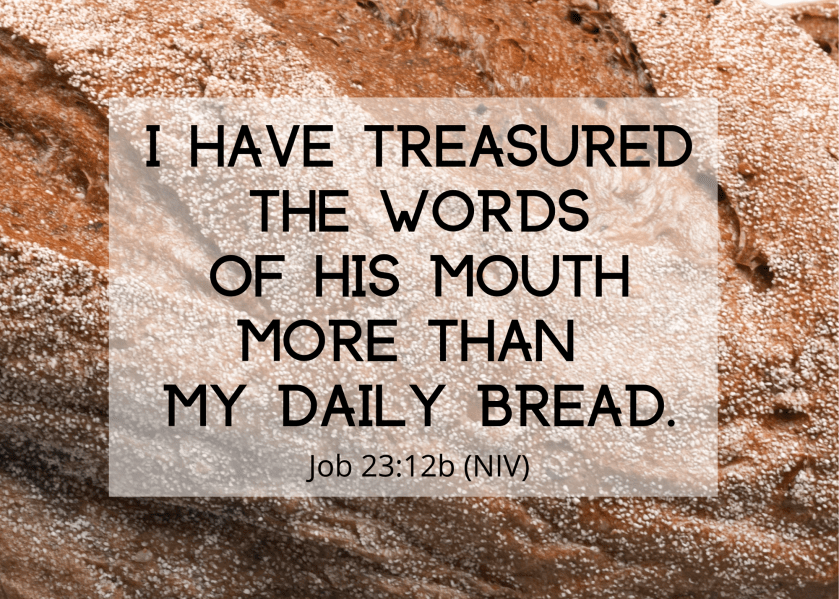
but have treasured his words more than daily food.
13 But once he has made his decision, who can change his mind?
Whatever he wants to do, he does.

-Tom Siderius

Questions for Reflection:

What are the true motivations of your heart for the things that you do?

Are we trying to earn our way to the grace that God gives freely?

When Human Understanding Fails

Job 16-20

Job 16:1-6(NLT) Job’s Fifth Speech: A Response to Eliphaz
1 Then Job spoke again:
2 “I have heard all this before.
What miserable comforters you are!
3 Won’t you ever stop blowing hot air?
What makes you keep on talking?
4 I could say the same things if you were in my place.
I could spout off criticism and shake my head at you.
5 But if it were me, I would encourage you.
I would try to take away your grief.
6 Instead, I suffer if I defend myself,
and I suffer no less if I refuse to speak.

Bildad then answers Job back again reasoning from human understanding and tradition that he has observed.   If Job is being punished by God then there surely must be a reason for it. 

Job 18:5-14(NLT) “Surely the light of the wicked will be snuffed out.
The sparks of their fire will not glow.
6 The light in their tent will grow dark.
The lamp hanging above them will be quenched.
7 The confident stride of the wicked will be shortened.
Their own schemes will be their downfall.
8 The wicked walk into a net.
They fall into a pit.
9 A trap grabs them by the heel.
A snare holds them tight.
10 A noose lies hidden on the ground.
A rope is stretched across their path.
11 “Terrors surround the wicked
and trouble them at every step.
12 Hunger depletes their strength,
and calamity waits for them to stumble.
13 Disease eats their skin;
death devours their limbs.
14 They are torn from the security of their homes
and are brought down to the king of terrors

Job continues to say “I” have done this, “I” have done that, or “I” have said, showing that he has not grasped why the situation that he is in has happened.  All the arguments that the miserable comforters expound are based on a human viewpoint, not on the righteous requirements of a just God.  We want the outcomes of our lives to be based on the good things that we do, not on the grace which God only can give us.  Without God we would all perish instantly with the Adversary able to accuse us just as Job with consequences ending in death.  If God was not good and gracious all would perish from the earth.

In Job 19 the section of his discourse includes these cherished words:

Job 19:23-29(NLT) “Oh, that my words could be recorded.
Oh, that they could be inscribed on a monument,
24 carved with an iron chisel and filled with lead,
engraved forever in the rock.
25 “But as for me, I know that my Redeemer lives,
and he will stand upon the earth at last.
26 And after my body has decayed,
yet in my body I will see God!
27 I will see him for myself.
Yes, I will see him with my own eyes.
I am overwhelmed at the thought!
28 “How dare you go on persecuting me,
saying, ‘It’s his own fault’?
29 You should fear punishment yourselves,
for your attitude deserves punishment.
Then you will know that there is indeed a judgment

Job speaks absolutely the truth about judgment coming for all.  The revelation that there will be a Redeemer on the earth, and that this is his deliverance is amazing.  Bodily resurrection is also foreshadowed here which also lights up the Word to our eyes. 

Remember as we read the book of Job that the overriding theme is that this is the oldest lesson in the world.  Man cannot justify or give himself righteousness.  Only God is righteous and we can receive it from Him by His grace.

-Tom Siderius

Questions for Reflection:

Have you ever used the logic of the comforters using human experience to explain God’s works?

Are the speeches and answers helping you to understand the futility of our human mind to explain our life experiences?

The Righteousness of God

Job 11-15

Our reading today starts with Zophar’s reply to Job’s defense of his righteousness. 

Job 11:1-6(NLT) Then Zophar the Naamathite replied to Job:
2 “Shouldn’t someone answer this torrent of words?
Is a person proved innocent just by a lot of talking?
3 Should I remain silent while you babble on?
When you mock God, shouldn’t someone make you ashamed?
4 You claim, ‘My beliefs are pure,’
and ‘I am clean in the sight of God.’
5 If only God would speak;
if only he would tell you what he thinks!
6 If only he would tell you the secrets of wisdom,
for true wisdom is not a simple matter.
Listen! God is doubtless punishing you
  far less than you deserve!

Job fires right back at Zophar with a defense of his words and his position.

Job 12:1-5(NLT) Then Job spoke again:
2 “You people really know everything, don’t you?
And when you die, wisdom will die with you!
3 Well, I know a few things myself—
and you’re no better than I am.
Who doesn’t know these things you’ve been saying?
4 Yet my friends laugh at me,
for I call on God and expect an answer.
I am a just and blameless man,
yet they laugh at me.
5 People who are at ease mock those in trouble.
They give a push to people who are stumbling

Job continues to plead with the comforters and God that he has no iniquity in him for God to judge him so harshly.  As the book goes on, we see these themes repeat with the “comforters” replying.

Job 13:20-24(NLT) “O God, grant me these two things,
and then I will be able to face you.
21 Remove your heavy hand from me,
and don’t terrify me with your awesome presence.
22 Now summon me, and I will answer!
Or let me speak to you, and you reply.
23 Tell me, what have I done wrong?
Show me my rebellion and my sin.
24 Why do you turn away from me?
Why do you treat me as your enemy?

Job 15:1-6(NLT) Then Eliphaz the Temanite replied:
2 “A wise man wouldn’t answer with such empty talk!
You are nothing but a windbag.
3 The wise don’t engage in empty chatter.
What good are such words?
4 Have you no fear of God,
no reverence for him?
5 Your sins are telling your mouth what to say.
Your words are based on clever deception.
6 Your own mouth condemns you, not I.
Your own lips testify against you.

The direction that all these discourses are going is to bring us to an understanding of what is the essence of the book.  Job is without “sin” it says in Chapter 1.  Job 1:1(NLT) “There once was a man named Job who lived in the land of Uz. He was blameless—a man of complete integrity. He feared God and stayed away from evil.”  But this verse focuses on the works of man in relationship to God, not the righteousness of God and the justice that His righteousness demands from us.  We can never accomplish by our own effort or will the goodness or perfection of the righteousness of God.  We have a rebellious sin nature that needs to be paid for and atoned for.  In order to have a relationship with the just God we need to be changed from what we are.  Today we see this section of Isaiah 53 fulfilled in our lives because Christ is the way that God has made payment for our rebellious nature.  Only by being changed in Christ can we overcome the crushing defeat of our best efforts to be good.  Our lives thankfully are subject to God’s mercy and grace in all we do. 

Isaiah 53:10-12 But it was the LORD’s good plan to crush him
and cause him grief.
Yet when his life is made an offering for sin,
he will have many descendants.
He will enjoy a long life,
and the LORD’s good plan will prosper in his hands.
11 When he sees all that is accomplished by his anguish,
he will be satisfied.
And because of his experience,
my righteous servant will make it possible
for many to be counted righteous,
for he will bear all their sins.
12 I will give him the honors of a victorious soldier,
because he exposed himself to death.
He was counted among the rebels.
He bore the sins of many and interceded for rebels.

Praise God for the gift of the Lord Jesus Christ that has given us new life in him.  Have a great day with God today.

-Tom Siderius

Questions for reflection:

Do you understand the statement about our “bent” nature and what does that mean (hint Rom 7:17-20)?

How can we start to see God in all His grace and mercy today?

God is Supreme

Job 6-10

The book of Job is the oldest book in the Bible after Genesis and that is why we are reading it in this particular chronological order.  Job’s time may have been contemporary with Abraham or even earlier.   The overriding theme in the book of Job is that God is supreme over all creation, and that we are subject to Him.  From man’s perspective we think we have control of the destiny and flow of our lives. We do the things that seem best to us, many times regardless of what God may say or want. 

Job 7:17-21(NLT)  “What are people, that you should make so much of us,
that you should think of us so often?
18 For you examine us every morning
and test us every moment.
19 Why won’t you leave me alone,
at least long enough for me to swallow!
20 If I have sinned, what have I done to you,
O watcher of all humanity?
Why make me your target?
Am I a burden to you?
21 Why not just forgive my sin
and take away my guilt?
For soon I will lie down in the dust and die.
When you look for me, I will be gone.”

Job is wallowing in the self-pity throughout the book that he is blameless, and God is persecuting him for no reason.  Job though does give us the clues to his troubles in chapters 1 and 3 where he says:

Job 1:5(NKJV) So it was, when the days of feasting had run their course, that Job would send and sanctify them, and he would rise early in the morning and offer burnt offerings according to the number of them all. For Job said, “It may be that my sons have sinned and cursed God in their hearts.” Thus Job did regularly.

Job 3:25-26(NLT) What I always feared has happened to me.
What I dreaded has come true.
26 I have no peace, no quietness.
I have no rest; only trouble comes.”

After this the three “miserable” comforters come and give their discourses to Job about why he is in the straits that he finds himself.  Eliphaz speaks first and then Bildad and last is Zophar.  Each reason with Job from a viewpoint of man relating to God.  The gist of their discourses is about how Job must have had sin in his life in to be in the predicament that he finds himself.  Job continues to self-justify himself that he has no sin to confess to God.  As we read these discourses from his comforters these are the themes.

Eliphaz reasons based on human experience.

Bildad reasons based on human tradition.

Zophar reasons based on human merit.

Here is an example of Eliphaz’s speech:

Job 8:8-10 “Just ask the previous generation.
Pay attention to the experience of our ancestors.
9 For we were born but yesterday and know nothing.
Our days on earth are as fleeting as a shadow.
10 But those who came before us will teach you.
They will teach you the wisdom of old.

-Tom Siderius

Questions for reflection:

Who is the shortest man in the Bible?  Bildad the Shuhite 😊

What is the contest in our lives between God’s way and religious practice?

What fear do you harbor deep in your heart that can trip you up in your walk with God?

Download and print the whole 2025 SGL Chronological Reading Plan

or just January for now….

Joy of Every Longing Heart

Job 1-5

Students may feel time stands still, waiting the release of a school day, but where reality is truly suspended is at a school dance.  I am no scientist, but I believe Albert Einstein must have been chaperoning teenagers when he discovered the theory of relativity.  It isn’t just one thing that makes it feel like you are locked into an eternal session on “Cotton-Eye Joe” on a Friday afternoon, but the combination of the shouting,  the music, the shouting, the running, the shouting, the smells, and the shouting, create a enormous sense of anticipation and longing for escape.

Today in our chronological study, we end up in a completely different book. Job is thought to historically settle in and around the time of Abraham, but there is room for debate. Personally, I like the fade to black, and the entry into another storyline.  Multiple narratives, whether in our texts or as we edify one another today, demonstrate that God is working to bring all things to one conclusion or resolution, which indeed is our great joy as we consider his uniting Kingdom.

Conversely, the vast majority of Job’s story is within the walls of great suffering, where time seemingly stands still; the playlist is that of devastating loss. Job’s health, his wealth, and his family are stripped from him.  He slowly and surely unpacks the persistence of physical and emotional pain, reminding us of the sovereignty of God: it is His prerogative to give and to take away.

Nonetheless, Job continues to seek joy and restoration with God, though time stands still in agonizing sorrow.  Leaning, reclining, and collapsing on God are the only available avenues to move forward through the most intense trials and longest of sufferings.  David says in Psalm 16:11: “You make known to me the path of life; in your presence there is fullness of joy; at your right hand are pleasures forevermore.” We long for security, satisfaction, and meaning, but the answer to these needs  do not come from momentary allowances. We can only attain this through God, who freely gives this and more through Jesus Christ.

Through His  life, death, and resurrection, we have abounding grace.  Through trials of every kind we can receive joy and develop perseverance because we know that our narrative is only one of many, tied to a single storyline about our Savior.  Though at times it feels like we will never move again, seeking God, we will be inspired to join in the conga-line with those before us who have died longing and waiting for their joy made complete.

Revelation 21:4 reminds us that eventually the noise and the music will stop, and we can finally go home  – “He will wipe away every tear from their eyes, and death shall be no more, neither shall there be mourning, nor crying, nor pain anymore, for the former things have passed away.”  Blessed be the name of the Lord! What great joy there is in eternity, to sustain us through the most taxing times where we feel the ticking of every second.  We will be in the presence of God. We will be made perfect and whole.  We will be reunited. Oh come, thou long expected Jesus.

-Aaron Winner

Reflection Questions

  1. What has God given to you? What has He taken away? Why and how can you praise Him for both? What “negative” things has He also taken away for you?
  2. Who or what else also shares responsibility for the suffering Job endures?
  3. Who do you know who has suffered much and continues to praise the name of the Lord?
  4. How can joy and perseverance grow in the face of trials, tears and suffering?

Have you downloaded and printed the 2025 SGL Chronological Reading Plan

or just one month at a time – here’s January…

Dear Desire of Every Nation

Genesis 8-11

If you have ever spent time in an airport terminal, you know how truly small the world can be. Travelers from all walks of life, zoom around in every direction.  Despite differences in cultures, status, and language, there is a common purpose among all: a deep desire to get somewhere.  While that “somewhere” might be to make a business deal, take a vacation, visit family, or relocate, each of us move to add value and meaning to our lives, to move to be a part of something greater than ourselves.

In Genesis 9, the world is a small place in a much different way. Those who survived the flood all belong to Noah’s family, who moved with a single purpose, obedience to the Creator.  God restored the connection in a covenant with all of creation.  A rainbow in the clouds became a sign of His promise, a reminder of both His faithfulness to a world, to redeem, restore, and sustain life, but also a reminder of the single sustaining purpose of humanity, to serve the Almighty God.  While God continues to uphold his side of the bargain, humanity once again falls into the trap of sin.  Noah and his family, like Adam and Eve, and like each one of us, are tempted by the self-serving desires of value, meaning, and knowledge that leads them astray from God’s command.

In Genesis 11, we see a culmination of humanity’s desire becoming misplaced. At Babel, people attempted to build a tower that reached the heavens. It is not to honor a God who created the Earth and flooded it at His command, but to make a name for themselves because they had moved some earth.  Was their longing for unity wrong? Absolutely not. God has given us an inmate desire to be connected, but the work of man without God, will never lead to Utopia.  Repeated time and again in history is the danger of groupthink that allows for and even endorses the most despicable behavior.  God’s response is to scatter these people and confuse their languages, reminding them that true unity and purpose can only be found in Him.

While the world still speaks some 7,000 languages, there is still a desire that binds each one of them. Jesus Christ has become the purification we receive in the flood and the desire for connection displayed in Babel.  He is both the covenant that brings us back to God, and the one who unites us as brothers and sisters in Him. The single purpose sought in Babel is now realized in the Church, where people of every nation, tribe, and tongue are united.  Like the airport, with a much greater sense of purpose and much less baggage, Jews, Greeks, slaves, free, men, women, impoverished and wealthy, and every other intersection of society are brought together.

Jesus Christ, and the purpose he brings to life, is the dearest desire of every nation.  The hope he brings, no matter the direction we are moving or even the trespasses accumulated against him, is the groaning inside each one of us. More than any other other time since Babel, we have an opportunity, to connect with people, nations, and even languages far beyond our own. Whether it is to our neighbor or the ends of the earth, let us continue to move for a single purpose, seeking and building the Kingdom of God.

-Aaron Winner

Reflection Questions

  1. Do you sometimes get moving…but forget what your purpose is? What is your greatest purpose today – and this year? How will you work towards fulfilling it?
  2. What went wrong at Babel? Have you ever been a part of a venture that crashed for the same reason? How do we proceed more carefully in the future?
  3. How might the stories of the flood and the tower of Babel have been different if Jesus had already been born, grown, baptized and was ministering at those respective times? How would your story be different if you had been born before Jesus?
  4. What do you desire that Jesus gives? What does your neighbor desire that Jesus has made available?

Download a print a yearly SGL Bible reading calendar…

or just one month at a time …

then find a Bible reading buddy for 2025.

Hope of All the Earth Thou Art

Genesis 4-7

Jan 2, 2025 – Day 2 of the SeekGrowLove 2025 Chronological Bible Reading Plan

Just a few months ago, my family and I found ourselves in the path of Hurricane Helene. While the storm left widespread devastation, we were fortunate to remain safe, experiencing minimal damage, and counting our blessings. However, like millions of others in our region, we found ourselves without power. Looking back now, I can’t remember exactly how many days we spent unplugged (although I most certainly knew the number at that time with every passing day) As I witnessed the unprecedented number of power trucks traveling in every direction,  I most assuredly knew the power would be restored, it was just a matter of time.  

You better believe that Noah had hash marks on the side of the ark. Noah knew beforehand how many days it would rain, but he didn’t know how long he would be making his home with a boatload of animals.  On day 41, he saw with his own eyes the Word of God fulfilled, for He had completed an unprecedented thing.  So Noah waited, holding onto hope that God would provide a way to get off the ark.

Noah’s enduring faith, to build the boat, to endure the storm, and to hang onto the promise, show the beautiful exchange of God’s grace and protection when we trust and hold onto hope. Noah found favor in God’s sight, but we can declare this to the world:  through Christ, we too can experience the fullness of God’s grace.  As we look to our Savior for this hope, we can emerge from the storms of life victorious.  Through the flooding waters of baptism we are cleansed.  But now, emerged from the flood, we wait.

There is still plenty of work to do.  We do not twiddle our thumbs until the return of Jesus. Noah continued his calling to give life and care for his flocks, herds, and packs while awaiting the return of a dove.  Like Noah, we have been given charge to continue the work of Jesus, giving hope to every nation.  If we are awaiting the return of Christ, we are approaching two-thousand years into our tally, but we are sustained, knowing the promise of God is not fleeting or pending.  It is fulfilled in its perfect time through Christ Jesus.

We would be crazy not to look to the horizon.  The fact that we do shows that we have a founded longing and are aware of the signs. We see the birth pains that lead to the return of Jesus with resurrection power, so let us declare and defend to every nation that He is the reason for the hope we have.

-Aaron Winner

Reflection Questions

  1. What have you waited for? While you were waiting what storms did you endure? What was the reason for your hope?
  2. What do we learn from Genesis about Noah? What do we learn about God from the account of Noah?
  3. How was Noah different from the rest of his generation? How can you be like Noah?

You can download and print the whole year’s Chronological Bible Reading Plan in a compact 1 page booklet form:

SGL.2025.CalendarBookletDownload

Or download and print just one month at a time in an easier to read format:

SGL.2025.JanuaryFullPageDownload

Who would you like to invite to be a Bible reading buddy with you in 2025?