Ok quizzers and especially National Quizzing Director, Jacob Ballard, hear me out! Numbers 7 should be part of the quizzing materials next year! I mean, while it is the longest chapter in Numbers, you really would only need to memorize 5 verses!
Numbers 7 is very repetitive because all 12 tribes of Israel come to present their gifts to the Tabernacle, and they all give almost exactly the same thing (apparently there was no Tabernacle gift registry 😉). But that was actually on purpose as God wanted all of the people to praise and participate in the rights and responsibilities equally. He wanted every tribe to be fully devoted to Him no matter the size of the tribe. That is a reminder to us that even if we are all of different socio-economic statuses, we all bring the same thing to God, our hearts and our devotion.
Numbers 8 describes how God set the descendants of Levi apart as royal priests. Whenever I have read about the jobs of the Levites, I’ve been glad that was not my calling. These guys were not standing around praying all day. They were working hard as they had to do a LOT of butchering. Like. All. Day. Long! My husband used to work in the meat department at our local grocery store. It is a lot of bloody, messy work. Ugh… and don’t get me started on cleaning all the tools! But these priests understood the importance of their jobs, helping God’s people atone for their sins through the sacrifice of the animals they raised. And it wasn’t a one-time thing for each person; it was continual for all of each person’s life. This reminds me of how thankful I am that we don’t have to do that anymore because of what Christ did for us (Hebrews 10). Besides eternal salvation, we also don’t have to spend a great deal of our time butchering animals and barbequing them!
Numbers 9 discusses God’s decrees on celebrating the Passover and then their “moving” protocol. Growing up in the Air Force, I think I can understand never knowing how long you would be in any given spot. Sometimes God would have the Israelites stay for a few days, sometimes for a few years. I don’t know if this is the reason, but I suspect God did not want them to become too comfortable where they were and wanted them to remember their current position was not their home. We too would be wise to remember that where we are now is not our permanent home and we should not become too comfortable within the world.
-Maria Knowlton
Reflection Questions
Have you ever moved at God’s command – or stayed put at His command?
How do we tell today when and where He wants us to go – or stay?
What are you learning about God in Numbers so far?
While Numbers 4 still involves some counting, it becomes much more interesting with a little Holy interior decorating! I fell down a little Google rabbit hole reading about what kind of leather was used in the temple. NIV says sea cow, NASB says porpoise, theologians have theorised other interpretations. But I think the point is, it was valuable and special. All of the designs and decor of the tabernacle were both God instructed and enabled. I have always wondered how the people building the tabernacle could build what they were told to build. I then heard from someone, that they were able to do this work because they were given the gift of the Holy Spirit (Exodus 31:1-6 and 35:30-36:2). I think this makes a lot of sense!
Also, and part of the importance of this passage is God was very clear who could touch what and when. Death comes to those who did not heed God’s commands, no matter how small they may seem. God will not be mocked nor disobeyed.
Numbers 5 and 6 are kind of a wild mix of blessings and curses. First Numbers 5 speaks of the sanctification of anyone who was ceremonially unclean or guilty of sin. Moses then writes of a “grain offering for jealousy.” I looked at several commentaries and still cannot quite understand why it was included in scripture and what it all means. One commentary reminds readers that this was a time of many rituals for many issues and this would not have been that odd to the people of that time. My own thought is that this was another situation where it was very important to obey God. I believe that God protected women who were innocent of adultery and they were not affected by this curse.
In Numbers 6, we learn what one needs to do to become a Nazirite. Reading this reminds me of the sacrifices my Catholic nun friends had to make to become a nun. It is very honorable to dedicate your life to God. However, it is not necessary to become a Nazirite or a nun/monk to dedicate your life to God. Because of Christ, through baptism, we can be sons and daughters of God. And we can receive the Aaronic Blessing:
The Lord bless you and keep you,
The Lord make his face shine upon you,
And be gracious to you;
The Lord turn his face toward you and give you peace. (Numbers 6:24-26)
God bless you this week as you obey His word!
-Maria Knowlton
Reflection Questions
What do you find in Numbers that reminds you of the importance of obeying God?
What do we learn about God so far in the book of Numbers?
Have you ever experienced the Lord making His face shine upon you? When? How does it feel? What do you think the Lord likes to make His face shine upon?
Once upon a time, I had to take a statistics class. It was awful! I am not a numbers person at all and the professor was dry and would trail off while he was talking. Every class was an exercise in trying to stay awake for an hour and 15 minutes! But I do think he could have spiced things up a bit if he had thrown in some fun or shocking stories in between the equations. For example: “So in this case p is equal to the sum of the number of participants in the study, which was looking at the correlation between owning a machete and a ninja outfit and ending up in the emergency room.”
So when I was reading the first two chapters, I was getting flashbacks of that statistics class. They are purely numbers and logistics. The 12 tribes of Israel had left Egypt about a year before and God was now “parking” the tabernacle in the desert, with the 12 tribes in specific stations around the tabernacle.
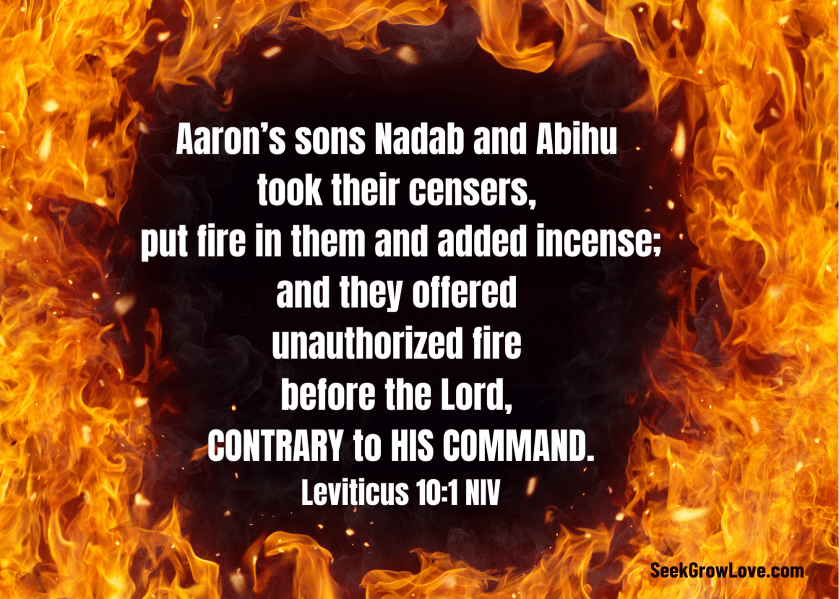
God had Moses and Aaron count all the men in the tribe. Boring! I like how Chuck Swindoll put it in his commentary, “Numbers takes the reader on a long and winding path through a desert of excruciating detail.” But then I hit chapter 3 and Aaron’s two eldest sons, Nadab and Abihu fall dead because they offer God an “unauthorized fire” and they had no children, WHAT??? That got my attention! Why was the fire “unauthorized”? Why did God strike them dead? So many questions??? But the biggest question the story starts to answer is WHY Numbers is included in our Bible.
Besides its historical significance, Numbers speaks of the importance of obedience to God and God’s intolerance of sin. Leviticus 10:1-2 gives a little more detail on what happened to Nadab and Abihu, but it was basically just straight up disobedience to God. We may think this was a pretty minor issue, but it points to the fact that God does not tolerate sin of any kind. No matter how “good” you are, you will not live a life of perfection and will at some point deserve the punishment Nadab and Abihu received. Goodness, do we need a savior! THANK GOD for JESUS!
So, yes, much of this book is boring, especially today’s reading, but unlike that statistics class, you will find application for your own life in this book.
-Maria Knowlton
Reflection Questions
God has a plan for His people, even for where each tribe was to park around the tabernacle. How might He share His plans today?
Why is God looking for, and expecting, obedience from His people during the time of Numbers? What does God’s desire and expectations look like today? Does the sacrifice of Jesus mean obedience isn’t required any more?
What application can you find for your life from Numbers 1-3?
We have finally come to the end of Leviticus and I hope that you’ve gained an appreciation for this “skipped-over” book: there is much we can learn about our God and how to serve Him within these pages, even if some of the specific details are different now under the new covenant with Jesus. One thing that will never change about our heavenly Father is something described in chapter 26: He blesses obedience and punishes disobedience.
Like most kids, I disobeyed my parents often when I was younger. If I was told not to do something, that’s immediately where my mind gravitated towards, even if there was the threat of punishment. I was also stubborn (and still am sometimes), and continued my disobedience even if the punishment was dealt out, until the punishment grew to a severity that wasn’t worth it anymore. A time-out from television didn’t mean much to me: neither did the extra chores that I was given. However, when those things didn’t work out and I was grounded from seeing my friends, I began to shape up and ask for forgiveness. My parents weren’t thrilled about punishing me, like most parents: they just needed to do something to get my attention and create an obedient spirit within me (probably the hardest job of a parent).
God as our heavenly Father is much the same way, and it is shown in Leviticus 26: He will punish the disobedience of His children until they shape up and realize the error of their ways. In this chapter, He gives the Israelite nation FIVE chances to change their ways and start listening to Him again, with increasing punishments: they unfortunately proved to be very stubborn and continued their disobedience until their nation was completely driven away from the Promised Land (which did happen). Although God warned them ahead of time, and gave them multiple chances to change, they kept acting out and disobeying until God had to go to extreme measures to get their attention.
However, despite all the disobedience and the punishments in this chapter, God says that if they will confess their sins and repent of their ways, He will forgive them (just like a good parent). He promises to bring them back to the Promised Land, restore the covenant that He made with their forefathers, love them again, and even dwell with them again: all they have to do is repent and start obeying Him again, because He knows what’s best for them.
We would do well to remember this lesson above all else: God blesses obedience, not disobedience. Far too often Christians have chosen to disobey God’s instructions and immediately expect His forgiveness because Jesus died for us. However, we cannot miss the most important part of receiving forgiveness: repentance.
“It is not those who are well who need a physician, but those who are sick. I have not come to call the righteous but sinners to repentance.” – Luke 5:31-32 NASB1995
Do you want to live a good life full of blessings? Then obey God’s instructions.
Have you disobeyed God’s instructions and are suffering for it? Ask for forgiveness and repent.
God is willing to work with us and forgive our sins, but we must do something about it. Like a good Father, He is expecting obedience and a change of heart. We cannot simply “skate by” in our Christian walk, expecting forgiveness when we have no change in our lives. We have to obey Him if we want His blessings.
-Talon Paul
Reflection Questions
How is God similar to your parents? How is God different from your parents?
What blessings does He give that make you want to obey Him? What punishments does He give that make you want to not disobey Him? If you want to obey God how do you learn what His instructions are?
In the United States, there are many holidays to celebrate and enjoy. At the federal government level, they recognize eleven holidays per year: there are even more if you include religious ones like Easter. Not only that, but we have laws that force us to take time off work every week and periodically throughout the year. Although you are allowed to work all seven days in a week, most employers are expected to pay even more money in overtime and usually prefer for their employees to simply take their days off.
These times of rest and celebration are often taken for granted: all of us have grown up in this environment of expected time-off and have never had to live in a world where we are expected to work every single day without relief. Yet, that was the world that the Israelites were coming out of when they left Egypt: there were no Human Relations department or Workers’ Union to argue against Pharaoh for their paid time off. They were slaves, and slaves were expected to work every day in extreme conditions without any sympathy. Once Moses helped free them from this oppressive world, God granted the Israelites the amazing gift of days free from work and yearly celebrations.
In Leviticus 23, we learn about all the blessed time that the Israelites were expected to rest and enjoy their lives under YHWH’s rulership. On a weekly basis, they were expected to take the seventh day off from any work (sabbath): if you were used to slavery and working every single day, how would you respond to that? What a gift from an amazing, caring God! Although there are warnings about being “cut off” if they choose to work that day, we should not get lost in the punishments and miss what a wonderful opportunity this was for the Israelites!
Not only do they receive a day of rest every week, but there are seven annual festivals that they get to enjoy: the great festivals and feasts of Passover, Unleavened Bread, First Fruits, Weeks, Trumpets, Atonement, and Tabernacles were to be celebrated every single year. Some of those celebrations are seven straight days of celebration and feasting! Can you imagine the shock and appreciation that the Israelites must have had for this generous and loving God, having come from their background in Egypt?
What stands out to me from this chapter is that, through everything God is commanding the people to do, He still is a caring Father that wants His children to enjoy the gifts He has for them. Yes, He needs them to obey His instructions (for their own good), but there can be great joy in serving Him with the right mindset. If they can see His laws as blessings, rather than restrictions, they will rejoice at the wonderful gifts that YHWH has for them. He is a God of joy and blessing, and we would do well to remember that as well when we faithfully serve Him.
“… the joy of the LORD is your strength.” – Nehemiah 8:10 NASB1995
-Talon Paul
Reflection Questions
What do you think God wanted His people to remember at each of the annual festivals and feasts He created? What was the point of each one? Which do you think would be your favorite and why?
Do you take regular days off (weekly and annually)? What is good to do on days off, according to God? How can you do more of that?
Do you see God as just a God of laws or a God of joy and blessings, too? What joy and blessings has He given you? How can you remember and celebrate these?
Chapter 20 of Leviticus is perhaps the most difficult passage in the entire Bible for modern readers in the United States. In this chapter, the practice of homosexuality is condemned as strongly as cheating on a spouse, beastiality, and incest: the practice is condemned so harshly that it is punishable by death within Israel. While we generally still disapprove of the other inappropriate sexual unions listed in this chapter, homosexuality has taken a major swing in the opposite direction, being viewed as completely okay for people to pursue, even within the Church: in fact, the majority of Christians in the United States now view this once-condemned practice as totally acceptable for anyone, even Christians. For example, as recently as 2024, the Methodist Church voted to reverse its anti-LGBTQ+ positions, creating a major division within the denominations: they now allow for even their religious leaders to be openly practicing these once-condemned practices from the Bible.
So what is a Christian to do today? We have clear and strong prohibitions in Leviticus to avoid homosexuality and other inappropriate sexual practices, and yet, Christians today are completely divided on whether to be accepting of these practices or not. As people who believe that God gave us the Bible, and who take its commands seriously, how are we supposed to understand such difficult texts in 2025?
We come back to the discussion on “holiness”: God desired that His people would live differently than those around them. He says of His people:
“I am the LORD your God, who has separated you from the peoples.” – Leviticus 20:24
“Thus you are to be holy to Me, for I the LORD am holy; and I have set you apart from the peoples to be Mine.” – Leviticus 20:26
It is absolutely true that homosexuality has been a practice throughout the world for as long as humans existed: people were practicing it in the land of Canaan when this book was written (Leviticus 20:23), people were practicing it in the Roman world when Jesus and the apostle Paul were preaching, and people are practicing it around the world now. It has been and will likely continue to be a practice throughout the world until Jesus returns. However, does that mean Christians are allowed to participate in such things? Does the New Testament have anything to say about it, since we are under a new covenant than the Israelites?
The command for God’s people (Christians) is still to remain holy and not conform to the standards of the world: we are expected to live, speak, and act differently than those around us, just like the Israelites were commanded to do. Although some of the specifics are different, like the food laws, the standards on morals and sexuality still remain under the new covenant.
“Do you not know that the unrighteous will not inherit the kingdom of God? Do not be deceived; neither fornicators, nor idolaters, nor adulterers, nor effeminate, nor homosexuals, nor thieves, nor the covetous, nor drunkards, nor revilers, nor swindlers, will inherit the kingdom of God.” – 1 Corinthians 6:9-10 NASB1995
“… the law is not made for a righteous person, but for those who are lawless and rebellious, for the ungodly and sinners, for the unholy and profane, for those who kill their fathers or mothers, for murderers and immoral men and homosexuals and kidnappers and liars and perjurers, and whatever else is contrary to sound teaching.” – 1 Timothy 1:9-10 NASB1995
As someone who has friends and family members who are actively involved in homosexual lifestyles, it is extremely difficult for myself to read these passages because I love all of them: I want them to be in Paradise with me when Jesus returns. However, our deep desire for our loved ones to be saved in God’s Kingdom doesn’t change the standards that He has set forth for being accepted into that Kingdom, and we cannot choose to disobey those standards because we don’t want to agree in our hearts. God makes the rules, not us, and we are called to simply listen and obey His instructions: as God’s people, we are expected to live “holy” and different lives than the world around us. We cannot compromise on what’s clearly been commanded, even if it’s difficult in our world today to go against the new standards being taught to us by the world.
“Therefore, I urge you, brethren, by the mercies of God, to present your bodies a living and holy sacrifice, acceptable to God, which is your spiritual service of worship. And do not be conformed to this world, but be transformed by the renewing of your mind, so that you may prove what the will of God is, that which is good and acceptable and perfect.” – Romans 12:1-2 NASB1995
“Do not love the world nor the things in the world. If anyone loves the world, the love of the Father is not in him. For all that is in the world, the lust of the flesh and the lust of the eyes and the boastful pride of life, is not from the Father, but is from the world. The world is passing away, and also its lusts; but the one who does the will of God lives forever.” – 1 John 2:15-17 NASB1995
-Talon Paul
Reflection Questions
What rules did you have growing up that you didn’t appreciate or always agree with? Did you only have to obey the rules that you would have written yourself?
What characteristics of God make Him the best rule maker? What might He have been thinking when He created male and female and called them “very good”?
What does God want His people to be separate from today? Why be holy? Who/what wins when Christians follow the ways of the world instead of God’s way? Who loses?
How do you think God wants us to respond today to a world (and sometimes a church) that accepts and celebrates what God says is an abomination?
If you ask anyone about what Jesus taught his followers to do, there is usually a wide variety of responses: however, most of the answers you will receive will focus on his command to “love your neighbor”. Indeed, this was considered the second greatest commandment by Jesus:
“The greatest commandment is, ‘Hear, O Israel! The Lord our God is one Lord; and you shall love the Lord your God with all your heart, and with all your soul, and with all your mind, and with all your strength.’ The second is this, ‘You shall love your neighbor as yourself.’ There is no other commandment greater than these.” – Mark 12:29-31 NASB1995
However, most people today would be shocked to learn where Jesus got this second greatest commandment from: the book of Leviticus!! In Leviticus 19:18, we find out that God has always desired His people to love their neighbor as themselves, even in a book that most modern readers want to throw away because it doesn’t seem “relevant” anymore. While we don’t have animal sacrifices and aren’t bound to certain ritualistic laws found in this book any longer, it is still a relevant book for Christian living: in the book of Leviticus, we not only find the second greatest commandment (according to Jesus), but also what loving our neighbor as ourselves looks like. How are we supposed to “love our neighbor as ourselves”?
Beginning in chapter 17, we begin a new section within Leviticus, oftentimes called the Holiness Code: in this new section, God stops directing instructions to the priests and begins addressing the people of Israel directly. In this Holiness Code are very relevant and practical ways that we can “love our neighbor as ourselves”. Among the descriptions in chapters 18 and 19 are:
Not pursuing improper sexual unions (still relevant today)
Not sacrificing your children to other false gods (still relevant today)
Showing reverence for your parents (still relevant today)
Leaving some of your wealth for the poor and needy (still relevant today)
Not stealing or lying (still relevant today)
Not withholding pay from someone you hired (still relevant today)
Having fair judgment in court (still relevant today)
Not hating or bearing a grudge against your neighbor (still relevant today)
As we can see, most of the Holiness Code is still proper for us to practice under the New Covenant (if not all of it), as we seek to love our neighbors as ourselves. There is one more part to loving our neighbor that we need to focus on and re-learn in our society today, but may be difficult to hear.
“… you may surely correct your neighbor, but shall not incur sin because of him.” – Leviticus 19:17b NASB1995
When I’ve made some bad decisions in my life, there have been people who have called me out on it and tried to correct my actions: in the moment, I didn’t enjoy it at all and felt “attacked”, but I learned quickly that they were only concerned, loved me deeply, and wanted me to do better. True love for our neighbor doesn’t turn a blind eye to their sins or allow them to continue down a dangerous road because we don’t want to “hurt their feelings”: true love is difficult, because it is hard to warn someone when they are doing the wrong things that could hurt them or others. Jesus knew this and commanded us to do the same thing.
“If your brother sins, rebuke him; and if he repents, forgive him.” – Luke 17:3
In our current world where we are very sensitive towards the emotional needs of our friends and family (which is good), we cannot ignore the clear commands from Scripture to step into their lives and help them see their need for change. If you want to truly love your neighbor as yourself and fulfill the second greatest command in Scripture, you MUST call your loved ones out when the moment calls for it: it is super uncomfortable and can feel damaging at first when they inevitably get upset, but could be the most life-changing and loving thing you ever did for them. Nobody has everything figured out perfectly until Jesus comes back, and if we are Christians, we will want to live the best we can until that Day comes: however, sometimes that comes with the pain of admitting we were wrong.
If someone you love is making choices that are damaging to their life (and spiritual life), don’t be afraid to say something: it is the most loving and difficult thing you can do for them.
-Talon Paul
Reflection Questions
Suppose we do a really good job of loving God – why would He care if we also love others or not? Have you ever met anyone who did a really good job of loving God but wasn’t very loving toward others?
Who has been there to love you by correcting you? Looking back, is there any time in your life when you wish someone would’ve shown love to you by correcting you – even if you might not have appreciated it at the time?
Are you aware of any current situations where God might want you to love your neighbor by lovingly correcting – speaking the truth in love? What might that look like? Is it a job you have been trying to avoid? What happens if we don’t do it? There is a lot of sin in the world. Does God want us to spend all of our time correcting? How do I decide when it is the loving thing to correct?
Whenever we watch a movie or read a book, we are anticipating “the moment” in the story where everything comes to a climax and all the puzzle pieces finally come together: chapter 16 of Leviticus is that climax within this book. In this chapter, God gives a special ceremony for the Israelite people, later called Yom Kippur (the Day of Atonement). At this special ceremony, the sins of ALL the people were forgiven and forgotten: at this special annual celebration, every person in God’s family gets a fresh start.
Once a year, the high priest would offer a sin offering for himself, his family, and all the people of Israel within the tabernacle. Since atonement and forgiveness are only possible through blood (Leviticus 17:11), the high priest offers this sacrifice on behalf of all the people to cover all their past yearly sins. He also presents a “scapegoat” before the people, a goat that would bear the sins of all the people and be led out into the wilderness, representing their sins being carried away and forgotten forever. Meanwhile, the people were expected to “deny themselves” in humility before God, repenting and mourning over the ways that they had offended their God throughout the year (and likely fasted from food and water).
What a wonderful and merciful act that God blessed His people with! This was the most important day of the year for every Israelite: the day that they could walk into a new year, cleansed and forgiven of every past mistake they’d made. God didn’t have to provide this ceremony: He only allowed it because He loves His people and understands that we are only dust.
“As far as the east is from the west, so far has He removed our transgressions from us. Just as a father has compassion on his children, so the LORD has compassion on those who fear Him. For He Himself knows our frame; He is mindful that we are but dust.” – Psalm 103:12-14 NASB1995
Unfortunately, under the Old Covenant, only the high priest was able to bring about this forgiveness and atonement: only he could offer the sacrifice needed to cover over the sins of the people. There hasn’t been a tabernacle, a Temple, or a priesthood for Israel since 70 AD… based on the standards of Leviticus, it is impossible for the people to have their sins forgiven before God. That is, unless God provided a better way, which He did.
We find out in the book of Hebrews that Jesus Christ has taken the role of our new High Priest, and also as the sacrifice we need to take away our sins: not only just for the year, but forever.
“Every priest stands daily ministering and offering time after time the same sacrifices, which can never take away sins; but Jesus, having offered one sacrifice for sins for all time, sat down at the right hand of God, waiting for that time onward until his enemies be made a footstool for his feet. For by one offering he has perfected for all time those who are sanctified.” – Hebrews 10:11-14 NASB1995
We all have regrets and understand that we haven’t lived perfectly: what if you knew that tomorrow all those deeply regretful moments would be washed away, never to be remembered again? Would that change the way you lived before God today? Under the New Covenant, we have the opportunity to live completely free from the guilt and pain that comes from regretful sin, because Jesus died in our place: this is an opportunity available to you, not just once a year, but every single day.
We all have the choice to live differently today than we did yesterday, because Jesus has removed all our sins from the past. What will you choose to do?
-Talon Paul
Reflection Questions
What similarities and differences do you see between Aaron as high priest and Jesus as high priest?
What regrets, guilt, and shame have you experienced? Are you living with them today? Do you need to? What are the New Covenant’s steps to accepting God’s free gift of forgiveness? What will you choose to do?
Did living under the Day of Atonement mean they could do whatever they wanted because once a year all the sins would be forgiven? Does living under the sacrifice of Jesus mean we can do whatever we want because we have forgiveness of sins every day of the year?
Two of my favorite foods to eat are bacon and shrimp (sometimes together): I absolutely love the smell, taste, and feeling of crunching into a crisp piece of bacon. Shrimp is a delicacy that I enjoy in all different styles of cooking: fried, grilled, or even cold with a side of cocktail sauce. And yet, when I read through today’s Leviticus passage, I find out that the Israelites weren’t supposed to eat either of these very popular items: they are said to be “unclean” for them and were to be avoided… Am I sinning against God by enjoying these dishes?
We must understand the concept of “cleanliness” and the purpose behind the food laws in this book to answer that question. First, what does being “clean” mean in Leviticus? According to scholar Walter Kaiser, “being clean makes a person fit and suitable for entering into the worship of God.” Being clean simply meant that you are in a proper position to enter into God’s presence: it didn’t necessarily mean that you had sinned against Him and were guilty of punishment (although, sinning would certainly make you unclean). For example, in Leviticus 12, a woman who recently gave birth was considered “unclean” until seven days had passed by. Did the woman sin by giving birth to a child, which God commanded for humans to do? (Genesis 1:28) Of course not: this is just one example that being “unclean” didn’t necessarily mean that you had sinned, but that you were just not allowed in God’s holy space for a period of time.
With that understanding, we need to look at the purpose behind the food laws in Leviticus. We are told:
“For I am the LORD your God. Consecrate yourselves therefore, and be holy, for I am holy. And you shall not make yourselves unclean with any of the swarming things that swarm on the earth. For I am the LORD who brought you up from the land of Egypt to be your God; thus you shall be holy, for I am holy.” – Leviticus 11:44-45 NASB1995
“I am the LORD your God. You shall not do what is done in the land of Egypt where you lived, nor are you to do what is done in the land of Canaan where I am bringing you; you shall not walk in their statutes.” – Leviticus 18:2-3 NASB1995
The entire purpose behind the food laws was for the Israelites to be “holy”, which means “set apart” or “different”: since they worshiped and represented a completely holy God, they were supposed to live differently than the people around them. Although all the animals were given to humanity for food (Genesis 9:3), the Israelites were supposed to look different than those around them. Why? So that people would notice and begin pursuing their holy God. The entire purpose is so that others would come to know the one true God and follow His ways.
So are Christians sinning against God by deliberately disobeying these food laws? Well, Jesus in his ministry redefined what it means to be “clean” and “unclean”: it is no longer based on the food we eat, but the condition of our hearts and behavior towards others. What matters the most is what’s inside the person’s heart, not what they take into their stomach.
“He said to them, ‘Are you so lacking in understanding also? Do you not understand that whatever goes into the man from outside cannot defile him, because it does not go into his heart, but into his stomach, and is eliminated?’ (Thus he declared all foods clean.) And he was saying, ‘That which proceeds out of the man, that is what defiles the man. For from within, out of the heart of men, proceed the evil thoughts, fornications, thefts, murders, adulteries, deeds of coveting, envy, slander, pride and foolishness. All these evil things proceed from within and defile the man.’” – Mark 7:18-23 NASB1995
Christians have the same command as the Israelites: to be “holy” like their heavenly Father is holy (Matthew 5:48). However, how we fulfill that command is different: under the New Covenant, we are supposed to be focused on making sure our hearts are pure, rather than our plates, if we want to be useful for God in this world. So, although we are now allowed to enjoy bacon and shrimp, Christians must ask themselves: “has my behavior brought glory to God, or am I unclean and unuseful because of the choices I’ve made and the words I’ve said today?”
-Talon Paul
Reflection Questions
“Has my behavior brought glory to God? Or am I unclean and unuseful because of the choices I’ve made and the words I’ve said today?”
What was the prescription for how the Israelites would get clean again in Leviticus?
According to the New Covenant how do Christians get clean again?
Leviticus is usually the most difficult book for people to read through, specifically because so many of the rituals from the ancient time of the Israelites don’t apply anymore. Many Christians when they come to this book in their Bible reading plans enter “skimming mode”, and brush over most of the content. However, we may be surprised at just how important this book really is when it comes to experiencing the presence of God. In order to understand how significant Leviticus really is, we need to look at the end of Exodus to grasp the story.
“Then the cloud covered the tent of meeting, and the glory of the LORD filled the tabernacle. Moses was not able to enter the tent of meeting because the cloud had settled on it, and the glory of the LORD filled the tabernacle.” – Exodus 40:34-35 NASB1995
The story up to this point has been God desiring to be with His people, but when His glory finally does come to earth in the tabernacle, even Moses isn’t able to experience it fully… Leviticus is the answer to the problem. Through the rituals and the laws that Leviticus spells out for the Israelites, they are able to fully experience God’s presence. What is really cool about this book is that it worked: when we come to the following book of Numbers, Moses is finally able to enter into the tabernacle and see God’s glory.
“Then the LORD spoke to Moses in the wilderness of Sinai, in the tent of meeting, on the first of the second month…” – Numbers 1:1 NASB1995
Moving forward, I hope that you will have a renewed appreciation for this often misunderstood and skipped-over book, especially as we discuss our chapters today. Through the first seven chapters, God has been telling Moses and his brother Aaron about all the very specific details they need to follow in order to bring forgiveness of sins into the Israelites’ lives. When we come to chapter eight today, they begin to put these instructions into practice: however, not everyone follows the clear instructions from God and suffers for it. Aaron’s sons, Nadab and Abihu, didn’t follow the proper procedure for worshiping before God, choosing to offer “strange fire” (10:1) onto the altar. Because they didn’t follow God’s instructions, they were struck dead and stand as an example for everyone that will worship afterwards.
We learn that God takes worship SERIOUSLY: to “worship” Him in an unworthy manner will not be tolerated. He told Moses and Aaron, “By those who come near Me I will be treated as holy, and before all the people I will be honored.” (10:3) He is a good God and Father who tells us exactly what we need to do, but will punish those who choose to “try it their own way”, especially those in positions of religious authority. No matter what, when we come to worship before our God and before our Savior, Jesus, we need to treat it as a serious matter, and seek to bring them total glory. True worship goes far beyond what type of music is played (hymns or contemporary), what order of service our church has “always used”, and beyond how we “feel” after the service: true worship is about God and Jesus being honored and exalted. If you don’t have that as your primary focus, nothing else matters.
-Talon Paul
Reflection Questions
Give some examples of how the world “tries it their own way” instead of following God’s instructions. When have you “tried it your own way” instead of following God’s instructions?
We aren’t told what Nadab and Abihu might have been thinking as they were experimenting with their ‘strange fire’. Whar are some possibilities?
Instant death is not always the consequence for acting contrary to God’s commands. What are some other consequences you have seen or experienced for acting contrary to God’s instructions?
Why do you think God places such great importance on worship, and worship done right? How do we come into His presence today?






 Seek Grow Love