
Daily Bible Readings
Today’s Devotion by Jake Ballard (IN)
Over the next three days, we will be reading the book of Lamentations.
If you are anything like me, when you are wanting to open the Bible and hear the word of the Lord, a book called “Lamentations” doesn’t CALL to you. Who wants to be told about being sad and mourning when we want a pick-me-up? However, the Bible is full of poetry in the genre of “lament”.
Before we talk about genre, let’s get situated in the book of Lamentations. In our English and Christian Bibles, we place Lamentations in a section we call the “Major Prophets”, the section from Isaiah to Daniel. However, Lamentations is not prophecy. Even if we recognize that prophecy is about BOTH foretelling (speaking about the future with God’s wisdom) and forth-telling (speaking about the current culture with God’s wisdom), Lamentations isn’t that. It is a poetic work in response to the destruction of Jerusalem by Babylon. As a book of poetry, in the Tanak (the Jewish order of the Old Testament), Lamentations is a part of the “writings,” which included the book of Psalms, Proverbs, and Job. (The Tanak is referenced when Jesus speaks about how everything must be fulfilled that was written of Jesus in the Law (Torah), Prophets (Nevi’im) and Writings (Ketuvim), TaNaK.)
Why is Lamentations included with our major prophets? Because many have attributed the poems to Jeremiah, the “weeping prophet”, who foresaw the destruction of the city and then lived through it in the early 580s BC (587/586). While we don’t know if it was by him, tradition has long held this to be the case, and it does make sense. Therefore, it has been included after the book we know Jeremiah wrote. This book was written after the destruction in response to the pain of loss that the people feel.
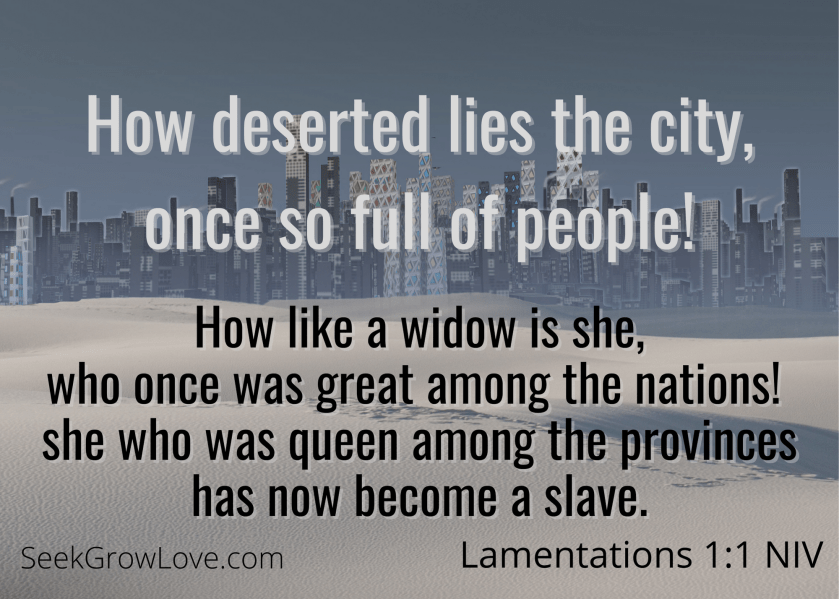
But why write the work? Lamentations is written to declare to the reader, but ultimately to God, the pain of the author. In chapter one, the author gives Jerusalem a voice, crying out to God in pain, despair and loss. The city is destroyed and betrayed. (1:1-2) What’s worse: it was because the people of the city and the Kingdom of Judah had sinned and turned away from God (1:8, 18) and therefore the destruction is Judgement from God. (1:15) Even in the midst of this pain, the city cries out for the Lord to look at them, see their suffering, and forgive (1:20). The author asks for God to vindicate the city in the presence of the evil enemies under which they suffer. (1:21-22).
However, the book is not just a factual recounting of the sufferings, nor a simple prose narrative. The author takes the time to write using the constraints of an acrostic in chapters 1-4. In chapters 1, 2, and 4, each line begins with a new Hebrew letter (basically, if we wrote a poem and started with “A”, then “B” and so forth.) There are 22 Hebrew letters, thus the 22 verses. And in Chapter 3, the pattern is even heightened so that every three lines start with the same letter. (“A… A… A… B…B…B” and so on for the 66 verses.)
However, knowing all this simply sets the stage. As you read the book, I want you to recognize that Lamentations is included in the word of God to allow you to see the beauty and the necessity of grief, especially as we take our grief to the Lord. God is willing to hear your lament. He is willing to receive all that you speak to him. Lamentations lets us know that God’s wrath against sin is severe, but those who come to him as children will always have a loving father listening to them.
Reflection Questions
What are you lamenting? Let lamentations give you permission to give it to God, to write it down and turn it into something beautiful.
Where does the world press against you? Lamentations shows us that God is over even the Kingdoms of the world, and we can go straight to him for forgiveness.
Where does sin cause a break between you and God? Let this book of sorrow become a book of repentance to turn back to him through faith in Jesus.
Tomorrow, we will focus on the messages found in Lamentations 1-4 and then we will pay close attention to the final chapter.
Prayer
Dear God our Father – I praise You because You are a holy and righteous God through all the ages. I am humbled to know that You, the same God who listened to Jeremiah, listens to me as well. Help me to grieve well, not only over the consequences of my sin, but over my sins that go against what You have made me to be. I repent of my sins. Show me, God, where I have gone astray and guide me in the way You want me to go, even when that requires correction and discipline.

