Romans 5:1 “Therefore, having been justified by faith, we have peace with God through our Lord Jesus Christ,” (NKJV)
Devotion by Merry Peterson (Canada)
In the part of Ontario where I live there is a museum called ‘Ripley’s Believe It or Not’. Inside there are lots of strange and unusual items and displays about occurrences that are most, well, quite frankly unusual! The sign says it all – believe it – or not. Some things in that museum I find really hard to believe.
Faith is really about belief. Our belief that God is who He says He is, and will do what He says He will do. That’s the tenet of having faith – those beliefs about God. His existence as the supreme ruler of the universe and that His declarations of what He will do He follows through on.
In the previous chapter we see that Abraham was justified by his faith even though the whole salvation plan through Jesus dying on the cross for our justification hadn’t happened yet in his time. It was Abraham’s belief that God was in control and able to do what He said He would do that brought him justification.
We as Christians have received justification through Christ’s sacrifice because we live in a different time frame than Abraham. Christ, the promised savior that God declared would become the sacrifice for sin has indeed died, and risen again, and our justification comes through that fulfilled promise.
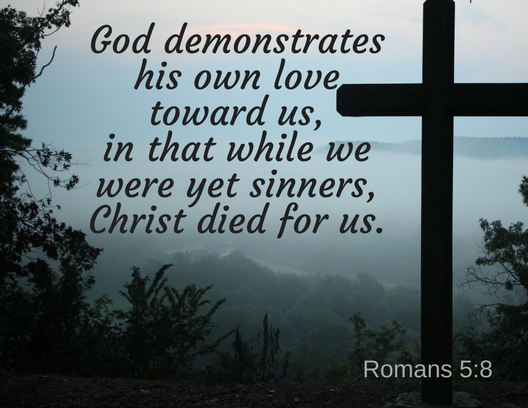
Notice that the fulfilled promise brings peace. We have peace with God through Christ. We have peace knowing that our sin is covered by Jesus’ blood, that we are no longer God’s enemies because of our sin. The blood of Christ washes away the debt of our sin. We become in good standing with God. How is this achieved – by our belief that God is in control and follows through on his promises. He said that Jesus would be the once for all atoning sacrifice for mankind bringing us justification with Himself. We believe it!
For Reflection:
Do you have friends or family members who have a hard time with faith?
When did you first start to have faith and believe?
Was there something or someone who helped you truly believe?
Are there ways that you could help guide another person to belief?
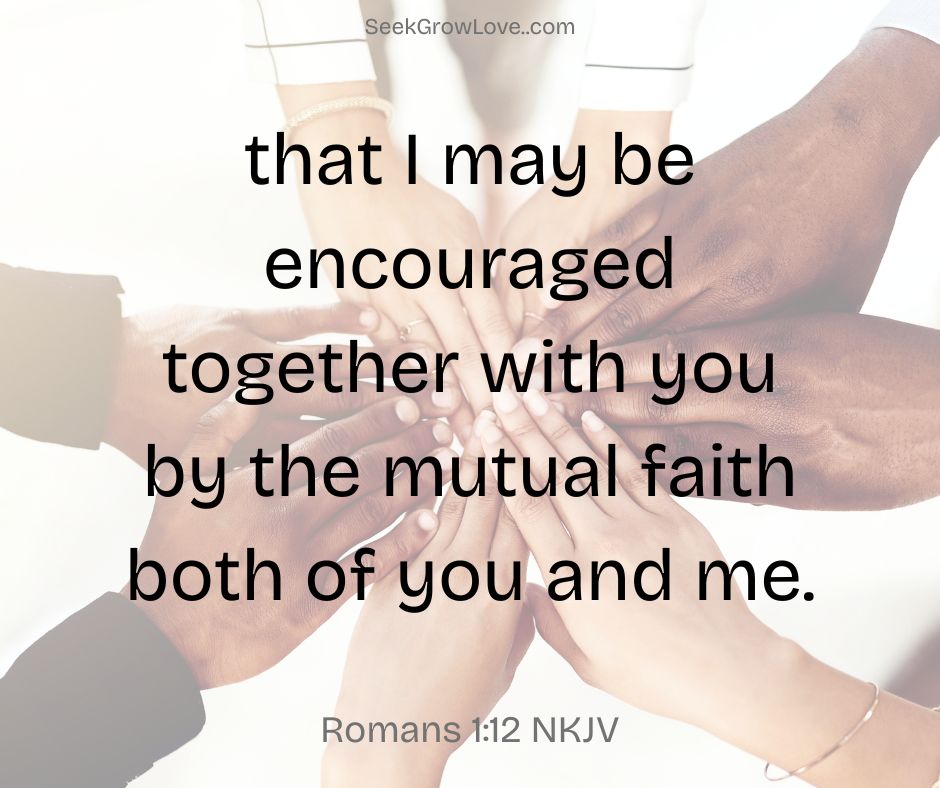
Have you ever wondered what makes Christian fellowship oh so sweet? Paul in this passage has expressed his earnest desire to be among his fellow brothers and sisters in Christ. His heart aches to be present with them, instead he finds himself writing a letter to them. He states in Romans chapter 1, verse 12 so “that I may be encouraged together with you by the mutual faith”. What he is expressing is his desire for the encouragement that comes from fellowshipping with one another.
When we get together as Christians to worship, sing, hang out together, share a meal, or other activities where we truly interact is when fellowship is sweetest. For an extended period of time I lived on the west coast. Let me tell you it is a very long way away from most of our churches in our conference of churches. I loved our 2 local congregations but it was ever so sweet when I would get to attend a camp or conference activity with other like-minded believers back east. I always found it encouraging and always had the opportunity to encourage and minister to others as we fellowshipped together. It was rejuvenating. The Apostle Paul is longing for that same rejuvenating fellowship.
Notice he mentions by mutual faith – that is why it is so important that we should fellowship together as believers. In Proverbs 27:17 we read “As iron sharpens iron, So a man sharpens the countenance of his friend.” To sharpen iron it must be rubbed against another piece of iron. This picture reminds us that by fellowshipping together – sometimes literally rubbing elbows – we are strengthening and encouraging one another providing the most mutual benefit. That is why Paul in other writing mentions not to forget the assembling of ourselves together – so we don’t lose the mutual benefit of encouraging one another. In our technological age of on-line church and digital meeting spaces let’s not forget what the Apostle Paul really yearned for, and felt was most beneficial – fellowship with other Christian believers. Let’s remember that meeting together is for mutual benefit in the faith – uplifting, encouraging, and helping to rejuvenate our brothers and sisters in the faith so they too can have joy for the journey.
For Reflection:
How can I be more diligent in taking part in opportunities to fellowship with other believers?
Have I taken this sweet, refreshing gift for granted that Paul longed for?
Is there something that is holding you back in serving the Lord? We are unclear what Paul’s infirmity was but we know that it was troublesome to him. Some have suggested it may have been an eye condition or some other physical issue that plagued him. We don’t know for sure but we do know it bothered him! However, he refused to let whatever his personal issue was to hold him back from serving the Lord fully and completely as best he was able.
Some of us have hindrances that hold us back. Maybe like me you are friendly but incredibly shy. Perhaps you have issues with self-esteem, or a physical issue that makes you self-conscious, or some other issue that holds you back from fully serving the Lord. The apostle Paul is a good example of what the Lord can do through someone, when they are willing to be used of him. Paul brings out in this passage that it is Christ who works through us to do his will and work in the world and he is able to work through, and past, our own thoughts of inability.
Christ can do more through us than we can imagine if we remain open and willing to serve him in the ways he calls us to. So in spite of our personal issues he works through us! This is where we should rejoice – that we can be useful for service no matter what situation we are in. This brings even more glory and honor to our Lord; when to the human train of thought we could be rendered useless, and yet, he uses us in a special, wonderful, effective way for him. You see it is not our ability, but Christ’s ability, through an open and willing heart that is ready to serve. Isn’t it wonderful to know that we have a Lord who is willing to use us even if we consider ourselves not ‘perfect’ for the job. He can take someone like you and me and through his strength and power, work in and through us to accomplish his kingdom purposes.
For Reflection:
What is made perfect in weakness? What weaknesses/hinderances to serving the Lord do you have?
Are you willing to allow the Lord to work through you with his strength to accomplish great things for him?
How could you encourage someone who may be struggling with allowing the Lord to use him or her?
2 Corinthians 7:1 “Therefore, having these promises, beloved, let us cleanse ourselves from all filthiness of the flesh and spirit, perfecting holiness in the fear of God.” (NKJV)
Devotion by Merry Peterson (Canada)
Do you remember the Sunday school chorus you may have learned when you were young that went something like this: ‘O be careful little eyes what you see, O be careful little eyes what you see. There’s a father up above who is looking down in love. O be careful little eyes what you see.’ This simple song with several more verses served as a reminder to us that what we take into our minds and what we allow our bodies to do can either lead us in good directions or bad directions and that God was looking down on us lovingly wanting us to make the best choices for ourselves.
There are bad directions we can go in that cause us to become filthy before God both in our inner spiritual life and how we outwardly conduct ourselves. In this verse we, like those first Christian believers, are being encouraged to pursue holiness in a world that is full of temptations that bring filthiness before God. In Corinth idol worship, temple prostitution and general perversion was normal in that day – all things that would be part of everyday life and could be a temptation to take part in unless you were of the new Christian faith.
Unfortunately, we live in a similar kind of culture today but the temptations are different. Today virtual reality, artificial intelligence interactions, violent gaming, tik-tok influences the whole pandora’s box on the internet present the most daily temptations to succumb to filthiness instead of pursuing holiness. Don’t get me wrong – you are reading this on the internet so not everything is an invitation to filthiness – congratulations on choosing to view something that will encourage you to pursue holiness! The Corinthians, and we, are faced with the same challenge. To pursue holiness. What does holiness look like in body and spirit anyway? Glad you asked.
Holiness means to be set apart – to choose differently. Part of holiness is choosing to fill our hearts and minds with the things that will draw us closer to the Lord and to use our bodies in ways that would be pleasing and honoring to him. A good way to keep your mind focused to pursue holiness is to follow Philippians 4:8 “Finally, brethren, whatever things are true, whatever things are noble, whatever things are just, whatever things are pure, whatever things are lovely, whatever things are of good report, if there is any virtue and if there is anything praiseworthy- meditate on these things.” If we follow this advice we are less likely to fall into the trap of allowing ourselves to become filthy before God in our thoughts and consequently our actions.
For Reflection:
Are there ways that I am allowing myself to be influenced towards pursuing filthiness before God instead of holiness? Are there habits that I should give up?
What plan can I put in place to help myself pursue choices that will help me to live a life that points towards holiness in choosing God’s best in my life?
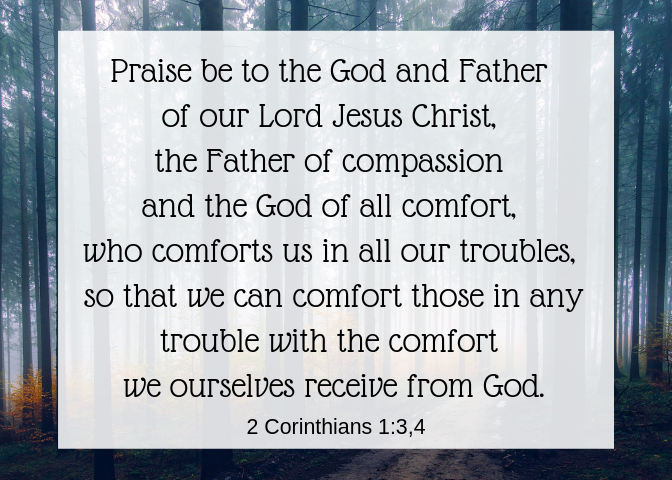
2 Corinthians 1:3-4 “Blessed be the God and Father of our Lord Jesus Christ, the Father of mercies and God of all comfort, who comforts us in all our tribulation, that we may be able to comfort those who are in any trouble, with the comfort with which we ourselves are comforted by God.” (NKJV)
Been there, done that. Experience is a wise teacher. We wish we didn’t have to go through trials because let’s face it – they are trying times! But what if your experience through trials was meant to help someone else when they are going through a similar trying time? The Apostle Paul in this verse is bringing to light the fact that we go through trials and afflictions with God’s help and comfort so that we – in turn can be of help and comfort to others who are going through something similar.
Think about all the afflictions the Apostle Paul had gone through when he was writing to the believers at Corinth. He had been blinded and received back his sight, he had been rejected by fellow believers, he had been through scary situations with mobs, and had misfortune while out at sea. He had even been stoned, and left for dead! God brought him through all these trials and strengthened him by each one. Paul is writing these words to encourage the Corinthians because he knew they would face trials as well.
People love to give advice – whether you asked for it or not! When you are going through a trial it’s most comforting to receive counsel from someone who has gone through the same situation as you. They’ve been there, they know the perils of the situation, the inward turmoil that happens and how God was there helping them through. I found comfort in talking with other people who have been in the same shoes. They blessed me with insight from their past experience, and their unwavering faith during the situation. I was comforted as I talked with those who like myself had been caregivers for their parents as they fought cancer. Little did I know that just a year later I would be the one giving counsel to a dear friend whose parent was fighting cancer.
When we go through trials it develops empathy within us to be able to understand what others are going through when they face similar trials. Our trials are not in vain – they are meant to be growing experiences so that we can help others through their trials. They find encouragement by our ability to endure, and, with God’s help, they too feel like they will make it through. It is a beautiful picture of building one another up in the Lord and encouraging one another. One might say that going through a trial can become a blessing in disguise.
For Reflection:
Have you been able to encourage someone who is facing a challenge that you had to face?
How did God help you and how might you seek to help others in the same situation?
This is such a beautiful passage concerning the resurrection. It brings a beautiful picture to my mind. Here’s the reason why – in my previous church I was privileged to work with a wonderful group of elders, one of whom had disabilities. He didn’t let his disabilities hold him down, with a great sense of humor he navigated life around them.
As a young man Boyd had the misfortune of contracting Polio. He spent time in the infamous iron lung equipment for treatment. As a result of this he was never able to stand up straight and tall again, and had troubles with his legs. He was stooped over and had to use a walking stick for assistance, and in later years ran around his expansive ranch on a motorized scooter. It was difficult to watch him navigate the stairs at church one step at a time, as best he could – he was determined. It took him a little longer to do the normal things in life, but he navigated around his inabilities, ran his ranch well, had a large family and kept the faith.
Boyd was an inspiration to all of us. When we laid him to rest at the end of his life’s journey we were all encouraged by this thought: In the resurrection our dear friend Boyd will stand straight and tall and will never have to use a walking stick or scooter ever again. In fact – he’ll be able to run, skip, dance, and leap for Joy to his heart’s content! His body was sown in dishonor, in weakness, broken by the ravages of illness. He will be raised to a glorious, whole, fully functioning new body. He will have the power to do what he couldn’t do before. He will trade his weakness for the strength he was meant to have.
At the Resurrection we too will be able to trade weakness for strength because of Christ and the resurrection power to bring wholeness to broken-ness. Each one of us suffers brokenness in some way. Through Christ our once brokenness will be made whole. When we are raised in the Resurrection whatever we struggled with will no longer be an issue – we too, like our friend Boyd will be made whole. What a glorious thought of how tremendous the resurrection will be!
For Reflection:
Are there disabilities or weaknesses that you struggle with?
Have you fully contemplated how wonderful it will be at the Resurrection when we will leave the old hinderances behind and go on to our new fully whole life with Christ?
Did you know you are a gift to everyone? We are all given certain gifts for the common good of all believers. God by His Spirit enables us to do different things but it is for a purpose – to benefit those whom we are in Christian fellowship with. As Paul was writing to the church body in Corinth he was letting them know that they all had various spiritual gifts. They were the emerging church at the time, still getting established in the ideas and practices of the Christian faith. Paul was reminding them of their individual gifts and that those gifts were to be used for the common good, edifying their brothers and sisters in Christ.
Do you have a certain gift that God has given you? I have a friend who has a God given gift of artistic ability. She blesses and encourages others with her drawings of Bible scriptures surrounded by scenes from nature. I find encouragement each time I see one of her illustrations. Sure, I can draw a stick figure – but I can’t meticulously draw the intricate details of a flower or butterfly that inspires the soul like she can – that is her God-given gift.
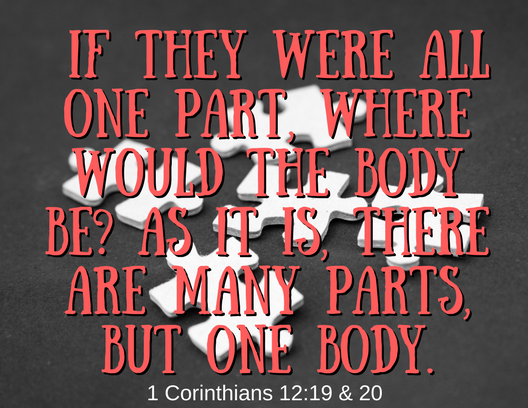
Each one of us has a different gift and we are to use it to benefit our brothers and sisters in Christ. Some people are empowered with prayer abilities, others give good Godly advice, others are good at teaching. Some have the gift of evangelism or hospitality, and some are just plain the most helpful people you know. These are all gifts that are given to us by God’s Spirit and they are all different. My abilities are different than my friend’s abilities. God doesn’t skip any one of us in the giving of these gifts – he wants us to use our specific gift for the benefit of everyone. No one can say that one gift is better than another because all of these gifts were meant to be used together to make a complete picture for how a body of believers should function together building each other up. Just imagine if your Christian fellowship group didn’t have anyone with a musical gift – the worship service might sound terrible! We need each person to exercise their spiritual gift so that we all can be enriched and God can be glorified.
For Reflection:
What gifts has God given you to help enrich the lives of those you are in fellowship with?
How have you been enriched by the gifts of others recently?
Have you thanked God for your gifts and the gifts of others?
Merry Peterson pastors the Freedom In Christ Church in Welland, Ontario, Canada. She has enjoyed being in pastoral ministry for many years and has worked on the side in education in both public and private sectors in various capacities.
The struggle of the Corinthian church continues in today’s reading: 1 Corinthians 9-11. In these chapters Paul addresses issues the church was having regarding worship and communion, while continuing to argue his point about permissible food. What I love most about this section is we really get to see Paul’s heart.
Paul had a love for people. Having experienced the amazing transformative love of Christ himself, he eagerly sought to share this with others. All people. Jew, Greek, male or female. Paul was willing to eat, drink, and share the Gospel with anyone.
Paul had a love for his mission. He considered it an “opportunity” to preach the Gospel (9:18 NLT). He was strong in his convictions and took it seriously. He was purposeful (9:26).
Today, we live very different lives from Paul. We live in a very different world than the one Paul lived. Yet the things that mattered most to Paul need to be what matters most to us. Paul’s work is not yet finished. We, as the church, need to continue what he and the other Apostles started. Love each other. Love others. Most importantly, love God. In our busy world today, may we never lose sight of this. May we see each day as an opportunity to be a light in the darkness.
Reflection Questions
What opportunities to share the Gospel has God given to you? What have you done with those opportunities?
How do you show your love for God? How do you show your love for people? Is there a group of people that you have not tried loving yet? How could you love more and more?
Rather than just complaining about the darkness, or fearing the darkness, or condemning the darkness, how can we be a light in the darkness?
I really enjoyed today’s reading. Paul had some zingers that actually got me laughing – my favorite being 8:2. In our reading today, we learn this letter is a response to one from the Corinthians (7:1). After a lengthy introduction in chapters 1-4, Paul gets right to addressing some specific concerns regarding the Corinthian church. There is a lot that can be discussed here, but the key seemed to be Paul encouraging the Corinthian church to remove distractions and get back to the business of spreading the Gospel.
Earlier this week I wrote about how the early church was moving in the days of the Apostles. In today’s reading, we see a church that has come to a standstill. It seems the Cornintian church lost focus on spreading the Gospel and what it meant to be the body of Christ. Paul mentions when he told the church to stay away from people “who indulge in sexual sin, or are greedy, or cheat people, or worship idols” he was referring specifically to believers who partake in these actions (5:10 NLT). Paul plainly puts that to stay away from all such people, you’d have to leave this earth – that was another one of those zingers I found humorous. The problem Paul has with the Corinthians is they are allowing a man living in sexual sin with this step mother to be an active member of their church. It’s a distraction. It’s giving the church a bad name, as Paul writes even pagans don’t tolerate such behavior. Paul is NOT telling the church to avoid sinners, but he is telling us to get the sin out of the church. There is a difference. Allowing one who is actively participating in sin with no signs of repentance within the church causes a distraction. Discord can break out amongst the people in the church over the issue. I believe Paul is also concerned with the Corinthians giving the church a bad name, in turn hindering the spread of “sincerity and truth” (5:8 NLT). He continues this idea in chapter 6, regarding the Corinthians use of the public courts to settle disputes. He doesn’t like that this is being done in front of non-believers. Why? Because, it is distracting from the Gospel message. It’s the same way with the issues of marriage and food discussed in chapters 7 and 8.
We have to remember the church was on a mission. Our New Testament stories and scripture come from what the early church did. Paul understood the importance of the movement and the urgency to share the Gospel. It seemed this specific Corinthian church had forgotten. Paul is urging the Corinthians to remove distractions and get back to the business of the church. I believe that is the biggest take away from today’s scripture. It’s not about whether we should be married or not, whether we eat this or that. It’s not even about what people we should avoid or allow in the church. It’s about refocusing the efforts of the church to do the work of Christ. Jesus tells us the two most important commandments are to love God and secondly love others. That is the movement to which Paul wants the Corinthians to return. It must be our focus as well. Paul sums it up pretty nicely in his opening statement in chapter 8, “But while knowledge makes us feel important, it is love that strengthens the church” (verse 1 NLT).
Reflection Questions
What distractions have gotten in the way of you intentionally spreading the Gospel? How can you minimize them (or eliminate them or use them to your advantage – depending on what your distractions are) so that you focus more on how to best love God and love others which must include spreading the good news?
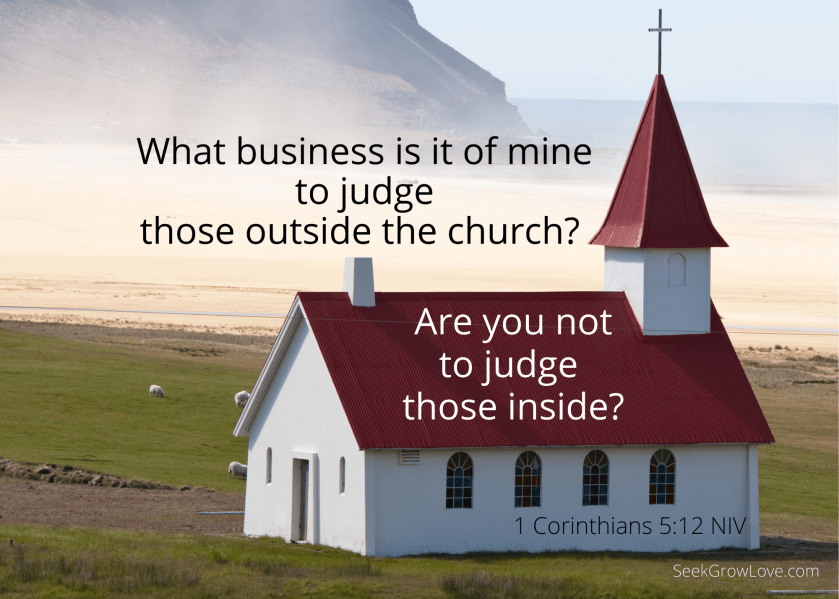
What should our response be to sin in the church? What should our response be to sin outside of the church? Why the difference? What happens when we get it mixed up and treat outside sin as we are supposed to treat inside sin? What happens when we get it mixed up and treat inside sin as we are supposed to treat outside sin?
After reading the whole Bible passage today, re-read 1 Corinthians 8:2. What is Paul saying in this verse? Why is he saying it? What can you learn from it? And how could you put it into practice?
What do you think God wants you personally to learn and put into practice today from this letter from Paul to the church in Corinth?
When Marcia initially asked me to write the devotions for this week, I briefly glanced at what the daily passages would be. When I saw some Corinthians, I remember thinking, Cool, I like Corinthians – it’s got some good stuff like the love chapter and resurrection chapter. Oh golly, did I underestimate the book of 1 Corinthians. I mean, I know Paul wrote some “hard to understand” things (2 Peter 3:16 NLT). I just didn’t realize, until today, I would have to write a response to some of these things.
Teaching, wisdom, and humility are some overarching themes in today’s text from 1 Corinthians chapters 1-4. Upon my first read through, I was stumped, and really wishing someone smarter than me had these chapters. I longed to search through my old notes from Bible college to see what my professor had to say. I have all my old notes – and Bob Jones, if you’re reading this, I have my handouts organized by theme in TWO collapsible file portfolios. 🙂 Unfortunately, everything is labeled somewhere in a box that has yet to be unearthed since my getting married and moving from Nebraska to Missouri. It then occurred to me I could spend hours diving deeper into the complexity of these four chapters with the aid of the internet. Seeing as it was 2pm Wednesday afternoon, Marcia needs my devotion tonight, and I’ve got a Thanksgiving Bible Study dinner at 5:30, I decided that wasn’t the way to go. So, I got out my interlinear Greek New Testament and started reading again, this time briefly summarizing the main ideas as I went. What I came up with was the Emilee Christian Simplified Version of 1 Corinthians 1-4. Doing this helped me better understand what Paul meant. I will share with you what I came up with, in hopes it does the same for you. This may be more informal than what you are used to reading – bear with me, please!
1:1-3: Paul and Sosthenes are writing a letter to the Corinthian church.
1:4-9: Speaking as Paul: I thank God for you. God loves you. God wants to use your church.
1:10-17: I hear you’ve been fighting – knock it off!
1:18-20: Earthly wisdom has no power against the cross.
1:21-31: God likes to use the weak and unexpected things of this world to further show His power. Side note – I particularly like this section and immediately thought of these four seemingly unexpected things God has used: a manger, shepherds, fishermen, and women as first witnesses to the resurrection.
2:1-5: When I came to you, I spoke in plain simple terms so you would understand that Gospel message.
2:6-11: I use more complex language while speaking to spiritually mature believers. This is different from worldly wisdom. Perhaps people were accusing Paul of using worldly ideas to explain the Gospel and this is his defense.
2:12-15: I’m talking about spiritual matters that do not make sense to those attempting to understand with worldly wisdom.
3: 1-3: Remember when I came to you I simplified things. I am still having to simplify things because your arguing and disagreeing is preventing you from understanding more complex spiritual thought.
3: 4-9: Summarizes what they’ve been arguing about. Explains that it doesn’t matter who brought you to the faith in Christ, what’s important is that you now have faith in Christ.
3:10-15: Christ is the foundation of our faith. Anyone may build upon this foundation by spreading the Good News. God’s judgment will reveal if one has done a good or bad job at expanding the foundation. We mere humans don’t need to burden ourselves with making those judgments.
3:16-17: The Church is God’s holy temple so behave and be holy – get your act together Corinthians!
3:18: Sounds like Paul saying he hopes the proud get knocked down a few pegs so they will in turn learn true wisdom.
3:19-20: Again there is a difference between God’s wisdom and the world’s understanding.
3:21-22: Don’t be boastful, don’t be prideful – all things belong to Christ who belongs to God.
4:1-5: It’s God’s place to judge.
4:6-7: So quit arguing about who is better – it’s not your job, it’s God’s.
4:8-13: Seriously, quit bickering over us Apostles! It’s rough enough out here spreading the Gospel we don’t need to deal with your infighting, too.
4:14:I’m not trying to shame you in saying these things, but you need to be disciplined because you are acting like children.
4:15-16:I feel responsible for your faith because I was the one who first told you about Christ – so I’ve got a right to call you out when you’re acting like children. Shape up. Do better.
4:17: I’m sending Timothy to help you.
4:18-21: I hear you want me to come visit, but is that what you really want? Because if I came to visit you now I would be mad and disappointed. Get your act together so that when I do come, we can have a good visit.
Food for Thought: I have to wonder if writing in lengthy complex statements was sort of Paul’s point. In trying to put spiritual things into the context and words of men, it seemed to me to make less sense. Is that a part of Paul’s argument? Perhaps Paul is demonstrating that to have complete understanding of God is foolish and what we should seek is to have faith.
Reflection Questions
What are some examples of what the world says is wise that God says is foolishness? When have you found yourself switching over from worldly wisdom to Godly wisdom?
If Paul came to your church, or wrote a letter to you, what might he say?
What arguments have you allowed to come between you and your brothers and sisters at church? What can you do to fix the problem?






 Seek Grow Love