This is such a beautiful passage concerning the resurrection. It brings a beautiful picture to my mind. Here’s the reason why – in my previous church I was privileged to work with a wonderful group of elders, one of whom had disabilities. He didn’t let his disabilities hold him down, with a great sense of humor he navigated life around them.
As a young man Boyd had the misfortune of contracting Polio. He spent time in the infamous iron lung equipment for treatment. As a result of this he was never able to stand up straight and tall again, and had troubles with his legs. He was stooped over and had to use a walking stick for assistance, and in later years ran around his expansive ranch on a motorized scooter. It was difficult to watch him navigate the stairs at church one step at a time, as best he could – he was determined. It took him a little longer to do the normal things in life, but he navigated around his inabilities, ran his ranch well, had a large family and kept the faith.
Boyd was an inspiration to all of us. When we laid him to rest at the end of his life’s journey we were all encouraged by this thought: In the resurrection our dear friend Boyd will stand straight and tall and will never have to use a walking stick or scooter ever again. In fact – he’ll be able to run, skip, dance, and leap for Joy to his heart’s content! His body was sown in dishonor, in weakness, broken by the ravages of illness. He will be raised to a glorious, whole, fully functioning new body. He will have the power to do what he couldn’t do before. He will trade his weakness for the strength he was meant to have.
At the Resurrection we too will be able to trade weakness for strength because of Christ and the resurrection power to bring wholeness to broken-ness. Each one of us suffers brokenness in some way. Through Christ our once brokenness will be made whole. When we are raised in the Resurrection whatever we struggled with will no longer be an issue – we too, like our friend Boyd will be made whole. What a glorious thought of how tremendous the resurrection will be!
For Reflection:
Are there disabilities or weaknesses that you struggle with?
Have you fully contemplated how wonderful it will be at the Resurrection when we will leave the old hinderances behind and go on to our new fully whole life with Christ?
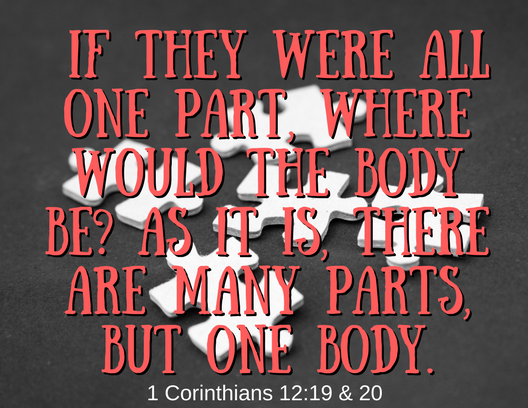
Did you know you are a gift to everyone? We are all given certain gifts for the common good of all believers. God by His Spirit enables us to do different things but it is for a purpose – to benefit those whom we are in Christian fellowship with. As Paul was writing to the church body in Corinth he was letting them know that they all had various spiritual gifts. They were the emerging church at the time, still getting established in the ideas and practices of the Christian faith. Paul was reminding them of their individual gifts and that those gifts were to be used for the common good, edifying their brothers and sisters in Christ.
Do you have a certain gift that God has given you? I have a friend who has a God given gift of artistic ability. She blesses and encourages others with her drawings of Bible scriptures surrounded by scenes from nature. I find encouragement each time I see one of her illustrations. Sure, I can draw a stick figure – but I can’t meticulously draw the intricate details of a flower or butterfly that inspires the soul like she can – that is her God-given gift.
Each one of us has a different gift and we are to use it to benefit our brothers and sisters in Christ. Some people are empowered with prayer abilities, others give good Godly advice, others are good at teaching. Some have the gift of evangelism or hospitality, and some are just plain the most helpful people you know. These are all gifts that are given to us by God’s Spirit and they are all different. My abilities are different than my friend’s abilities. God doesn’t skip any one of us in the giving of these gifts – he wants us to use our specific gift for the benefit of everyone. No one can say that one gift is better than another because all of these gifts were meant to be used together to make a complete picture for how a body of believers should function together building each other up. Just imagine if your Christian fellowship group didn’t have anyone with a musical gift – the worship service might sound terrible! We need each person to exercise their spiritual gift so that we all can be enriched and God can be glorified.
For Reflection:
What gifts has God given you to help enrich the lives of those you are in fellowship with?
How have you been enriched by the gifts of others recently?
Have you thanked God for your gifts and the gifts of others?
Merry Peterson pastors the Freedom In Christ Church in Welland, Ontario, Canada. She has enjoyed being in pastoral ministry for many years and has worked on the side in education in both public and private sectors in various capacities.
The struggle of the Corinthian church continues in today’s reading: 1 Corinthians 9-11. In these chapters Paul addresses issues the church was having regarding worship and communion, while continuing to argue his point about permissible food. What I love most about this section is we really get to see Paul’s heart.
Paul had a love for people. Having experienced the amazing transformative love of Christ himself, he eagerly sought to share this with others. All people. Jew, Greek, male or female. Paul was willing to eat, drink, and share the Gospel with anyone.
Paul had a love for his mission. He considered it an “opportunity” to preach the Gospel (9:18 NLT). He was strong in his convictions and took it seriously. He was purposeful (9:26).
Today, we live very different lives from Paul. We live in a very different world than the one Paul lived. Yet the things that mattered most to Paul need to be what matters most to us. Paul’s work is not yet finished. We, as the church, need to continue what he and the other Apostles started. Love each other. Love others. Most importantly, love God. In our busy world today, may we never lose sight of this. May we see each day as an opportunity to be a light in the darkness.
Reflection Questions
What opportunities to share the Gospel has God given to you? What have you done with those opportunities?
How do you show your love for God? How do you show your love for people? Is there a group of people that you have not tried loving yet? How could you love more and more?
Rather than just complaining about the darkness, or fearing the darkness, or condemning the darkness, how can we be a light in the darkness?
I really enjoyed today’s reading. Paul had some zingers that actually got me laughing – my favorite being 8:2. In our reading today, we learn this letter is a response to one from the Corinthians (7:1). After a lengthy introduction in chapters 1-4, Paul gets right to addressing some specific concerns regarding the Corinthian church. There is a lot that can be discussed here, but the key seemed to be Paul encouraging the Corinthian church to remove distractions and get back to the business of spreading the Gospel.
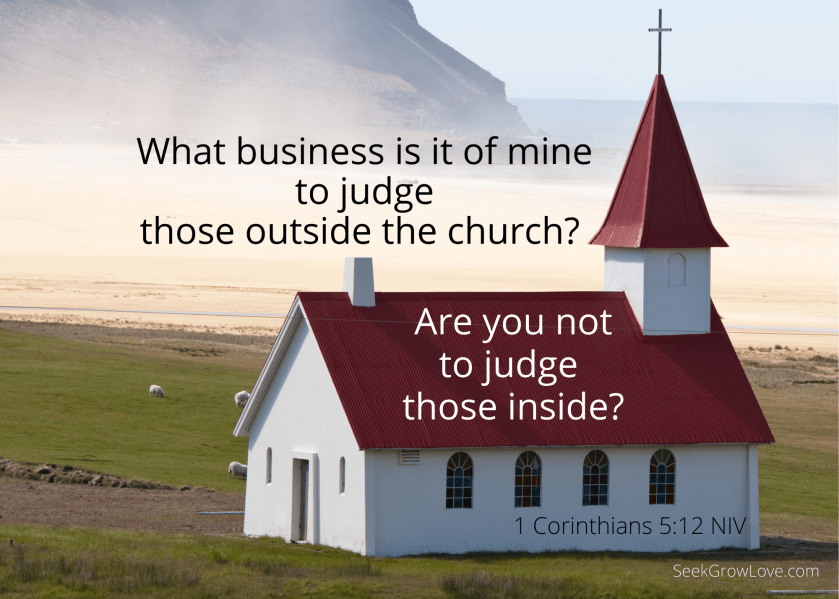
Earlier this week I wrote about how the early church was moving in the days of the Apostles. In today’s reading, we see a church that has come to a standstill. It seems the Cornintian church lost focus on spreading the Gospel and what it meant to be the body of Christ. Paul mentions when he told the church to stay away from people “who indulge in sexual sin, or are greedy, or cheat people, or worship idols” he was referring specifically to believers who partake in these actions (5:10 NLT). Paul plainly puts that to stay away from all such people, you’d have to leave this earth – that was another one of those zingers I found humorous. The problem Paul has with the Corinthians is they are allowing a man living in sexual sin with this step mother to be an active member of their church. It’s a distraction. It’s giving the church a bad name, as Paul writes even pagans don’t tolerate such behavior. Paul is NOT telling the church to avoid sinners, but he is telling us to get the sin out of the church. There is a difference. Allowing one who is actively participating in sin with no signs of repentance within the church causes a distraction. Discord can break out amongst the people in the church over the issue. I believe Paul is also concerned with the Corinthians giving the church a bad name, in turn hindering the spread of “sincerity and truth” (5:8 NLT). He continues this idea in chapter 6, regarding the Corinthians use of the public courts to settle disputes. He doesn’t like that this is being done in front of non-believers. Why? Because, it is distracting from the Gospel message. It’s the same way with the issues of marriage and food discussed in chapters 7 and 8.
We have to remember the church was on a mission. Our New Testament stories and scripture come from what the early church did. Paul understood the importance of the movement and the urgency to share the Gospel. It seemed this specific Corinthian church had forgotten. Paul is urging the Corinthians to remove distractions and get back to the business of the church. I believe that is the biggest take away from today’s scripture. It’s not about whether we should be married or not, whether we eat this or that. It’s not even about what people we should avoid or allow in the church. It’s about refocusing the efforts of the church to do the work of Christ. Jesus tells us the two most important commandments are to love God and secondly love others. That is the movement to which Paul wants the Corinthians to return. It must be our focus as well. Paul sums it up pretty nicely in his opening statement in chapter 8, “But while knowledge makes us feel important, it is love that strengthens the church” (verse 1 NLT).
Reflection Questions
What distractions have gotten in the way of you intentionally spreading the Gospel? How can you minimize them (or eliminate them or use them to your advantage – depending on what your distractions are) so that you focus more on how to best love God and love others which must include spreading the good news?
What should our response be to sin in the church? What should our response be to sin outside of the church? Why the difference? What happens when we get it mixed up and treat outside sin as we are supposed to treat inside sin? What happens when we get it mixed up and treat inside sin as we are supposed to treat outside sin?
After reading the whole Bible passage today, re-read 1 Corinthians 8:2. What is Paul saying in this verse? Why is he saying it? What can you learn from it? And how could you put it into practice?
What do you think God wants you personally to learn and put into practice today from this letter from Paul to the church in Corinth?
When Marcia initially asked me to write the devotions for this week, I briefly glanced at what the daily passages would be. When I saw some Corinthians, I remember thinking, Cool, I like Corinthians – it’s got some good stuff like the love chapter and resurrection chapter. Oh golly, did I underestimate the book of 1 Corinthians. I mean, I know Paul wrote some “hard to understand” things (2 Peter 3:16 NLT). I just didn’t realize, until today, I would have to write a response to some of these things.
Teaching, wisdom, and humility are some overarching themes in today’s text from 1 Corinthians chapters 1-4. Upon my first read through, I was stumped, and really wishing someone smarter than me had these chapters. I longed to search through my old notes from Bible college to see what my professor had to say. I have all my old notes – and Bob Jones, if you’re reading this, I have my handouts organized by theme in TWO collapsible file portfolios. 🙂 Unfortunately, everything is labeled somewhere in a box that has yet to be unearthed since my getting married and moving from Nebraska to Missouri. It then occurred to me I could spend hours diving deeper into the complexity of these four chapters with the aid of the internet. Seeing as it was 2pm Wednesday afternoon, Marcia needs my devotion tonight, and I’ve got a Thanksgiving Bible Study dinner at 5:30, I decided that wasn’t the way to go. So, I got out my interlinear Greek New Testament and started reading again, this time briefly summarizing the main ideas as I went. What I came up with was the Emilee Christian Simplified Version of 1 Corinthians 1-4. Doing this helped me better understand what Paul meant. I will share with you what I came up with, in hopes it does the same for you. This may be more informal than what you are used to reading – bear with me, please!
1:1-3: Paul and Sosthenes are writing a letter to the Corinthian church.
1:4-9: Speaking as Paul: I thank God for you. God loves you. God wants to use your church.
1:10-17: I hear you’ve been fighting – knock it off!
1:18-20: Earthly wisdom has no power against the cross.
1:21-31: God likes to use the weak and unexpected things of this world to further show His power. Side note – I particularly like this section and immediately thought of these four seemingly unexpected things God has used: a manger, shepherds, fishermen, and women as first witnesses to the resurrection.
2:1-5: When I came to you, I spoke in plain simple terms so you would understand that Gospel message.
2:6-11: I use more complex language while speaking to spiritually mature believers. This is different from worldly wisdom. Perhaps people were accusing Paul of using worldly ideas to explain the Gospel and this is his defense.
2:12-15: I’m talking about spiritual matters that do not make sense to those attempting to understand with worldly wisdom.
3: 1-3: Remember when I came to you I simplified things. I am still having to simplify things because your arguing and disagreeing is preventing you from understanding more complex spiritual thought.
3: 4-9: Summarizes what they’ve been arguing about. Explains that it doesn’t matter who brought you to the faith in Christ, what’s important is that you now have faith in Christ.
3:10-15: Christ is the foundation of our faith. Anyone may build upon this foundation by spreading the Good News. God’s judgment will reveal if one has done a good or bad job at expanding the foundation. We mere humans don’t need to burden ourselves with making those judgments.
3:16-17: The Church is God’s holy temple so behave and be holy – get your act together Corinthians!
3:18: Sounds like Paul saying he hopes the proud get knocked down a few pegs so they will in turn learn true wisdom.
3:19-20: Again there is a difference between God’s wisdom and the world’s understanding.
3:21-22: Don’t be boastful, don’t be prideful – all things belong to Christ who belongs to God.
4:1-5: It’s God’s place to judge.
4:6-7: So quit arguing about who is better – it’s not your job, it’s God’s.
4:8-13: Seriously, quit bickering over us Apostles! It’s rough enough out here spreading the Gospel we don’t need to deal with your infighting, too.
4:14:I’m not trying to shame you in saying these things, but you need to be disciplined because you are acting like children.
4:15-16:I feel responsible for your faith because I was the one who first told you about Christ – so I’ve got a right to call you out when you’re acting like children. Shape up. Do better.
4:17: I’m sending Timothy to help you.
4:18-21: I hear you want me to come visit, but is that what you really want? Because if I came to visit you now I would be mad and disappointed. Get your act together so that when I do come, we can have a good visit.
Food for Thought: I have to wonder if writing in lengthy complex statements was sort of Paul’s point. In trying to put spiritual things into the context and words of men, it seemed to me to make less sense. Is that a part of Paul’s argument? Perhaps Paul is demonstrating that to have complete understanding of God is foolish and what we should seek is to have faith.
Reflection Questions
What are some examples of what the world says is wise that God says is foolishness? When have you found yourself switching over from worldly wisdom to Godly wisdom?
If Paul came to your church, or wrote a letter to you, what might he say?
What arguments have you allowed to come between you and your brothers and sisters at church? What can you do to fix the problem?
1 Corinthians 15 is a chapter all about resurrection. In 1 Corinthians 15 there were people within the church who don’t believe in the resurrection and feel like it’s not an important belief of being a Christian.
Unfortunately, this is still a belief held by some people today. There are people in the world that teach that the death and resurrection of Christ never really happened, instead it’s just a made up story. Some people even try to water down the gospel and come up with scenarios that are more “plausible” than Jesus dying and being resurrected. This is an incredibly dangerous thought process as the validity of the resurrection gives us purpose as Christians.
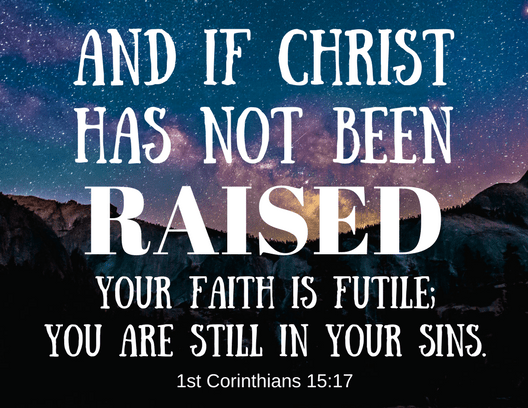
In 1 Corinthians 15:3-8, Paul reminds those that don’t believe in the resurrection that there is evidence it happened. There were hundreds of eyewitnesses that saw Jesus alive after being publicly executed by the Romans. Paul then goes on to explain that without the resurrection we are all lost. In 1 Corinthians 15:17-18 Paul says
“And if Christ has not been raised, your faith is futile; you are still in your sins.Then those also who have fallen asleep in Christ are lost.”
Paul is essentially saying that without the resurrection our faith is pointless. We are unable to be saved and our loved ones are unable to be raised from the dead. Paul then goes on to remind us that the resurrection is real! The resurrection of Jesus reminds us of what’s really important in our lives, to glorify God during our lives on Earth.
-Brooke Cisneros
Reflection Questions
Why does it matter if you believe in the resurrection of Jesus Christ or not?
Do you believe in the resurrection of Jesus Christ?
How can you put into action verses 57 & 58, Paul’s concluding words on the resurrection and the difference it should make in our lives?
When we began this week on Sunday we read about Spiritual gifts in chapter 12. We saw that there is no “I” in “team” and that everyone in the church has gifts and needs to be using their gifts to help the church grow and carry out its mission.
There is one key transitional sentence at the end of chapter 12 leading into chapter 13: “And I will show you a still more excellent way.” The more excellent way is the way of love. From Monday to Friday, we have looked at love, not as an abstract idea but as a concrete set of actions. Love is made up of behaviors that are patterned after God. When we love we show people who God is and what God does.
Today, we look at how Paul closes out this “Love chapter” in verses 8-13:
Love never ends. As for prophecies, they will pass away; as for tongues, they will cease; as for knowledge, it will pass away. For we know in part and we prophesy in part, but when the perfect comes, the partial will pass away. When I was a child, I spoke like a child, I thought like a child, I reasoned like a child. When I became a man, I gave up childish ways. For now we see in a mirror dimly, but then face to face. Now I know in part; then I shall know fully, even as I have been fully known.
So now faith, hope, and love abide, these three; but the greatest of these is love.
Here as Paul brings this section to completion he brings home the point. It’s important to be gifted, to use your gifts and talents to serve in the Church and to serve God in the world, but as important as those gifts are, they are not the ultimate or final good, they are penultimate or next to last good. To speak a prophetic word to exhort a congregation is important, to exercise the gift of speaking to the world in ways that are understood by people of different languages is valuable, and knowledge is a necessary good to a flourishing life and church, but all of these are penultimate good, not ultimate. They will give way to the eternal, but love will outlast everything. At the end of all things love for God is love.
I’m getting older and I have some serious health challenges which remind me that I am a mortal person. Unless Jesus Christ returns very soon I will one day join those who have gone to “sleep in the dust of the earth” (Daniel 12:2) awaiting the resurrection. As I get closer to my personal end, I am more aware of that which is truly most important in life. It’s not my accomplishments, it’s not how much money I’ve earned, at the end of the day what matters most is “Did I love?” Jesus summed up the entire teaching of God with 2 things: “Love God and Love others”. Paul is adding more depth and clarity to what love looks like and what we all should aspire to be. Every morning we should ask, “God, how can I love well today?” And at the end of the day ask “God, how well did I love today?”
Reflection Questions
When you hear the words “Love never ends” what comes to your mind?
Why do you think Paul says that being loving is even more important than being gifted?
When will you start to begin your days asking “God, how can I love well today?” And at the end of the day ask “God, how well did I love today?”
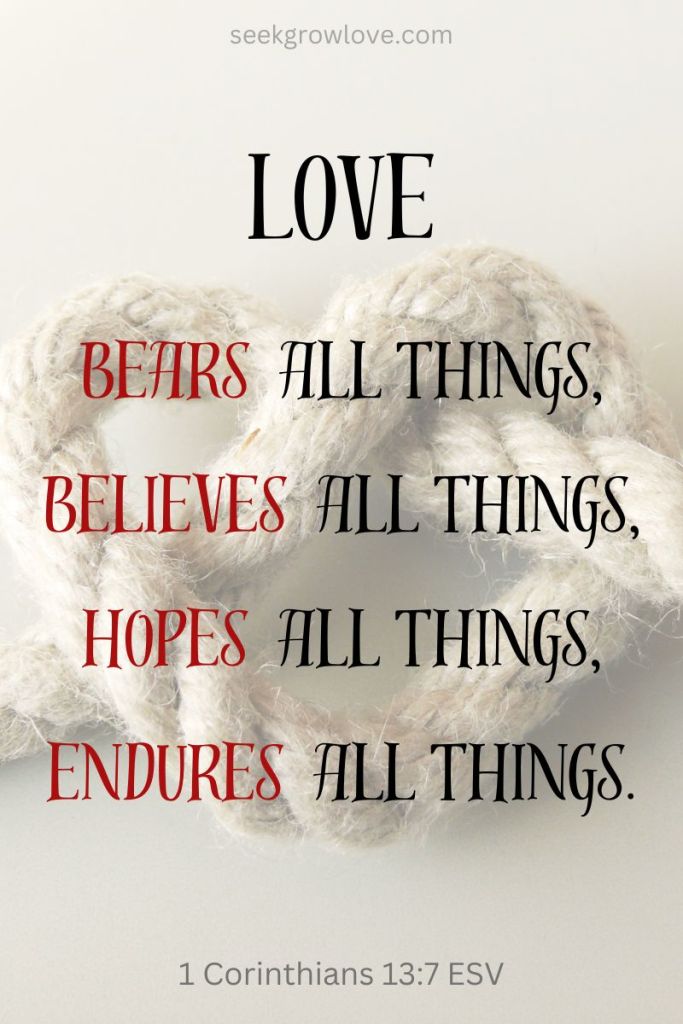
Love bears all things, believes all things, hopes all things, endures all things.
Through this week of reading through 1 Corinthians 13 Paul is giving us concrete examples of what It means to love. He’s building this message into a kind of crescendo. Like a great symphony or chorale masterwork, the various themes of the story build on themselves. Here he is moving toward the peak of this love song with 4 things that love does: love bears, love believes, love hopes and love endures. That would be a lot. But he adds “all things.”
I could take time and give you a detailed exegesis of what each of these words means in the original Greek and how they are used in Corinthians and throughout Paul’s writings and the Bible as a way to arrive at their precise meanings, but I’m not going to do that. Instead, I’m going to tell you a story.
I grew up in a loving family. My father was a pastor and also a school teacher. My mom was a pastor’s wife and drove a school bus and took care of our family, keeping us fed every day precisely at 6 p.m., our clothes washed and our house neat. I felt loved and supported along with my 2 older sisters Cheryl and Debbie. I was the baby, younger than my two older siblings by 7 and 10 years. My parents were in their early 40’s, our family was settled and my oldest sister had already left the nest and gotten married. I was an active boy, a happy ‘tween who played baseball and basketball and hadn’t started noticing girls yet at eleven, but life was sweet. We went to Church every Sunday and learned about God and his love for us.
Then the world changed. My Mom found out that she was going to have another baby. Surprise! Jeff, you’re not going to be the youngest child anymore, you get to be a big brother. I couldn’t wait, after years of being the only boy, the little brother who had to listen to his older sisters who both loved me but could also be a bit bossy. Sometimes it felt like I had a Dad and 3 Moms telling me what to do. Now I would have a little brother to boss around and to show how to hit a baseball and shoot a free throw. I even had a name picked out for my little brother, Scott. I don’t know why I picked that name, but that was the name I picked for my little brother.
As it turned out, “Scott” was born a little girl, whom my parents named Christine Noelle (she was born right after Christmas so she got a very Christmasy-sounding name). Before I got to meet my little sister (I got over the fact that she was not my little brother Scott) my parents shared that she was a special child. She was born with some differences in her little body that made her look different from other babies that I had known and she would not be able to do all the things that other children did in the way that they did them. The name for my sister’s condition was called Down’s Syndrome. I didn’t fully understand what that meant, but I was glad when my parents got to bring her home and we all loved her very much.
For the next 50 years my Father and Mother, and after my father died my mother alone, provided love and care for Christine. She received cutting-edge health care. She had multiple surgeries to repair things that normally didn’t function well in children with Down’s Syndrome that would help extend her life. She started getting therapy and schooling and grew to be a happy and loving young woman.
I found out many years later, as an adult, that when she was born her doctor advised my parents to have her institutionalized. He said she would never live with a good quality of life and would be a burden to them. It would be best for them, for the family, and everyone else to let her be put away. I am so glad that my parents did not listen to the advice of their physician but to the love of God in their hearts.
My mother, who is now 90 has spent the last 50 years loving my sister Christine. Christine has spent the last 50 years loving my mom. My mom has spent 50 years bearing, believing, hoping, and enduring many trials and challenges while caring for my sister. She has been for me, a model of what Paul talks about when he describes what true love is all about.
At 90, my Mom has come to recognize her limits, she will not be around forever to care for Christine, but even now she is acting in love to help prepare my sister to live a good and flourishing life after my Mom is no longer here.
I could tell many other stories about love that I have seen and experienced in my life.
When we love in selfless ways we bear God’s image to the world.
Pastor Jeff Fletcher
Reflection Questions
Think of a person in your life who modeled a selfless love for others. What does their life teach you about God’s love?
Why does Paul connect bearing, believing, hoping and enduring all things with concrete examples of love?
What is something you can do today to show selfless love for another?
Usually, when we watch a movie we are introduced to a hero or heroic group to root for. We want the “good guy” to win and the “bad guy” to lose. We need to see Batman defeat the Joker or 007 to defeat the agents of SPECTRE.
Occasionally, though, the filmmaker sneaks one by us and we find ourselves rooting for the anti-hero. The show Breaking Bad did an outstanding job of getting us to root for Walter White who morphed from being an ordinary hard-working science teacher husband and dad to Heisenberg, the drug kingpin of the southwest who poisoned people with his methamphetamine creation.
I recently saw someone post on Reddit that he realized later in life that the movie Top Gun had us rooting for Maverick instead of Ice Man when clearly Ice Man was the far better pilot and person. “Iceman was the only pilot that: actually obeyed the rules, was a skilled flier, never killed anybody in the entire movie and correctly identified all of Maverick’s faults.” Yet we were all rooting for Maverick.
To that, I will simply add that I can’t imagine why anyone would ever root for the evil New York Yankees, Dallas Cowboys, or Alabama Crimson Tide. (I’ll stop before I make some more lifelong enemies).
The spirit of this age is constantly working to pull people away from finding joy in truth. The Bible contains an epic story about our hero, a loving God who creates a place where everything is good and populates it with people in his divine image to care for the earth, who are opposed by those he created. But God loves this creation so much that he will stop at nothing to find ways to rescue and restore that which is lost and broken and corrupt.
We are currently living amidst the ongoing battle against that which is true and right. People are daily undermining what is good and just and loving and claiming that that which is evil and corrupt is good, and that which is good and holy is evil.
For Paul, true love does not root for the villain or the anti-hero. True love does not rejoice that evil is victorious. True love finds its joy in the truth that is consistent with God and God’s love.
Jesus predicted that before the end of this age, there would be a decrease in love. In Matthew 24:12 Jesus says: “And because lawlessness will be increased, the love of many will grow cold.” When people reject what is true and right, when people reject the ways that God lays before us to keep a rightly ordered society, it will result in a loss of love. Lovelessness is the natural outgrowth of lawlessness.
Jesus said “I am the way, the truth and the life.” (John 14:6). If you want to have true life, you have to follow the path of Jesus, the path of truth. Paul says essentially, you can’t find love if you reject God’s truth. You can’t truly love God and love people if you don’t love God’s truth.
Today, ask yourself, “Are there things in my life that I know are the opposite of God’s truth?” If you answer “yes”, you must be willing to reorient your life to pursue God’s truth and rejoice in God’s truth to practice true love.
Pastor Jeff Fletcher
Reflection Questions
Why do you think increased lawlessness results in failure to love the truth?
Why is society becoming more enamored with anti-heroes who are opposed to truth?
Happy hump day! We’re here in the middle of the work/school week. Are you tired of hearing about love yet? Like that TV advertising guy used to say: “But wait! There’s more.”
Sometimes, the best way to learn about what something is is to consider its opposite.
In verse 5 Paul gives three more examples of what love is NOT.:[Love] does not insist on its own way; it is not irritable or resentful;
For the past almost 40 years, I have lived with the most beautiful, amazing, wonderful woman. This woman has patiently served alongside me as a pastor’s wife in places far from her family and friends. She even let me drag her halfway across the world to England to start a church with a toddler in tow and she was “great with child” as in, about to pop. She has been a great wife to me and a mom to our 11 children.
I love her more than anything on the planet and her name is Karen. Sadly, the name Karen has, in recent years come to be associated with a certain kind of middle-aged woman who is, shall we say a bit entitled, difficult to please, and hard to get along with. The woman who “asks to speak to the manager” is referred to as a “Karen”. I like to tell people “My wife is named Karen but she is not a Karen.”
Why do “Karens” cause endless eye rolls? Because they are very insistent on getting their way, they tend to be easily irritated by normal human flaws and frustrating situations, and they carry resentment towards those who upset them, they are not quick to forgive and give people a second chance.
If the Apostle Paul was writing to today’s Christians he could simply say “Don’t be a Karen” and would easily get his point across. Instead, Paul might say be an Annabelle, which means “loving” or for a male be an Amadeus, which means “love of God.” (Although for many Annabelle was ruined by the horror movie franchise bearing that name. For older people like me the name Amadeus was ruined by the movie about Mozart- a talented musician and horrible person).
Instead of being a Karen who insists on having her way, be an Annabelle who, as Paul says in Philippians 2:3 learns to “value others above yourselves.” Instead of being a Karen who is irritable or easily angered be an Amadeus who is “slow to speak and slow to anger.” (James 1:19). Instead of being a Karen who is resentful, be a person who practices forgiving “70 times 7” as Jesus taught. (Matthew 18:22).
By now you might be wondering, does Paul want me to become like, a whole different person by doing all these practical, loving things? Paul wants us to allow the one perfectly loving person, Jesus, to radically take over our lives. To be so full of God’s spirit and love that “to live is Christ.”
Pastor Jeff Fletcher
Reflection Questions
Can you think of a time when you were around a “Karen”? How did that make you feel?
Can you think of a time when you acted like a “Karen”? How do you think it impacted others?
What are concrete ways that you can show love by valuing others above yourself?







 Seek Grow Love