Proverbs 16:18 says: “Pride goes before destruction, and a haughty spirit before a fall.” I think the perfect poster child for this proverb is none other than Haman, the villain of the book of Esther.
Haman had a lot of plans, didn’t he? He plotted and schemed and thought he had everything locked in. He was the king’s right hand man and proud to be in that position.
But, when his true colors were revealed to the king, he was taken down. And he fell hard.
We might look at Haman’s story and think, “Of course! I saw that coming. If only he’d read Proverbs 16.” But, as we see in Jesus’s words in Matthew 7, sometimes we can’t see the log in our own eye.
I’m not immune to feeling prideful. It comes out in me sometimes, and I’m willing to bet that it comes out in you, too. It’s so easy to spot and talk about someone else’s sin. But it’s not easy when we have to face our own.
So when we feel pride creeping in, what do we do? Psalm 73:26 says, “My flesh and my heart may fail, but God is the strength of my heart and my portion forever.” Every good thing we have, every good thing we are…is God’s. He is the source, and recognizing that we can do nothing apart from Him is humbling. And it halts pride right in its tracks.
Reflection Questions:
Have you ever had, or witnessed in someone else, a downfall from pride?
How do we protect our hearts against what Proverbs 16:18 warns us about? Is there a Scripture that speaks to you about this?
Sometimes (usually in the midst of a scuffle with technology) I wonder if living in 2025 is really for me. Maybe I would have been more suited for life in the 1800s, living life on the prairie. But then I remember how much I love indoor plumbing.
I kid, but in all seriousness I wonder, do you ever feel this way, too? Why are you placed in the here and now? For me, feeling equipped doesn’t always come easy. My guess is that you often feel the same. The world moves quickly and so much is happening…and sometimes I feel a bit helpless. What can I even contribute to the story? Where is my place here?
I bet this, in part, is what Esther wrestled with when Mordecai relays to her in chapter 4, verse 14, “And who knows whether you have not come to the kingdom for such a time as this?”
At first, she was in fear of her life, knowing that if she approached the king she would likely be put to death. In no way did she feel prepared to do what Mordecai asked of her – as if she was in a position to approach the king as anyone special. But, when Mordecai reminds her of what is at stake, she is convicted and courageously decides to take action.
I want to confront my insecurities and fears like Esther. Whether I’m facing a small task or a life-altering one, I want to show up for God. Because He told me, I know that I am made in His image, and He has placed me here, in this place and at this moment, for His purposes. I want to be an instrument He can use to further His Kingdom. How about you?
Reflection Questions:
Have you ever felt inadequate or out of place? What did you do in response to that?
Has there been a time in your life when you were called to be brave, like Esther, beyond your own strength? How did you experience God in that moment?
What is God calling you to do today? How can you be courageous and embrace what He has for you?
Esther 9:22 – “as the time when the Jews got relief from their enemies, and as the month when their sorrow was turned into joy and their mourning into a day of celebration. He wrote them to observe the days as days of feasting and joy and giving presents of food to one another and gifts to the poor.”
How often do you remember and celebrate the mercies God has shown you?
In this last section of the book of Esther we read about the establishment of the celebration of Purim which commemorates when the Jews saw their fear and sorrow turn into relief and joy as the edict of annihilation was overturned.
All throughout the Old Testament, God calls His people to set aside specific days to remember and celebrate all that was done on their behalf. From Passover to Purim and Rosh Hashanah to Chanukah, these Jewish holidays are full of traditions that have been passed down through the generations.
As New Testament believers we take time to celebrate Christmas and Easter. He is our Messiah, and our salvation and hope are only available to us because of his perfect life, atoning death, and miraculous resurrection.
Additionally, many of us regularly partake in communion, once again recognizing the sacrifice of Jesus on the cross and the promise of eternal life in the Kingdom of God.
But doesn’t God show us His grace and mercy daily? Shouldn’t we set aside time each day to pause, reflect, and give glory and honor for all that has been accomplished on our behalf? Like the Jews in the time of Esther, we too have been saved from the threat of annihilation from our enemies. We have been given the power of the Holy Spirit to do battle and conquer fear and so much more.
Every day we have reason to celebrate. Abundant living is ours today! God has given us so much. Let us never take it for granted.
-Bethany Ligon
Reflection Questions
Why do you think God gave directions for days of celebration? What benefits do they have?
What has God given you that He wants you to remember?
What was to be included in the celebration of Purim? What ingredients can you include in your holy days and in your every day?
Esther 6:6 – “When Haman entered, the king asked, ‘What should be done for the man the king delights to honor?’”
Today’s Old Testament reading includes some of the most dramatic events! In the end, the bad guy loses and the good guy wins. And through it all we see how humility comes before honor and pride comes before a fall.
At the end of Esther chapter four we see Esther demonstrating humility as she recognizes that the only hope she has to save the Jews from destruction is to fast and pray to God.
Esther is also humble as she risks her life to approach the king uninvited. She knows that the only hope that she has of saving her people is if she shows proper honor to the king.
Mordecai showed humility as he continued to show up to the king’s gate day after day. The king had failed to acknowledge Mordecai’s part in uncovering the conspiracy to kill him. But that didn’t stop Mordecai from doing what he was called to do. What I find especially intriguing is that even in the light of impending destruction of all the Jews, Mordecai remained faithful and humble; he resisted becoming bitter and resentful.
Have you ever been overlooked? Ignored or dismissed after putting forth effort on behalf of someone else or to complete a task. Have you ever taken initiative only to have someone else receive the credit?
If so, it can be disappointing, frustrating, and disheartening, which can then lead to apathy or even bitterness and resentment.
But as believers, we are called to a higher standard. We are instructed multiple times that we do not work for anyone other than God. It is Him who we aim to please. He sees us, He knows how hard we work, He is aware of the self-discipline that is required to practice excellence. And even if our efforts are never acknowledged by others around us, we can count on God being fair and just.
In due time, Mordecai was honored in the king’s court, Esther kept her status as queen, and the Jews were saved from destruction. And as for Haman, his pride led to his death.
God saw and made what was wrong, right. He will do the same for you as you live in humility and honor Him in all that you think, say, and do.
-Bethany Ligon
Reflection Questions
How is fasting (as seen at the end of chapter 4) an act of humility? What is your experience with fasting? How do you think God views fasting? Do you think there was benefit in the 3 day fast of Esther, her maids, Mordecai and the Jewish people?
Where would you rate yourself on the humility – pride scale? What do you tend towards?
What are the dangers that come with pride? When have you seen the pride fall?
Esther 3:15 – “Spurred on by the king’s command, the couriers went out, and the edict was issued in the citadel of Susa. The king and Haman sat down to drink, but the city of Susa was bewildered.”
The third chapter of Esther opens up with yet another character of the narrative being introduced, Haman. We don’t know where he came from or what he did to deserve such a high rank among the king’s court, but we quickly learn that he comes from a lineage that is known for being at odds with Israel, the Agagites. We also learn that he thinks of himself as someone who deserves to be honored by those who are lower in status. And when Mordecai refuses to bow down to Haman, that’s when life as the Hebrews knew it, would change almost over night.
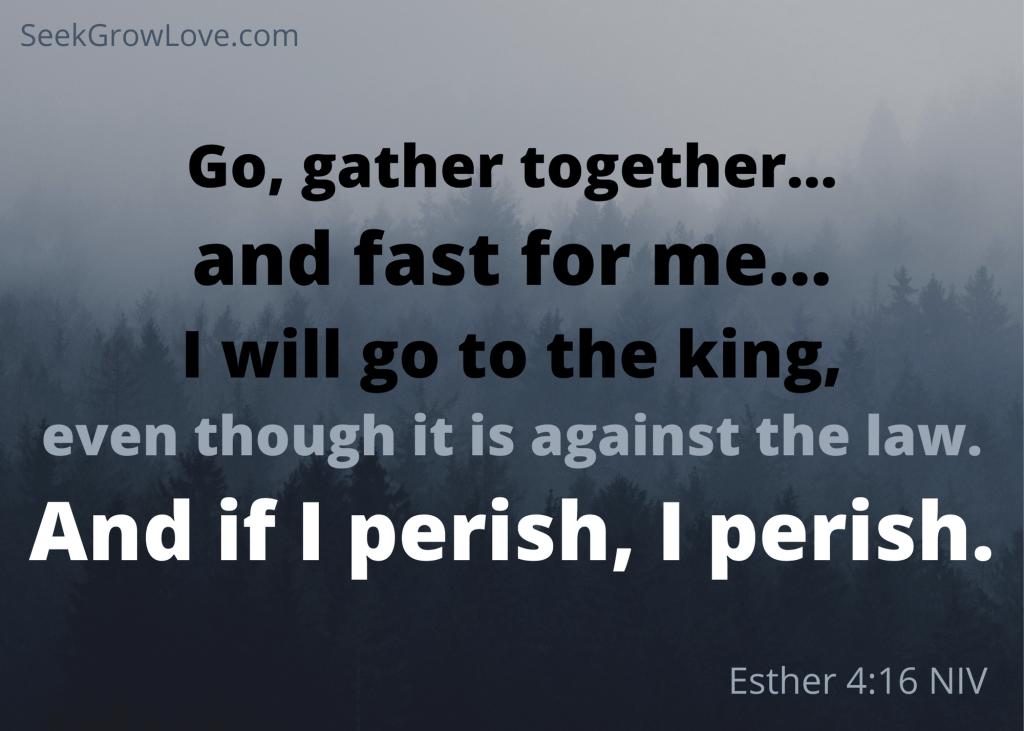
Chapter four has some of the most famous sentences recorded. As Mordecai is imploring Esther to take action to save her people from annihilation, he says to her, “And who knows but that you have come to a royal position for such a time as this?” (verse 14) And two verses later, Esther replies, “I will go to the king, even though it is against the law. And if I perish, I perish.”
Talk about resolve in a time of tribulation! Esther’s character in this time is certainly one to take notice and imitate.
Which brings me to the phrase that jumped out at me in preparation for today and it’s found back in chapter 3, verse 15. Haman is thrilled that his plot will be carried out, even if he has to wait months for it to come to fruition. But just in case the king starts to really think about what he’s agreed to, Haman takes him out for drinks to keep him distracted. Meanwhile, the city of Susa is left wondering why would an edict for the complete destruction of a people group be made? What happened? Why the Jews, what did they do? What if Jews were intermarried, would some family members be killed while others be left alone? What if I did business with some Jews? What if my closest friends were Jews? Was I just expected to stand aside and let the authorities carry out a nonsensical edict? Who am I to stand against the government?
Does this sound like another time as described in modern day world history books?
As an ordinary citizen in my town, in my state, in my country, there are plenty of times when governing authorities make decisions that don’t quite make sense. I admit that while I do participate in elections, I’m otherwise not politically active or especially knowledgeable beyond the headlines that pop up in my notifications. And so I can relate to the citizens of Susa who were left bewildered. Would I take action to try to stop the impending atrocities or would I remain in my confused state and watch events play out?
There are plenty of causes that anyone could choose to become involved in to make a difference for the vulnerable. How and when is between the individual and God. But that’s not exactly where I’m going with this.
I do want to remind you, dear friend, that even when this world leaves us bewildered, confused, or even indignite over injustices, as believers in the faith, we are also citizens of the Kingdom of God. And as God is eternal and true, we do not have to wonder or worry about some other authority coming in and stripping us of our spiritual citizenship. God is Almighty, He is holy, He is just, He is compassionate, He reigns over all creation, nothing is beyond His notice or His control. His care is over each and every one of us; He is trustworthy and faithful to His people. We can remain confident through prosperous times and turbulent trials that not only are we citizens, but we are children and even co-heirs with Christ in a Kingdom that will never end.
-Bethany Ligon
Reflection Questions
What do we learn of Esther’s character? Mordecai’s? Haman’s? The kings? Of those characteristics you listed which ones can you see in yourself this past month? Which would you like to work on eliminating in your life? Which would you like to work on growing in your life?
When have you been bewildered – perhaps by a government decision?
What do you know from your own experiences and from Esther’s life about God’s character?
Esther 2:5 – “Now there was in the citadel of Susa a Jew of the tribe of Benjamin, named Mordecai son of Jair, the son of Shimei, the son of Kish,”
The book of Esther opens up with introducing the reader to the reign of King Xerxes of Persia. His kingdom was vast and wide. His wealth was beyond measure. His wife, Queen Vashti, was one of the most beautiful women in all of the land. He seemed to have it all. Except King Xerxes didn’t have it all. He hadn’t yet conquered Greece. And his wife, well, she wasn’t keen on being paraded around objectified by men in drunken states. And for this, she was punished, dethroned, and for all intents and purposes, exiled. Now, King Xerxes didn’t have a queen.
Chapter two of Esther opens up with the phrase, “Now there was…” introducing us to a new set of characters in the story, Mordecai and Esther, who are the individuals that we should really turn our attention to. These two new characters are Hebrew exiles living in Persia under the reign of King Xerxes. And as we read through the book of Esther, we see that their presence in this kingdom is vital to the survival of Xerxes, but more significantly, the Hebrew population in Persia.
This phrase “Now there was…” has gotten me thinking about the other times it is used in Scripture. Within the NIV translation, it is used eight additional times. (Gen 12:10; 26:1; Nu 20:2; 2 Sam 9:2; 1 Kings 13:11; Luke 2:25; 23:50; and John 3:1) It’s an author’s way of transitioning to something new, maybe even something unexpected.
As we find ourselves in the middle of Advent season, I’m going to take my devotional-writer prerogative and divert slightly and transition to another, but related, idea. (We’ll come back to Esther tomorrow, I promise.)
I am thinking of key people in the narrative of Jesus’ birth that also deserve a “Now there was” introduction.
Now there was…Mary, the betrothed of Joseph, chosen by God to be the mother of the long awaited Messiah.
Now there was…Joseph, the man selected to raise the Messiah as his own.
Now there was…Gabriel, the angel who was sent to share the news of parenthood with Mary and Joseph.
Now there were…the shepherds who witnessed a great company of the heavenly hosts praising God upon the birth of Jesus.
Now there were…the Wise Men who traveled from afar to present gifts of frankincense, gold, and myrrh to the new born child.
All of these people had a role in introducing Jesus to the world, just as he was born. There are many prophets who foretold Jesus in the Old Testament. There are many apostles and disciples who continued to tell the world about Jesus through the Gospels and Epistles of the New Testament.
Who is telling the world today about Jesus?
Now there was…YOU.
We each have the privilege and responsibility to continue to share the Gospel message to those who do not know it yet.
As we celebrate the birth of Jesus with family and friends, let us not forget that there might be someone we know who needs to be introduced to the Lord and Savior of the world. They need to hear the message that they are loved, that they can be healed, that there is hope beyond what they experience today. YOU can be the difference for someone else today and give them the greatest gift of all, the Gospel message.
May God bless you and keep you as you go about your day.
-Bethany Ligon
Reflection Questions
In the first two chapters of Esther what have we learned so far about the main characters: the King of Persia, Mordecai, and Esther? How would you describe each one?
Choose a character from the events of the birth of Jesus. How would you describe him/her?
How would you like to introduce someone to Jesus? Pray about the opportunity, the words, the hearts (yours and theirs) that can make the difference.
Esther’s boldness is often written about… If I perish, I perish.
Kind of melodramatic.
The real story here, although not presented with as much flourish, is Esther’s discernment. When Mordecai tells her what she needs to do, she doesn’t just swoon the ‘if I perish’ line and exit stage left to appeal to the king. She asks for time to pray and fast herself, and asks for others to join her.
Go, gather all the Jews to be found in Susa, and hold a fast on my behalf, and do not eat or drink for three days, night or day. I and my young women will also fast as you do. Then I will go to the king… 4:16
After this, Esther still doesn’t march into the king’s presence and boldly present her ask. What she does is be intentional with each and every action and word. She chooses what to wear, and she puts herself in the right place. And she stands there.
Esther put on her royal robes and stood in the inner court of the king’s palace. 5:1
Even after the king receives her and asks for her request, all but assuring her that the answer will be yes, she continues to act with discernment.
And the king said to her, “What is it, Queen Esther? What is your request? It shall be given you, even to the half of my kingdom.” And Esther said, “If it please the king, let the king and Haman come today to a feast that I have prepared for the king.” 5:3-4
At the feast, the king repeats his promise to give her what she desires, but still she doesn’t ask. We can’t really explain why she does what she does, but what can explain it is that she is being led by a wise and knowing God because she has taken the time to listen to him.
And as they were drinking wine after the feast, the king said to Esther, “What is your wish? It shall be granted you. And what is your request? Even to the half of my kingdom, it shall be fulfilled.” Then Esther answered, “My wish and my request is: If I have found favor in the sight of the king, and if it please the king to grant my wish and fulfill my request, let the king and Haman come to the feast that I will prepare for them, and tomorrow I will do as the king has said.” 5:6-8
And then this happens…
On that night the king could not sleep. 6:1
A-ha! His sleepless night led to him doing a little light reading which opened a door for God to speak directly into him. God didn’t put Esther in this place so she could convince the king, he put her there simply to ask. And she did, the next day…
And on the second day, as they were drinking wine after the feast, the king again said to Esther, “What is your wish, Queen Esther? It shall be granted you. And what is your request? Even to the half of my kingdom, it shall be fulfilled.”Then Queen Esther answered, “If I have found favor in your sight, O king, and if it please the king, let my life be granted me for my wish, and my people for my request. For we have been sold, I and my people, to be destroyed, to be killed, and to be annihilated. If we had been sold merely as slaves, men and women, I would have been silent, for our affliction is not to be compared with the loss to the king.” Then King Ahasuerus said to Queen Esther, “Who is he, and where is he, who has dared to do this?” And Esther said, “A foe and enemy! This wicked Haman!” 7:1-6
Far too often, I think we inflate just how much God needs us. He truly does the heavy lifting far more effectively than we can. Our job is to learn to tune in to when it’s time to speak and when it’s time to put on the royal robes and just stand.
How often do we think we’re helping God, or are certain that we’re on the path to do the most good (both positive intentions, by the way) but we’re not doing an awful lot of praying or fasting before we move, speak, or bulldoze ahead?
Maybe God’s thinking, ‘It’s great that you’re willing to perish, but all I really need you to do is just stand there today.’
-Susan Landry
Reflection Questions
Have you tried praying and fasting before making a large decision or bold action? If so, did you find it beneficial? Whether you have done it before or not, what might God want you to spend time praying and fasting about?
Can you think of a time you may have been to0 quick to act – not acting within God’s perfect timing?
When have you seen examples of God’s perfect timing?
And all the king’s servants who were at the king’s gate bowed down and paid homage to Haman, for the king had so commanded concerning him. But Mordecai did not bow down or pay homage. Esther 3:2
When I read this description, it reminds me of a scene from a movie. In The Avengers, Loki tells a group of people outside an opera house to kneel before him. There’s one old man in the crowd who stands when Loki says to the people,
“In the end, you will always kneel.”
“Not to men like you,” the gray-haired man says.
Loki responds arrogantly, “There are no men like me.”
“There are always men like you.”
Turns out, he was right! There have always been men like Loki, people who are consumed with pride, hungry for power and so murderous in their pursuit of it that they are willing to wipe out a population of people. Genocides in Rwanda, Bosnia…the Holocaust. These modern tragedies, though horrendous, are not new.
Haman, from our passage in Esther, was so like Loki that he set out to destroy not only Mordecai, but his entire people.
Letters were sent by couriers to all the king’s provinces with instruction to destroy, to kill, and to annihilate all Jews, young and old, women and children, in one day, the thirteenth day of the twelfth month, which is the month of Adar, and to plunder their goods. Esther 3:13
I don’t watch scary movies…but isn’t that kind of the plot of The Purge?
Haman was clearly a petty man. Willing to murder an entire race because one man didn’t give him the respect he felt he deserved.
…when Haman saw that Mordecai did not bow down or pay homage to him, Haman was filled with fury. Esther 3:5
Most of us won’t commit genocide over a slight. Most of us won’t even get filled with fury when we don’t get the recognition we deserve. But we may become filled with jealousy, or bitterness, or discouragement. Ego can take a lot of different forms.
Haman based his worth in his status, and it was easily dismantled when that status was challenged. Like Haman, we can find our worth in the wrong place. Our successes or wins, being right, our appearance, finances, being liked, our intellect… really any number of things. And when that worth is dismantled (as it will surely be) we can go the way of Haman and act out to try and earn what we have lost, or we may simply feel worthless.
I don’t think we’re any more aware of doing this than Haman was. We are deceived, and we experience the results of our deceit, causing us to react. Maybe instead of trying to change our reactions, we would be better served to dig a little deeper and expose where it is we believe our value is based. Awareness may not eliminate our bent, but shining a light on deceit is the first step in seeing the truth.
-Susan Landry
Reflection Questions:
How would you describe Haman? How would you describe Mordecai? How are you like, and unlike, each of these characters?
How are you most likely to react when your ego is damaged?
Where do you find your worth? Is it serving you well? Are there adjustments to be made? What does God say makes you valuable?
I wanted to focus on Esther chapters 1-2 today, since that section makes us think about some important and difficult things. If you’re not an adult, you will be soon, and reading the bible as an adult means you notice things that your younger, more innocent self didn’t notice. And once you notice things, you can’t un-notice them. Instead, you will have to think about them and try to sort them out. You could call them the “seriously-why-is-this-in-the-bible” moments, and the bible offers so many of them. I’ve found that you really get the value out of them if you awkwardly lean into them rather than ignore them. So let’s get uncomfortable for a few minutes.
The context is that King Ahasuerus is on the hunt for a new queen after removing Queen Vashti from her position for not obeying his command. He orders that beautiful young virgins be gathered up (by force) from his entire kingdom, and he would pick his favorite to be queen. This is basically an ancient version of “The Bachelor,” but the women had no say in whether they would participate or not. After going through a year-long intense beauty regimen (like a spa day, but for a year), each woman would have her turn to spend the night with the king. The morning after, she would be moved to a harem of concubines, to be called upon whenever the king wanted.
It is more than clear that when the women have their night with the king, his expectation is a sexual encounter. Given that the women have no say in this, they are essentially prisoners, and that makes the king, well, a serial rapist. Like so many kings we have heard about, this king is a tyrant and is abusive of his power. He is accountable to nobody, does what he wants, and treats people like things for his own gain. In this case, being a candidate for queen is not a privilege, it is a terrifying situation. Each of the women now belong to the king forever whether they like it or not. Not cooperating would probably mean death for them.
It is sometimes difficult to know what to do with an unpleasant passage such as this. It’s not the kind of thing that causes you to feel inspired or connected to God, but we’re able to learn something from it.
Beware of power. The king is a great example of how having power can corrupt you. When there are no checks or balances, and your word is the law of the land, you can have whatever you desire, even if your desires turn dark. Unfortunately, the church is not immune to this danger. There is something that tends to happen when a church becomes a mega-church and the pastor attains celebrity status. Narcissism takes over, and some pastors or leaders commit terrible abuses of people. We need to put systems of accountability in place to help prevent this. Also, we need to lean on the example of leadership that Jesus gave us. It was never about using power for his own advantage, but about serving people (see Philippians 2:5-8).
Do not take advantage of people. At one point in time it may have been culturally acceptable to own people as property. That time is long gone. There is a reason why the practice of slavery is illegal in every country of the world. Treating anyone like they are property or like they are worth less than you violates their status as the image of God. It is easy to love things and use people. Do the opposite. Love people and use things.
Real-life ethics are hard. The right path through our circumstances is not always clear. Esther faces some tricky ethical dilemmas in this story. Should she cooperate with the king, or should she risk harm or death and resist him? What would be more right? Should she tell the king about the plot to assassinate him? After all, allowing him to be assassinated could be a quick solution to some of her problems, but on the other hand, it could invite equal or worse troubles. Esther opts for the long game, telling the king of the assassination plot, which shows her loyalty and gains the king’s trust. Having the king’s trust proves to be crucial later on in the story.
There is hope. Esther is not in a great situation, but (spoiler alert) we know from the rest of her story that God is able to use her in powerful ways to bring about something good. This doesn’t mean that God causes the bad circumstances we find ourselves in, but he is always working to make the best of them. Partner with God in that mission.
-Jay Laurent
Hi, I’m Jay. I’m a nerd by trade and passion. I enjoy consuming, playing, and creating music whenever I can. I’m a big fan of books and coffee, especially together. My wife, Lauren, and I live in Illinois, and love to play board games, watch shows or movies, or go on a good hike together.
Reflection Questions:
1. What power do you have? What can you do to put checks on it so that you won’t abuse it?
2. What troubles are you going through? How might God be working in your life through (or despite) them? Who is God shaping you to be on the other side of them?
God calls His people to be bold and courageous, willing to face the forces of this world and even death if it comes to it. Since the beginning of humanity, the enemy has been set on destroying the people of God. The story of Esther is no exception to either of these truths. Esther was the Queen of King Ahasuerus (or Xerxes), the king of the Persian Empire. Previously in the book of Esther, we are introduced to a few important figures in the story: King Ahsuerus, Esther the Queen, Haman, an official of the king who hated the Jews, and Mordecai, her cousin who took her as his own daughter. Long story short, Haman devised a plan that would bring the targeting and killing of all the Jews in the land. For obvious reason, Mordecai and all the Jews were mourning and in great distress over this decree from the King for their execution!
That is when we see an amazing conversation between Mordecai and Esther with the help of some messengers going in and out of the King’s palace. (Mordecai was in mourning garments and thus was not allowed to enter.) As you read this conversation between Esther and Mordecai, remember the situation Esther is in. She is the beloved Queen of Ahasuerus, living in luxury and high status to one of the most powerful people in the world at that time. She is also a Jew herself and her King unknowingly ordered the decree of her people’s destruction! She had a choice to make, stay quiet and continue her way of life that was pleasant and full of material wealth, or risk her life in an attempt to save her people. The fact that she is even discussing what to do with Mordecai shows her heart. As the conversation continues, Mordecai says something of brilliant wisdom and faith towards God, “If you keep silent at this time, relief and deliverance will rise for the Jews from another place, but you and your father’s house will perish. And who knows whether you have not come to the kingdom for such a time as this?” Mordecai brings up a few excellent points. One, sometimes our worst course of action isn’t doing something evil, but not doing something good. Two, God loves his people and will bring them into salvation, no matter how messy or tragic things become. Three, recognize how your particular situation can be used by God to bring God’s kingdom on earth as it is in heaven. In response to this, Esther completely reveals what choice she is going to make, “I will go to the king, though it is against the law, and if I perish, I perish”. That is a claim of boldness for her God. That is a heart of love for Yahweh and her neighbor. That is what it looks like to live for the glory and worship of God!
What problems do you see around you? With whom do you have a strong relationship? What tools do you have at your disposal? What choices do you have to make? How will you rely on God to be bold and courageous while facing the struggles around you? I encourage you all today to look at the amazing example Esther set for us about what it means to be a child of God. Be willing to serve Him with such boldness that you are truly willing to say, “If I perish, I perish.” Be smart with the time, place, and resources God has put at your disposal. “Who knows whether you have not come…for such a time as this?”
-Isaac Cain
Questions for Reflection and Discussion
Give some examples of when the worst course of action isn’t doing something evil, but not doing something good. Are there any that come to mind from your own life? What did you do – or not do? Any good (and courageous) actions you wish you would have done?
Do you have a Mordecai in your life – someone who helps break down the problem in front of you and helps you see your potential while challenging you and praying for you? To whom can you be a Mordecai?
What were all of God’s people in Susa to be doing to support Esther? What were the results? Go ahead and read more from the book of Esther to see how God’s perfect timing and work in men’s hearts, along with Esther’s courageous actions saved the day. Have you ever tried calling out to God with fasting?
How will you rely on God to be bold and courageous while facing the struggles around you?
And, that concludes our look into the Highlights of the Old Testament books of law and history (the first 17 books of the Old Testament). Tomorrow, we go back to the New Testament with a one-chapter-a-day look at the gospel of John which will lead us right into Resurrection Sunday. What will we learn about our Savior Jesus?






 Seek Grow Love