So They Will Know

Exodus 7-9

Moses does not believe that he can speak adequately, so what does God say? He does not tell Moses, “I am sorry. I picked the wrong man.” No. Instead He says, “I picked you for a reason. If you can not speak, then delegate that duty to Aaron.” God still says that He is going to speak through Moses, not Aaron. Once Aaron has received the words from Moses, then Aaron can speak them to Pharaoh. In fact, this is the way that religion is going to work for the rest of human history. God will pick a prophet, whether that prophet thinks he is capable or not, and will speak to the rest of humanity through that single person. God is also able to set up leadership through this prophet and the prophet can lead others and coordinate with them in order to achieve more and reach more people. This is what is established in the Levitical priesthood.

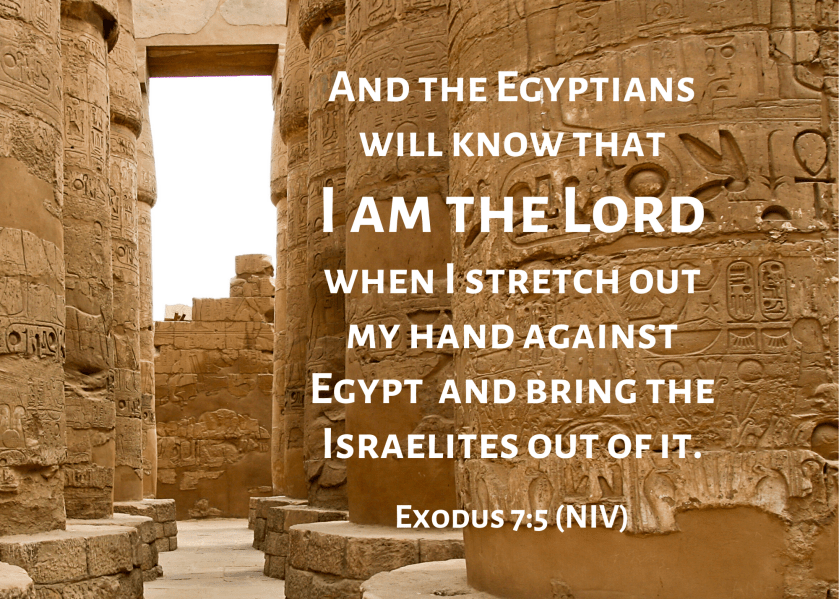
I recently heard an interesting interpretation on the hardening of Pharaoh’s heart. I have usually not been able to define the phrase “hardened heart” when I read it. This interpretation however, defines the hardening of a heart as making a man brave. Under this interpretation, God did not force Pharaoh to refuse to listen. Pharaoh first chose to ignore the words of God. Then, when he became fearful because of the plagues, he was willing to let the Israelites go. It is at this point that God makes Pharaoh brave, allowing the Pharaoh to hold to his original decision not to let them go. I think this interpretation has some merit and is interesting at least.

Why did God choose the plagues that he chose? Why did he turn the Nile to blood? He could have turned it to mud or dried it up or anything. Why did he send a plague of frogs? Why not crocodiles or giant river snakes or something a little more intimidating? Why gnats? Gnats are just tiny little things, a nuisance at worst. Well God is the mastermind behind all of this, so He must have known what he was doing. Let’s try to think about all of these plagues in the context of Egypt. We know that Egypt is full of sorcerers who have a handful of tricks. We also know that the Egyptians were polytheistic and had many zoomorphic gods. Finally, we know that the Pharaoh had been oppressing the Egyptians with hard work and even worse, had slaughtered all of their baby boys.

God could have just dried up all of the water in the Nile and it would have had the same effect. All the fish would die and begin to rot and stink. There would be no water to drink. Yet God chose blood. This relates to what I said yesterday about turning people by degrees. God is starting with a plague that the Egyptians think is mere magic. The same thing occurs for the frogs, but the magicians can not create gnats. There is definitely some symbolism to blood in the Nile, possibly referring to the Pharaoh’s slaughter of the newborns. I also think it has to do with the significance of the river to Egypt. That river was a large part of the economy for them, they relied on it. So God took it away. Man should rely on God because he is the source of life. Even at this point in history, people knew that blood is an essential part of life and thought that a person’s life was in their blood. Thus, by turning the river to blood, God is saying, “I give life and I take away life.”

The plague of frogs is a weird one for me. The way it is described makes it sound like an inconvenience; they are just everywhere. One commentator I read said that this was poking fun at the Egyptians gods Hapi and Heqt. God was directly challenging the gods of Egypt.

The gnats are particularly nasty. Have you ever been out on a run in the summer when all of a sudden your mouth is full of gnats? Maybe that is just me. It is one of the most unpleasant experiences. Now have you ever been in a dry, dusty field running around and kicking up dirt? That is also quite unpleasant. It gets tough to breath. One time I was in a situation like this and I had to keep blowing my nose until it stopped coming out black. Now replace the dust in this field with gnats. That is a nightmare.

I am going to stop there and ask that you ask yourself these questions and see if you can come up with an answer. Why flies? Why livestock? Why boils? Why hail? God has every tool imaginable at his disposal, yet He deems these to be the best plagues for this situation. Why is that?

Thanks everyone for starting this plan and sticking to it! If you started from the beginning, great job making it this far and if you are just joining, I hope that you are able to find a routine of your own or hop in with this one. There is nothing better for the mind than to focus on God’s word daily.

Thanks for reading,

Nathaniel Johnson

(originally posted for SeekGrowLove on February 1, 2020)

Reflection Questions

  1. Why do you think God chose the plagues that he did? At which plaque would you have let the Israelites go?
  2. How might you describe a hard/hardened heart? Where have you seen one before? Have you ever experienced one? When is there a downside to being brave?
  3. What were some of the truly miraculous things about the plagues – including the timing, the location, the extent of each? What were the Egyptians learning? What were the Israelites learning? What are you learning? Who can you pass this knowledge on to?

Be with My Mouth

Exodus 4-6

Oh Dear Lord, please be with my mouth and teach me what I shall speak! Because my mouth is not eloquent.

Sometimes it is downright rude. Sometimes it lies. Sometimes it gets angry. Sometimes it hurts people.

Oh Dear Lord, please be with my mouth and teach me what I shall speak! Sometimes it stays shut when it should open to speak your words. Sometimes it forgets to give you praise. Sometimes it prefers to be grouchy or selfish instead of thankful.

Oh Dear Lord, please be with my mouth and teach me what I shall speak! Sometimes it doesn’t speak up for the oppressed. Sometimes it misses opportunities to spread joy and hope and your love. Sometimes…

Oh Dear Lord, please be with my mouth and teach me what I shall speak!

In Exodus 3 & 4 Moses is giving God lots of reasons (excuses) why He should pick someone else for the job of delivering God’s first-born child (the Israelites) out of slavery in Egypt.

  • I am nobody special
  • I don’t even know your name
  • The elders won’t believe me
  • I am not eloquent
  • Somebody else can do it better

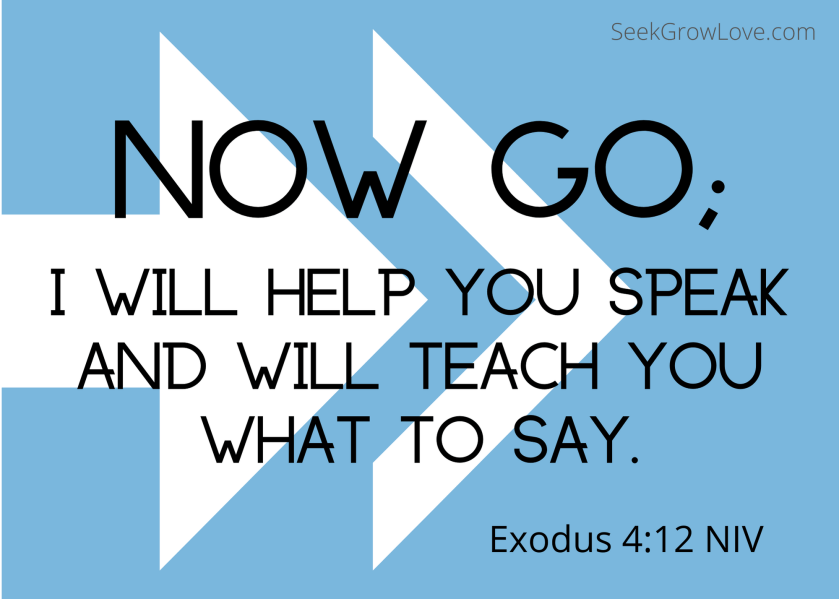
God has answers for it all. I love the Lord’s words in Exodus 4:12 (ESV): “Now therefore go, and I will be with your mouth and teach you what you shall speak.” What a beautiful promise! Yet, Moses still pleaded with Him to just send someone else! God got angry at that one. How many times does this child of God need to be reassured that his God is bigger than any fear that comes with doing His Work. The maker of your mouth can teach you how to use it – when you step up and GO where He wants you to GO! Did you notice that little two letter word at the start of God’s promise to be with Moses’ mouth and to teach him what to say? You’ll never know what words God is waiting to teach you to say if you say no and don’t go.

God graciously compromised with Moses and rather than sending someone else instead of Moses, He sent someone else to go along with Moses, his brother Aaron who was not ‘coincidentally’ coming out to the wilderness to meet Moses.

Maybe it’s time I spend less time on my excuses and instead say YES, step out and GO and trust God to do what He says He will do – be with my mouth and teach me what I shall speak!

-Marcia Railton

Reflection Questions

  1. What excuses have you tried giving God for not stepping out to do a job He wants you to do? How do they stand up to your GREAT BIG GOD?
  2. How can you be someone’s Aaron and come alongside him/her to do a job for God that perhaps neither of you would feel you could do “on your own”? Though, you are of course never “on your own” when you are doing the Lord’s work!? What are some other instances that God used the buddy system and what were some advantages to having a partner?
  3. So – the big question is – where does God want you to go? If you aren’t sure yet, be praying. And then, thank Him for being with your mouth and teaching you what you shall speak.

His Name Forever

Exodus 1-3

After Moses fled Egypt and saved the Midianite women from the jerks at the well he settled down and had children and lived a simple life as a farmer/shepherd.  Meanwhile the rest of the Israelites were groaning in their captivity in Egypt and their cry rose up to God and he took pity on them (Exodus 2:23-25).  God was then ready to call up Moses out of the wilderness so that he can carry out God’s plan.

Exodus 3:10-15

10 So now, go. I am sending you to Pharaoh to bring my people the Israelites out of Egypt.”

11 But Moses said to God, “Who am I that I should go to Pharaoh and bring the Israelites out of Egypt?”

12 And God said, “I will be with you. And this will be the sign to you that it is I who have sent you: When you have brought the people out of Egypt, you will worship God on this mountain.”

13 Moses said to God, “Suppose I go to the Israelites and say to them, ‘The God of your fathers has sent me to you,’ and they ask me, ‘What is his name?’ Then what shall I tell them?”

14 God said to Moses, “I am who I am. This is what you are to say to the Israelites: ‘I am has sent me to you.’”

15 God also said to Moses, “Say to the Israelites, ‘The Lord, the God of your fathers—the God of Abraham, the God of Isaac and the God of Jacob—has sent me to you.’

“This is my name forever,

   the name you shall call me

   from generation to generation.”

It is very interesting that Moses had to ask God about his name.  In the eyes of the Israelites God had abandoned them when they were enslaved in Egypt, and they had mostly wandered away from God since then and had taken on the gods of the Egyptians.  It was the mindset of the Israelites that God had forsaken his promises to Abraham, Isaac and Jacob and Moses was basically asking if God was wanting to start over in his relationship with the Israelites and form new covenants.  God emphatically states that he is to be known to his people as the God of Abraham, the God of Isaac, and the God of Jacob, to remind them that those promises still stand, and will stand for eternity. It is helpful to remember God in terms of what he has done for you or your loved ones, which is why God instructs the people to remember him as the God of Abraham so they will remember the stories that have been passed down of God’s faithfulness to their ancestors.

We need to be reminded of the fact that God does not change his mind like we do.  God does not forget a promise. Just because things have changed in our lives and we are having doubts doesn’t mean that God is no longer the one who created the foundations of the earth.  If we have sinned, or walked away from God for a time, or had a traumatic event in our lives it doesn’t change the fact that God IS, and that the blood of His Son Jesus can still cover our sins.

-Chris Mattison

(Originally posted for SeekGrowLove on Oct 3, 2018)

Reflection Questions

  1. What do we learn about Moses in the first 3 chapters of Exodus?
  2. How did the first 40 years of his life, spent in Egypt in the Pharaoh’s house, help prepare him for the job God selected him to do when he was 80? How did his years in Midian help prepare him? What talents, characteristics, knowledge, wisdom, connections, experiences, failures and accomplishments are in your past and present that could be useful for a future task God is preparing you for?
  3. What examples of God’s faithfulness would you do well to remember and pass on to the next generation so they can remember, too?
  4. What does it mean to you that God wants to be known by this same name forever? What does it tell us about God? What does it tell us about the past, present and future?

As the Lord Commanded

xr:d:DAF9DaYtKWE:7,j:8357973981139934165,t:24021713

Old Testament: Exodus 39 & 40

Poetry: Psalm 36

New Testament: Acts 3

One of my favorite pastimes is sewing simple bags and quilts and occasionally even clothes. I love looking at fabrics and dreaming about what could be made with it. Yesterday I even drove four hours for a really good fabric sale – and lunch with mom -thanks mom! I can spend hours on the internet researching what people are making with their fabric, how did they do it and who has the best detailed directions to help me make what I want to make.

So, pretty much, Exodus 39 was written for people like me. The rest of you might not be too interested in the detailed step-by-step directions of what the fiber and gold artisans created for the priests to wear when they were ministering in the tabernacle. You might not be curious how they fastened the gold filigree settings which held the precious onyx stones to the shoulder pieces. You might not have nodded knowingly when they explained that a band was added around the neckline to prevent it from tearing because you saw the same need on the Nativity costumes.

But there is something big in this chapter that anyone can notice and appreciate – even those who have never in their life held a needle in their hand or contemplated making clothes. And that is the number of times the phrase, “as the Lord commanded him/Moses” is repeated. Seven times it is used just in the sections of chapter 39 regarding the priestly clothes. Additionally, the same or very similar phrases are used eleven more times in the rest of this chapter and the next as Moses inspects and then assembles in place all the final pieces of the tabernacle created by the craftsmen: the magnificent ark of testimony with its stately gold cherubim, the altar for burnt offerings, the altar for incense, the intricate lampstand, the wash basin, the courtyard curtains, bases and stands, and coverings, the garments and all the other pieces, right down to the ropes and tent pegs. When all these pieces are put together – just as the Lord commanded – then, they finally have a place where God’s glory would dwell. So why is it recorded 18 times in these two chapters that the work was done as the Lord had commanded? Perhaps because it matters to God if the work is done as He commands.

If I want to make an outfit I can find countless books and blogs, patterns, tutorials and videos showing me the steps I can take. Some create clothes I am just not interested in or wouldn’t fit me at all. Others have glaring errors, or sometimes even little mistakes that end up making a big difference in the end: missed steps, mismeasurements, or sloppy work. It can be a big challenge finding the best directions I can truly trust that will help me create the final product I desire.

Similarly, there are countless sets of directions for how to make the life you desire. You can find directions for life everywhere: TV commercials, movies, self-help books, classrooms, churches, parents, peers, and endless online sites to name a few. Some directions I know I am not interested in at all: the end product wouldn’t fit me, just isn’t my style or not what I am looking for. Others look like they would create a life that would be perfect for me. But, it turns out the directions have errors: they don’t include all the proper steps, they add in steps that trip you up, they don’t give the correct measurements, they use materials that won’t stand up to the wear and tear life brings, they lead to sloppy work and sloppy lives. If I follow those directions my finished product will not be what I intended to create.

God alone has the best detailed directions for making what I want to make – a life devoted to Him, ready for His Son’s return, and ready to dwell in His glory forever and ever. While I wait for His full glorious kingdom on earth, I want to make a place – my life – where a sliver of God’s glory dwells in me and shines through. In order to create this project I need all the pieces created just as He commands. I need to use all the proper materials and resources and carefully follow the step by step tutorial I trust. The directions God gives in His Word tell me every step I need to take, and those I don’t need and those I definitely don’t want. Following God’s directions and commands will keep me from creating a sloppy life with fraying edges. God knows the best way to do life, will I listen and do as the Lord commands?

God knows. How often I forget. God knows the best way. His commands can be trusted. In Exodus 39, this seamstress loves that God even knows how to keep the neckline from fraying – and he tells us – add a band. Do it right. Follow the Lord’s commands and the end product will be a thing of beauty that brings glory to Him.

We have work to do. Will we do it the way God commands?

-Marcia Railton

Reflection Questions

  1. As I considered all the gold and ornaments and details God chose for the priests I had two thoughts regarding our worship today. 1 – While our pastor’s roles are different from the priests of Moses’ day, I wonder if God wants us to show more honor and respect to their position than we do, even if they no longer wear jewels on their breastpiece. 2 – Maybe God cares a bit more than we previously thought about our own attire when we come before Him. What do you think?
  2. Why do you think it mattered to God what the priests wore? Why do you think it mattered to God what the tabernacle looked like?
  3. What kind of a life are you working to create? Whose directions are you following or are you making up your own? What bad directions have you already decided you won’t be using? What does following God’s directions look like?

Gold and Goat Hair

Exodus 35:5a NIV

Old Testament: Exodus 35 & 36

Poetry: Psalm 34

New Testament: Acts 1

Gold and goat hair. Silver and sea cow hides. Bronze metal and blue yarn. Onyx stones and olive oil. These all were great offerings to do the work of God. These were just some of the precious, as well as the more common, everyday items that were brought as offerings to create the very first tabernacle.

God had given Moses some very specific plans for what He wanted for His tabernacle including the furnishings and priestly garments. The creative Creator who designed heaven and earth and fashioned all sorts of lands, plants, fish, birds, animals and unique human beings was now showing His flair for architecture (albeit tent-like architecture that would travel well), interior decorating (including specific dimensions, materials and details for the furnishings and surfaces), and even fashion designing (of the stunning priestly wardrobe).

God gave the precise plans – and He also gave His Spirit. God gave His Spirit to fill these craftsmen (Bezalel, Oholiab and other skilled persons) with skill, ability and knowledge so they would know how to create His masterpieces in gold, silver, bronze, stones, wood and “all kinds of artistic craftsmanship” (Exodus 35:33). And the Bible records that God also gave both Bezalel and Oholiab the ability to teach others these skills. What a creative and masterful and wise Spirit of God, which God still gives today! Have you received any of His crafty, skilled Spirit? If so, how are you using it to do His work? Are you able to teach others what God has given you? How can teaching others your skills and abilities further God’s work?

God gave the plans and His Spirit with the skills, it was up to the people to give the resources. ”All the Israelite men and women who were willing brought to the LORD freewill offerings for all the work the LORD through Moses had commanded them to do.”  (Exodus 35:29) These offerings were not required (as other offerings were), but these were voluntary offerings. ”Everyone who was willing and whose heart moved him came and brought an offering to the Lord for the work.” (Exodus 35:21) And they did give! They donated their gold jewelry to the cause. Those who had acacia wood, bronze, spices and oil gave what they had. The skilled willing women got to work spinning the colorful yarn, linen and goat hair. There was no gift too large and no gift too small. It was all given with a willing heart and would be used for the Lord’s work. They even gave and gave until they were told to stop because they had given more than enough to complete the sanctuary. 

I am not sure your church would find a good use for your donated goat hair today…um, wait, correction, my quick internet search just now revealed several common uses for goat hair including paintbrushes, rugs, carpet, and even Mohair or cashmere (different from rabbit cashmere) to be used in making sweaters or even fine pants for your pastor. So, go ahead keep collecting your goat hair for God, if that is what you have and your willing heart is telling you to give it to Lord’s work. 

And also consider, what do you have, or could you acquire with what you have, to provide for God’s work today. I’m guessing God’s not planning on building a tabernacle in your backyard, but do not doubt He has many, many plans that you can be an exciting part of with your participation and your offerings. What is your church doing that you can be a part of, contributing your time, talents and what you have to a larger extent than ever before? Could the children’s ministry use new crayons or is the kitchen running out of coffee cups? Would a tray of cookies be useful after church or could you help provide a spring cleaning spruce-up? What needs can you provide? Do you have a crafty skill to create a piece of artwork or functional thing of beauty (furniture or banner or blanket) for God’s church or even for His work outside of the church (perhaps a donation for a non-profit organization). Where is God’s work around the world in need of what you have? Sometimes the need is as simple as highlighters, glasses, or flat frisbees. Sometimes it’s Bibles, bikes and fertilizer. Sometimes it’s larger, like a church building – a new tabernacle. What do you have (given to you by God), that He would love to see you use to further His work with one of your neighbors in need – your means of transportation, your coffeepot, you sharing a skill? 

What is your heart moving you to offer to God’s work? Consider both your valuable and precious resources as well as your common and everyday items? What gold and goat hair will you offer to God with a willing heart? 

-Marcia Railton

Reflection & APplication

  1. What do you have (or have the means to acquire) that could be used to do the work of the Lord? How is your heart moving you to give offerings to the Lord’s work? 
  2. Pray about it and do it.

Abounding in Love

*Old Testament: Exodus 33 &34

Poetry: Psalm 33

New Testament: Matthew 28

As a child, I remember making an emergency run to the neighborhood store with my Mom for a box of cereal. It was the night before Valentine’s Day. Our teacher had told us to decorate a cereal box to transform it into our personal Valentine’s Day mail box. Of course, I had forgotten all about this class project until the night before it was due. Everyone in our class would buy a pack of cards. I liked opening my box of cards and reading through each one as I addressed and signed them. I was so excited to drop the cards in the other boxes for my classmates. The class card exchange has been a long-standing tradition and a fun way for kids to express fondness for classmates. Expressing fondness, admiration or appreciation for others is definitely a skill that I want to pass on to the next generation. And more importantly, I want all of us to be able to express our love to God and show the love of God to others. In fact, Jesus taught us that the greatest commandment is to love the Lord our God with all our heart, soul, mind and strength and the second commandment is to love our neighbor as ourselves.(Mark 12:29-31)

The LORD has always shown human beings His love. He created us, cares for us, provides for us, sustains us…His interactions show His love because God is Love. The love that God shows us is perfect love, agape love. You know that perfect love of God: love that is patient, kind, not envious, not boastful, not proud. Love that doesn’t dishonor others, is not self-seeking, is not easily angered, and doesn’t keep a record of wrongs. This love doesn’t delight in evil, but rejoices with the truth. (1 Corinthians 13) You know. That kind of love. The love that never fails.

Moses had many opportunities to experience the LORD’s love through his own life and through the LORD’s interaction with the Hebrew people. But leading this rebellious group had Moses seeking God more than ever. He pleaded for His presence to go with them on their journey and he asked to see God’s glory. God grants his request. Early in the morning, Moses heads up Mount Sinai with the new stone tablets in his hands. We see Moses being rewarded for seeking a close, loving relationship with the LORD. The LORD came down in the cloud and stood there with him. He passed in front of Moses, proclaiming, “The LORD, the LORD, the compassionate and gracious God, slow to anger, abounding in love and faithfulness, maintaining love to thousands, and forgiving wickedness, rebellion and sin.”  (Exodus 34:6 & 7)

Just like Moses, we are so thankful for who the LORD is-abounding in love and maintaining love to thousands. But the LORD also states that He is just. He does not leave the guilty unpunished. That is the part that might scare us. After all, every one of us has sinned and come short of the glory of God. But the fear of the LORD is the beginning of wisdom and it is wise to realize that God is bigger than we are and has our lives in his hands. But as we grow closer to God, we realize that He wants all people to be saved and to come to a knowledge of the truth. He truly wants only the best for us. What Jesus called abundant life. Our fear of the Lord should motivate us to repentance and acceptance of His Son.  As 1 John 4:18 states, “There is no fear in love. But perfect love drives out fear, because fear has to do with punishment. The one who fears is not made perfect in love.” His amazing love for the world was so great that He gave us His only begotten Son, our Lord Jesus Christ. In love God offers us the opportunity to believe in Jesus and receive eternal life. (John 3:16) So it is time to walk closely with the LORD allowing Him to fill us with His perfect love.

-Rebecca Dauksas

Reflection Questions

  1. How would you describe God’s abounding love? 
  2. How did Moses experience it?
  3. How have you experienced it?
  4. How can you express your love for God today?
  5. How can you show the love of God to others today?

Homemade Idols

*Old Testament: Exodus 31 & 32

Poetry: Psalm 32

New Testament: Matthew 27

I grew up on a farm and was around cows a lot. Never once did I find qualities to be worshipped in our cows. Sure, sometimes they did something cute or funny, but to lift a calf into idol worship seems ridiculous to me. Yet many ancient cultures worshipped the bull. Apparently, the Hebrew people were aware of this practice, too. So while Moses is receiving the Law of the Lord on the mountain, Aaron is left in charge. The people told him to make them gods who would go before them. And amazingly he does it. He creates the idol from their jewelry. Aaron goes on to build an altar in front of it. He announces that they will have a festival to the Lord with burnt offerings and fellowship offerings. The LORD is writing instructions for Moses of who He is and how they can worship Him, but they decide to create their own idol and practice their own form of worship. Along with these bad decisions, they eat, drink and indulge in revelry.

The golden calf should illustrate the ridiculousness of placing anything or anyone in a position of worship. The LORD is the only One who should be there.

I wonder if we had our modern-day idols put out on public display with altars in front of them, what would we find? Things that represent power, relationships, careers, educational degrees, wealth, fame…What offerings are being given for these idols? Are we offering most of our energy, time, focus or money?

Even good things can become idols when we make someone or something else the highest priority in our lives. Material possessions can be viewed as blessings from the LORD. We can thank Him for them and use them to help others. When we do this, we are using God’s blessings for good, but if we become consumed in our material possessions, they become an obstacle to fully loving and serving the LORD.

We should ask ourselves, “Does anything or anyone hold a higher priority in my life than the LORD?”  In Colossians 3:5 we are told to “Put to death, therefore, whatever belongs to your earthly nature: sexual immorality, impurity, lust, evil desires and greed, which is idolatry”.
So we see here that evil things need to be eliminated from our life before we find that they have become idols.

The Hebrews show us the seriousness of putting idols in the place of the LORD. They made themselves a laughingstock to the other nations and they broke a blood covenant with the LORD. (Ex. 24:7-8) How much better it would have been if Aaron had refused? Even when leadership falters, we should stand for the LORD. Let’s move out any idols and make the LORD the center of our world by loving Him with all our heart, soul, mind and strength.

-Rebecca Dauksas

Reflection Questions

  1. Does anything or anyone hold a higher priority in your life than the LORD? What or who? 
  2. What offerings are being given for these idols? Are you offering most of your energy, time, focus or money to anything or anyone who is not the LORD God?
  3. What will you do to put God first (either again, or for the first time in your life)? What changes need to be made? What habits need to be broken? What habits need to be started? What will you do today to make it so? 

The Big Ten

Old Testament: Exodus 19 & 20

Poetry: Psalm 27

New Testament: Matthew 23

Today’s reading of Exodus 19 & 20 is probably one of the most familiar passages in the whole Bible for it includes the Ten Commandments.  It is important to understand the context of these commandments.  God entered into a covenantal relationship with Abraham and Abraham’s descendants through Isaac and Jacob and Jacob’s sons who became the twelve tribes of Israel.  God promised to bless and provide for his people and in exchange His people promised to be faithful and obedient to God and worship God alone.

After 400 years of slavery, Israel has grown from 12 sons and their immediate family to millions of people.  These people, God’s covenant people, will be settling in a land where they will need to live in community.  They are no longer slaves.  They are now responsible to live in that community in peace and productivity.   They need help to know how to live together.  God provides His people with the structure of how to live together as God’s people.  The Ten Commandments and subsequently nearly 600 additional laws were all designed to help them be healthy and blessed representatives of God to the rest of the world.

God loves all people.  We must never falsely believe that God only loves certain people.  God considers all human beings His children and loves them all.  God wants to be in a right relationship with all of his children; however, many are disobedient and have no willingness to be in a relationship with God and many deny that God even exists.

So God needed to start with one group of people and prepare them to be a special, chosen people who would bring the knowledge of God to others.  Exodus 19:5-6 says, “Now if you obey me fully and keep my covenant, then out of all nations you will be my treasured possession. Although the whole earth is mine, you will be for me a kingdom of priests and a holy nation.’

Israel was to be a kingdom of priests and a holy nation.  A priest is one who helps connect people and God.  God would go on to designate priests in Israel to help the people connect with God, but His expectation for Israel was that the whole nation serve as priests to help other nations connect with God.  Because the whole nation was being set apart by God to be priests for the world, they needed to live holy or set apart lives.  There were behavioral expectations that they were to follow.  They had to be exclusively loyal to God, they could not murder, steal, lie, cheat, they were to be respectful and honoring of parents and not misuse God’s name.

Now we are completing what God began in Israel.  Through Christ we have entered into a covenant with God.  We are now the covenant people, we are called to be a kingdom of priests and a holy nation.  That is the Church’s role.  And God expects us to live lives of holiness as we are set apart to serve God.  As you read through the many laws in the Old Testament, recognize that some applied very narrowly to the Nation of Israel and do not necessarily apply to us.  Dietary laws and sanitary laws were important in Israel at the time they were given but are no longer applicable.  However, some of the laws which pertain to morality have been reaffirmed by Jesus Christ for the Church.  In other words, as Christians we are free to eat pork and worship on Sundays, but we are not free to practice polygamy or murder.

God is truly a God of grace and mercy, but God is also a God who hates sin and punishes sin.  In this way we are still to live in fear of the Lord: Exodus 20:20 “the fear of God will be with you to keep you from sinning.”

Jeff Fletcher

(originally posted Feb 5, 2020 for SeekGrowLove)

Reflection Questions

  1. Looking at each one of the Ten Commandments, what can you learn about God? Why do you think He included each one in this list?
  2. Which of these commandments do you need to look at more closely in your own life? What will help you abide by them better?
  3. Looking at Matthew 23, the scribes and Pharisees Jesus was speaking about had worked hard at following the Ten (and additional commandments). But Jesus was not pleased. What were their problems? How can you avoid these problems?

Fight-Pray-Watch-Write

Old Testament: Exodus 17 & 18

Poetry: Psalm 26

New Testament: Matthew 22:15-46

Sunday I said I love a good underdog story. It just so happens I also love a good battle story – and the Bible does not disappoint. There are many great battle stories in God’s word, including one in today’s reading in Exodus 17 of young Joshua (this is the first time he is mentioned in Scripture) battling the Amalekite army that attacked the Israelites.

My favorite kind of story though are the faith stories. How did God come through and save the day – again? What was needed and how did God deliver? Who was praying, where, and who witnessed the answer to prayer? And, how did they praise God for the answers sent? And – once again – the Bible does not disappoint. 

In fact, the battle story of Joshua vs. the Amalekites is also a great faith story. For while we have Joshua leading his very first battle with an army he put together in a day, we also have Moses holding the staff of God on the top of a hill overlooking the battle below. The action on the battlefield is just part of the story. It is the intercession on the hill which is pivotal in the outcome below. ”As long as Moses held up his hands, the Israelites were wining, but whenever he lowered his hands the Amalekites were winning.” (Exodus 17:11) 80 year old Moses wasn’t on the battlefield but he was so important in the events of the day!

The trouble is – fatigue and weariness set in and his arms were getting heavier and heavier. He couldn’t hold up his arms any longer. He couldn’t do it alone. Intercession for the army below was not a one man job. Luckily, Aaron and Hur were on hand, saw the need, and stepped up. They provided a stone for Moses to sit on and with Aaron on one side and Hur on the other, they propped up Moses’ weary arms so that his hands remained outstretched toward heaven. 

And at the end of the day (and it did take all day) the Israelites beat back the Amalekites. And it wasn’t just because of the Joshua and his soldiers. And it wasn’t just because of the steadfast intercession of Moses, Aaron and Hur. It was a direct result of all of those AND mostly due to a mighty God who gave the victory. Moses realized this and he gave the glory to God as he built an altar to God and called it, “The LORD is my Banner.”

Does your prayer matter? Yes! There is great power in prayer and too often we take it much too lightly. We might mumble off a few sentences about, “Dear God please be with _____ and help her with ______ today.” But, when was the last time we let prayer and intercession order the events of our day, inconvenience us, or even cause a bit of pain? 

What could be changed if we take more seriously the job of lifting our hands to the throne of God? Realizing that prayer is not a one man job, who can we involve in praying with us? If you are currently on the battlefield, who can you ask to lift up hands in prayer for you and the victory you are fighting for? And how will you give the glory to God for sending answers and showing his goodness, power and love. 

I am thankful these stories have been written down to for us to learn and remember. And, I love that God told Moses to write the events of that day long ago down for Joshua to remember. How often do we forget how God displayed His goodness and power in our own lives and through the intercession of others? What great faith stories have you witnessed – perhaps as the warrior on the battlefield or perhaps as the intercessor on the hill? Will you write it down?

-Marcia Railton

Reflection & APPLICATION

  1. It is not recorded what specific words Moses may have been praying aloud or silently. In fact the word pray is not included in this passage. Do you think we might focus a bit too much on what words we say in prayer when God is more interested in our heart and arms uplifted to him (not just physically, but spiritually lifting needs to him with a devoted heart)? 
  2. There were a lot of questions in the devotion to contemplate. Which ones do you want to spend more time on?
  3. This has been on my mind for awhile now – so today is the perfect day to ask for your help! I would love to compile a collection of written faith stories from warriors and intercessors who have seen the One True God provide the victory – in both big and small ways: the keys were found, the prodigal son returned, the need was met in unexpected ways. Do you have a story you would write down to be shared? If so, please reach out to me so I can read and share your story! You can leave a comment below or find me on facebook or email me at grow16br@gmail.com. 

The Long Way Around

Old Testament: Exodus 13 & 14

Poetry: Psalm 24

New Testament: Matthew 21:33-46

I love a good underdog story. And there aren’t many better than the slaves overcoming Pharaoh. 

There are SO MANY phrases that stick out to me as I am reading Exodus 13 & 14 that make this story stand out as a grand and glorious experience of what God can do and why it is worthy of being remembered. 

The Israelites have JUST left behind their lives as slaves. And God says – let’s remember this event, every year, in fact, for 7 days every year let’s celebrate my power and goodness and these events unfolding now. And why? So you and your future generations can be reminded “that the law of the Lord is to be on your lips; for with a powerful hand the Lord brought you out of…” (Exodus 13:9)?  What reminders and signs and symbols do you have on your calendar and in your home and in your life that remind you and the future generations to speak of God’s power and rescue and goodness? 

Do you ever get frustrated when the GPS sends you the long way around when you know the area just well enough to know there is a shorter way which is generally quicker? Or, maybe you can relate to when God doesn’t send the quick and easy answer you had in mind, but sends you on a completely different path in life, perhaps even through the desert. God did the same for the Israelites – for a very good reason. We don’t always get to see, hear or understand WHY the GPS sent us this way instead of that. Perhaps there was an accident ahead or a bridge out and so a better route was selected. Similarly, we don’t always get to see, hear and understand God’s reasoning on why He chooses which path to send us on. But in this particular case Moses writes that God knew the quickest route to the promised land would be through the Philistine country. But, he also knew they weren’t ready for war and if they faced war now they might get scared and return to Egypt. ”So God led the people around by the desert road toward the Red Sea.” (Exodus 13:18). Can we trust that God knows best, even better than our GPS? He knows which road is best for you, too.

Even when it seems to end at the Sea.

Because, at the edge of the water God does some pretty amazing things! Well, actually, He doesn’t wait til we get to the edge. He was sending a pillar of cloud to guide them during the day and a pillar of fire to guide by night – that sounds like a pretty cool night light to follow. God was showing His protection and guidance, but can you imagine the fear they must have felt when they looked up and saw the Egyptians coming after them, as they were at the edge of the Sea. Terrifying fear that leads to anger and outrage directed toward Moses and the Lord. But Moses says, “Do not fear! Stand firm and see the salvation of the Lord that he will provide for you today; for the Egyptians that you see today you will never, ever see again. The Lord will fight for you, and you can be still.” (Exodus 14:13,14 NET). What fearful situations have we found ourselves in where our fear turns to anger toward God and men? Could it be God is telling us to stand firm to see how He will deliver us, save us, and fight for us? 

I love how it says the angel of God and the pillar of cloud which had been leading the way now moved to the rear, positioning themselves between the scared Israelites and the powerful Egyptians and all night the cloud brought darkness to the Egyptians and light to the Israelites. 

Now the stage is set and God acts – again – in a mighty way! He sends a strong east wind all night long. We’ve all seen some amazing and terrifying things wind has done. But this beats them all. A wind strong and long enough to drive the sea back and turn it into dry land, with a wall of water on the right and a wall of water on the left. Typically people don’t survive well in hurricane force winds that create walls of water. But on this miraculous night, the people, young and old as well as all their flocks and herds all walk across the sea on that dry land! Can you imagine the amazement and awe and dream-like experience that must have been! I wonder if it was difficult to walk upright? I wonder how wide the dry path was for the 600,000 men (and women and children)? I wonder if there were children on the edge of the dry path trying to run their fingers through the wall of water while their mothers were urging them ahead. I wonder what the Egyptians thought as they followed in their chariots, still in the dark. 

Exodus 14:24 says, “During the last watch of the night the Lord looked down from the pillar of fire and cloud at the Egyptian army and threw it into confusion.” Some versions say He made the wheels come off the chariots, others translate it that He jammed their wheels so driving the chariots was difficult. Either way, it seems to me a bit humorous – as long as I am not an Egyptian. We love to remember the God who saves His people – as long as we are one of His people. It would be wise for us to also remember He can and has and will frustrate and confuse the way of His enemies, and make sure we are not in that category. 

Don’t find yourself still in the dark – walking on the wrong side of His cloud of protection and guidance. God is providing light on the other side. Seek Him and what pleases Him. And Stand Firm and watch His salvation. 

-Marcia Railton

Reflection Questions

  1. In what ways have you seen God provide favor, protection, guidance and sometimes even miraculous intervention to save His people? 
  2. Is there a time God may have led you on the longer, indirect route to save you from an unknown pain on a shorter more direct route? 
  3. How will you seek to remember and share with future generations what God has done – both during the time of the Israelites and in your life as well?