A Golden Thread

*Old Testament: Genesis 27 & 28

Poetry: Psalm 11

New Testament: Matthew 11

Jumping into our Old Testament reading today of Genesis 27-28, we find ourselves among a muddy set of characters. Isaac, Rebekah, Jacob, and Esau are quite the dysfunctional family in a lot of ways. As a kid I heard the story of Jacob and Esau many times, and I remember coming home from Sunday School one week quite indignant as to why the “liar” got the blessing.  That just didn’t make sense to my immature brain which was picking up information from stories in isolation, and in many ways, is still working on weaving them all together. Jacob and his manipulative mother had stood out to me as being the “bad guys” in the story since they were busy lying, sneaking around, wearing hairy disguises, whipping up really good goat stews that just might taste like something Esau’s hunting could have contributed to, and yet somehow, they got away with it. What good Sunday school teacher would have the moral of the story be “lie, cheat, and steal and you’ll be blessed”?

 Now when I read this story, I realize….it’s kinda like war. Ultimately, like most stories of human beings, all of the characters are wrong in different ways at different times and full of mistakes. In this case, at times they were all conniving and trusting in themselves to fix problems versus trusting God wholly and His sovereign plan.  While Rebekah had been told the older would serve the younger, she certainly hadn’t been told to take matters in her own hands and assume she had to be manipulative and conniving to achieve what God himself had already told her was going to happen. Nor had Jacob been instructed to trick and lie to his father. And Esau certainly was not just an innocent victim with his misplaced priorities like bowls of red stew and pagan wives. Interestingly, according to commentaries, Isaac lived 40 more  years after giving the blessing to Jacob. I always pictured him on his deathbed in this story, but apparently he had another 40 years to see what unfolded! 

God had a plan, a promise, a land and blessings to give, despite this family’s actions, not because of them. The story of this imperfect crew in Genesis 27-28 falls after Abraham has died. They are descendants of the promises given to Abraham already, and in Chapter 28, Jacob hears those promises reiterated again to him personally. As promised, not because his costume was really good and his lying skills were top notch, Jacob’s descendants are bountiful, and form the biological lineage of King David and our Messiah, Jesus. Genesis in fact, is a book full of beautiful promises, and not just promises found in interesting tales of old, full of characters who like red stew. They are full of incredibly relevant promises for any Christian today, and are absolutely central to the gospel message. For that matter, these passages are also very relevant to current events today and a land that we must trust to God’s sovereign plan. He doesn’t need our plotting, manipulating, and worrying.  Not only that, He doesn’t want them. God alone knows the who, what, when, where, why, and how of it all. Jesus will return. The meek will inherit the earth. 

In trying to come up with an analogy for the importance of the promises of Genesis in relationship to the gospel, and how they impact what we live for, hope in, and are sustained by, I realized Anthony Buzzard, a faithful teacher of the Abrahamic faith, had already done it for me. In an article I ran across recently in his Focus on the Kingdom magazine, I found comfort and inspiration in his golden thread description:

Underlying the entire Bible story, running like a golden thread through Scripture, is the promise made to Abraham that he would receive, as a reward for his obedience to God’s call to leave Ur of the Chaldees, prosperity, progeny, and property. This amazing, divinely promised guarantee of success, which Christians are invited to share as spiritual children of Abraham, is summed up in the compact phrase “the blessing of Abraham.” This beautiful and memorable phrase is found only twice in Scripture, in Galatians 3:14 and Genesis 28:4. This provides the essential link between the two Testaments.

The article, The Land Promise to Abraham and His Descendants: The Key to the Whole Bible Plot, can be read here.

May He also give you the blessing of Abraham, to you and to your descendants with you, so that you may possess the land where you live as a stranger, which God gave to Abraham.

 New American Standard Bible (La Habra, CA: The Lockman Foundation, 2020), Genesis 28:4.

in order that in Christ Jesus the blessing of Abraham would come to the Gentiles, so that we would receive the promise of the Spirit through faith. 

 New American Standard Bible (La Habra, CA: The Lockman Foundation, 2020), Galatians 3:14.

Reflection Questions:

What can you do to facilitate more trust in God and less tendency to manipulate and control circumstances in your life and around you?

How can you weave more of the “golden thread” of the promises to Abraham into your mind, heart, and life and learn more about what those are?

Have you ever had goat stew? 🙂 

-Jennifer Hall

God Provides in Times of Testing

Old Testament: Genesis 21 & 22

Poetry: Psalm 8

New Testament: Matthew 8

God had promised Abraham, in Genesis 17:19, “Your wife Sarah will bear you a son, and you will call him Isaac.  I will establish my covenant with him as an everlasting covenant for his descendants after him.”

At this point, Abraham was over 100 years old, and had faithfully followed God.  In Genesis 12, Abraham obeyed when God told him to leave his country and family.  Abraham allowed Lot to take the lush land around Sodom in Genesis 13, and trusted God to provide for his own flocks and herds on barren mountains.  In Genesis 15, Abraham trusted God’s promise that he would have a son in his old age, and God counted that faith as righteousness.

In Genesis 22:2, we find God commanding Abraham, “Take your son, your only son, Isaac, whom you love and go to the region of Moriah.  Sacrifice him there as a burnt offering on one of the mountains I will tell you about.”

This doesn’t make sense.  God had explicitly promised that God’s promises to Abraham would be passed down through Isaac’s descendants, and now God was commanding Abraham to sacrifice him – apparently destroying the promise He had made to Abraham.

By this point, Abraham had developed a very close relationship with God.  In fact, we’re told 3 times in the Bible that Abraham was God’s friend (2 Chron 20:7, Isaiah 41:8, James 2:23) – and as far as I know, Abraham is the only person in the Bible of whom this is said.

We’re told in Hebrews 11:19 that Abraham reasoned that God was able to raise the dead, and that He was going to keep His promise.

So early the next morning, Abraham took Isaac and 2 servants and left for the place God told him to go.  When they got close, Abraham told the servants, “Stay here with the donkey while I and the boy go over there.  We will worship and we (emphasis added) will come back to you.”

As they got even closer, Isaac asked his dad, “The fire and wood are here, but where is the lamb for the burnt offering?”

Can you imagine how this must have broken Abraham’s heart, looking down into his son’s questioning face, knowing that in a few minutes he would be killing his beloved son, who would be the offering?  Abraham answered, “God himself will provide the lamb.”  (Actually, God had provided Isaac – as a miracle baby in his parent’s old age.)  When they reached the place God had told him about, Abraham built an altar, arranged the wood, tied up Isaac, and laid him on the altar.  

As he was getting ready to kill Isaac, the angel of the Lord called to him from heaven and stopped him.  Abraham then saw a ram caught in the brush by its horns, and sacrificed it instead.  God then promised Abraham, as recorded in Genesis 22:16-18, “I swear by myself, declared the Lord, that because you have done this and have not withheld your son, your only son, I will surely bless you and make your descendants as numerous as the stars in the sky and as the sand on the seashore… and through your offspring, all nations on earth will be blessed, because you have obeyed me.”

I could point out all the similarities of Abraham’s being willing to sacrifice his son Isaac, and God being willing to sacrifice His Son, Jesus.  I could point out the significance of another quote from this chapter, “Jehovah Jireh – on the mountain of the Lord it will be provided.”  (This was the mountain where Soloman’s temple was built hundreds of years later.)  I could point out the importance of obeying God, and the benefits that result.

Instead, I want to comment on who, when, where, how, and why of God’s provision.  

Who:  God tested Abraham with a very difficult test even after a life of serving God.  We see that God provided the ram in this case only after Abraham trusted and obeyed God – even though it didn’t make sense.  Assertion:  God provides for those who trust Him and obey Him.  

When:  God provided for Abraham at the very last minute, not before.  We’re told in Hebrews 4:16 that we will “receive mercy and find grace to help us in our time of need.”  Assertion:  God provides precisely when we need something, not when we think we need it.  (i.e.  according to God’s timing.)

Where:  God provided for Abraham only after Abraham went where God told him to go, and after he obeyed everything God told him to do.  Assertion:  God will provide if we are where He wants us to be.  We should have no expectation of receiving God’s provision if we aren’t where He wants us to be. 

How:  God didn’t send an angel from heaven with an offering for Abraham to sacrifice, God provided a normal ram, caught in a normal thicket, by it’s normal horns.  And God didn’t send a whole flock of sheep, just one ram, because that was all that was needed.   Assertion:  God will usually provide in ways that are very natural – don’t look for miracles.

Why:  In times of testing, it’s easy to only think about our problems, and focus on, “why is this happening to me?”  I think there may be two general reasons why trials come.  First, we are told in Romans 8:28, “And we know that in all things God works for the good of those who love Him, who have been called according to His purpose.”  Note that this only applies if we are living according to His purpose.  Also note that trials are by definition difficult, and won’t seem to be beneficial at the time.  Second, ultimately, everything is for God’s glory.  Isaiah 43:7 says, “everyone who is called by my name, whom I created for my glory…”  We see an example of this with God destroying Pharaoh and his army for God’s glory in Ex 14:4, 17.  Assertion:  God allows trials and gives provision for our good and for His glory.

The bottom line is, if we are faithfully following God, times of testing will come.  If we remain true to God, if we are where He wants us to be, and if we are obedient to Him, he will provide what we need (not necessarily what we want), at the very last minute, usually through normal means – and this is for our good.  If we aren’t following God, the times of testing may just be to bring Glory to Him.  I’d rather be in that first group.  How about you?

–Steve Mattison

(originally posted January 11, 2021 for SeekGrowLove)

I am sorry this was not posted this morning – I thought it was – and then was surprised to see it still sitting here this evening. We are enjoying a weekend of reFuel North, a youth retreat in northern Indiana and haven’t been on the computer today. 

Reflection Questions

  1. In what times of testing have you seen God provide for you? How?
  2. Are you where God wants you to be now so that He can provide for you?
  3. What do you learn from Abraham in Genesis 21 & 22?

The Workers are Fewer

Old Testament: Genesis 7-8

Poetry: Psalm 1

New Testament: Matthew 5:13-16

According to a study by the NORC at the University of Chicago, the last three decades have seen a rapid decline in those who confidently believe there is a God. In 1993, two-thirds of respondents answered “yes” to the claim they “know God exists and have no doubts.” In the most recent survey taken last year, this number has been reduced to 50%. That means in roughly a generation, 50 million Americans have reduced, abandoned, or failed to pass on their faith. No doubt, we are seeing the symptoms of this in our culture, where the most influential theology being preached is that each man or woman is their own idol and that their identity, narrative, or definitions supersede any relationships, including God.

“The Lord saw how great the wickedness of the human race had become on the earth, and that every inclination of the thoughts of the human heart was only evil all the time.” – Genesis 6:5

“Remember this! In the last days there will be many troubles because people will love themselves, love money, brag, and be proud. They will say evil things against others and will not obey their parents or be thankful or be the kind of people God wants. They will not love others, will refuse to forgive, will gossip, and will not control themselves. They will be cruel, will hate what is good, will turn against their friends, and will do foolish things without thinking. They will be conceited, will love pleasure instead of God, and will act as if they serve God but will not have his power. Stay away from those people.” – 2 Timothy 3:1-5

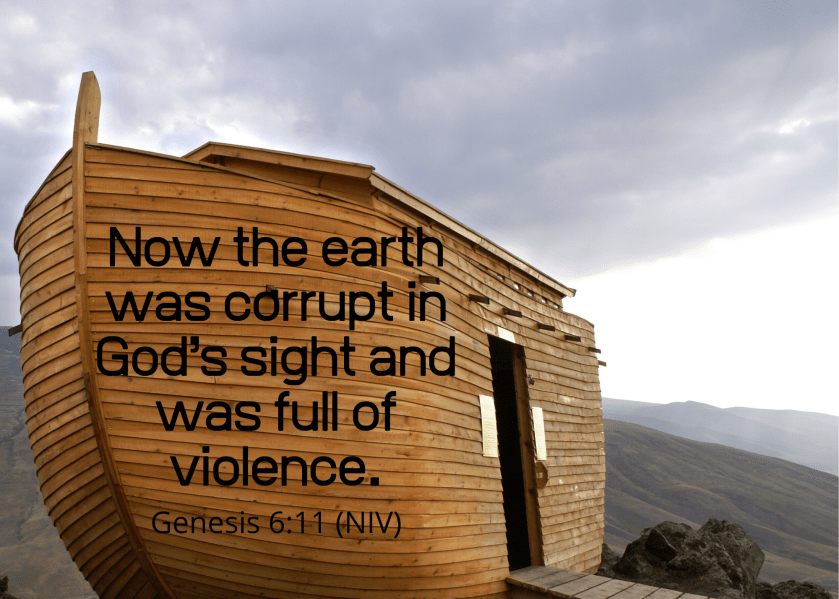
I would love to end this first week of 2024 on a more positive note, but here we are at the ministry of Noah, and I can’t help but see the correlations. I consider myself a church half-full, not half-empty type of person, so please understand I am not hanging an albatross around the neck of the place I call home. Recently, we have seen and could see more revival as people realize there is no salvation in pursuing self. Nevertheless, as it stands today, it seems like the wind is blowing hard in a different direction, and I can’t help but look at the forecast and know that the rain is coming. It may not be here or now, but it is. It is so disheartening to see people jump off the boat, abandon their God, so they can instead find their own way swimming to survive. I want none of us to be the next person overboard, so let us be ready to answer the challenges of the storm that very well may lie ahead, and be defiantly obedient as the prescriptions of Jesus in Matthew 6

Leave your righteousness at the door – Jesus says that if actions are done for the sake of being seen by others or if we are religiously pious thinking that we are worth saving and others are not, that we have already received our reward in full. Noah was the only righteous man left, but while building the boat, he did not tout his own righteousness. He preached to bring salvation to others, even if it fell upon deaf ears. We do not decide who is and isn’t worthy (see: Jonah). Our own righteousness is as filthy rags and none of us can be restored without the atonement of Jesus.

Extend the grace of forgiveness of God – If for no other reason, we should forgive because it is the measure for which we are forgiven; however, we forgive because we have the love of Christ that shows us mercy every time that we fall short. By simply listening and looking for those who thirst, we become more like Christ. A quote that has stuck with me by psychologist Russell Barkley, “The children who need love the most will always ask for it in the most unloving ways.” Do not let rhetoric or trespasses keep you from loving those who need Living Water. You can be the bearer of grace and forgiveness they are most desperately looking for if you cut through the crap and see the child of God.

Endure any suffering with joy – Those of us in the United States have enjoyed a pretty good run of Christian values as the dominant culture. While this run has been far from perfect, it has been easy to avoid persecution. It is very likely that my children will not live in this world. God, I pray that they will be able to declare you in a world that will try to snuff them out. For us all, may we endure the coming trials with joy. When we are persecuted because of the Gospel, we suffer alongside Him. What greater joy could there be than to live out the fullness of Christ?

Don’t worry about not going with the flow – God has promised to take care of our needs if we trust in Him and share His words. We may be unflatteringly categorized, lose our social standing, our job, live threatened, or the reality of violence. If God takes care of the flowers and the sparrows, He will take care of you in every single instance. Even though the traffic may be moving against you, be singularly focused on the Gospel of the Coming Kingdom, and everything else will be added unto you. Ask for your daily bread and then get to work for His Glory because the harvest is becoming more plentiful, but the workers are fewer.

-Aaron Winner

  1. Describe the world you live in today. What similarities do you see to the time of Noah?
  2. What do you admire most about Noah? What can you learn from him? What do you learn about God in Genesis 7 & 8?
  3. What is the problem of going with the flow? How can you help yourself, your family, your church stay in the boat?

Breath of Life

Old Testament: Genesis 2

Poetry: Psalm 1

New Testament: Matthew 2

A little over five months ago, I experienced the scariest moment of my existence. I was awoken by my wife, in a growing panic, informing me that our two-day old newborn had stopped breathing.  I rushed to the desk to get help, and watched helplessly as nurses left our room with our baby who had turned purplish-blue that will be forever imprinted on my psyche.  Later we would be told that since she was born Cesarean, she didn’t get the benefit from a squeeze on her exit that would have expelled the amniotic fluid from her lungs that was now choking her.  Praise be to God, working through the practice of quick-acting nurses, that she again found breath to sustain her life.

“Then the Lord God formed a man from the dust of the ground and breathed into his nostrils the breath of life, and the man became a living being.” – Genesis 2:7

Adam was born in a far more unique way.  God took a pile of minerals and animated it with his breath.  What was lifeless moments before became the image of the Creator.  Some might say that only Adam or Jesus are the ones that uniquely reflect our God, but Psalm 139 depicts God as a tailor, stitching us together.  Our Heavenly Father is intimate with the fabric that forms our thoughts because he picked it out Himself.  By creating a consciousness with this breath of life we now have the distinction, like Adam and Jesus, that we have a part to play in the purpose of God, and there are no understudies for your role.

You have been handed a script. By having access to the words of God, in some sense, you have life-giving power.  Since scripture is God-breathed (2 Tim 3:16)  it means it brings about the same igniting animation.  Jesus uses the Word of God to fight temptation, perform miracles, fulfill prophecy, and raise people from the dead.  Likewise we are told we can use it for teaching, correcting, training, and rebuking. Knowing His Word allows our life to perform our role now, but also gives us access to the Power of God.

Again Jesus said, “Peace be with you! As the Father has sent me, I am sending you.” And with that he breathed on them and said, “Receive the Holy Spirit. If you forgive anyone’s sins, their sins are forgiven; if you do not forgive them, they are not forgiven.” – John 20:21-23

Jesus Christ, the Living Water and Word of God, has demonstrated this new form of life.  It is not giving viability to a sandbox, but instead is a life-giving resurrection that brings on a new form not yet seen except by the firstfruits, Christ himself.  We are called to more than a single designed life-giving birth, but to be reborn, given life eternal.  While we cannot enter the womb a second time, the squeeze brought on by the conviction of the Living Word and the Holy Spirit is necessary to purge and refine, readying us for His Kingdom. Like Adam, we too, are made with a Promise to be placed alongside God, so let’s suck less air, and stay committed to filling our lungs and exhalations with His life-giving words.

-Aaron Winner

Reflection Questions

  1. Describe in what ways you have received life-giving breath from God?
  2. What do you think is God’s purpose for you? How are you doing at fulfilling that purpose? 
  3. How can you help pass along the breath of life to one in need of it? What is your life-giving power? 

A Gross Chapter in History

Old Testament Reading: Genesis 37 & 38

Psalm Reading: Psalm 21

New Testament Reading: Matthew 20

Not everything in the Bible is what we would call “child-friendly”; there are numerous accounts of despicable things taking place at the hands of people who are supposed to be God’s chosen ones. Betrayal, murder, inappropriate relationships, and more; I guess you could say that the Bible isn’t designed to be a Disney sitcom, but instead, tells the story of real people in real situations. Unfortunately, thanks to sin in our world, those real situations are often bleak,
strange, and sometimes down-right gross. That’s what we find in Genesis 38, and I’ll warn you ahead of time, it is not for the faint of heart.


In this story, we have an account of Judah, the man who is later promised to have the Messiah come from his family line (Genesis 49:10), caught up in a dramatic sequence of events with his daughter-in-law, Tamar. Unfortunately for Tamar, everyone she married, quickly died; even though we may not understand the cultural practices of a brother marrying his ex-sister-in-law to
preserve their family line, we can understand the grief, disappointment, and the feeling of guilt she must have been under. Even though it wasn’t her fault, it would be difficult not to blame yourself when this happens over and over again.


Skipping ahead and not going into all the gross details about her tricking Judah into giving her a son (what?!), we find out that Tamar finally does bear children and can breathe a sigh of relief. What isn’t immediately obvious to us in this story is how significant these children would later be in the biblical story. Her children are named Perez and Zerah (v. 29-30); and if you skip ahead to the New Testament in Matthew 1:3, Perez is found in the genealogy of Jesus himself! It is through this gross, bleak, and very strange story that God brings about the Savior of the world! This is just one example among many of what the entire book of Genesis is trying to communicate to us: “you meant evil against me, but God meant it for good” (Genesis 50:20).


Just like Judah and Tamar, God can turn our most difficult, strange, and sometimes gross situations into something wonderful and life-changing. Paul tells us in Romans 8:28 that “God causes all things to work together for good to those who love God”. How true this is: God can use anything in your life, no matter how dark and disappointing it may be, and turn it into something great, if you will simply love and trust Him with it.

-Talon Paul

Reflection Questions

  1. What do we learn of Er, Onan, Judah and Tamar in Genesis 38? What sins are they guilty of? We are not given all the details of what God is thinking, but from what we do know, why do you think some of these characters are struck dead and others become part of Jesus’ genealogy? (There might be a clue in verse 26)?
  2. What do we learn of God in our reading today? Does He take sin lightly? Does He only work with perfect people? What type of heart and actions is He looking for?

When You are in Distress

Old Testament Reading: Genesis 35 & 36

Psalms Reading: Psalm 20

New Testament Reading: Matthew 19

In life we come to places where we are in distress, we feel hopeless, and we feel like our circumstances couldn’t be darker. But God is full of hope and knows his plans for us if we trust him.

We begin in Genesis, Jacob has fled from his home from his brother Esau, and after he left Laban now Jacob is being told by God to return to Bethel, the place where he had stopped after running from his brother and having a dream.

Before they get there Jacob tells his family in Genesis 35:2

“So, Jacob said to his household and all who were with him, get rid of the foreign gods you have with you, and purify yourselves and change your clothes. We must get up and go to Bethel. I will build an alter there to the God who has answered me in my day of distress. He has been there with me everywhere I have gone.”

Jacob is telling his family how God has blessed him and that they are not going back to that place of foreign gods. Just as we are not going back to our places of distress and false gods.

Psalm 20:1

“May the Lord answer you in a day of trouble; may the name of Jacob’s God protect you.”

God provides answers in all our times of distress. In our times of trouble, when we don’t understand why things are happening, he knows why things are happening. He provides us comfort in our struggles; we need to lean on him. God will provide.

It is after this that God tells Jacob to be fruitful and multiply, and he reminds Jacob of the promise he had made to Abraham and Isaac concerning the land.

This means something to us too when times get difficult. We will experience the blessings of God at times, but when questionable circumstances come our way, we need to remember how we obtained those blessings. Forgetting about God in times of need would be a sure sign that we are getting on the wrong path.

Matthew 19 also contains a lot of information. Jesus had to deal with the pharisees trying to trip him up constantly, but what stands out to me is Matthew 19:21-22.

“If you want to be perfect,” Jesus said to him, “go sell your belongings and give to the poor, and you will have treasure in heaven. Then come, follow me.” When the young man heard this, he went away grieving, because he had many possessions.”

This man was faithful to God and had a lot of possessions, but he did not connect his possessions with God’s blessings.  The same goes with us, too often we forget that when times are good and we are feeling high in life, that our blessings come from God!

We can’t forget that in our good and bad times that no matter what, we are to devote ourselves to God. Trust in him and he will bring you through everything that you experience.

-Hannah Eldred

Reflection Questions

  1. What are your usual responses when you feel you are in a time of distress? Are they helpful responses?
  2. What can we learn from our Bible passages today regarding how to turn to God?
  3. What can we learn from our Bible passages today regarding who God is and what He does?

Trusting God for the Outcome

Old Testament Reading: Genesis 27 & 28

Psalms Reading: Psalm 16

New Testament Reading: Matthew 15

Genesis 28:15 – Behold, I am with you and will keep you wherever you go and will bring you back to this land.  For I will not leave you until I have done what I have promised you. 

This is an appropriate text for me right now; in that it speaks to me in trusting God for the outcome.  Genesis 27 and 28 tells the story of how Jacob stole his brother’s blessing after he had already manipulated Esau out of his birthright in Genesis 25.

I want to make mention that earlier in Genesis 25 Rebekah was concerned about her pregnancy because according to scripture, “The babies jostled with each other within her.”

When she inquired of the Lord, He told her, “Two nations are in your womb and two peoples within you will be separated; one people will be stronger than the other and the older will serve the younger.”

So, in the scripture from today (Genesis 27)  we learn that Rebekah heard Isaac tell Esau to go out and hunt some wild game and prepare him a tasty meal.  Afterward, Isaac was going to give Esau his blessing.

Rebekah took it upon herself to have Jacob go get two choice goats and she prepared a meal that Isaac would enjoy.  She also used the goat skins to fool Isaac into believing that Jacob was indeed Esau – using the goat skins to make Jacob’s arms feel hairy.  As a result of this trickery, Isaac blessed Jacob instead of Esau.

When Esau showed up, he found out that his father had already given his blessing to Jacob.  When Esau pleaded  for some sort of blessing the only hope that Isaac could give him was found in Genesis 27:39 & 40:

“Your dwelling will be away from the earth’s richness,

Away from the dew of heaven above.  You will live by the sword

And you will serve your brother.  But when you grow restless,

You will throw his yoke from off your neck.”

Esau vowed that after his father had died, he would surely kill his brother Jacob. 

The things that trouble us in life may not be to such an extreme, but there are some things that I believe we can learn from this story that may help us in times when we are unsure of our path.

I just got home from ReFUEL at Camp Mack.  The theme was ‘Peace treaty’.  The youth were challenged in many ways.  One of the ways they were challenged was to not be in a hurry for the answer that you think God should give you.

Maybe the answer you were hoping for isn’t the one that God is prepared to give….. right now.  We can be like Rebekah and try to manipulate the situation in order to achieve the outcome that we were hoping for.  The question to ask is, “Is God working in that situation?”  Does trying to manipulate the situation always work for the good?

We learn from Genesis 28 that Jacob had to take off and head for Paddan Aram.  It was there that he was supposed to live and find a wife from the daughters of Laban.  It was on the way there, in Bethel, that Jacob had a dream of a stairway resting on the earth and angels ascending and descending up and down that stairway.  It was there that God reiterated the same promise that He had made to Abraham and Isaac.  He said,

“I am the Lord, the God of your father Abraham and the God of Isaac. 

I will give you and your descendants the land on which you are lying. 

Your descendants will be like the dust of the earth, and you will spread

Out to the west and to the east, to the north and to the south. 

All peoples on earth will be blessed through you and your offspring……”.

Genesis 28:13 & 14

So, from this story, I perceive that we should not be in a hurry to get the answer that we wish God would give.  What if God’s plan for your life will end up the way that you would hope, but through a means that would be better for us in the long run.

Surely, we can see that even though Jacob went along with Rebekah’s plan to get the blessing through trickery,  God still worked to bring His blessing upon Jacob, but at what cost.

Jacob had to wait 14 years for the wife he wanted.  He had to work very hard to achieve the riches that he ended up with.  Ultimately, when he went home years later, he was in fear for his life.  Why?  Because his brother vowed to kill him.

We will never know how God would have worked if Rebekah hadn’t resorted to tricking Isaac into giving his blessing to Jacob instead of Esau.  It all worked out for Jacob and Esau.  The elder (Esau) didn’t serve his younger brother Jacob.  They did reconcile later, but the people from the land of Edom (descendants of Esau) did eventually serve Israel – a fulfillment of the prophecy spoken by God.

So, as I go through life.  I want to make sure that I am praying for God’s guidance in my decisions.  I don’t want to get in such a hurry that I try to manipulate the situation to create the outcome that I desire.  This is so important to me.  I need to try to be an example for my daughters, Hannah and Sofie, and others around me.  If I am quick to do what I need to do to ensure an outcome, what does that teach others?

-Rick Eldred

(Today and the rest of this week we will hear from various adults and young adults who were at reFuel this past weekend.)

Reflection Questions

Please also read Psalm 16.  It speaks clearly of the refuge that we can find in the Lord.  And ask yourself these questions:

  1. What is it in my life that I want from God?
  2. Am I being patient and prayerful when it comes to waiting for his timing?
  3. Is God your Refuge?
  4. Do others watching me see my trust in God?
  5. What can I learn of God from His Scriptures today?

If You Love Your Kids, Obey God

Old Testament Reading: Genesis 25 & 26

Psalms Reading: Psalm 15

New Testament Reading: Matthew 14

Abraham was a man of incredible faith.  God made astounding promises to Abraham, and Abraham believed God – and this was credited to him as righteousness.  Abraham lived a long and faithful life of service to God, then, as recorded in Genesis 25, Abraham died.

We’re picking up the story in Genesis 26 – after Abraham was dead and gone.  Genesis 26 starts by telling about a famine in the land that was so bad that Isaac (Abraham’s heir) had to move to have enough food to eat.

Then we find this amazing encounter in Genesis 26:2-6, “The Lord appeared to Isaac and said, ‘Do not go down to Egypt; live in the land where I tell you to live. Stay in this land for a while, and I will be with you and will bless you. For to you and your descendants I will give all these lands and will confirm the oath I swore to your father Abraham. I will make your descendants as numerous as the stars in the sky and will give them all these lands, and through your offspring all nations on earth will be blessed, because Abraham obeyed me and did everything I required of him, keeping my commands, my decrees and my instructions.’ So Isaac stayed in Gerar.”

God promised:

  • To give Isaac and his descendants all these lands
  • To confirm the oath God has sworn to Abraham
  • To make Isaac’s descendants as numerous as the stars of the sky
  • To bless all nations on earth through Isaac’s offspring (Jesus)

And did you notice why God extended all of these promises to Isaac?  “Why” is recorded in verse 5: “because Abraham obeyed me and did everything (emphasis added) I required of him, keeping my commands, my decrees and my instructions.”

Did you catch that?  Isaac was promised that he would receive incredible blessings because his dad had obeyed God and had done everything God required.  

A couple of years later, in Genesis 26:24, we read, “That night the Lord appeared to him and said, “I am the God of your father Abraham. Do not be afraid, for I am with you; I will bless you and will increase the number of your descendants for the sake of my servant Abraham.”

Again, God extended blessings to Isaac because of Abraham’s faithfulness.

And oh yeah, most of that obedience to God was before Isaac was even born.

We’ve heard about the blessings for ourselves if we follow God – especially eternal life in the Kingdom of God.  We don’t often think of the blessings for our descendants because of our faithfulness to God. 

When I was young, my dad would have us memorize scripture.  One of those verses he had us memorize was Psalm 37:25 which says, “I was young and now I am old, yet I have never seen the righteous forsaken or their children begging bread.”

I think the point my dad was trying to make was that we needed to be righteous, and God would never forsake us.  But I remember thinking something like this at the time: “I’m glad my dad is righteous, because in spite of my not necessarily being righteous, I will be blessed because of my dad’s righteousness.”

Now that I’m old, I recognize that the decisions I made, and the example I demonstrated had an impact (for good or for bad) on my kids.  As a result, they have picked up both some of my good traits and some of my bad traits.  I wish now that I had demonstrated more good examples and fewer bad examples – not only for my own benefit, but also for the benefit of my children.

Now let’s talk about you.  It doesn’t matter if you’re a teen, a parent, a grandparent, young, or old.  The most important thing you can do with your life is to obey God, and do everything He requires.  This will guarantee you eternal life in God’s coming kingdom, and may also give you many blessings in this life (not necessarily including health and wealth).  But in addition to your blessings, you may also pass along an inheritance of faithfulness to God to your kids – even those unborn.  And then they too can have incredible blessings.  

So, if you love your kids, obey God.

-Steve Mattison

Reflection Questions

  1. What are all the benefits/blessings you see to obeying God? Which have you already enjoyed? Which are you still looking forward to?
  2. How are you doing in the faithfulness department? Will God be able to tell your descendants that you obeyed Him, did everything He required, and followed His laws?
  3. What did God reveal about Himself to you today?

Will He Provide?

Old Testament Reading: Genesis 21 & 22

Psalms Reading: Psalm 13

New Testament Reading: Matthew 12

God had promised Abraham, in Genesis 17:19, “Your wife Sarah will bear you a son, and you will call him Isaac.  I will establish my covenant with him as an everlasting covenant for his descendants after him.”

At this point, Abraham was over 100 years old, and had faithfully followed God.  In Genesis 12, Abraham obeyed when God told him to leave his country and family.  Abraham allowed Lot to take the lush land around Sodom in Genesis 13, and trusted God to provide for his own flocks and herds on barren mountains.  In Genesis 15, Abraham trusted God’s promise that he would have a son in his old age, and God counted that faith as righteousness.

In Genesis 22:2, we find God commanding Abraham, “Take your son, your only son, Isaac, whom you love and go to the region of Moriah.  Sacrifice him there as a burnt offering on one of the mountains I will tell you about.”

This doesn’t make sense.  God had explicitly promised that God’s promises to Abraham would be passed down through Isaac’s descendants, and now God was commanding Abraham to sacrifice him – apparently destroying the promise He had made to Abraham.

By this point, Abraham had developed a very close relationship with God.  In fact, we’re told 3 times in the Bible that Abraham was God’s friend (2 Chron 20:7, Isaiah 41:8, James 2:23) – and as far as I know, Abraham is the only person in the Bible of whom this is said.

We’re told in Hebrews 11:19 that Abraham reasoned that God was able to raise the dead, and that He was going to keep His promise.

So early the next morning, Abraham took Isaac and 2 servants and left for the place God told him to go.  When they got close, Abraham told the servants, “Stay here with the donkey while I and the boy go over there.  We will worship and we (emphasis added) will come back to you.”

As they got even closer, Isaac asked his dad, “The fire and wood are here, but where is the lamb for the burnt offering?”

Can you imagine how this must have broken Abraham’s heart, looking down into his son’s questioning face, knowing that in a few minutes he would be killing his beloved son, who would be the offering?  Abraham answered, “God himself will provide the lamb.”  (Actually, God had provided Isaac – as a miracle baby in his parent’s old age.)  When they reached the place God had told him about, Abraham built an altar, arranged the wood, tied up Isaac, and laid him on the altar.  

As he was getting ready to kill Isaac, the angel of the Lord called to him from heaven and stopped him.  Abraham then saw a ram caught in the brush by its horns, and sacrificed it instead.  God then promised Abraham, as recorded in Genesis 22:16-18, “I swear by myself, declared the Lord, that because you have done this and have not withheld your son, your only son, I will surely bless you and make your descendants as numerous as the stars in the sky and as the sand on the seashore… and through your offspring, all nations on earth will be blessed, because you have obeyed me.”

I could point out all the similarities of Abraham’s being willing to sacrifice his son Isaac, and God being willing to sacrifice His Son, Jesus.  I could point out the significance of another quote from this chapter, “Jehovah Jireh – on the mountain of the Lord it will be provided.”  (This was the mountain where Soloman’s temple was built hundreds of years later.)  I could point out the importance of obeying God, and the benefits that result.

Instead, I want to comment on who, when, where, how, and why of God’s provision.  

Who:  God tested Abraham with a very difficult test even after a life of serving God.  We see that God provided the ram in this case only after Abraham trusted and obeyed God – even though it didn’t make sense.  Assertion:  God provides for those who trust Him and obey Him.  

When:  God provided for Abraham at the very last minute, not before.  We’re told in Hebrews 4:16 that we will “receive mercy and find grace to help us in our time of need.”  Assertion:  God provides precisely when we need something, not when we think we need it.  (i.e.  according to God’s timing.)

Where:  God provided for Abraham only after Abraham went where God told him to go, and after he obeyed everything God told him to do.  Assertion:  God will provide if we are where He wants us to be.  We should have no expectation of receiving God’s provision if we aren’t where He wants us to be. 

How:  God didn’t send an angel from heaven with an offering for Abraham to sacrifice, God provided a normal ram, caught in a normal thicket, by it’s normal horns.  And God didn’t send a whole flock of sheep, just one ram, because that was all that was needed.   Assertion:  God will usually provide in ways that are very natural – don’t look for miracles.

Why:  In times of testing, it’s easy to only think about our problems, and focus on, “why is this happening to me?”  I think there may be two general reasons why trials come.  First, we are told in Romans 8:28, “And we know that in all things God works for the good of those who love Him, who have been called according to His purpose.”  Note that this only applies if we are living according to His purpose.  Also note that trials are by definition difficult, and won’t seem to be beneficial at the time.  Second, ultimately, everything is for God’s glory.  Isaiah 43:7 says, “everyone who is called by my name, whom I created for my glory…”  We see an example of this with God destroying Pharaoh and his army for God’s glory in Ex 14:4, 17.  Assertion:  God allows trials and gives provision for our good and for His glory.

The bottom line is, if we are faithfully following God, times of testing will come.  If we remain true to God, if we are where He wants us to be, and if we are obedient to Him, he will provide what we need (not necessarily what we want), at the very last minute, usually through normal means – and this is for our good.  If we aren’t following God, the times of testing may just be to bring Glory to Him.  I’d rather be in that first group.  How about you?

–Steve Mattison

Reflection Questions

  1. Abraham’s thoughts and feelings aren’t recorded much in Genesis, what do you think he may have been thinking and feeling on that 3 day trip to where God wanted him – and after? What similarities do you find in Psalm 11?
  2. How and when has God provided what you needed? What did you learn about God from that experience?
  3. Is there anything that you may be holding onto too tightly, loving more than God? How can you practice trusting and obeying God and not withholding from Him?
  4. What did God reveal about Himself to you in your reading of His words today?

He Sees and Examines

Old Testament Reading: Genesis 17 & 18

Psalm Reading: Psalm 11

New Testament Reading: Matthew 10

Yes, indeed. You can be guaranteed, God sees (you can review yesterday’s devotion if you missed it). For many people in innumerable situations across the centuries, the fact that God sees has given reassuring peace and comfort. The oppressed, the grief-striken, the helpless, the victim, and the fatherless have all been introduced to the God who sees and His Son who changes lives.

In today’s Psalm 11 it even records, “He observes the sons of men; his eyes examine the sons of men. The LORD examines the righteous.” (Psalm 11:4b, 5a NIV). He examines the righteous – that’s much more than a casual “see” and walk on. It gives me a picture of a kind, thorough, knowledgeable doctor. He has listened to your list of ailments and what you hypothesize might be needed but his careful examination will reveal the true issues and in wisdom he will prescribe and deliver what you really need at just the right time. “The LORD examines the righteous.”

It is a comforting first half of Psalm 11:5. The verse doesn’t end there. We are reminded that it is not ONLY the righteous God sees. And when he sees the unrighteous – he also takes action. “…but the wicked and those who love violence his soul hates. On the wicked he will rain fiery coals and burning sulfur, a scorching wind will be their lot. For the LORD is righteous, he loves justice; upright men will see his face” (Psalm 11:5b-7 NIV).

God sees.

God examines.

God acts.

God loves justice.

In our Genesis passage we see God seeing Sarai and Abraham. He has been promising that Abraham will be the father of many descendants, a great nation and kings. But they are old – with no child of their own. Sometimes it’s hard to keep believing that God sees. God reminds them, “Is anything too hard for the LORD?” (Genesis 18:14 NIV). Sarai tries to get away with a little lie – saying she didn’t laugh at the crazy idea that within the year she, an old woman, would have a baby. But God sees even the little laugh. He examines the righteous (not the perfect – but the righteous). Don’t try to fool the all-seeing God.

Then the story turns…to God preparing to visit Sodom, a city full of sin . He has heard of their wickedness. Is it time for Him to act? Is it time for justice? We will have to see tomorrow when we read Genesis 19. But, if you want a little hint, recall what the Psalmist said regarding what God will do to the wicked: he will rain fiery coals and burning sulfur. Even in our Matthew passage, where Jesus is preparing his disciples to go out into the towns of Israel, knowing full well that many will not accept them or the message they bring, he references Sodom and judgment.

God does see.

It is reassuring to the righteous.

It is judgment for the wicked.

What does He see in you?

He isn’t fooled. He sees. He examines. He loves justice.

-Marcia Railton

Reflection Questions

  1. What does God see in you? What might His examination reveal are your true ‘health needs’ to be addressed, and the remedies He is offering? Are there any areas where you have been trying to lie to God?
  2. Matthew 10 is one of those chapters you could read every day for a week or more and still find new insight. Jesus is preparing his disciples to share the good news of the kingdom in a world that sometimes/often rejects it. What is helpful for you to hear from Jesus? Are we to just give up and keep silent if the world rejects the message?
  3. In today’s Scripture reading you see God is ________.