“I Feel Put Upon”

 Jeremiah 18-22 

When my son was little, we spent a lot of time watching Thomas the Tank Engine and Friends. One of Thomas’s friends was an engine named Percy. Percy was good at his job, but sometimes he just felt he was given way too much work and it was unfair. “I feel put upon!” Percy would declare at various times. While reading today’s chapters, I think Jeremiah was saying the same thing (but in Hebrew 😀). 

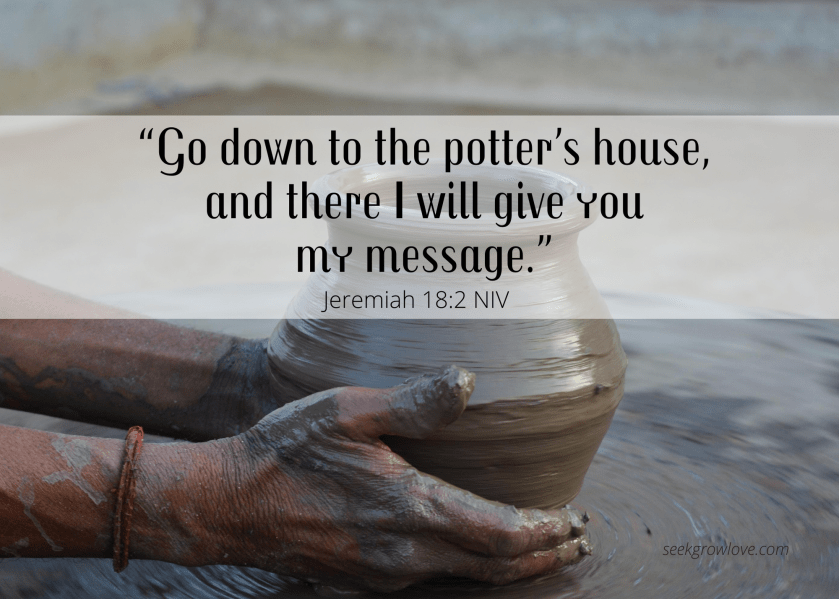
And really, I don’t blame him. God had him observe a potter creating and destroying vessels at his pleasure to demonstrate what God will do with His people. Then He had Jeremiah buy a clay jar and smash it in front of the leaders of Judah to demonstrate what God will do to Judah. And what does Jeremiah get for his obedience? Beaten and mocked. Not only that, but Jeremiah saw that nothing was happening to the evil people, in fact, they seemed to be doing quite well. He was frustrated and felt defeated. I think I would have, too. Any half-way mature person knows that life isn’t fair, but sometimes it’s hard not to be frustrated when you always seem to be on the unfair end of things and that’s where Jeremiah is here. But despite his anger and frustration, he still acknowledges that no matter what, Jeremiah would praise Him and continue to prophesy in His name. Which is probably a good thing because after years of warnings, God begins moving His hand against Judah. 

In chapter 21, we see that the warning of destruction of kings was no longer a vague, general mourning. People are being named. King Zedekiah was told he would be captured by the Babylonians, King Josiah’s eldest had been exiled, and his next son, Jehoiakim’s death was predicted to be un- mourned and dishonorable. Then it’s Jeremiah’s job to try to convince the people to surrender to Babylon so they will go “easy” on them and not kill them. No wonder this guy wasn’t very popular. I hadn’t really given it much thought before but in verse 20:18, Jeremiah mentions his friends. They certainly aren’t good friends as they are plotting to kill him. But unlike Jonah who was commanded to go and preach to a far off nation, Jeremiah was preaching to the people he grew up with and lived around. The people he traded goods with, the people he talked to while on the way to the temple, people who had been a part of his everyday life. Between being scorned for delivering these messages and knowing what was in store for his community, no wonder Jeremiah was down and depressed. He WAS put upon. 

We’ll have to keep reading to find out what happens to Judah and Jeremiah. But in the meantime, think about the times you’ve felt “put upon” by the Lord. What happened? Did He stay with you? Like Jeremiah, did you praise Him anyway? 

Prayer: 

Dear Lord, 

There are times in life when You have given us a burden and we feel “put upon”. Help us to have an attitude of peace and contentment at these times because You have chosen us to carry that burden. Please give us the strength to do it with pleasure. 

In Christ’s Name, 

Amen 

-Maria Knowlton

Reflection Questions

  1. “Think about the times you’ve felt ‘put upon’ by the Lord. What happened? Did He stay with you? Like Jeremiah, did you praise Him anyway?”
  2. Have you ever delivered warnings from God to someone you know? What was the hardest part? What did this person think of you? What do you think God thought of you? What happens when no one warns?
  3. Would you rather…speak for man or for God?
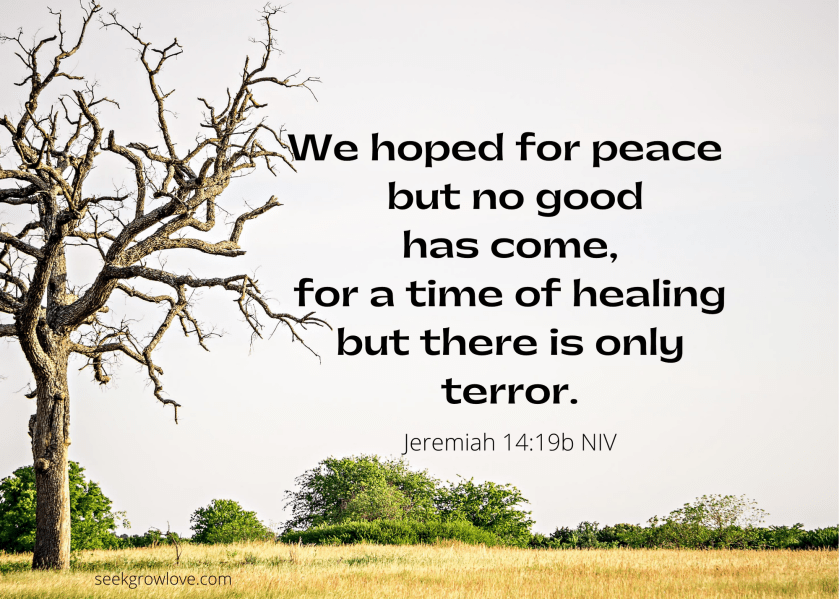
“Per My Last Email”

Jeremiah 14-17

“Per my last email.” I’ve never actually used those words in text or speech, because everyone knows what that means, “ I ALREADY TOLD YOU THIS INFORMATION!!!” It’s a little passive-aggressive, so I’ve only ever thought it. I’ve often wondered throughout scripture, if God has thought similarly. In Jeremiah 14, Judah begins to experience a serious drought. The people begin crying as they start to notice God is not hearing their prayers. WHY are You treating us like a stranger ( 13:8)? WHY are You acting like You can’t do anything for us (13:8)? WHY have You afflicted us so that we cannot heal (13:19) I can only imagine God was thinking, “per my last PROPHET, I ALREADY TOLD YOU WHY!!!!” By this time, at least according to my study Bible’s timeline, Jeremiah had probably been warning the people of Judah for well over 15 years. The people could not claim ignorance of God’s coming judgment and this drought was just the beginning. It does dawn on some of the people that , oh yeah, maybe this has something to do with our complete disregard for Your laws and decrees. Or maybe, it wasn’t even that many people realizing their sins in this passage…maybe it was just Jeremiah…which means it really wasn’t much of an apology at all. 

In chapter 15, God gets a little graphic with His description of Judah’s destruction, using the sword, dogs, birds, and beast (15:3). And that sets the tone for the first half of the chapter. In the second half, Jeremiah and God have a heart to heart chat. I really feel for Jeremiah. It is really hard when you’ve tried so hard to be good, only to have people treat you bad. In this case, make plans to murder you (thankfully, although I can relate with the former, I can’t with the latter)! Jeremiah also expresses disappointment in feeling God has abandoned him. But God assures him He has not, and He will reward him. But not before chapter 16. 

God then asks Jeremiah to go into a type of self exile. He was forbidden from marrying, having kids, or participating in funeral traditions. As God used Hosea as a living object lesson, He uses Jeremiah to live out an example of what God’s coming punishment would be like. Families would be destroyed and so many would die there would be no time for mourning. 

All of this, including chapter 17 is a bleak description of Judah’s folly and God’s wrath. But then oddly, in the middle of the listed curses, is a blessing (17:7-8). If the people would trust in the Lord, they would be planted firmly and withstand the droughts and coming destruction. 

Today’s reading ends with a reminder of God’s command to keep the Sabbath holy. Apparently, the people had given up on this command and were treating the Sabbath just like every other day. ( We could have a very long discussion about what that means for us now… but that’s for another day). 

Unfortunately, like a previous email, the people of Judah disregard all of the Lord’s instructions and decrees brought to them by Jeremiah. 

Just like the people of Judah, we too have been warned, comforted, educated, and instructed by the Holy Word of God. When it comes to the final judgement, we can’t claim ignorance. WE GOT THE EMAIL! Let us put into the practice all we have read and heard until the day of Christ’s return! 

Prayer: 

Dear Father, 

You have given us all we need to come to an understanding of You, Your love, and Your decrees. Please open our hearts to greater learning and understanding so that You know we take Your word seriously. 

Im Christ’s name we pray, 

Amen 

-Maria Knowlton

Reflection Questions

  1. What do you tend to think and feel when someone “under” you completely ignores directions you gave? What happens to your relationship? What are your thoughts and feelings when/if they apologize and return to following directions well? What are the similarities and differences when it is God over you and you are His child who has ignored His direction?
  2. When/in what regards might God be telling you: “Per my last email”?
  3. What benefits do you find in reading and studying God’s Word- his “original email” to you? What are the problems and dangers of not reading and studying His Word?
  4. What is needed beyond reading and studying His Word?

Sorting Through the Muck

Jeremiah 10-13

 In nursing school, we were taught to remind patients not to google their symptoms because of all the “muck” there is out there. And given the right combination of benign systems, you can diagnose yourself with the black plague pretty quickly. But I can tell you right now not a single one of my patients under the age of 100 didn’t google their symptoms as soon as they surfaced. In conversations with my patients, I quickly learned that an admonishment against googling wasn’t going to work. I needed to help my patients navigate through all the muck of the internet to find information that is actually helpful (sites that are sponsored by hospital systems such as Mayo Clinic or Cleveland Clinic, or associations such as the American Heart Association or Cystic Fibrosis Foundation are generally reliable). 

Since you’ve probably visited the internet before, you probably already know much muck exists in the writings of any topic you look up. Even in looking up commentary on the book of Jeremiah, I came across writings that were complete perversions of the scriptures. The writers added “facts” to twist scripture to their agendas. I wonder if they even noticed the irony that their writings on Jeremiah are EXACTLY the kind of things God was warning Judah about. 

We saw in chapter 7 and now in 10 that the people of Judah added their idol worship to their worship of the ONE TRUE GOD. And clearly, people are still doing it today. 

I learned, through what seems to be a much more godly commentary site, that this is called syncretism. Syncretism is “the amalgamation or attempted amalgamation of different religions, cultures, or schools of thought.” (Internet dictionary). The writer of the commentary notes, “ YHWH hates syncretism. He has given us clear instruction on how we are to live, behave, and worship Him. He does not take lightly when we decide to trust more in our wisdom and modify His instructions as we see fit.” 

In chapter 12, we really start to feel bad for Jeremiah. He’s asking God why the evil are getting away with everything and seem to prosper and God’s response was that it was going to get a lot worse! In light of our present circumstances and prophecy, we may feel the same way. 

Then in chapter 13, God uses an object lesson to show what will happen to Judah if they do not turn to Him. The NASB calls it a linen belt and the Message calls it shorts. Either way, Jeremiah was commanded to wear it right away. As this belt or shorts was worn close to the body, it represented how closely the Lord holds Judah to Himself. God then has Jeremiah take them off and stick them between some rocks and retrieve them a few days later. Not surprisingly, they were completely tattered and torn (though being a guy, Jeremiah probably wore them anyway 😀). Just like time, weather, and lack of care ruined the shorts, God promised to ruin Judah if they continued to ignore His commands. In verses 15-16, God tells the people to hear, pay attention, do not be arrogant and give God the glory and He would not destroy them. Stay tuned to find out if they heed this warning…or not. 

Jeremiah was not called “The Weeping Prophet” for nothing. But I think the more tragic thing is that society hasn’t changed much. There are those who are doing the EXACT same things for which God severely punished the practitioners. Jeremiah would be appalled. He would be weeping that there are so many sinking in so much muck. 

Praise God that we don’t need to wade through the muck of untruths that surround us. No matter the person or their credentials, we must always hold up their teachings to the only source for truth, the Holy Bible, because God and His truth are not hiding from us nor are far from us! (Acts 17:24-28) 

Prayer: 

Dear Lord, 

Please let me be aware if there are any thoughts, beliefs, or behaviors that contradict your decrees. Please help me to keep my offering of worship pure and true. 

In Jesus’ Name, 

Amen 

-Maria Knowlton

Reflection Questions

  1. What ailments does the world have today? What symptoms do they have? What is the prognosis? Is there any cure available? How many will ignore the warnings of the wise doctor (and nurse)?
  2. What muck have you seen others and/or yourself following or mixing with Bible truth? Continue praying for God to show you truth – and keep seeking it in God’s precious Word.
  3. What are your thoughts and feelings reading through all of God’s warnings to Judah through the prophet Jeremiah? Who needs to hear these warnings today? Are there words God wants you to speak? Ask him.

Entitlement

 Jeremiah 7-9 

Whether it’s social media, the news, gossip about the neighbor down the road, we seem to hear the term “entitlement” a lot these days. For whatever reasons, some people think they deserve preferential treatment. We could blame social media for what seems to be an uptick in this kind of behavior, and to some extent, that might be true. However, we do find in today’s reading, that entitlement goes back a really long time. 

In chapter 7, we see Judah believed that because they lived on the land of the Lord’s Temple, they were invincible. This belief caused them to become so bold that they begin committing crimes and worshiping other gods and then going directly to the temple to “worship” God (7:9-11) As if that were not bad enough, in verse 30, the people seem to have skipped the middle man and just went ahead and set up their idols and worse in the temple (7:30) They were truly entitled, thinking their lineage and perfunctory worship was enough. 

But of course, God sees all this. I like how the Message version puts it, “I’ve got eyes in my head. I can see what’s going on.” God even tells them that they can go ahead and eat the sacrifices they offered because they are now meaningless to Him (7:21). 

Throughout the rest of our reading, God tells the people through Jeremiah, what He has seen. 

Yet amazingly, woven throughout the description of sins and their consequences, God lays out what they need to do to be saved from destruction. 

Reform from your ways and your actions and I will let you live in this place (7:3). 

Obey me and I will be your God and you will be my people. Walk in all the ways I command you, that it may go well with you (7:23-24). 

But let him who boasts boast about this, that he understands and knows Me. That I am the Lord who exercises kindness, justice, and righteousness on earth for in those I delight, declares the Lord. (9:24) 

Well, not so much in chapter 8…that’s mostly promised punishments. Yikes! 

As Christians we know that we are not entitled to anything. We are not entitled because of our lineage in the church, the amount of time or finances we give, or even all the lessons we teach. We are only entitled to salvation through the grace of God through Christ. And Praise the Lord for that! 

Prayer: 

Dear Lord, 

Please never let us get so complacent in our worship that it becomes meaningless to You. Let us walk in obedience that you may be our God and we will be your people. 

In Christ’s precious name, 

Amen 

-Maria Knowlton

Reflection Questions

  1. Where have you seen entitlement – in society, Scripture, your life?
  2. Is there anything in your life that you have been pretending that God does not see? He sees. Stop pretending and talk to God about it.
  3. Do you think the Lord delights in you? How have you seen God’s kindness, justice and righteousness to you or others (9:24)? What are you still looking forward to?

Burnt Bedbugs

Jeremiah 4-6

Recently, I was involved in a discussion about parasites. (Old people, right?) One person was telling how their house became infested with bed bugs after buying a used car. Exterminators had to come and use equipment that heated up the ENTIRE house to 135 degrees fahrenheit! All plastics, foods, and other meltable items had to be removed from the home and it cost thousands of dollars. But it was the only way to completely get rid of every one of those little buggers! This story popped into my head while spending time in today’s reading. 

Chapter 4 starts out almost hopeful. Jeremiah tells the people of Judah that if they just turn to God, God will forgive them and they will live free. That hopefulness lasts for about 4 verses. Then, Jeremiah warns of destruction from the north (Babylon). The rest of our reading is pretty dire. In chapter 5, Jeremiah lists their sins, the reasons the Lord is so displeased with them. His chosen people were being cruel to each other, getting rich through exploitation of the poor, and rebellious towards His decrees. Even the priest and prophets were proven to be cheats and liars and no one seems to notice or care (5:31). 

So God promises destruction, similar to what the exterminators have to do to get rid of bedbugs. In 4:11, Jeremiah speaks of a scorching wind that will come and bring ruin to the land, followed by the army from a distant land. While God promises not to destroy it completely, it will be enough that the earth will mourn its loss (4:28). 

Jeremiah ends today’s reading by comparing Judah with metal. As a blacksmith tests metal to determine its strength, God has tested the people but finds they are like tin foil (6:28-30). 

Or maybe they are like all the plastic that had to be removed before my friend’s house had to be heated up to the extreme to destroy the bugs. They would not be able to survive God’s judgment without his mercy. We will read more about that later. 

As we consider these passages today, let’s reflect on the fact that we would be in the same position as the people of Judah without the sacrificial grace we have received through Jesus Christ. Like a plastic popcorn bowl, Jesus has taken us out of the house before the coming heat.. In this case, the second death (Revelation 20:14-15). 

Prayer: 

Dear Lord, 

While the judgement of Your people may be hard to hear, we must so that we can learn from their sins and so that we can also more greatly appreciate the importance of the grace we have received through the blood of Jesus Christ. Let us be aware of the ways the world is trying to turn us to rebellion. Thank you for your promises of peace in this life and everlasting time with You in the next. 

In your Son’s name, Amen 

-Maria Knowlton

Reflection Questions

  1. What are some of the world’s thoughts on God’s judgment? What does God tell Jeremiah about His judgment?
  2. Who gets God’s judgment? Who gets God’s mercy? What does Jeremiah say?

Ambivalent

 Jeremiah 1-3 

So I talked to this young, expecting mother about the importance of safe sleep for a newborn. No pillows, blankets, toys. I arrive at her home, as a home visiting nurse, to see the baby shortly after birth. And she is asleep, surrounded by pillows, blankets, and toys. I talked to another mother about cutting back on smoking by using nicotine patches. On my next visit, I ask if she was able to get a prescription for the patches. Her eyes drop and she says a shy, “No…” I try not to look judgmental or disappointed. We have further discussions but inside, I am a bit frustrated and when I have a full day of those kinds of interactions, I really start to question my choice of vocations. And I also feel like I might be getting a taste of what Jeremiah went through and understand how he got his nick-name, “The Weeping Prophet.” 

In his self-titled book, Jeremiah is introduced as the young son of a priest, making him a Levite. Most Biblical scholars agree he was probably a cup bearer and probably around 17 to 20 years old. Reminiscent of Moses, God calls Jeremiah to him and gives him an important job. While Moses’s excuse was that he was not a good public speaker, Jeremiah tells God, “But I’m just a boy.” (1:6) I wonder if God rolled His eyes. : ) 

But God goes on to tell him that he is to be a prophet, to warn Judah that destruction is coming. God gives him the words and in the first 3 chapters of the book, Jeremiah is pretty harsh. Like in Hosea, and throughout the Old Testament, he compares Judah, and Israel as a whole, to cheating spouses. But unlike Jonah and the prophet Zephaniah, Jeremiah is largely ignored. He warns, he pleads, and the people continue to do their own thing. They know God exists but ignore His direction and commands. And Jeremiah knows what the coming consequences are. 

They were ambivalent. I mentioned that word in yesterday’s devotion. It is a good word for describing those sitting on a proverbial ‘fence.’ They know the consequence of their behavior, but the behavior is easier, more fun. There are a lot of, “ Yeah, but…” in the conversations. Yeah, I know I should stop smoking, but it’s so hard. Yeah I know God is going to destroy our nation, but is my little idol really going to make a difference? It can be so frustrating for those whose job it is to dole out the warnings. I’ve only been a nurse, giving medical and safety advice for about 7 years. Jeremiah was a prophet for over 40 years. I can only imagine! And he wasn’t allowed to quit! 

As we read these passages that are hard to read or hear, let us think about the areas in our own lives where we are ambivalent about our obedience to the Lord. 

Prayer: 

Dear Lord, help us to listen to your Word and those in our lives who give us Godly wisdom. Help us embrace what is good and what is good for us in Your eyes and reject the bad. Please let us let go of excuses. 

In Christ’s Name, 

Amen 

-Maria Knowlton

Reflection Questions

  1. Do you more often stubbornly follow your own evil heart or go God’s way?
  2. In what areas of your life have you been or are you currently ambivalent about obeying God? What excuses have you tried giving God or others about your actions or attitudes?
  3. What changes might Jeremiah prescribe for you personally? For your church? For your nation and world today?

Vengeance is the Lord’s

OLD TESTAMENT: Jeremiah 51 & 52

POETRY: Psalm 119:97-104

NEW TESTAMENT: Revelation 6

In Jeremiah 51-52, we continue to read about the rise and fall of one of Israel and Judah’s greatest adversaries – Babylon. Most would think they had it coming; after the ruthless destruction of Judah and years of the children of God being held in captivity, how else would Yahweh react? One might even wonder why it took so long for Him to free His people from these evil, power-hungry conquerors. As we’ve seen throughout the Old Testament, (particularly Judges, 1st and 2nd Kings, and Isaiah) the Israelites had their own series of mishaps and repeated sin. As a result, God – in His perfect timing – used Babylon to bring retribution to His people. However, He did not let Babylon’s wickedness go unpunished. Eventually, their arrogance and sin led to their ruin. Through Jeremiah, God declared that Babylon would be punished for its pride and cruelty. This was not just a political event, but a fulfillment of God’s divine justice and plan.

Our God’s ways are not to be challenged, nor is His wrath to be evoked. Vivid imagery is painted throughout the 64 verses of chapter 51, which follows the previous 46 verses in chapter 50 (in which the proclamation of Babylon’s grim downfall was only getting started). The LORD our God has a fierce vengeance, one that nobody should desire to face. Our God is a God of love, but as seen in these chapters, He does indeed declare enemies. And to be an enemy of the one true God is pretty much the worst place you could possibly find yourself in. These scriptures serve as a powerful reminder of God’s complex and perfect character. He is surely abounding in love, kindness, and mercy, but He is also a God of justice, holiness, and righteous wrath. This understanding brings to mind two important truths:

1. We can rest assured that justice is ultimately in the hands of God, and punishment will be bestowed upon His enemies on the day of judgment. We don’t carry the burden of deciding who is worthy of God’s love, and instead have freedom in Christ to love everyone God places in our lives – choosing to love the person and not the sin. In a world filled with brokenness and division, we can be a light of grace, knowing that God’s justice will prevail.

2. I do not want to be an enemy of God, and I know you don’t either. These chapters challenge us to examine our own hearts and lives. Live each day knowing fully that you are fearfully and wonderfully made, you are a servant of Christ, you are the beating heart of the church, you are the hands and feet of God, and you are His beloved child. In a fervent endeavor to avoid ever being known as an enemy of God, anchor your identity instead in these things, and place your trust in the unshakable Kingdom of God. For the empires of this world will fall, but His is everlasting.

To be a part of God’s everlasting kingdom means surrendering our own desires and aligning ourselves with His greater purposes. It means that we are called to walk in obedience, trusting that His plans are far beyond our comprehension. Babylon fell because it was built on the shaky ground of pride, greed, and corruption. But as followers of Christ, we stand firm on the solid foundation of God’s eternal kingdom—a kingdom defined by love, justice, mercy, and truth.

-Isabella Osborn

Reflection Questions

  1. Are there areas in my life where I am relying on my own strength or worldly systems instead of trusting in God’s good and perfect ways?
  2. How can I actively align my daily choices and actions with God’s kingdom values?
  3. In what ways can I guard my heart against pride and self-reliance, ensuring that my foundation is rooted in Christ rather than the fleeting things of this world? 

Just Discipline and Then Restoration

OLD TESTAMENT: Jeremiah 46-48

POETRY: Psalm 119:81-88

NEW TESTAMENT: Revelation 4

Today we remember that God is not just the God of the Jews – but the God of the world – all the nations.  And as God has watched the sins of these nations – so will He exact discipline on these nations.  Jeremiah writes what God tells him to write regarding the coming destruction that God will oversee and orchestrate against Israel’s neighbors.

Jeremiah uses vivid imagery to describe these events:

“The sword will devour till it is satisfied, till it has quenched its thirst with blood.”  (Jeremiah 46:10 NIV)

“Moab is disgraced for she is shattered.” (Jeremiah 48:20 NIV)

His descriptions show not only how scary and total the destruction will be – but also what a sad state of affairs these societies had become.  The most powerful passage that got my attention was in the message against the Philistines, “Terrified fathers run madly, without a backward glance at their helpless children.” (Jeremiah 47:3b NLT).  Where have the strong, brave protectors and defenders of their families gone?

We would do well to pay special attention to the passages that point to the reasons for this judgment.  All of these neighbors are being punished for their mistreatment of God’s chosen people, as well as for their own sins. “Since you trust in your deeds and riches, you too will be taken captive…We have heard of Moab’s pride – her overweening pride and conceit, her pride and arrogance and the haughtiness of her heart…In Moab I will put an end to those who make offerings on the high places and burn incense to their gods…Moab will be destroyed as a nation because she defied the LORD” (Jeremiah 48:7, 29, 35, 42 NIV).   How many similarities do you have to Moab, which was just one of the countries that would feel the burn of God’s discipline?  How do you treat God and His people?  Is your pride in check?  Where do you put your trust – in your job, your finances, your teachers, your doctors, yourself – or in God?  When have you defied the Lord God? Do you offer your best and first time, talents and resources to God or to selfish pursuits and false gods?

After 46 verses of judgment against Moab, the final verse of chapter 48 says, “Yet, I will restore the fortunes of Moab in days to come.”   Hope and restoration is coming – at least for those judged worthy.  Amongst all the condemnation of these chapters, Jeremiah includes a beautiful word from God for Israel as well,

“But do not be afraid, Jacob, my servant;
    do not be dismayed, Israel.
For I will bring you home again from distant lands,
    and your children will return from their exile.
Israel[f] will return to a life of peace and quiet,
    and no one will terrorize them.
28 Do not be afraid, Jacob, my servant,
    for I am with you,” says the Lord.
“I will completely destroy the nations to which I have exiled you,
    but I will not completely destroy you.
I will discipline you, but with justice;
    I cannot let you go unpunished.” (Jeremiah 46: 27-28 NLT)

God sees and will not let the guilty go unpunished.  But His deepest desire is to find and reward faithfulness in His children so He can live with them in peace.  God still judges in His love today – as a wise and caring parent.  There will yet be a time of unequaled punishment for those who appeared to get away with evil with a proud heart, relying on themselves and turning their backs on God.  This is discipline with justice.  And, then, there will be restoration and peace for those faithful to God.  Which camp will you be in? Come Lord Jesus Come – may he find us faithful.

Marcia Railton

(Originally posted Aug 21, 2020 for SeekGrowLove)

Reflection Questions

  1. Just as last week we asked if you could see yourself in any of the 7 churches in Revelation, today we ask, can you see any little bit of yourself in the descriptions of the sins of Israel and her neighbors during the time of Jeremiah?
  2. As asked above, how do you treat God and His people?  Is your pride in check?  Where do you put your trust – in your job, your finances, your teachers, your doctors, yourself – or in God?  When have you defied the Lord God? Do you offer your best and first time, talents and resources to God or to selfish pursuits and false gods? What other similar questions can you create from the sins and offenses given in today’s reading?
  3. What might God’s just discipline look like? Why is it just?

A Kingdom Promise

OLD TESTAMENT: Jeremiah 3 & 4

POETRY: Psalm 115

NEW TESTAMENT: 2 Peter 2

What are you tempted to do when things get bad? Especially in the USA right now, it seems like everyone is divided, the country is full of anger, and Christianity is on the decline. What’s going on? Is there any hope?

Looking through Scripture, we can find examples of difficult times for the people of God. Jeremiah chapter 3 is one such example. In the beginning of the chapter, God talks again and again about how corrupt and faithless the people of Israel and Judah have been. God uses the language of divorce, sexual immorality, and idolatry to describe the past mistakes of Israel and the current status for Judah. The problems were obvious. The solution also seemed obvious — return to the Lord. And not only did God declare that this was the right answer — He actively called for His people to return to Him.

But what did the people do?

Reading the rest of the book of Jeremiah, we know that they did not return to the true worship of Yahweh, at least before the exile.

Nevertheless, the middle of Jeremiah 3 should catch our attention. The story does not end with the faithlessness, corruption, and sin.

Jeremiah 3:15-18 (ESV)

15 “‘And I will give you shepherds after my own heart, who will feed you with knowledge and understanding.

16 And when you have multiplied and been fruitful in the land, in those days, declares the LORD, they shall no more say, “The ark of the covenant of the LORD.” It shall not come to mind or be remembered or missed; it shall not be made again.

17 At that time Jerusalem shall be called the throne of the LORD, and all nations shall gather to it, to the presence of the LORD in Jerusalem, and they shall no more stubbornly follow their own evil heart.

18 In those days the house of Judah shall join the house of Israel, and together they shall come from the land of the north to the land that I gave your fathers for a heritage.

The story ends with the goodness of God. No matter what, God will send good shepherds, most importantly the Good Shepherd, Jesus. All nations will come to worship God in the holy city of Jerusalem. The people of God will be reunited again. This is a kingdom promise, a kingdom promise located in the darkest period of the history of the people of God.

Friends, that is our lesson for today: no matter how dark the world gets, no matter how hopeless our future seems, the kingdom is coming. The King is returning.

Instead of focusing on the darkness around us and the turmoil (war, politics, etc.), let’s focus on God and on the hope we have for the future. And let’s share that with others, too.

-Will Barlow

Reflection Questions

Self assessment: how are you feeling with all that is going on in the world today?

    What can you do to be a brighter light in the midst of this darkness?

    How can you stay anchored in the hope of the return of Jesus while also paying appropriate attention to the things of the world?

    Standing for God

    OLD TESTAMENT: Jeremiah 1 & 2

    POETRY: Psalm 115

    NEW TESTAMENT: 2 Peter 1

    Have you ever thought that it was too hard to stand for God in the middle of this dark world? Have you ever feared ridicule that kept you from sharing your faith with someone? I know that I have thought both of these things at times in my life.

    One example in Scripture that serves to encourage us in this category is Jeremiah. Jeremiah served as a prophet in one of the darkest days for the people of God, beginning his ministry right before the exile into Babylon. Jeremiah 1 chronicles the “call” of Jeremiah to serve God.

    Jeremiah 1:4-5 (ESV)

    4 Now the word of the LORD came to me, saying,

    5 “Before I formed you in the womb I knew you, and before you were born I consecrated you; I appointed you a prophet to the nations.”

    God tells Jeremiah that He knew him before he was born! Not only that, God called Jeremiah to be a prophet before he was born. What an incredible calling! And Jeremiah would need this kind of encouragement and consolation, because the people of God at this point in history were not inclined to listen to the Lord’s instruction. In fact, Jeremiah’s whole life would be filled with heartache and sorrow as he fulfilled his role as a prophet to the people of Judah in this time before and during the exile.

    Jeremiah, just like Moses and many throughout the Bible (and perhaps some of us, too!), argued with God’s choice. God responds with the only words that Jeremiah needed to hear (and the only words that we often need to hear):

    “Do not be afraid of them, for I am with you to deliver you.”

    They continue talking — God shows Jeremiah some visions. At the end of the chapter, God reiterates this simple word to Jeremiah:

    “They will fight against you, but they shall not prevail against you, for I am with you, declares the LORD, to deliver you.”

    Jeremiah faced many challenges in his life. He was tempted to be discouraged at every turn. And yet, in his darkest moments, he could remember the simple words that God told him the day that he was called:

    “I am with you.”

    Today, you can rest knowing that God is with you, just like He was with Jeremiah. We may face different types of battles than Jeremiah did, but the same God that was with Jeremiah is with us. He will deliver us.

    -Will Barlow

    Reflection Questions

    What do you notice in your mind and body when you face opposition? Do you tense up, get angry, feel intimidated? How can you acknowledge and hold space for these feelings while also living your faith out the way that you desire to?

      What can you do to be more intentional to stand for God bravely as Jeremiah did?

      Have you ever argued with God when He has asked you to do something? What did you do? What can you learn from that experience?