Watch Out for Those Thorns!

Old Testament: Numbers 23 & 24

Poetry: Job 18

New Testament: Mark 4:1-25

It’s getting close to planting time in northern Indiana, so it seems a great time to look again at the Parable of the Sower – one of my favorite parables. And I love how I still find new thoughts and ideas in this teaching from Jesus. I remember how this parable ministered to me when I was a young youth worker experiencing heartache over a youth who had received the word but was going in a different direction. This parable encouraged me. Jesus didn’t expect that every seed we helped to sow would grow into a healthy, whole, fruit-bearing plant. But, he did, and does, expect us to keep sowing the seed. And, we never know which of the seeds we sow will indeed grow, bloom, and produce beautiful, life-giving fruit.

Today I want to zero in on the seed among the thorns, but first a quick review of the other three types of soil and Jesus’ explanation of each to provide contrast.

Seed 1 – fell along the path – birds came and ate it – as soon as they heard the word Satan (the birds) came and ate it

Seed 2 – fell on rocky places – not much soil – not much root – sprang up quickly – when sun comes up plant is scorched and withers – receive the word with joy – but lasts only a short time – trouble and persecution comes and the plant falls away

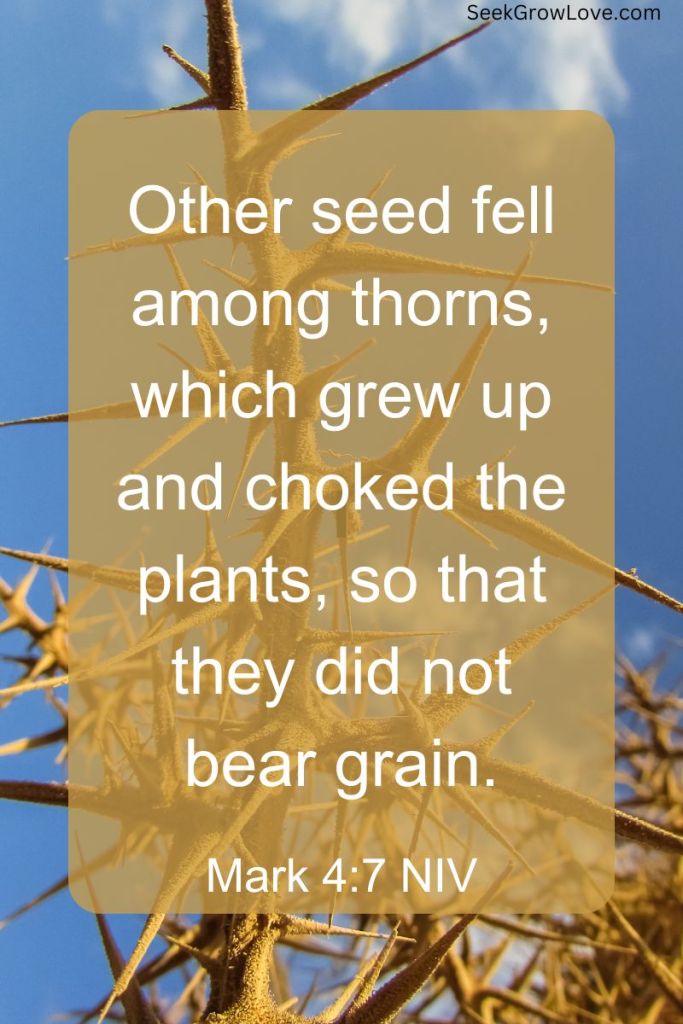
Seed 3 – fell among thorns – thorns grew up and choked the plant – plants did not bear grain – hear the word – but worries of this life, deceitfulness of wealth, and the desires for other things comes in – the plant is choked out, making it unfruitful

Seed 4 – fell on good soil – came up and grew and produced a crop, multiplying 30, 60, or even 100 times – hear the word, accept it and produce a crop

It is important to remember that in each of these scenarios the seed is all the same. There is nothing inferior to seed 1, 2 or 3. It is the same as seed 4. It is the perfect word of God being sown into the world. What creates the difference is where in the world it lands. Some people will accept it and do all that is necessary to make it grow in their lives and even produce fruit to give life to others. Some people will not. But, either way, the seed is still good and perfect.

The new thing I saw when I read the parable this time is that the plant from seed 3 that fell among the thorns did not necessarily die. Seed 1 never had a chance at life. Seed 2 enjoyed life for a short time but withered/fell away. I think in my mind I was giving a death sentence to seed 3 already as well. But, that’s not exactly what the Scriptures actually say. Both in the original parable and Jesus’ explanation it says the plant was choked by the thorns – it does not say killed by the thorns – at least not yet.

It is not down and out, yet. It is still alive – it might be sitting in your pew with you at church or it might be your neighbor across the street. It has a pulse. It might be a family member – it might be you. It is not dead, yet. It is alive – but it is not healthy. A healthy plant doesn’t have thorns wrapped around its neck. Jesus tells us the result of being choked by the thorns was that it did not bear grain – it was unfruitful. It is alive – but it is not experiencing the abundant life that Jesus spoke of. It is not producing and displaying the life-giving fruit of the Spirit. It is not reproducing and giving new life to others. It is alive but it isn’t passing along life. It is a sad place to be – whether you are a plant or a Christian.

Who needs a vegetable garden with no vegetables? Or an orchard with no apples? Or a wheat field with no wheat? Or a Christian with no fruit?

What can be done for such a plant? Is there any hope for the plant choked by thorns? I say yes! Cut off the thorns! Sometimes when I am gardening I am not sure what needs to be pruned and what needs to stay. What would kill the plant and what would help it grow healthy? I love that Jesus tells us exactly what the thorns are so we know what to cut out. He tells us the thorns are “the worries of this life, the deceitfulness of wealth, and the desires for other things” (vs. 19). And if you aren’t cutting them out, be sure that they are choking new life out of you. A worried Christian. A greedy Christian, or a Christian relying on his own bank account. A Christian with other priorities. It is not a healthy place to be. And it certainly doesn’t promote new life.

Examine your plant carefully. Being alive is good. But are you bearing fruit? What does your fruit look like? What does it smell and taste like? Where are you giving new life to others? If you aren’t sure if you are bearing fruit now – what do you want your fruit to look like? What do you need to get rid of first?

What thorns might be creeping up toward your neck? What are you worried about? Do you think your problems are too big for your God? What are you putting your trust in? God or yourself or your job or your paycheck? Do you hoard, are you always striving for the next big toy, is it hard to be generous? Have you bought any of the ‘deceitfulness of wealth’? Is pleasing God the most important thing in your life? Or are there other things you desire more? What have you made the number one priority in your life?

Cut out the thorns so you can have life – and bear fruit – which will in turn give life.

-Marcia Railton
Questions above – and what other questions would you add?

Bring Your Friends to Jesus

Old Testament: Numbers 19 & 20

Poetry: Job 16

New Testament: Mark 2

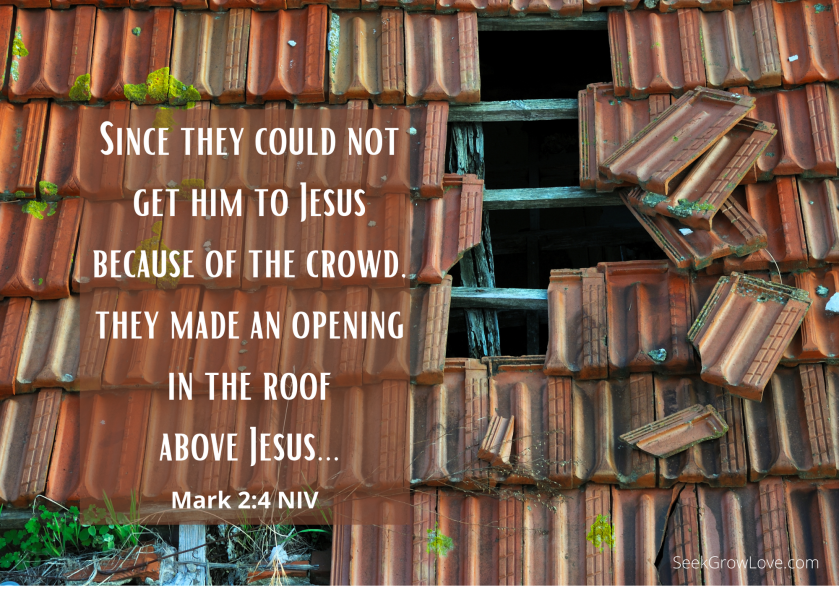
In Mark 2, we find the story of Jesus healing a paralyzed man.  Jesus was becoming more well known, and more popular.  He was inside a house, and some men brought their friend to Jesus so Jesus could heal him.  But because such a big crowd had gathered, there wasn’t room to bring him to Jesus, not even outside the door.  So the friends took the man onto the roof, dug through the roof, and let him down in front of Jesus.

I have to admire these friends.  They were very concerned about their friend, and wanted to see him healed.  They believed Jesus could and would heal him, if they could just get him to Jesus.  They didn’t just “pray about it”, they stepped out on faith and did something about it.  They dug through the roof, and let their friend get close to Jesus – and Jesus rewarded their efforts.

Mark 2:5 tells us, “When Jesus saw their faith, he said to the paralytic, “Son, your sins are forgiven.”  Jesus obviously saw that the man was crippled, but Jesus saw what wouldn’t have been nearly as obvious to us.  The man’s biggest problem was his sin – so Jesus healed him of that first.  This is the greatest miracle Jesus performed (and still performs).  

The teachers of the law said that Jesus was blaspheming, believing only God can forgive sin.  I’m guessing they were thinking, “it’s easy to tell someone their sins are forgiven, since you can’t prove they are really forgiven.”  Jesus then told them, “But that you may know that the Son of Man has authority on earth to forgive sins…”  He said to the paralytic, “I tell you, get up, take up your mat, and go home.”  So the man got up, took his mat, and walked out.

I love this story, not only because I love reading about all of Jesus’ miracles, but specifically because this is the only story I can think of where someone is healed because of the faith of his friends.  We’re not told, maybe the paralyzed man asked to be taken to Jesus.  But any way about it, Jesus saw the faith of the friends, forgave the man’s sins, and ultimately healed him.

This story puts me to shame.  I invite you to ask yourself some questions…

Am I this concerned about my friends?  

Am I willing to be uncomfortable – maybe even make a scene – to bring someone to Jesus?  

Am I willing to not just “pray for” someone, but actually “do something” for someone?  

Would Jesus see my faith and forgive and even heal someone I care deeply about?

Finally, do I need Jesus’ ultimate miracle for myself – to have him forgive me of my sins?  This miracle meets the greatest need.  It costs the most.  It brings the greatest blessing.  It has the longest lasting results.  And Jesus is still doing it daily.

–Steve Mattison

(Originally posted for SeekGrowLove on October 6, 2020)

Questions – See Above

Let’s Go Fish!

Mark 1:17 NIV for SGL

Old Testament: Numbers 17 & 18

Poetry: Job 15

New Testament: Mark 1

I used to own a pair of fish that my best friend gave me. I thought I was a decent fish owner. But then I went off to Australia for three weeks and when I returned, I came home to find that the slow-release food supply that I put into the tank, didn’t dissolve. My poor fish starved to death. Oops.

So your reservation to take seriously any of my mentioning of fish, fishing, or fishermen would totally be understandable.

But I ask that you hear me out, just this once, for this particular topic. After all, I did my due diligence and Googled some information.

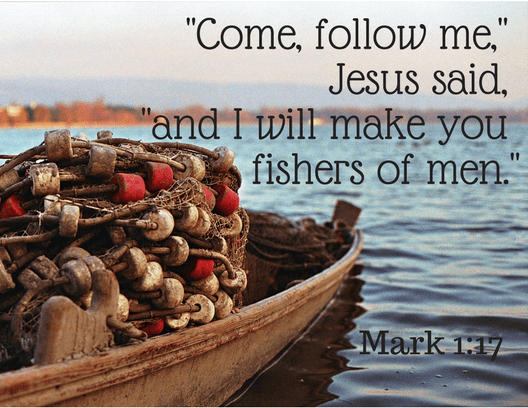
Mark 1:17 says, “Come, follow me,” Jesus said, “and I will make you fishers of men.”

Being a fisherman was way back then and continues even today to be a daily job. Likewise, as we follow Jesus daily, our casting of nets should happen every day we are around others. If we are called to be fishers of men, all of our interactions need to be with the purpose of building relationships and showing others, verbally and nonverbally, what life with Jesus as our Lord looks like.

Peter and Andrew knew when the best time to go fishing was. According to www.takemefishing.org (I’m totally serious… ) the best time to fish is usually later on in the day. I know that there are probably a gazillion other variables that should be considered, so don’t go dismissing the bigger picture here. Later in the day, the fish are primed for feeding because their metabolism and digestion are roaring. There is a lesson for us here – in order for people to win others to Christ, they need to be primed. In God’s own timing, a person’s heart will be open to receive the Gospel. As fishers of men, we need to be praying for those opportunities to present themselves so we are able to discern what to say and when to say it.

We know from verse 16, that Simon (later called Peter) and his brother Andrew used nets for fishing. Not a pole, line and lure, but nets. They caught hundreds of fish at a time. When Jesus says that he will make us fishers of men, I think His intention is that we not just teach a few people about Jesus, but that we influence hundreds of people, over our lifetime, to consider what life as a follower of Jesus would look like.

We also know from verse 16, that fishing was not a solo effort. It demanded at least a pair to get the job done. Our faith is meant to be in a community. Yes, Jesus goes off to a solitary place in verse 35 of Chapter 1, but that doesn’t mean we live in a vacuum. Working and serving with other believers is how our faith is supposed to be carried out.

I fully admit that sharing the Gospel is not my strength. But as I read this verse, I became convicted that this is something that I need to take more seriously. That’s partly why I chose it to be the verse to memorize for the week. So even though it is a short verse and easy to commit to memory, it’s potential to change my life and the lives of those around me, is significant.

Wanna go fishin’?

-Bethany Ligon

(Originally posted for SeekGrowLove on September 11, 2017)

Reflection Questions

  1. How have you been helped by your fishing community? How can you help them?
  2. How committed are you to following Jesus and fishing for people? What do you find hardest about these jobs? What gets in the way?
  3. Pray to God about how He would like to see you fishing for men/people. What does it look like? When and where will it be done? Who will your fishing partners be?

The Action Story

Old Testament: Zechariah 9-10

Poetry: Psalm 146

*Theme Week – Celebrating Jesus: Mark 1

            Every writer, speaker, film-maker has their own particular style for telling a story or giving a presentation.  When I preach a sermon I usually choose one particular theme.  I often start with a story that I have personally experienced and then try to help the listener make a connection to that same kind of story/situation and then connect the Bible story/text to that same theme.  It’s a slow build up to the main theme.  That’s one way to do it.

            Some choose to jump right in and focus on the action.  If you’ve ever seen a James Bond movie or a Tom Cruise Mission Impossible movie, you notice that almost always it begins right in the midst of the action.. very little warm up, just a kind of… boom! You’re right in the middle of the action- jumping out of an airplane, skiing down a mountain, climbing up the outside of a skyscraper, whatever.

            When it comes to the four Gospels, each one is different in how they begin.  Matthew goes back to the Old Testament and give a genealogy for Jesus, showing how his is connected to some of Israel’s great people like Abraham, Isaac, Jacob and King David and then he tells the story of Jesus’s birth in Bethlehem and how Mary’s betrothed, Joseph, was a good and honorable man.  Luke starts with the announcements of the pregnancies of John the Baptist and Jesus followed by their birth stories.  John’s Gospel follows the pattern of Genesis one and goes back to the beginning with God’s word, his promise and plan and then showing that Jesus fulfills that plan.  All three of those Gospels give back stories and slow roll outs.  Then there’s Mark.  Mark starts out… Boom!  John the Baptist is an adult and doing his ministry of preaching and baptizing.  Then Jesus appears as a grown adult and gets baptized by John and God’s voice descends upon Jesus proclaiming that he is God’s son and that God is pleased with him.

            Mark’s Gospel is an action story.  We know nothing about Jesus as a baby, how he came to be conceived of a virgin or in a manger.  Mark doesn’t mention wise men.  What matters to Mark is:  “What’s Jesus doing now that his mission is getting ready to start?”  We still know from Mark that Jesus is the son of God, because God announces it from heaven.  Mark doesn’t feel the need to share how Jesus happened to be the son of God, God just tells us.  Boom! Action!

            Mark’s favorite word seems to be “immediately”.  Jesus comes out of the water and “immediately” the heavens are torn open and God’s speaks.  Then “immediately” the spirit sends Jesus out to the wilderness to be tempted by Satan.  Compared to the other Gospels not a lot of detail.  We don’t hear from Mark how Jesus was tempted by Satan or how he responded, just that it happened.  Then Jesus is suddenly back in Galilee announcing- “It’s time! The kingdom of God is coming right away”.  Can you feel the urgency in Mark’s storytelling? 

            Next, Jesus is by the sea calling the fishermen to follow him and “immediately they follow him.” He moves on down and finds two more fishermen and “immediately” he calls them.  He goes to Capernaum and “immediately” enters the synagogue and starts teaching.  Then he “immediately” casts out an unclean spirit from a young man. Then he “immediately” leaves the synagogue and goes to the home of Simon and Andrew where Simon’s mother in law is sick and “immediately” they tell Jesus about her illness and he heals her.  From there every sick person in town is being brought to him to be healed.

            Next, Jesus is getting up very early in the morning to go pray and the disciples come looking for him.  There is urgency- “everyone is looking for you.”  Jesus then leads them from town to town preaching and casting out demons.  He meets a leper and touches him and “immediately” the leper is healed.

            Each of the four gospels tell the story of Jesus but do it in different styles.  Luke spends over 19,000 words telling the story, Matthew is right behind at over 18,000 words, John uses just over 15,000 words, and Mark, you guessed it- it is by far the shortest, telling the story of Jesus at just over 11,000 words- in just a little over half the words that Luke uses.  Mark probably had his own reasons for telling the story with so much action and so few words.  It’s still the story of Jesus, told from Mark’s perspective and it still touches on the main points- Jesus is the son of God, Jesus was baptized and tempted, Jesus preached the good news and healed people, and Jesus was on the move.  Mark goes on to show that Jesus was crucified and that God raised him from the dead.

            Isn’t it great that God allows us to keep our own personality and style as we serve him?  The story of Jesus has never and will never change, but how we present Jesus to others may depend on all kinds of factors including our own personality and style as well as the needs of our conversation partners.  God doesn’t make cookie cutter disciples.  God tells the story of Jesus through many different people.  How is he using you to tell the story of Jesus?

-Jeff Fletcher

Reflection Questions

  1. Why do you think God chose four different writers to tell the story of Jesus? 
  2. What do you appreciate about Mark chapter 1?
  3. God tells the story of Jesus through many different people.  How is he using you to tell the story of Jesus?

The Ultimate Rescue

*New Testament Reading:  Mark 13

Psalms Reading:  82

Old Testament Reading:  Isaiah 47-48 

“And then they will see the Son of Man coming in clouds with great power and glory.”   – Mark 13:26 (ESV)

Remember the rescue scene from yesterday’s questions (https://www.youtube.com/watch?v=4pFUP0HZwWM)? 

Well, here is the biggest rescue scene ever!  Mark 13:24-27, “But in those days, after that tribulation, the sun will be darkened, and the moon will not give its light, and the stars will be falling from heaven, and the powers in the heavens will be shaken.”  

Can you picture it?  The utter despair and hopelessness that the world will experience? 

Well, thankfully there’s more.  “And then they will see the Son of Man coming in clouds with great power and glory.  And then he will send out the angels and gather his elect from the four winds, from the ends of the earth to the ends of heaven.” 

Does that give you chills?  Just when everything appears to be doomed and evil is going to win,  God steps in and sends Jesus back.  For us. 

Verses 19-20 say, “For in those days there will be such tribulation as has not been from the beginning of the creation that God created until now, and never will be. And if the Lord had not cut short the days, no human being would be saved. But for the sake of the elect, whom he chose, he shortened the days.”

It isn’t going to be fun, in those last days, for believers.  Those who follow Jesus Christ will be persecuted; sadly, some to the point of breaking.  This is why we need each other – to be encouraged to stand firm.  Verses 32-33 say, “But concerning that day or that hour, no one knows, not even the angels in heaven, nor the Son, but only the Father. 33 Be on guard, keep awake.[a] For you do not know when the time will come.”  

But we do know that it WILL come. 

Amy Blanchard

Reflection Questions

  1. We must encourage one another to be on guard, to stay awake, and to stand firm.  We must see one another to do this, build genuine relationships, and be available to serve one another.  Hebrews 10:25 tells us to not neglect meeting together.  If you do not have a church you call home, please reach out to someone to help you find one.  If you do, are you involved in ways that encourage others, serve others, support others? 
  2. Trusting God’s promise of being rescued can be hard.  What are some ways He has come through for you already?  Keep reminding yourself of the times He has shown Himself faithful to you.

God Made Them Male and Female

*New Testament Reading:  Mark 10

Psalms Reading:  79

Old Testament Reading:  Isaiah 41-42 

The Pharisees ask Jesus about divorce to test him.  Rather than just answer their question, Jesus directs them to God’s original design for marriage…vs 6- 9 But from the beginning of creation, ‘God made them male and female.’ ‘Therefore a man shall leave his father and mother and hold fast to his wife, and the two shall become one flesh.’ So they are no longer two but one flesh. What therefore God has joined together, let not man separate.” There are several days’ worth of material in just that short passage.

Today, however, I want to focus on the phrase “God made them male and female”.   This is a quote from Genesis 1:27, “So God created man in his own image, in the image of God he created him; male and female he created them.”   Psalm 139:13-16 says of God, “For you formed my inward parts; you knitted me together in my mother’s womb….My frame was not hidden from you, when I was being made in secret, intricately woven in the depths …”.  Malachi 3:6a tells us, “For I the Lord do not change…”

When you put these thoughts together, you can see that God designed each one of us.  Individually, specifically, intentionally, purposefully.  He chose YOUR personality, eye color, height, if you like spicy foods or not, how you will process good and bad news, what will motivate you, and what sex/gender you are.  We can color our hair or learn to like certain foods, but we cannot change what we are at the core of who God made us to be.  HE CHOSE your gender.  HE CHOSE your gender because HE WANTED YOU.

How we bring glory to God is to be the best version we can of who He made us to be.  There are lots of gray areas up for interpretation in the Bible.  However, God is very black and white on the issue of gender.  He created them male and female.  That’s it.  No other options. 

Since that was so short, I feel like I have space to tackle one more piece from today’s reading.  Let’s look at God’s view of marriage and sex (another area where God is very black and white in His design).  In Mark 10 we read, ”…and the two shall become one flesh.  So they are no longer two but one flesh.  What therefore God has joined together, let not man separate.”   God’s plan and desire for marriage is that one man and one woman get married and stay married until death separates them (yes, there are a few specific exceptions to this, and I’m not digging into that here, but please talk to your pastor or an elder or trusted godly person if you have questions on this.).  God’s plan for sex is that it is a wonderful gift for pleasure and for procreation, only to be experienced within the boundaries of marriage as stated above.

The world today says that anything goes.  The Bible says differently.  It matters to God what we do with our bodies.  If you have already stepped outside of the boundaries that God has set for His children, know that He will forgive you and that He will remove your sin from you as far as the east is from the west (Psalm 103:12).  You need only ask Him.  I know because I was there.  He will not only forgive you, but help you to forgive yourself, too.

I will leave you with 1 Corinthians 6:18-20.  “Flee from sexual immorality. Every other sin a person commits is outside the body, but the sexually immoral person sins against his own body.  Or do you not know that your body is a temple of the Holy Spirit within you, whom you have from God? You are not your own, for you were bought with a price. So glorify God in your body.”

Amy Blanchard

Reflection Questions

  1. Your body becomes a temple of the Holy Spirit when you choose to follow God’s plan for salvation.  In short, it is belief, repentance, baptism.  If you have not made that commitment, please consider speaking to someone who can help guide you there.  Are you treating your body as God’s temple?  If not, why not?
  2. Repentance is an acknowledgement that what we did was wrong and a turning away from that action, attitude, inaction, etc.  Since we all sin, we all need to repent.  Is there anything in your life that you need to repent of today? 
  3. It is a struggle to go against what the world is telling you is good.  God expects us to stand firm in our knowledge of His design.  What else did these passages reveal to you about God’s character?

Defiled…or Not

*New Testament Reading:  Mark 7

Psalms Reading:  76

Old Testament Reading:  Isaiah 35-36 

­­­­­­­­­­­­­­­­­­­­­

There is nothing outside a person that by going into him can defile him, but the things that come out of a person are what defile him. – Mark 10:14 (ESV)

“Goodness Gracious!”  “Jiminy!”  “Good Golly!”  And, occasionally, “Uffda”.  Laugh if you want, but these are actually phrases that come out of my mouth when surprised or startled.  I have many issues and sins that I struggle with in my life (just ask my family), but bad language isn’t one of them.  Why not?  Likely because I don’t put that into my mind.  It bothers me to watch movies with a lot of bad language and I don’t surround myself with people who talk that way (at least they don’t in front of me). 

In Mark 7:14-15 we read:  And he [Jesus] called the people to him again and said to them, “Hear me, all of you, and understand: There is nothing outside a person that by going into him can defile him, but the things that come out of a person are what defile him.” And Mark 7:20-23 gets more specific:  And he said, “What comes out of a person is what defiles him. For from within, out of the heart of man, come evil thoughts, sexual immorality, theft, murder, adultery, coveting, wickedness, deceit, sensuality, envy, slander, pride, foolishness. All these evil things come from within, and they defile a person.”

There are two parts of this that need to be addressed.  First, what does it mean to defile yourself?  Here are some definitions I found for defile:  to spoil; to make dirty; to corrupt; to take away the purity, honor, or goodness of.  Second, for something to come out, it must be in, right?  So, how does that list of what comes out of the heart get into the heart? 

Think of the song O Be Careful Little Eyes. 

O be careful little eyes what you see
For the Father up above
Is looking down in love
So, be careful little eyes what you see

The other verses are O be careful little ears what you hear, little tongue what you say, hands what you do, feet where you go, heart whom you trust, and mind what you think.   All of these put ideas/thoughts into our minds.  Once there, we use our minds to decide what to do with the thought.  Are we going to take it captive and make it obedient to Christ (2 Corinthians 10:50)?  Are we going to let it conform us to the world or transform us to be renewed to know God’s will (Romans 12:2)? 

Other verses can give us more clarity and direction. 

1 Corinthians 15:33:  Do not be deceived: “Bad company ruins good morals.” Or, “corrupts good character” (NIV)

Psalm 119:11:  I have hidden your word in my heart that I might not sin against you.

What you put in (read, watch, listen to, etc.) and who you surround yourself with (face-to-face, groups online, etc.) WILL come out.   God goes so far as to warn us not to be deceived about such things.  Luke 6:45 says, “For the mouth speaks what the heart is full of.” And it’s not just the words from our mouths.  It’s our actions, inactions, attitudes, etc.  Be aware that what comes out reveals our hearts – as clean or unclean.  The choice is up to us.

Amy Blanchard

Reflection Questions

  1. What are you putting into your mind? 
  2. What comes out of you – your actions, words, and attitudes?  What do they reflect is in your heart? 
  3. God reveals himself through His Son, Jesus.  Jesus gives us a list of evil things that defile us.  What does this list reveal about God’s character to you?

Exercising Faith

Old Testament: Isaiah 33 & 34

Poetry: Psalm 75

New Testament: Mark 6

In Mark chapter 6, Jesus summons his disciples to go on a boat to Bethsaida, while he stays behind on land to pray. Their boat got to the middle of the lake, and Jesus, seeing them, started walking towards them. Little did they know, he was walking on water towards the boat. After seeing him, they immediately thought he was a ghost and were terrified. Seeing them frightened, he immediately said, “Take courage! It is I. Don’t be afraid.” 


   Jesus, with the power of His Father God, walked on water, which is not normal in any way, but Jesus told them to not be afraid. Do you sometimes find it hard to trust in God? It might be during a hard test, you might be in a difficult situation with your family or friends, or maybe you’re a new brother or sister of Christ who is struggling to find their purpose in the world. Trusting in God can lift a heavy weight off your shoulders. Faith is a lot like a muscle. The more we exercise our faith, the stronger our trust in God becomes. When we practice and train ourselves to have more faith, it becomes easier to have trust, and to rely on God. So ask yourself, are you willing to practice trusting in him?

-Hannah Bormes

Reflection Questions

  1. When was the last time you exercised your faith muscle? How did it work out for you?
  2. In what current situation would Jesus tell you to not be afraid? Why? How can exercising your faith muscles help you lessen your fear?
  3. What might God be asking you to do with His power?

An Unclean Spirit

Old Testament: Isaiah 31 & 32

Poetry: Psalm 74

*New Testament: Mark 5

The man was pacing.  Spewing forth profanities in a low but steady stream.  I was working at my part-time job at the public library and in charge of the building during my shift.  The agitated man was on the open upper level—I was at the checkout counter on the lower level, busy with patrons. 

The troubled man would quiet down and sit, and I would breathe a sigh of relief.  Then he would pop up again, pacing round and round with a new surge of profanity flowing from his mouth.  Slowly, I climbed the steps to the upper level. 

I walked over to straighten some magazines, so I could observe him closeup.  He was thin, wiry build, gray hair and beard, with eyes focused straight ahead, seeing things no one else could see.  He was completely unaware of me or any of the other people there.  I could see the uneasy expressions on their faces as he continued his verbal tirade, circling the floor. 

I knew I needed to take action, but felt confronting him might be dangerous, to me and the other patrons, most of whom were now exiting the upper level.

I walked down the wide, open stairway and called the non-emergency police phone number.  Waiting for the officers to arrive, I kept my eyes focused upstairs.  Minutes passed at a snail’s pace.  Finally, the officers walked in, talked to me, and went upstairs to speak to this distressed individual.

The final outcome—the man left the library, accompanied out by the officers, because he could not agree to quiet his profanity.  I was relieved and saddened at the same time.  It was obvious this man’s mind was troubled, whether it was because of PTSD, substance abuse, or something else.  But it was February, it was cold, and perhaps he was homeless like some of our other library visitors.  Yet, his “demons” had their way, and he lost a safe, warm space to spend a Saturday afternoon.

In Mark 5, Jesus encounters a man in much dire circumstances compared to the man in the library.  Jesus and his disciples had just reached dry land after traveling in a boat together.  While out on the Sea of Galilee, a raging storm arose, and Jesus calmed it to utter peace, much to the astonishment and trepidation of the disciples. 

Now, a new, alarming situation awaited the group.  Talk about a night of sheer drama!

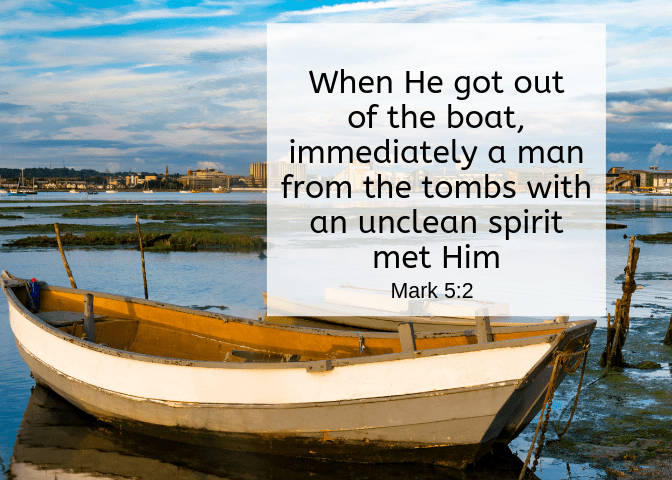
A naked, bleeding, shrieking man meets Jesus at the shore.  An unclean spirit lives inside of him, which causes him to behave like a madman.  Consequently, he wanders about the town cemetery, banished from people.  In the past, he had been subdued with shackles and chains, but amazingly they could not hold him for long.  Night and day, he roams through the tombs, screaming and cutting himself with stones.

When the tormented man sees Jesus, he approaches and bows before him, but not before Jesus had already addressed the unclean spirit dwelling inside him. 

“And shouting with a loud voice, he said, ‘What business do You have with me, Jesus, Son of the Most High God? I implore You by God, do not torment me!’ For He had already been saying to him, ‘Come out of the man, you unclean spirit!’ And He was asking him, ‘What is your name?’ And he said to Him, ‘My name is Legion, for we are many.’” (verses 7-9)

The unclean spirit recognizes Jesus fully—“Jesus Son of the Most High God.”  It knows his true identity. Jesus asks the spirit its name.  The answer received—“My name is Legion, for we are many.”  A Roman legion could be up to six thousand soldiers.  Whatever the number, the demon possession of this suffering pitiful man is overwhelming in magnitude.

The demons realize their “home” in the man is ending.  Jesus, Son of the Most High God, has calmed the wild sea and he will calm this wild man.  The demons do not want to leave the area.  They implore Jesus to send them into a large herd of pigs nearby.  

Jesus agrees.  The demons enter the herd of two thousand pigs; the pigs promptly rush down the bank into the sea, and drown.  Two thousand pigs destroyed.  All the observers of this frightening scene witness the massive destructive power of Satan.  Yet, what is their reaction to the miracle performed before them? 

The bewildered herdsmen run to share this news in the city and country.  Like any modern day curiosity, gawkers return to see for themselves what has happened.

And what do they see?  The well-known “mad man” is calmly sitting near Jesus, clothed and in his right mind.  At peace.  Instead of being happy for him and the city as a whole, verse 15 says the gawkers become frightened.  They beg Jesus to leave.  They cannot comprehend the scene before them, and they are filled with fear. 

But the “mad man,” now the “miracle man,” reacts as we would expect.  He begs Jesus to take him along, the complete opposite response of the townspeople.

Jesus answers. ”And He did not let him, but He said to him, ‘Go home to your people and report to them what great things the Lord has done for you, and how He had mercy on you.’”

Imagine the witness this man will be for the Lord.  From torment to peace, from screams to praises, from broken to whole, from darkness to light. 

Past, present future, Jesus changes lives.  Miraculously!  Dramatically!  And yes, sometimes slowly and quietly.  But when you truly encounter Jesus, Son of the Most High God, your life changes. 

I wish there had been a different outcome for the troubled man in the library.  I thought about him for days.  I know God saw him, I know God loves him.  I can only hope and pray his “demons” have left him. 

Jesus, Son of the Most High God, sits at our Father’s right hand, constantly interceding for us“Christ Jesus is He who died, but rather, was raised, who is at the right hand of God, who also intercedes for us.”  Romans 8:34

Give Jesus your personal struggles.  Give him your anxious thoughts.  He’s ready and waiting to take them all.  Just hand them over.

Paula Kirkpatrick

Reflection Questions

  1.  The demon-possessed man had great strength, and he broke free from shackles and chains.  Why could no one subdue him?
  2. We can’t win in spiritual warfare with our own power.  We need to rely on the Lord.  How do we accomplish this?
  3. The people who came to see the demon-possessed man healed and the pigs destroyed, begged Jesus to leave.  Put yourself in their place.  Would you have had the same reaction?

“Why Are You So Afraid?”

Old Testament: Isaiah 29 & 30

Poetry: Psalm 73

*New Testament: Mark 4

This will be a shorter one and something to reflect on throughout the day.  Something that can be applied to everyone’s life in a different way.  In this chapter there is a great windstorm.  Personally, I hate storms, ask anyone who’s been near me when one happens, I tense up and want to just get away from it, they terrify me.  And it terrified the disciples too.  They proceed to wake Jesus up who calmed the storm.  He asks them after “Why are you so afraid?  Have you still no faith?”.

If we look at our own lives, we also have storms.  Most of them won’t be actual storms that can shake a house or uproot a tree, but things in our own lives that cause worry and doubt.  They will differ from person to person and even day to day.  I’m also sure some of my storms would look like little spouts of rain compared to the hurricanes others face.  But look at what Jesus said, “Why are you so afraid?”.  I can’t pretend to know what everyone who reads this is going through.  But ask yourself – why are you so afraid?  Is what you’re afraid of that important in the grand scheme?  Take a step back and look at it. 

And the second thing Jesus asks them, “Have you still no faith?”.  Have you no faith that you can prevail?  Have you no faith that there is one greater than us who cares for each one of us personally, one who loves each of us?  Have you no faith there is a Kingdom coming that will put an end to every storm you face?  You can prevail.  Have faith in that, and have faith there is and always will be one stronger than you that you can always trust to be there. 

As you go through your day reflect on your own storms and ask yourself “Why are you so afraid? Have you still no faith?”

-Philip Kirkpatrick

Reflection Questions

  1. What do you find yourself afraid of? Why? What causes you to worry or doubt? Why? Is there a better way to look at what causes you fear, worry and doubt?
  2. Do you know “someone” larger than your fears that you can always trust? How has he proven he is trustworthy?
  3. How can we each work at growing our faith so it is stronger in the storms?
  4. Who do you know who has a strong faith you can learn from?