The Man with the Withered Hand

Old Testament: Isaiah 27 & 28

Poetry: Psalm 72

*New Testament: Mark 3

My dad had polio.   Polio is an illness caused by a virus. It can sometimes lead to paralysis.  Polio reached pandemic levels throughout the world in the first half of the 20th century.

My dad was diagnosed as a teenager in the early 1940’s, and he spent weeks and weeks in St Anthony Hospital in Rockford, IL.  I don’t know much more about that challenging time in his life, because he did not talk about it to my brother and me.  It didn’t occur to us to ask him about it.  We were kids.  We simply knew our dad had had polio and he walked with a limp.  One of his legs had been severely affected by the disease. 

My dad was a carpenter, and he was usually dressed in a gray work shirt and jeans, or occasionally in dress pants and shirt.  But NEVER in shorts.

One day when I was a teenager, my dad injured his affected leg.  My mom needed to render first aid and dad’s pant leg was rolled up above his knee.  For the first time, I saw my dad’s leg that caused him to limp.  I was shocked!  It looked thin, wrinkled, shriveled.  How could the sight before me be a man’s leg?  My dad was strong, rugged, tough, a working man who did hard physical labor.  I turned away, sensing I had seen something I shouldn’t.  At that moment, I began to “see” my dad differently, I began to slowly understand, he had endured pain and sacrifice to provide for his family.  His shriveled leg was a testament to that. 

In the beginning verses of Mark 3, Jesus enters the synagogue and encounters a man with a withered hand.  The hand is useless.  One Commentary says the hand muscles were shrunken and the limb shorter than normal—the cause may have been infantile paralysis.  In any event, the man was unable to work for his living.

Jesus sees his need.  He has compassion for him.  He also sees the Pharisees watching, waiting for his next move.

In recent days, Jesus had healed a paralytic man, and dined with tax gatherers and sinners.  In both instances, the scribes of the Pharisees questioned Jesus’ words and actions. 

Now it is the Sabbath.  Jesus and his disciples had just passed through a grainfield and picked and eaten some heads of grain.  (Mark 2:23-28) The Pharisees had called him out on it, saying Jesus was doing work on the Sabbath, the day of rest.  By the time of Jesus’ ministry, the Mosaic law of Sabbath rest, (Exodus 20:9-11) had been “enhanced” by the religious leaders through the years to include countless petty regulations and rules.  Jesus had deflected the Pharisees in the grainfield encounter, citing David’s eating of the shewbread (I Samuel 21:1-6) and declaring, “The Sabbath was made for man, and not man for the Sabbath.  Consequently, the Son of Man is Lord even of the Sabbath.”

Perhaps minutes to hours later, the Pharisees are now ready to pounce again with a new Sabbath challenge.  Jesus is prepared.  He asks the disabled man to step forward, so all the crowd can see him. (verse 3).  And then Jesus addresses the Pharisees.

“Is it lawful on the Sabbath to do good or to do harm, to save a life or to kill?” (verse 4)

We can imagine the silence was deafening.  Because, indeed, the Pharisees did not respond.  And then we come to verse 5, filled with emotions, drama and action.

After looking around at them with anger, grieved at their hardness of heart, He said to the man, “Stretch out your hand.” And he stretched it out, and his hand was restored.” 

Jesus looks deep into each Pharisee’s eyes, face, inner feelings.  He is angry at their lack of compassion, at their challenges to his God-given authority, at their unhearing, unseeing judgement.  The anger turns to grief as Jesus witnesses the hardness of their hearts to his ministry.  The Pharisees choose their “enhanced” laws over a poor man’s plight, choose their power OVER him, instead of a blessing FOR him. 

Then brilliantly, Jesus asks the disabled man to stretch out his hand.  The hand is cured without any labor, but simply by Jesus’ voice.  Jesus does not break the Sabbath labor laws, and neither does the man.  Surely the Pharisees will approve.  Their reaction is recorded in verse 6.

The Pharisees went out and immediately began conspiring with the Herodians against Him, as to how they might put Him to death.”

The Pharisees’ reputation with the people has been thwarted.  They will not accept this outcome.  Immediately their plans for Jesus’ destruction begin.

Only the man with the withered hand was rewarded.  Healed, restored, able to work and enjoy his life.  Forever blessed by the Savior.   

My father awaits that blessing too.  At Jesus’ return, he will rise up from the grave, his withered, diseased leg fully restored.  No more limping, no more pain.  Oh, what a day that will be.  I can’t wait to see him.  I can’t wait to see my coming King.

Paula Kirkpatrick 

Reflection Questions

  1.  Think about a person you know who will be healed when Jesus returns.  How does that motivate you to share the good news of salvation in Jesus?
  2.  Jewish law had “evolved” to extreme regulations about what was considered work on the Sabbath.  How do you feel about businesses that stay closed on Sunday, to honor the Lord? 
  3. Are we ever guilty of “following the rules” instead of having compassion for people in a difficult situation?  What example can you think of?
No Excuses

Old Testament: Isaiah 23 & 24

Poetry: Psalm 70

New Testament: Mark 1

In Mark 1 Jesus calls his first disciples.  He calls four people.  Now these four are all fisherman with jobs and lives.  But they leave those lives and jobs to follow Jesus.  Take a second to really think about how much they’re giving up there.  They’re losing their job, their lifestyle and leaving their own homes.  All to follow someone after he says just one thing to them.  Now it doesn’t say that they stopped ,thought about it, and followed Jesus, but that “At once they left their nets and followed him” (Mark 1:18 NIV) and “Without delay he called them, and they left their father Zebedee in the boat with the hired men and follow him” (Mark 1:20 NIV).  They left immediately to follow Jesus; they were willing to give up their own lives which they had plans for.  They gave that all up to follow Jesus.  They did it quickly and without hesitation.  Now they could have had insight like in Matthew 16:17, “Jesus replied, ‘Blessed are you, Simon son of Jonah, for this was not revealed to you by flesh and blood, but by my Father in heaven’”.  I would think that they did but we can still learn from their example here.

Another thing to notice here is that Jesus is not calling scribes or priests who might know the old testament the best and who are the most well educated.  There is plenty of reasons for this.  He is calling fishermen as his first.  The first time something is done it’s setting a precedent.  Everything Jesus did set a precedent for us to follow.  But he’s showing us here that you don’t need to be the most educated, or the smartest to follow and serve him.  That is the precedent he is setting for us.  The precedent that continues even to this day.  And he took these fishermen and made them into the vessels he would use to spread the gospel even after he was gone, when they were no longer fishermen, but fishers of men. 

Now we can apply this to our own lives as well.  We’ve all been called to follow Jesus just as the first disciples were.  Yet so many times we hesitate, because we don’t want to give up things, or we’re too scared.  Take a page from these disciples, they left their lives and their homes to follow.  We should be willing to do what is asked of us as well. Most of the time what we are called to give up isn’t even as much as they gave up.  Not only that, but when we are called to do something, we should be doing it right away.  They didn’t have the full picture of who he was and were willing to follow, we should be able to as well.  Let me qualify all that by saying we should give thought and prayer if we’re going to do something, and if we are called to do something that doesn’t mean you have to give up everything you know like the disciples, they were after all in a different situation than most of us. 

And if you’re stuck thinking that “I’m not qualified” or “Someone else better can do it because I’m not good enough” you should forget those thoughts.  Because Jesus set the precedent that we all, no matter how skilled or unskilled, can serve.  Just like the disciples he equips us for what we are called to do.   You don’t need to be the best to serve.  Moses who is famous for leading the Israelites out of Egypt was a flawed person.  And if you’re saying “I’m not ready yet because I’m too young, not good enough, etc yet” then when do you become ready.  Setting a random age where you say that you know enough now?  We are called to serve, not called to serve in 20 years. 

Don’t be afraid to serve in what way you are called and do it without delay when you are called. 

-Philip Kirkpatrick

Reflection Questions

  1. What do you feel the Lord has called you to do? How are you being called to follow Jesus? If you are unsure, pray to hear directions more clearly.
  2. What excuses have you given in the past for not following the calling right away?
  3. Would Jesus think any of these excuses are valid?
  4. What are you willing to give up in order to follow Jesus well?

Do you Know the Son of the Vineyard Owner?

Theme Week: 1 God, 1 Messiah – Mark 12

Old Testament Reading: Deuteronomy 5 & 6

Psalms Reading: Psalm 79

In Mark 12 Jesus hinted at his identity as God’s son, starting in the parable of the tenants. For a listener to have recognized Jesus in the parable may have depended on recognizing the tenants as his opponents, the current leaders of the nation – but they recognized themselves in the parable. The parable is quite different from how Nehemiah 9 presented the history of the nation. The whole of the land is pictured as a vineyard, carefully prepared by God. The emphasis is on the great lengths God went to in His mercy despite the repeated failings of the tenants. Jesus’ parable focuses on the last stage of the story, the current leadership which betrayed the trust they had been given. No parable conveys the real life situation exactly, and the image in the parable of the tenants seeking to take the inheritance for themselves by killing the heir cannot be precise – the leaders were not going to acknowledge Jesus’ identity. But they did arrange his death out of a mix of reasons that included avoiding having their positions disrupted.

     Jesus hinted at his identity again when he discussed Psalm 110:1, the Old Testament verse most often quoted in the New Testament. In the Hebrew the phrase “the Lord said to my Lord” uses God’s name (as revealed to Moses) and sets up a conversation between God and someone David (the psalmist) calls “my Lord”. Jesus asks the reasonable question why, since it was understood that the “Lord” in this text was David’s own descendant, that David would write of his descendant as his own “Lord”. The crowd may only have seen this as an interesting puzzle, but we can recognize he was showing that one of the sons of David was going to be something more significant than that one role could involve.

     In various ways Jesus came “at the right time”, fulfilling prophecies and meeting needs, including by arriving when he would be rejected. If he was not rejected, the plan could not go forward as God intended. Yet Jesus was recognizable, in a number of ways. Even in this chapter he showed his insight more than once. He showed it when he declared that holding to the one God above all, and loving your neighbor, are the height of wisdom. Anyone who set out to follow those commands would see in Jesus a fellow servant of God. But those who valued something else were still able to turn against him.

     The fact that idolatry was no longer accepted in Jewish society did not make the nation righteous, and it did not mean that the people all gained a clear grasp of God. “Idolater” may once have seemed like a good shorthand for describing a sinful character. Why, after all, would someone who did not wish to serve God choose to worship at His altar, when there were so many options to choose from? But with idolatry uncommon the “sinners” mingled with the “purer” of the flock. And sinners wished to masquerade as righteous. Some perhaps even tried to fool themselves. As Jeremiah once said, “the heart is more deceitful than all else” (17:9, NASB); God can understand all human hearts, but we can have difficulty understanding even our own. The sort of person who in the past might have knelt at a family idol of silver, while mocking his neighbor’s wooden idol, could easily fit in with some niches of Israel’s new religious elite. The scene described at the end of the chapter, with the wealthy dropping off tiny portions of their riches to great acclaim while a poor widow gave all she had, screams that the system needed reform. Yes, the donations might achieve some purpose in terms of charity or service work. But it seems like a system with fewer risks for the givers could be developed.

Lord, thank you for giving your son for me. Allow me to grow in love for you each day, and to grow in my understanding of love so that I can share it with others as well. You are a great God, and greatly to be praised. Your son, who allowed himself to die for me, is a remarkably trusting and loving man and I want to grow in my ability to be like him. Thank you, Lord. In Jesus’ name, amen.

-Daniel Smead

Reflection Questions:

  1. What do you think are some things that God wants people to understand about Him?
  2. Having created your list from the first question, based on whatever standards, now try to think about what practical benefits might exist for people to know those things. There may be cases where you trust God wants a thing known, because of scripture for example, but you aren’t actually sure why.
  3. What are characteristics you think are true of both God and His son, and what are some characteristics that are different between them? How about characteristics that are specific to only Jesus, and no one else?

Witnesses

Mark 16

Sunday, August 7, 2022

After numerous chapters devoted to preparing for the death and subsequent sacrifice of Christ, we finally reach the glorious reward of the Resurrection! Mark chapter 16, compared to the other gospels, is quite sparse in descriptive details of the Resurrection and Ascension of Jesus. However, what it does depict breathes a message of hope and love for the future of the church, as well as a final instruction.

               When Mary and Mary were given the message to tell the remaining disciples that Christ had risen, the disciples couldn’t believe it. “When they heard that Jesus was alive and that she had seen him, they did not believe it.” Mark 16:11. In fact, it seems like one of the things the disciples are best at is not believing something until they see it. They did not have faith that the thing they had been listening to Jesus predict for the past several years would come to fruition. Don’t worry because Jesus rebuked them for not believing when he found them again. Do you struggle to believe what Jesus has promised us? Sometimes it’s difficult to imagine a world where we all get along, where there is no longer pain. But without faith, we will never see this world; not because it won’t exist, but because we lack the faith to see it. Have faith!

               The final message Jesus gives the disciples is to “Go into all the world and preach the good news to all creation. Whoever believes and is baptized will be saved, but whoever does not believe will be condemned.” Mark 16:15. That is our grand mission! What are you doing today to increase the Kingdom of God? Some of us are not called to verbally preach the word, and some of us are blessed with such a gift. But not being good at public speaking is no excuse to not spread the word.

               Actions can speak significantly louder than words. In fact, that’s often the best way to spread the word; by living it out. To speak the message of Christ with empty words whilst living a life completely contrary is almost worse than to have never spoken a word at all. It is by watching the lives of those who follow Christ that we will be living examples of the love he provides us. In your joy, in your struggles, in your sadness, and in your blessings, praise God that you have been given this life to live. Focus on becoming the people that God has instructed us to become and devote your successes to Him. Live your life with the purpose of praising and worshipping Him, and He will reward you. As Christ commands it, do not simply speak the word; live it. Amen

-Mason Kiel

AND

2 witnesses are better than one! Today we have TWO writers for you – so below is your second devotion on Mark 16. Thank you Mason AND Jeff for writing for today. Keep sharing the good good news! Jesus is Alive!

            Have you ever been a witness who was called on to testify in court?  I have.  It was an interesting experience.  I had seen a crime committed, I reported it to the police, the criminal was arrested, I was asked to give a written statement to the police and I was later called on to testify at their trial.  I will say that when you witness something that causes excitement, gets your heart pounding, and puts you in “fight or flight” mode, it affects your thinking and perspective.  Everything seemed to be going faster than it really was.  Normally it’s more believable when several people give their eyewitness testimony.  Of course, no two witnesses agree on every detail.  Each person sees different things from different vantage points.  Each person remembers different details.  Each person recalls the sequence of events in a slightly different order.  These variations in detail are actually normal and good.  If every witness testified exactly the same details in the same way the lawyers for the other side would be arguing that they were unreliable because they obviously got together and rehearsed their testimony, which is a big no-no.

            When people read the Gospel accounts of Jesus they are seeing the story of Jesus unfold through the eyes of a variety of different witnesses.   The Spirit of God is the inspiration behind each of the writers, but God works through human beings and through different witnesses.  So it should come as no surprise when we read the four Gospels, Matthew, Mark, Luke, and John, and also the writings of Paul, Peter, James, and others, that while they are telling basically the same story, they do so from different perspectives.  The Gospel writers are either reporting what they themselves witnessed or what other eyewitnesses reported to them.  They tell the same story with different perspectives and often emphasize different parts of the story or place the events of the story in slightly different orders in keeping with the overall theme of their account.  Each story has different audiences in mind, different themes, and is not carbon copies of each other.

            One very important rule that is repeated throughout the Bible is that there must be a minimum of two or three witnesses. (See Deuteronomy 19:15, Matthew 18:16, John 8:17, and several other passages).  We’ve already noted that there are four Gospel accounts in the New Testament which fulfill that important principle.

            It is also interesting to note the background of who is qualified to be a witness.  Jewish law has a list of different types of people who are not permitted to be called as witnesses: “women, slaves, minors, lunatics, the deaf, the blind, the wicked, the contemptible, relatives, and the interested parties (Yad, Edut 9:1).” https://www.jewishvirtuallibrary.org/witness .  The Talmud, which is a Jewish Commentary from ancient times gives more details about who the “wicked” are who cannot testify.  At one point in ancient Jewish history, shepherds were included in the list of people disqualified from witnessing. “As a class, shepherds acquired a bad reputation as being lawless, dishonest, and unreliable, above all because of their habit of trespassing on other people’s lands to graze their flocks.” https://www.churchtimes.co.uk/articles/2015/20-february/regulars/out-of-the-question/shepherds-character-reference.

            Here’s what I find very interesting: two categories of people who were not permitted to act as witnesses were shepherds and women.  I’m not interested in debating the fairness of those exclusions, but simply note that at the time of Jesus’ birth, life, and death, some of the people who were not accepted as reliable witnesses were shepherds and women.  Why is this important? Consider, who were the first eyewitnesses who heard the angelic announcement about the birth of Jesus?  Luke says it was “Shepherds living out in the fields keeping watch over their flocks at night” (Luke 2:8).  It was to these “unreliable witness” shepherds that the angels appeared.  And it was these unreliable witness shepherds who went and reported to Mary and Joseph all that they had seen and then went out and “spread the word” about all that they had seen. (Luke 2:17)

            Now, maybe that was just a fluke… but maybe not.  In today’s reading, Mark 16, we fast forward to just after the death of Jesus.  Who is it who first go to the tomb after Jesus died?  Once again, it was to “unreliable witnesses” – this time it was women.  To whom did the angel appear announcing that Christ had risen?  “Unreliable witness” women.  Maybe it wasn’t a fluke after all.  Maybe it’s a part of God’s deliberate plan to choose people to be witnesses of these important saving acts of God, which the world normally rejects.  Does God choose to reveal His great acts of saving to the lowly people the world rejects?  It seems He does.  In fact, now that you know to look for it, pay attention when you read the Gospels and notice how many times the witnesses God uses come from the ranks of the supposed “unreliable witnesses.”  How many times does God use women, or tax collectors (another category of unreliable witness) or slaves, the blind, the deaf, or just plain sinners to be His witnesses?  You’ll find that from beginning to end, the Gospel is filled with “unreliable witnesses” who turn out to be very reliable.  And in a giant flip-flop of societal expectations, it is the lawyers and religious professionals from the reliable witness class who are the ones who bring false charges against Jesus.

            But the real question that each of us needs to ask ourselves today is, am I a reliable witness for Jesus?  Am I willing to tell the truth about what I have seen, heard, and known firsthand about Jesus in my own life?  Am I willing to tell “the truth, the whole truth, and nothing but the truth” about Jesus?

-Jeff Fletcher

Questions for Discussion:

  1.  Why do you think God chose “unreliable witnesses” to be the witnesses to Jesus’ birth and resurrection and other key events?
  2. When was the last time you told someone else “witnessed” what you have seen,  heard, or experienced about Jesus?
  3. Who is someone whom you could witness to today?

Crucify Him!

Mark 15

Saturday, August 6, 2022

Chapter 15 of Mark reaches the climax of the story of Jesus, but of course not the end. It’s the pivotal part where the prophecies he had been teaching of his death and sacrifice for our sins will come to fruition. No doubt, you’ve heard this story a thousand times, and for good reason. This event, the sacrifice of the lamb, is the only reason we are allowed to undeservingly reach salvation. What’s more impressive is that this story, just like virtually every other parable and sermon Jesus gave, can be interpreted to apply multiple lessons to our lives.

For instance, when bombarded by accusations and insults from the chief priests, Jesus stood firm in his teaching of remaining non-confrontational. “But Jesus still made no reply, and Pilate was amazed.” Mark 15:5. Jesus is able to remain non-confrontational when all he had to do was respond with a single truthful testimony. He refrained, knowing that all of humanity needed his sacrifice, as God willed it. Could you remain truthful and non-violent when the worst of life is hurled at you? How about when what’s being said is so obviously false, yet they won’t back down?

“’What shall I do, then, with the one you call the king of the Jews?’ Pilate asked them. ‘Crucify him!’ they shouted. ‘Why? What crime has he committed?’ asked Pilate. But they shouted all the louder, ‘Crucify him!’” Mark 15:12-14. Here, the people are accusing Jesus only on the basis of rage. There is no reasoning behind their decision, only malice. They refuse to listen to any voice of reason, as they are blinded by their own lust for destruction. Don’t be deceived by the masses and be sure to think critically for yourself. Never take someone else’s words as absolute truth without a grain of salt.

Nowadays, especially with the internet, people are more connected than they have ever been in all of human history. We see news quicker, respond quicker, think less, and react according to what we think other people would want. Whose opinion is the only one that ultimately matters? God’s, of course. Just like the members of the court who accused Jesus in an effort to please themselves, we lose sight of the only thing that matters. What’s worse is that we mock Jesus in our stupor as well; just like the court of those who crucified Jesus.

“They put a purple robe on him, then twisted together a crown of thorns and set it on him. And they began to call out to him, ‘Hail, king of the Jews!’” Mark 15:17-18. They mock him for they do not know who they mock. Do you mock Jesus with your words or actions?

Mark 15:31-32 says, “In the same way the chief priests and the teachers of the law mocked him among themselves. ‘He saved others,’ they said, ‘but he can’t save himself! Let this Christ, this King of Israel, come down now from the cross, that we may see and believe.’ Those crucified with him also heaped insults on him.” They mock the power of Christ because they do not believe what they cannot see. Even other people condemned to die with him are heaving insults at him because they cannot see beyond themselves or their own understanding. And look what it did—it sent our only hope of salvation into the most miserable state a person can physically endure.

“And at the ninth hour Jesus cried out in a loud voice, ‘Eloi, Eloi, lama sabachthani?’—which means ‘My God, my God, why have you forsaken me?’” Mark 15:34. They sent Jesus into this state, and it is by their actions that they will be condemned. Jesus was blameless and had every right to scream from the depths of his soul at the nature of his torture. Do you ever feel that God has forsaken you? Sometimes it seems like He has left us because we don’t see His guiding hand. Be thankful for the things that you have and do not need and be thankful for the things you do not have but do rightfully deserve as a result of your sins.

Mark 15:39 says, “And when the centurion, who stood there in front of Jesus, heard his cry and saw how he died, he said, ‘Surely this man was the son of God!’” Only after seeing it can they believe, because although they see, they do not look. Remember not to be led in your thinking by the masses, for they do not know the manner of which the things they speak. Take heart in your suffering, for the true prize still awaits.

-Mason Kiel

Application Questions

  1. How are you at staying truthful and non-confrontational when you are wrongly attacked?
  2. What does Jesus’ sacrifice mean to you?
  3. How do we remain thankful in our darkest hour?

A Day to Remember

Mark 14

Friday, August 5, 2022

It’s a story we’ve heard a thousand times – Mark chapter 14. Jesus predicts that one of his disciples will betray him, one will deny him, and they feast for one last supper. He’s arrested and, in the face of threat of death, commits to remaining non-violent; even going as far as to heal those who oppose him. The archetype of betrayal, prophecy, and endurance coming together in one of the final chapters of Jesus’s time on earth. So, what more could we take away from these things after hearing it repeated our entire lives? There is always something new to be learned or applied if you’re willing to try to find it.

Starting at the beginning of the passage, a woman approaches Jesus with an exorbitantly expensive container of perfume. She takes this jar of perfume and dumps it all over Jesus, to which she receives backlash. Those in the company ridicule her for not utilizing the perfume for something better, like helping the poor. Admittedly, this would be a very honorable thing to do. But surprisingly, Jesus stands up for her and tells them to not shame her for doing a good thing to him. “The poor you will always have with you, and you can help them any time you want. But you will not always have me.” Mark 14:7.

This is an interesting thing for Jesus to say, as I would imagine him having the mindset of ‘do everything to help those in need,’ but this circumstance seems to be different. There will always be the poor and needy, there will always be the hurt and the wicked. Jesus is the light in darkness, as darkness is the default state, only interrupted by the presence of light, not vice versa. If we spend all of our energy trying to eliminate the darkness, we will lose sight of the light that sustains us incipiently.

Jesus is well aware of this, as the light that sustains and empowers him is God. He cries out “Abba, Father, everything is possible for you. Take this cup from me. Yet not what I will, but what you will.” Mark 14:36. Jesus is crying out in the most passionate and sincerely affectionate way imaginable to his father, begging that his death be made unnecessary, that this burden will be taken from him. However, he takes the proper mindset of being able to accept that what he wants may not be what God wants. When you pray to God for an answer, are you able to accept what He responds with in the same faith Jesus could? It’s no mere feat, but then again Jesus is no mere man.

Not only does he accept what needs to happen, but he also stands firm on what he teaches. If you remember from yesterday, Jesus specifically said to not be afraid when we are brought before the court for our faith, but to answer as the Spirit guides you to, as it is the voice of the Spirit that will talk for you. When they had arrested him and grilled him with questions, “… Jesus remained silent and gave no answer.” Mark 14:61. He needed not respond to their trickery but waited until he knew what he was saying to tell them the truth. For this, they killed him. Could you stand for truth until the end? Could you stand with what you believe and know to be true even if every person would hate you for it? If so, you would be stronger than Peter. He lacked this ability, and defied Jesus 3 times—to which end it destroyed him.

“Immediately the rooster crowed the second time. Then Peter remembered the word Jesus had spoken to him: ‘Before the rooster crows twice you will disown me three times.’ And he broke down and wept.” Mark 14:72. Have you ever gotten to the point in your sin where you don’t even recognize who you are anymore? For Peter, he had been spending the past couple years of his life devoted to following Jesus to the end. And yet, when it mattered most, he denied even knowing him. He had become so distraught by his sin that he had nothing else to do than weep at what he’d done.

Sometimes, when we recognize that we’ve fallen so far from the righteous path laid before us, and become so wrapped up in our sin, all we can do is weep and pray that God can forgive us. In fact, it’s often in these moments that we convince ourselves that there’s no way God could possibly forgive us for what we’ve done… but that would be missing the whole point of the story! Jesus died so that even in the midst of our most egregious pain from sin, we have the opportunity to be forgiven. Even Paul, who was a Christian-slaying murderer found salvation! Do not waste this opportunity that Christ has given to you, but rather repent for your sins and devote your life toward serving his purpose. Amen.

-Mason Kiel

Application Questions

  1. Even if you’ve read Mark 14 many times before – what stands out to you today?
  2. How can you extravagantly love and honor Jesus?
  3. What does it mean to pray, “Not my will but yours be done”? What do you need to surrender and give up to God?
  4. In the past, how have you deserted or denied Jesus? Have you accepted Jesus’ forgiveness?

Be on Guard!

Mark 13

Thursday, August 4, 2022

   In comparison to the previous several chapters, Mark chapter 13 takes a rapid shift into a different topic. Recently Jesus has been responding to the trickery of the Sadducees and corrupt chiefs and priests, but as he and the disciples leave Jerusalem, he begins to speak on the nature of the end of times. Other than the fact that several of the disciples specifically questioned Jesus on the matter privately, I am assuming that this is sparking the point at which Jesus is coming to some sort of terms with what is about to happen. He has been warning the disciples of his death in somewhat cryptic manners, but I would imagine that seeing the state of the city and the leaders who were about to crucify him only made him feel worse.

               Now of course, as is always the case, it is important to be able to read the Bible with discernment between literal and poetic/prophetic verse. Interpret with great caution for yourself what makes the most sense in the context of what is being said, so that we don’t confuse literal for metaphor or vice versa. For this reason, I will go through some of what Jesus is about to say and without completely putting a definitive interpretation to it, as much as I can (as is so difficult to do with revelational scripture), I will provide objective fruit for thought that is applicable regardless of your interpretation.

               Alright, Jesus begins answering four of the disciples’ questions on what will happen at the end of days, when the stones and buildings will be thrown down. Jesus starts explaining the things that will happen, presumably in order although that is not clarified here, in detail. He first says, “Watch out that no one deceives you. Many will come in my name, claiming, ‘I am he,’ and will deceive many.” Mark 13:5-6. Already he explains that false prophets will come claiming to be the Messiah, and that we are not to believe them. This is the main delineating difference between Christians and the Jewish beliefs; they still await a Messiah. This first point is fairly simple; we must be careful that we do not accept or invite another Messiah, for the one and only has already come. Let’s continue.

               “When you hear of wars and rumors of wars, do not be alarmed. Such things must happen, but the end is still to come. Nation will rise against nation, and kingdom against kingdom. There will be earthquakes in various places, and famines. These are the beginning of birth pains.” Mark 13:7-8. Is this not incredibly applicable with what’s going on in the world right now? The news, 24/7, is pumping us with the prospect of potential growing war as the war in Europe is expanding and tensions between America and China heighten day after day. Increased frequency of earthquakes and constant food shortages around the world as farmers are told to stop planting their farms… But remember, “Do not be alarmed.” Have we not already won the war? Our battle is not in the flesh but for the salvation of our souls. The world will always be a bad place, as it is destined to be, but we aren’t put here to worry and cower in fear.

               The passage continues with, “You must be on your guard. You will be handed over to the local councils and flogged in the synagogues. On account of me you will stand before governors and kings as witnesses to them. And the gospel must first be preached to all nations. Whenever you are arrested and brought to trial, do not worry beforehand about what to say. Just say whatever is given you at the time, for it is not you speaking, but the Holy Spirit.” Mark 13:9-10. This is a tale as old as time, but ever more important to be prepared for as rights and freedoms around the world are being slowly and quietly removed or revoked in the heat of terror. Not only that, but believers will be brought forward within the church to be punished for the truth. We’ll be thrown in jail and persecuted for his sake. But again, we are told not to worry. What better cause is there to not worry about ridicule than the unquestionable word of God and truth? We have won the war with God on our side, have no fear in the face of adversity.

               But what should we do in light of these things? Sure, we can say that we should have no fear, but it’s much easier said than done when facing the edge of tyranny’s sword against faith that is coming. Let’s continue reading to find out. “Therefore, keep watch because you do not know when the owner of the house will come back—whether in the evening, or at midnight, or when the rooster crows, or at dawn. If he comes suddenly, do not let him find you sleeping. What I say to you, I say to everyone: ‘Watch!’” Mark 13:35-37. Be prepared! Fortify your heart and soul with the truth of the word and watch for the second coming of Christ! Don’t wait until tomorrow to finally start that Bible reading plan, or tell your family you love them, or volunteer to work at that homeless shelter. We know not when Jesus is coming back, so we must be prepared at all times for when he does.

               Remember, “All men will hate you because of me, but he who stands firm to the end will be saved.” Mark 13:13. Our battle is already won, in the face of all worldly adversity, so be prepared for his coming.

-Mason Kiel

Application Questions

  1. How many times in Mark 13 does Jesus warn to watch, watch out or be on guard (or whatever terms your translation uses)?
  2. Why is this important to Jesus? Is it important to you?
  3. What will it look like for you to be diligently watching for the owner of the house to return?
  4. Do you sometimes find yourself worried about the condition of the world or the end times events? What would Jesus say? What can we do to overcome these fears?

Sending the Son

Mark 12

Wednesday, August 3, 2022

Jesus, over and over again in Mark chapter 12, both evades the entrapment of those who wish him harm and enlightens his followers concurrently. In this chapter, men of simultaneous hypocrisy and high standing as well as the Sadducees attempted to either ask Jesus a question to bait him into testifying against the law of Moses or deny his Christhood. He first tells a story of a vineyard and its owner, then corrects hypocrites in their mentality on taxes, and catches the Sadducees in their deliberately poor interpretation of the word.

               I highly suggest that, before reading further, you go read Chapter 12:1-12 for yourself because it caught me off guard! But anyway, the chapter begins with Jesus laying out a parable of a man who purchased a vineyard and put effort into making it a fruitful investment. He put a wall around it, bought a winepress, and even built a watchtower for its protection. Having invested this much of himself into it, he went on a rightful journey as he rented it out to some tenants. However, in their stupor, the tenants got greedy and refused to pay the vineyard owner what was due. The owner sent man after man to collect the money, all of which were returned either beaten or dead (not good). After the man had sent all his servants to collect the money, he was left with only his son. He hoped that, since it was his only son whom he loved dearly, they would finally respect him. But rather, they saw this as an opportunity to take the owner’s inheritance for themselves, and they killed the son too! Jesus then says, “What then will the owner of the vineyard do? He will come and kill those tenants and give the vineyard to others. Haven’t you read this scripture: ‘The stone the builders rejected has become the capstone; the Lord has done this, and it is marvelous in our eyes.’”

The chief priests, teachers, and elders who had questioned Jesus’ authority wanted so badly to persecute Jesus for telling this story, because it was clear that Jesus was talking about them. You see, the owner of the vineyard represents God, who built a beautiful place for the tenants, us humans, to live. He put effort into creating this world, and when He sent his only and beloved son to talk to us, man killed the son of God. But it does not end there. The scripture that he quoted stands as a retribution for the murder of Jesus. ‘The stone the builders rejected has become the capstone, the Lord has done this, and it is marvelous in our eyes.’ For those who don’t know, the capstone is the stone to surmount all other stones in a wall or pillar. That is, God took the stone that man rejected and elevated him to a position above the rest, and it is marvelous.

This also acts as a warning to us. Although that part is not as fun to think about, to ignore it would be doing injustice to the passage as a whole. The owner of the vineyard is to come and kill the tenants, because they killed his son. God has every right to put those who desecrate His son in their place. When Jesus comes to you with an answer or a question, do you push him away or do you welcome him?

In this passage, the son coming to the tenants is a final gift from the owner of the vineyard, that he may still have mercy on them after all that they had done. And yet, they squander this gift by killing him. Are you squandering the gift that God so graciously gave you; this life on earth blessed by salvation through the blood of Christ? We must not be overcome with greed and selfishness of the pleasures of this world that are only here because God put them here in the first place. If gratitude can be seen as a parent of all virtues, (by this meaning that we can’t truly express any other virtue without first being gracious for the current state in which we preside), then we need to be gracious for what God gave us. We are blessed to have this time on earth that we may spread the word and increase the Kingdom of God, as is our mission.

-Mason Kiel

Application Questions

  1. What do we learn about Jesus from this parable?
  2. Do you accept that God has sent His beloved Son for you? How do you receive him?
  3. What does it mean to you that, “The stone the builders rejected has become the cornerstone (or capstone); the Lord has done this, and it is marvelous in our eyes”? (Mark 12:10&11 – quoted from Psalm 118). Do you give Jesus the place of capstone/cornerstone in your life now? What does/would that look like?

Faith in God

Mark 11

Tuesday, August 2, 2022

Chapter 11 of Mark is so saturated in beautiful parables and stories that it can be difficult to draw one single lesson from each separate part. The chapter contains Jesus riding into Jerusalem on the colt, him cursing a fig tree, driving heretics out of the temple, and providing a puzzling dilemma to those who wish to destroy him. From this, however, we’ll try to draw something coherent.

The story begins with Jesus and the disciples entering the city of Jerusalem. Like the confusing things Jesus asked the disciples to do that we were discussing yesterday, He asks several of the disciples to go into town and mysteriously grab a tied-up colt. What could the meaning of this possibly be? Why would Jesus have them specifically say that the Lord needs it, and it will be back shortly? My best assumption is that this was partially meant to draw the attention of the townspeople that the Christ was coming. Additionally, simply because he called for it to happen, it was so. This is a very similar archetype to what Jesus does with a fig tree the next morning. But just keep in mind, Jesus said for it to be so, and it was.

The next morning “Jesus was hungry” (Mark 11:12) and went to find figs on a fig tree he had seen. As it wasn’t the season for the fruit to bear, there were no figs. Because of this, Jesus curses the tree itself: “[May] no one ever eat fruit from you again.” Mark 11:14. This made me audibly laugh out loud when I read it because it seemed so out of place and random for Jesus to get mad that he was hungry and then curse a tree. It is not explained at first but keep this in the back of your mind for later; it’s foreshadowing.

Jesus then entered the temple and saw that people were committing heathenish and blasphemous acts in the temple of God. “He overturned the tables of the money changers and the benches of those selling doves and would not allow anyone to carry merchandise through the temple courts. And as he taught them, he said, ‘Is it not written: My house will be called a house of prayer for all nations? But you have made it a den of robbers.’” Mark 11:15-17. This is one of the few instances that makes me believe that anger as an emotion is not a sin, but unrightfully acting upon your anger trespasses into the bounds of sin. It has been referenced as ‘righteous anger.’ In his letter to the Ephesians, Paul writes “In your anger do not sin.” Ephesians 4:26. In this circumstance, Jesus became rightfully angry at the desecration of his Father’s home and rightfully drove the sinners out who were blaspheming the house of God.

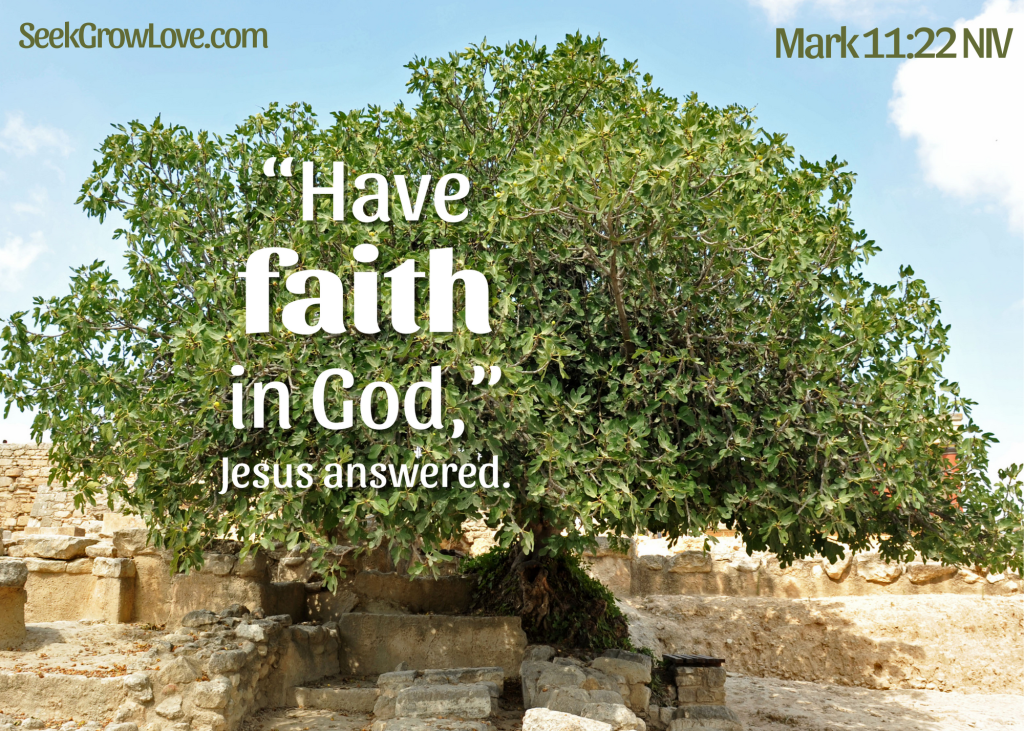
After doing this, as they were leaving the city, they saw that the fig tree Jesus had cursed the day before had wilted and effectively died. They were astonished by this, and Jesus replied, “Have faith in God, I tell you the truth, if anyone says to this mountain, ‘Go, throw yourself into the sea,’ and does not doubt in his heart but believes that what he says will happen, it will be done for him. Therefore, I tell you, whatever you ask for in prayer, believe that you have received it, and it will be yours.” Mark 11:22-24. I’m sure it would be hard to believe at first when Jesus cursed the tree that anything would happen so suddenly, but because Jesus said so in total belief and had patience, the tree wilted as He commanded. When you are praying for something that God would ordain to happen, do you believe in your heart without doubt that it will be given to you? If not, you have not the faith that is required for any reward to be manifested. Have faith that God wants the best for you and be ready to see the answer that God gives you.

Just as Jesus had faith in what he ordered and committed himself to an effort to do what is right (protect the house of God), he was rewarded. It is our goal to emulate this pattern of faith, prayer, and work to glorify God in the belief that He will reward us for our good efforts.

-Mason Kiel

Application Questions

  1. As Jesus entered Jerusalem what did the people expect? The disciples? Jesus? Have you ever misunderstood God’s plan or Jesus’ purpose? What were you focusing on? What is Jesus focused on?
  2. Have you ever been angry enough about sin and unrighteousness to do something about it? Did you sin while doing it? How do we ensure that in our anger we do not sin?
  3. Not having enough faith is indeed one reason your prayers may not be answered. How would you go about boosting your faith? What are other Biblical reasons for prayer not being answered?

Surrender, Sacrifice and Serve

Mark 10

Monday, August 1, 2022

Yesterday, we discussed how we are called to recognize that what we want may not be what God has in store for us. It is up to us to give up our false understanding and lean on the trust we have in God. Today’s passage drums a similar beat. It contains examples of Jesus fulfilling the old law, God’s desires for us, those who will receive this message, and what can happen if we but give ourselves over to Him.

Chapter 10 begins with some Pharisees approaching Jesus on the law concerning Moses. I believe this was yet another one of their attempts to trick Jesus into going against the law of Moses, and thus giving them a reason to condemn Him. He responds by telling them that “it was because your hearts were hard that Moses wrote you this law” – Mark 10:5 (the law that a man is permitted to write a certificate of divorce if he so wishes.) He then continues with, “But at the beginning of creation God made them male and female. For this reason, a man will leave his father and mother and be united to his wife, and the two will become one flesh. So, they are no longer two, but one. Therefore, what God has joined together, let man not separate.” – Mark 10:6-9. I especially love the verbiage of not letting man separate what God has joined, because God’s way is ultimately the only way that matters, and his say is the final word.

Adding to what God has set forth, Jesus rebukes the disciples for hindering children from hearing what Jesus had to say and His blessing. (Side note: this chapter is full of teachings concerning children, which is quite important.) In Mark 10:14-15 Jesus says “… Let the little children come to me, and do not hinder them, for the kingdom of God belongs to such as these. I tell you the truth, anyone who will not receive the kingdom of God like a little child will never enter it.” Not only has God set forth that the kingdom of God belongs to the little children, but also that it is the ultimate end-goal for every person to reach. It is not, of course, only for the children, but it is a metaphor for the childlike innocence and earnestness of the heart that we should have in our attempt to reach salvation. Not out of spite or a fake face that we put on to appear like we love God.

The second part of this passage ties in well with yesterday’s takeaway; our call to give up from ourselves so that we may gain so much more in return. A beautiful verse expressing this idea is Mark 10:29-31 where Jesus says, “I tell you the truth, no one who has left home or brothers or sisters or mother or father or children or fields for me and the gospel will fail to receive a hundred times as much in this present age (homes, brothers, sisters, mothers, children and fields—and with them, persecutions) and in the age to come, eternal life. But many who are first will be last, and the last first.” That, my brothers and sisters, is a very difficult task to complete. Would you be able to give up everything in your life for your faith?

Fortunately, it is not without reward, for as much as we give, we will be rewarded 10 times 10 fold over! Perhaps the best way to think of it is that no riches we gain on earth matter in the end, because an eternal life with God is unfathomably more valuable than anything in this life. We must, however, do these things with an earnest heart and not from a realm of bitterness. What’s more is that this principle is not given without an example – Jesus’s sacrifice.

Mark 10:45 says, “For even the Son of Man did not come to be served, but to serve, and to give his life as a ransom for many.” Even Christ, the most holy of any human to walk this earth, gave of Himself for the sanctity and salvation of others.

The first step towards an eternal life is to trust that God is in control even in the most unsettling or confusing of times. The next step is to then give everything you have to Him, and to be prepared to do so for His glory every day.

-Mason Kiel

Application Questions

  1. Jesus gave many lessons in Mark 10. Looking through the chapter, which one is the biggest challenge for you right now? Why is it difficult? What do you think Jesus would say to you regarding this challenge? What steps would Jesus have you work on to grow closer to what God wants you to be/do.
  2. How does remembering the reward help when it is hard to surrender, sacrifice and serve?
  3. Who and how will you serve today?