Oddly enough, as I read through Revelation 15, I thought of so many Disney movies. No, not the fictional characters or the talking animals. Instead, the random break out in song no matter what else is going on or crazy circumstances that they are in.
We are given the picture of the angels holding the plagues that would complete God’s wrath – and then take a look to the left, a song breaks out and all those that were singing had harps that were given to them by God. Timing seems pretty odd with the upcoming events about to take place.
They are singing 2 songs – both redemption songs. One like the one that Moses sings after He had freed them from slavery in Egypt and the other a saving from death and destruction He provided through Christ. These songs are giving God glory and praise for what He has done.
It doesn’t matter what is happening around them, the singers have reason to sing. They have been saved by an amazing conquering God. We too have reason to sing. It may seem weird to break out and sing at random moments but I think that is a glimpse of the kingdom. We will sing praises to the God that is worthy to be praised.
The angels are about to spread the plagues and the redeemed are singing to their God.
Not to make light of these events foretold, but our world at times may feel like a plague is upon us. We still have reason to sing. Never miss an opportunity to sing praises to our God. Don’t let the distractions of this world get in the way of our ultimate purpose; to worship the one that sets us free.
-John Wincapaw
Reflection Questions
How can you practice giving God praise and glory even in the midst of scary, overwhelming or unknown circumstances? How can you bring glory to His name in the midst of your activities?
How does music help us display our emotions?
Create a short (or long) song of praise to God, using the song of Revelation 15 as inspiration. What do you praise Him for? Do you fear Him as well (Revelation 15:4)? Why?
There is a lot happening in Chapter 14 – including the introduction to the 144,000 – the 3 angels and their messages – and the harvest.
The 144,000 with God’s and Christ’s names on their forehead – coming after the beast’s mark in the last chapter – we see a group of the faithful that have remained pure to God and taken His mark.
Before we get to the messages of the angels, this stuck out to me:
6 And I saw another angel flying through the sky, carrying the eternal Good News to proclaim to the people who belong to this world—to every nation, tribe, language, and people.
We see the eternal gospel (good news) – the message of love, hope and salvation all found in the promise of God’s kingdom. This angel has the responsibility to make sure that everyone hears this truth. No one is forced to accept this gospel but everyone gets the opportunity to hear it and make a choice.
It sounds like the commission that Christ left his disciples and then they have passed this responsibility down through the church and us. It will ultimately be fulfilled through our preaching and teaching and in entirety by one of God’s messengers.
We have a role in this. Those that have received this truth are charged to proclaim it. Through what we say and do, our life is a proclamation to those who may not know the truth that Christ taught, lived and promised.
The message of the angels was really for those that have not accepted this truth – fear God, evil has lost and those of you that joined the beast have picked the wrong team. Times up!
After these messages we see another small note added by John for the faithful before God’s wrath:
12 This means that God’s holy people must endure persecution patiently, obeying his commands and maintaining their faith in Jesus.
The chapter ends with a gruesome depiction of God’s wrath through a harvest.
Further motivation to choose the right team. If you have been following these devotions, you have heard the eternal Gospel – have you accepted and further began proclaiming it?
-John Wincapaw
Reflection Questions
What evidence do you have of what team is the right team?
What motivates you most to be actively choosing the right team?
How can you share the eternal good news this week?
Multiple times throughout the book of Revelation Jesus is referred to as faithful and trustworthy. In chapter 12 we are introduced to a deceptive dragon and in 13 his beast minions that also deceive.
We are all given a choice. To follow what is faithful and true or what is deceptive and false.
When painted so clearly it seems silly that some would actually choose the latter. Unfortunately, if you look around, we see Christians dabble in the ways of the world. They straddle the fence of what is right and wrong.
Those who straddle will be deceived. Right and wrong becomes muddied. Black and white becomes gray. They will slowly drift further from what is faithful and true and more in line with the way of the world.
Vs. 8 describes those who fall into that trap:
“And all the people who belong to this world worshiped the beast. They are the ones whose names were not written in the Book of Life that belongs to the Lamb who was slaughtered before the world was made.”
Revelation 13:8
A few verses later is the mark of the beast. A time when a clear choice will have to be made. Will you be branded and continue to live a worldly life that takes your name out of the book of life? Or will you maintain your allegiance to Christ even if it means severe persecution, being cut off from buying goods and even possible death?
That day may come in our lifetime; it may not. You do not have to wait until then to make your choice.
Like Joshua (Joshua 24) – choose for today whom you will serve – as for me, I will serve the Lord.
Where does your allegiance lie?
Choose today! Choose to follow what is faithful and true and stay vigilant to not be deceived.
-John Wincapaw
Reflection Questions
Can you think of a time when you were deceived by Satan or by “the world”? What could you do differently to not be deceived next time?
Because of the evil, deception and difficult times John writes that God’s people will need what 3 characteristics (see Revelation 13:10 and 18). What grade would you give yourself in each of these areas? What can you do to strengthen yourself in each area?
How has Jesus shown himself to be faithful and true?
The book of Revelation at times can be difficult to read and understand. Ultimately it is a letter to the followers of Christ to encourage them to remain with the God that has already won the battle and further telling us how to remain faithful in the difficult times that are sure to come.
Chapter 12 starts with a cosmic battle with a dragon and a woman with child. The dragon, attacks the woman and her child. And although it appears the dragon has the child briefly, he is snatched away to signify his power cannot contain him.
The dragon is defeated and is thrown to the earth, and in response to his defeat, continues his war on earth.
This is the situation in which we live: Christ has defeated death and sin, but evil is still at war with and among Christ’s people.
John tells us in verse 11 that we too can conquer through the imitation of Christ and lives of love and the message of the gospel:
“And they have defeated him by the blood of the Lamb and by their testimony. And they did not love their lives so much that they were afraid to die.”
Revelation 12:11 NLT
So then the message of chapter 12 to us is first to rejoice that God has already won. And then second, to receive the encouragement to be faithful ourselves: to witness even though we face opposition, persecution and in some cases even death.
It is through this sacrificial living that the kingdom of God advances, and it is to this faithfulness that John is calling us.
-John Wincapaw
Reflection Questions
According to Revelation 12, what part of the battle has been fought and won? What evidence do you have of this? What part of the battle are you still actively fighting? What evidence do you have? How is your battle going?
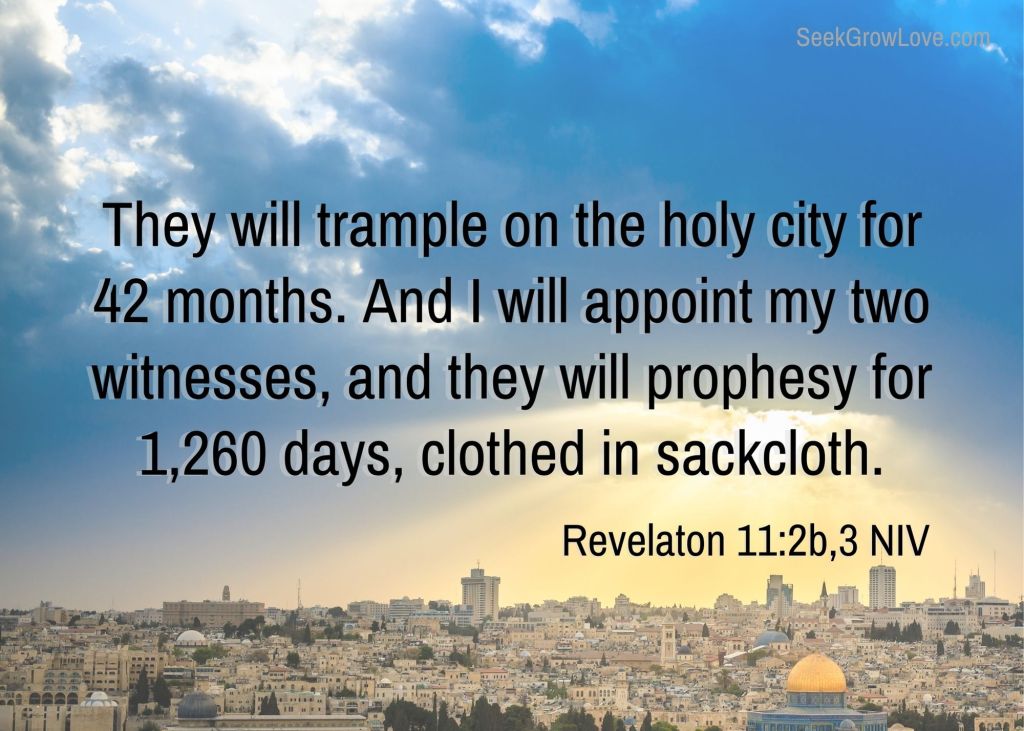
In Revelation 11 John is told to measure God’s Temple and the altar, and the people worshipping there – except the outer court. We never learn that John reported or used these measurements, perhaps it is all a complex object lesson. (Later an angel also measures the New Jerusalem, see 21:15.) Still, the fact of doing this made John walk over every part of the Temple, and it took time. Ezekiel 40‑42 seems to list what he needed to measure – with the addition of the worshippers, and I don’t know how he did that. The whole scene also creates another lengthy pause for John in the vision, which is hard to visualize when reading.
John then learns about the Two Witnesses, who sound like a combination of Elijah with Moses and Aaron. The ability to breathe fire, while new for prophets, fits well if these verses are taken as part of the second woe. Reading about their authority it could seem odd that the nations will walk over Jerusalem and the Temple’s outer court in that time, rather than being driven away. But the witnesses will be in sackcloth for mourning. It will not be their role to drive out all the wicked, but to speak truth. The choice of what happened to the city belonged to its population. Their miracles will strike against those who seek to kill them, and back up their statements, but their basic ministry will be in their words.
And “when they have finished their testimony” the witnesses will be killed in Jerusalem. It is quite the image to think of wicked people celebrating ‘Happy Two Witnesses Day’ and exchanging gifts, perhaps commemorative shirts or mugs. But the wicked will have rejoiced in error. In the immediate aftermath thousands in Jerusalem will die, but the rest “gave glory to God.” Maybe those giving glory will be the first fruit of the witnesses’ ministries at that time. If so, I think they will be welcomed to the truth with joy, and the witnesses will count their own deaths as worthwhile. But I believe that the testimony of what these two will faithfully do has already brought great good, before they have even begun to prophesy – that is one of the strange potentials with prophecy about prophets.
The blowing of the Seventh Trumpet is answered with voices from heaven. The kingdom of the world has become the kingdom of our Lord and of His Christ! God, the Almighty, has begun to reign! But it seems like God will be reigning over a world that is still populated by many of the wicked. If the seventh trumpet launches the third woe there is a lot of damage to come, although nothing more is said about that here. John has been told he needs to “prophesy again,” and perhaps it will be necessary to go backward to gain traction to go forward. The three-and-a-half year period which is discussed early in chapter 11 will come up again in chapters 12 and 13. While many people see the seven trumpets as leading into the woeful seven bowls of the wrath of God that is not for several more chapters.
Chapter 11 closes with another reference to the Temple in heaven, as it opens to reveal the ark of the covenant. I think that for the equivalent of the Holy of Holies in the heavenly tabernacle to open says the separation between God and mankind is being reduced or eliminated. This may not be a safe thing for the general population. Rather than a promise of blessings about to pour onto the world, it may mean that holiness will be called for.
Lord, I see in John and the unnamed witnesses people who understood servanthood, who accepted the risks in following Jesus and were completely committed. Allow me to be as humble and as brave as one of your prophets. I don’t need to tell the future. Please let me grow into that passion to do what you desire of me, guided by your Spirit, living in your love, serving in faith, working toward hope. May your will be done. Amen.
-Daniel Smead
Reflection Questions
What good can come from the prophecy of the coming of the Two Witnesses before they have even come? What do you personally gain from looking into the book of Revelation? Who do you know who could potentially benefit from knowing what is in this revelation? Pray for them, and for your faithfulness as a servant of God.
What are your thoughts and feelings about the separation between God and mankind being reduced or eliminated? Why?
After the sixth trumpet we have a break when John is prepared for what comes next, which mirrors the break after the sixth seal when the 144,000 were sealed. We are reminded that all through this vision John has been writing what he sees, as Jesus told him to do back in 1:19 (10:4). I wonder if he started the vision in front of a blank scroll and finished with a completed work. Or was the writing part of his vision, and he needed to rewrite it all afterward? And I wonder, again, how often what he wrote came to him as part of the vision and how often his words are his efforts to convey what he experienced. For example, did John make the distinction of a “strong angel” himself, based on experience in this vision looking at different angels?
It wasn’t pointed out at the time, but in chapter 5 it was a “strong angel” that proclaimed the question about whether anyone could open the seals of the book in God’s hand. And now a “strong angel” holds the small book John will eat. Perhaps this is setting up transitions in the vision for us, as the book John eats seems to establish his personal involvement in the next part of the vision. (There is one more “strong angel” reference, in 18:21, punctuating and concluding the section on Babylon.)
When our strong angel in chapter 10 cries out like a lion roars, seven peals of thunder respond – these may refer to the peals of thunder that come from God’s throne (4:5). But John is told by a voice from heaven not to write down what the thunders said. Among all the details in Revelation this lack of information can be one of the most interesting things for us. What secret is left out here? I have sometimes suggested it might have been a self-unfulfilling prophecy (my own phrase), something we can’t be allowed to know because knowing it in advance would make it awkward for it to still take place. Like “tomorrow [fill in the blank date] king [fill in the blank name] falls.” In the context it is hard to expect a minor statement – the strong angel is just about to swear an oath by God that the mystery of God is on the verge of being completed.
The same voice from heaven tells John to get the book and eat it, which he does, but first he is warned by the strong angel that it will be sweet in his mouth but bitter in his stomach. This is interesting, because in Ezekiel 2:8–3:3 we get a similar story of eating a scroll that tastes sweet but there is no mention of bitterness. This is more like comments in Jeremiah 15:16-17 about him eating God’s words and finding them a joy and delight, but then being filled with indignation. What John ate was easy to take in but would result in him needing to “prophesy again concerning many people and nations and tongues and kings.” The phrase “prophesy again” is sometimes taken to mean that the next part of the vision will revisit ground, duplicating some parts of the story to get at new aspects of it. And not all of that prophecy would be a joy and a delight. But God will be revealing what He recognizes needs to be shown.
It may be worth recalling that John is in exile when he sees this vision. He will emerge from it to send his letters, his warnings and encouragements and predictions, and continue in exile. We don’t really know how bringing more attention to himself this way during a time of persecution affected his situation. Maybe not positively. But John was God’s worker and working for God isn’t always pleasant for the one working, at the time. But I trust that John absolutely knew the job was worth it, and I hope that he found the experience of his vision encouraging.
Lord, forgive me the foolishness I sometimes experience of wanting to know what you aren’t interested in telling me, and showing too little interest in what you have made plain for me. You have shown me things that are good, help me to act on that awareness. You have shown me things that are not good, help me to act on that awareness as well. If at times I have found your words bitter in my stomach I have little right to claim I have been cheated, for they were sweet on my tongue. And I acknowledge you have given me far more than I ever can give you. Help me to serve you as I ought to, even if I feel I am in the valley of the shadow of death. Your light can never be overcome. I will trust in you. Amen.
-Daniel Smead
Reflection Questions
What are your thoughts and feelings when you read verse 7, “But in the days when the seventh angel is about to sound his trumpet, the mystery of God will be accomplished, just as he announced to his servants the prophets.”
What words of God might be sweet in the mouth, but sour in the stomach?
Chapter 9 gives much more detail on the first and second woes than the first four trumpets, which received just six verses. That mirrors the brief coverage of the first four seals. It is true that seven is “a number of completion or perfection”, but I think more than that is involved with the several sets of seven in Revelation. John’s vision is very complicated, but how it was relayed to him helped him pass it along. It also helped others to memorize it (many believers have heard rather than read Revelation). One aspect is how certain descriptions parallel or contrast with each other. Another useful detail is the images it contains, particularly the throne. Most of John’s vision can be placed relative to that central image. We can’t automatically visualize how that gives the vision structure, but we can attempt to bring it to mind. Perhaps John didn’t always hear the 24 elders at the same volume in the background of a scene, they could have been ‘turned down’ in his perception to let him concentrate on a new event, but several times we read of scenes happening near the throne or of John looking farther away. We don’t always understand the significance of the details John provides, but some of that may be in what we are actually looking for. John provided this book for audiences with varying needs, encouraging in times of persecution, reminding of God’s promises, and offering warnings, among others. Perhaps the final generation of this age will make very special use of the vision, employing some of its peculiar design as an aid to its understanding, when taken in context with events.
The fifth trumpet involves a pit being unlocked to release creatures that are like winged locust-horses prepared for battle. They have human faces with lion’s teeth, long human hair and something like gold crowns. They also have scorpion tails that they will use for five months to deliver pain in a reign of terror. Their targets are only those who don’t have God’s seal on their foreheads (9:4, referring back to chapter 7). These attacks cause so much pain people wish to be dead, but they aren’t killed. You can choose whether to see them as monsters, or perhaps a really complex metaphor. In Jeremiah 51 we read of an army serving God in bringing judgment described as “a population like locusts” (v. 14) and “horses like bristly locusts” (v. 27), maybe picturing their armor. But this goes a fair way beyond that. And it doesn’t help that their leader is described as an angel king known as Destruction or Destroyer. We only hear of him this one time, but it seems like we will read about the pit again a few days from now – the key to the pit will be brought back by another angel so that the devil can be locked up there (20:1-3).
The sixth trumpet is blown, and a voice speaks from the four horns of the golden altar (in front of God’s throne). This takes us back to just before the start of the sequence of seven trumpets when a censer filled with fire from the golden altar was cast onto the world. Each of the first four trumpets related to flame, and the fifth trumpet involved a burning star falling from the sky and smoke rising up. Now with the sixth trumpet the reference to flame is very distinct. The voice calls for four angels which have been bound at the Euphrates River in the Middle East to be released. We are told they were kept in waiting for this exact day and hour, but it isn’t fully plain what their role in the situation is. Perhaps they act as generals directing the force which emerges, for there comes a massive army of what are in effect mobile flame throwers. They are described as 200 million horsemen mounted on creatures with lion’s heads and snake tails capable of producing fire, smoke, and sulfur from the mouths at both ends. Sulfur (which has also been known as brimstone) produces a dangerous gas when it burns, and its flames are difficult to put out. The text pictures the fire, smoke, and sulfur as three plagues on humanity.
We are not given a timeframe for how long the second woe devastates humanity, but the death toll is a third of the global population. We also learn that in the wake of these events the survivors do not change their ways. In 6:16 we heard that the people realized God’s wrath had come, but they wanted to hide from it rather than repent. This text reaffirms that remorseless attitude, as well as stating some of the evils they were guilty of. Between the two trumpets there is quite the display, first a group of people who hurt so badly they wish they were dead but who don’t improve their lives during the course of five months of this, and then the deaths of masses of people without providing a cautionary tale to anyone. If God is teaching lessons by these events perhaps it is less to the people of that time than to us, letting us see how far gone matters will be by then, making us aware that God picked the right time for the end of the age. Renewal needs to come, I long for renewal actually, but let it be at the right time. The Father knows all the right days and hours.
Lord, you are loving and patient and kind. But you will not let the wicked go unpunished. You are the one who provided the Lamb, you wanted the stain of sin to be removed from me before I even knew what it was. You want to avoid punishing. You want to save, to protect, to shelter. You once flooded your creation and said you would never do it again. But you reserved this world for fire because the flood didn’t solve everything. And I’m sorry all this came about. I grieve that it was necessary. Please show me how to be a blessing, to use your Spirit to make this world a better place and reduce some of the suffering that might have been in it when you will need to act. Thank you God, I love you. Amen.
-Daniel Smead
Reflection and Application Questions
Would you rather…live through the events of the 5th trumpet or be killed in the events of the 6th?
Why do you think God prompted John to write down the vision of the book of Revelation? Why are we reading it today? What specific further actions should it lead us to?
Can you give an example of God’s perfect timing, either from the Bible or a personal account?
How would you describe God’s love AND His need to punish the wicked to someone who has never met God?
At the start of chapter 8 the Lamb opens the final, seventh, seal of God’s book, and there is silence in heaven for about half an hour. John may have experienced this, felt it, but it is difficult as a reader to appreciate a dramatic pause. And it was not just a pause but a silence – praise has been the backdrop of John’s vision for some time, from beasts and elders and angels and creatures, and more recently they were joined by a vast throng. Suddenly all is silent. This was reverence. The book was fully open. We humans still aren’t told what that means precisely, but what it means is very big.
We then transition into a new series of seven with the blowing of trumpets. It isn’t quite clear whether this resulted from opening the seventh seal, or not. People question whether the trumpet blasts proceed chronologically after the seals or if the trumpets describe some of the same time as the seals, perhaps focusing in tighter and narrowing our attention.
After the trumpets were distributed, and before they were to be blown, we are reminded that the tabernacle on earth was a shadow of the one in heaven. An angel works with the prayers of the saints that are on the golden altar before the throne, mixing them with incense in a censer and letting the mix go up to God on His throne. Maybe these are the prayers of believers on earth, or this may be yet another reference to the souls of the saints that are beneath the altar, calling God to render judgment soon. Then the angel puts fire from the altar into the censer and casts it down onto the earth – the sounds that accompany its fall suggest this may symbolize judgement commencing (or resuming).
As the trumpets begin to blast (sounding after the quiet, like a new fall of Jericho) there are disasters that bring to mind the plagues against Egypt, and the destruction of Sodom and Gomorrah. As with the first four seals the first four trumpets seem to go together in a set, but the big number this time is one-third rather than one-fourth. We don’t know whether a single huge portion of the planet (land, sea, and rivers) is rendered uninhabitable or if scattered sections across it are devastated. Each of the first three trumpets involves things falling from the sky, and the fourth involves the sky growing darker as the lights start to go out. The impression is of creation being undone – but not fully undone, because God still has use for it. It is tempting to say that the falling objects are of increasing size and violence, but we struggle to understand John’s reporting of his vision. For one thing, sometimes we are unsure whether to treat John’s words more as descriptive of what he saw in the vision or as coming from the vision. For example, verse 8 says that something like a mountain fell into the sea, and verse 10 says a great star fell in the waters – from our perspective of what a star really is we may suppose that these two objects were not very different in size but that the “star” probably glowed as it fell. Both would be terrifying.
One more pause comes with the final verse of the chapter, as an eagle warns that the remaining three trumpet blasts will mark terrible woes. It is unclear if anyone living on the earth can hear the warning. Of course the warning has long been available in the book of Revelation. It remains remarkable for God to offer a warning to people He is on the verge of bringing these punishments to for their sins. But God doesn’t stop caring about His creation even when faced with tearing it apart. We’re talking about the God who is aware of the death of every bird. Creation groans, but God lays out plans so that one day it will be freed from the curse.
Lord, thank you for your openness to the prayers of your saints. And thank you for not always saying yes to prayers. I, for one, would not have been wise enough to choose all of your plans. You are kind enough to guide us into things we do not understand. Thank you for the opportunity to worship you and rejoice in your presence. Please also help me take opportunities to be silent before you. You are awesome and deserving of both my loudest praise and my silent reverence. Thank you, Lord. Amen.
-Daniel Smead
Reflection and Application Questions
What do you think the significance or purpose of the silence might be when the 7th seal is opened? Have you sat before God in silence? What might the benefit be?
What are your thoughts on God’s justice and judgment? Have you ever prayed for it (for someone else more sinful than yourself of course)? How can we better appreciate God’s timing and wisdom in this matter?
Have you thanked God for his creation today? Thank Him for His plans to free us from the curse.
Chapter 7 is one of the passages in Revelation which can seem like it reverses or unworks what God had done before. God had called out a people for His own, setting Israel apart. Then God sent Jesus and brought up an upheaval in the relationship of God and humanity. The events of Pentecost launched the church, and while it took some time for Jews and Gentiles to be combined in one organization it can be a surprise for people to find Israel identified here again, and not just as a nation but with 12 tribes. But even in this context the tribes are set together with the peoples of the world, based on their common acceptance of God and the Lamb.
At the start of the chapter a period of calm is established. Perhaps this does not follow chronologically from the events that were described just before, we may be stepping away from that part of the vision to get another angle on things. We are told about four angels who have been authorized to bring destruction with the four winds of the world – from the four main directions – but for now the angels are keeping the winds still at the instruction of another angel holding the seal of God. In this time of calm that angel seals 144,000 people, 12,000 each from 12 tribes of Israel. This is a vision so perhaps the sealing process passed quickly, as can happen in a dream.
The identities of the tribes who were sealed create a small puzzle. We are used to reading of Joseph’s blessing being passed to his sons Manasseh and Ephraim (for the ‘half-tribes’), forming a set of 12 tribes only when Levi is excluded from the normal count. Levi gets excluded because Levi’s descendants gained a special role with God in the time of Moses and that was treated as their inheritance instead of land. But here Ephraim is excluded, and we have the “Tribe of Joseph” and the Tribe of Manasseh joining the Tribe of Levi. We lose Dan, the northernmost tribe, instead. Why? It might be because Ephraim’s name is so associated with the line of kings who brought idolatry to Israel, and that Dan was the tribe first associated with idolatry in the time of the judges (Judges 18:30-31). But we also have in Ezekiel 48:2 the prophecy that Dan will be in the kingdom and receive land, so there is something symbolic happening here rather than something permanent.
The larger point is that God continues to have a portion of people who are sealed for Him – God never gave up on Israel, never gave up the promises made to Abraham, Isaac, Jacob, David, etc. The results may not look like what people were expecting at different points along the way, but God does not forget to give gifts (just as God does not forget to give punishments, which the previous chapter was establishing). The significance of the seal itself in the Revelation vision doesn’t come up until chapter 9, but in marking those who are with God it provides protection (at least). I see this as being rather like the Passover in Egypt, but rather than being told to remain safe within certain buildings marked with blood the people themselves were marked for God and therefore able to travel with protection. And unlike those earlier Hebrew people they were not being told to separate themselves from everyone else, the context pairs them with a crowd “beyond count” from every nation and people.
The crowd in white robes sounds much like those who had been slain (6:11) who were “waiting” for their fellow servants who were to die. We are told that these many “came out of great tribulation” (7:14) but are not told how many (if any) survived it. This may be another reference to the souls from under the altar. Or others may have been added to the number. What is clear is that God rewards His servants. It says they shall hunger no more, thirst no more, and no longer will the sun beat down on them. It sounds like we are being told that the curse on the soil doesn’t apply to them anymore; they no longer must be concerned about working by the sweat of their brow to eat. Springs of living water are being offered, and God Himself will wipe the tears from their eyes. Pain and struggle is being reversed – permanently. You can see why I think this chapter may step out of the chronology of the vision to give an overview of promises that are being offered, refreshing our memory of joy.
Lord, you keep your promises, even the ones I don’t fully understand. Please help me to take seriously what you have said to me, and what I say to you. Thank you that you love so much better than I do. Let me be committed to learning from you, not simply facts or ideas, but growing as a person and growing in my relationships with others and with you. Help me to remember that you never want anything bad for me. Help me trust you to show me right paths. Thank you, Amen.
-Daniel Smead
Application & Reflection Questions
Who will receive the punishments of Revelation 6? Who will receive the rewards of Revelation 7?
What do we learn from Revelation 7 about worship, commitment and faithfulness?
What are some gifts and rewards God has already given to you? What gifts and rewards are you still looking forward to? Give thanks to God for what He has done, is doing, and will do!
With chapter six the Lamb begins to open the seven seals of God’s book. John has not been told what that book contains, but he understands it is important. It becomes clear that the breaking of each seal moves history forward toward the kingdom of God. Some people may think of the book of Revelation as a set of descriptions of disasters – it is not, really, but for those who think of it that way the start of their evidence is here. Great violence will precede the arrival of the reign of peace we all anticipate.
People have tried to understand what the seven seals of the book are like by questioning how they are set up. Must they all be broken before anything can be done with the book? Or does the breaking of each seal allow a new section of the book to be read out, until the next seal is reached? Might it be that the portion being read describes what John is seeing? Or are the contents of the book about matters beyond all of this? Either way, there is more to God’s plan than what is relayed to us at this time.
The first four seals (v. 2-8) tell us about the famous “four horsemen of the apocalypse” (“apocalypse” just comes from the Greek word for “revelation” or “uncovering” found in Revelation 1:1). We could describe them in different ways, but it looks like a pattern of conquest leading to war and crop failure and then widespread death (including from famine and wild animals). Here we get one of Revelation’s really big numbers – one fourth of the world is given over to the power of the fourth horseman. We don’t know if that means one fourth of the world’s population dies, or if that large a region of the world was affected by the warfare, but this implies massive displacement of people along with the deaths.
The fifth seal reminds us not to get too particular in our interpretation, however, as it shows us the souls of those who had died for the word of God complaining about the delay in judgment. Not the most literal image, certainly. Its presence here lets us understand the urgency and value God places on the restoration of those who have served Him, even though they are not literally suffering anxiety over the delay. It is similar to when God told Cain that Abel’s blood cried out to Him from the ground (Genesis 4:10). God is motivated to action even when the victim of evil is no longer alive to cry out. And even if by our standards God seems slow to act, God will act (2 Peter 3:9). The fifth seal reminds us why all of this destruction happens – God loves His children and will not leave guilt unanswered. The fifth seal also provides one reason why it is not happening faster – because there were still more to be killed who chose to serve God, and so of course there had been more to be saved in choosing God (v. 11).
The events described in verses 12 and 13 align this chapter with Jesus’ words in Matthew 24:29; Mark 13:24 (where Jesus quotes Joel 2:31). Notably, Revelation has sometimes been described as having perhaps 500 references to the Old Testament, possibly without a single direct quotation used in it. This can make it a challenge to keep up with the allusions to other texts.
The splitting of the sky like a scroll in verse 14 picks up an image from Isaiah 34:4; if we read from that chapter we will get more language of the day of God’s vengeance. All the mountains and islands of the world moving seems to be more than the great earthquake in Revelation 6:12 could accomplish, so we may need to suppose many related earthquakes and aftershocks. A fourth of the world had been disrupted, but now all of it is. The world’s kings and all who had served them try to hide in what is left of the caves and rocks of the mountains. “Fall on us and hide us,” they plead, because the day of wrath of God and the Lamb has come “and who is able to stand?”
It seems like this is a parallel with the souls under the altar. Instead of being told to wait, and comforted, these people are trying to hide and finding no comfort. Something has happened that lets them know why the world is disrupted, but they have not chosen to repent. The text has not taken any effort to describe what kind of people they are, but the language is being picked up from passages about the wicked who spurned God (Isaiah 2:19; Hosea 10:8). I still find it hard not to grieve for them, even just reading about them in advance of their struggles. But I recognize that if we are ever to do anything for them we need to try to do that in advance, to prevent them from reaching this moment in time, and such a point of corruption. I’m not sure if I am meant to feel sympathy for people in the day of God’s wrath or not, but I know this – no one is living in that day yet, so I can still serve.
Lord, please help me to care deeply about the lives of the people around me. There are so many lost sheep in need of a shepherd, and even dogs who need the opportunity to eat crumbs from beneath the table. One day it will be the last day, and no one will be able to stand. But right now there are things that can be done to strengthen those with weak ankles, to lift up those with faltering hearts, to encourage and to love. Please let me be forgiving, bold, honest, compassionate, so that Christ can be seen in His body and your name can be exalted. Thank you, Amen.
-Daniel Smead
Reflection Questions
What feelings do you have as you read through Revelation 6? What images are most powerful to you? How does it make you view the One who sits on the throne and the Lamb who has the power to open the seals?
How can you prepare today – and every day between now and then – for the coming wrath of the Lord and His Lamb?
Continue to pray the prayer at the end of the devotion. Who is God revealing to you and what would God have you do for them? How? When? Why? With what attitude?




 Seek Grow Love