
A Mystery

1 Samuel 27-28
Psalm 51
Romans 9

-Devotion by Sarah Johnson (MN)

Some people are a big fan of mysteries.  I am not one of those people.  When getting a new fiction book, I start by reading the last paragraph of the last chapter just so I know what to expect (trust me, I know it’s weird…).  So you can imagine there are many things within our faith that are a challenge for me to grapple with as “mysteries of God”.  Romans 9 is a great example of one of those things that requires me to acknowledge that I simply do not, cannot, and most definitely should not know everything there is to know about our Creator.

Paul starts this chapter off by attempting to describe how deeply he loves his Jewish community and desperately wants them to understand Jesus, so much so that he wishes he himself could simply be cursed and cut off for the sake of his people (v. 3).  This is similar to how Moses offers himself to be blotted out of God’s book when he watches his people worshipping a golden calf (Exodus 30:32).  In both of these instances, these men have a deep love for their people, and yet their love alone is just not enough to change their salvation.  There was only one who was capable of holding that type of power in substitution, the man Jesus Christ.  Paul references many Old Testament passages that point to a coming Messiah and how salvation may be brought to the Gentiles in this letter – he knows exactly what doubts his fellow Jewish believers may have, and tries to proactively present his case, as he often does in his writing.

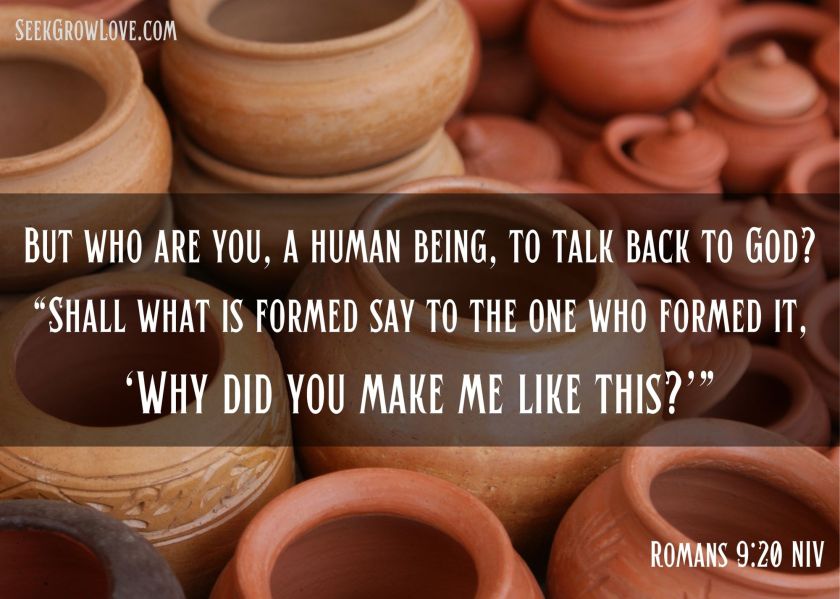
And then we start getting into that mystery part of things… God is sovereign, the Ruler over all, the one who decides who he extends mercy to, and who he hardens (v. 18).  Well that’s just not fair, is it??  I want to justify these verses in my own mind to make them “nicer” – somehow I want to twist these words, rationalize them, make them more presentable, and far less mysterious.  But in doing so, I remove God from His rightful place of sovereignty in my mind.   I am absolutely the type of person Paul references in verse 19 – “one of you will say to me: Then why does God still blame us? For who is able to resist His will?”.  I am nothing more than a mere clump of clay, pretending as if I have any right to tell the potter what to make of me.  

In his study of Romans book, author Jared C. Willson writes this on my very thoughts above: “If we dictate to God what he must be like, then we are not in fact worshiping God – we are worshiping an idol, for it is a god of our own making.”  When I try to over-simplify or “clean up” these mysterious moments of God, I am no longer genuinely focused on Him.  I am focusing on the more presentable parts of the gospel, when in reality, we must wrestle with ALL parts, praying for wisdom and understanding as we navigate the mystery.

I will not pretend to know why God does what He does.  I will not pretend to understand why some people just won’t grasp the gospel.  I will not pretend I can figure out the mysteries of God.  So while it may be confusing, and at times slightly disheartening or even frustrating, I will also choose to find comfort in the fact that it does not depend on human desire, or effort, but on God’s mercy alone (v.16).  What a beautiful mystery!

Reflection Questions

  1. Have there been moments in your faith walk when you attempted to dictate to God what He must be like?  Looking back now, are you able to see what you missed in doing so?
  2. The last few verses of this chapter describe Jesus as a stumbling stone.  How might believers stumble over the truth of Jesus?

Prayer

What an honor it is to speak to You Lord God, the Maker of Heaven and Earth and me. Help me see You for who You are – a God too big and great and right for my comprehension. And help me see me for who You made me to be, and do what You want me to do.
The Mystery

Revelation 7-10

Devotion by Daniel Smead (MN) – originally posted for SGL on Nov 25, 2022 on Revelation 10

After the sixth trumpet we have a break when John is prepared for what comes next, which mirrors the break after the sixth seal when the 144,000 were sealed. We are reminded that all through this vision John has been writing what he sees, as Jesus told him to do back in 1:19 (10:4). I wonder if he started the vision in front of a blank scroll and finished with a completed work. Or was the writing part of his vision, and he needed to rewrite it all afterward? And I wonder, again, how often what he wrote came to him as part of the vision and how often his words are his efforts to convey what he experienced. For example, did John make the distinction of a “strong angel” himself, based on experience in this vision looking at different angels?

It wasn’t pointed out at the time, but in chapter 5 it was a “strong angel” that proclaimed the question about whether anyone could open the seals of the book in God’s hand. And now a “strong angel” holds the small book John will eat. Perhaps this is setting up transitions in the vision for us, as the book John eats seems to establish his personal involvement in the next part of the vision. (There is one more “strong angel” reference, in 18:21, punctuating and concluding the section on Babylon.)

When our strong angel in chapter 10 cries out like a lion roars, seven peals of thunder respond – these may refer to the peals of thunder that come from God’s throne (4:5). But John is told by a voice from heaven not to write down what the thunders said. Among all the details in Revelation this lack of information can be one of the most interesting things for us. What secret is left out here? I have sometimes suggested it might have been a self-unfulfilling prophecy (my own phrase), something we can’t be allowed to know because knowing it in advance would make it awkward for it to still take place. Like “tomorrow [fill in the blank date] king [fill in the blank name] falls.” In the context it is hard to expect a minor statement – the strong angel is just about to swear an oath by God that the mystery of God is on the verge of being completed.

The same voice from heaven tells John to get the book and eat it, which he does, but first he is warned by the strong angel that it will be sweet in his mouth but bitter in his stomach. This is interesting, because in Ezekiel 2:8–3:3 we get a similar story of eating a scroll that tastes sweet but there is no mention of bitterness. This is more like comments in Jeremiah 15:16-17 about him eating God’s words and finding them a joy and delight, but then being filled with indignation. What John ate was easy to take in but would result in him needing to “prophesy again concerning many people and nations and tongues and kings.” The phrase “prophesy again” is sometimes taken to mean that the next part of the vision will revisit ground, duplicating some parts of the story to get at new aspects of it. And not all of that prophecy would be a joy and a delight. But God will be revealing what He recognizes needs to be shown.

It may be worth recalling that John is in exile when he sees this vision. He will emerge from it to send his letters, his warnings and encouragements and predictions, and continue in exile. We don’t really know how bringing more attention to himself this way during a time of persecution affected his situation. Maybe not positively. But John was God’s worker and working for God isn’t always pleasant for the one working, at the time. But I trust that John absolutely knew the job was worth it, and I hope that he found the experience of his vision encouraging.

Lord, forgive me the foolishness I sometimes experience of wanting to know what you aren’t interested in telling me, and showing too little interest in what you have made plain for me. You have shown me things that are good, help me to act on that awareness. You have shown me things that are not good, help me to act on that awareness as well. If at times I have found your words bitter in my stomach I have little right to claim I have been cheated, for they were sweet on my tongue. And I acknowledge you have given me far more than I ever can give you. Help me to serve you as I ought to, even if I feel I am in the valley of the shadow of death. Your light can never be overcome. I will trust in you. Amen.

Reflection Questions

  1. What are your thoughts and feelings when you read verse 7, “But in the days when the seventh angel is about to sound his trumpet, the mystery of God will be accomplished, just as he announced to his servants the prophets.”
  2. What words of God might be sweet in the mouth, but sour in the stomach?

The Mystery

Revelation 10

Friday, November 25, 2022

After the sixth trumpet we have a break when John is prepared for what comes next, which mirrors the break after the sixth seal when the 144,000 were sealed. We are reminded that all through this vision John has been writing what he sees, as Jesus told him to do back in 1:19 (10:4). I wonder if he started the vision in front of a blank scroll and finished with a completed work. Or was the writing part of his vision, and he needed to rewrite it all afterward? And I wonder, again, how often what he wrote came to him as part of the vision and how often his words are his efforts to convey what he experienced. For example, did John make the distinction of a “strong angel” himself, based on experience in this vision looking at different angels?

It wasn’t pointed out at the time, but in chapter 5 it was a “strong angel” that proclaimed the question about whether anyone could open the seals of the book in God’s hand. And now a “strong angel” holds the small book John will eat. Perhaps this is setting up transitions in the vision for us, as the book John eats seems to establish his personal involvement in the next part of the vision. (There is one more “strong angel” reference, in 18:21, punctuating and concluding the section on Babylon.)

When our strong angel in chapter 10 cries out like a lion roars, seven peals of thunder respond – these may refer to the peals of thunder that come from God’s throne (4:5). But John is told by a voice from heaven not to write down what the thunders said. Among all the details in Revelation this lack of information can be one of the most interesting things for us. What secret is left out here? I have sometimes suggested it might have been a self-unfulfilling prophecy (my own phrase), something we can’t be allowed to know because knowing it in advance would make it awkward for it to still take place. Like “tomorrow [fill in the blank date] king [fill in the blank name] falls.” In the context it is hard to expect a minor statement – the strong angel is just about to swear an oath by God that the mystery of God is on the verge of being completed.

The same voice from heaven tells John to get the book and eat it, which he does, but first he is warned by the strong angel that it will be sweet in his mouth but bitter in his stomach. This is interesting, because in Ezekiel 2:8–3:3 we get a similar story of eating a scroll that tastes sweet but there is no mention of bitterness. This is more like comments in Jeremiah 15:16-17 about him eating God’s words and finding them a joy and delight, but then being filled with indignation. What John ate was easy to take in but would result in him needing to “prophesy again concerning many people and nations and tongues and kings.” The phrase “prophesy again” is sometimes taken to mean that the next part of the vision will revisit ground, duplicating some parts of the story to get at new aspects of it. And not all of that prophecy would be a joy and a delight. But God will be revealing what He recognizes needs to be shown.

It may be worth recalling that John is in exile when he sees this vision. He will emerge from it to send his letters, his warnings and encouragements and predictions, and continue in exile. We don’t really know how bringing more attention to himself this way during a time of persecution affected his situation. Maybe not positively. But John was God’s worker and working for God isn’t always pleasant for the one working, at the time. But I trust that John absolutely knew the job was worth it, and I hope that he found the experience of his vision encouraging.

Lord, forgive me the foolishness I sometimes experience of wanting to know what you aren’t interested in telling me, and showing too little interest in what you have made plain for me. You have shown me things that are good, help me to act on that awareness. You have shown me things that are not good, help me to act on that awareness as well. If at times I have found your words bitter in my stomach I have little right to claim I have been cheated, for they were sweet on my tongue. And I acknowledge you have given me far more than I ever can give you. Help me to serve you as I ought to, even if I feel I am in the valley of the shadow of death. Your light can never be overcome. I will trust in you. Amen.

-Daniel Smead

Reflection Questions

  1. What are your thoughts and feelings when you read verse 7, “But in the days when the seventh angel is about to sound his trumpet, the mystery of God will be accomplished, just as he announced to his servants the prophets.”
  2. What words of God might be sweet in the mouth, but sour in the stomach?