When I’m writing these, I find a section or verse that stands out to me. Today, 1 Timothy 6:11-16 particularly stood out. I would encourage you all to reread it before reading this article.
Whenever I read this I can’t help but hear a rallying voice, the type of speech given in a movie right before they enter the final battle for the fate of the universe or something equally important. It just strikes me in that way. In a way, that’s what this section is. It’s written from a leader of the church to a member. Like how a leader tells his troops an inspiring thing before the battle. For Timothy and us, every day is a battle. Paul in verse 12 writes: “Fight the good fight of the faith.” Sounds pretty similar to me. So, let’s look at this through the lens of an inspiring speech given to us in our daily battles. I’m gonna go through two verses here.
Do your best here to think about this in an inspiring way. If you’re feeling ambitious, you could even speak it aloud. If you’re having trouble imagining it think about an actor in an intense scene, and try to channel that energy. Verse 11 reads: “But you, man of God, flee from all this, and pursue righteousness, godliness, faith, love, endurance and gentleness.” Right here, Paul is writing about what we are to do. He calls us to pursue righteousness, godliness, faith, and love. These are pretty straightforward things, but we all have room to improve on all accounts, so read each with the gravity they deserve.
In verse 16, Paul is talking about God here: “who alone is immortal and who lives in unapproachable light, whom no one has seen or can see. To him be honor and might forever. Amen.” In the idea of a rallying speech, I think this is the best way to end one for a Christian. It’s giving God the glory; it just feels right. We learn in the Lord’s Prayer that a fair portion of our prayers should be giving glory and praise to God. So, in this case, it seems right too. I also like that this verse ends with ‘amen’.
Let me close this out with a challenge. On days when you’re maybe a bit tired and are reading your Bible, envision in your mind it as a speech, an inspiring one. It might not work for every verse, but maybe it’ll give you the energy to focus a bit more on what you’re reading.
-Philip Kirkpatrick
Reflection Questions
What do you think Paul was preparing Timothy for? What battles are you facing? How can Paul’s words motivate and inspire you to fight the good fight of the faith? What would that look like for you?
If you have the time today I would like you to read through Psalm 101 before reading this and then read it again after.
Psalm 101 speaks of integrity. It’s pretty clear-cut, in the ESV version, the Psalm is even called “I will walk with integrity”. The way it’s put there speaks to me, it isn’t saying “I should”, there is no question in that statement, “I will walk with integrity”. I’ll wrap back to the part about integrity later.
First, I want to focus on a phrase. Throughout the whole Psalm, the phrase that we read over and over is “I will”. Throughout the world, and even in myself, I don’t hear that sort of conviction in daily life. “I will” is substituted for “I might”, “I could”, etc. These all convey a sense of being able to back out. Even the term “I can” lacks the certainty that “I will” has. “I can” can mean that you can but lack the conviction to do it. And taking it a step further, even the phrase “I will” can lack conviction. For example “I will go take out the trash” or “I will drive you to school”. In Psalm 101 it’s a much different form of “I will” from those.
So we have conviction, but for what? As said before with the heading, integrity. When I search for the definition of the word “integrity”, I get this in response, “integrity is the quality of being honest and having strong moral principles; moral uprightness.” I think this definition has been generalized for the public and for the rest of the world. The word moral can be subjective in exactly what it entails. I think we as Christians have a great example of what to look for in integrity though, Psalm 101. It lays out our “moral principles” pretty well throughout it. Which I think makes it a great thing to read and study.
As I said at the start, I would challenge you to read Psalm 101 again. But this time, focus on the conviction behind it, and look at the integrity it talks about. Take it one line at a time and dwell on what is said.
-Philip Kirkpatrick
Reflection Questions
What are you convicted about doing?
What “I will” statements do you find in Psalm 101? Which do you already feel strongly about and would also say, “I will…”? Which seem like wise statements but you could use more conviction in this area to move from “I should” or “I can” to “I will”? Pray about these.
How would you rate your own integrity? What do you admire about people you know with strong moral principles? What is God looking for as far as integrity goes?
My name is Philip Kirkpatrick. I’m 17, live in Minnesota, and attend Pine Grove Bible Church. Some of you may have met me before and some of you may have no idea who I am. I share this for two reasons, the first is to give those who don’t know me a little bit of background on who’s writing, and the second is because it relates to what I’m writing about. As I was reading 1 Timothy 4, one of the verses stuck out to me. That is verse 12, the NIV version states:
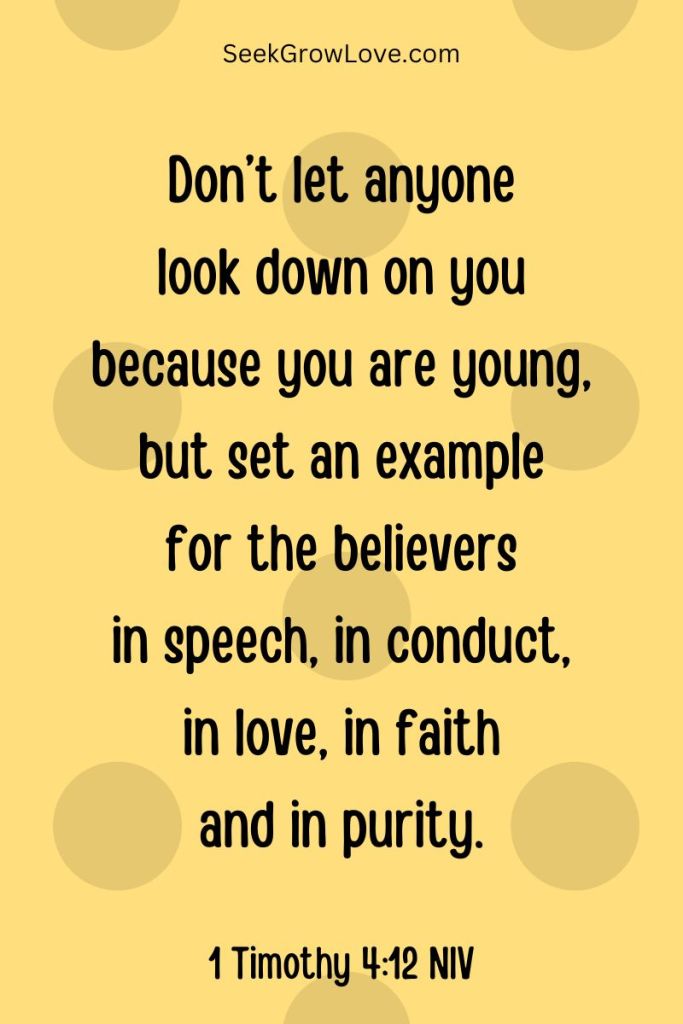
‘Don’t let anyone look down on you because you are young, but set an example for the believers in speech, in conduct, in love, in faith and in purity.’
Considering my age and youthfulness, this verse stuck out to me. Reading it over, it seems pretty straightforward to me. I’m going to break this up into two parts. The first part simply states that just because of someone’s young age, it doesn’t mean they should be looked down on. Looking back now, I can think of times that I surprised my parents by having an answer they didn’t expect me to get, or knowing a big word and casually dropping it in the middle of a sentence. Even today I find myself surprised at times by those younger than me when they find answers I didn’t expect or know things that I don’t. Something to keep in mind here is that just because someone is young doesn’t mean that person doesn’t have good ideas.
This also plays into something called a logical fallacy. A logical fallacy is an illogical argument in its simplest form. In this case, it’s an Ad Hominem fallacy. This logical fallacy can be used to state that someone who may typically not have good ideas, someone young and inexperienced in this case, can’t come up with good ideas. The Ad Hominem Fallacy in other words; it is an attack against the person, not the argument or idea they are proposing. So in the case of someone young, it’s saying you can’t dismiss it simply due to age.
The second part of this verse here tells us that we should set an example for others in 5 ways: speech, conduct, love, faith, and purity. I’m not going to dig into all those and explain them all. Overall it can be defined by how we act. We should act in a manner befitting a Christian.
To the younger: set an example to the older on how to act.
To the older: set an example to the younger on how to act.
And to all, don’t look down on someone because of their age, listen, and consider what they have to say.
-Philip Kirkpatrick
Reflection Questions
When have you taken notice of a good example set by someone young? Have you ever been guilty of looking down on someone just because of their age?
Consider each of the ways we are to set an example for believers: in speech, in conduct, in love, in faith and in purity. Think of times when you set an example in each of these areas. Are you strongest in one of those areas? Which ones could you work on more this week?
Did you go on vacation this summer? Where did you go? Perhaps you’re planning a late summer getaway before the arrival of Labor Day.
Whether you travel to a new destination or a familiar cabin on a lake, it is good to get away and take a break from work and school. Time away can be refreshing and often you gain a new perspective on life.
But, vacations don’t last forever. All too quickly, it’s time to come home. The closer you get, the faster you want to arrive. Finally, your home appears. Carrying suitcases, backpacks, and bags of “stuff”, you walk through the door. Big exhale! You’re home! Oh, it’s so good to be home.
Hopefully, when you think of your home, you think of comfort, security, safety, enjoyment. It’s where you can be yourself, where you can relax.
Does God feel that way about His home? Yes, He is in heaven, and yes, someday He will dwell with man on earth. (Revelation 21:1-3) But, the Bible mentions another HOME for our Father God. PRAISE. God is “at home” in our praises.
Psalm 22:3 KJV says, “But thou art holy, O thou that inhabitest the praises of Israel.” The NASB version says simply, “Yet You are holy, O You are enthroned upon the praises of Israel.”
Jack R. Taylor says this in The Hallelujah Factor— “Praise is where God lives. It is his permanent address. While God is everywhere, he is not everywhere manifested. He is at home in praise and, being at home, he manifests himself best as God! When you or I choose to make God at home through praise, we invite him to act ‘at home.’ He is enthroned and liberated to act mightily in praise.”
One of the best examples of this in Scripture is our OT reading for today, II Chronicles 20.
The sons of Moab and Ammon came to make war against Jehoshaphat, King of Judah. Jehoshaphat was afraid, and he proclaimed a fast throughout Judah. Then all of Judah gathered as Jehoshaphat addressed the Lord. He recounted God’s power and previous protection. Then Jehoshaphat stated the current problem, (vs 10-11), the powerlessness of the people, (vs 12a), and their concentration on God—“our eyes are on you.” (vs. 12b)
The Spirit of God, through Jahaziel, gave God’s answer to Jehoshaphat and the people of Judah. “Don’t fear, the battle is not yours but God’s. You need not fight. Stand and see the salvation of the Lord.”
The next morning, singers went out before the army, singing, “Give thanks to the Lord, for his lovingkindness is everlasting.” WHEN they began singing and praising, the enemy was ambushed by one another. No one escaped. Jehoshaphat and his people found goods and garments among the enemies, and it took them 3 days to retrieve it all.
The people’s praise prompted God to act. No other recorded military battle compares to the miracle that happened that day.
Psalm 8:2 says, “Through the praise of children and infants you have established a stronghold against your enemies, to silence the foe and the avenger.”
How marvelous is our God. He hears us. He fights for us. He rewards us.
Did you start your morning in praise to God? What a difference it can make. God desires to move in your life, to guide you, to comfort you, to defend and protect you.
Allow Him to reside each day in your praises. And discover the joy He has planned for your life.
-Paula Kirkpatrick
Reflection Questions
Is praise a regular part of your prayer life?
Meditate on this phrase from II Chronicles 20:12b—“We do not know what to do, but our eyes are on You.”
When things seem insurmountable in your life, will you begin your appeal to God with praise?
Have you ever felt like you don’t know what to do in life? You feel like you need a book of instructions to take with you everywhere you go? Well, there may not be any instruction manuals available, but the Bible as our guide is. In 1 Timothy chapter 2, Paul lists these sets of rules that we should live by, either through worship, or living through daily life.
In 1 Timothy 2, it states: “8 Therefore I want the men everywhere to pray, lifting up holy hands without anger or disputing. 9 I also want the women to dress modestly, with decency and propriety, adorning themselves, not with elaborate hairstyles or gold or pearls or expensive clothes, 10 but with good deeds, appropriate for women who profess to worship God.”
Paul says that God wants us to live peaceably with all people, making prayer and petitions, and thanksgiving amongst everyone, as it pleases Him. He also mentions that God doesn’t want people to be flashy in their worship to Him. In verse 9 he states that he wants women to dress modestly and adorn themselves with good deeds rather than gold or pearls. When we dress for worship, we should dress with good intentions and be pleasing in God’s sight. Also in worship, we should pray for each other. Our family, our friends, church friends, even the people you dislike the most. The point is, even if you feel that you think you’re not going to have an easy life, just remember that you have an incredible book of life to guide you through the tough times, and that these simple rules are things that we should live by. Praying for people and dressing modestly may seem difficult at times, but with God, anything is possible.
-Hannah Bormes
Reflection Questions
What rules for life do you find in 1 Timothy 2 that you want to live by better and better?
Can you think of a time of anger and disputing when it would have been better to lift up holy hands in prayer? How can you use this method next time?
Why do you think Paul addressed modesty? Do you think it should be addressed today – if so, how?
The 2024 Summer Olympics has just been completed in Paris. During the two weeks of competition, there were 32 sports and 329 events across 48 disciplines. Around 10,500 athletes from 206 National Olympic Committees competed. Among those athletes, several shared their Christian witness with the media.
Hezley Rivera, Women’s Gymnastics, was asked how she made the 2024 team. Her first response was to give God credit for her success. Later she posted Philippians 4:13 on her Instagram account under pictures of her with the Olympian team. In a recent interview, she said, “I’m just enjoying the journey and the process, and I’m so blessed, and I thank God every day.” Hezley won a team Olympic gold medal on July 30th in Paris.
Sydney McLaughlin-Levrone, who competes in the Women’s 400 Hurdles, shared her personal testimony in her memoir, Far Beyond Gold: Running from Fear to Faith. Her perspective changed from gaging her worth by a perfect run, to being balanced spiritually in her personal life as well as her sport. In January, Sydney told “Women’s Running” this– “My life wasn’t about me. It was about showing the world God’s power, wisdom, kindness, love, and forgiveness.”
McLaughlin-Levrone won her second consecutive Olympic gold medal in the 400-meter hurdles on Aug. 8th, posting another world record time at 50.37. As the only woman to win the event in two consecutive Olympic Games, she said, “Just grateful for all that has been taking place. God has been good to me.”
In our reading of I Timothy 1 today, Paul begins his letter to Timothy, his son in the faith, by urging him to stay in Ephesus, even though the work might be difficult. The Ephesians needed to hear God’s truth, and Timothy had been called by God to deliver that truth to them. Then, in a way to encourage Timothy to stay strong, Paul shared HIS PERSONAL TESTIMONY.
“I thank Christ Jesus our Lord, who has given me strength, that he considered me trustworthy, appointing me to his service. 13 Even though I was once a blasphemer and a persecutor and a violent man, I was shown mercy because I acted in ignorance and unbelief. 14 The grace of our Lord was poured out on me abundantly, along with the faith and love that are in Christ Jesus.
15 Here is a trustworthy saying that deserves full acceptance: Christ Jesus came into the world to save sinners—of whom I am the worst. 16 But for that very reason I was shown mercy so that in me, the worst of sinners, Christ Jesus might display his immense patience as an example for those who would believe in him and receive eternal life. 17 Now to the King eternal, immortal, invisible, the only God, be honor and glory for ever and ever. Amen.” I Timothy 1:12-17
What a plain, powerful testimony Paul shared with Timothy. Paul’s past persecution of Christians didn’t make him ineligible to serve God. Mercy and grace were given to him on the road to Damascus. He claims to be the worst of sinners, but Jesus saw the potential in Paul to be a mighty missionary for him. And in verse 17, his one sentence prayer expresses his highest allegiance and worship to Almighty God.
These heartfelt words were meant to encourage Timothy, who might have felt unworthy to deal with the challenges at Ephesus.
Paul had a moving testimony, the Olympians above have shared their testimonies. What is your testimony?
Amy Blanchard, the Christian Education Director for the Pine Grove Bible Church, Brooklyn Park, MN developed a plan for willing adults in the church to share their testimonies with the high school and young adult Sunday School classes. The testimony sharing time takes place every few years over a period of several months—that way each young person growing up in the church eventually hears the Pine Grove members’ stories of their personal calls to follow Jesus.
Her goals, (in her own words) are as follows;
“To allow kids to meet/get to know others in our church and hear their stories and see how they can relate to them (and for you to see how you can relate to our kids)
To open the door for the kids to hear that there are many times and ways one can come to the Lord
So our kids can hear how others influence us and see that we, in turn, influence others
To allow us to share our testimonies – we all have a story. Sharing our personal story helps us to, ‘…have a full understanding of every good thing we have in Christ.’ “
What a tremendous way to hear conversion experiences, and to show by example that everyone has a story that needs to be told –not only to our brothers and sisters in Christ, but with those we interact with each day.
Paul shared his personal testimony with Timothy to strengthen and embolden him. But it also encourages us to think about our “call to Christ” and how our lives can impact those around us.
I Peter 3:15 says, “Always be prepared to give an answer to everyone who asks you to give the reason for the hope that you have. Do this with gentleness and respect.”
What is your personal testimony? Pray for opportunities to share it, and you will be blessed in ways you never could have imagined.
-Paula Kirkpatrick
Reflection Questions
Do you have a personal testimony? If the answer is no, why not?
Has someone ever encouraged you with their personal testimony? Have you later told them how it impacted your life?
Have you ever heard of the saying, “Give credit where credit is due?” It is thought the expression was coined by Samuel Adams in a letter dated Oct. 29th, 1777! That was quite a while ago! Now, almost two and a half centuries later, “giving credit” has become a whole new ballgame.
Today’s generation has always had easy internet access. And with that access, has been seemingly limitless information. But, can a person easily find the original source of an idea, trend, or promoted “fact” on social media platforms, where it can be shared multiple times and morph into a whole different idea or supposed “truth”?
According to a recent survey, only 8% of students always give credit to original creators, 35% of students sometimes do, while 30% never give credit to original trendsetters. (And who knows if this survey is correct—I found it on the internet!)
The Bible tells us there is only One who is due credit for all the world around us, the beauty, and majesty of His Creation.
“Ascribe to the Lord, all you families of nations, ascribe to the Lord glory and strength. 8 Ascribe to the Lord the glory due his name; bring an offering and come into his courts. 9 Worship the Lord in the splendor of his holiness; tremble before him, all the earth.” Psalm 96: 7-9
Ascribe is an interesting word. It means acknowledge, attribute, or GIVE CREDIT. All of the earth trembles before Him as all people consider His mighty strength and unmatched splendor.
Our praise leads to this acknowledgement of God’s greatness. In verses 1-3 we are told to sing, proclaim, and tell about His salvation, glory and wonderful deeds.
As our outward praise is heard and shared, it leads to an inward attitude of worship, basking in the Lord’s presence. We adore God for who He is.
Not just His people, but ALL of His Creation sings God’s praises. In verses 11-13, we see this. Have you walked along an ocean beach and HEARD the water’s roar? Have you gazed upon a field of Texas bluebells, multi-colored tulips, or bright yellow sunflowers, their BEAUTY GLORIFYING God’s presence? Have you wandered through a forest of pine trees, and HEARD their joyful song in the breeze? If you have done one or more of these things, lift up your praise in harmony to Creation’s melodies.
Acknowledge His presence in your every waking moment. Savor His warmth and love. Live a life of worship each day. Give credit—ALL CREDIT—where credit is due—to the Lord God Almighty.
-Paula Kirkpatrick
Reflection Questions
Do you dwell in God’s presence each day? How better could you do that?
Are praise and thanksgiving a regular part of your prayer life?
Psalm 95 encourages praise and worship to the LORD with joy and thanksgiving. When I was in upper elementary school, I was challenged to make note of three things I was thankful for every day. I gave the same challenge to those who attended Family Camp at the end of my sermon Sunday night. I challenge you today to find at least three things you are thankful for and lift them up to the LORD in praise.
In 2 Chronicles 13 and 14, you read about the reign of Abijah and Asa, kings of Judah. Unlike King Rehoboam who did evil in the eyes of the LORD, these two both pointed the people back to God, but in different ways. Abijah focused on the fact that the Levites were still faithfully serving and teaching in the temple. He recognized the faults of the king of Israel for having false priests who were not faithful to the LORD most high. King Abijah recognized who God was and the implications that had on the people of Judah. King Asa went farther than King Abijah by removing anything that was meant for idol worship. He also commanded the people to seek God and follow His law. Under both these kings, the nation of Judah was prosperous and had great success when defending their land. They recognized and encouraged truth among the nation.
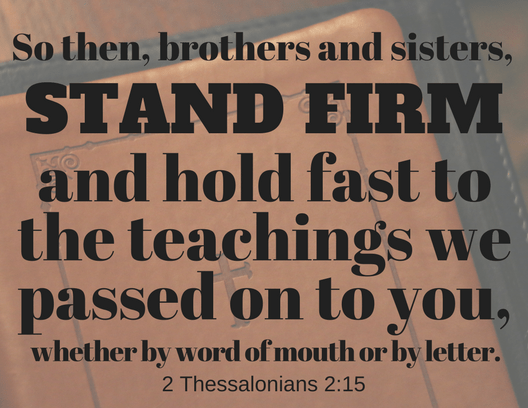
2 Thessalonians 2 warns against a man of lawlessness who will say he is higher than God as well as encourage lawlessness and wickedness. This man is not like the kings you read about in 2 Chronicles. He will lead people away from God instead of towards God. Paul writes in verse 15 “So then, brethren, stand firm and hold to the traditions which you were taught, whether by word of mouth or by letter from us.” The way to combat this lawlessness is to stand firm in what you have been taught. Abijah stood firm in what he had been taught about God being with the people of Judah. Asa stood firm in what he had been taught by pointing people back to following God’s commands. Both successfully and literally fought off those who were against God.
This is going to look different within your own life. Instead of fighting a nation, you are fighting on an individual level. 1 Peter 5:8-9 says “Be alert and of sober mind. Your enemy the devil prowls around like a roaring lion looking for someone to devour. Resist him, standing firm in the faith, because you know that the family of believers throughout the world is undergoing the same kind of sufferings” (NIV). Temptation will come your way. Lawlessness approaches. Luckily, the Bible warns against that happening so you can be prepared to stand firm in your faith just like Abijah and Asa. One way you can be prepared to stand firm is doing what I challenged you to do at the beginning of this devotional. Finding the good in life that you can praise God for doing. Recognizing His presence and work within your life helps combat against the negativity of the world.
Judy Hopps, from the movie Zootopia, is a good example of how your mentality can help you stand firm or be swayed. Judy is a small bunny whose childhood dream was to become a cop. She worked her hardest to pass from the police academy. She continued to work towards her strong desire to do good even when everyone around her didn’t think she could do it. When she ended up as a meter maid, she still tried to keep a positive attitude about her situation to stand firm in her convictions of doing good as a police officer. If you’ve seen in the movie she doesn’t always have that attitude and when she doesn’t, it doesn’t go well for her. Her joy and determination were completely gone so she ended up giving up. Judy lost her strong stance and fell.
The same can be true within our own lives. Not only should we know and understand the scripture in order to be firmly rooted in truth, we must also be firmly rooted in thanksgiving and praise. Recognizing God’s work in your life will help you stand firm. Having both knowledge and an attitude of thanksgiving, your foundation will be deeply rooted and ready for whatever comes. Like Paul warned against, a lawless one will come. He will spread lies and try to topple believers. You must stand firm in your faith like the good kings of 2 Chronicles. Knowing what is within the Word will help you stand firm, but having a heart of praise will keep you close to God and your attitude in a positive place.
-Makenna Landry
Reflection:
1 – What are three things you can praise God for today?
2 – How has thankfulness helped you stand firm when the world seems bleak?
3 – What stood out to you the most in the lives of King Abijah and King Asa?
The start of 1 Thessalonians 5 shares the promising truth of Jesus’s return. We can rest assured as children of light and look forward to Jesus’s glorious return that will usher in the Kingdom of God. This mindset of being children of light or being light itself is shared in the following passages:
“For you were formerly darkness, but now you are Light in the Lord; walk as children of Light.” Ephesians 5:8
“You are the light of the world. A town built on a hill cannot be hidden. Neither do people light a lamp and put it under a bowl. Instead they put it on its stand, and it gives light to everyone in the house. In the same way, let your light shine before others, that they may see your good deeds and glorify your Father in heaven.” Matthew 5:14-16
“But you are a chosen race, a royal priesthood, a holy nation, a people for his own possession, that you may proclaim the excellencies of him who called you out of darkness into his marvelous light.” 1 Peter 2:9
Our identity is found within the Bible. We can find peace and hope in our identity. You are a child of light. You are light through Christ. This means you are filled with the love and goodness of God, and your life has been sanctified through Christ’s sacrifice on the cross. What you have read about in the last few devotionals are all centered around living out this light. Living in a manner that brings glory to God by shining your light to all those around you.
I grew up going to Midwest Family Camp every year. One of the most important items I would pack would be a flashlight. The walk from the tabernacle to the girls’ yurts was long and dark at night so that flashlight made it less likely to trip and fall over uneven ground. One of my friends would commonly forget her flashlight so most years we would walk together sharing the light. It would have been selfish to have kept the light to myself and it would have caused her to stumble and fall without it. The same applies to the light we have received from Christ. It is not something to be hidden under a bushel, we have to let it shine, let it shine, let it shine. Allow the identity you find through Christ to shine forth to those around you.
Take Solomon as an example of this. Was he a perfect guy? Absolutely not. But as you read in today’s readings his actions and skills shined brightly to those around him. The queen that visited Solomon saw how much God cared for His people through the actions of Solomon. She recognized the glory of God because of Solomon. He did not hide the light that God had given him. Solomon worked hard and would always point his work back to God, like you have read in the last few days of 2 Chronicles. God’s light and love shines through all His children. Don’t hide it!
-Makenna Landry
Reflection:
1- What has been the main takeaway of 1 Thessalonians?
2- How has King Solomon’s life served as an example to you?
3- What is one way you can shine your light to those around you?
1 Thessalonians 4 continues in the instruction of how believers should be living. Paul commends the people in Thessalonica for doing well in following God’s commands and encourages them to do even more. Paul writes that God calls us to sanctification. Sanctification means to be made clean or holy. God calls us to be clean and holy. He provides this cleansing through Christ’s death and resurrection. Hebrews 10:10 says “By this will we have been sanctified through the offering of the body of Jesus Christ once for all” (NASB95). This verse is in the midst of a passage that expresses that Jesus’s sacrifice is sufficient for us and there will be sanctification and forgiveness through his sacrifice. It aligns with what Paul writes confirming that we have been made clean from our sins through Christ.
In the 2 Chronicles reading for today, some of that same theme of cleansing/forgiveness of sin can be seen. God appears to Solomon after the finishing of the temple and tells Solomon that He will be present in the temple. In 2 Chronicles 7:14, God says “and My people who are called by My name humble themselves, pray and seek My face, and turn from their evil ways, then I will hear from heaven, forgive their sin, and heal their land.” God has often reminded His people that He will forgive their sins. In the time of Solomon, the cleansing of sins was sought through prayer with an animal sacrifice. Hebrews shows that the sacrifices are no longer needed because of Christ and 1 Thessalonians encourages how to live out this cleansing of sins.
In 1 Thessalonians 4:9-12, Paul discusses one of the ways to live a sanctified life. Paul reminds the readers to love one another which God has taught them previously. In the case of the Thessalonians they were doing well with showing this brotherly love to those around them. Because they are doing well, Paul encourages them to love even more. What a high praise to have received from Paul and great encouragement to continue not only in doing well but to do it even more! If Paul wrote you a letter inspired by God, would he praise you for the love you show others or would he need to teach you what it means to love those around you?
1 Thessalonians 4:11 says, “to seek to lead a quiet life, to mind your own business, and to work with your hands, as we commanded you” (HCSB). This reminds me of Hebrews 12:14 which says, “Pursue peace with all men, and the sanctification without which no one will see the Lord” (NASB95). A quiet life that pursues peace with all people can be a difficult life to lead. Living a quiet life that is minding your own business and seeking peace with those around you is centered around living out our sanctification. Through our forgiveness, we are called to love those around us which looks like living quietly, minding our own business, and seeking peace.
If you’re in any social setting where people are involved, it can be difficult to both love them deeply and also mind your own business while trying to pursue peace. Everyone has something that you won’t like about them. It might annoy you and get on your nerves. It could be anything from a difference of beliefs or political views, to the way someone pronounces a specific word. It’s really easy to get frustrated and lash out at someone who is annoying you, but that is not living out our sanctification. When a moment comes where you are feeling frustrated, annoyed, upset, or angry with someone, try to take a moment to remember the two verses from the previous paragraph. When in a place of disagreement or frustration, seeking peace and loving the person takes priority over being right and having your way. Showing grace and forgiveness will display the forgiveness you have received. It will also allow the person to feel loved and cared for.
-Makenna Landry
Reflection:
How do you live out sanctification in your life?
When someone is getting on your nerves or you come to a disagreement, how do you seek to live peacefully and quietly with them?








 Seek Grow Love