An Appetizer

Old Testament: Genesis 43 & 44

Poetry: Psalm 19

*New Testament: Matthew 14

If you’ve ever been to the Texas Roadhouse restaurant, there is one thing you can always count on: bread and cinnamon butter. This is provided before every meal as a free appetizer, and on more than one occasion, we’ve had enough to be full by the time our actual meal arrived (the same can be said of the breadsticks at Olive Garden). Those rolls were not the meal, and were never intended to be the only thing you enjoyed: however, it gave you a taste of what was to come later, and whet your appetite for more (if you had enough room left in your stomach).

Our passage in Matthew 14 reminds me of our experiences at Texas Roadhouse: it offers us a “taste of what’s to come” in the kingdom of God. There were many people following Jesus at the time, and they were hungry from their journey of traveling after him: so Jesus miraculously offers them enough bread and fish to feed 5,000 men (probably about 10,000 people when you include women and children). What Jesus was doing was showing them what the kingdom of God was going to be like, as he was talking to them about its splendor. In Isaiah 25:6-9, we learn that the kingdom of God will be a time of tremendous feasting and the end of hunger forever: Jesus gives the crowd a foretaste of what this incredible moment will be like by doing this miracle for them.

There are two cautions that all Christians should be aware of when it comes to the kingdom of God. First, there are some Christians who are only focused on the kingdom of God in the future. While we still wait for the kingdom to come fully, we are able to presently experience some of it NOW and offer that to others (notice that Jesus invited his disciples to perform this miracle first). We are able to enjoy some of the kingdom of God’s blessings now, through the power of the Holy Spirit in our lives, as we anxiously await to experience it fully in the end when Jesus comes. We should never neglect the fact that “the kingdom of God is in our midst” when we have Christ dwelling inside of us (Luke 17:20-21).

The second caution for Christians is living too much in this life without having a hope for the future reign of God’s kingdom. Jesus is very clear: the kingdom of God will not come fully until he returns (Matthew 25:31-40). While we can experience an “appetizer” now, it’s not the full meal: never fill up completely on the blessings of this age, but look forward with hope towards the future when Jesus returns. We should LOVE his appearing in the clouds, longing for that day to come soon (2 Timothy 4:8). We need a balance of now and then: living for the future kingdom today, with hope that it is coming soon.

Do you look forward to Jesus’ return and the kingdom of God? How can you enjoy it today?

Talon Paul

Reflection Questions

  1. Do you look forward to Jesus’ return and the kingdom of God?
  2. How can you enjoy it today?
  3. How can you help feed (spiritually and/or physically) those who are hungry for more of Jesus and those in need of an appetizer of the coming glorious feast in the kingdom of God?
Your Hometown

Old Testament: Genesis 41 & 42

Poetry: Psalm 18

*New Testament: Matthew 13:53-58

When I moved away from my home in Illinois to Atlanta Bible College (12 hours away), I was equally excited and nervous. I longed for adventure and to see the world outside of my hometown, especially since there were only about 1200 people in the town I graduated from. However, I gained much more from having stepped outside my comfortable realm of family and friends: I gained eternal life in Jesus Christ. I had to get away from my comfortability to see my need for Jesus, for I wasn’t even a Christian at that point (a non-believer going to a Bible college still sounds silly to me, but it is what happened). However, I always had the intention of returning home one day with my newfound knowledge, and hopefully reaching the troubled friends that I used to run around with… but I still haven’t made it back yet…


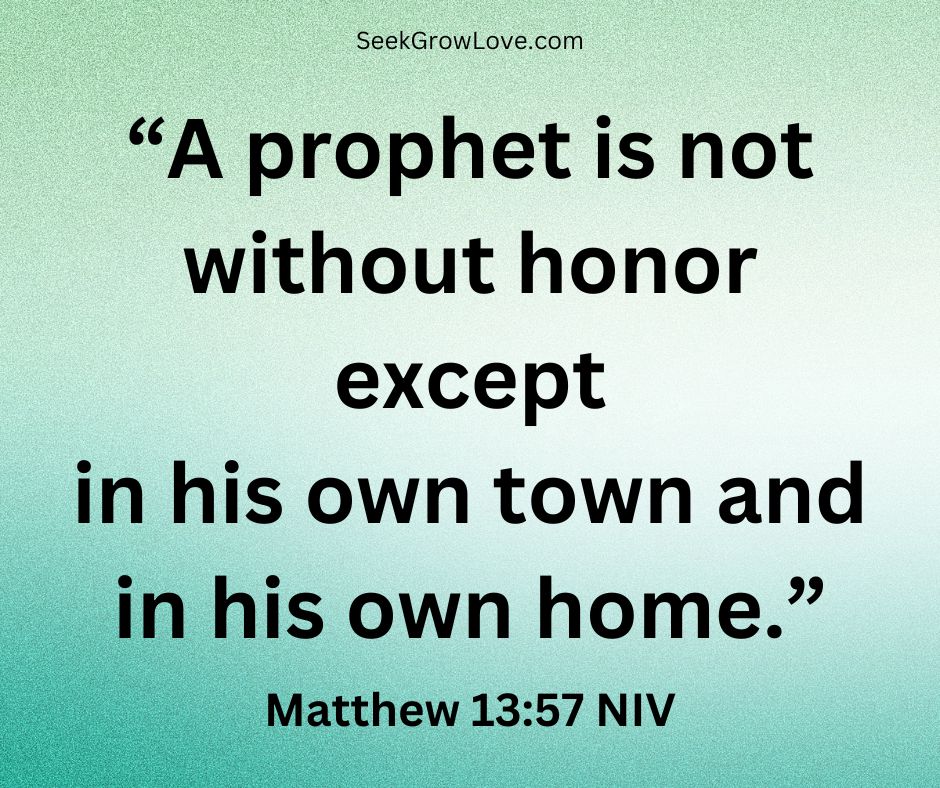
I believe God has been deliberately keeping me from returning back to my old stomping grounds because of Jesus’ statement in our passage today: “A prophet is not without honor except in his hometown and in his own household.” See, I’ve had the opportunity offered to return home and even pastor my home church: TWICE. And yet, both times that I’ve been offered, there was something going on that prevented it from happening. Having to say no both times was a definite challenge, complete with tears and pain, especially having our son being a distance from his grandparents, but there was definitely divine protection involved.


Ask yourself this: if Jesus couldn’t do it, do you think you can? I used to reason in my head that Jesus didn’t really mean what he said: but I was wrong. If Jesus was even rejected by his own people, why would I assume that I would be any different? Would the friends and family that saw me partying in high school automatically start listening to me about eternal life and morality? Would my parents and grandparents automatically start listening to me about how to live?
Would they be convinced that my life had changed, or would they only remember what I used to be like? As painful as it is to admit, sometimes the last people who we can convince are family and former friends, like Jesus… and yet, we’ve gained so much more by choosing his path. We have new friends and family all throughout the world, all those who have made the same decision we have: choosing Jesus. He is fulfilling his promise in our lives that he made to Peter in Matthew 19:29, granting us a hundred times as much in this life and in the age to come.


My encouragement to you today is to consider exploring what options are out there that Jesus is drawing you towards. It is scary and challenging some days, but the benefits far outweigh the negatives. There is a large world out there that needs you and what Jesus has instilled in your heart: don’t be afraid to leave home and pursue the kingdom of God.


Talon Paul

Reflection Questions

  1. Are there times when you have already stepped out of your comfort zone and beyond your hometown circle of family and friends to pursue the kingdom of God and share with others? If so, what was the hardest part for you? And, what blessings have you received from doing so?
  2. Are there some people you can practice giving more honor to, perhaps from your own town or family?
  3. Where might Jesus be calling you to go with the message of the kingdom? What are the challenges and the advantages to going beyond your current hometown and family? 

Cast Your Net Wide

Old Testament: Genesis 39 & 40

Poetry: Psalm 17

New Testament: Matthew 13:47-52


There is a sharp difference between commercial fishing and recreational fishing. With recreational fishing that we are all more familiar with, we are selective in the bait we choose and try to reel in one fish at a time: depending on what type of fish you want to catch, you will choose to use something different. For example, if you want to catch catfish like I did when I was younger, you’ll have more luck using stinky chicken liver than ordinary worms (I can tell stories of how bad that stuff can stink up a truck). But commercial fishing is very different: you are trying to catch as much as possible with a net, and will sort out whatever garbage after you have pulled it in. Commercial fishermen are not selective (except in what area to fish in): they cast their net wide and hope for the best.


Jesus compares the kingdom of God/heaven to this type of commercial fishing: at the end of the age, the angels will draw up everybody and then sort them out. The kingdom of God is not seeking individual fish, but casting its net over EVERY potential fish, because every person has a chance at having eternal life. Unfortunately, as with commercial fishing, some are going to be bad and reject the offer Jesus came to bring: they will reap the consequences of their decision
in the end. However, that is the nature of commercial fishing and the nature of the kingdom of God: allowing everyone to have a chance in the net, and letting the angels sort it out in the end.


Jesus called us to be fishers of men and participate in his fishing expedition (Matthew 4:19): however, he was calling us to be like commercial fishermen rather than recreational. We are expected to cast our net of the gospel WIDE, offering it to whoever we come across, not being selective about who gets to hear it. While we recognize that there will be some people who reject our message (and maybe persecute us), we are doing our duty by offering them the
chance of eternal life. Unfortunately, we often pick-and-choose who we think should hear the gospel for various reasons, rather than “being ready in season and out of season” (2 Timothy 4:2) for the person who comes across us. We need to remember our calling as fishermen and put aside our personal preferences.


Ask yourselves these questions today:


1. Are your nets ready? (Do you understand the gospel yourself?)
2. Are you willing to step out onto the boat? (Are you moving towards the people rather than sheltering inside?)
3. Are you prepared for the fish you might encounter along the way? (Are you ready for anybody to accept the message, even if they seem “less desirable” in your eyes?)


– Talon Paul

When Giving it All is a Wise Investment

Old Testament: Genesis 37 & 38

Poetry: Psalm 16

New Testament: Matthew 13:44-46

Some of my favorite commercials have come from the Klondike Bar ice cream company. Their catchphrase is “What would you do for a Klondike?”, followed by some of the most extreme examples of people doing something to get their ice cream bar. One of my favorite commercials involved a man willing to shave off one of his eyebrows and looking ridiculous for the ice cream (I apparently am not willing to do much, because I’ve never actually eaten one).


We are asked a similar question in our devotion today, but not involving ice cream: this involves the kingdom of God. In Matthew 13, the kingdom of God is compared to two gentlemen willing to sell everything that they possess to acquire it, like a hidden treasure or a precious pearl. They recognize two things: the kingdom of God is something of tremendous value, and that everything they own cannot compare with its marvelous wonder. Although they are sacrificing much, they are making the wisest investment of their life. Imagine if you had the opportunity to possess a winning lottery ticket that would give you 100 million dollars: all it would take is to sell all your possessions… would you take that deal? Would that lottery ticket not be able to buy back everything you had and more?


See, Jesus also promised that if we give our lives for the kingdom of God, we would receive a hundred times as much in this life and in the next age (see Matthew 19:27-30). He wasn’t asking us to simply give up everything just because he felt like it: he promised infinitely more than we could ever imagine, if we would simply trust him and follow his kingdom-way. You would
be making the wisest investment of your life if you chose the kingdom of God over every possible path that this life has to offer, and you would gain much more than this life could ever offer. So, “What would you do for the kingdom of God?” What are you willing to risk for eternal life?


Perhaps a more direct question is in order as well: “What are you NOT willing to risk for the kingdom of God?” We all have something we hold dear, whether that be personal possessions, a deeply-held family connection, or a desired career path. There are some things that will be difficult to let go of to pursue Jesus and the kingdom of God, but that’s the point: he wants you FULLY committed, willing to give him everything because he gave everything for you. This is something that we must consistently ask ourselves and reflect on what we are holding back from our Lord.


What would you do for the kingdom of God?


Talon Paul

Reflection Questions

  1. Both men in today’s parables recognized the kingdom of God as something of great value. What value do you place on the kingdom of God? Why?
  2. What have you already given up to pursue Jesus and the Kingdom of God?
  3. What are you having a difficult time letting go of in order to gain the kingdom of God? 
  4. Explain how giving it all can be a wise investment.
  5. What is the wisest investment you can make with your day today, and with the week ahead of you, if you are fully committed to living for the kingdom? 

Change Your Garments

Old Testament: Genesis 35 & 36

Poetry: Psalm 15

New Testament: Matthew 13:31-35

Genesis 35 begins with God telling Jacob to go to Bethel and make an altar there to “the God who appeared to you when you fled from your brother Esau.” God is reminding Jacob of what He has done for him in the past. Do you remember what Rachel did a few chapters back? She stole her father’s idols! Jacob’s household STILL has these foreign gods in their possession. The very first commandment in the Ten Commandments (which will be) given to Moses is “You shall have no other gods before me”. What have Jacob’s people done? They have sinned! 

I find this next part so interesting. In verses 2 and 3 Jacob gives instructions to his people. He says “put away the foreign gods that are among you and purify yourselves and change your garments.” This is repentance. Did Jacob say that they could keep the idols in their spare room and ignore them? NO. They took everything that was an idol or connected to paganism and buried them in the ground. They cast the items of sin out of their midst. Then, after turning away, they purified themselves and changed their clothes. 

One commentary makes an interesting point about the garments. There are multiple places in scripture where garments symbolize the character of people. How interesting is it that Jacob told his people to change their garments, almost like a physical way to visualize the heart change of repentance? This gives even more depth to the verses that say things like “put on Christ” or “put on the new self”. WOW! Let’s take a second to thank the Lord for the true gift of Jesus and what that means for our personal lives. The Old Testament is filled with people making altars to God for numerous things. We don’t have to do that anymore because Jesus was the ultimate sacrifice. Now, our lives are an offering to God and Christ is the one to cover all of our sins. How amazing is that?

Okay, back to Jacob. What do you notice about God in this chapter? I notice how gracious God is. These people had taken false gods! There was no reason why they deserved to have God on their side. But He is still faithful to them! He guides them, protects them, and then blesses them by giving Jacob an incredible promise at the end of the chapter. 


How amazing it is to have a God that will forgive us. I want this story to prompt us today to think about any areas in our lives where we are holding on to sin. If we are in Christ, we are a new creation, and although that doesn’t mean we are perfect yet, it does mean that we are continually being transformed. Ephesians 4 says, “to put off your old self, which belongs to your former manner of life and is corrupt through deceitful desires, and to be renewed in the spirit of your minds, and to put on the new self, created after the likeness of God in true righteousness and holiness.” What does that look like in your life? Think about how you can “put on the new self” today.

-Katelyn Salyers

Reflection Questions

  1. What will it look like to take off your old self? What do you need to get out of your house, your heart, your life? Are you hiding any foreign gods?
  2. What will it look like to put on your new self today? How can you put on a clean set of clothes?

Good Seed, Weed Seed

Old Testament: Genesis 33 & 34

Poetry: Psalm 14

New Testament: Matthew 13:24-43

“The Kingdom of heaven is like…”Six times we will read that phrase through the rest of Matthew 13 as Jesus shares parable after parable, with the purpose of explaining the Kingdom of heaven, first to the large crowd on the shore and then more directly to his disciples. Jesus knows that they are expecting a Messiah to come rule and set up a kingdom that will overthrow the Roman army and government. Jesus wants them to know the Kingdom he is teaching about is far greater and very different from what they are looking and hoping for. 

It is interesting that Matthew is the only Old or New Testament writer who will use the phrase “kingdom of heaven”. Many of the same parables will also be told in Mark and Luke and they will use the phrase “kingdom of God”. John doesn’t include all of Jesus’ parables in his gospel account, but does write of the “kingdom of God.” So, why is Matthew different? As a Jew himself Matthew was writing to convince the other Jews that Jesus was indeed the Messiah promised to Jews long ago. His original audience was very aware of God’s laws about misusing His name and so they cautiously omitted referring to God by name and replaced God’s name with the place God dwells – heaven. Matthew was not trying to create confusion about where this Kingdom would take place. As we read these parables and continue throughout the gospels and New Testament let’s look again and again to see if the hope of the kingdom Jesus taught is to be whisked away to live in clouds or to inherit and possess the land. And when does it take place? 

A word repeated many more times than “kingdom” in Matthew 13 is “hear”. Open up your ears and really listen to what Jesus has to say. Don’t assume you’ve heard this sermon before so you can check out. He has mysteries to reveal about the kingdom, but so many will miss it because they don’t really listen to the words of Jesus. So, this year instead of reading through Matthew 13 in one day we thought it would be profitable to slow down and take the parables one day at a time. Many times through the year in our SeekGrowLove Bible reading plan when we come to a new parable we will give a day to the reading and thinking and hearing of that parable. Sometimes the devotion might be written about one of the other Bible passages, but you can still take the opportunity to soak in what Jesus is saying and teaching, often about God’s kingdom. 

So, today’s parable is about weeds (we’ll go back and hit the mustard seed and yeast tomorrow). Who doesn’t love a good weed story? And, with this particular weed parable we get the benefit of hearing Jesus’ explanation when the disciples questioned Jesus after the crowds were gone. But the story didn’t start with weeds – it started with the Son of Man planting good wheat seeds in the world. But then the devil sneaks in at night and plants weed seeds. And so the sons of the kingdom and the sons of the evil one grow up together. This is your neighborhood, your school, your office environment, your world. Side by side. Sons of the kingdom and sons of the evil one. Growing older and taller, together. All mixed up, together. Side by side. Wheat and weeds. Righteous and wicked. Until…

Why do we have to wait? Can’t we just take out the weeds NOW? No, Jesus says. Both will grow together until the time of the harvest at the end of the age. Will the weeds and the wheat be sorted out when they each die? No, Jesus says. Both will grow together until the time of the harvest at the end of the age. We aren’t there yet, but every day we are a day closer.  What will the harvest look like? Let’s hear what Jesus has to say: “The Son of Man will send out his angels and they will weed out of his kingdom everything that causes sin and all who do evil. They will throw them into the fiery furnace, where there will be weeping and gnashing of teeth. Then the righteous will shine like the sun in the kingdom of their Father. He who has ears, let him hear” (Matthew 13:41-43). 

Wheat or weeds? You are one or the other. There isn’t a third choice. Which do you want to be?

Son of the Kingdom or Son of the evil one? You are one or the other. Which do you want to be? Which will you strive to be? What will it look like?

Fiery furnace or shining like the sun? Which will the harvest reveal as your destiny? 

Have you heard the words of Jesus? How will you respond? 

-Marcia Railton

Reflection Questions

  1. What have you been taught about the Kingdom of God/Kingdom of Heaven? Does it line up with Jesus’ words and teachings?
  2. How can we better listen to and actually hear and then respond to the words of Jesus? 
  3. What encouragement and warnings do you find in the parable of the weeds? 
  4. How can you grow as a Son of the Kingdom living amongst the sons of the evil one? 
  5. What are some of the “everything that causes sin” that you look forward to being destroyed at the harvest at the end of the age?

The Good Soil

Old Testament: Genesis 31 & 32

Poetry: Psalm 13

New Testament: Matthew 13:1-23

Today’s reading in Matthew covers the parable of the sower. I want to focus on one of the soils. The last of the four types of ground that the seeds fall on is good soil. This soil allows the seed to grow deep roots without competition from neighboring weeds. Roots play a crucial role in the life of a plant – both anchoring it to the ground and absorbing important nutrients. Jesus explains later in the chapter that the good soil is the one who hears the word of the Kingdom and understands it. 

There are a couple of other places in the New Testament that use the idea of being rooted. One of those places is Ephesians 3:16-19, which says that Christ dwells in our hearts and that by being rooted and grounded in love we may fully grasp the incredible love of Christ. I love using plants and roots as a metaphor for our lives as believers, both individually and together. When we hear the message of the Kingdom and it takes root in our lives, the power of God’s spirit strengthens us in our inward being. We have a union with Christ, as well as a union with each other as brothers and sisters in him. What does this mean for us? 

The idea of being “rooted and grounded in love” seems to imply the love of the believers around us. That together we can fully know the love of Christ. “Grounded” can also be translated as “to lay the foundation.” It is actually the same word used in Matthew 7:25 when Jesus talks about the wise man’s house being founded on the rock. This foundation, this ground that we are rooted into is love. 

Reading these verses made me think of the tree called Pando. Have you heard of this tree before? It is a one-tree aspen forest in Utah. There are over 47,000 trunks all connected through ONE root system. On the surface, they look like individual trees, but underneath, you see that they are all one–together. Crazy, right?

I think this is a beautiful representation of the body of Christ. When the word of the Kingdom is planted in your heart you join the foundation called the Church. We are built up, encouraged, and loved by each other. 

As you read this parable, I want to encourage you to think about how the gospel has taken root in your life. Can you see how your faith has grown? How are you being rooted and grounded in love in your local church body? Is there one way this week that you can build those roots further? 

-Katelyn Salyers

Reflection Questions

  1. Can you see how your faith has grown? How are you being rooted and grounded in love in your local church body? Is there one way this week that you can build those roots further? 
  2. Can you give an example of each of the other types of soil in the Parable of the Sower? Have any of these been a problem for you? 

Good Fruit, Bad Fruit

Old Testament: Genesis 29 & 30

Poetry: Psalm 12

New Testament: Matthew 12

Have you ever eaten a fresh orange straight from a tree? Or maybe an apple from an orchard? Fresh fruit is SO good. I know that some of you are currently in the thick of a snowy, cold winter. For those of us in the Southwest section of the U.S. it’s actually one of our growing seasons, believe it or not! Orange trees are fully loaded with fruit, here in Phoenix, Arizona. Well…most of them….

I have a small little tree right in the middle of my backyard. I did not plant this tree. Whoever planted it didn’t leave any information about what kind of tree it was. I’m a midwest girl and I could not tell you what kind of leaves each fruit tree has. This little dude is small enough that it isn’t growing any fruit yet (although maybe that’s more on us than this tree!). Since I can’t see its fruit, it is hard to tell what kind of tree it is. (For the record, I did google it and I think it is an orange tree.)

In Matthew 12:33, Jesus confronts the Pharisees by using trees as a metaphor for their speech and hearts. He says “Either make the tree good and its fruit good, or make the tree bad and its fruit bad, for the tree is known by its fruit.” He’s calling them out because they were attempting to “speak good” things while their hearts were “evil”. Woah. Now, Jesus was speaking to this group of people, however, I think we can take something away from his instruction. 

The Bible talks A LOT about our tongue (the words we say), and our actions. In fact, our reading in Psalms today mentions this as well! Verses 3-4 talks about those who boast with their tongue. In Ephesians 2, we see that God’s grace is what saves us so that we cannot boast about our own abilities and actions. (Kinda like the Pharisees were trying to do in Matthew 12). It is by His mercy that we can have a relationship with Him. Because of this, our “tree” can be rooted in Him – the ultimate source of life. He is the reason that we must not be conformed to the world but instead, be transformed by the renewal of our minds (Romans 12). THIS is where the good fruit comes from!

Jesus says in Matthew 12:34 that out of the abundance of our hearts, the mouth speaks. Our words are the outward reflection of our hearts. Proverbs 18:21 says that death and life are in the power of the tongue. What we say has an influence on people. I’m sure all of us can attest to this in our personal lives. 

I want to encourage and prompt you with this: we are called to be the salt and light of the world. How do we do those things? By our words and our actions. God has given us a calling to bring His light, love, and goodness to those around us. I pray that our hearts and minds may continually be transformed to be more and more like Jesus. Because of this, we will bear good fruit so that others can see God’s goodness and love.

-Katelyn Salyers

Reflection Questions

  1. How is your fruit looking and tasting? What do others see coming from your life? What does Jesus see? 
  2. What fruit have you produced that you want to create more of? What fruit from your life would you call bad fruit? How can you alter production to produce more of the good fruit and less of the bad fruit?
  3. Jesus goes on to say, “For by your words you will be acquitted, and by your words you will be condemned.” (Matthew 12:37) Do we often forget the power and consequences of our words? Will your words spoken last week acquit or condemn you? How can you better control the words you say?

A Golden Thread

*Old Testament: Genesis 27 & 28

Poetry: Psalm 11

New Testament: Matthew 11

Jumping into our Old Testament reading today of Genesis 27-28, we find ourselves among a muddy set of characters. Isaac, Rebekah, Jacob, and Esau are quite the dysfunctional family in a lot of ways. As a kid I heard the story of Jacob and Esau many times, and I remember coming home from Sunday School one week quite indignant as to why the “liar” got the blessing.  That just didn’t make sense to my immature brain which was picking up information from stories in isolation, and in many ways, is still working on weaving them all together. Jacob and his manipulative mother had stood out to me as being the “bad guys” in the story since they were busy lying, sneaking around, wearing hairy disguises, whipping up really good goat stews that just might taste like something Esau’s hunting could have contributed to, and yet somehow, they got away with it. What good Sunday school teacher would have the moral of the story be “lie, cheat, and steal and you’ll be blessed”?

 Now when I read this story, I realize….it’s kinda like war. Ultimately, like most stories of human beings, all of the characters are wrong in different ways at different times and full of mistakes. In this case, at times they were all conniving and trusting in themselves to fix problems versus trusting God wholly and His sovereign plan.  While Rebekah had been told the older would serve the younger, she certainly hadn’t been told to take matters in her own hands and assume she had to be manipulative and conniving to achieve what God himself had already told her was going to happen. Nor had Jacob been instructed to trick and lie to his father. And Esau certainly was not just an innocent victim with his misplaced priorities like bowls of red stew and pagan wives. Interestingly, according to commentaries, Isaac lived 40 more  years after giving the blessing to Jacob. I always pictured him on his deathbed in this story, but apparently he had another 40 years to see what unfolded! 

God had a plan, a promise, a land and blessings to give, despite this family’s actions, not because of them. The story of this imperfect crew in Genesis 27-28 falls after Abraham has died. They are descendants of the promises given to Abraham already, and in Chapter 28, Jacob hears those promises reiterated again to him personally. As promised, not because his costume was really good and his lying skills were top notch, Jacob’s descendants are bountiful, and form the biological lineage of King David and our Messiah, Jesus. Genesis in fact, is a book full of beautiful promises, and not just promises found in interesting tales of old, full of characters who like red stew. They are full of incredibly relevant promises for any Christian today, and are absolutely central to the gospel message. For that matter, these passages are also very relevant to current events today and a land that we must trust to God’s sovereign plan. He doesn’t need our plotting, manipulating, and worrying.  Not only that, He doesn’t want them. God alone knows the who, what, when, where, why, and how of it all. Jesus will return. The meek will inherit the earth. 

In trying to come up with an analogy for the importance of the promises of Genesis in relationship to the gospel, and how they impact what we live for, hope in, and are sustained by, I realized Anthony Buzzard, a faithful teacher of the Abrahamic faith, had already done it for me. In an article I ran across recently in his Focus on the Kingdom magazine, I found comfort and inspiration in his golden thread description:

Underlying the entire Bible story, running like a golden thread through Scripture, is the promise made to Abraham that he would receive, as a reward for his obedience to God’s call to leave Ur of the Chaldees, prosperity, progeny, and property. This amazing, divinely promised guarantee of success, which Christians are invited to share as spiritual children of Abraham, is summed up in the compact phrase “the blessing of Abraham.” This beautiful and memorable phrase is found only twice in Scripture, in Galatians 3:14 and Genesis 28:4. This provides the essential link between the two Testaments.

The article, The Land Promise to Abraham and His Descendants: The Key to the Whole Bible Plot, can be read here.

May He also give you the blessing of Abraham, to you and to your descendants with you, so that you may possess the land where you live as a stranger, which God gave to Abraham.

 New American Standard Bible (La Habra, CA: The Lockman Foundation, 2020), Genesis 28:4.

in order that in Christ Jesus the blessing of Abraham would come to the Gentiles, so that we would receive the promise of the Spirit through faith. 

 New American Standard Bible (La Habra, CA: The Lockman Foundation, 2020), Galatians 3:14.

Reflection Questions:

What can you do to facilitate more trust in God and less tendency to manipulate and control circumstances in your life and around you?

How can you weave more of the “golden thread” of the promises to Abraham into your mind, heart, and life and learn more about what those are?

Have you ever had goat stew? 🙂 

-Jennifer Hall

Your Father’s Care

Old Testament: Genesis 25 & 26

Poetry: Psalm 10

* New Testament: Matthew 10

Have you ever been outside somewhere and simply sat in silence for a while? Maybe it was in your backyard, a forest, or a beach. Often, if we quickly look at a landscape we only notice the “big picture” things – the mountain in the background, the fact that there are trees in certain places, maybe we notice a path up ahead. But if we take a couple of minutes and just observe the area around us, we begin to realize that there is a lot more happening than we first thought. You might notice how the leaves move in the wind, or see bugs crawling over the dirt, or maybe you can spot where the birdsong is coming from in the canopy above. 

It takes intentionality to notice the small details around us. 

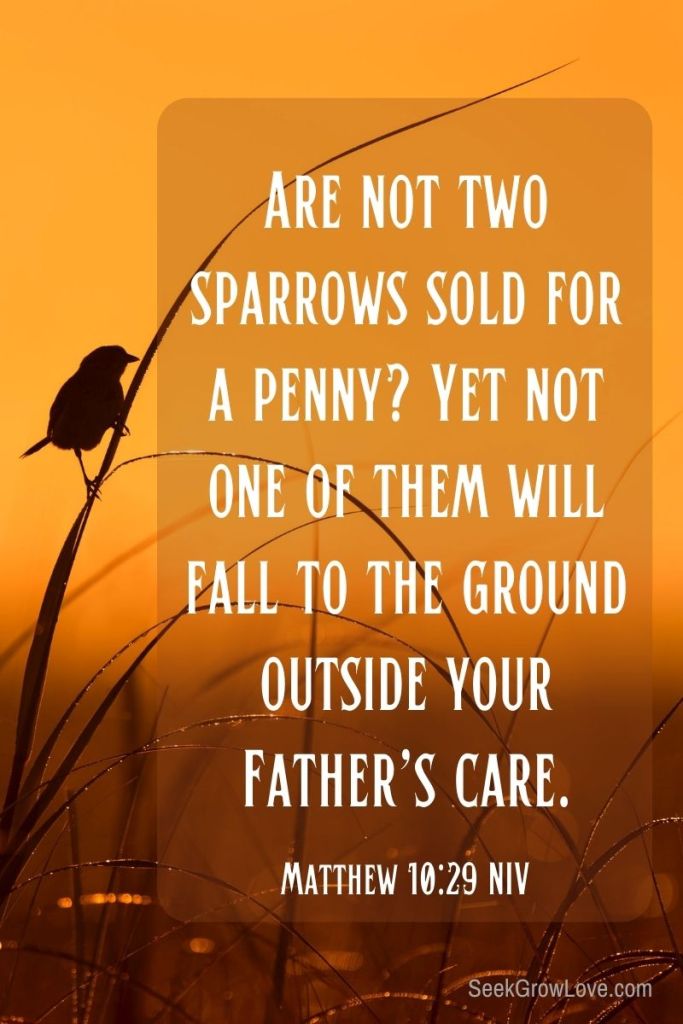
Matthew 10:29-31 has always been one of my favorite portions of scripture. Sparrows are small, ordinary, brown birds that are very unimpressive in the world of birds. You probably won’t brag to your friends about the sparrows you saw on your bird-watching trip. However, the Bible mentions these little guys multiple times! 

Luke 12 gives us a little more insight into just how insignificant these birds were. You could buy 5 sparrows for two Roman coins that were each worth less than an hour’s wage. They were cheaper when you bought more. These birds were pretty much worthless in Jesus’ day. 

Look at what Jesus says! He says that the Father sees every single one. 

We might pass by a tree, completely unaware that a little bird is perched in the branches. But the creator of the universe knows exactly where it sits. 

Let that sink in for a moment.

Jesus then makes a comment about the hairs on your head. Now I don’t know if you’ve ever tried to count each of your hairs…but I did when I was a kid. I remember hearing this verse and being the determined child that I was, I sat down to try. I didn’t get very far. I don’t think I even got past one teeny little section of hair! God can count ‘em! How crazy is that?? 

We then read in verse 31, “Fear not”. Why is Jesus telling them not to be afraid? If we look at the previous portion of Matthew 10 we see Jesus calling his disciples. This calling is pretty intense, right? He tells them that they will be doing all of these amazing things but they will ALSO be persecuted, hated, brought to trial, and sent as sheep in the midst of wolves. That sounds pretty terrifying if you ask me! 

That is when Jesus speaks these incredible words – that even one of the insignificant and seemingly worthless little birds (that we might totally pass by, unaware) is not forgotten by the Father. You are of more value than many sparrows, and our God sees you. And He knows you. And even then, He still loves you.

I want to make a note. Some of us have read this passage countless times. We may even have it memorized. I really want to encourage you (myself included) to let these verses sink deeply into our hearts. Take a moment to meditate on what it truly means to be seen and known by God. How will knowing this impact your life? How will you live your everyday life, with the understanding that even in all the chaos of life and in the grand scheme of the world, the Almighty God cares for you? I hope you find immense comfort and joy in that beautiful truth.

-Katelyn Salyers

Reflection & Application

  1. It is a little too cold in some parts of the world today to ask you to go outside and sit for awhile, so if you have to do your sitting inside, that works, too. But, as Katelyn suggests, take some time and consider what this passage means to you. What thoughts and feelings do you have when you hear each of these statements: God sees you, God knows you, God values you, God loves you. Pray to Him about it. 
  2. What COULD you be afraid of right now? How does knowing and believing Matthew 10 help combat fear?