Genetic Edge

Judges 1-3

The study of genetics is fascinating. I remember being rather annoyed by punnett square assignments in my sophomore Biology class, but as an expectant parent it was fun to guess the likelihood of our children bearing unique characteristics of my husband and myself (…and it is ironic that four children from the same DNA can be so drastically different!). One of our four children looks like my mini-me, while the other three possess more of my husband’s physical traits. Though two children seem to be a mix of our personalities, one child definitely inherited my introverted and cautious personality while another one is every bit as ornery as I hear his father was at that age. Unfortunately, I did not provide our children with the recessive gene needed to match my husband’s red hair, and I don’t think he’ll ever forgive me for it. Ha! 

While some traits can be considered rare, one with which we are all probably familiar is the concept of dominant hand usage. Today, about 90% of the population demonstrates right-hand dominance, while 9% prefer to use their left hand and 1% are ambidextrous. This likely-inherited recessive trait of left handedness allowed our protagonist in today’s Bible reading to execute a most epic assassination to free the Israelites from oppression. 

Yesterday, we read Joshua’s monologue in which he recited a battle cry for his people to remember the Lord and continually choose to follow Him; today, we read about how, after Joshua died, the next generation didn’t know about God and started worshipping the gods of their neighbors. Even after all the miracles that God had performed for his people, the collective generation dropped the ball big time and failed to teach their children about God. So… God got their attention by turning them over to their enemies. 

The Lord selected leaders (“judges”) to help guide the people in His ways, but the Israelites ignored the judges and continued worshipping gods, doing evil even more so after each judge died. So, the Lord gave the people over to their enemies. In Judges 3:14, we find the Israelites being ruled by Eglon, the Moabite king, for almost two decades. The people finally called out to the Lord to save them, and He sent them Ehud as their leader/judge. 

The following verse specifically notes that Ehud was left-handed; God had a unique purpose for Ehud’s special trait. Ehud hand-delivered the Israelites’ tribute to the king, which was more or less a tax that the people had to pay as subjugates. In the days before metal detectors, the king’s security would check a visitor’s left side for weapons, since right handed people would sheathe a sword on their left side for ease of draw. Because Ehud was left handed, he would have hidden his sword on his right side, allowing him to pass inspection as an assumedly unarmed visitor. As he delivered the tribute to King Eglon, Ehud told the king that he had a secret message to share. The king, falling right into his trap, dismissed all the guards. Ehud seized his opportunity. Leaning in with a “secret message from God,” Ehud drew his clandestine sword and plunged it, hilt and all, into the belly of the obese ruler. (You can read all the gory details in the text.) Then Ehud locked the doors and escaped through the porch. The king’s attendants assumed that the king was “relieving himself,” so they “waited to the point of embarrassment” (a very long time!) before they finally unlocked the room to discover their gullible king dead on the floor. Their polite delay provided Ehud a nice buffer of time in which to abscond. Then the tables turned as the Israelites conquered Moab and enjoyed eighty years of peace. 

The left handed trait might have been viewed as a peculiar weakness, but God used Ehud’s uniqueness to accomplish something great for His people!

-Rachel Cain

Reflections:

Do you have any traits that you thought were a flaw, but that God used for His glory? 

Praise or Platitudes

Joshua 22-24

In these final chapters of Joshua, we read his deathbed advice to his people. Filled with nuggets of wisdom, Joshua calls the people to remember their history and God’s faithfulness, and he encourages them to continue following God. Joshua reminds the people that there is only One True God, YHWH, and that the household idols and the gods of the people around them are not truly going to save them. Yet still Joshua asks them to make a conscious decision, to declare their devotion one way or the other: “Choose this day whom you will serve… but as for me and my house, we will serve the LORD!” What a powerful charge to the people! If anyone had been unclear about Joshua’s position, there was no doubt after this profound declaration. Of course, the people agree that they will follow God, and of course, it wouldn’t be long before they would turn away yet again.

Joshua, famous among his people as a devoted follower of the One True God, knew humanity’s tendency to have idolatrous hearts. As he closed out his life, he wanted to remind the people to focus on what – WHO – is truly the most important. If you’re anything like me, you probably scoff at the ways in which the Israelites kept turning from God in spite of all His miraculous provisions, but in reality, all of humanity worships something; the idols are just different for each of us. We have an innate desire to worship, and that should be directed toward our Creator. However, our flesh can often lead us to worship the things of this world – money, entertainment, sex, identity, work, comfort, power, nature, and self – more than we worship our God. We must be alert to the things of this world that are vying for our devotion, keeping our eyes attuned and faithful to our God above all else. 

Don’t let Joshua’s words be just an empty platitude on your dining room wall, but really take it to heart. Whom will you serve? Will you follow the empty gods of this age, or will you wake up every day willing to follow the One True God? 

-Rachel Cain

Reflections:


What does it mean to really serve the Lord? What idols do you need to cast aside to really seek and serve Him? 

Research the ways in which Joshua is a foreshadowing of Jesus. There are many interesting parallels! 

Safe Cities

Joshua 19-21

After studying the Underground Railroad, my family and I toured a local church that played a major role in helping escaped slaves reach freedom. Though the dismal, subterranean tunnel boasted no modern amenities, its hidden passage beneath the church’s sanctuary had served as a refuge for countless escapees on their way to freedom. How I wished the walls could talk! There are no written records of the tunnel’s guests from that time period, probably to protect the identities of the escaped slaves (and besides, most local records were destroyed in the 1913 flood that ravaged this region), but shards of pottery and discarded animal bones from choice cuts of meat provide evidence of the meals that were smuggled in to nourish the “fugitives.” I was speechless while envisioning the grueling journey a desperate, sweet soul must have endured to arrive this far north – more than 60 miles beyond the Ohio River – weighed down by the well-preserved foot chains that had been found in that very tunnel. 

The escaped slaves were hungry for safety. “Safety” is a concept that we often take for granted in this twenty-first century, first-world country; in many countries, simply proclaiming Christianity could cost one’s life. I find it interesting that God designated several cities of safety for his people in the Promised Land. These were cities to which anyone could escape who had accidentally killed someone, in which they would safely await trial without threat of the victim’s family avenging the (potentially innocent) murderer. 

Though we no longer have similar cities of refuge, this concept is a foreshadowing of sorts to Jesus: in him, we sinners find refuge from our enemy. “We run to Christ to escape the danger we are in from the curse and condemnation of the law, from the wrath of God, and from an eternity in hell. Only Christ provides refuge from these things, and it is to Him alone that we must run. Just as the cities were open to all who fled to them for safety, it is Christ who provides safety to all who come to Him for refuge from sin and its punishment.” (quote source). 

“He is our refuge and strength, an ever-present help in trouble.” Psalm 46:1

“Therefore, we who have fled to him for refuge can have great confidence as we hold to the hope that lies before us. This hope is a strong and trustworthy anchor for our souls.” (Hebrews 6:18, NLT)

I am so grateful for the hope that lies before us! Aren’t you?!

-Rachel Cain

Reflection: 

Look up synonyms for the word “refuge.” Which one stands out most to you in your journey of faith? 

“He kept every promise he had made to the Israelites; each one came true.” (Joshua 21:45) What a powerful verse! God is always faithful. Reflect on his faithfulness in your life by writing a memoir or journal about how he has moved in your life, and share it with those close to you. 

Burn the Ships

Hesitant Hebrews

Joshua 16-18

It was so close they could almost taste the milk and honey on their lips – their Promised Land! After centuries of oppression and slavery under Pharaoh followed by 40 more years wandering free in the wilderness, the Israelites finally possessed the metaphorical keys to their inheritance. Many of the tribes ventured out right away for their assigned territories, ready to explore, conquer, and settle at last, but several tribes remained behind. Why wouldn’t they ropedrop this momentous occasion and charge with abandon straight to their inheritance?

Though I cannot speak for all the Israelites since I have not walked in their sandals, this is my speculation based on what I’ve read: they desired the path of least resistance. Though they were promised that the land would be theirs, they had to go in and take it. There were still other people living on those properties; it would require a lot of effort to drive them out. Yes, God had guaranteed that this land would be theirs, but that didn’t mean their possession of it would be effortless. In the beginning of their nomadic desert life, remember how they had longed to return to the familiarity of slavery and oppression in Egypt? Now, well accustomed to desert dwelling, they didn’t want to expend the energy to settle into the cities, which would still require them (albeit with the promise of success!) to conquer it. It was more comfortable to stay in their crummy environment than to embrace the best land that God had for them.

I am reminded of Spanish conquistador Hernan Cortes who was determined to conquer the interior of Mexico, including the Aztec empire and a vast swath of land from the Caribbean to the Pacific. This fierce leader and fighter, frustrated that his men were too focused on the possibility of going home and too scared to invade this new territory, took away their temptation to retreat by doing what any extreme leader would do: he burnt the ships. Now, there was no turning back, no reason to not forge ahead and claim this land. 

Perhaps the seven tribes had become so lazy or complacent in their faith that they didn’t even care that God had something infinitely better in store for them. As C.S. Lewis said, “It would seem that Our Lord finds our desires not too strong, but too weak. We are half-hearted creatures, fooling about with drink and sex and ambition when infinite joy is offered us, like an ignorant child who wants to go on making mud pies in a slum because he cannot imagine what is meant by the offer of a holiday at the sea. We are far too easily pleased.”

Ultimately, in part because the Israelites did not fully drive out the inhabitants of their Promised Land, God’s people became immersed in the culture, false gods, child sacrifice, and overall moral corruption of the people around them, which perpetuated the spiral of falling away from God and then begging Him to save them. Though written much later, Romans 12:2 would have been good advice for the Israelites (who were called to be set apart for God), and it is still wise for us as present-day believers to heed its wisdom: “Don’t become so well-adjusted to your culture that you fit into it without even thinking. Instead, fix your attention on God. You’ll be changed from the inside out. Readily recognize what he wants from you, and quickly respond to it. Unlike the culture around you, always dragging you down to its level of immaturity, God brings the best out of you, develops well-formed maturity in you.”

So, what ships are holding you back? What comfort, familiarity, or apathy is keeping you from fully following God? Sometimes I am a lot like the 7 tribes and Cortes’ crew. While I claim to desire God’s calling on my life, I often let the comforts of the present and anxieties about the future hold me back from fully embracing His plan for my life. Let us pray for God’s strength to follow wherever He may lead us. 

-Rachel Cain

Reflection: 

Watch this powerful music video about “burning the ships” and charging ahead into God’s will for our lives. 

Priestly Portion

Joshua 12-15

I’ve heard sad stories of siblings living hostilely toward one another for decades because of arguments regarding the inheritance from a late parent. I wonder if the Israelites assumed God picked favorites as he doled out their assigned territories in the Promised Land. 

Remember Caleb? At eighty-five years old, Caleb finally realized his dream of inheriting Hebron four decades after he had first explored it. He and Joshua were the only two of the dozen spies who had encouraged the nation to take their Promised Land; the ten other agents involved in the espionage had invoked great fear in their people. As a result of their collective lack of faith, the Israelite nation would wander for 40 more years in the wilderness while most of that unfaithful generation died off. Caleb, now an octogenarian, was very eager to finally claim the territory that had been promised to him two scores ago. He and Joshua had kept the faith, remained true to God, and waited patiently to receive their inheritance, just like we must wait patiently for our Promised Land, the Kingdom (Romans 8:25). 

Perhaps the Levites, the tribe designated to serve as priests, initially felt slighted when they learned that they would inherit no land at all; rather, God promised to be their portion and take care of their needs as they served as religious leaders for His people. Though it might seem like they had received nothing tangible, they actually received the best gift: a closeness with and dependence on God that most would never experience. 

We, too, are beneficiaries of a similar priestly portion:  “But you are a chosen people, a royal priesthood, a holy nation, God’s special possession, that you may declare the praises of him who called you out of darkness into his wonderful light.” 1 Peter 2:9 

Unfortunately, we tend to chase temporary things in this life, like fortune and fame, rather than keeping our eyes on the eternal prize. None of this truly satisfies, and we can’t take it with us when we die – you’ll never see a hearse pulling a U-Haul, after all! Jesus reminds us to “store up treasures in heaven… for where your treasure is, there your heart will be also” (Matthew 6:20-21). As followers of Jesus, we have a much greater inheritance promised to us, far better than all the riches of this world. 

I leave you with the priestly blessing from Numbers 6:24-26: 

The Lord bless you and keep you;

the Lord make his face shine on you and be gracious to you;

the Lord turn his face toward you and give you peace.

-Rachel Cain

Reflection: 


What does it mean personally to you that God is your portion? How does that impact your soul?

Meditate on these scriptures as you thank God for being your portion! 

  • My flesh and my heart may fail,but God is the strength of my heart and my portion forever. Psalm 73:26
  • Because of the Lord’s great love we are not consumed, for his compassions never fail. They are new every morning; great is your faithfulness. I say to myself, “The Lord is my portion; therefore I will wait for him.” Lamentations 3:22-24
  • And this is God’s plan: Both Gentiles and Jews who believe the Good News share equally in the riches inherited by God’s children. Both are part of the same body, and both enjoy the promise of blessings because they belong to Christ Jesus. Ephesians 3:6

Gotcha!

Joshua 9-11

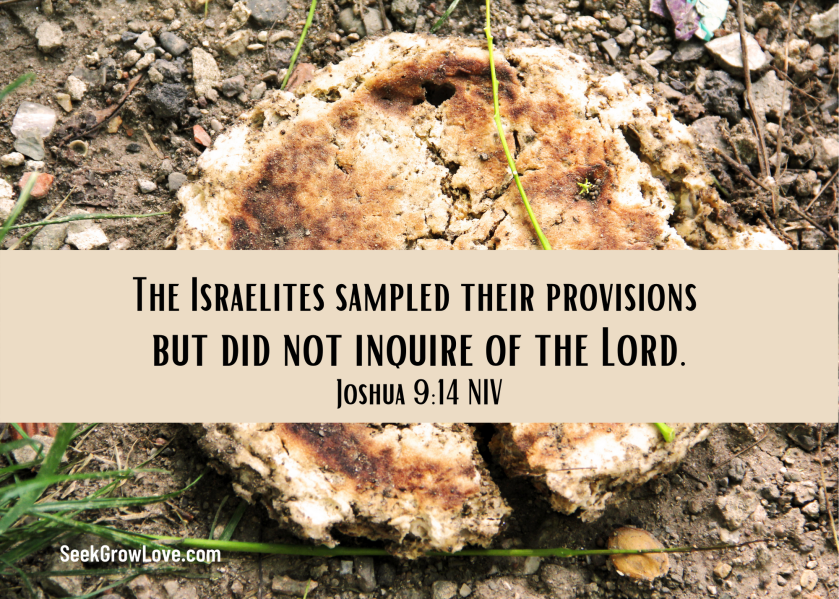
When the inhabitants of Gibeon heard what Joshua had done to Jericho and Ai, they acted deceptively. They gathered provisions and took worn-out sacks on their donkeys and old wineskins, cracked and mended. They wore old, patched sandals on their feet and threadbare clothing on their bodies. Their entire provision of bread was dry and crumbly. They went to Joshua in the camp at Gilgal and said to him and the men of Israel, “We have come from a distant land. Please make a treaty with us… Then the men of Israel took some of their provisions, but did not seek the LORD’s decision. 15 So Joshua established peace with them and made a treaty to let them live, and the leaders of the community swore an oath to them. Joshua 9:3-6;14-15  (CSB)

“Be skeptical of everyone, including the skeptics”. I don’t know where this quote or phrase came from, but I often find myself in that mindset. Why? Because of stories like this. There are those out there who would try to deceive and use this deception to take advantage of others. I used to get calls and emails all the time at the church from people who were looking for money to help with something. There was always a story about why they were in this tough situation. The second half of that quote also resonates because sometimes people just like the status quo or throw cold water on other people’s ideas.

Maybe some of those people were deceptive, and maybe some of them were genuine. I don’t know. What I do know is that there were occasions where I would try to give something, but there were times that I did not. I did my best to discern who was authentic, but I couldn’t really know. What I could do was pray about it and see if God gave me a push in one direction or another, but if he didn’t, I’d need to make a choice. In situations of meeting needs or requests, you can’t help everyone, we have finite resources. I do think it is important not to be dismissive of every request because there are people who genuinely have needs and come to churches as a last resort.

When the Gibeonites came to Joshua and the men of Israel, they did their best to pull one over them, and it worked. The leadership did appear to be skeptical and questioned the Gibeonites, but they neglected to check with something powerful that they had at their disposal: access to Almighty God! Rather than checking on what God wanted them to do, to seek wisdom in this situation that some of them even thought might be a little fishy, they made a knee-jerk decision and swore a treaty to do no harm.

Don’t you think that it would have been wise to consult God when there were treacherous peoples all about the land? The Gibeonites got their protection, but they found themselves indentured to the Israelites because of their shenanigans. I guess that beats death? Some might disagree.

When faced with big decisions, we should come before God and seek wisdom. Especially when we are the leaders of his institutions. Whether leading the Israelites four millennia ago or leading in Christ’s Church today, when we face big decisions (skeptical about what is going on or not), we must always ask what God would have us do. We have scripture to guide us, as well as the Spirit of God that will guide us when we are earnestly seeking after him. When we see leaders fall or make ruinous decisions, we can probably rest assured knowing that they did not honestly seek God’s will and input for that decision. Unless God is intent on making a statement with you like he did with Hosea, he is not going to tell you to make decisions that would be considered dubious by wise observers.

-JJ Fletcher

Reflection Questions

  1. Can you think of a time that not seeking God’s decision burned you? How did you respond or recover after?
  2. Do you find yourself to have a healthy level of skepticism, or do you often find yourself being a bit too Pollyannish? Is there value in both? What are some of the drawbacks of each of these traits?
  3. Do you think Joshua and the leaders learned something from this experience?
  4. How do you think it best to navigate people who are too extreme on the scale of being too trusting or distrusting? What can we do to be a good emissary of Jesus in those situations?

Messy Parts

Joshua 1-4

Then Joshua son of Nun sent two men secretly from Shittim as spies, saying, “Go, view the land, especially Jericho.” So they went, and entered the house of a prostitute whose name was Rahab, and spent the night there. Joshua 2:1 (NRSV)

Context is important. Out of context, this verse might convey something completely different from the story that follows. In the same way, when we hear an unsavory detail about an individual, it could easily prejudice our opinion of them. Everyone has messy parts of their lives, but those messy parts don’t tell the whole story.

Descriptors carry weight. Rahab the prostitute… If, in casual conversation, you hear that about someone, what do you think? The modern vernacular is “sex worker” trying to clean up a description about someone who works in a profession that is not lacking in crude descriptors. We won’t go there. You probably don’t think the best of that individual. You ask what happened that they went down that path in their life? So many questions… or maybe none. We write them off as someone who is living outside of God’s will and God’s grace.

The spies are commissioned to go and get a close-up of what Jericho is about. Boots on the ground in an espionage mission to help determine what will need to happen to eliminate a fortress city that is currently situated in the land that has been promised to God’s people.  

The spies get there, they meet a prostitute, and they go lay low in her house. Probably not who they expected to find as a sympathizer. Rahab is knowledgeable about the God of Israel. She offers and provides help to these spies and ensures they remain hidden from the Canaanites, who are wary and fearful of the impending insurgence of Israelites into “their land”.

But a prostitute…

Everyone does not get to choose their lot in life. Millions of people are trafficked or remain in a human sex trafficking situation at any given time. These people do not enter this willingly, it is essentially slavery.

Rahab. A prostitute. By choice? We don’t get much clarity here, but Rahab was likely forced into this situation where she engaged in prostitution. Slavery of this kind would not have been uncommon. Perhaps she was widowed or divorced and had no other recourse? Again, we don’t know. What we do know is that this unlikely ally to the people of Israel changed the course of history. While her profession was unsavory, her heart was made of gold. She had respect for Yahweh, the God of the Israelites, and she was willing to help Israel for a guarantee of safety and liberation. Seems legit. It’s a bad situation Rahab has found herself in, but she has heard of the power of God and wants to be a part of the community that is protected by the almighty God.

The spies promise her safety if she protects them, and they uphold their end of the bargain after she keeps them safe (Josh 6:22).  When Jericho is destroyed, Rahab and her household are spared.

James 2:23-26 says, “And the scripture was fulfilled that says, “Abraham believed God, and it was credited to him as righteousness,” and he was called God’s friend. You see that a person is considered righteous by what they do and not by faith alone. In the same way, was not even Rahab the prostitute considered righteous for what she did when she gave lodging to the spies and sent them off in a different direction? As the body without the spirit is dead, so faith without deeds is dead” (NIV).

Describing Rahab as a prostitute, something that she did in Jericho, does not do her justice. We are, after all, talking about King David’s great-great-great grandmother. She is not just a footnote in history; she is in the genealogy of the savior of the world (Matthew 1:5)! Rahab is, in her actions, a savior for the Israelites, especially the two spies who trusted her, and is an ancestor to Jesus, the most consequential figure in human history. The Son of Man, the Son of God, the anointed king of the coming Kingdom of God.

When I think about Rahab, I think about a talk that Tony Campolo gave about throwing a birthday party for a prostitute at 3 AM. You can watch it here: https://www.youtube.com/watch?v=kWlMV-UmueM&ab_channel=EvanCourtney

Don’t write people off. They may be far from God or living in situations that, for lack of a better descriptor, we would call complex. No one is beyond redemption, and we should strive to extend grace and try to bring the joy that we find in Christ into the lives of everyone we meet, whether they be a pastor, an executive, that elderly woman who sits three rows in front of you every week at church, or the prostitute you bump into at a diner at 3 AM when you are adjusting to being many time zones away from home.

-JJ Fletcher

Reflection Questions:

  1. Why is it so easy to dismiss “unsavory” people?
  2. Do you have “unsavory” parts to your life that you don’t want anyone to know about? What if people knew? How would they treat you? Is there a way you can use the messy parts of your story to help someone else?
  3. What can we glean from the role of Rahab in the victory of the Israelites over Jericho? What can we glean from how the spies treated and trusted her?
  4. Sin is sin. Why does sexual sin have a different gravitas than most other sins?

Power in Song

Deuteronomy 32-34 & Psalm 91

When Moses had finished reciting all these words to all Israel, he said to them: “Take to heart all the words that I am giving in witness against you today; give them as a command to your children, so that they may diligently observe all the words of this law”. Deuteronomy 32:45-46 (NRSV)

I’m a music lover.  My memory of “contemporary” music goes back about 30 years. 1995-1996 is when I first remember getting into music on the radio. It’s not just the music of my era… I grew up listening to the classic rock format as well as ‘90s rock and pop. If I were to anonymously give you a top 20 list of my favorite albums or songs (which I’d probably never be able to narrow down), you might be left scratching your head, wondering who this person is and when they were born. Powerful is the art of song and music. I love music for the notation, the way that notes and chords are put together to create melody and harmony, even dissonance, but also for the lyrics… The way that someone can convey emotion or conviction in a way that hits hard, that makes you think and feel.

Great songs come in many forms. There is much to be gleaned from a simple lyric – Jesus loves me, this I know, for the Bible tells me so; and there is much to contemplate from an imaginative and thoughtfully written gem that paints an image in the mind: “Could we with ink the ocean fill, and were the skies of parchment made; were every stalk on earth a quill, and everyone a scribe by trade; to write the love of God above would drain the ocean dry; nor could the scroll contain the whole, though stretched from sky to sky”.

The Beatles were a smash with their early simplistic songs, but also with more thought-provoking tunes toward the end of their run. Leonard Cohen’s “Hallelujah” (Jeff Buckley did it better) is one of the most gut-wrenching (in a good way) songs that I can think of. It carries the listener through peaks and valleys of emotion as it describes tensions in the human experience of love. Perhaps I have digressed too much, but I can get distracted when I get into the minutiae of music.

In Deuteronomy 32, we have recorded a song that Moses recited to the Israelites shortly before he went up to Mount Nebo to get a distant view of the promised land and then die. In this song, we see a variety of things addressed. Moses glorifies Yahweh, his God, but takes the people on a journey to envision their future failure and rejection of God’s ways that they are on a path toward. Challenges, encouragement, and perspective.

While Moses covers some pretty negative territory regarding the Israelites in his words, he also gives assurance that Yahweh is a God of mercy and redemption and that his people will be cleansed. Despite impending failure, there is forgiveness and mercy on the docket, and there will ultimately be protection for the people of God against their adversaries.

I find it a little curious that Moses addresses the people in song, diverging from the status quo of God’s revelation to his people up to this point, but song can be a powerful way to commit things to memory. In contrast to the ten commandments and the subsequent revelation of the full law, this presentation perhaps was remembered and recited in a way that was engaging and complementary. 

-JJ Fletcher

Reflection Questions:

  1. How has music impacted your relationship with God and Jesus?
  2. Do you find it easier to remember lyrics and scripture put to song than simply memorizing bible verses?
  3. How do we balance the desire that we might have for catchy and relatable tunes with the directive to glorify and worship God with music?
  4. What impact do you think Moses’s addressing the people in this manner had on them? (might be helpful to look back at Deuteronomy 31:19-22)

Carrot and Stick

Deuteronomy 28-29

“And if you faithfully obey the voice of the LORD your God, being careful to do all his commandments that I command you today, the LORD your God will set you high above all the nations of the earth… But if you will not obey the voice of the LORD your God or be careful to do all his commandments and his statutes that I command you today, then all these curses shall come upon you and overtake you. Deuteronomy 28:1;15 (ESV)

Motivating my four children, ages 4 to 12, requires different strategies. My 12-year-old is motivated by rewards, i.e., if you do all your chores and then some extra work, you can have an extra 30 minutes playing the Switch. Consequences, however, don’t seem to faze her quite as much. The other 3 children are less cut and dry and require a more measured approach with rewards and consequences; however, one great challenge is follow-through. As busy parents with hundreds of things to do each day and limited energy reserves, it can be difficult to be consistent and follow through on our threats and promises.

God is not inconsistent. God is merciful, but he follows through on his promises. In Deuteronomy 28:1, he promises a blessing in return for obedience, but in Deuteronomy 28:15, he promises punishment for disobedience. It’s the same as a carrot and stick. Something tasty to motivate or something that brings pain to correct course. We see through Israel’s history that even though God followed through on his promises of blessing, he still had to break out the stick to use on a hard-headed people.

Over the past couple of weeks, I have been preaching from Romans 7-8. In Romans 7, Paul writes about not understanding his actions. Paul knows what is right, he knows what God desires of him, and he wants to be obedient, but there’s a problem. Despite the faith in and knowledge of God’s ways, Paul succumbs to human desire and does the things he does not want to do, i.e., the things of the flesh. Can you believe it? Paul, the apostle, was a “slave” to sin in the flesh! Is that hard to believe? Paul is human like us, and despite what we know is right, we often don’t do the right thing. Why, why, why? Because sin is ingrained in the flesh.

There are debates on something called original sin, which is not something we’ll get into here, but it is clear we learn how to sin from an early age. We are naturally selfish as children; we need to be self-focused to survive, but as we mature, we should become less self-focused and more focused on the big picture. In the Christian view, we should be imitating Jesus, who humbled himself (Philippians 2). Jesus was a model of selflessness and submission to God’s will. Jesus did not want to die, yet he was obedient to the point of death so that many could be ransomed from the death that comes from sin; he saw the big picture. Though we can see the big picture, we often fall short of the kind of selflessness that Jesus modeled.

Unlike the Israelites under the old covenant, we have Jesus in clear view. We are not holding out hope for a future savior but rather holding onto the promise that the blood of Jesus has covered our sins past, present, and future. While we are called to obedience, God does not hold our salvation in limbo every time we mess up. We are faced with the present consequences of our mishaps with sin, but we have constant forgiveness through the blood of Christ Jesus. If we confess our sins, he is faithful and just and will forgive us our sins and purify us from all unrighteousness” 1 John 1:9 (NIV). We don’t have to go through the carrot and stick metaphor as partakers of the New Covenant in Christ’s blood. We must strive to be obedient, but fess up when we miss the mark, and move forward in each new day as we are redeemed by the blood of the lamb.

-J.J. Fletcher

Reflection Questions:

  1. Why do you think it is so hard to balance the desires of the flesh with the knowledge of the living God and some pretty clear instructions on his will for us?
  2. Is it easy to become discouraged when we fall short? What are some obstacles to confidence in our faith walk?
  3. Does a tendency toward legalism sometimes impede our ability to deal with flaws in ourselves and others?
  4. Is there a place for carrot-and-stick dynamics in church life and discipline?
  5. What would Paul think about the way that some modern churches deal with reconciling the desires of the flesh with faithfulness to the gospel?

A First Fruit Sacrifice

Deuteronomy 24-27

And behold, now I bring the first of the fruit of the ground, which you, O LORD, have given me.’ And you shall set it down before the LORD your God and worship before the LORD your God. Deuteronomy 26:10 (ESV)

It is Sunday morning. What are you going to do this morning (or, depending on when you read this, what did you do this morning)? It is the first day of the week; did you spend it on yourself, or did you give some of your time in worship of Yahweh our God and in remembrance of his son, Jesus, our savior? Most of those reading this likely attended a local church this morning, but some of you may have needed to work, or perhaps there was another reason for not being in church today.

Why am I asking these questions? Deuteronomy 26 speaks of the act of giving the first fruits of the harvest as an offering to God. Looking forward to the entrance into the land of milk and honey, the promised land, the Israelites are instructed to take a portion of their first fruits and bring it to the priest to set before the altar. Taking a portion of what God has blessed them with and giving it back as a sacrifice or offering. Things are different now. We are not under the ceremonial law, but are we exempt from sacrifices?

Through him then, let us offer up a sacrifice of praise to God continually, that is, the fruit of lips that make confession to his name. Do not neglect to do good and to share what you have, for such sacrifices are pleasing to God. Hebrews 13:15-16 (REV)

Worship is something God desires of us, and while it is not for us, it does us good, for it puts God into our focus and puts him in his exalted place. Jesus told his disciples to break bread and partake of the cup whenever they got together “in remembrance of me”. We need to remember Jesus’ sacrifice as we try to live sacrificial lives.

Gathering for worship and fellowship is important, but it is a sacrifice. Many people don’t work on Sunday, a day to sleep in and relax! We may see the value of setting this time aside for worship, but sometimes we may struggle with it. Churches are filled with imperfect people (sorry if this comes as a surprise to you), and sometimes those people are a source of pain in our lives. We hurt one another and sometimes struggle to confess our sins against one another, and sometimes we fail to forgive those who sin against us (that seems backwards from how Jesus instructed us to pray). Maybe we see this sacrifice of our time as a duty, and we lose some of the wonder that we experienced toward Christ’s church.

There can be reconciliation through our sacrifices of praise and obedience, just as Christ’s sacrifice reconciles us to God, as we spend time in community and in fellowship through the spirit of God, we should be transformed to be like Jesus, who was able to forgive the betrayal and brutality that was directed to him. Jesus had to slog through difficulties and disappointments like we do; he had his times of questioning, and maybe he even struggled at seeing the wonder of it all at times. Through obedience, sacrifice, and confession, we can be conformed to his image of Jesus and also glorify God as we recognize him as our provider and source of our hope.

-J.J. Fletcher

Reflection Questions:

  1. What do we have for first fruits that can be brought before God?
  2. I see time as being our most valuable resource. When we give time to God, what does this do to and for us?
  3. Do you give money to your church or other ministries? How does financial offering correlate to first fruits?
  4. When you give the first fruits of your day or week to God in devotion or worship, does it differ from giving him whatever you have left at the end of a long day or week?