In Your Weakness

Exodus 4

February 10

God is the very epitome of a patient and loving father in the beginning of this scenario. Moses is feeling very insecure and inept for the task God has called him to do. I personally can really relate to Moses’ fear and apprehension when it comes to public speaking. God doesn’t respond with anger or derision in this moment with something along the lines of “Don’t be ridiculous Moses! You are speaking to the God of the universe here. I’ve got you covered.” Instead, He very patiently answers Moses’ questions and actually gives him a step-by-step game plan of how to carry out his mission. 

Even with this carefully thought out plan so carefully and lovingly delivered to him, Moses is still overcome by his own anxiety and insecurity.

10 Moses said to the Lord, “Pardon your servant, Lord. I have never been eloquent, neither in the past nor since you have spoken to your servant. I am slow of speech and tongue.”

11 The Lord said to him, “Who gave human beings their mouths? Who makes them deaf or mute? Who gives them sight or makes them blind? Is it not I, the Lord? 12 Now go; I will help you speak and will teach you what to say.”

Moses still doesn’t seem to get the point God is making. Even after He assures him that He will be with him to help him speak and will teach him what to say, Moses has the audacity to tell the God of the universe no!  13 But Moses said, “Pardon your servant, Lord. Please send someone else.” The audacity! But, wait?!? Have I been like Moses in my life more than I care to admit? Do we let our own fears and insecurities keep us from carrying out our God-given missions? Do they overshadow our confidence in God and His abilities? Are we ultimately saying that we don’t believe that God is up to the task?

Disobedience is dangerous! We read in verses 24-16:  24 At a lodging place on the way, the Lord met Moses and was about to kill him. 25 But Zipporah took a flint knife, cut off her son’s foreskin and touched Moses’ feet with it. “Surely you are a bridegroom of blood to me,” she said. 26 So the Lord let him alone. (At that time she said “bridegroom of blood,” referring to circumcision.)

Moses knew the requirements for circumcision and he also knew that the God of the universe was calling him to complete a task and he had been disobedient in both regards. Genesis 17:12: “And he that is eight days old shall be circumcised among you, every man child in your generations, he that is born in the house, or bought with money of any stranger, which is not of thy seed.”

I am not sure if this scene was in any way a reference to Jesus being a bridegroom of blood to us, but it certainly came to mind for me. What a gift that Jesus’ blood covers our sins and we are given a chance at new hope!

Getting back to Moses’ insecurity and lack of belief that he could carry out what God called him to do. While reading this chapter, I called to mind Paul’s words in 2 Corinthians chapter 12 concerning the thorn of his flesh,

8 Three times I pleaded with the Lord to take it away from me. 9 But he said to me, “My grace is sufficient for you, for my power is made perfect in weakness.” Therefore I will boast all the more gladly about my weaknesses, so that Christ’s power may rest on me. 10 That is why, for Christ’s sake, I delight in weaknesses, in insults, in hardships, in persecutions, in difficulties. For when I am weak, then I am strong.

What a comforting reminder that we can actually boast in our weaknesses because Christ’s power is actually made perfect in our weakness. We don’t have to have it all together, God meets us right where we are and equips us as He sees fit in order for us to carry out his missions. Trust Him!

-Kristy Cisneros

Questions for Reflection and Discussion

  1. Have you ever felt led to do something for God but shrinked back because you were afraid you were not good enough for the task? What would God tell you?
  2. What are some ways that we can use our weaknesses to glorify God and honor Christ? What strengths will be provided?
  3. How did Zipporah and Aaron each add to or compliment Moses’ ministry? How have you been a help to the spiritual life and work of another?
  4. What will you learn from Moses’ example that you can put into action this week to help ensure that you will participate fully in God’s plans for you? What excuses will you overcome? What does God want to teach you what to say? Who may God be calling to be on your team in ministry?

Tomorrow we will skip ahead to Exodus 12

Faithful with the Little Things

Exodus 1

February 7

In this first chapter of Exodus, we see that the Israelites are viewed as a formidable threat due to their increasing numbers. There was a great fear that the Israelites would continue to multiply and if war were to break out, they would choose to join with Egypt’s enemies and eventually leave the country. In verse 16, we read of the horrific remedy that the king of Egypt concocted and delivered to the midwives: “When you are helping the Hebrew women during childbirth on the delivery stool, if you see that the baby is a boy, kill him; but if it is a girl, let her live.”

We then read with great relief in verse 17 that the midwives “feared God and did not do what the king of Egypt had told them to do; they let the boys live.” 

Do we always have the courage to do what is right in the eyes of God—even at great risk and cost to ourselves? We might think that we would never be put in such a dire predicament, but I believe our faith is tested in both big and small ways. Our faithfulness in the “small things” can actually speak to the overall health of our faith. As stated in Luke 16:10, “The one who is faithful in a very little thing is also faithful in much; and the one who is unrighteous in a very little thing is also unrighteous in much.” Imagine you are eating dinner at a restaurant and you notice the server forgot to charge you for that delicious artichoke and spinach appetizer. Do you think, “Ha! It’s my lucky day!” or do you remember that the right thing to do in the eyes of our Heavenly Father is to pay for everything that you ordered?

I have a theory. I think that it might actually be easier to make the right choice in dire circumstances as opposed to authentically living out our faith on a daily basis amidst the small trials and challenges of life that constantly wash up against us. Have you ever been in the ocean or even in a tidal pool at a water park and found it hard to regain your footing after getting knocked down by a wave? Even the smallest of waves can wipe us out and deplete us of strength if we don’t feel like we can catch our breath between the waves. Psalm 42 gives us some comfort for these times:

6 “My soul is downcast within me; therefore I will remember you in the land of the Jordan, the heights of Hermon—from Mount Mizar. 7 Deep calls to deep in the roar of your waterfalls; all your waves and breakers have swept over me. 8 By day the Lord directs his love, at night his song is with me—a prayer to the God of my life.”

May we be encouraged by this reminder that God’s song is with us and that He rewards our faithfulness. Verses 20-21 of Exodus 1 demonstrates how God rewarded the faithfulness of the Hebrew midwives: “So God was kind to the midwives and the people increased and became even more numerous. And because the midwives feared God, he gave them families of their own.”

May our goal always be to please our Heavenly Father in the big and “small” things and to lean into Him when the waves of challenge sweep over us.

-Kristy Cisneros

Questions for Reflection and Discussion

  1. Do you find it difficult to live out your faith authentically when faced with the big and small challenges of life? 
  2. How can we better lean into God during times of challenge?
  3. Which heroes of the faith inspire you with how they leaned into God during times of trouble?

Tomorrow we continue with Exodus 2

Be the Right Person

At the Right Time in the Right Place

Daniel 11, 12

     Have you ever been the right person at the right time in the right place?  My wife and I were driving home one evening after dark.  We came upon a slow- moving vehicle that was being driven rather erratically.  It swerved from side to side.  It would speed up for a moment and then slow way down.  We even witnessed this vehicle cross the center line several times.  Oncoming vehicles sometimes were forced off the road to avoid this driver. We thought that we were about to see a terrible accident. Of course, this driver was impaired in some way.  I am sensitive toward the subject of drunk drivers.  I was badly injured and my best friend killed by one many years ago.  Of course, we called 911.  However, while my wife was talking to the 911 operator, we noticed that a police cruiser was sitting in a parking lot next to the road.  We pulled alongside and described the situation.  To their credit, the officers quickly sped off in pursuit and had the vehicle pulled over in less than a minute.  The driver, a middle aged woman, was clearly inebriated.  We hope that we helped to save some family from a devastating tragedy that evening.  Perhaps, our decision to get involved may have even saved that drunk driver from a life of guilt, prison, or from death itself.   However, we did nothing more than what many people would do.  If you found yourself in a similar situation, I know that you would act.  The right person is often given the right place and the right time to act, to get involved.

     The book of Daniel often describes events that are earth shattering and world changing.  People often get caught up in forces that are beyond their control and they feel helpless.  However, the book of Daniel also gives examples of those individuals who rise to the occasion by standing for their faith.  These individual acts of faith actually change the course of events: Daniel refused to eat the king’s food, Meschach, Shadrach and Abed-nego refused to bow to the image, and Daniel broke the law and risked the lion’s den to pray to the LORD. 

Daniel 11 and 12 describe the incredible times and events that will occur at the end of this age.  Forces will be at work that will be beyond our control.  Yet, it is still a moment for individuals to make a stand.  According to Daniel and the book of Revelation, the time of the end will be characterized by great deception.  Many people, even believers, will be fooled and tricked by the antichrist.   Daniel 11:32 reads, “By smooth words he will turn to godlessness those who act wickedly toward the covenant…..”  However, some make a stand.  Daniel 11:32 continues, “….but the people who know their God will display strength and take action…”  They will be the right people at the right time in the right place.

 Daniel 11:33 adds, “Those who have insight among the people will give understanding to the many….”  Yet there will be a price for this courage.  Daniel 11:33 continues, “…yet they will fall by sword and by flame, by captivity and by plunder for many days.”  However, Daniel 12:3 makes this promise: “Those who have insight will shine brightly like the brightness of the expanse of heaven, and those who lead the many to righteousness, like the stars forever and ever.” 

We live in a time of great confusion.  We have become strangers to God while we worship the idols that we have created.   Many people fear the future and wonder how it is all going to end.  For all our worldliness, our country is confused about sexuality and gender.  People have forgotten what is right and what is wrong, what is truth and what is false.  This world needs a voice of reason.  It needs truth.  It needs people of courage and faith.  The answers are “hidden in plain sight.”  They are right here in the Bible.  Insight will be found by those who are looking for it and by those who thirst for it.  Those who have insight will shine like the stars.  Be the right person so that you can act when the right time and the right place comes to you.

-Scott Deane

Read or listen to today’s Bible reading plan passages at BibleGateway.com here – Daniel 11 & 12 and 1 John 1

Courage to Be Different

Daniel 3-4

     Imagine living in a country where the wider culture is not sympathetic to your faith.  Perhaps, the world around you is even openly hostile to your Christian confession. At this very moment, there are countries around the world where it is dangerous to be a Christian.  You might face persecution.  You face social stigma and even penalties simply for being a believer.  The government may even scrutinize every thing that you say and teach.  Sermons would be submitted to government for their approval.  You might become the victim of mob violence.  These things where once isolated to countries on the other side of the globe.  Now, even in Western democracies, Christian beliefs are coming under increasing criticism.  Those who stand for truth are being libeled as “haters” and “bigots.”  It takes courage to stand alone for the faith, to stand for truth when the whole world opposes you.

     We are not the first to travel this road nor will we be the last.  Our story focuses upon the courage of Meshach, Shadrach and Abed-nego.  Along with Daniel, these three young men were taken from their home in Jerusalem to the city of Babylon.  They found themselves in a strange place with strange customs.  However, these young men wanted to honor the God of their fathers in this foreign land.  They refused to defile themselves with the “unclean” food provided to them and instead ate vegetables and drank water (Daniel chapter 1).  Because they made themselves an exception, they became exceptional young men.  Their abilities were obvious to Nebuchadnezzar the king of Babylon and he appointed them to high positions within his empire.

   Nebuchadnezzar erected a large golden idol on a plain near the city of Babylon. It was rather large at 90 feet high and 9 feet wide.  It was covered in gold and glimmered in the sunlight.  Nebuchadnezzar’s own ego was wrapped up in this creation.  He arranged an elaborate event.  All of his middle managers, lesser and greater bureaucrats, and all his officials were commanded to come to this image.  It really became a test of loyalty to Nebuchadnezzar himself.  It was a mandated gathering.  It was not optional!  It was a day of much pomp and circumstance.  When the orchestra began to play, it was the signal for all to bow down and worship this massive idol.  If one failed to worship, they would be thrown into a furnace of fire.  When it was discovered that Meshach, Shadrach, and Abed-nego failed to bow down, Nebuchadnezzar, though angry, offered these three a second chance.  Nebuchadnezzar threatened in Daniel 3:15, “…what god can deliver you out of my hand?”  However, though respectful to the king, Meshach, Shadrach, and Abed-nego made it clear that they would not be unfaithful to the true God by bowing down to this vile image.  In Daniel 3:17,18, they reply, “…our God whom we serve is able to deliver us from the furnace of blazing fire; and he will deliver us out of your hand O King.  But even if He does not, let it be known to you, O king, that we are not going to serve your gods or worship the golden image that you set up.”  Whether they lived or died, they determined to be different than the rest.  They would honor God.  This is courage.  Of course, we know that these three were rescued from the fire by an angel.  Nebuchadnezzar did not have the final word.  He was not, as he had claimed, all powerful.  There is One who is greater than all.  We remember that the final judge is not the government, or the mob, or the culture in which we live.  God will always have the last word.  He rewards those who are faithful to Him.

-Scott Deane

Read or listen to today’s Bible reading plan passages at BibleGateway.com here – Daniel 3 & 4 and Psalm 139-141

Don’t Quit

Jeremiah 35 & 36

We sure could use a few more Jeremiahs today!  He was quick to follow God’s instructions, and he boldly spoke God’s truth even when it was quite unpopular.  And, he didn’t quit!

At the time of the events of Jeremiah chapter 36 the prophet had already been preaching to his Jewish brothers and sisters for over 20 years – warning them again and again of God’s displeasure and the coming wrath if they don’t repent and turn from their wicked ways.  Over and over again he has urged the people, the kings, the priests to stop sinning and return to God.  But as a nation, they don’t get it.  They revel in their freedom, follow after the gods of their neighbors and fall further and further from what God designed them to be – His chosen people who love Him and follow Him and are blessed by Him.

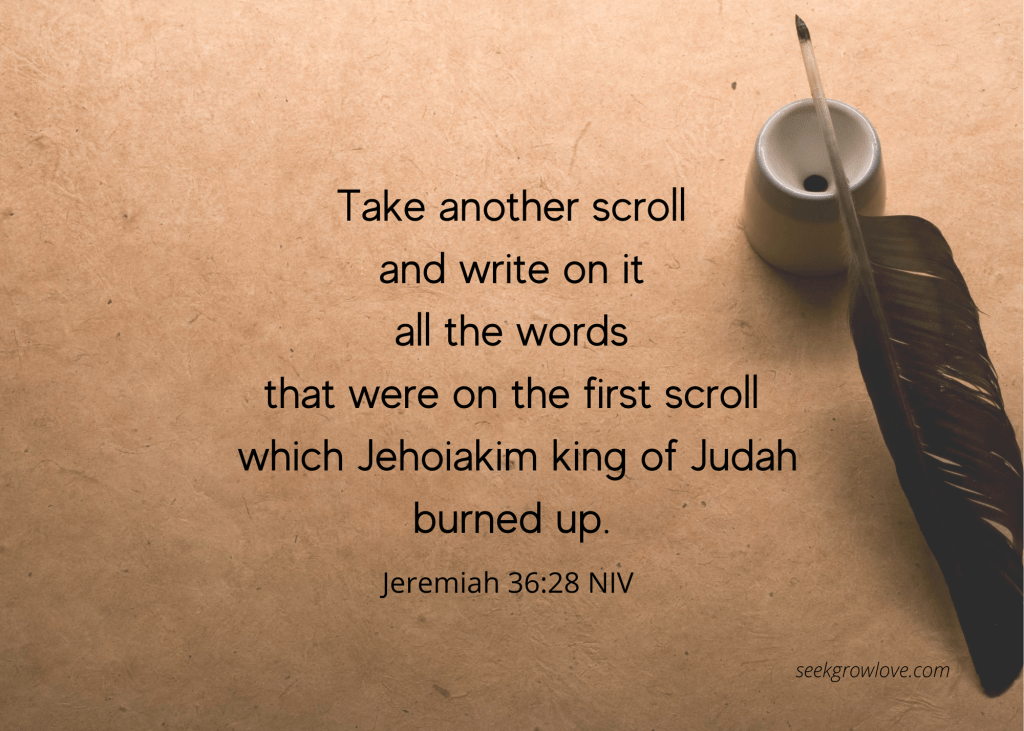
The 20 plus years of preaching hasn’t turned the hearts of Judah back to their Creator.  Maybe if it was ALL written down – would the people listen then?  God tells Jeremiah to write down all the sermons he has ever preached – every word that God has given him from the very start of his ministry.  God said, “Perhaps when the people of Judah hear about every disaster I plan to inflict on them, each of them will turn from his wicked way; then I will forgive their wickedness and their sin.” (Jeremiah 36:3 NIV).  Even though God hates the sins of His people He still loves them and wants to give them another chance to come back to Him.  And so a great project begins.  Jeremiah dictates as his scribe Baruch writes it all down.  Perhaps the people will listen.  They spend over a year writing – God has said a lot.  How will the people respond to this book that lays it all out?

Since Jeremiah’s unpopular (but very Godly) message has already had him personally banned from the temple, Baruch is sent to read God’s words through Jeremiah to the people.  One who hears it, Micaiah, realizes the importance of what has been written and he arranges a reading of it with some of the royal officials.  “When they heard all these words, they looked at each other in fear” (Jeremiah 36:16) and they arrange for the king himself to hear the words on the scroll from Baruch, Jeremiah, and ultimately God.

Here’s the king’s chance.  He can hear God’s word and repent and lead the nation into a time of Godly reformation, thus saving them from God’s wrath at the hands of the Babylonians – just as his father Josiah had done years ago.  But King Jehoiakim thinks he knows better.  His arrogance and hardened heart don’t crack.  Instead, as the scroll is read to him in his chambers, he cuts it apart and burns God’s word, piece by piece.

Can you imagine the anger and defeat and perhaps fear Jeremiah and Baruch may have felt when they heard the fate of their scroll – God’s words?  To know the utter disrespect they (and their God) had received – and how their work was violated and destroyed.  And they didn’t even have a copy saved on their hard drive.  Totally lost.  Over a year’s work, gone.  But, God’s Word stands forever (Isaiah 40:8).  So, when God tells Jeremiah to write it all down again – with an extra word for Jehoiakim – Jeremiah and Baruch get to work – and the second work is completed, more impressive than the first. And perhaps much of what we read today in the book of Jeremiah comes from this second labor of love and obedience and great persistence.

God’s Words are priceless.  Some will hear and respond and pass it on. Like Jeremiah they are motivated to live by, love and share God’s words in order to save themselves and their hearers  (1 Timothy 4:16).  But others will scoff, show no fear and even seek to destroy it.  It does not change the supreme importance and value of the words – or the God who spoke them.  Nations, kings, priests, people; past, present and future will be judged by how they respond to God and His Word.  The king who brazenly cut apart and burned the scroll paid with his life – and his children and country suffered mightily for it as well.  Jeremiah and Baruch had far from an easy life – but they didn’t give up.  They kept at it – writing, sharing, reading, speaking and living God’s Word.  They persistently worked striving to help save those in danger of experiencing God’s wrath.  Will you stand with them today and be a Jeremiah?

-Marcia Railton

Sorry we were late in sending today’s devotion out.

Today’s Bible reading passages can be read or listened to at BibleGateway.com here – Jeremiah 35 & 36 and Hebrews 9

Words Matter

Jeremiah 1-2; Psalm 90-91

This past Saturday women (and some men) gathered in front of the US Capital in Washington, DC and in state capitals across the United States to protest for women’s rights to choose to abort their unwanted babies.  One of the signs held up said “Rage, Rage Against the Denial of Your Rights”.

That’s a dangerous way to begin today’s devotions.  Some of you are likely offended or possibly even angry at me for what I wrote.  I referred to them as unwanted “babies” and not “fetuses” or “products of conception.”  Words matter.  If a person says “illegal aliens” referring to those who cross the border without proper documentation and not “undocumented aliens” we know that they have an opinion about the status of those who have entered the country.  “Illegal” sounds like a bad thing, like someone has broken a law and might be punished, whereas “Undocumented” sounds like some innocent mistake or a government slip up.  I forgot my hall pass on my way to the bathroom and so I’m undocumented.  That’s different than bringing a gun to school or taking drugs at school.  Those activities are illegal and should be punished somehow, but crossing over the border without proper authorization, that shouldn’t be illegal, right? (If your sarcasm detector is now going off then it’s working properly)

Words matter, whether you say “illegal” or “undocumented” or whether you say “unborn or pre-born baby” or “product of conception.”  If I refer to a “product of conception” that a woman has a right to dispose of, that’s no big deal.  But if I say that it’s a human baby that is alive and waiting to exit her mother’s womb, and that we are killing that baby, that sounds pretty awful.  No one wants to think about killing babies.  No one should have the right to kill babies, but every woman should have a right to dispose of an inconvenient or unwanted ‘product of conception”.

Words matter.  Jeremiah 1 wasn’t written specifically to address the issue of human life, and yet Jeremiah’s inspired words, given to him by God, are worthy of reflection and application to our context today. 

“The word of the Lord came to me, saying,

“Before I formed you in the womb I knew you,

    before you were born I set you apart;

    I appointed you as a prophet to the nations.”- Jeremiah 1:4-5

Here, God is calling Jeremiah to be his prophetic voice to the people of Israel.  Jeremiah is an integral part of God’s plan to prophecy against His people Israel for their worship of other gods.  Before Jeremiah was even born, God had a plan for his life.  While Jeremiah was still in his mother’s womb, God set Jeremiah apart to be a prophet.  This is such a rich passage and we could reflect on it a hundred different ways.  It speaks about God and his omniscience (that’s a technical term that means God knows everything).  God is able to peer into the future and see that this tiny little cluster of cells which carries in it the DNA for a male human person who  probably has brown eyes, brown hair and olive skin, will grow up to be able to speak for God 20 or 30 years in the future and be a key part of God’s plan.

This little tiny cluster of cells in that young Jewish woman’s womb would  one day be born, grow up  and go in the name of God to confront an entire nation with its rebellion against God.  

“My people have committed two sins:

They have forsaken me,

    the spring of living water,

and have dug their own cisterns,

    broken cisterns that cannot hold water.”- Jeremiah 2:13

It was this tiny pre-born human, who God would use to condemn his people because: “On your clothes is found  the lifeblood of the innocent poor.”- Jeremiah 2:34

God condemns Israel because her clothes are stained with the blood of the innocent and the helpless.  Again, in the context Jeremiah is not referring specifically to pre-born babies who have been unjustly murdered (aborted).  However, in our present context, those words have a clear application.  Who are the most innocent and helpless human beings in the world today?  It is the pre-born humans whose Mother’s don’t want to allow  them to live.  As thousands gather around the country to rage at the prospect of some states seeking to bring greater justice and defend the defenseless we must ask ourselves “How in the world did we get here?”

When God called Jeremiah it was to take a courageous stand against a wicked and corrupt nation.  Is God calling His people today to take a courageous stand?  I think so.

“Get yourself ready! Stand up and say to them whatever I command you. Do not be terrified by them, or I will terrify you before them. Today I have made you a fortified city, an iron pillar and a bronze wall to stand against the whole land—against the kings of Judah, its officials, its priests and the people of the land. They will fight against you but will not overcome you, for I am with you and will rescue you,” declares the Lord.” -Jeremiahs 1:17-19

If you, like Jeremiah, accept the call to speak faithfully for God against the current culture of death, and in doing so invite the rage of those who don’t want their right to murder unwanted pre-born human babies, then put Psalm 91 in your back pocket and carry it with you wherever you go: 

“Whoever dwells in the shelter of the Most High

    will rest in the shadow of the Almighty.

I will say of the Lord, “He is my refuge and my fortress,

    my God, in whom I trust.”-Psalm 91:1-2

The Lord be with you.

Jeff Fletcher

Today’s Bible reading passages can be read or listened to at BibleGateway.com hereJeremiah 1-2 and Psalm 90-91

Right Place. Right Time. Right Action.

Esther 3-4

Yesterday, we began to read the book of Esther. Let’s quickly summarize what happened in the first couple of chapters to bring us up to speed for today’s reading:

Chapter 1: King Xerxes, King of Persia, is having a pretty awesome party.  He is serving up an endless buffet with unlimited refills.  He has a few too many refills and calls for his wife, Vashti, because he wants to look at her. She refuses.  He consults with his friends (who might have had a few too many as well),and they decide to execute her as an example to prevent disrespect throughout the kingdom.  Buzzkill. Proclamation in Caveman Voice: Men Strong. Women Weak.  

Chapter 2:  King Xerxes decides it is time for a new queen.  Hmm. What’s a good way to pick my next wife? Personality. No. Virtuous qualities? No. Oh! Beauty contest.  Proclamation in Caveman Voice: Send Pretty Women. Enter Esther – fits the bill. Also, she’s Jewish, although Xerxes doesn’t know, doesn’t care because that doesn’t affect her looks.  Another party.  Mordecai, Esther’s uncle, uncovers a plot to assassinate Xerxes. Mordecai tells Esther who tells Xerxes. Esther trusted. Mordecai trusted. Conspirators impaled.

Have your plot uncovered and being impaled? Unfortunate. But having the car ahead of me pay for my weekly McDonalds run?  Being seated in the section at the ballpark that receives a free loaf of bread? Sitting down at a restaurant and having a meal served on the house? All of this, and more, has happened to me.  I’m a pretty lucky guy.  It seems that I find myself at the right place, the right time.  It’s either that or people just really think that I need food. Being in the correct location at a critical moment is important.  Ask anyone who has ever been late for an interview, or ended up at the wrong Starbucks. But in many circumstances, those two factors are simply not enough.   An equally important prerequisite that isn’t always taken into account (and makes the expression way too long like in the title) is the right action.  Many times you must DO something in order to take advantage of the golden opportunity that is being presented.  Just existing in a place or a moment isn’t enough.

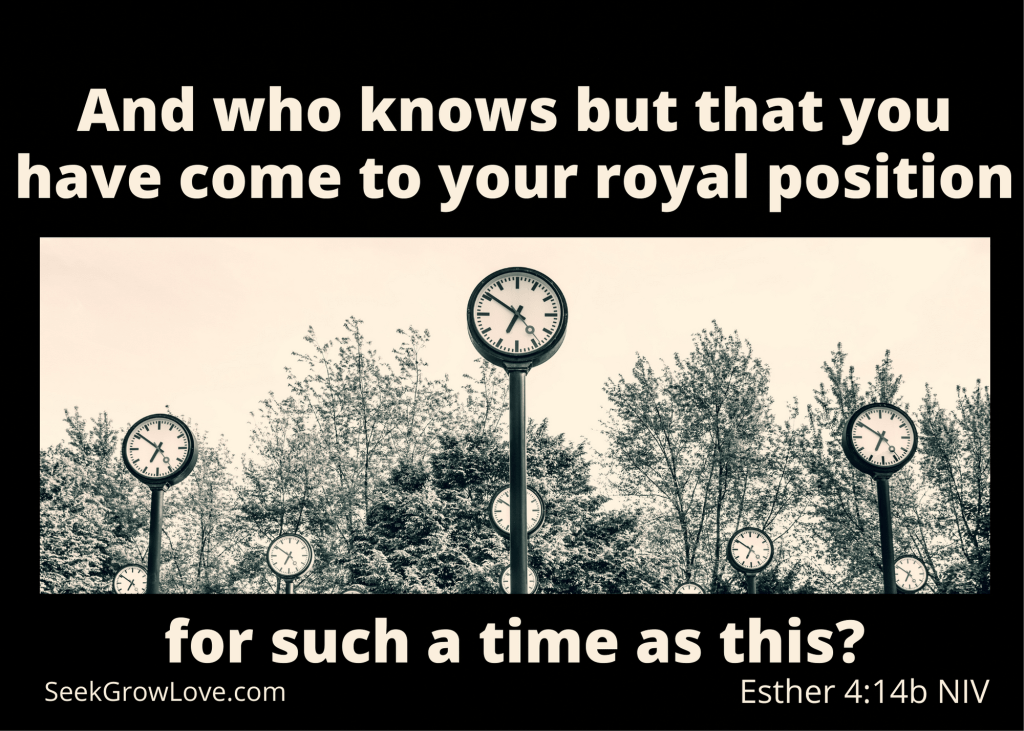
When Esther’s words were reported to Mordecai, he sent back this answer: “Do not think that because you are in the king’s house you alone of all the Jews will escape.  For if you remain silent at this time, relief and deliverance for the Jews will arise from another place, but you and your father’s family will perish. And who knows but that you have come to your royal position for such a time as this?” – Esther 4:12-14

Christians are already in some of the prime real estate for evangelizing.  Christians are in schools. Christians are in workplaces.  Christians are on TV and radio. They make TikToks and podcasts.  I would say that for most of us, we err on the side of being in the world a little more than not.  Having a presence in each of these locations, at this time in history, is not in itself a bad thing.  In a caveman voice: School good. Work good. TikTok, umn, me no say.  But when you sit on your hands and let the world continue to spin in the same way it always has, then you are in the midst of the right location, the right time, but the wrong action.  Simply being an elevated, passive Jew in the kingdom of Persia was not going to save her people from being put to death.  Xerxes, didn’t even know. Being a passive Christian in the same manner is equally reckless. They may not even know. THEY. MAY. NOT. EVEN. KNOW. This is most definitely the correct time. Heed Mordecai’s warning. You MUST become an influencer, not in a manner that will get you more clout or draw attention to yourself, but in a manner that draws attention to God.  You most definitely were made for a time such as this.

But you are a chosen people, a royal priesthood, a holy nation, God’s special possession, that you may declare the praises of him who called you out of darkness into his wonderful light…Live such good lives among the pagans that, though they accuse you of doing wrong, they may see your good deeds and glorify God on the day he visits us. – 1 Peter 2: 9,12

–Aaron Winner

Today’s Bible reading passages can be read or listened to at BibleGateway here – Esther 3-4 and 1 Corinthians 14

Overcoming your Thoughts

Reading for today:

Ezra 3-4 … 1 Corinthians 3

If you were to get the Bjorksnas dresser from Ikea with all of its 678 (just a guess) pieces, are you the kind of person who would meticulously follow the instructions or are you more of a ‘this looks about right’ kind of person?

Twice in today’s passage, Ezra records that the people returning from exile did things “in accordance with what is written”

“Jeshua son of Jozadak and his brothers the priests along with Zerubbabel son of Shealtiel and his brothers began to build the altar of Israel’s God in order to offer burnt offerings on it, as it is written in the law of Moses, the man of God.” (Ezra 3:2)

“They celebrated the Festival of Booths as prescribed, and offered burnt offerings each day, based on the number specified by ordinance for each festival day.” (Ezra 3:4)

What makes this even more impressive is what we find out in between these two verses:

“They set up the altar on its foundation and offered burnt offerings for the morning and evening on it to the Lord even though they feared the surrounding peoples.” (Ezra 3:3)

Even though they feared…

They did all these things, so careful to faithfully follow the specific instructions of their God, despite their fear. Impressive.

We’re doing a study in our Wednesday night class right now on a book about changing your thoughts, which leads to a changed life.

The place we’re at in our study currently is teaching us that at the root of any behavior that we might wish to change is a lie that we have (probably unknowingly) believed. We are learning how to identify those lies and create new neural pathways in our brains to (hopefully) eventually develop new behaviors. (If you’re interested, btw, the book is Winning the War in Your Mind, by Craig Groeschel .)

Typically, when we start to practice taking that new pathway, it can feel weird…it can feel uncomfortable…it can even feel scary. But it’s only in acting when we feel scared or uncomfortable that we are able to overcome the existing pathway and create a new one.

This scientific knowledge confirms what the Bible has told us for generations, which is that we are transformed by the renewing of our minds:

Do not conform to the pattern of this world, but be transformed by the renewing of your mind. Then you will be able to test and approve what God’s will is—his good, pleasing and perfect will.

Romans 12:2

The only way to overcome a falsehood is with the truth. And in order for truth to really permeate our mind it has to become personal to us.

Simply printing out a Bible verse and sticking it to your mirror isn’t going to cut it. Take that verse, pull out the truth as it applies to the lie you are believing and write a declaration.

Here’s what I mean:

  • You struggle with trusting God, so you decide to hang up the verse that says, “He who did not spare his own Son but gave him up for us all, how will he not also, along with him, graciously give us all things?” to remind yourself of the truth that you can trust God to take care of you.
  • Instead, consider taking that same verse and personalizing it by writing out a statement like this, “God loves me more than I love myself. He knows me more than I know myself. He has my best interests at heart and He can be trusted. If He didn’t spare His own Son, but gave Him for us all, I can trust that he will graciously give me all things as well.”
  • And then even shorten it further, perhaps, to put to memory, “I can trust that God will graciously give me all things.”

Write it. Speak it. Think it. And as you begin to practice a new behavior, rooted in truth, it may feel scary. But press through and keep at it!

Renew your mind and overcome the lies that hold you back from living the life that God intends for you to live.

-Susan Landry

Today’s Bible reading passages can be read or listened to at BibleGateway here – Ezra 3-4 and 1 Corinthians 3

The Enemy desires everything we have

2 Kings 19-20; Proverbs 14

In our previous readings, there were examples of two choices that could be made when faced with trouble. One could follow the one true God or follow their own god. Hezekiah was the king of Judah who chose to follow God, and we should too. However, Hezekiah was not exempt from later circumstances with choices to be made. The choice to follow God or not was – and is – ongoing.

At the end of Chapter 18, we see that Hezekiah stumbled. He accepted defeat from the Assyrian army after years of conquering and standing strong with his God. He gave the king of Assyria what belonged to his God (gold from the temple of Yahweh). Even after meeting their demands, it was not enough. The enemy desired everything of Hezekiah and his people. He desired their worship.

The king of Assyria sent armies to Jerusalem and surrounded it. The leader of the army told the people to accept defeat because their God would not deliver them from the king of Assyria. He went on to offer the people great things such as a land full of plentiful good food and drink. It could be theirs if only they would forsake their God.

This time (it was over the course of a few repeated circumstances with the same choice – following God), Hezekiah made the right choice. He prayed. He proclaimed the majesty of his God and asked that all would know that Yahweh alone was God. What a prayer. And then what a response from God! What an outcome! Yahweh heard and delivered.

Yet again, God prospered Hezekiah. While all the cities around him, even the northern kingdom of Israel, had been desolated and the people carried away into exile, God did great things in Jerusalem under King Hezekiah. The great things (good food and drink) that were offered to the people of Judah if they would just forsake their God and follow the king of Assyria became abundant in Jerusalem and a remnant was spared for years when they chose to follow God. Remarkable!

It is clear to me that Yahweh God alone wants our worship. He wants our hearts. When we are faced with a choice to follow him or not, he rewards those who choose him.

The people in Hezekiah’s kingdom were seeing defeat all around them. They knew what taking a stand against the king of Assyria might mean for them. The northern kingdom had starved to the point of eating their own dead children before they accepted defeat (as we read in other places, the king of Israel was told by God to surrender. Instead, he allowed his people to die). For Hezekiah’s people, having the temptation of a land full of food and drink dangling above them would have been hard to resist. Yet they did resist. In the face of temptation, they listened to their king and remained silent.   

I thought about Jesus when I read this passage and how he was led by the spirit to be tempted when he was hungry. The very last thing he was tempted with was being placed on a high mountain (maybe like the Asherah?) and given a choice to have all that he saw from that high place if he only worshipped the devil. Jesus said “Go, Satan! For it is written, ‘You shall worship Yahweh your God, and serve him only.’”

If our Lord Jesus was not exempt from temptation in his time of need, neither should we expect to be. We all have a choice to make. Will we serve God in our times of trouble? Will we serve God when tempted with pleasure or even with our basic needs? Know what Yahweh has done for his people when they choose him. “Have you not heard?” (2 Kings 19:25). In our time, he has supplied every need through our Lord Jesus Christ. Choose him! He has already won. If we follow him, we’ve won too. Pray like Hezekiah. Command the enemy to flee like Jesus. When difficult circumstances arise again, keep choosing God. Tell Satan to Go!

-Juliet Taylor

Today’s Bible reading passages can be read or listened to at BibleGateway here – 2 Kings 19-20 and Proverbs 14

Destroy the Asherah

2 Kings 17-18

There seems to be a persistent theme when it comes to the kings of God’s people. There were kings who served Yahweh their God and kings who served false gods. In 2 Kings 17-18, we are told a tale of two kings. The first king, Hoshea, king over Israel in Samaria, did evil in the sight of Yahweh God. During Hoshea’s reign, the king of Assyria came up against him. Instead of relying on Yahweh for help in the time of trouble, Hoshea sought the help of foreign aid and made foreign gods.

He set pillars up and Asherim (wooden symbols of a female deity) on every high hill and under every green tree. He served Idols and worshiped stars. He made the people pass through the fire (sacrificed them to gods) and practiced divination and enchantments.

Over and over again, Yahweh God tells Israel to turn from their evil ways and keep his commandments and statutes, but they would not listen. They became stiff-necked and vain and did what Yahweh God commanded them not to do under Hoshea’s leadership. They put their trust in other gods and did not fear the one true God. The next and last king of Israel did accordingly. As a result, Israel was carried away into exile. God removed them from his sight.

Then there was Hezekiah, king over Judah. He did right in the sight of Yahweh. He removed pillars and cut down the Asherah. He trusted in Yahweh God and clung to him. He kept his commandments. Yahweh was with him and wherever he went he prospered. While all the nations surrounding him were taken into captivity, Hezekiah not only withstood the forces against him, but conquered them because he put his trust in Yahweh God, listened to his commandments, and removed the false gods from his kingdom.

In our times of trouble, will we despise the word of God and serve little self-made gods like Hoshea, or will we destroy the Asherah of our lives and serve the one true God like Hezekiah? We are told by our Lord Jesus that we will have trouble in this life but to take courage because he has overcome the world. In response to trouble, we have two choices to make that can lead to two very different outcomes. We can create and rely on our own Asherah or destroy it and rely on Yahweh God alone through his son Jesus Messiah.

We don’t live in a day and age when most people are physically making objects out of wood to worship or sacrificing their children to other gods. We may however worship and sacrifice to other “gods” that we’ve made priority in our lives over Yahweh God. If we’re not careful, we may find ourselves making our personal lives our priority. We can pursue a self-indulgent lifestyle that involves making ourselves happy, making ourselves financially secure, and making ourselves feel safe. We can sacrifice our time, energy, and focus on all things not God. We’ve got to stop doing this if our desire is to serve the one true God.

Idols can be hidden. There was a time when God ordained the bronze serpent in the wilderness as a symbol of the coming Messiah. It was to be held high for all Israel to look upon and live in the face of death. Yet, we find in 2 Kings that Hezekiah destroys it. Why? Because it had become a symbol of worship beyond what God intended for it to be. What once represented the Messiah who brings life became idol worship.

Have we set up idols of influence in our lives “on every high hill and under every green tree” without even realizing it? Have we become stiff-necked and vain with our priorities and done the very thing God commands us not to do? If we have, there’s hope! Thank God we have repentance and forgiveness through our Lord Jesus Messiah. Identify the Asherah in your life, repent, destroy it, and rely on God. 

-Juliet Taylor

Hello brothers and sisters in Christ! I am thankful for this opportunity to write.  I am a Biblical Unitarian and have been for life (although I didn’t know we had a name until recently). I grew up attending fellowship based off of the teachings of the Way International Ministries. There were some years I spent listening to church online from Living Hope International Ministries, until I found a local church that believed like me. I currently attend Higher Ground Church, now affiliated with The Church of God General Conference. I’ve been with my home church for about 14 years and attend with my husband and two boys. 
We love Yahweh God, his son Jesus Messiah, and long to be with them in the Kingdom of God. Love to all and God Bless! -Juliet

Today’s Bible reading passages can be read or listened to at BibleGateway here – 2 Kings 17-18 and Proverbs 13