Acts 9:17 – Then Ananias went to the house and entered it. Placing his hands on Saul, he said, “Brother Saul, the Lord – Jesus, who appeared to you on the road as you were coming here – has sent me so that you may see again and be filled with the Holy Spirit.”
A few days ago, I shared thoughts on becoming sensitive to the Holy Spirit, instead of clinging tight to traditions of the Law.
And yesterday, I shared my thoughts on evangelizing.
In Acts chapter nine we have an example of a new believer being asked to do what some might describe as a dangerous mission – go visit the Jewish leader who is known to breath out murderous threats against followers of Jesus.
May I be honest? If I had been Ananias, I would have been second guessing this new gospel message and all that God was asking me to do. I may have even been tempted to just flat out disobey and tell God “no”.
Thank goodness Ananias chose to believe God and responded in obedience. Thank goodness Ananias trusted in God’s faithfulness, even when it didn’t make any sense. Thank goodness Ananias is an example we can turn to when we are also asked to do things that take us way out of our comfort zone.
Ananias is called a disciple – so it’s not too much of a stretch to think that he was a devoted man of prayer and scripture study. Ananias was most likely in a spiritual posture to notice when the Lord was speaking to him. He wasn’t so wrapped up in his daily routines that he didn’t know when the Lord called to him in a vision.
On the other hand, Saul, one who was devoted to the Law, had to be struck with blindness in order for the Lord to get his attention.
The dichotomy of how the Lord spoke to these two men is striking, but both were startling. One was approached in a vision, the other lost his vision. One was told “go”, the other was told “stop”. One had to overcome doubt and act in faith, the other had to be humbled and overcome pride.
This story of Saul’s conversion and Ananias’ part in it, shows us that God will use whatever method necessary to get us to stop and listen in order to make an impact for His Kingdom.
-Bethany Ligon
Questions for Reflection and Discussion
Have you ever done something for God that was a reach out of your comfort zone? What was the result? Would you do it again? Would you do something even more daring – for God?
When was a time God probably wanted you to GO? When was a time God probably wanted you to STOP? Ask God if He is currently calling you to GO or to STOP. Then do it.
I have noticed a common trend in people who have started their own business or way of life. One of the main motivations for them to begin was the ability to be their own boss. They can work at their own pace in their own way. They in a sense can excuse themselves from submitting to an authority above them. I am not accusing those who have done this of being sinful or doing the wrong thing. I am simply noting a human behavior that is core to us: we don’t always like to submit and sometimes our motivation to climb up in reputation or status is to excuse ourselves from the act of submission.
In light of this, I want to focus on something we see from Jesus in John chapter five. Jesus’ combination of position and attitude are profound and completely backwards to our way of operating. Who is Jesus? He is the one and only begotten son of God. He is the only man ever to live who never sinned in his life—he was quite literally perfect. He is the only man so far to have ever seen the full face of God. He is the only man who sits at the right hand of God. He is the man who is the dividing line between those who are in the kingdom of God and those who are not. So in light of this inconceivably high status and position, did he ever think he could excuse himself from submission to God? Well, let’s take a look at what he says in verse 19, “Truly, truly, I say to you, the Son can do nothing of his own accord, but only what he sees the Father doing. For whatever the Father does, that the Son does likewise.”
Here is the only man in existence who had every right to “excuse himself from submission” and do things his own way in our eyes. Yet, no one has ever submitted as completely and humbly as Jesus did. In fact, the only way he ever received that level of honor and power was through his act of submitting to Yahweh, God of the universe. Only through becoming lowly can you be raised on high!
Jesus is our Lord; what he does we must do. So, if he believes that he must submit himself completely to his Father and do only what he sees God doing, then we must submit ourselves completely to God too. Also, this act of submitting to God’s will in our life and dying to our own is not for God’s service at our expense. He is infinite, He has everything, there is nothing He could possibly gain from your service. So, what’s the point? Why submit and serve a God who doesn’t need serving? In all honesty, it is in your best interest. Submission to God is all about God but it is all for you. When a good and loving father tells his child to obey him, is it because he will benefit at the child’s expense, or is it because it’s in the best interest of the child? (I’ll give you a hint. It is in the best interest of the child.)
I encourage you to follow the example of our Lord Jesus today. He felt that he should submit himself completely to God, and we should too. Only through submission can we enter into God’s kingdom.
-Isaac Cain
Questions for Reflection and Discussion
Read John 5 looking for everything you can find out about Jesus. Who does he say he is? What does he do? What is his relationship with God and with men?
What is the danger in studying Scriptures but not accepting Jesus for who he says he is?
Jesus said he did not seek his own will, but the will of the one who sent him (vs.30). How will you follow his example and lay aside your own will to do the will of your Heavenly Father?
Choose a verse from John 5 to write out and post on your refrigerator or bathroom mirror. What does this verse mean to you?
I have a similar ailment to Naaman’s. No, not leprosy, but a pride that makes me want to be right, even sometimes to the point of thinking God (or the man of God) is doing it wrong if He/they aren’t following the step by step plans I designed. And, sometimes a pride like that leads to a bit of anger when our best laid plans are contradicted by an all-knowing and pretty creative God who also likes to witness our obedience.
So, here we have Naaman – the proud, leprous army commander of the country of Aram at the door of Elisha’s house. He had already humbled himself to listen to the captured Israelite servant girl who was sure Naaman could be healed of his dangerous skin disease if he got to the prophet of God in Samaria (capital city of Israel, Aram’s enemy). He had already secured from the king of Aram a very impressive payment (including 750 pounds of silver and 150 pounds of gold and 10 sets of clothing) for the one who could heal Naaman. He had already travelled by horse and chariot over 100 miles – first to the king of Israel (who was absolutely no help and was scared this was an enemy trap) – and now to the door of the prophet Elisha’s house.
Naaman has rehearsed in his mind how this is all going to go down. His life is about to be changed and the dreaded leprosy will be gone forever. So, he is completely caught off guard when Elisha instead of waving his magic wand (or hand) sends a servant out to him to tell him to go wash 7 times in the Jordan River which is another 30 miles down the road. 2 Kings 5:11 says, “But Naaman went away angry and said, ‘I thought that he would surely come out to me and stand and call on the name of the Lord his God, wave his hand over the spot and cure me of my leprosy. ‘” He went away angry because God’s plans didn’t match up with his. He had envisioned instant and easy healing – the wave of a holy man’s hand. He had faith it could be so – that was good. But he also had prideful arrogance that he should be the one to choose how God worked. And when his plans and God’s plans didn’t match up – then God must be wrong. God desired faith and simple obedience. Naaman had faith and a big helping of pride, arrogance and anger. Faith without obedience (deeds) is dead. He would rather live with his deadly leprosy than humble himself to obey and do it God’s way. And he walked away from the healing God had prepared for him.
Some stories tragically end this way. How devastating if Naaman’s story also ended with him angrily turning his back on the blessings God wanted to pour out on him in the dirty Jordan River. Luckily for Naaman, he had some bold and wise servants who calmly reasoned with him and convinced him to try it God’s way. And, when he had faith and obedience, he received the blessing and new life that he was searching for – because he humbled himself and did it God’s way.
God, please heal me of my pride. I don’t want my stubborn pride to get in the way of receiving your blessings. Help me to faithfully obey you, even if I had a different plan. I don’t have to be right – You are. Always.
-Marcia Railton
Questions for Reflection and Discussion
Has there been a time your plans and expectations didn’t match up with God’s? How did you handle it?
Why do you think people tend to get mad at God when they don’t understand or abide by His plan? Have you seen some angrily walk away from God and the blessings He wanted to give? What wise and bold counsel would you offer?
How do you rate your own faith and obedience? How can you improve both your faith and your obedience?
Later in this chapter Gehazi gets into trouble because of his covetousness. Explain what happens to him and why? What other sins did he commit? Has wanting what others have ever gotten you into trouble? How do we avoid the great dangers of covetousness?
As we mentioned yesterday, Elijah did what God told him to do, and did it when God told him to do it. So in I Kings 18, when God told Elijah to “Go and present yourself to Ahab, and I will send rain on the land.” Elijah went to find Ahab – even though Elijah was a wanted man. And Elijah knew that God was going to finally send rain – after a 3.5 year drought.
When they met, Elijah proposed a “God contest” to Ahab. He told Ahab to gather at Mount Carmel the 450 prophets of Baal and the 400 prophets of Asherah, along with representatives from throughout all of Israel. (The 400 prophets of Asherah declined the invitation.) Once everyone was assembled, Elijah made a speech in front of all of the representatives saying (1 Kings 18:21), “How long will you waver between two opinions? If the Lord is God, follow him; but if Baal is God, follow him.”
Then Elijah proposed a challenge. Give a bull to the 450 prophets of Baal, and Elijah would get a bull. They would build an altar, and he would build an altar. They would pray to Baal, and he would pray to Jehovah. The god that answered by fire from heaven would be the real god. All the people replied, “What you say is good.”
So the 450 prophets of Baal got to go first. They chose their bull, and built their altar. They prayed from morning until noon, but nothing happened. At noon, Elijah started taunting them, “Shout louder! Surely he is a god. Perhaps he is deep in thought, or busy, or traveling. Maybe he is sleeping and must be awakened.” So they shouted louder, and started slashing themselves with swords and spears – but there was still no response.
Then Elijah got his turn. He rebuilt the altar of God, cut up the bull, and put it on top of his altar. He then dug a trench around the altar, and had the people pour 12 large jars of water over the offering and the wood. (Remember there had been a drought for 3.5 years, so water was very precious, and this had to have seemed like a huge waste of water.) The water completely filled the trench – Elijah was giving himself a handicap. Then Elijah prayed, “O Lord, God of Abraham, Isaac, and Israel, let it be known today that you are God in Israel and that I am your servant and have done all these things at your command. Answer me, O Lord, answer me, so these people will know that you, O Lord, are God, and that you are turning their hearts back again.”
Did you notice Elijah’s reason for asking God to send fire from heaven? Was it to make Elijah look good? No. It was to show the people that Jehovah is the only true God, and to show the people that Elijah obeyed God. And ultimately, it was so the people would turn back to God.
Anyway, Elijah prayed, then *poof* fire fell from heaven and burned up the sacrifice, the wood, the stones, and even the water. When the people saw this, they fell face-down on the ground and said, “The Lord – He is God. The Lord – He is God.”
Once the 450 prophets of Baal were slaughtered, Elijah told Ahab to go eat and drink before the rain started. Then Elijah knelt to the ground and prayed for rain. He sent his servant to look out over the Mediterranean Sea to see if he saw any clouds. There were none. This was repeated. After the seventh prayer, the servant said he saw a small cloud forming. Elijah told Ahab to jump in his chariot and escape to Jezreel before the rain stopped him, so Ahab rode off. “The power of the Lord came upon Elijah and, tucking his cloak into his belt, he ran ahead of Ahab all the way to Jezreel.” – 17 miles.
In addition to Elijah’s obedience mentioned in yesterday’s devotion, in this story we see examples of his incredible faith. Would you have had the guts to confront Ahab, even though Ahab had put a bounty on your head? Elijah did. Would you have been bold enough to challenge the pagan priests to a contest to call fire from heaven to declare which god was real? Elijah did. Would you have been so bold as to tell Ahab to eat before the rain stopped him – even though the sky was still clear. Elijah did.
How could Elijah have such profound faith in God? It was because he was doing what God had told him to do. And since he was obeying God, he had complete faith that God had things under control, even when things seemed impossible. And then as icing on the cake, God gave him supernatural strength and endurance to outrun a horse and chariot for 17 miles to stay ahead of the rain.
The incredible faith, answers to prayer, and incredible endurance that Elijah experienced were all because he followed God wholeheartedly.
Wouldn’t you love to have incredible faith, amazing answers to prayer, and other incredible things happen to you too? You can – if you too choose to follow God wholeheartedly, and obey him in every way. Or are you stuck “wavering between two opinions?” If so, I’m reminded of Revelation 3:15-16, “I know your deeds, that you are neither cold nor hot. I wish you were either one or the other! So, because you are lukewarm – neither hot nor cold – I am about to spit you out of my mouth.”
Make up your mind. Completely commit to one side or the other. I’m choosing Elijah’s side – God’s side. Which will you choose?
-Steve Mattison
Questions for Reflection and Discussion
Imagine you were an observer on Mount Carmel. What sights, sounds, smells, and emotions would you experience? What would you tell others about this experience?
What other false gods and idols have taken the place of Baal today?
Can you be on God’s side – just a little bit? What will happen?
How are you doing at following God wholeheartedly? What would God suggest you change in order to follow Him better?
1 Kings 17 has so much in it, it’s almost impossible to cover it all in one devotion. It starts with Elijah standing before King Ahab and declaring that there wouldn’t be rain for the next few years, except at Elijah’s command. We need a little context for this. King Ahab’s wife was Jezebel, a foreigner, who worshiped Baal. Baal was the Phoenician fertility god that supposedly sent rain. Jezebel was actively trying to cause Israel to worship Baal, and was trying to eliminate the worship of Jehovah, the one true God.
God had made promises to Moses long before in Deuteronomy 11:13-14, “If you faithfully obey the commands I am giving you today – to love the Lord your God and to serve him with all your heart and with all your soul – then I will send rain on your land in its season, both autumn and spring rains, so that you may gather in your grain, new wine, and oil.” In Deuteronomy 28, we find the curses for turning away from God. In verses 23-24, we find, “the sky over your head will be bronze, the ground beneath you iron. The Lord will turn the rain of your country into dust and powder; it will come down from the skies until you are destroyed.”
Remember that God always keeps his word, whether it is the promise of blessing for obedience, or of cursing for disobedience. And in Israel, at that time, the country had already been worshiping the two calf idols that Jeroboam had made many generations before. Now, the Israelites were increasing their rebellion by completely turning away from God, so God sent Elijah to Ahab to punish the country, and to set up a showdown three and a half years later to prove once and for all who was the real God.
Once Elijah had delivered his message, God sent him to a ravine, where ravens brought him food twice a day, and he drank from a brook – until it dried up.
Then, God sent Elijah to a poor widow in a foreign country. Elijah asked her for some water and food. The widow told him (1 Kings 17:12), “I don’t have any bread – only a handful of flour in a jar and a little oil in a jug. I’m gathering a few sticks to take home and make a meal for myself and my son, so that we may eat it – and die.”
Elijah told her that if she baked that bread for him, after that, she could bake some for herself and for her son – because God would cause the flour and oil not to run out until the famine was over. If you were that widow, would you have given your last meal to a stranger? She did, and as a result of her faith and God’s blessing, her flour and oil did not run out – just like Elijah had said.
Eventually, the widow’s son got sick and died. Elijah prayed, “O Lord my God, let this boy’s life return to him!” And in verse 22, we read, “The Lord heard Elijah’s cry, and the boy’s life returned to him, and he lived.” Incredible!
I see several applications in this chapter to us today.
Elijah was a godly man. His name meant “the Lord (Jehovah) is my God”, and his name fits. And this was at a time when virtually everyone else had forsaken God. It’s only because Elijah was a godly man that his prayers were so powerfully answered, and that God protected him. We too need to be godly if we want good things from God.
Elijah went where God told him to go, and when God told him to go there. Presumably, God sent Elijah to Ahab. We know that God sent him to the Kerith Ravine – and because of his obedience, God provided for him. Then, after the brook dried up, Elijah didn’t go anywhere until God told him to go to Zarephath and meet up with the widow God had arranged. Again Elijah obeyed, and God provided. We need to be willing to do what God says, when he says it, if we expect God to provide for us.
Elijah experienced hardship, even though he was obviously doing God’s will. He certainly didn’t have a life of ease, but God did provide for his needs. We can expect the same.
Elijah could pray! He prayed that there would be a drought, and it happened. He prayed that the boy would be resurrected, and he was. We’re told in James 5:17-18, “Elijah was a man just like us. He prayed earnestly that it would not rain, and it did not rain on the land for three and a half years. Again he prayed, and the heavens gave rain, and the earth produced its crops.” Yes, these were incredible miracles, but God did the miracles, not Elijah. Elijah was a person just like us, but he was close to God, and God answered his prayers. If we want our prayers to be answered, we too need to be close to God.
Everything Elijah was able to do was because of his obedience to God. How do you compare?
-Steve Mattison
Questions for Reflection and Discussion
God has a way of creatively providing for those who obey Him. How did God provide for Elijah’s needs? How have you experienced God’s providence?
What was the widow asked to do to help provide for the man of God? Why do you think she did it? How can God use you to help provide for His faithful people in hard times? What are you willing to sacrifice to be used by God in this way? What do you think would have happened to her if she had declined helping and fed herself and her son first? What would have happened to Elijah?
What do you think of Elijah’s prayer life? What do you think of yours? What do you think contributed to Elijah’s prayer life? If you want to see your prayer life deepen and expand, what steps should you take? How serious are you about it?
Sometimes we have a hard time distinguishing – what is right? But God doesn’t. God is right.
In 2 Samuel 6, David was excitedly bringing the ark of the covenant, which was a physical symbol of God’s throne and sovereignty, to the royal city of Jerusalem. He wanted to honor God and set an example for the Israelites by showing the proper respect, worship and awe of God and he wanted to bring God’s presence into his holy city. This was a very good and right plan. God likes to be honored.
However, the Levites were supposed to be responsible for moving the ark of the covenant by following the law given by God as to HOW to move the sacred ark. God had earlier given rather specific directions on how it was to be moved. It was not to be touched. Covered with layers of curtain, sea cow hides, and a blue cloth, the ark was to be carried on poles stretched across the shoulders of the Levites. Generations before, God had specifically said, “They must not touch the holy things or they will die.” (Numbers 4:15). But, those rules and consequences had been given so long ago…
Rather than following God’s rules, they were doing things the way they had seen others do. They were following what had been advised and done by the pagan Philistines who had earlier captured the ark of God, been greatly afflicted because of it, and returned it to Israel on a new cart. (That is also a great account about the ark of the covenant found in 1 Samuel 5 & 6. )
So now the Israelites were moving the ark of God on a new cart, just as they had seen others do before. The oxen stumbled and the cart jerked and the ark shifted and well-meaning, but wrong, Uzzah reached out his hand to steady the ark. He died immediately for touching the holy things that God had said to not touch.
It is so much easier getting into trouble because we don’t do things the right way when we dumbly follow the example of the ungodly rather than the law of God. And it’s not just the Israelites of David’s day, it is a common problem with Christians today as well. What are things that God has said are wrong that society says are fine? And way too many of God’s people are following in the ways of the world instead of remaining firmly rooted in God’s directions for holy living? We aren’t supposed to do things the way we see others do them: lying, cheating, gossiping, divorce and remarriage, addictions, abortion, living together before marriage, one night stands, disrespecting our parents and leaders, homosexuality, course joking, hurting others, touching the ark of the covenant. There are reasons for God’s rules and they are right. He is a righteous God and there are and will be consequences for disregarding God’s right way.
At Uzzah’s sudden death, David was angry and afraid of the Lord. It seemed God was harsh and cruel. This is often what happens when a righteous God does what He says He will do when people who are wrong fail to follow God’s right way and heed His warnings.
Luckily, David doesn’t stay in this mindset. After leaving the ark behind for three months, they try again. THIS time David makes sure they do it the right way. The Levites are ready to do the job the way God had designed and instructed. There is no cart and no touching the ark. The story is also retold in 1 Chronicles 15 and there it specifically records David as saying to the Levites, “‘It was because you, the Levites, did not bring it up the first time that the Lord our God broke out in anger against us. We did not inquire of him about how to do it in the prescribed way.’ So the priests and Levites consecrated themselves in order to bring up the ark of the Lord, the God of Israel. 15 And the Levites carried the ark of God with the poles on their shoulders, as Moses had commanded in accordance with the word of the Lord.”(1 Chronicles 15:13-15 NIV)
Rather than continuing to be angry with God, David searched to see what was right. How could they fix the mistake they had made? How could they try again to do it right in the eyes of God? And God was pleased as they entered Jerusalem with the ark upon the shoulders of the Levites.
-Marcia Railton
Questions for Reflection and Discussion
In what way(s) have you followed what you have seen others do, rather than what God has directed? Have you already seen any negative consequences? How can you try again to fix the mistake and do it God’s right way instead? In nothing comes to mind, pray about it.
What would be wise to do when we find we are angry with God?
When David’s wife Michal saw David worshiping and praising God with dance (in his linen ephod – a sleeveless hip-length garment worn by those in service to God) she despised him. Why? What did God think of her reaction? Are you ever guilty of being more concerned about appearing proper and dignified and “royal” than lowering yourself to give God the praise He deserves? How are you willing to be humiliated in your own eyes (2 Samuel 6:22) in order to worship God?
Like Moses, Joshua had an opportunity to give a farewell message to the Israelite people he had led before dying. Under his leadership things have gone well. One of the greatest compliments given to a godly leader would be that your people served the Lord throughout your tenure. In verse 31 Joshua gets just that.
Joshua uses these last moments to remind (common theme in this book) the people of where they came from and what God has done to get them to the promised land. God was the sole source of their successes and their only failures were when they tried to do it on their own.
The part of his speech that gets the most attention is a challenge. After telling them all what God has done he looks out at the people and asks them to make a choice. If serving this God I have described is undesirable, then choose for yourselves this day whom you will serve. Don’t wait, waiver or wander. As for me and my family, we will serve the Lord.
It is a choice that is set out before each individual both then and now. Half commitments are not acceptable. It is a decision that we continue to make each day as we face the temptation to wander. Like Joshua, as for me and my family, we will serve the Lord.
-John Wincapaw
Questions for Reflection and Discussion
Look at Genesis 12:1-7 to see the significance of gathering the people at Shechem for these final words from Joshua.
As Joshua recounts the history of the Israelites, what part did God play? Consider your own history – where has God been at work to bring you to where you are today (both during your lifetime and your ancestors)?
What other ‘gods’ (popularity, addictions, wealth, power, affection, leisure, hobbies, security, or a significant person) have you been tempted to serve? When have you made a wrong choice?
What do you choose today? Why? What can be a reminder of your commitment?
The Israelites’ failures in the desert can be summarized simply down to disobedience. Even though God was leading the way, they stubbornly chose their own. Will the new generation do the same?
Once they have crossed the Jordan, the people have dedicated themselves to follow and obey. God quickly puts that to the test. He promises them Jericho but he tells them to take it in the most unorthodox way. He is going to show them that it will all be done by his power and not theirs.
Imagine being excited to fight for God! He has proven he is with you. You are ready to go out on his behalf and the order comes down the command chain that we are not fighting but instead we are marching. Talk about a let down. You get to come back to camp and tell everyone of your great triumphs – err, a few miles walk around a city wall. And it gets worse. They have to do it for 6 days without seeing any results.
I’m sure there was plenty of confusion and likely complaining. But on day 7, it was different. They got to walk around 7 times and wait for it, SHOUT! Talk about a warrior’s perfect picture of their first battle. I’m sure this tugged on all their desires to take this in their own hands and do what they were trained to do – fight.
They were faithful – and after the 7th trip on the 7th day, they let out a shout and the wall collapsed and they finally got to fight. Although they did not understand God’s way in the beginning or during the process, it made sense in the end. They were able to go in and take the city without loss. Had they tried any other way, this level of success was unattainable.
Most had learned that following God’s way (even when you don’t fully understand) was the best path. If interested in finding out again what happens when they disobey, you don’t have to look far, just read the next chapter.
-John Wincapaw
Questions for Reflection and Discussion
When would God have you be silent? How well do you do this? When would God want you to SHOUT? How well do you do this?
In what ways does God’s battle plans today seem crazy to a world that does not follow and obey God?
Why was Rahab and her family spared (see Joshua chapter 2)? How can we be involved in saving lives from the coming destruction?
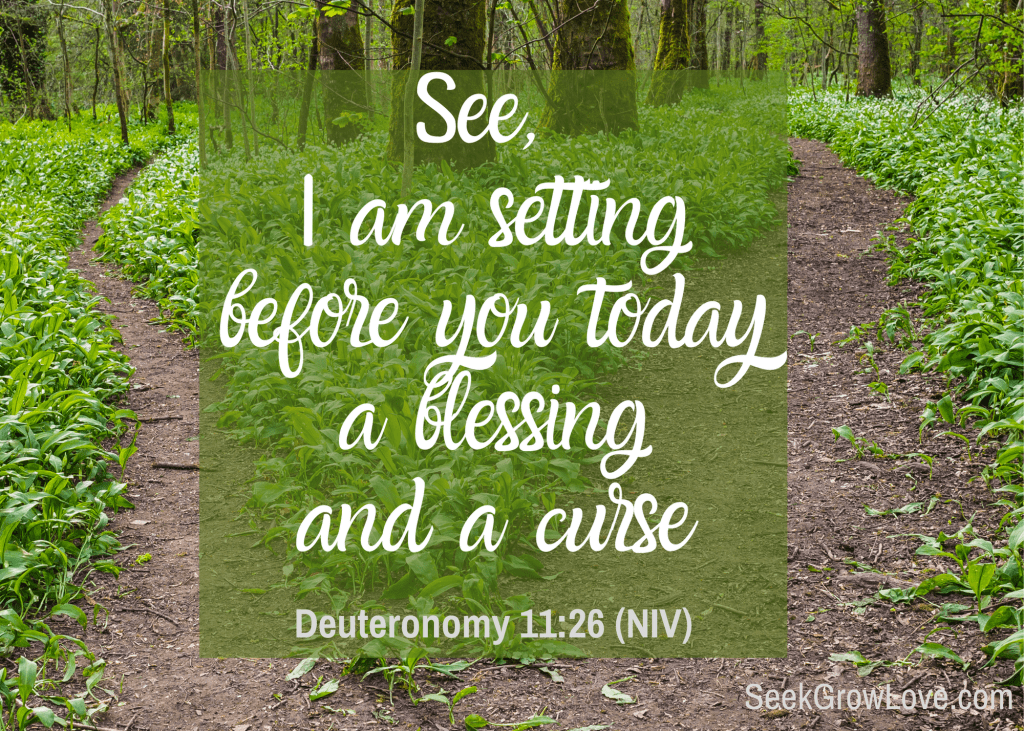
See, I am setting before you today a blessing and a curse—the blessing if you obey the commands of the Lord your God that I am giving you today; the curse if you disobey the commands of the Lord your God and turn from the way that I command you today by following other gods.
Chapter 11 is a constant reminder for obedience. We see multiple reminders to be careful – which to me shows how easy it is mess up. If we are not paying attention we can easily fall.
The Israelites are about to finally leave the wilderness and go into the land that was promised. Before entering they are given some instruction to help them not fall away like those before them. It was focused on obedience to the law and commands that were being given to them.
We often think of obedience as a restriction from the things we would like to do. But here we are reminded that God desires blessing for us and those blessings are for those who make the choice of obedience.
Obedience isn’t just knowing God or about his commands. It is making the choice to follow them. Making the choice to have them be a priority in your life. Surrounding yourself with reminders to do what is right so you are not tempted to fall away.
It is a choice! We are not forced to do anything. God did not create humans as robots. He gave us the choice to obey or not. We make a choice everyday and that choice is tied together with love. If we love God we will obey him!
Those that love God will obey God. Those that obey God will be blessed by God.
-John Wincapaw
Questions for Reflection and Discussion
When have you experienced God’s blessings for obedience?
Can you think of a time you may have experienced God’s punishment or curses because of a time of disobedience?
What have you seen of God’s power and might with your own eyes? How can you pass this along to those younger than you who did not experience what you did? Why is that important to do?
Love is one of the most powerful things in the world. You love your friends and your church, but most importantly you love your family. God is our father and he gives unconditional love to us. As we should give him this love he also shows us many times in the Bible, that love comes with boundaries and rules. The commands in Deuteronomy 6 show this. In any relationship there has to be boundaries and rules in order for it to be a healthy and loving relationship. These rules, like not putting your lord your God to the test, must be followed. Love comes with these boundaries and rules to have a steady balance. Look at the relationships you have. The love you have with certain people comes with certain boundaries and rules.
-Genesis Dylewski
Questions for Reflection and Discussion
How do you show your love for God? With your heart? With your soul? With your strength? Are there any areas of your life where you feel you should love God more? How so?
What was to be taught to the children? How? Why? How well are you passing along the knowledge of who God is, and how to love and obey Him to the younger generation? What can you do this week and throughout the year to increase your involvement and effectiveness with teaching and encouraging the children and youth in their Christian faith and upbringing? What will happen if we don’t?