For me, the theme of today’s reading was obedience in the face of fear. If God is calling us, the only right answer is obedience. In yesterday’s reading of Matthew 28, we read about the agony Jesus experienced on the cross and how he alone had to bear the crushing weight of humanity’s sins. Jesus felt fear on the cross, but that did not stop him from responding with obedience to God’s plan. In Exodus 1 and 2 we learn that Israel is becoming a formidable threat to Egypt. Pharaoh tries to minimize this threat by ordering the Hebrew midwives to kill any newborn boys right after they are delivered. The Hebrew midwives would not hear of taking part in such an abomination. They were obedient to God’s laws and the result was victorious. In Exodus 1 we read,
20 So God was good to the midwives, and the Israelites continued to multiply, growing more and more powerful. 21 And because the midwives feared God, he gave them families of their own. (NLT)
We read about more bravery in Exodus 2 when Moses’ mother kept the baby Moses hidden for three months. She then concocted a plan to place him in a basket among the river reeds. Moses’ sister Miriam hung out to see what would happen. As the story goes, Pharaoh’s daughter finds him and takes pity on him. I have to think Moses’ mother and sister had to have been afraid when they went to execute their plan, but they felt the fear and did it anyway.
I think the acts of boldness of the Hebrew midwives and Moses’ mother and sister demonstrated that they must have had a healthy and reverential fear of God as David did.
In the first two verses of Psalm 29, David highlights God’s splendor, glory, power and might.
1 Honor the Lord, you heavenly beings;
honor the Lord for his glory and strength.
2 Honor the Lord for the glory of his name.
Worship the Lord in the splendor of his holiness. (NLT)
Following God often requires boldness and not letting our fears overshadow what God has called us to do. We have a special reminder in verse 11 of Psalm 29 that God equips us during hard times:
The Lord gives his people strength.
The Lord blesses them with peace. (NLT)
If we trust in God’s goodness, we know that He has our best interest at heart and will supply us with the strength we need. Therefore, feel the fear and be obedient anyway.
-Kristy Cisneros
Reflection Questions:
Do you struggle with being obedient to God’s calling? Do you feel fear overshadows doing the right thing? Pray to God to deepen your trust. As we learned in yesterday’s reading, it is important to trust in God’s timing and goodness— even in the face of fear.
What do we learn about God and His character in our Bible reading today?
Abraham was a man of incredible faith. God made astounding promises to Abraham, and Abraham believed God – and this was credited to him as righteousness. Abraham lived a long and faithful life of service to God, then, as recorded in Genesis 25, Abraham died.
We’re picking up the story in Genesis 26 – after Abraham was dead and gone. Genesis 26 starts by telling about a famine in the land that was so bad that Isaac (Abraham’s heir) had to move to have enough food to eat.
Then we find this amazing encounter in Genesis 26:2-6, “The Lord appeared to Isaac and said, ‘Do not go down to Egypt; live in the land where I tell you to live. Stay in this land for a while, and I will be with you and will bless you. For to you and your descendants I will give all these lands and will confirm the oath I swore to your father Abraham. I will make your descendants as numerous as the stars in the sky and will give them all these lands, and through your offspring all nations on earth will be blessed, because Abraham obeyed me and did everything I required of him, keeping my commands, my decrees and my instructions.’ So Isaac stayed in Gerar.”
God promised:
To give Isaac and his descendants all these lands
To confirm the oath God has sworn to Abraham
To make Isaac’s descendants as numerous as the stars of the sky
To bless all nations on earth through Isaac’s offspring (Jesus)
And did you notice why God extended all of these promises to Isaac? “Why” is recorded in verse 5: “because Abraham obeyed me and did everything (emphasis added)I required of him, keeping my commands, my decrees and my instructions.”
Did you catch that? Isaac was promised that he would receive incredible blessings because his dad had obeyed God and had done everything God required.
A couple of years later, in Genesis 26:24, we read, “That night the Lord appeared to him and said, “I am the God of your father Abraham. Do not be afraid, for I am with you; I will bless you and will increase the number of your descendants for the sake of my servant Abraham.”
Again, God extended blessings to Isaac because of Abraham’s faithfulness.
And oh yeah, most of that obedience to God was before Isaac was even born.
We’ve heard about the blessings for ourselves if we follow God – especially eternal life in the Kingdom of God. We don’t often think of the blessings for our descendants because of our faithfulness to God.
When I was young, my dad would have us memorize scripture. One of those verses he had us memorize was Psalm 37:25 which says, “I was young and now I am old, yet I have never seen the righteous forsaken or their children begging bread.”
I think the point my dad was trying to make was that we needed to be righteous, and God would never forsake us. But I remember thinking something like this at the time: “I’m glad my dad is righteous, because in spite of my not necessarily being righteous, I will be blessed because of my dad’s righteousness.”
Now that I’m old, I recognize that the decisions I made, and the example I demonstrated had an impact (for good or for bad) on my kids. As a result, they have picked up both some of my good traits and some of my bad traits. I wish now that I had demonstrated more good examples and fewer bad examples – not only for my own benefit, but also for the benefit of my children.
Now let’s talk about you. It doesn’t matter if you’re a teen, a parent, a grandparent, young, or old. The most important thing you can do with your life is to obey God, and do everything He requires. This will guarantee you eternal life in God’s coming kingdom, and may also give you many blessings in this life (not necessarily including health and wealth). But in addition to your blessings, you may also pass along an inheritance of faithfulness to God to your kids – even those unborn. And then they too can have incredible blessings.
So, if you love your kids, obey God.
-Steve Mattison
Reflection Questions
What are all the benefits/blessings you see to obeying God? Which have you already enjoyed? Which are you still looking forward to?
How are you doing in the faithfulness department? Will God be able to tell your descendants that you obeyed Him, did everything He required, and followed His laws?
God had promised Abraham, in Genesis 17:19, “Your wife Sarah will bear you a son, and you will call him Isaac. I will establish my covenant with him as an everlasting covenant for his descendants after him.”
At this point, Abraham was over 100 years old, and had faithfully followed God. In Genesis 12, Abraham obeyed when God told him to leave his country and family. Abraham allowed Lot to take the lush land around Sodom in Genesis 13, and trusted God to provide for his own flocks and herds on barren mountains. In Genesis 15, Abraham trusted God’s promise that he would have a son in his old age, and God counted that faith as righteousness.
In Genesis 22:2, we find God commanding Abraham, “Take your son, your only son, Isaac, whom you love and go to the region of Moriah. Sacrifice him there as a burnt offering on one of the mountains I will tell you about.”
This doesn’t make sense. God had explicitly promised that God’s promises to Abraham would be passed down through Isaac’s descendants, and now God was commanding Abraham to sacrifice him – apparently destroying the promise He had made to Abraham.
By this point, Abraham had developed a very close relationship with God. In fact, we’re told 3 times in the Bible that Abraham was God’s friend (2 Chron 20:7, Isaiah 41:8, James 2:23) – and as far as I know, Abraham is the only person in the Bible of whom this is said.
We’re told in Hebrews 11:19 that Abraham reasoned that God was able to raise the dead, and that He was going to keep His promise.
So early the next morning, Abraham took Isaac and 2 servants and left for the place God told him to go. When they got close, Abraham told the servants, “Stay here with the donkey while I and the boy go over there. We will worship and we (emphasis added) will come back to you.”
As they got even closer, Isaac asked his dad, “The fire and wood are here, but where is the lamb for the burnt offering?”
Can you imagine how this must have broken Abraham’s heart, looking down into his son’s questioning face, knowing that in a few minutes he would be killing his beloved son, who would be the offering? Abraham answered, “God himself will provide the lamb.” (Actually, God had provided Isaac – as a miracle baby in his parent’s old age.) When they reached the place God had told him about, Abraham built an altar, arranged the wood, tied up Isaac, and laid him on the altar.
As he was getting ready to kill Isaac, the angel of the Lord called to him from heaven and stopped him. Abraham then saw a ram caught in the brush by its horns, and sacrificed it instead. God then promised Abraham, as recorded in Genesis 22:16-18, “I swear by myself, declared the Lord, that because you have done this and have not withheld your son, your only son, I will surely bless you and make your descendants as numerous as the stars in the sky and as the sand on the seashore… and through your offspring, all nations on earth will be blessed, because you have obeyed me.”
I could point out all the similarities of Abraham’s being willing to sacrifice his son Isaac, and God being willing to sacrifice His Son, Jesus. I could point out the significance of another quote from this chapter, “Jehovah Jireh – on the mountain of the Lord it will be provided.” (This was the mountain where Soloman’s temple was built hundreds of years later.) I could point out the importance of obeying God, and the benefits that result.
Instead, I want to comment on who, when, where, how, and why of God’s provision.
Who: God tested Abraham with a very difficult test even after a life of serving God. We see that God provided the ram in this case only after Abraham trusted and obeyed God – even though it didn’t make sense. Assertion: God provides for those who trust Him and obey Him.
When: God provided for Abraham at the very last minute, not before. We’re told in Hebrews 4:16 that we will “receive mercy and find grace to help us in our time of need.” Assertion: God provides precisely when we need something, not when we think we need it. (i.e. according to God’s timing.)
Where: God provided for Abraham only after Abraham went where God told him to go, and after he obeyed everything God told him to do. Assertion: God will provide if we are where He wants us to be. We should have no expectation of receiving God’s provision if we aren’t where He wants us to be.
How: God didn’t send an angel from heaven with an offering for Abraham to sacrifice, God provided a normal ram, caught in a normal thicket, by it’s normal horns. And God didn’t send a whole flock of sheep, just one ram, because that was all that was needed. Assertion: God will usually provide in ways that are very natural – don’t look for miracles.
Why: In times of testing, it’s easy to only think about our problems, and focus on, “why is this happening to me?” I think there may be two general reasons why trials come. First, we are told in Romans 8:28, “And we know that in all things God works for the good of those who love Him, who have been called according to His purpose.” Note that this only applies if we are living according to His purpose. Also note that trials are by definition difficult, and won’t seem to be beneficial at the time. Second, ultimately, everything is for God’s glory. Isaiah 43:7 says, “everyone who is called by my name, whom I created for my glory…” We see an example of this with God destroying Pharaoh and his army for God’s glory in Ex 14:4, 17. Assertion: God allows trials and gives provision for our good and for His glory.
The bottom line is, if we are faithfully following God, times of testing will come. If we remain true to God, if we are where He wants us to be, and if we are obedient to Him, he will provide what we need (not necessarily what we want), at the very last minute, usually through normal means – and this is for our good. If we aren’t following God, the times of testing may just be to bring Glory to Him. I’d rather be in that first group. How about you?
–Steve Mattison
Reflection Questions
Abraham’s thoughts and feelings aren’t recorded much in Genesis, what do you think he may have been thinking and feeling on that 3 day trip to where God wanted him – and after? What similarities do you find in Psalm 11?
How and when has God provided what you needed? What did you learn about God from that experience?
Is there anything that you may be holding onto too tightly, loving more than God? How can you practice trusting and obeying God and not withholding from Him?
What did God reveal about Himself to you in your reading of His words today?
Dr. Albert Mehrabian, a leading researcher in the field of body language, estimates that over half of our social communication is done through nonverbal cues. Where we place our hands and feet, how or where we choose to stand or sit, the angle at which we hold our head, or even in the position of our eyebrows communicate our desires, our emotions, and our confidence (or lack thereof). Additionally, about one-third of how we send our message is with the tone and inflection in our voice, not the words themselves. In fact, less than 10% of our social cueing has to do with our spoken word choices. The conclusion of the study is similar to the first verse of Psalm 1: where we choose to sit, where we choose to stand, and where we choose to step communicates our posture to our Heavenly Father and the world around us vastly more than words alone.
“Blessed is the one who does not walk in step with the wicked or stand in the way that sinners take or sit in the company of mockers. but whose delight is in the law of the Lord,and who meditates on his law day and night. That person is like a tree planted by streams of water, which yields its fruit in season and whose leaf does not wither— whatever they do prospers.” – Psalm 1:1-3
There is a good chance that today holds a contrast to where your feet landed yesterday. Most likely, this Monday represents a return to work, school, or some other social role you will have to step into, stand up in, or sit through. As you enter the threshold, who or what are you walking towards or away from? Where and what are you standing beside or standing in the way of? How and who do you find yourself sitting beside, dwelling with, and meditating upon? Take note not only of the words you say aloud, but the thoughts and signals you send with your body because God doesn’t want a tithe of lip service; He desires the whole of your soul as a living sacrifice.
There is a blessing for living close to the commandments of our Creator. Those who put their roots down with God are the direct recipients of the Living Water He provides. When we walk in His ways, when we stand on His promises, when we sit and meditate on His statutes, it completely changes our body language. We don’t wither, but we become confident in the hope we have. We are not empty vessels filled with cliche Christianism, but we bear the fruit of the Spirit for others to see. We can simply sit and delight in the joy of the Lord because we serve a God of promises and follow-through. Our posture, our actions, and our words stem from the refreshing source from which we draw life more abundantly. Wherever we step, stand, or sit, let the Living Water flow and the Kingdom of God flourish.
– Aaron Winner
Reflection Questions
Compare and contrast the person in Psalm 1:1-3 to the person in verses 4-5? How would you describe each and what makes them different?
Who or what are you walking, standing, sitting amongst? What do you find delight in? What are you meditating on? Are there any changes that ought to be made in order to be where you want to be at the end – of 2023, or of this life?
What do we learn about the LORD God in Psalm 1? Mark it in your margins, journal it, pray to the God of Psalm 1.
AND -in preparation for tomorrow, when we will begin a chapter by chapter New Testament reading – here’s a little…
Introduction to the Book of Matthew
Before we introduce the book of Matthew, let’s quickly contrast it with the book of Genesis and the whole Old Testament.
The book of Genesis begins the Old Testament (and the Bible). The theme of the Old Testament can be summed up in Genesis 5:1, which says, “This is the book of the generations of Adam…”. The rest of Genesis 5 has another recurring theme, “… and then he died”. The Old Testament was the story of Adam, his sin (and the consequences of that sin), and his descendants. It illustrates the truth that “the wages of sin is death” (Romans 6:23a). The Old Testament contains many of God’s promises – waiting for fulfillment.
The book of Matthew begins the New Testament. Matthew starts with, “This is the genealogy of Jesus the Messiah the son of David, the son of Abraham.” This begins the story of Jesus, and reveals “the gift of God is eternal life in Christ Jesus our Lord.” (Romans 6:23b) The New Testament describes the fulfillment of God’s promises made in the Old Testament.
Matthew was one of Jesus’ 12 apostles, whom Jesus called from being a tax collector (read hated outcast) to being in the inner circle of the Savior of the world. Many years after Jesus’ ascension, Matthew wrote the book of Matthew to convince a Jewish audience that Jesus was (and is) the Messiah – God’s chosen and anointed deliverer for His people – who fulfilled so many of the prophecies in the Old Testament.
Even though the Bible doesn’t contain anything that Matthew himself said, the book of Matthew which he wrote reveals Jesus as the Messiah promised and sent by God. May the book of Matthew speak to you and reveal God’s great gift, Jesus the Messiah, to you in a whole new way as we seek to grow in Christ together this year.
-Steve Mattison
Download and print the 2023 Reading Plan below. You can choose to follow along in 1,2 or 3 readings a day. If you read all three you will read through the whole Bible in 2023.
Forgiveness. We’ve all been there and have wrestled with this single task. Except, it isn’t a single task is it? Forgiveness happens over and over and over again. Forgiveness can be a hard concept to grasp. It is human nature to want to fall into our sinful desire to repay evil with evil, turn a blind eye to those who hurt us, or to decide that one is simply not deserving of our forgiveness. Luke 17:4 states, “Even if they sin against you seven times in a day and seven times come back to you saying ‘I repent’ you must forgive them.” I find the next verse to be so interesting as the apostles reply back to Jesus as he’s teaching and call out, “Increase our faith!” How easy is it to feel like we do not have the kind of faith that is capable of believing in the teachings we’ve learned, to feel like we simply can’t trust God in every circumstance, or that we don’t have the strength to obey God’s commandments? We are not perfect by any means, but we are able to serve the Lord and fulfill our duty even with the smallest amount of faith.
In this chapter we are encouraged to do many things: to teach little ones, not causing them to stumble or cause a hindrance to their faith, to forgive anytime you can, and to serve with all that you have so that when you return to your master you can tell them that your duty has been fulfilled. Can you imagine the great and mighty things that can be done if we take our faith, no matter how small it may be, and place it into an all powerful, all knowing God? We as humans are not strong enough to bear the stumbling blocks of this world alone. May we rely on the strength that comes from God to overcome such things to live a life that is pleasing according to God’s perfect will.
Romans 12:2
“Do not conform to the patterns of this world, but be transformed by the renewing of your mind, that you will be able to test and approve what God’s will is– his good, pleasing, and perfect will.
– Kayla Elwell
Reflection Questions
Is there currently somebody you need to forgive? Do you feel like you need an increase in faith to do what Jesus has told you to do? What would Jesus say? (Check Luke 17.)
As today is Christmas Eve, consider the faith of those in Luke 1 & 2. Whose faith is an example for you to follow? Whose faith fell short for a time?
Have you ever tried reasoning with someone who just doesn’t get it? After reading Malachi that’s exactly how I felt. At this point the temple is built and the Israelites are settled back into their traditions and way of life. They are now waiting for the prophecies of their Messiah to be fulfilled. But with this wait and settling in came the return of sin, doubt and once again a disconnection and separation from God.
The Israelites began to sacrifice improper animals, they were withholding tithes, they were marrying outsiders, they weren’t obeying and honoring the covenant they had with God. With all this corruption going on they refused to see themselves as the problem. Instead they put the blame on God questioning his very love for them (Malachi 1:2) . Almost desperately God points the finger back at them, reminding them of his great love and his promise of a Messiah. He urges them to take responsibility for their actions and remember to obey the covenant they have with Him.
I found it interesting that the last book of the Old Testament left me with a feeling of desperation. You felt the need for the Messiah and I almost couldn’t wait for him to come, then I realized: wait, Jesus did come! Today we have a new covenant with God, one that is fulfilled by grace through Jesus Christ.
I hope you get it.
-Elleigh Dylewski
(originally posted for SeekGrowLove -then named Grow16 – on April 26, 2017)
Reflection Questions
Verse 13 of Malachi 3 says: “’Your words have been arrogant against Me,’ says the Lord. ‘Yet you say, “What have we spoken against You?’” Have you heard others (or yourself) speaking arrogantly against God? Are there still some who don’t recognize this as an offense to God?
What other offenses are being done against God – in Malachi 3 and today?
While deciding what to write for each day this week I was quite confused about the second chapter of the prophet Nahum. The book at face value is a prophecy of a military assault on Nineveh. Verses one and two call the people of Nineveh to battle. Verses three through seven go through the visions of the battle. Using phrases like “Chariots rage in the streets” and “The palace is dissolved” or my personal favorite, “They run like lightning.” Close to the end of this section is the phrase “She shall be led away captive.” Nahum saw the outcome of the battle and knew that Nineveh would eventually fall to the hands of this mighty army. In verses eight through twelve, is the prophecy of Nineveh crumbling and being looted after the war. “Take spoil of silver! Take spoil of gold! There is no end of treasure, or wealth of every desirable prize.” Nineveh was seriously gone.
“I am against you,” declares the LORD Almighty. “I will burn up your chariots in smoke, and the sword will devour your young lions. I will leave you no prey on the earth. The voices of your messengers will no longer be heard.”
That was Nahum 2:13. The direct quote from God, the LORD Almighty, was that he was against Nineveh. While reading a commentary about this, the author quoted Romans 8:31 “…If God is for us then who can stop us.” The author followed it up with the question “If God is against you, who can be for you?”
This small chapter of the Bible is one that may not be entertaining at first glance but there at the end, ask yourself the question; “Would God have a reason to be against me?”
Pray for discernment of all things in your life, and repent. Get right with what rules God has laid out for us to follow, so that God will be for us.
-John Evans
APPLIcation
Really, ask yourself the question, “Would God have a reason to be against me?” Pray for discernment, examine yourself and repent.
Are there any of God’s rules that you need to work a bit harder at following? Which ones
How would you answer question 1 in light of Romans 3:23? What does Jesus’ sacrifice for your forgiveness mean to you? Does this mean you can sin now?
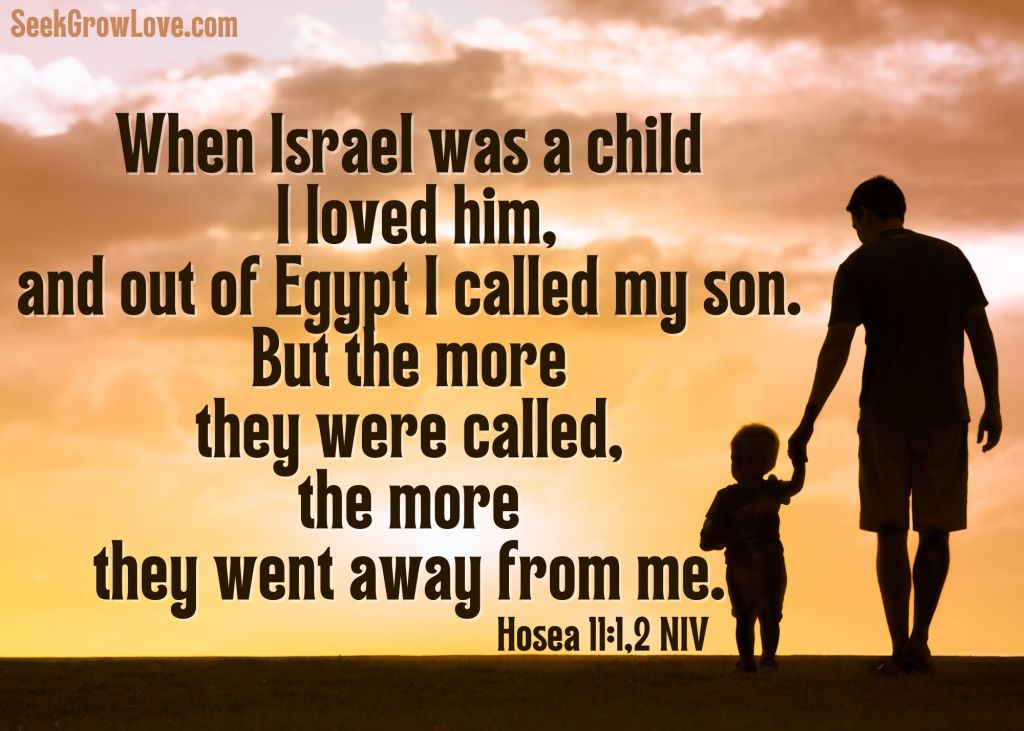
I was touched by the beautiful imagery of the LORD calling to Israel as a child. Teaching him to walk and taking him into His arms. Here the LORD is also leading with kindness and bonded to His people in love. And I can just imagine a compassionate care taker releasing an animal from its burden-taking off the bridle and bit to allow the animal to freely eat and drink. The love and compassion of God are so evident in these passages. But Israel’s obstinance is also evident. These collections of poetry are calling out again to the people. Turn to God, do what is right and be saved. God desires for people to come to Him to be healed, forgiven and saved, but as we have seen over and over, the people continued to reject Him.
We are told what the result is, “Because there is no faithfulness or kindness or knowledge of God in the land. There is swearing, deception, murder, stealing and adultery. They employ violence, so that bloodshed follows bloodshed. Therefore, the land mourns, and everyone who lives in it languishes (4:1-3a)”. It is disturbing that this scripture could be describing parts of our own country today. But the poetic words of the prophet Hosea still speak through this book. Telling us about the LORD’S perfect character and His justice. We still hear a main theme of not rejecting, but accepting and remaining faithful to our God. How horrible to become stubborn and self-willed against the Only True Living God. That is a place that we never want to occupy. Unfortunately, I know that we could name some individuals who have turned away and have chosen lives that are in complete opposition to God. But we want to be those that faithfully hold to God. Hosea 14 describes it this way, “Whoever is wise, let him understand these things; Whoever is discerning, let him know them. For the ways of the Lord are right, and the righteous will walk in them, but transgressors will stumble in them (v.9)”. Hosea explains that someday the sons of Israel will return and seek the LORD their God; they will come trembling to the LORD and to His goodness. It is incredible that we can know, walk with, and most of all be in a loving relationship with Him right now.
-Rebecca Dauksas
Reflection Questions
How is your nation like Israel? How are they different from Israel? How are you like Israel? How are you different from Israel?
How would you describe God as a parent?
How will you respond as His child? When have you been rebelled against Him? What is His desire for You?
In Isaiah 40 we talked about how God provides comfort in our seasons of trouble, but we can also see God’s comfort here in Jeremiah 18. Here in this chapter, God tells Jeremiah to go and watch a potter in his house, and what he sees is this.
Jeremiah 18:1-4
“This is the word that came to Jeremiah from the Lord: “Go down at once to the potter’s house; there I will reveal my words to you.” So, I went down to the potter’s house, and there he was, working away at the wheel. But the jar that he was making from the clay became flawed in the potter’s hand, so he made it into another jar, as it seemed right for him to do.”
God then says to Israel, “Can I not treat you as this potter treats his clay?… Just like clay in the potter’s hand, so you are in my hand.”
The comfort comes from the hope that God is our potter. He can make something new out of any situation we may be in.
In some seasons of life, we may feel like we are broken and there is no coming back from that brokenness. But there is newness in the clay. That brokenness we feel is fixable, and God will make something new out of that brokenness.
Now when God is telling Israel this in Jeremiah 18, he means it in a different way. In this time Israel was disobedient of God.
God says in Jeremiah 18:7-8
“At one moment I might announce concerning a nation or a kingdom that I will uproot, tear down, and destroy it. However, if that nation about which I have made the announcement turns from its evil, I will relent concerning the disaster I had planned to do to it.”
This passage was as much a lesson for individuals as it was to Israel. Listen to God but know that he will make new beautiful things out of broken things.
-Hannah Eldred
Reflection Questions
What does it mean to you that you are the clay and the Lord God is the potter?
Have you seen a time in your life (or the life of someone else) when God turned a marred pot into a work of art and function? What was the best part of this transformation? Was it easy or still a bit difficult to be the molded clay?
What can be learned at the potter’s house about God’s discipline?
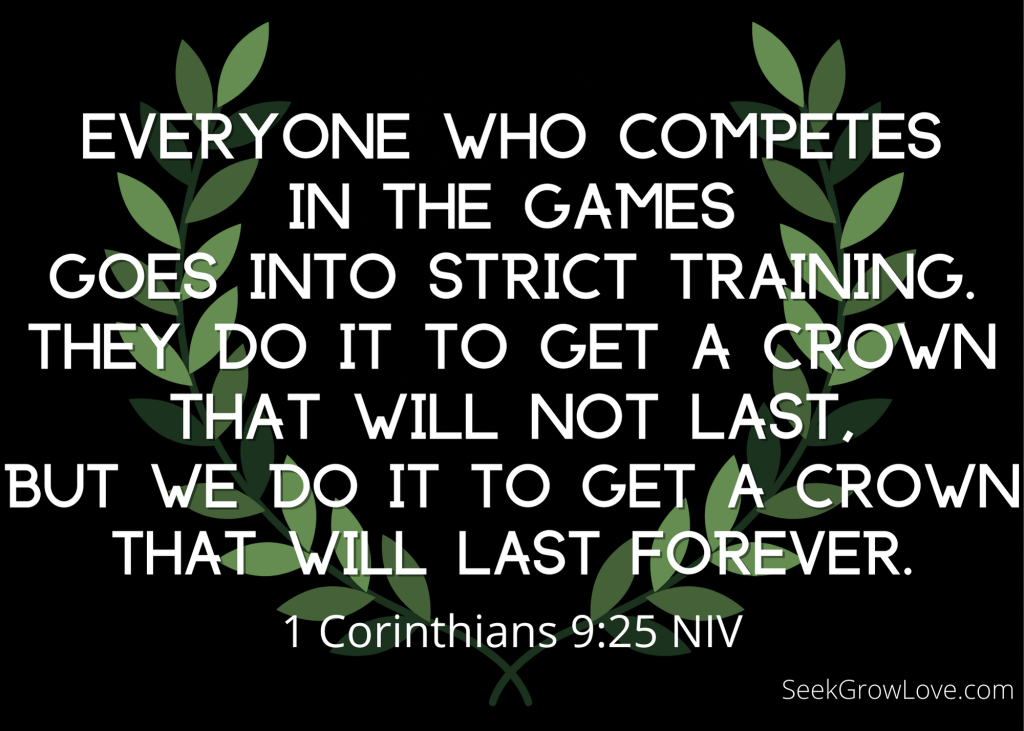
Do you not know that in a race all the runners run, but only one gets the prize? Run in such a way as to get the prize. (1 Corinthians 9: 24)
Being competitive is sometimes presented in a negative light. Probably because competition can bring out the ‘jerk’ in people. That’s too bad, because in his letter to the Corinthians, Paul is telling them (and us) to lean into that competitive spirit.
Paul is using this as an analogy, by the way, he’s not telling us that we are in competition with other believers. He uses two phrases that I hope will inspire you as you run your race.
“strict training”
Athletes preparing for a big competition don’t eat whatever they want and binge Netflix all day. What do they do instead? They do things that will help them succeed in their goal. (Winning!) Paul’s goal, and ours, is “a crown that will last forever.”
How do we train for eternal life?
The word obey comes to mind. In order to obey we need to really know Scripture. If we want to hear the words “Well done, good and faithful servant,” we need to know what the Master expects of us. And we need to do it, even when it’s hard. Just like the athlete in training gets off the couch and goes to practice, even when he’s tired, we need to obey even when it doesn’t make sense to our human sensibilities.
“do not run aimlessly”
If you’ve ever been to a kid’s sporting event, you know that there are players that do not have their head in the game. They are wandering around the field, chatting with friends, maybe even picking flowers in the grass. Adorable.
Not so adorable when it’s adults in an Olympic competition and not cute when we’re talking about forever.
So many of us say that we are sharing our faith by the way that we live our lives. But how much of that is a cop-out because we’re not comfortable evangelizing? If we are actively sharing our faith through our life, we will be intentional in planning ways to do it. We won’t just be going about our life, wandering aimlessly along.
I encourage you today to make a training plan. How are you getting ready for Christ’s return? I also encourage you to make a game plan. How are you looking for ways to share your faith with those around you?
-Susan Landry
(Editor’s Note: Sorry this was sent out later today. It’s been fun hearing from a variety of writers this week, but today’s scheduled writer ran into a health issue and was unable to write. So, we went back in time and found this great devotion from 2019 – thank you, Susan – definitely good enough to read again. God bless you as you Seek, Grow and Love!)
Questions for Reflection and Discussion
How often do you remember that you are training for a crown that will last forever? If we remembered this more often how might it change our hearts, our schedules, our free time, our priorities, our training routine? What could you do differently this week, remembering the goal of your training and perhaps making it a little more “strict” than it has been lately?
Are there any ways in which God may say you have been running aimlessly? What adjustments do you think Paul would suggest? Are you willing to do them?