Where is the darkest place you have been? So dark, you were scared to take a step? The most difficult place you’ve been? So difficult, you doubted? When have your dark, difficult, trying circumstances caused you to doubt what you previously knew to be true?
You are not alone. John has been there, too. Sometimes referred to as John the Baptist or the Baptizer for his message of repentance and baptism, John had faithfully worked for years. Known for his simple lifestyle, his ministry was not about him – but about the one who was to come – the Messiah. He had prepared the way for Jesus’ entrance. He had not taken the easy road. He had not backed down from authority. He continually stood for what was right and true – even when it landed him in prison. The ruling Herod and his wife didn’t appreciate John speaking out against their unlawful marriage.
With his ministry and freedom taken from him, and his future in question, John had a lot of time to think in the darkness of his circumstances. Why? What if…? Was it worth it? Was this supposed to happen? Had he been right? Or wrong? We don’t know all the questions John asked in his prison cell. But, we do know the most important one. The one he needed an answer to. He sent his disciples to ask Jesus, “Are you the one who was to come, or should we expect someone else?” (Matthew 11:3)
And Jesus answered. Restating the truth that John needed to hear again. Pulling up Old Testament scripture from Isaiah and giving evidence of how his own ministry lined up with what had been foretold: the blind see, the lame walk, the leper is cured, the deaf hear, the dead are raised and the GOOD NEWS is preached to the poor (Matthew 11:5).
In our dark days and when we question what we knew to be true, we would do well to return to Jesus. Tell me again, Jesus. Give me proof of who you are. Read again who he is, what he has done, what he taught, what he did for me. The story of Jesus never gets old, but we do need to be reminded of what we know. And then we have the beautiful opportunity and mandate to tell others of what we have seen and heard.
In the rest of this chapter (as well as the previous one) Jesus demonstrates that following him can be hard. People will criticize everything – our job is not to make people happy. There will be many unrepentant people (and cities) who do not accept the work that Jesus has done for them or the path that Jesus has laid out. Don’t be swayed, know that judgement will come and make sure you are on the right side. Stay close to the one who knows and reveals the Father. Jesus, the Son of God, is the only way. Work with him. Stay attached to Jesus. Take his yoke upon you (Matthew 11:29).
-Marcia Railton
Reflection Questions
Who is Jesus? Do you know that he is the one who was to come? How do you know this? What is the value in reading the Old Testament? What is the value in reading the New Testament?
What is repentance? Why is it important? Without it, what will happen? (Matthew 11:20-24)
What do you learn about God in today’s reading? What do you learn of His Son?
Yes, indeed. You can be guaranteed, God sees (you can review yesterday’s devotion if you missed it). For many people in innumerable situations across the centuries, the fact that God sees has given reassuring peace and comfort. The oppressed, the grief-striken, the helpless, the victim, and the fatherless have all been introduced to the God who sees and His Son who changes lives.
In today’s Psalm 11 it even records, “He observes the sons of men; his eyes examine the sons of men. The LORD examines the righteous.” (Psalm 11:4b, 5a NIV). He examines the righteous – that’s much more than a casual “see” and walk on. It gives me a picture of a kind, thorough, knowledgeable doctor. He has listened to your list of ailments and what you hypothesize might be needed but his careful examination will reveal the true issues and in wisdom he will prescribe and deliver what you really need at just the right time. “The LORD examines the righteous.”
It is a comforting first half of Psalm 11:5. The verse doesn’t end there. We are reminded that it is not ONLY the righteous God sees. And when he sees the unrighteous – he also takes action. “…but the wicked and those who love violence his soul hates. On the wicked he will rain fiery coals and burning sulfur, a scorching wind will be their lot. For the LORD is righteous, he loves justice; upright men will see his face” (Psalm 11:5b-7 NIV).
God sees.
God examines.
God acts.
God loves justice.
In our Genesis passage we see God seeing Sarai and Abraham. He has been promising that Abraham will be the father of many descendants, a great nation and kings. But they are old – with no child of their own. Sometimes it’s hard to keep believing that God sees. God reminds them, “Is anything too hard for the LORD?” (Genesis 18:14 NIV). Sarai tries to get away with a little lie – saying she didn’t laugh at the crazy idea that within the year she, an old woman, would have a baby. But God sees even the little laugh. He examines the righteous (not the perfect – but the righteous). Don’t try to fool the all-seeing God.
Then the story turns…to God preparing to visit Sodom, a city full of sin . He has heard of their wickedness. Is it time for Him to act? Is it time for justice? We will have to see tomorrow when we read Genesis 19. But, if you want a little hint, recall what the Psalmist said regarding what God will do to the wicked: he will rain fiery coals and burning sulfur. Even in our Matthew passage, where Jesus is preparing his disciples to go out into the towns of Israel, knowing full well that many will not accept them or the message they bring, he references Sodom and judgment.
God does see.
It is reassuring to the righteous.
It is judgment for the wicked.
What does He see in you?
He isn’t fooled. He sees. He examines. He loves justice.
-Marcia Railton
Reflection Questions
What does God see in you? What might His examination reveal are your true ‘health needs’ to be addressed, and the remedies He is offering? Are there any areas where you have been trying to lie to God?
Matthew 10 is one of those chapters you could read every day for a week or more and still find new insight. Jesus is preparing his disciples to share the good news of the kingdom in a world that sometimes/often rejects it. What is helpful for you to hear from Jesus? Are we to just give up and keep silent if the world rejects the message?
In today’s Scripture reading you see God is ________.
Mistaken identity. Incorrectly thinking you found or recognize someone. It makes for a funny sitcom, dramatic court scene or suspenseful spy thriller. But in real life – and specifically when dealing with eternal life – it’s not the best time to realize – you don’t really know who you are dealing with. There is a lot of that going on in Matthew 7:15-23. Now’s a good time to go click the Matthew 7 link above and give it a read if you haven’t yet. Don’t trust my words – I might not be who I say I am, but the words of God are always true and here in Matthew His Son, Jesus, speaks words that are trustworthy and accurate and when acted upon can even save your life/house from destruction in the storm (Matthew 7:24-27). Give it a read.
Its a great chapter with a lot of wisdom – too much for one devotion. Last year I happened to be writing about this chapter in January as well and I was drawn first to “Do not judge…” This week the picture that sticks in my brain is Jesus on THAT day (THE day of judgment) when all will be seen clearly and Jesus effectively sorts out all cases of mistaken identity. Jesus gives the example of those who call him, “Lord, Lord” – but are NOT allowed to enter the kingdom. He even says there will be MANY who call him Lord AND who prophesy (speak) in the name of Jesus, drive out demons and perform miracles – who will NOT be given access to the kingdom. These are not “name only Christians” who only come to church on Easter. These are the ones leading the service! It seems everyone would be quick to call them Christians. But what everyone thinks about these “Christians” won’t matter on judgment day. Jesus sees. Jesus knows. He isn’t fooled by a sheep costume.
How can we tell we aren’t being mistaken about their identity? Is that a sheep? Or is that a wolf? Sometimes it is hard to know. It appears to me that perhaps many of them don’t even know! Did those wolves really think they were the sheep, doing all the right sheeply things? Will they be totally surprised when Jesus denies them entrance to the kingdom? I am guessing the answer is yes for many.
What about me? If I could be wrong about them, and they could be wrong about themselves, could I be wrong about myself? How deep does this mistaken identity problem go? How can I tell? I don’t want to wait until THAT day to find out I was wrong! I don’t want Jesus to block my entrance to eternal life. I don’t want Jesus to call me an evildoer and say that he never knew me. I want to be known by Jesus on that day. So what do I do today?
Jesus tells us. He says it’s not enough to call him Lord and brag about an impressive ministry checklist. Instead, we must be doing the will of His Father in heaven. Am I doing God’s will? How will I know? He’s not just looking for a lot of boxes checked off – that didn’t work. What does He really want from me? What is His will?
Anytime you are sincerely trying to give someone what they want – a birthday present for a family member, a job well done for a boss, or a surprise for a friend – the more you know about the recipient the easier it is to know what they want. Similarly, the more we know God the easier it is to know what He wants, what His will is, and what He doesn’t want. And the best way to get to know God is spending time with Him – seeking Him in His Scriptures, reading His words, speaking to Him in prayer, building a relationship that goes far beyond a checklist.
Don’t be wrong about who God is and what He wills. Seek Him today. Seek Him today and every day from now until THAT day.
Dear God, I pray, reveal yourself to me. Please show me who you are and what you want. I don’t want to be wrong about You and Your Son and Your Kingdom and Your Will. Help me to know your will and do it. I want to be known by Your Son, today and on that day. Help me be pleasing to You.
-Marcia Railton
Reflection Questions
What is your favorite part of Matthew 7 today? Why? How can you act upon it (hear these words and put it into practice – vs 24)?
How can you guard against cases of mistaken identity? What should we look for in determining if one is a true sheep?
What do you learn about God in your reading today? How can you use this information wisely?
We are a week into our Bible reading plan for 2023. What are your thoughts so far? I have enjoyed reading Scripture and searching for what God is revealing about Himself in the words He inspired the authors to write. Previously, I have most often looked at the Bible as an instruction manual for life, and as such it is extremely valuable. I, for one, need a good bit of direction in my life! And while there are a lot of instruction manuals out there, I want to use God’s directions rather than the world’s. But I am realizing His words are so much more! They allow us the privilege to know God – really KNOW Him. What He likes, what He doesn’t like, what He IS like, what He does, what He doesn’t do, what He will do, what He desires, what thrills Him, what makes Him angry, what He plans, what He promises, what He controls, what He doesn’t control, even if He could. These are the things you would want to know about someone if you were considering entering into a serious relationship. It goes much deeper than knowing a name, a pronoun and 6 descriptive adjectives and thinking that we now know that person.
So, why is it important to really KNOW God? I am reminded of a very sad passage in Romans. It begins by saying all men should know there is a God because of the works of His glorious creation. Yes, we should. But, we know of too many who don’t. What went wrong? “For even though they knew God, they did not honor Him as God or give thanks, but they became futile in their reasonings, and their senseless hearts were darkened. Claiming to be wise, they became fools, and they exchanged the glory of the incorruptible God for an image…Therefore God gave them up to vile impurity…For they exchanged the truth of God for falsehood, and worshiped and served the creature rather than the Creator, who is blessed forever. Amen.” (Romans 1:21-25 NASB)
So many today have been at a point where they would say there is a God, but because they didn’t honor Him or give Him thanks, it was easy to turn their backs on Him and become fools and be given over to sin and judgment. When we SEE God for who He is and really KNOW who He is, the true response is honor and thanks. We can not give an unknown being genuine honor and thanks. The best list of rules won’t save us. If you don’t have a serious relationship with the author of the best instruction manual in the world, the words will be lost, neglected and even despised. It is time, for us and our children, to get to KNOW God Almighty – so we will honor Him and give thanks and be serious about our relationship with Him.
So, that’s one reason I am enjoying getting to know the author of this great instruction book more and more. In our Old Testament readings we are just finishing with the events of Noah’s life. What did you learn about God from Genesis 6-9? There isn’t one set of correct answers. But some of the things I jotted in my journal over the past few days include:
He feels pain – He sees evil in His creation.
He plans destruction of evil – but He still sees and gives favor to those who walk with Him and are righteous.
He is detail-oriented, gives precise directions that work well. He’s a good ship designer (that means He’s smart).
He creates covenants to save.
He saves families.
It happens as God said it will. He is trustworthy and true.
He controls the floodgates and springs. He controls the animals. He controls the winds. He is powerful.
He blesses with fruitfulness and children.
He gives plants and animals to eat.
He made man in His own image (How many times will we read this – how many times will we ignore it? Trading the truth of the creator was part of the lie spoken of in Romans. I think that makes it important. Thank you God for making us in Your image – you are incredible to make us – and super generous to make us in YOUR image!)
He will demand an accounting for the life of men. He values life, every life.
He makes covenants. He remembers His covenants. He created the rainbow.
If you haven’t tried it yet – I encourage you to give it a go. Read at least one of today’s passages, searching for what you can learn of God. What is He like? What does He like? What did He do? What will He do? It will give you reason to give Him glory and thanks. It will prepare you for a serious relationship with Him – for all eternity.
-Marcia Railton
Reflection Questions
What’s in it for me? What are the benefits to having a serious relationship with God, rather than just agreeing that there is a God out there somewhere?
Do you believe God created you and the world? Does it matter?
If you’ve tried it – what did God reveal about Himself in your reading so far this week, or today? If you haven’t tried it yet – now is the time. Ask Him, God – what do you want to show me about yourself? And then dig in, seeking Him. When He shows you a bit of Himself, how will you express your honor, glory and thanks?
In some circles, to say you don’t like the beach is blasphemy. What?!?! You don’t like the sea? the sun? the sound? the sand? I do. I like them all individually, but something about the collection of all those things alongside the umbrella, towels, bathing suits, etc. just isn’t my thing. Sorry if I have offended you. Don’t worry, more offense to come. This is why I have never understood why people want to live along the coast, especially in the Southeast United States. Year after year, hurricanes pound the Gulf and Atlantic coastline one after another. The scenes of destruction are played over and over again, with very few structures standing after the wind blows, the rains come down, and the surge amasses. However, in the age of technology, there is most certainly time to prepare for the storm. Days and sometimes weeks out, the predictions come and the readying begins. The evacuation notices go out, priorities are readjusted, the search is on for the supplies needed, windows and doors are boarded shut, and then you must wait. None of these actions stop the storm from coming, but they will assure you will see the other side of it.
Unfortunately, not every challenging life circumstance comes with an evacuation warning, but there are sometimes when we can anticipate the storm. It may be a move to college, rearing your children through their teens, a long battle with an illness, or even some pleasant “storms” like marriage and the welcoming of an infant into the world. When we know the season is coming, whether it is forty days or a hundred years away, the examples of Jesus Christ and Noah tell us we should prepare for the moment we are called to. There may be testing, trials, temptation, frustration, and outright rejection, but we can ready ourselves with the tool God has called, the word of God, an ark, or a cross for whatever is in the forecast.
“Jesus answered, “It is written: ‘Man shall not live on bread alone, but on every word that comes from the mouth of God.” – Matthew 4:4
“Noah did everything just as God commanded him.” – Genesis 6:22
In Matthew 4, Jesus takes a getaway to catch some sun and put his feet in the sand, but it is far from a vacation. He is led to the desert by the Holy Spirit to prepare for His ministry. He denies himself food and water, to be focused solely on God. The spiritual discipline of fasting can take many forms, but it is traditionally done with the things we cannot live without: food and drink. Imagine for a moment if you committed to fasting for a single day. If you found a place physically removed from your demands, how much time could you spend focused on preparing yourself for God’s calling? Depending on how much you scan your pantry, the amount of food prep involved, and how well you chew, it is possible to gain a couple of hours. Where else could you gain a similar amount of time? Could you lock away your phone, remote, or computer for a day and read scripture during your unwinding time? Could you deny yourself an hour or two of sleep once a week to get up and pray? While literally impossible to make every day a fasting day, it is the practice of someone who is preparing to weather whatever spiritual or physical battle is coming their way. There is no doubt that the rain is coming for you. The flood is rising to meet you. Are you putting in your hours on the boat? Are you making time to fill your mind with the Word of God? If not, adjust your priority, and get rid of even physical necessity. Reinforce all the openings with His Word. Make sure to make God the first thought or the only thought through fasting sooner rather than later and frequent rather than seldom. And the house on the Rock will stand firm against any squall long after the storm subsides.
“The rain fell, the torrents raged, and the winds blew and beat against that house; yet it did not fall, because its foundation was on the rock.” Matthew 7:25
-Aaron Winner
Reflection Questions
Who did the tempter recognize Jesus as? What three things did he tempt Jesus with? How did Jesus respond each time? How do you respond to your temptations?
How did Jesus prepare for the storm? (Matt 4:2,4) How have you previously prepared for storms (if at all)? How can you try the Jesus method?
What are some similarities, and differences, between Jesus and Noah: their characteristics, their focus, the world around them, the task before them, etc…
What do we learn about the God of Jesus and Noah? Is He interested in more than making you happy and comfortable (removing storms)? How does He provide and empower you to weather the storms?
Cheese. If I had to pinpoint a single food that will assure tossing and turning, vivid dreams, and even a bit of snoring, all it takes is a serving size before bed and a restless night is almost guaranteed. Nevertheless, if cheese alone caused distress in my sleep, it simply would take some discipline in my diet to cure this issue. My resting is subjected to more interruptions. The rumblings of my mind often disturb the counting of sheep more than the rumblings in my gut. Thinking about the stresses of work, school, family or reliving the failings of my day can be the late night double feature playing inside my head. Without the perspective that comes from God, it is hard to find rest.
“Then the Lord said to Cain, “Why are you angry? Why is your face downcast? If you do what is right, will you not be accepted? But if you do not do what is right, sin is crouching at your door; it desires to have you, but you must rule over it.” Genesis 4:6-7
“Tremble and do not sin; when you are on your beds, search your hearts and be silent. Offer the sacrifices of the righteous and trust in the Lord.” Psalm 4: 4,5
Like Cain, the source of this restlessness often stems from some type of disconnection from God. We are hanging on to something that the eternal God has made clear is His area of reckoning. Our past. Our future. Our sin. Our fear. Our stress. Our anger. All of these are the cheese that is gumming up the works of the rest we can find in God even when we are weak and heavy laden. Continually turning towards the issues provides anything but relief, further stalling your slumber. Furthermore, sin is waiting outside our door when we choose to act without the “green light” of God’s will. Instead of searching your finite mind for an answer, humble yourself and seek the face of the infinite God.
This works well beyond the confines of your covers. It can be found behind a steering wheel when you are driving away from another argument, sitting at a desk reminded of the endless list of things that you won’t get done today, or kneeling behind a closed door drowning in depression of loss. The solution is the same in all situations: worship God Almighty. When we are reminded of who He is, we don’t have to hold the answer because He has readied one and is holding onto us. While it’s possible to receive revelation in these moments (James states that our God gives wisdom generously to all without finding fault), the answer we may receive is His presence into our mercy, fears, and shortcoming, which is the relief we so desperately need to quiet our minds and catch a few winks. The silence is not rejection or a stalling tactic. The silence is the peace that comes from trust in the Lord so you can rest in peace.
“In peace I will lie down and sleep, for you alone, Lord, make me dwell in safety.” Psalm 4:8
-Aaron Winner
Reflection Questions
Where could your life use a little more peace? Where have you looked for it?
What do we learn from the narrative of Cain and Abel regarding peace, and also the lack thereof? What do we learn from David’s example in Psalm 4?
In your Bible reading today, what do you discover about God and his character? Thank Him for it.
“In the beginning God created the heavens and the earth. Now the earth was formless and empty, darkness was over the surface of the deep, and the Spirit of God was hovering over the waters. And God said, “Let there be light,” and there was light.” Genesis 1:1-3
The origin of the universe is a topic of serious debate in both Christian and secular culture. There are many who spend their entire lives, tens of thousands of hours, dissecting chapter one of Genesis or looking for clues through a telescope of how we came to be. While I hope to shed some “light” and context to today’s reading, you will be disappointed if you are looking for a detailed outline of theory or a presentation of observable evidence; you have the wrong blogger. What has become apparent to me in my last couple of readings of Genesis is the simple significance of verse one of our sacred scripture. Whether you argue the lifetime of the universe or the age of earth is thousands or billions of years old, God wanted you to know the understatement of eternity: He created the heavens. He created the earth.
The newest estimates place the universe somewhere at 93 billion lightyears across. This space is filled with roughly two trillion galaxies, each containing millions of stars. It’s incomprehensible, without description, unfathomable to our miniscule minds. While there is “universal” truth when we look to the heavens (Psalm 8:1-4), it is no wonder God doesn’t bog us down with the details. The focus of this revealed narrative is on Earth; the light, the sky, the lands, the seas, the moon and sun, the animals, and finally, us. This makes perfect sense when we consider it was deliberately made for you and I to inhabit for eternity, not just for the handful of breaths that are in life as we know it.
“Then God said: Let us make human beings in our image, after our likeness. Let them have dominion over the fish of the sea, the birds of the air, the tame animals, all the wild animals, and all the creatures that crawl on the earth. God created mankind in his image; in the image of God he created them; male and female he created them.” – Genesis 1:26, 27
While all creation gives glory to God, much of it inspiring awe and wonder, we are the only creation that is directly made in the likeness of the Creator (Gen 1:26). The two-billion galaxy creating Heavenly Father has exalted you as the highest and most purposeful creation. Each one of your 100 trillion cells carry 3.2 billion pairs of unique DNA coding that makes you, you. Again, these are pretty profound and puzzling figures, speaking to the deliberate nature of God Almighty. Because we are made in his likeness, and through Christ are adopted as children of the Light, we have access to the God of the infinite expanse. And He is not only the God of initial creation, but the God of new creation. The same power that raised Christ from the dead, can be the power that lives in each one of us (Eph. 1:18-21). Jesus has let it be known that there is a place that is being prepared for us according to this new covenant, so we may not only have access to God, but to fully dwell with our Father, God and His son, Jesus Christ. Hallelujah – this is the plan from the beginning.
–Aaron Winner
Reflection Questions
Where do you see God’s amazing qualities in His creation?
What does it mean to you that you are made in His image?
How would you describe the new creation (through Jesus)?
Today is a really fun day to ask – What does God reveal about Himself to you in Genesis 1 & 2? What difference does that make in your relationship with God? Throughout the rest of our Bible reading this year, take note each time God’s creating is mentioned, it might be more than you think. You can create a marking, such as a C in a circle, to add in your Bible margins or journal pages whenever you find reference to God creating.
Praise and thank Him for being the God he is!
(Editor’s Note: If you find yourself unsure of God’s creating – or enjoying more “proof” to share with others – keep searching. There are many scientific and well-researched articles with evidence pointing to the Creator of Genesis 1. You might be interested in starting with a series of devotions written for SeekGrowLove in January 2021 by Greg Landry. Click here for the first one.)
Dr. Albert Mehrabian, a leading researcher in the field of body language, estimates that over half of our social communication is done through nonverbal cues. Where we place our hands and feet, how or where we choose to stand or sit, the angle at which we hold our head, or even in the position of our eyebrows communicate our desires, our emotions, and our confidence (or lack thereof). Additionally, about one-third of how we send our message is with the tone and inflection in our voice, not the words themselves. In fact, less than 10% of our social cueing has to do with our spoken word choices. The conclusion of the study is similar to the first verse of Psalm 1: where we choose to sit, where we choose to stand, and where we choose to step communicates our posture to our Heavenly Father and the world around us vastly more than words alone.
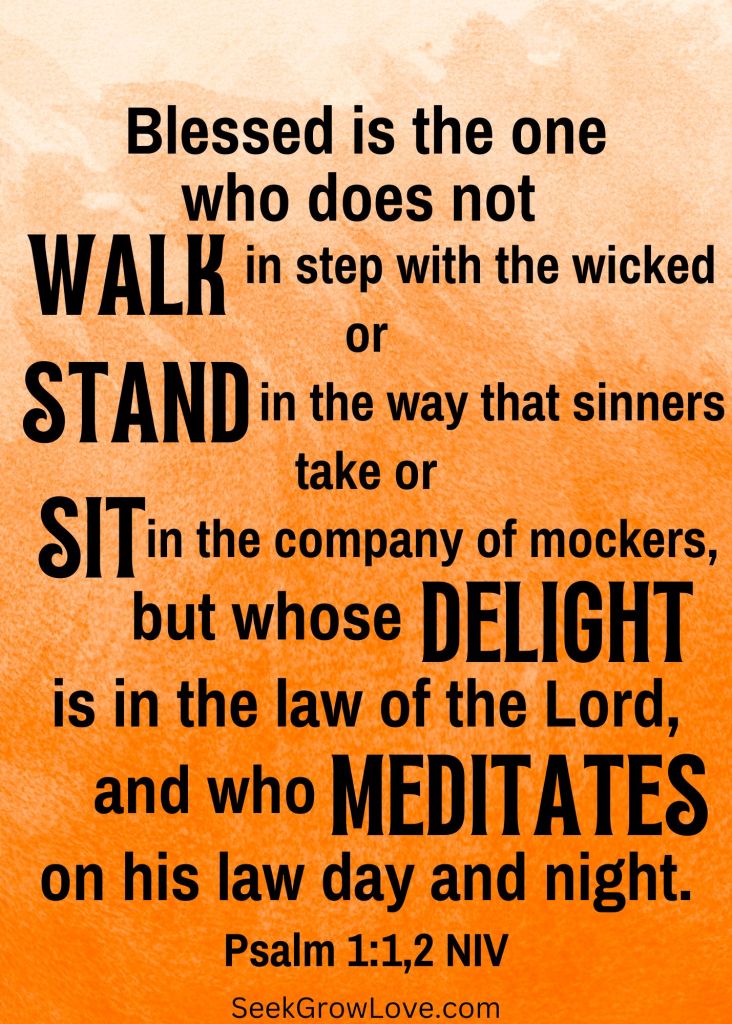
“Blessed is the one who does not walk in step with the wicked or stand in the way that sinners take or sit in the company of mockers. but whose delight is in the law of the Lord,and who meditates on his law day and night. That person is like a tree planted by streams of water, which yields its fruit in season and whose leaf does not wither— whatever they do prospers.” – Psalm 1:1-3
There is a good chance that today holds a contrast to where your feet landed yesterday. Most likely, this Monday represents a return to work, school, or some other social role you will have to step into, stand up in, or sit through. As you enter the threshold, who or what are you walking towards or away from? Where and what are you standing beside or standing in the way of? How and who do you find yourself sitting beside, dwelling with, and meditating upon? Take note not only of the words you say aloud, but the thoughts and signals you send with your body because God doesn’t want a tithe of lip service; He desires the whole of your soul as a living sacrifice.
There is a blessing for living close to the commandments of our Creator. Those who put their roots down with God are the direct recipients of the Living Water He provides. When we walk in His ways, when we stand on His promises, when we sit and meditate on His statutes, it completely changes our body language. We don’t wither, but we become confident in the hope we have. We are not empty vessels filled with cliche Christianism, but we bear the fruit of the Spirit for others to see. We can simply sit and delight in the joy of the Lord because we serve a God of promises and follow-through. Our posture, our actions, and our words stem from the refreshing source from which we draw life more abundantly. Wherever we step, stand, or sit, let the Living Water flow and the Kingdom of God flourish.
– Aaron Winner
Reflection Questions
Compare and contrast the person in Psalm 1:1-3 to the person in verses 4-5? How would you describe each and what makes them different?
Who or what are you walking, standing, sitting amongst? What do you find delight in? What are you meditating on? Are there any changes that ought to be made in order to be where you want to be at the end – of 2023, or of this life?
What do we learn about the LORD God in Psalm 1? Mark it in your margins, journal it, pray to the God of Psalm 1.
AND -in preparation for tomorrow, when we will begin a chapter by chapter New Testament reading – here’s a little…
Introduction to the Book of Matthew
Before we introduce the book of Matthew, let’s quickly contrast it with the book of Genesis and the whole Old Testament.
The book of Genesis begins the Old Testament (and the Bible). The theme of the Old Testament can be summed up in Genesis 5:1, which says, “This is the book of the generations of Adam…”. The rest of Genesis 5 has another recurring theme, “… and then he died”. The Old Testament was the story of Adam, his sin (and the consequences of that sin), and his descendants. It illustrates the truth that “the wages of sin is death” (Romans 6:23a). The Old Testament contains many of God’s promises – waiting for fulfillment.
The book of Matthew begins the New Testament. Matthew starts with, “This is the genealogy of Jesus the Messiah the son of David, the son of Abraham.” This begins the story of Jesus, and reveals “the gift of God is eternal life in Christ Jesus our Lord.” (Romans 6:23b) The New Testament describes the fulfillment of God’s promises made in the Old Testament.
Matthew was one of Jesus’ 12 apostles, whom Jesus called from being a tax collector (read hated outcast) to being in the inner circle of the Savior of the world. Many years after Jesus’ ascension, Matthew wrote the book of Matthew to convince a Jewish audience that Jesus was (and is) the Messiah – God’s chosen and anointed deliverer for His people – who fulfilled so many of the prophecies in the Old Testament.
Even though the Bible doesn’t contain anything that Matthew himself said, the book of Matthew which he wrote reveals Jesus as the Messiah promised and sent by God. May the book of Matthew speak to you and reveal God’s great gift, Jesus the Messiah, to you in a whole new way as we seek to grow in Christ together this year.
-Steve Mattison
Download and print the 2023 Reading Plan below. You can choose to follow along in 1,2 or 3 readings a day. If you read all three you will read through the whole Bible in 2023.
Welcome to the first post of our 2023 SeekGrowLove Bible reading plan! We are beginning the year with a little time in Psalm 119, and in the next couple days will add in the other Old Testament and New Testament readings. You can download and print the whole plan found at the end of today’s post. Every time we begin a new book of the Bible, we will include a little introduction written by Steve Mattison.
Introducing the Book – Psalm
The book of Psalms was Israel’s songbook. It contains a collection of psalms (or songs) that primarily focus on praising God for who he is and for what he has done. The Hebrew title is, “the book of praises.” Most of these psalms are prayers to God written by King David, although other authors, ranging from Moses, to Solomon, to the sons of Korah also contributed.
The book of Psalms teaches us to seek God with our whole heart, to tell Him the truth and to tell Him everything, and to worship Him because of who He is, not just because of what He has done. It contains a range of topics, from people crying out to God from the depths of their despair, to those praising God with jubilation from the depths of their hearts.
The book of Psalms has spoken to me in my lowest lows as well as in my highest highs. May the inspired words in this book resonate well with you as you read these psalms this year.
Psalm 119 Devotion
Who in their right mind is thinking about the end right now? Really? Terrible title. TERRIBLE. This is the time of fresh starts! New beginnings! Redos! Our mind focused on the brief novelty of this moment’s pants kicking; the annual motivation for improvements we have put off for weeks, months, or even years. While we might commit to a dream today, I would say there is little thought given to the realities of December 31st, 2023: 365 calendar days away. Whether it’s gym memberships, nicotine patches, cauliflower pizzas, saving accounts, or even bible reading plans, have we bought into the idea that we are preparing ourselves for a full year of commitment in our resolutions? Look at your Google Calendar or your bank statement: what have you planned and paid for in a full-year upfront knowing that it will change your life by the end? Or is your resolve more like the free 7-day trial, leaving one foot in 2022 in case you want to make a getaway?
“How can a young person stay on the path of purity? By living according to your word. I seek you with all my heart; do not let me stray from your commands. I have hidden your word in my heart that I might not sin against you.” Psalm 119:9-11
I will go ahead and say, it is not fiscally responsible, or even logically feasible, to pile up a year’s worth of cauliflower pizza into a deep freeze, but our commitment level to any life-changing resolution, should count the cost of sacrifice with the end in mind. This is an echo of what our Heavenly Father has done through Jesus Christ. Paul speaks to this in Colossians 1:16 when he states “For through [Jesus] were all things created, things that are in heaven, and things that are in earth, visible and invisible, whether they be thrones, or dominions, or principalities, or powers: all things were created by him, and for him.” Our eternal God has dictated to us the rules, plans, and ordinations of his personal and universal will that will lead us to a relationship with Him, which has ended the penalty of sin with the blood of Jesus Christ and leads to the big finale, the Kingdom of God. Knowing the end, it is much easier to keep to and dictate the decrees of each day. Without the end in mind, we are just tragic creatures of toil, mindlessly moving from one task to the next.
“Teach me, O LORD, to follow your decrees; then I will keep them to the end.” – Psalm 119:33
Our God is not a God of chaos (1 Cor 14:33). He works in logic and rules that are shared with us because WE as heirs according to the promise are included in the end. We don’t have to feel out the way, make up the path, or bump down the lane. God has made his moral law clear. It is not just a list of “thou shalt nots” but enhancements and boundaries provided for our own physical safety, societal responsibility, psychological well-being, and the eternal enhancement of the connection and relationship between the Heavenly Father and his children. He is not a part-time parent, nor can we be part-time children. You can’t periodically pause your subscription or ghost your way out of the membership. Our life is better lived, today and eternally, when we are resolute to learning and practicing His ways that are forged in the ultimate love and truths. We become devoted.
That devotion begins with finding a way to be connected to the Word of God every single day. It could be found in this blog. It could be found in personal study, podcast, prayer time, or all the above. What I propose, if we truly are wanting to grow in the word of God this year, to engage and act upon His message that is delivered through His word, you and I must set alarms, write in on our mirrors, put it in our checklist and calendars, and make it priority. Being here to read every day provides an opportunity to do that alongside others who are also seeking out a devoted life to Christ. If our end of life is found in 2023, if Jesus returns, or the Lord tarries for another year and He still gives us life, how much more abundant will December 31st, 2023 be if we have committed ourselves fully to understanding the precepts, the statutes, the laws, the understanding, and the wisdom of your heavenly Father? Let’s be committed to the end, even if we are at a loss of where to begin our year.
“May my lips overflow with praise, for you teach me your decrees. May my tongue sing of your word, for all your commands are righteous. May your hand be ready to help me, for I have chosen your precepts. I long for your salvation, Lord, and your law gives me delight. Let me live so that I may praise you, and may your laws sustain me.” -Psalm 119:171-175
-Aaron Winner
Reflection Questions
In reading through Psalm 119 what do you see of God’s character – how does He show who He is through His inspired word? This is a question we will be asking regularly this year (sometimes phrased differently). We think you will find great benefit in journaling, or making notes in your Bible margin, on how you see and what you learn of God and His character from His written word every day this year.
What are your favorite verses of Psalm 119? What words are used in Psalm 119 to name God’s law or directions for life? What are the benefits given for knowing, following, loving these words of God? What do you find about the results of neglecting these words of God? How would you rate your knowledge of and then, love for, the words of God?
Where do you want to be at the end of 2023? What steps will help you get there? Spend some time in prayer to the God of Psalm 119.
What an exciting time of year! Who is ready for 2023 and a NEW SeekGrowLove Bible reading plan?
At the bottom of this post you will find the new schedule! Wouldn’t it be great if 2023 was the year you daily read the Bible more than ever before?
What does God want to reveal about himself to you – every day of 2023? Come along on the journey with Seek Grow Love to find out!
This year the Seek Grow Love reading plan includes 3 daily readings. Choose 1, 2 or 3 of the readings to complete each day – if you do all three everyday (or get caught up if needed) you will read through the whole Bible in 2023.
– The Old Testament reading is 2-3 chapters a day and takes you through the entire Old Testament, with the exception of Psalms and Proverbs.
– In the second column, one Psalm or Proverb is assigned to each day and through the year each will be repeated.
– The New Testament column is typically one chapter of the New Testament each day. The gospels are spread out throughout the year, Matthew is at the start and end of the year, and Acts will be read after Luke in the spring, the rest of the New Testament is mostly in order. A few weeks will be devoted to a theme related to a holiday season, FUEL theme, or a doctrinal topic.
You may find benefit in spreading out the readings through your day and praying through the Psalm. Perhaps one or more of the readings will work well to do together with your family. You may also find it helpful having an accountability partner, or even creating a small group to share what you have been reading and learning.
Visit SeekGrowLove.com to read daily devotions based on this reading plan, and on the website you can sign up to have the devotions emailed to you every morning. Each devotion will include reflection questions. This year, we specifically challenge you to search everyday for what God is revealing about himself throughout His Scriptures. It would be a great year to start a little journal (or note in your Bible margins or online Bible notes) and record daily what you have read and what you learn about God, His character, His power, His love, His Son, etc… in that passage.
You can also follow on our Facebook page (Seek Grow Love) and Instagram (seekgrowlove).
God bless you as you seek the LORD and read His words this year!






 Seek Grow Love