Overcoming the Opposition

Nehemiah 6-7

So much work had already been done – the walls of Jerusalem had been rebuilt – now they just needed to finish the gates. Surely this project was God-ordained and he picked the right leader for the job – Nehemiah. He was able to get everyone motivated and working together, and despite the opposition they were able to finish their job on the 25th of Elul (which appears to correspond to somewhere between Sept 15 and October 2). So, this week is a super time to celebrate the work that is accomplished when working for God.

So much good had been done already – but the work did not end and neither did the opposition!

Nehemiah was under attack. Satan (along with Tobia, Sanballat, Geshem and the rest of those fighting against God) were using every weapon at their disposal to bring this righteous leader down: lies, fear, wolves in sheep’s clothing, attempting to distract him from his work with other business, spreading gossip and accusations of sedition to either silence him or get him in serious trouble with the authorities, even hiring a false “prophet” to scare him into sinning.

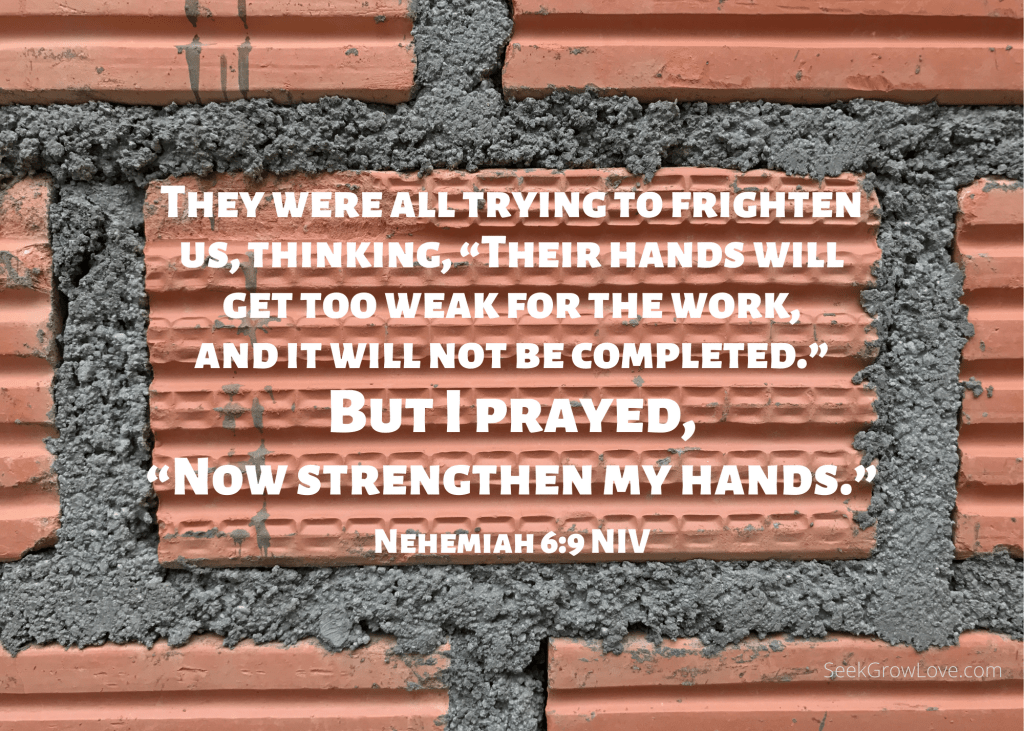
But Nehemiah stood strong. We continue to see him turn to God in prayer. Asking for strong hands and asking for God to take care of those getting in the way of the Lord’s work. He obviously had a strong knowledge of God’s law to not be tricked into sinning. This gave him wise discernment in knowing who to listen to and what to do, and not do. And, he knew to fear God not men.

We can learn a lot from Nehemiah today because Satan keeps using the same ploys. Adolf Hitler wrote, “Mental confusion, contradiction of feeling, indecisiveness, panic; these are our weapons.” Evil men seeking to destroy God’s work have come and gone and yet remain today. It is indeed a vivid reminder that, “Our struggle is not against flesh and blood, but against the rulers, against the authorities, against the powers of this dark world and against the spiritual forces of evil in the heavenly realms.” (Ephesians 6:12 NIV). They love nothing more than trying to interrupt God’s work and if they can bring down a godly leader at the same time they probably get bonus points.

We see so much of this evil and oppression today. But like Nehemiah, we must not give up! We must turn to God again and again when faced with the lies and fears and Satan’s strong man tactics that would love to have us throw in the towel and take the easy way instead. Pray, fast, seek His word and His way, don’t fear man, resist sin, use discernment in knowing who to trust, what to say and do. Pray, too, for our leaders that they will have the wisdom and strong hands of Nehemiah

Satan has been running rampant and the result is a broken world. Keep at God’s rebuilding work – one brick at a time.

Marcia Railton

Speaking of our opposition, mental confusion, lies, panic, and pleasing man not God, reminds me of the life and death fight for the most innocent of God’s creations. Tonight would be a great time to watch See Life 2020 and #LoveEveryHeartbeat. And pray for strong hands – and hearts – to do the work God wants you to do.

Today’s Bible passage can be read or listened to at BibleGateway here – Nehemiah 6-7

Tomorrow we will read Nehemiah 8-10 as we continue seeking God on our

Response to a Broken World

Nehemiah 1-5

I love the man Nehemiah! I love his passion, his prayers and his “get ‘er done” action. At the start of our story he holds the position of royal cupbearer to King Artaxerxes, so we can assume he is no slacker but is quite driven, reliable and trustworthy. He has spent his whole life in Babylon/Persia, and done very well in this “foreign” environment. But kudos to those who raised and influenced him, for his Jewish heart was still steadfast in serving the God of Abraham, Isaac and Jacob and his ancestors.

It had been 90 years since the first group of Jewish exiles had returned to Jerusalem. And just 13 years ago Artaxerxes had allowed Ezra to return to rebuild the temple. Nehemiah learns some have just come from Judah and he asks them how his “homeland” is doing. And what he hears breaks his heart. It is natural to be heartbroken at bad news. But for a lot of people the heartbreak is soon replaced with other feelings – perhaps relief that it didn’t happen to you, perhaps just busy-ness with other daily activities. But Nehemiah mourned, fasted and prayed (with confession) for several days when he heard that the people of Judah were still in distress and the walls of Jerusalem were still torn down. Just as this was breaking God’s heart, Nehemiah allowed his heart to be broken, too. And as he prays and fasts he listens for God’s answer, and just like Esther he too uses the position God has placed him in to be a part of the solution. If you find yourself mourning what God mourns, and you don’t know what to do…follow Nehemiah’s example with prayer and fasting and watch for God’s plan to develop – and then do it!

I won’t retell the rest of the story that Nehemiah tells so well – but make sure you catch some of the neat details that we would do well to remember when we seek to do God’s work.

Nehemiah was scared to death going before the king – this was not an easy thing to do, and it could even cost him his life – but doing God’s work is always worth it.

Even as the king was asking Nehemiah what he wanted, Nehemiah was praying away! He knew he wasn’t doing this on his own – and he would continue to give God the credit for the king’s generosity and for the work that would be done.

Nehemiah didn’t try to build the wall on his own. There was something for everyone to do – and Nehemiah got them going. The city officials, the temple servants, the families, the daughters, even the goldsmiths and the perfumers were out there working. Certainly most of them would never have said their spiritual gift was rebuilding walls – but Nehemiah provided the leadership, the need was presented to them and, most of them, were ready to roll up their sleeves and get to work. What job is God calling you to do with your brothers and sisters?

I would have loved to see Baruch the son of Zabbai complete his section of the wall – Nehemiah reports he “zealously” did his work. This wasn’t a half-hearted effort for him. Will you be known as one who zealously does the work of the Lord?

The world didn’t stop to applaud God’s construction team – in fact, God’s people faced much opposition, ridicule, anger, threats and violence from many sides. It would have been easy to give in to their fears and give up. But instead, they responded FIRST with prayer and then they kept at it – with one hand to do the work and one hand to carry the weapon to defend themselves if needed. They meant business. They looked after one another and once again commited themselves to finishing the job God gave them.

Nehemiah also stood up for those who had been taken advantage of and he corrected those who had performed acts of injustice for their own selfish gain.

The world could sure use more leaders like Nehemiah. How will you step up? There is much broken in our world today. What is breaking your heart and God’s? Begin with prayer and fasting. And then continue with prayer as you attack God’s work with wisdom and action even in the face of opposition. His work is always worth it.

-Marcia Railton

Today’s Bible passage can be read or listened to at BibleGateway here – Nehemiah 1-5

Tomorrow we will read the next two chapters in Nehemiah’s story as we continue on our journey through the

Can you believe next week we start the New Testament!

Love and Marriage

Ezra 7-10

Ezra, who was from the lineage of Aaron the high priest came up from Babylon. He was skilled in the Mosaic Law. King Artaxerxes gave the children of Israel the right to return to Jerusalem if they chose. In 7:10 it says, “For Ezra had prepared his heart to seek the Law of the Lord, and to do it, and to teach statutes and ordinances in Israel”. A letter was given to the ones returning from the king. Interestingly enough, this would have been the stepson of Queen Esther. Maybe he had heard about God through her. He starts out “Artaxerxes, king of kings, to Ezra the priest, a scribe of the Law of the God of heaven:” He allowed the Israelites who wanted to return to go back, they were given gold and silver from the royal treasury, and then they were urged that if they needed anymore, that they were to pay for it from the king’s treasury. Ezra said in 7:27 “Blessed be the Lord God of our fathers, who has put such a thing as this in the king’s heart, to beautify the house of the Lord which is in Jerusalem.” It sounds like Queen Esther must have talked about God to her family, and the king acknowledged that he was the God of heaven, and he did not want to have the wrath of God on him or his sons.

In chapter 8 they list those who returned, I love 8:21 “Then I proclaimed a fast there at the river of Ahava, that we might humble ourselves before our God, to seek from Him the right way for us and our little ones and all our possessions.” They fasted and prayed to God before making any decisions, just like we read in Esther as well. It is important that we follow these guidelines in our lives before we make decisions, pray about it and ask God to lead us in the direction that He would have us take.

In Chapter 9, we see the beginning of some problems, the children of Israel had taken pagan wives for some of their sons and daughters, even the religious leaders were included in this sin. Ezra was very upset at this and he prayed and wept before God because of their sin. They had been forbidden in Deuteronomy 7:3, to take foreign wives. Now, this was not a matter of being racist, because the foreign people could convert to Judaism, but the ones they married were pagans, which meant that they continued to worship idols. In 1 Kings 11:2b “the Lord said to the children of Israel “You shall not intermarry with them, nor they with you. Surely they will turn away your heart after their gods. Solomon clung to these in love.” V.4 “For it was so, when Solomon was old, that his wives turned his heart after other gods, and his heart was not loyal to the Lord his God, as was the heart of his father David.” This was when their idolatry began which eventually led to the kingdom being conquered by the Babylonians. It is a fact that if we marry outside our faith it makes it more difficult to love God with our heart, soul, and might. That’s why we are told in 1 Corinthians not to be “unequally yoked with an unbeliever.” I believe who we choose to marry is one of the most important decisions we can make in our lives. I have a friend who said that of her four children, only one remained in the faith. She said it was who they married that made the difference. One married someone who was an active participant in church, two would go on occasion, and one married an atheist. When we marry, we are to be one, and it works best to be in accord with one another, and to both be pulling in the same direction. You will not get very far if the two oxen are trying to go in opposite directions.

The assembly decided that they would put away the pagan wives and children that they had with them. They confessed their sin and repented of it. Ezra 10:2b “We have trespassed against our God and have taken pagan wives from the peoples of the land; yet now there is hope in Israel in spite of this.” 10: 10b-11 “You have transgressed and have taken pagan wives, adding to the guilt of Israel. Now therefore, make confession to the Lord God of your fathers, and to do His will; separate yourselves from the peoples of the land, and from the pagan wives.” There was hope when the people repented because God will always accept us back when we return to him.

That is what is so encouraging to us as we read the history of the Old Testament. None of our patriarchs were perfect but God is able to use imperfect people to accomplish His will. We all need to be willing to let God use us in our imperfections. When we sin and make mistakes, that isn’t the end, if we return to God, he will return to us as we read earlier this week.

-Sherry Alcumbrack

Today’s Bible passage can be read or listened to at BibleGateway here – Ezra 7-10

Tomorrow we will begin the book of Nehemiah (chapters 1-5) as we continue on our

Haman’s Pride and Prejudice – Part 2 (The Rest of the Story)

Esther 6-10

When we left you yesterday, evil Haman was going to go in the next day and ask King Ahasuerus to hang Mordecai on the gallows that he had built in anticipation. Now we will find out the rest of the story. During that night the King was having trouble sleeping so he asked for his book of records to be brought to him and read out loud. In it they read the story of Mordecai saving his life. He asked how they had honored him, and they said that nothing had been done for him. And Mordecai had not ever tried to get any special recognition for this act of bravery.

When Haman shows up that morning to visit the king, he asks Haman, “What shall be done for the man whom the king delights to honor?” Haman, thinking he must be talking about him, says, dress him in a royal robe, put him on a royal horse with a crest, and then have a prince lead him through town, proclaiming before him. The King said, Quick, do everything you have suggested for Mordecai the Jew, who saved my life. Not quite what he envisioned.

The King and Haman go later that evening to the special banquet with Queen Esther. Once again, the King tells her she will receive anything she asks for, up to half of the kingdom. Chapter 7:3 “Then Queen Esther answered and said, “If I have found favor in your sight, O king, and if it pleases the king, let my life be given me at my petition, and my people at my request.” Our enemy will have us destroyed, killed, and annihilated. He asks, “Who is this enemy?” she replies, “The adversary and enemy is this wicked Haman!” Haman pleaded for his life, but the king sent him to the gallows that he had built for Mordecai to be hanged. King Ahasuerus gave Queen Esther Haman’s estate, and gave the signet ring that he took from Haman to Mordecai because the Queen appointed him to manage things. Then she begged the king to stop the decree that Haman had already sent out to kill the Jews. He had another decree sent out that allowed the Jews to protect themselves against anyone who would assault them. The Jews overpowered those who hated and wished to destroy them.  After two days of fighting, they enjoyed a day of rest, celebrating their victory with a feast. Mordecai made a decree that the Jewish people would celebrate this holiday every year as a time when, God through Esther, saved the lives of the Jewish people and the evil plot which Haman had devised failed and returned upon his head. His ten sons were also killed on the gallows. The days of Purim are still celebrated by the Jewish people today. King Ahasuerus advanced Mordecai in his kingdom until he was second only to the king. Chapter 10:3 says: “For Mordecai the Jew was second to King Ahasuerus and was great among the Jews and well received by the multitude of his brethren, seeking the good of his people and speaking peace to all his countrymen.”

This story reminds me of how faithful God is to his children. I am reminded of Genesis 50:20 when Joseph told his brothers, “But as for you, you meant evil against me; but God meant it for good, in order to bring it about as it is this day, to save many people alive.” The things Haman had devised were evil, but God was able to turn it around for the good of His people. God had orchestrated so many things to be in place to save them. We need to trust God, even when we are going through hard times. We need to realize that we are not going through them alone, because God has promised that he will be with us.  It also brought Ephesians 3:20 to mind, “Now to Him who is able to do exceedingly, abundantly above all that we ask or think, according to the power that works in us.” Queen Esther asked for her life and the life of her people. She was given that and more. The King gave her the estate of Haman and Mordecai was able to advance to the number 2 man in the kingdom, even though they were Jews. He became very powerful and influential, and it says in the last verse that even with all his power, “he was seeking the good of his people and speaking peace to all of his countrymen.” Mordecai was a wise man and he used his life to lead people to seek God and live a life according to his will. What purpose have we been made for, let’s be courageous and trust God and let him use us as He wills, let’s seek good for others as we work for God’s glory.

-Sherry Alcumbrack

Today’s Bible passage can be read or listened to on BibleGateway here – Esther 6-10

Tomorrow we will finish up the book of Ezra (7-10) and then just 2 more books to read in the Old Testament before we get to start the New Testament next Wednesday.

Haman’s Pride and Prejudice

Esther 1-5

When we read a good book, there are several things that we look for. A hero, a villain, a little romance, and some intrigue. We always enjoy a book with some plot twists to keep us guessing. The book of Esther has all that and more. Many scholars have mentioned that God is not mentioned in Esther, but the story is all about His faithfulness to His children.

Once upon a time in a land far away, King Ahasuerus, King of the Medes and Persians was throwing a banquet to show off his wealth and power. He wanted to show off his beautiful Queen Vashti, but she refused his summons. His advisors demanded he divorce her because the other wives in the kingdom would not honor their husbands. They decided to host a beauty pageant of all the young ladies in the land to choose the next Queen.

In the city of Sushan, lived a Jew named Mordecai, his father was one of the captives under Nebuchadnezzar. Mordecai was raising his first cousin, Esther, because she was orphaned. Esther was picked to be one of the candidates for Queen. Esther had not told anyone she was a Jew due to Mordecai’s advice. Some of the people looked down upon the Jews. Esther went before the King and found favor in the sight of all. 2:17a “The King loved Esther more than all the other women.” He made her his Queen.

Mordecai sat at the gate and heard Bigham and Teresh, the doorkeepers, plotting to kill King Ahasuerus.  Mordecai told Queen Esther, and she told King Ahasuerus in Mordecai’s name. It was checked out, found to be true, and both were hung on gallows and it was written down in the book of the chronicles, in the presence of the King. 

There was an evil prince named Haman whom King Ahasuerus promoted over the other princes. Everyone had to bow and pay homage to Haman. Mordecai would not bow to him, and it filled Haman with rage. He convinced the King that all the Jews were opposed to the King and that they should be destroyed. The King told him in 3:11 “to do with them as seems good to you.” Haman sent out a decree to kill, destroy, and annihilate all the Jews, both young and old on one day.  When the Jews heard of this, there was great mourning, with fasting, weeping, and wailing. Many wore sack cloth and ashes. Mordecai sent Esther a message and showed her the decree, and he suggested that she go to the King and plead before him for her people. She said she had not been called to visit the King in 30 days, and she would be killed if she went before him and he did not extend his gold scepter to her.” Esther promises to approach the King and asks all the Jewish people to fast and pray for the three days prior to the meeting. So, Mordecai did all that was asked of him.

On the 3rd day she went before the King in her royal robes and found favor. He held out his golden scepter. The King asked her request and in 5:3b “It shall be given to you, up to half of the kingdom.” She asked the King and Haman to come to a banquet that she would prepare. They went to the banquet, the King once again asked for her petition and said that it would be granted her. She asked for him to come back the next night along with Haman to another banquet. Haman went out joyful but when he saw Mordecai in the Kings gate, he was filled with hate in his heart. He told his wife that Queen Esther had invited him to a banquet with the King, and he was invited back for the next day. But he couldn’t enjoy it as long as Mordecai the Jew sat in the Kings gate. His wife suggested he build huge gallows and then suggest that Mordecai be hanged from it in the morning. This pleased him and gallows was built. You will need to come back tomorrow for the…. rest of the story.

When we read this story it’s easy for us to think we would do the same thing that Esther did because we know how it will end, but it took a lot of courage for her to even go before the King with her request because she knew that he could command to have her killed if he so chose. These are a couple of my favorite verses in this passage 4:13-14 “And Mordecai told them to answer Esther; ‘Do not think in your heart that you will escape in the king’s palace any more than all the other Jews. For if you remain completely silent at this time, relief and deliverance will arise for the Jews from another place, but you and your father’s house will perish. Yet who knows whether you have come to the kingdom for such a time as this.’” And Esther sends this reply to Mordecai 4:16b “And so I will go to the king, which is against the law; and if I perish, I perish!” Mordecai totally trusted God to save the Jewish people, somehow, someway. He reminds Esther that maybe God put her in the position she is in for just this reason.

We need to trust in God to know that if we can do the right thing and glorify God in the process that God has us right where He wants us, and He will use us if we allow Him to. Esther didn’t go into this blindly, and she did things in the correct order. She asks everyone to fast and pray to God for her to find favor with the King, after they did that, she courageously put her life on the line, she was willing to lay down her life for a just cause. We need to be looking for our “such a time as this”, when we allow God to use us to fulfill His purpose.

-Sherry Alcumbrack

Today’s Bible passage can be read or listened to at BibleGateway here – Esther 1-5

Tomorrow we will read the rest of Esther’s story as we continue on our

We’re Marching to Zion

Zechariah 8-14

My mother always loved to put together puzzles, the more pieces, the better. It always amazed me how patiently she would work at it, but in the end, when all the pieces were together you could quite clearly see the complete picture. As I read Zechariah, all the puzzle pieces haven’t been assembled yet, and we can’t see clearly the complete picture, but we can see the incredible love that God has for Israel, the land, and his children.

Chapters 1-6 is about the rebuilding of the physical temple, Chapters 7-8 are about them obeying the laws of God, and Chapters 9-14 tells that God will send a Messiah who will be Priest and King. This Messiah will take away our sin and he will rule over us.

He has promised to bless those who returned from exile to Jerusalem.  In 8:3, He says “I will return to Zion, And dwell in the midst of Jerusalem. Jerusalem shall be called the City of Truth, The Mountain of the Lord of hosts, The Holy Mountain.” Then we skip down to 8:8 “I will bring them back, And they shall dwell in the midst of Jerusalem, They shall be My people And I will be their God, In truth and righteousness.” He wanted them to build His temple in Zion once again, and he encourages them to let their hands be strong, and not to worry about their enemies because He will protect them.  8:21 says “Let us continue to go and pray before the Lord And seek the Lord of hosts.”  It even says that people from other languages will grasp the sleeve of the Jews and say, “Let us go with you, for we have heard that God is with you.” He tells the people that He will take care of them. He will protect them from their enemies. He has promised them good things, but it always comes with a choice for the people. It has been a choice for them during this entire story, just as it is a choice for us today. They must obey his commands.

In 9:9, we have a prophecy about Jesus “Behold your King is coming to you; He is just and having salvation, Lowly and riding on a donkey. A colt, the foal of a donkey.”  This was fulfilled when Jesus rode into Jerusalem on a donkey in the New Testament. They were looking to their King to come like Thor in the Avengers with power and great glory. They imagined their Messiah coming in on a royal stallion as a warrior to save them. In verses 11-17, he asserts that He will save His people, His flock.  In Chapter 12 he writes about the coming deliverance of Jerusalem. In Chapter 13:9b “They will call on My name, And I will answer them, I will say, This is My people, And each one will say, ‘The Lord is my God.’” Chapter 14 is a victorious chapter about the coming of Jesus. When Jesus comes back the Second time, he will be coming as a victorious warrior, who will save His people. 14:9 says “And the Lord shall be King over all the earth. In that day it shall be- The Lord is one, And His name one.” I may not understand everything that Zechariah is saying but I know the most important thing is that God loves us, one day Jesus will come back as our Messiah, and Savior and will set up the Kingdom of God, and God will dwell with us in Zion. As Zechariah’s name proclaims, “the Lord has remembered”; He has remembered His promise to his children and the promise will be fulfilled.

-Sherry Alcumbrack

Today’s Bible passage can be read or listened to at BibleGateway here – Zechariah 8-14

Tomorrow we begin the exciting book of Esther (chapters 1-5) as we continue on our

God’s Return Policy

Zechariah 1-7

Have any of you ever bought something and then decided that you need to return it and you check to see what the return policy is before you take it back. In Zechariah, we will read about God’s return policy. The book of Zechariah begins in the 8th month of the 2nd year of King Darius of Persia. Babylon had destroyed the temple in 586 BC. The Jewish people finished building the new temple in 516 BC. This book takes place in 520 BC when Zechariah and Haggai, both contemporary prophets, urged the people to finish building the temple. God had made promises to Israel, and one promise was that the children of Israel would return to their land from exile and the Lord would return to His temple with them. Jeremiah 29:10: “For thus says the Lord; after seventy years are completed at Babylon, I will visit you and perform my good work toward you and cause you to return to this place.” In Zechariah, God was making good on His promises. Fittingly, the name Zechariah means “the Lord has remembered.” The children of Israel were returning to their homeland.

But Zechariah doesn’t just have messages for the children of Israel in 500 BC, it still speaks to us today. Chapter 1:3 “Thus says the Lord of hosts, ‘Return to me, and I will return to you,’ says the Lord of hosts.” This is a recurring theme in the Bible since the fall in the Garden of Eden, God, wants to have a relationship with His children, and He has promised if we turn to Him, He will turn to us. It continues in the New Testament, James 4: 8 says, “Draw near to God, and He will draw near to you.” So often we, like the children of Israel refuse the offer of a close and personal relationship with the Lord of hosts. God used Zechariah to encourage the children of Israel in what may have seemed like an impossible task, rebuilding the temple. He wanted them to know that they could not do this task on their own but with His help, it would be done. In Chapter 4:6b it says, “Not by might nor by power, but by My Spirit, says the Lord of hosts.” When we have a task that we think we can’t accomplish, we may be right, if we are depending on our might or power. We need to rely on God, and His might and power, when we have difficult times in our life. This verse seems very appropriate for what our nation is going through today. Chapter 7:9-10 says, “Thus says the Lord of hosts, ‘Execute true justice, show mercy and compassion everyone to his brother. Do not oppress the widow or the fatherless, the alien, or the poor. Let none of you plan evil in his heart against his brother.”  In these verses we find the heart of God and how He wants us to treat others. The world will be a better place when we all take these words to heart and show the love of God to all that we meet and have contact with in our lives. It’s good to know that God’s return policy has no restrictions or exceptions. “Return to God and He will return to you.”

-Sherry Alcumbrack

Today’s Bible reading passage can be read or listened to at BibleGateway here – Zechariah 1-7

Tomorrow we will read Zechariah 8-14 as we continue on our

My House Is In Ruins

Haggai

Yesterday we ran across Ezra 5:1-2, which mentions that the prophets Haggai and Zechariah come and encourage the people in Jerusalem to continue rebuilding the temple. As promised, today we are zooming into Haggai’s role in this. How convenient that there is a book in the bible named Haggai that gives us this information.

We know from Ezra 4 that the people in Jerusalem were forced to stop rebuilding the temple by the Persian king Artaxerxes. Some time passes by, and Haggai comes on the scene to prophesy to them. God has some things to get across to them.

The temple sits unfinished, and people of Jerusalem are either too fearful or apathetic to continue working on it. God calls them out on this, saying that his house is in ruins while they are decking out their own. They have been running around doing their own thing, and they never seem to have enough of anything. It’s a rat race. And since the house of God is being neglected, there is a drought in every aspect of their lives. God commands them to get working on the temple again.

This convicts their hearts as it should ours as well. What is the work God has called us to do that we’ve been putting off? What are we allowing to distract us from it? How could we be more intentional about building the opportunities to encounter God in our daily lives?

Heeding this conviction, the people begin building again, but there are some who are discouraged about something we saw in Ezra 3. The people who are old enough to have seen the original temple think this new temple is nothing in comparison. God tells them to take courage, and work, because he is with them. He assures them his spirit is among them as promised when he brought them out of Egypt. That hasn’t changed, don’t be afraid. God tells them he will “shake” things, which at first sounds like an earthquake, but is a dramatic way of saying he will upset the balance. The treasures will be transferred from the nations to his house. He owns all the gold and silver anyway! What doesn’t God own? God promises the splendor of this new temple will be more than the old, and that he will give prosperity.

When you work for God, you do what you can. It is easy to get discouraged. But the one who commissioned you will honor your efforts. He has all the resources in the universe at his fingertips to make it happen. What may be impossible for you is possible for God; he wants it to be your project too.

What follows is an interesting discussion about how contagious holy and unclean things are. If you are carrying around a holy ribeye steak and it touches your fries or soda, does it make the fries and soda holy too? No. But if you touch a dead guy and then touch your fries or soda, does it make them unclean? Yes. Holiness doesn’t just spread automatically, it takes work. Spreading bad things around takes no effort at all. You don’t have to do anything at all, things will fall apart without your attention. “So is it with this people, and with this nation before me, says the LORD; and so with every work of their hands; and what they offer there is unclean.” It’s like there was a contagion of apathy spreading while they were not doing the work, or the work they were doing was with the wrong heart, and things were not going well for them. But now that they are working on the temple according to God’s wishes, they will be blessed. They’ll have enough of everything.

What’s the reason God wants them to build a temple, anyway? It isn’t like God needs a temple. He would be just fine without one. The temple is the way they know how to connect with God and have his life-giving presence among them. To build this temple is to invite his presence. To not build it is to signal to God that they aren’t interested enough in his presence. For us, the temple isn’t a structure we go to, but a kind of metaphor for the sacredness of our own bodies, the network of others in our churches and faith communities, and the use of our time.

At the close of the book of Haggai, God mentions shaking things up in a dramatic way again, and that he will make the governor Zerubbabel a “signet ring” or chosen one. It sounds like God is making him a messiah of sorts. Of course, with hindsight, we know he won’t be the messiah. But he is being recognized by God as a leader of significance. And to add to his significance, he is from the line of David, mentioned in the genealogies of Christ provided by both Matthew and Luke. That’s quite the legacy, when you think about it.

There’s a lot that God wants to do, and he is asking for our cooperation, to take up the projects with him, and by doing so, to invite his presence. My advice to you, and I am speaking to myself as well, is to not put off those good things God has put on your heart to do. Even if you don’t feel ready, you’ve got the support network of the God of the universe, and your brothers and sisters in Christ.

-Jay Laurent

Today’s Bible reading can be read or listened to at Bible Gateway here – Haggai 1-2

Tomorrow we read Zechariah 1-7 as we continue on our

The Scourge Of Red Tape

Ezra 4-6 and Psalm 137

Part of today’s reading is Psalm 137. I’m starting with it because this is not a note to end on. Sit with it a few minutes, but don’t take it with you for the whole day. Maybe there is no helping that. 

Psalm 137 is a tour through the raw emotions felt by those in exile. It’s the lament of the desperately misplaced. It’s a prayer to remember their home, Jerusalem, and their former standing with God. It’s a chilling and shocking request for God to repay Babylon for what they did to Jerusalem, concluding with the horrifying mental image of babies being smashed against rocks. The emotions are palpable and powerful.

Let that be a “looking back” exercise from where we are in Ezra. Look how far things have come, from complete and utter despair in a foreign land, to being home again and in the process of rebuilding and restoring. Speaking of Ezra…

When you try to do something worthwhile, there is likely to be a few obstacles. Even the most simple of projects can take twice as long as you’d thought. And that’s without anyone trying to sabotage your efforts.

At this point in the book of Ezra, the people of Jerusalem are working hard on rebuilding the city and temple, probably running into all the usual pitfalls of trying to build things. But they have a much bigger problem: Some locals are trying to stop them from building, even actively sabotaging their building plans.

These locals write the king about the people in Jerusalem, employing disinformation and half-truths, and claiming that they are all troublemakers who will rebel once the city and walls are built. The king Artaxerxes can agree that, historically speaking, they are indeed troublemakers, and he orders the construction halted.

Amidst the long hiatus, the Jews in Jerusalem receive some much needed encouragement from the prophets Haggai and Zechariah, and are sparked to begin rebuilding again. Tomorrow we’ll be looking at the part Haggai played in this.

Soon after starting the project back up, they are pestered by the locals again, who are questioning if they have permission to build. They provide their entire story, and inform the locals that Cyrus commanded them to rebuild. Word gets back to the king and they do some fact checking in the archives. They find the papers regarding the edict of Cyrus, and the king makes it clear that the original edict stands. The rebuilding will continue, and the efforts will be subsidized by the empire, including animals to sacrifice.

But did you catch what the king’s motivations are? It is “so that they may offer pleasing sacrifices to the God of heaven, and pray for the life of the king as his children.” So it isn’t so much for the people as much as it’s to ensure the well-being of the king. What, did you think the king wasn’t getting something out this deal?

Overcoming these obstacles, the rebuilding of the temple is eventually finished, followed by a dedication for the temple, a massive sacrifice to atone for the sins of Israel, the appointing of priests, and observing feasts (think back to the first temple in 1 Kings 8). In other words, they are doing all the things they were not able to do while in exile. Now they have a stronger connection to and reestablishment of their worship and traditions they enjoyed before they were exiled.

It is a joyous day. Indeed they’ve come far toward restoration, but we’re left with an anti-climax and the feeling that there is much work left to be done. You can’t just build a temple, go through some motions, snap your fingers, and declare that the people are restored. There is work yet to be done on the hearts of the people.

-Jay Laurent

Today’s Bible passage can be read or listened to at BibleGateway here – Psalm 137 & Ezra 4-6

Tomorrow we will read the two chapter book of Haggai as we continue on the

Hello, IT. Yeah Huh. Have You Tried Forcing An Unexpected Reboot?

Ezra 1-3

The book of Ezra picks up the story of Israel at a very important moment: the return from exile. The Persians swoop in and conquer the Babylonians in 539 BC. The persian King, Cyrus the Great, acknowledging God for giving him the kingdoms of the earth, issues a proclamation that the temple in Jerusalem should be rebuilt. The Jews who were taken captive and exiled in Babylon are allowed to return to the land they call home and help rebuild the temple. We’re reminded of the Exodus, when God’s people were freed from the clutches of Pharaoh.

For an ancient king, Cyrus seems to be especially respectful of the customs and religions of his subjects. It turns out that this is in a way beneficial for him, since allowing your subjects freedom of religion and not enslaving them earns you so much more support and makes for a more stable empire. He was a bit of a trend setter in this regard.

Cyrus is reversing what Nebuchadnezzar set in motion. Nebuchadnezzar and his Babylonian empire conquered Jerusalem, destroyed the temple, took the temple vessels, and scattered the people into exile. Cyrus has conquered Babylon, allowed everyone to go back to where they call home, given back the temple vessels, and ordered the temple rebuilt. But really it is God doing the exiling and reversing, through the hands of these kings, to give his people another chance.

Ezra 2 gives an extensive list of the wave of 50,000 some people who returned to Judah, and details the livestock, if you were dying to know. We usually think this kind of passage is a bit of a drag, but it’s really more of a celebration, with more confetti at every name and number. Think of the importance they placed on leadership, and the legacy and roles of the people mentioned. Each of these people are going back to wherever they call home, where they have deep roots and history. Each of them has something unique to contribute toward rebuilding their lives, and they’ll need the skills and resources of everyone to restore Jerusalem and the temple.

Similarly, in the body of Christ, we need the unique skills and gifts everyone brings to the table. We all play an important role in taking care of each other and reaching out into the world.

And so the project begins. First things first! They make sure there is at least an altar and that the usual schedule of sacrifices is back on track. They are trying to build a continuity between what their lives were like before the exile and what they are like now after the exile. Being able to worship again is a stepping stone toward restoration. Routines are important!

Into the second year after returning to Jerusalem, the materials and workers are all being gathered to get the temple together again. When the foundation is laid, there is a big ceremony with music and singing to God. They sing, “For he is good, for his steadfast love endures forever toward Israel.” Things are looking up. We’ve got the people, the temple foundation, and some semblance of our usual worship.

But there is something in the air that signals to us that not everything is quite right again. While many people are shouting loudly for joy, many of the older folks who saw the first temple are weeping loudly. It is bittersweet. It is good that there is now at least part of a temple, yet it doesn’t hold a candle to what it was before.

We end chapter 3 with this very divided response to the temple. The noise is so loud that they can’t tell who is joyful and who is sorrowful. They’ve been waiting so many years just for this chance to rebuild, and now it’s not even clear if it is a good thing or not. 

But restoration is a process. Most things that we want, we can get almost instantly. I can drive to the store and get ice cream. I can order something from Amazon almost without moving a muscle, and it will arrive in two days. Way in the future, in the year 2000, we’ll just think of what we need, and it will materialize in our teleportation device. But doing something of significance takes time, effort, prayer, and also probably money. And so does rebuilding Jerusalem. It is tempting to compare back to what things used to be like (the “good old days”) and be discouraged. What we might be missing is that God’s plans and ideas usually break our categories for what we think is even possible.

-Jay Laurent

Today’s Bible passage can be read or listened to on BibleGateway here – Ezra 1-3

Tomorrow’s Bible reading will be Ezra 4-6 and Psalm 137 as we continue on our