I have a confession to make. I really don’t like conflict and because of that I don’t always confront situations or people as I should or as is necessary. Now thankfully the Lord is growing me in this area because the reality is confrontation and conflict is necessary. Actually the New Testament teaches that there is a time and place for believers to hold each other accountable with regard to sin. Many Christians and churches struggle with this. It’s uncomfortable, awkward, and scary yet our Lord himself exemplified this in today’s chapter of Matthew 23 (read Matt. 18.15).
Seven times in Matthew 23 Jesus says “woe to you” with reference to the Pharisees. “Woe” is a prophetic denunciation that the prophets in the Old Testament used to warn people that their behavior was not pleasing to God and if they didn’t correct their actions God’s punishment and judgement would come.
The crime of the Pharisees was that they were so caught up in religious activities that it compromised true obedience God really desired. Jesus loves and forgives but he will not tolerate empty obedience and religious service. He will not be sweet to that which God hates and opposes. Likewise as followers of Jesus we must strive to become like him in all respects including standing up for the truth even when that means calling out sin and that which God hates.
This must be done with great wisdom and care and love. I’ll include passages that speak to this theme. I’d encourage you to read them and get exposed to this New Testament teaching. We as Christians have a duty to lovingly hold other believers accountable with regard to sin.
Passages for further study:
.Matt. 16.21-23
.Matt. 18.15-20
.I Cor. 5.1-5
.Gal. 2.11-14
.Gal. 6.1
.Eph. 5.11-14
.I Tim. 5.20
.Tit. 3.10-11
.Jam. 4.17
Jacob Rohrer
Today’s Bible passages can be read or listened to at Bible Gateway here – Matthew 23 and Luke 20-21.
There’s a song on K-Love (Christian radio station) called “Love God and Love People” by Danny Gokey. The chorus goes “Gotta keep it real simple, keep it real simple bring everything back down to ground zero, cause it all comes down to this love God and love people”. The song is very catchy, yet while this command is simple at the same time it takes an entire lifetime to grow and mature in living out the greatest command God has given to his people.
The greatest commandment is found in today’s passage and it comes from the lips of the greatest teacher who ever walked the earth, our Lord Jesus Christ. I could say much on this topic yet I will keep it brief and to the point. The two commandments Jesus states as the first and second most important come from the Old Testament. The first and greatest commandment, love God, comes from Deuteronomy 6.4-5. The second commandment, love people, comes from Leviticus 19.18. These two texts Jesus sees as the greatest commandments because the whole law of God can be summed up in these two commands. Also, Jesus not only tells us the two most important commandments but he gives us the divine priority of Christian love. God comes first and only then people. As Christians we do not love people first and then God. We love God first in priority then our neighbor. A blessed Christian life is one that seeks to love God before all else.
For the rest of this devotion, I want to focus on the first and greatest commandment. What does it mean to love God? To love God means to love him with our entire person or being. There are three aspects of our person that we are to love God with in Deuteronomy 6.4-5. These three are; the mind, the soul, and our might.
To love God with our mind means primarily that we engage with the truth God has revealed about himself in scripture. In short, we love God when we read, study, and meditate upon the Bible. To love God with our soul means to love him with our emotions, affections, and desires. If we say we know God yet are unmoved by him, we don’t know him. It is impossible to love God and remain cold and indifferent. Our emotions do not form the foundation of our relationship with God but they do accentuate and enhance our experience of God. Lastly, to love God with our might is to love him with our physical body and ability and the resources he has given us. To love God with our body can mean using it for serving other people.
To love God means to love him first in priority and to love him with every area of our life and being.
-Jacob Rohrer
Today’s Bible passages can be read at BibleGateway here – Matthew 22 and Mark 12
My sheep hear my voice. I know them, and they follow me.I give them eternal life, and they will never perish. No one will snatch them out of my hand. -John 10:27-28 NRSV
Rejection is something that all of us have, or will, face in this life. And, I can honestly say that it never feels great. You know that feeling where you feel like your stomach hits the floor? For a moment, it’s hard to catch a breath. In that moment you feel like you’ve lost it all. As humans, we want people to believe in us. We want to be trusted in, relied upon. And, we also hate the loneliness that comes from people choosing to walk away from us or not abide in our words.
So, what must it have felt like for our Messiah to constantly face people who were unwilling to believe him? How did he have the strength to continue to persevere? We see in the ministry of the Son of Man, the Perfect Man, an ability to consistently rely upon the Word of his father. We see in Jesus complete confidence in God and his plan for Jesus’s ministry. And, over and over, we see Christ giving all glory to God. Jesus knows with complete clarity where his power is coming from and how important it is.
Can you imagine knowing you are the Son of God, proclaiming the gospel that you know without any doubt is true, and having your Jewish brothers and sisters threaten you with stoning?
Fear, dismay, sadness. I can say if I had been in the shoes of Jesus at the end of John 10, I would be overwhelmed with emotion. The steadiness that we see in the Lord is astonishing, and takes an exuberant amount of courage.
32 Jesus replied, “I have shown you many good works from the Father. For which of these are you going to stone me?”
Wow. Jesus has just laid out his cards. He is saying, “Look this is who I am. I have been sent by my father to do his good works. You have seen many of these works. And you are going to stone me now?” He is making it clear that by stoning Jesus, the Jews are going against the glory of God. WOAH. What an argument. Its clean, simple, and most importantly, transcendent.
Although we see that Jesus escapes being stoned that day in John 10, we all know that he did have to endure the cross for us. The perfect man that did it all right covered our sin with his blood. And then, God raised him from the dead. Because of that, we have been grafted into an eternal kingdom where righteousness will reign!
But in this life, we will continue to face rejection. We will always have people that don’t believe us. And no, we aren’t going to be perfect. But because of the sacrifice that Jesus made on our behalf, we have the ability to also trust in and rely upon the Word of God. We have the opportunity to serve and be loved by our Creator. How beautiful is that?
When we choose to follow in the footsteps of Jesus, we learn what it takes to be spiritually confident. Trust in God. Trust in his Word. Proclaim his good works. That is where true confidence begins.
Imagery of sheep and shepherd are found all throughout the Bible, in both the old and the new testaments. Because of this, I think we sometimes forget some of the metaphorical imagery that comes with the sheep and shepherd dynamic. Sheep are not an intelligent animal in any sense of the word. They often wander off and get themselves in trouble. When threatened by predators, sheep will often clump themselves together in such a tight pack, that sheep in the center will often suffocate. All in all, sheep are fully reliant on their shepherd for protection, food water, and for their own survival.
Here in John 10, when Jesus is speaking about sheep, and he being the good shepherd, the people probably would have seen it as insulting when he compared them to sheep. But the point that Jesus is trying to make, is that like sheep we could not depend on ourselves for salvation from the consequences of our bad choices. God had to send us a shepherd who would “lay down his life for his sheep”. So he sent us His son Jesus. And as Jesus said, no one took his life from him, but he laid it down of his own accord. I don’t think we could have asked God to send us a better shepherd than who He sent us, His one and only son, Jesus. In just over a week, the Thanksgiving season will begin, and I think that this year we need to spend time thanking God, for the gift of the Good Shepherd, who laid down his life willingly, for us his sheep.
Jonny Smith
Today’s Bible passage can be read or listened to at BibleGateway here – John 9:1 – 10:21
Tomorrow’s passages will be the rest of John 10 and Luke 10.
Okay, let me start by saying, it was SO hard deciding where to even start when I was writing today’s devotion. There is just so much meat in these two chapters, and I highly recommend that you set aside enough time today to really dig into these scriptures.
In today’s first chapter, John 7, we watch as Jesus instructs his disciples to go to the feast without him, because the Jews do not hate the disciples as they do Jesus. Eventually Jesus goes, but in secret. He went to the temple and began teaching, aware that if he were to make himself known to too many people, things wouldn’t end well. Which of course, in the long run, they didn’t – but let’s not get ahead of ourselves. As Jesus said, his time had not yet fully come. This is one of the reasons he was often so discreet. He couldn’t yet draw too much attention to himself, because he knew that would almost immediately lead to his death. This is important to note because he was not done with his time on earth; he knew there was more to accomplish before fulfilling the prophecy. And so he did, showing as much love and kindness as possible, and bringing thousands and thousands of people into the light. (And in doing so, setting an example for us to do the same.)
We could, of course, continue to talk about this one chapter for days and days, however, there’s also a ton of good stuff worth addressing from the next chapter, John 8. This one’s actually jam-packed with wise words and food for thought… so let’s dive in.
The first little section in John 8 is the story of the adulterous woman, which is definitely a good one and can teach us a lot. However if you don’t know already, this story was not in early manuscripts of the book of John, and was likely not written by him. Regardless, the important take away of this story is that none of us have the right to judge another, for we all sin, and we all deserve forgiveness. What stood out to me most though, is that Jesus said “I do not condemn you, either. Go…” which of course is the point of the story, but then he said, “From now on sin no more.” We can’t forget this part in Jesus’ line of thinking. Yes, we can be forgiven, but that doesn’t mean just getting away with something and then going and doing it again. It’s also about repentance; turning yourself around and doing things different from there on out. That’s maybe the most important step: what you do after the fact.
In the next few sections of chapter 8, we’re walked through a series of conversations between Jesus and the Pharisees/Jews. Repeatedly, Jesus (humbly) says something authoritative, and repeatedly, the Pharisees have some illegitimate reason to disagree. Jesus describes himself in many ways over chapter 8: the Light, the Son, the Truth, etc. This is who he is, always, but it is in this chapter that these attributes resulted in so many people coming to believe in him, and so many people coming to hate him. What the Pharisees failed to understand was that Jesus truly did have authority over them. He is the Mediator between God and man. When he claims all these things about who he is, it’s not to glorify himself, it’s simply the truth, God’s truth. As the Son of God he speaks God’s truth, not on his own initiative, but as the Father teaches him (John 8:28).
Jesus has to repeat himself many times in chapter 8, because his audience is really not getting it. At one point he even asks, “Why are you not understanding what I am saying?” which I always imagine was said in slight exasperation. From this point on, he really begins spelling it out for them, and for us. In verses 38-47 Jesus refers to two fathers, ours and his. At first the Jews think he means their descendant, Abraham. He proceeds to tell them that if they were truly children of Abraham, they would be acting like Abraham, but they’re not. Then they try to refute this by saying, oh well actually no, God is our one Father. Jesus then replies with, well if God was your Father, you would love me, because He’s the one who sent me. Then he reveals that the father he was really referring to as theirs was the devil, which had to have stung, but should really make us think. Who are we allowing to lead our lives? As children of God, are we fully giving ourselves to Him- our Creator, our Potter, our Abba.
Lastly I want to quickly mention something about 8:58. Jesus says, “Truly, truly, I say to you, before Abraham was born, I am” (NASB). Many times trinitarians take this verse and try to claim that this means Jesus was around forever, making him one with God. However, it was really translated wrong, (as many verses are, due to the overwhelming amount of biased translators) and if translated correctly, would read something more like, “I am he,” or “I am the one,” which in this context, would just be referring to himself as the Messiah, existing not physically in Abraham’s time, or before, but in God’s plans for the world.
As you go through the rest of your week, pray that, being of God, you may hear the word of God, because followers of God WILL hear Him, and will know the truth (John 8:45-47), and the truth will set you free (John 8:32).
– Isabella Osborn
It’s a treat to hear from Isabella today. She is a wise and caring home-school student from South Carolina who loves loving God and others.
Today’s Bible passage can be read or listened to at BibleGateway here – John 7-8
Tomorrow we will read John 9:1-10:21 as we continue on our journey through God’s Word. Come follow along!
One parable that comes up many times when you talk about forgiveness is the parable of the Unmerciful Servant. This parable demonstrates how we should forgive others no matter how big their sin is. But to understand this parable best, we have to understand to whom Jesus was teaching, why Jesus was teaching this parable, and what happened before Jesus started telling the parable.
Before Jesus taught the parable, Peter asks in Matthew 18:21 “Lord, how many times shall I forgive my brother or sister who sins against me? Up to seven times?” To him, it probably felt like he was doing more than he needed to by forgiving others that many times. But Jesus responded that you should forgive others up to seventy times seven times.
After saying this, Jesus goes into the teaching of the parable of the Unmerciful Servant. The parable starts by telling how the kingdom of heaven is like a king who wanted to settle accounts with his slaves. One of the slaves who had been brought to the king owed him ten thousand talents, which was equal to 20 years of work. Since the slave could not pay back the money, the king ordered for the slave, his family, and everything he owned to be sold. The slave pleaded with the king and asked for time to repay everything back to the king. The king then cancelled the slave’s dept in mercy towards him.
Just like the slave, we are in the debt of God. The ten thousand talents which the slave could not repay back is like our sins. We have all fallen short of the glory of God (Romans 3:23). Our response to God is to ask for the forgiveness of our sins, just like what the slave did. Through mercy, God grants us that forgiveness and cancels our sins.
We are like the slave in the beginning of the parable, but we do not want to be like the slave at the end of the parable. After leaving the king’s presence, the slave finds a fellow slave who owes him a hundred denarii, and demands to be repaid. One denarius was worth one day’s wage. The fellow slave pleaded with the slave, asking for time to repay his debt. The slave, however, did not show mercy to his fellow slave and had him thrown in jail. Other slaves who were watching this unfold, went and reported to the king what they had just seen. When the king found out what had happened, he was very angry for he had shown mercy to the slave, but the slave would not show that same mercy to others. Because the slave had thrown his fellow slave in jail for owing a debt, the king threw the slave in jail for owing him debt.
This parable concludes with Jesus explaining how if we do not forgive others, God will treat us the same way. We have been shown mercy by God, deserving to be punished but instead were forgiven. In the same way, we need to show mercy and forgiveness to others who sin against us. Matthew 6:14-15 says, “For if you forgive other people when they sin against you, your heavenly Father will also forgive you. But if you do not forgive others their sins, your Father will not forgive your sins.” We want that forgiveness from God, and to receive it we must forgive others who sin against us. If we do not forgive others, God will not forgive us.
Saying that we forgive somebody, but not truly forgiving them in your heart, is not real forgiveness. The forgiveness towards others must come from our hearts to count. Matthew 18:35 states, “My heavenly Father will also do the same to you, if each of you does not forgive his brother from your heart.” In every version that I have looked at, it explicitly states that it must be from your heart.
When forgiveness comes from our hearts, we are forgiving others with no pride or desire for revenge. If we have pride or a desire for revenge, there is no true repentance or forgiveness. The slave in the parable did not have true repentance and forgiveness, which caused him to not forgive others. He had not truly repented, but was glad just to be “off the hook.”
As Ephesians 4:32 says, we need to be kind, compassionate, and forgiving towards others, just as God has forgiven us.
Kaitlyn Hamilton
Kaitlyn, a middle school student from Michigan, has made the most of a wild and crazy 2020 and she is already working on her third time reading through the whole Bible this year. Way to go! Thanks for sharing with us today!
Today’s Bible passage can be read or listened to at BibleGateway – Matthew 18
Tomorrow’s reading will be John 7-8 as we continue on our journey through the Bible. Print your copy of our Bible Reading Plan and hop onboard! Kaitlyn will tell you there is something new to discover every time you read His Word!
In each of our passages that we read today is the transfiguration of Jesus. Jesus had just asked them, “Who do you say that I am?” The Jewish people revered Moses and Elijah as great prophets of God. I believe that this vision was a way to show them that Jesus is even more than a great prophet. To the Jewish people God was always associated with the cloud. In Exodus, He was in the cloud that was leading them through the desert; when He talked to Moses, He appeared in a cloud; when the glory of the Lord was in the tabernacle, it was covered in a cloud, and when they dedicated the temple, the glory of God was associated with a cloud. 1 Kings 8:10 says,”When the priests withdrew from the Holy Place, the cloud filled the temple of the Lord.”
The transfiguration is showing them that Jesus is to be more honored than both of these men. Mark 9:7 says, “Then a cloud appeared and covered them, and a voice came from the cloud: ‘This is my Son, whom I love. Listen to him!’” God is telling them, and in essence telling us, to listen to what Jesus is saying. To take his teachings to heart. Jesus is not trying to lift himself up and tout his own glory. He is trying to glorify the Father, and teach others about the kingdom. Acts 3:22 reads, “For Moses said, ‘The Lord your God will raise up for you a prophet like me from among your own people; you must listen to everything he tells you.” Yes, they had other prophets but they paled in comparison to the Son of God, and we are told to listen to everything that he tells us. We need to make sure that we are reading and closely following what Jesus was teaching them. Today, there is a “Be Kind” movement. Jesus started that movement years ago, it’s just now catching on. He said to “Love God, and Love others.” Pretty simple and straight forward. The world would be a much better place if we would all listen to the words that Jesus spoke. But we can’t just listen, we also have to act on the words that he said.
Sometimes we, just like the disciples, have a hard time living what Jesus was teaching. It goes against our natural desires, which is to look out for ourselves. Jesus tells them once again about his impending death and resurrection, and he sees them having a conversation. He asks them, even though he knew, what they were disputing about as they walked to Capernaum. They would not answer him, because they had been arguing over who would be the greatest among them. This story always reminds me of one of my children and their first cousin. When they were together, they always wanted to be first at everything. The first to get their food, the first to finish eating, the first in running, etc. So one day I told them, “In the Bible it says, the first shall be last and the last shall be first.” Then they both decided they wanted to be last, so they would then be first. They may not have learned the true meaning of these words. Mark 9:35 says “Sitting down, Jesus called the Twelve and said, ‘Anyone who wants to be first must be the very last, and the servant of all.’” With these simple words, Jesus has given us a fundamental truth. So many of the world’s problems would be solved if we would take these words to heart. If we would try to make others’ lives better instead of making our life better. If we would become the servant of those around us. Jesus typified this when he washed the disciple’s feet. He could have sat down and demanded that someone wash his feet, because he was the Son of God, but instead he showed true leadership by serving them. With his death he was serving all of mankind so that we would have a chance to share in the kingdom when he comes back as the King of Kings.
Tomorrow’s passage will be Matthew 18 as we continue on our Bible reading plan. It’s not too late to jump on board to learn more and more about this King of Kings!
Well, that was the question the Pharisees and teachers of the law asked Jesus: Why don’t your disciples wash their hands before they eat? Good question, most of us would agree it’s a good thing to wash your hands before you eat, and when you return from the marketplace, and several other times of the day. This Jewish delegation (comparable to today’s church leaders) were very curious about Jesus and his followers. They had traveled all the way from Jerusalem to Galilee (approximately 70 miles over rough terrain, most likely walking for 2 or more days) to check out this Jesus. They had heard about his many miracles and teachings, and had probably been around long enough to witness some as well. They were watching him closely to decide what they were going to do with this man. And then they saw a problem they could attack: Jesus’ disciples didn’t wash before they ate. It is interesting that Matthew says “your disciples”, Mark says, “some of your disciples”, but it does not say that Jesus didn’t wash – so it doesn’t appear the Pharisees could personally attack Jesus for his own uncleanliness – but what of his disciples? They asked Jesus, “Why do your disciples break the tradition of the elders? They don’t wash their hands before they eat!” (Matthew 15:2 – even with exclamation!)
Jesus quickly flipped the question around – “And why do you break the command of God for the sake of your tradition? (Matthew 15:3). And then he gave an example of how they enticed people to break God’s law which said to honor their parents. It appears they were encouraging people to give large showy gifts to God even when it meant they no longer had the means to provide for their aging parents. Jesus shows how the Pharisees had majored in the most minor issues (like pointing out someone’s dirty hands) and left the most important things neglected.
I think of my daycare children and all the potty-training and hand-washing I have taught over the years. I can certainly attest that hand-washing is very important. However, supremely more important is that child’s love for God and others. Imagine a child who is a beast all day long. Fighting with the other children, biting, ripping toys out of their playmates’ hands, yelling at authority, and screaming during lunch time prayer. But, they washed their hands very well before coming to the table. When I give a report to the parents at the end of the day how foolish it would be for me to congratulate them on a child who follows well the rules of man and has clean hands to eat.
Likewise, at the end of the day, we will stand before Judge Jesus. Some will expect to be commended. They did a really great job of following the laws of the land or the traditions of the church, they loved their family, excelled in their business and other man-made expectations. They always washed their hands before they ate. They were good people.
But, that is not what will matter. Jesus will be rewarding those who truly love God and love people – not just in their words but in their actions and sacrifices and daily priorities. Did they keep God’s law first, even when society said they should follow man’s law instead? Did they accept God’s son as the only way to salvation, even when the world said there are many different roads to salvation? Did they carry their cross, even when the world mocked and pointed fingers and threw accusations?
Beware of following the wisdom of this world and the traditions of men. It won’t get you where you want to be in the end. Instead, consider carefully God’s way, every time, and walk in it. In what areas of your life would God have you turn your back on the traditions of men and human rules and expectations to instead dive deeper and deeper into His way – love God, love others, accept Jesus, prepare for the Kingdom.
-Marcia Railton
Today’s Bible reading can be read or listened to at BibleGateway here – Matthew 15 and Mark 7
Tomorrow we will read Matthew 16, Mark 8, and Luke 9:18-27 as we continue reading God’s Word.
Some days I have trouble feeding my hungry family. It’s not because there isn’t lots of food options in the house (only some of them past-dated). It’s just that sometimes I didn’t plan ahead and I am missing that one ingredient needed for what sounds good, or I am just tired, or it’s simply one of those days I would rather be anywhere but the kitchen. Feeding 5 seems like a rather large chore some days. I can’t even begin to imagine what I would do if I was given the job of feeding 5,000 men! This is definitely time for a miracle!
The Feeding of the 5.000 must have been a favorite event to recall during the time of the early church as it is one of the very few (or, even the only) miracles of Jesus recorded in all 4 gospels. It is fun to see the slight differences each writer brings to their retelling.
Matthew records this event as happening right after Jesus heard about the beheading of John the Baptist(14:13). Mark and Luke recall that the disciples had just returned from their Jesus-appointed “mission trips” and were reporting on all they had experienced. Jesus was definitely looking for a quiet place to be alone with his disciples so he took them to a remote location. But the crowds still found him. As an introvert I love and value the time I have alone with my quiet. But as a follower of Jesus, I must remember so much of the job he would have me do requires connection with others (in-person or even virtually in 2020). Jesus had compassion on the crowd, re-ordered his calendar and priorities, and pushed back his quiet time with God til later (he DID still get his quiet time though – even if it was when most people were sleeping). Luke records, “He welcomed them and spoke to them about the kingdom of God, and healed those who needed healing.” (9:10).
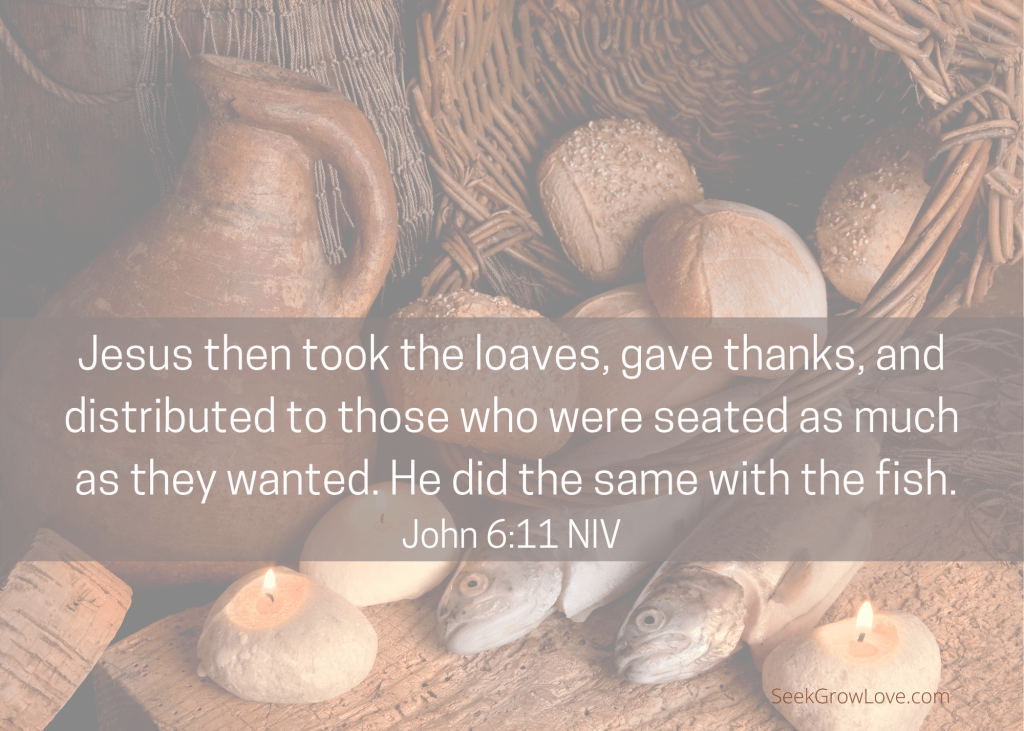
Today we are reading of the event from John’s gospel. John had been an eyewitness to see so many of Jesus’ miracles, but he chose to include only 7 in his gospel account – one of them being the Feeding of the 5,000. Dr. Joe Martin, New Testament professor at Atlanta Bible College, loves to point out all the details we get from John. Unlike the other gospel writers, John wrote his gospel later in life, when the brain’s old memory bank is overflowing with fun little details of events long past. John is in fact the only author who tells where the 5 loaves and 2 fish came from – the little boy’s lunch. John even includes that the loaves were made of barley (a cheaper grain most often consumed by the poor). He also recalls and includes which disciple said what when. He did all he could to help his readers watch this amazing miracle unfold.
Can you picture yourself in that crowd, stomach growling but not wanting to leave to find food – you don’t want to miss a minute with Jesus. And then, you’re told to sit down and the food starts coming – and coming – and coming. Sure, it is simple barley loaves and fish, but they taste so good and filling. Word passes around that all this food came from one little boy’s lunch. How in the world could so many people eat and be filled with 5 loaves and 2 fish? There was no logical explanation. This man Jesus who had taken the bread and fish and gave thanks to his Father had just performed a miracle and you were there to see it and taste it and fill you up inside. You can’t wait to tell your friends and neighbors about your experience with this man Jesus.
After a retelling of the amazing walking on water scene (which truly deserves a devotion of its own), John includes the teaching Jesus gave calling himself the Bread of Life. Jesus realized that since he had miraculously fed the multitudes he would have a following constantly looking for another free lunch . How could he explain to them that through God’s plan, he (Jesus) could offer them so much more than a free meal that would fade away and be replaced with gnawing hunger again. God’s design was so much greater. Jesus said: “For my Father’s will is that everyone who looks to the Son and believes in him shall have eternal life, and I will raise him up at the last day.” (John 6:40).
You may have missed the free lunch, but don’t let this offer pass you by!
Remember Jesus’ words to Satan (and recited from what would become Deuteronomy) “Man does not live on bread alone, but on every word that comes from the mouth of God.” (Matthew 4:4 NIV). Look to God, fill yourself up on His Word and His Son. Nothing else satisfies. Nothing else leads to eternal life but the Bread of Life, the Son of God.
-Marcia Railton
Today’s Bible reading can be read or listened to on BibleGateway here – John 6.
Tomorrow we will read Matthew 15 and Mark 7 as we continue on our 2020 Chronological Bible reading plan.
Each day’s new reading through the gospels brings more “favorites” from the life and teachings of Jesus. So it is with today’s – too many great stories to choose what to write about. Since we will be reading John’s account of the feeding of the 5,000 and Walking on the Water tomorrow, we will focus today on Herod, his wife (and former sister-in-law) Herodias, her dancing daughter and the head of John the Baptist.
It is a difficult story to stomach. So much evil. Perhaps we have gotten used to questionable leaders and too much violence, and the familiarity of this short passage on Herod and John the Baptist can make it quick to read and pass over. But imagine knowing these people, living amongst them, and hearing of these events for the first time. Imagine sitting down to your morning cup of coffee, opening the newspaper and reading of the events that transpired just last night.
Of course you would have known King Herod was having his birthday party last night – everyone could hear the sounds from his palace. And, yes, the newspaper calls him King Herod, since that is what he loves to be called, even though everyone knows his dad had been the last King Herod (yes, the one responsible for killing all the baby boys of Bethlehem about 30 years ago). In reality, now Herod Antipas was just a “tetrach”, ruling over just one quarter of his father’s territory, all the while being watched over by the real Roman authorities.
Herod had divorced his wife in order to marry his half-brother’s wife, Herodias. The only trouble was this prophet of God known as John the Baptist had been speaking out against this marriage, saying it was unlawful. Unlawful for who? Who’s law was it anyway? God’s? Herod wasn’t one to try to follow all those outdated laws – it was so much easier to just make new laws instead (similar to today’s society which is very good at ignoring God’s law and replacing it with their own).
His wife, Herodias, was not one to stand idly by while a prophet pointed out the sins of her family. Something had to be done. Herod (prompted by his wife) had John arrested, bound and put in prison. But, that wasn’t enough. While Matthew records that Herod wanted to kill John, Mark has a slightly different interpretation of Herod and perhaps digs a little deeper into his motives, relationships and thoughts. Mark says that it was Herodias who, “nursed a grudge against John and wanted to kill him. But she was not able to, because Herod feared John and protected him, knowing him to be a righteous and holy man. When Herod heard John, he was greatly puzzled; yet he liked to listen to him.” (Mark 6:19-20) which I am sure made his wife even more livid.
So, we come to the night of Herod’s birthday party and the entertainment for the evening – Herod’s dancing step-daughter (unnamed in the gospels, but Jewish historian Josephus records her name to be Salome). We aren’t told the details (thankfully), but we can guess that this was not a 5 year old girl performing her latest ballet or tap recital pieces for her father’s dinner guests. Whatever the dance included, it seems likely she was being exploited by her mother and ogled (or worse) by her step-father and all his male guests. These men liked her dance so much Herod thought it fitting to offer this dancing wonder anything she wanted (up to half his kingdom).
That’s a lot for a girl to think on – so she goes running out to get her mother’s advice. Herodias is prepared for this moment and she has no trouble involving her “innocent” daughter in getting what she has been waiting for – the death of John the Baptist, in the most gruesome way she could imagine – his head on a platter for her daughter.
Herod is in conflicted agony but sees no way out. The execution is ordered and completed. The head is delivered.
Can you imagine the varying emotions of each and every participant and those who will hear of these events.
What are John’s last thoughts?
Does Salome have nightmares? What does she become?
What do Jesus – and his 12 Disciples feel? If this is what comes of the one who prepares the way of the Messiah, what is the future of the Messiah – of his followers?
Herod will be mentioned just once more in the gospels – when Jesus is arrested, bound and brought before Herod on trial. Jesus remains silent – but quite likely he is remembering Herod and John as well as looking into his future.
Some days it just looks like evil triumphs.
But God is still at work. This is not where the story ends.
Herod will go to war and suffer defeat at the hands of the angry father of his first wife, whom he had divorced to marry Herodias. Later, Herod and Herodias will be sent into exile, where it is recorded Herod dies.
But, that’s not really the end, either.
A resurrection day is coming. A day when John the Baptist will rise from the dead. Can you imagine the reunion he will have with Jesus? I want to see that!
And, a judgment day is coming. Herod and Herodias will appear before the judge. At that time there is only one law that will matter – God’s. And, only one way to salvation – to accept the Lord Jesus Christ.
Some days it looks like evil triumphs – but that’s not how it ends!









 Seek Grow Love