Ready for the Day. And Ready for the Night.

Old Testament: Exodus 23 & 24

Poetry: Psalm 29

New Testament: Matthew 25:1-13

Are you ready for the day? Do you have clean clothes to wear, you have your keys, phone and wallet, your homework is done, you have prepared for the meeting or test, and you remembered to brush your teeth before leaving the house. It’s a good feeling to be ready. 

When was the last time you were caught unprepared? You scrambled to put together a clean (maybe matching) outfit because the dirty hamper was overflowing, the teacher gave a pop quiz, visitors found a messy house, you didn’t have the project complete when the boss wanted it, the bill wasn’t paid by the due date, and in the rush to get out the door you forgot to brush your teeth. It’s no fun not being ready. 

In Matthew 25 today we read of the Parable of the Ten Virgins, or Bridesmaids, depending on which version you read. They are all anxiously waiting for the bridegroom’s arrival and they all have a lamp/torch/light with them as it is day now but they don’t know when he might come, so they (seem) prepared to wait even if it grows dark. And it does. 

Jesus tells us five of the virgins (typically referring to purity) were wise and five (still, pure virgins) were foolish. And since they all had their lamps with them and were anxiously awaiting the bridegroom’s (Jesus’) arrival I feel it is safe to say that all ten would call themselves “Christians” or Jesus followers. The five foolish aren’t chasing after the world and doing immoral, evil things. They have their lights and are waiting, right along with the five wise.  I think they are even sitting in the church pew and doing all the right things right along with the wise, all day long.

And then it grows dark. BOTH the wise and foolish get drowsy and even begin to sleep. BOTH are wakened with the great news, “The Bridegroom is coming!” But now we run into trouble. Well – half of them/us do. 

Five of them didn’t bring oil to keep their lamps burning, their lights are going out, and they haven’t seen the bridegroom yet. They desperately demand to get some oil from the five wise who brought oil with them, but the wise know they don’t have enough oil for both their light and another light. In the final moments the foolish run off scrambling to go buy more oil. And it is in those final moments that the long anticipated arrival of the bridegroom takes place. He finds the five wise waiting with their lights burning bright and he ushers them into the wedding feast. The door is shut and the party begins. 

In the previous chapter Jesus had just warned of the darkness that would proceed his second coming: increased wickedness, love of most growing cold, many deceived by false prophets and false christs, war, famine, earthquakes, and persecution. He warned that during that time of darkness many Jesus followers will fall away. They are the 5 foolish. They are the ones who won’t have enough fuel to keep their light burning through the darkness. They are the ones who will miss the party and be left out in the dark and will hear the Savior say, “I don’t know you.” 

Each person needs to be prepared – and stay prepared – even in the final dark days/moments/hours. Just having a light in the daytime is not enough. Just walking with the wise, right crowd is not enough. It won’t work to get into the Kingdom with a spouse, parent, grandparent, pastor, or friend who is prepared. You need your own light – AND the oil to keep it burning bright all night long if needed. 

Which half will you be a part of? Are you prepared? Are you ready? Do you have your light with you? That’s a good first step! But are you also prepared for the coming darkness that will indeed come before the Savior arrives? Do you have enough fuel to keep your light burning bright until you are ushered into the great wedding feast? Are your ready for the day? Are you ready for the night?

-Marcia Railton

Reflection Questions

  1. First off, are you a Jesus follower, waiting for his return, prepared with a light?
  2. Are you prepared to keep your light burning in the darkness?
  3. What part of the darkness scares you most (wickedness, deception, natural disasters, famine, persecution)? How can you work on strengthening your stand now and preparing for the darkness so you won’t fall away in the darkness? 

The Beginning of Birth Pains

xr:d:DAF8NF_5EZI:9,j:2796027509192958279,t:24020812

Old Testament: Exodus 21 & 22

Poetry: Psalm 28

New Testament: Matthew 24

            I have never had a baby.  Shocker, I know!  As a male member of the human race the act of childbirth has and will forever elude my lived experience.  However, as a father of eleven Fletchers, I have spent many years of my adult life in the company of pregnant women, or more precisely, a pregnant woman.  I was there for all eleven births and I caught most of them (the last one came so quickly that I caught him solo).  All this is to offer to you my credentials that, although never directly experiencing labor, I have been present for enough births to recognize the various stages that women go through in childbirth.  Fun fact, for women who have more than one baby the Braxton Hicks contractions (otherwise known as false labor) can come several weeks or even months before the baby is actually born.  Braxton Hicks contractions are one way that the body prepares itself for labor.  It’s like an athlete doing warm up exercises before the actual event.   Muscles tighten and relax as they practice for the real thing when it comes. 

                Today’s devotion isn’t really about childbirth, it’s about being prepared for the return of Jesus Christ, the end of this present age and the preparation for the age to come, the Kingdom of God.  Matthew 24 is known as the “little apocalypse”.  Apocalypse is another term for Revelation.  In the Bible the book of Revelation is 22 chapters long and goes into a lot of detail about the end of this age and the coming of Jesus.  Matthew 24 is a condensed version, kind of a mini-sermon Jesus preached to his followers shortly before he went to the cross.  (You will run across parallel or “synoptic” passages when we get to Mark 13 and Luke 21).

                Jesus’ purpose here is to prepare his followers to be ready for times of great tribulation or distress that would come immediately prior to his return.  If you’ve ever read or heard a sermon about the apocalypse or the end of the world or Armageddon you probably are aware that Jesus warned that before things get amazingly better- ie. The New Heavens and the New Earth, Christ returning to rule over all the world bringing a final end to all sin and death and setting free the whole earth from the “curse” of death… before things get amazingly better, there will be a time when they become incredibly hard.

                A brief study of the history of the Church for the last 2000 years will show that Christians have gone through hard times a lot.  In the first 2 centuries the problem was the Roman Empire.  Followers of Jesus were often told that they had to renounce their loyalty to Jesus and declare their loyalty to Caesar alone.  When they refused, some of them were thrown to the lions or burned at the stake.

                Since Christianity was legalized in the Roman Empire it has faced challenges in many parts of the world at different times.  In the 17th century Christian missionaries in Japan were killed for their faith.  In the 1930’s Christians in Germany who failed to support Hitler faced severe persecution and some, most notably Dietrich Bonhoeffer, were executed for resisting Nazism.  Christians in Communist China and the Soviet Union experienced incredible persecution during most of the 20th century.  There are places in the Islamic world today where Christians who attempt to proselytize Muslims face the threat of execution.

                Every generation of Christians since the first century could look at what was happening in the world and see the potential for the end of the world.  Jesus’ own disciples asked him right after his resurrection, before he ascended to God, “Is it NOW, Lord?” (Acts 1:6).

                2020 was a really challenging year with Covid, racial division, murder hornets, wildfires and hurricanes.  I had a lot of people asking me if I thought the end of the world was coming.  Perhaps you’ve wondered that yourselves.

                Matthew 24 is a great place to go when you start wondering if this is the end.  Like a woman who is going to have a baby, she may have “birth pangs” for a long time before the baby is actually ready to be born.  The same is true with the coming Kingdom of God.  I think every generation of Christians experience some amount of persecution or “natural” disasters or other tragedies that leave them wondering if the end could be near.  Just as Braxton Hicks contractions are God’s way of preparing a woman to give birth by having her muscles practice for the big event, God permits every generation to experience a certain amount of trials and tribulations to help prepare God’s people for the final “great push” that will occur right before Jesus returns.

                Jesus himself said that no one knows exactly when he will return.  He said that even he doesn’t know.  That is something that only God knows.  What Jesus does say to his disciples then and to us today is that we need to stay ready, we shouldn’t fall asleep in our faith.  He warns that as troubles and persecution increase and as the world becomes a less loving and more violent place that many of his followers would fall away:

                “At that time many will turn away from the faith and will betray and hate each other, and many false prophets will appear and deceive many people. Because of the increase of wickedness, the love of most will grow cold, but the one who stands firm to the end will be saved.” (Matthew 24:10-12).

                Jesus might come very soon. I can’t predict when.  All I can do is make sure that I’m ready whenever he does come.  I must make sure that I stay faithful and don’t turn away even if the persecution gets really bad.  I think Christians living in the United States are getting ready to face some real persecution in the near future.  In fact, I think we already are.  There is a lot of pressure to conform to the changing norms of society.  Cancel culture will not have any respect for Christianity.  Some of the things that the Bible teaches about how we are supposed to live, particularly in areas of morality, sexuality and gender norms are considered anathema by the current progressive climate.  As people place more value on becoming “woke” more followers of Jesus, young and old will be persecuted if they fail to change their values.  Remember, Caesar doesn’t like to be rejected as God, neither does the devil, and neither do the progressive elites.  In the wake of the coming persecution Jesus our Lord tells us to “stand firm.”

-Pastor Jeff Fletcher

(originally posted January 24, 2021 for SeekGrowLove)

Reflection Questions

  1. Make a list of what Jesus warns us of in Matthew 24. How does it help to know what to expect?
  2. How can you guard against the deception of false christs and false prophets?
  3. Have you already seen a bit of the increase of wickedness and the love of most growing cold? Has it affected you personally? What temperature is your love? 
  4. What can you do today to help prepare yourself to stand firm to the end? What can you do today to help prepare others to stand firm to the end? 

The Big Ten

Old Testament: Exodus 19 & 20

Poetry: Psalm 27

New Testament: Matthew 23

Today’s reading of Exodus 19 & 20 is probably one of the most familiar passages in the whole Bible for it includes the Ten Commandments.  It is important to understand the context of these commandments.  God entered into a covenantal relationship with Abraham and Abraham’s descendants through Isaac and Jacob and Jacob’s sons who became the twelve tribes of Israel.  God promised to bless and provide for his people and in exchange His people promised to be faithful and obedient to God and worship God alone.

After 400 years of slavery, Israel has grown from 12 sons and their immediate family to millions of people.  These people, God’s covenant people, will be settling in a land where they will need to live in community.  They are no longer slaves.  They are now responsible to live in that community in peace and productivity.   They need help to know how to live together.  God provides His people with the structure of how to live together as God’s people.  The Ten Commandments and subsequently nearly 600 additional laws were all designed to help them be healthy and blessed representatives of God to the rest of the world.

God loves all people.  We must never falsely believe that God only loves certain people.  God considers all human beings His children and loves them all.  God wants to be in a right relationship with all of his children; however, many are disobedient and have no willingness to be in a relationship with God and many deny that God even exists.

So God needed to start with one group of people and prepare them to be a special, chosen people who would bring the knowledge of God to others.  Exodus 19:5-6 says, “Now if you obey me fully and keep my covenant, then out of all nations you will be my treasured possession. Although the whole earth is mine, you will be for me a kingdom of priests and a holy nation.’

Israel was to be a kingdom of priests and a holy nation.  A priest is one who helps connect people and God.  God would go on to designate priests in Israel to help the people connect with God, but His expectation for Israel was that the whole nation serve as priests to help other nations connect with God.  Because the whole nation was being set apart by God to be priests for the world, they needed to live holy or set apart lives.  There were behavioral expectations that they were to follow.  They had to be exclusively loyal to God, they could not murder, steal, lie, cheat, they were to be respectful and honoring of parents and not misuse God’s name.

Now we are completing what God began in Israel.  Through Christ we have entered into a covenant with God.  We are now the covenant people, we are called to be a kingdom of priests and a holy nation.  That is the Church’s role.  And God expects us to live lives of holiness as we are set apart to serve God.  As you read through the many laws in the Old Testament, recognize that some applied very narrowly to the Nation of Israel and do not necessarily apply to us.  Dietary laws and sanitary laws were important in Israel at the time they were given but are no longer applicable.  However, some of the laws which pertain to morality have been reaffirmed by Jesus Christ for the Church.  In other words, as Christians we are free to eat pork and worship on Sundays, but we are not free to practice polygamy or murder.

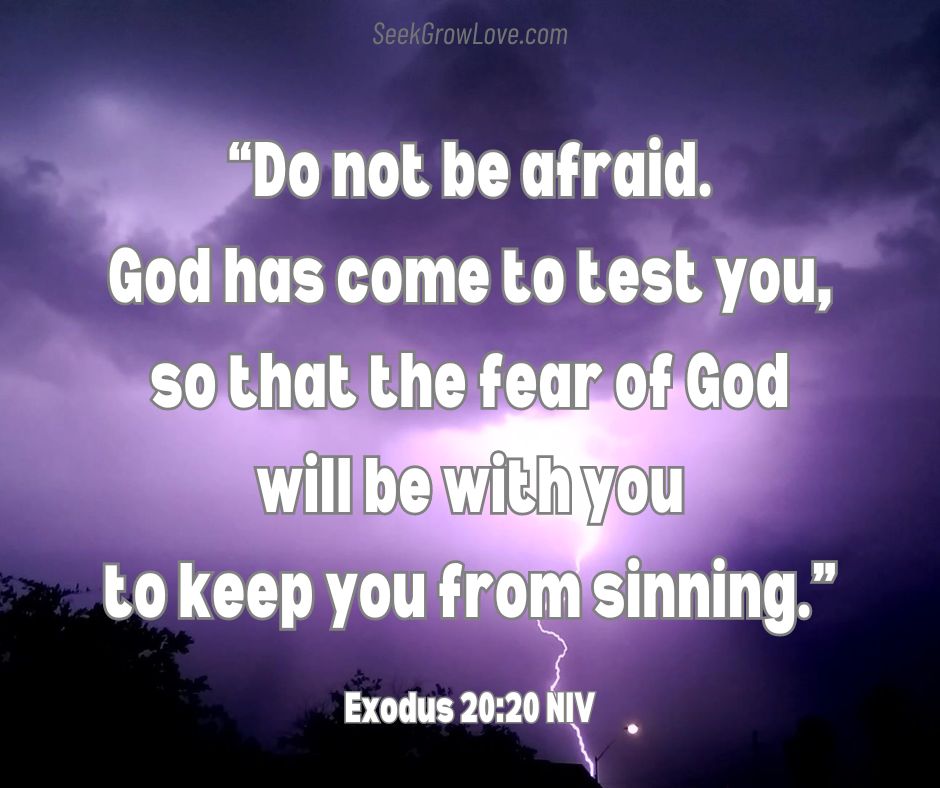
God is truly a God of grace and mercy, but God is also a God who hates sin and punishes sin.  In this way we are still to live in fear of the Lord: Exodus 20:20 “the fear of God will be with you to keep you from sinning.”

Jeff Fletcher

(originally posted Feb 5, 2020 for SeekGrowLove)

Reflection Questions

  1. Looking at each one of the Ten Commandments, what can you learn about God? Why do you think He included each one in this list?
  2. Which of these commandments do you need to look at more closely in your own life? What will help you abide by them better?
  3. Looking at Matthew 23, the scribes and Pharisees Jesus was speaking about had worked hard at following the Ten (and additional commandments). But Jesus was not pleased. What were their problems? How can you avoid these problems?

Fight-Pray-Watch-Write

Old Testament: Exodus 17 & 18

Poetry: Psalm 26

New Testament: Matthew 22:15-46

Sunday I said I love a good underdog story. It just so happens I also love a good battle story – and the Bible does not disappoint. There are many great battle stories in God’s word, including one in today’s reading in Exodus 17 of young Joshua (this is the first time he is mentioned in Scripture) battling the Amalekite army that attacked the Israelites.

My favorite kind of story though are the faith stories. How did God come through and save the day – again? What was needed and how did God deliver? Who was praying, where, and who witnessed the answer to prayer? And, how did they praise God for the answers sent? And – once again – the Bible does not disappoint. 

In fact, the battle story of Joshua vs. the Amalekites is also a great faith story. For while we have Joshua leading his very first battle with an army he put together in a day, we also have Moses holding the staff of God on the top of a hill overlooking the battle below. The action on the battlefield is just part of the story. It is the intercession on the hill which is pivotal in the outcome below. ”As long as Moses held up his hands, the Israelites were wining, but whenever he lowered his hands the Amalekites were winning.” (Exodus 17:11) 80 year old Moses wasn’t on the battlefield but he was so important in the events of the day!

The trouble is – fatigue and weariness set in and his arms were getting heavier and heavier. He couldn’t hold up his arms any longer. He couldn’t do it alone. Intercession for the army below was not a one man job. Luckily, Aaron and Hur were on hand, saw the need, and stepped up. They provided a stone for Moses to sit on and with Aaron on one side and Hur on the other, they propped up Moses’ weary arms so that his hands remained outstretched toward heaven. 

And at the end of the day (and it did take all day) the Israelites beat back the Amalekites. And it wasn’t just because of the Joshua and his soldiers. And it wasn’t just because of the steadfast intercession of Moses, Aaron and Hur. It was a direct result of all of those AND mostly due to a mighty God who gave the victory. Moses realized this and he gave the glory to God as he built an altar to God and called it, “The LORD is my Banner.”

Does your prayer matter? Yes! There is great power in prayer and too often we take it much too lightly. We might mumble off a few sentences about, “Dear God please be with _____ and help her with ______ today.” But, when was the last time we let prayer and intercession order the events of our day, inconvenience us, or even cause a bit of pain? 

What could be changed if we take more seriously the job of lifting our hands to the throne of God? Realizing that prayer is not a one man job, who can we involve in praying with us? If you are currently on the battlefield, who can you ask to lift up hands in prayer for you and the victory you are fighting for? And how will you give the glory to God for sending answers and showing his goodness, power and love. 

I am thankful these stories have been written down to for us to learn and remember. And, I love that God told Moses to write the events of that day long ago down for Joshua to remember. How often do we forget how God displayed His goodness and power in our own lives and through the intercession of others? What great faith stories have you witnessed – perhaps as the warrior on the battlefield or perhaps as the intercessor on the hill? Will you write it down?

-Marcia Railton

Reflection & APPLICATION

  1. It is not recorded what specific words Moses may have been praying aloud or silently. In fact the word pray is not included in this passage. Do you think we might focus a bit too much on what words we say in prayer when God is more interested in our heart and arms uplifted to him (not just physically, but spiritually lifting needs to him with a devoted heart)? 
  2. There were a lot of questions in the devotion to contemplate. Which ones do you want to spend more time on?
  3. This has been on my mind for awhile now – so today is the perfect day to ask for your help! I would love to compile a collection of written faith stories from warriors and intercessors who have seen the One True God provide the victory – in both big and small ways: the keys were found, the prodigal son returned, the need was met in unexpected ways. Do you have a story you would write down to be shared? If so, please reach out to me so I can read and share your story! You can leave a comment below or find me on facebook or email me at grow16br@gmail.com. 

Your Royal Wedding Banquet Invite

Old Testament: Exodus 15 & 16

Poetry: Psalm 25

New Testament: Matthew 22:1-14

What was the best party you have ever been to? How did you get invited? What was your relationship with the host? With the guest of honor? Who else was there? What did you wear?

Or, maybe there was a party you were invited to that you didn’t make time for? Perhaps you didn’t really know the guest of honor that well so you weren’t too interested. Or maybe you were mad at the host so you stayed away? Or you figured it would be boring since they didn’t have (insert hobby/entertainment/person of interest). But then, come to find out – you missed out on the party of the century.

Jesus knew we like to talk about parties. Wedding receptions are particularly exciting – and royal wedding parties top the charts. So what a perfect parable and analogy for the Kingdom God is preparing. God is the King – and as host of the party he decides who to invite to this event of all events which will honor His Son – Jesus.

The guest list starts out somewhat small and elite which is very fitting for a royal party. The Jews were the first to be invited to the party. They could trace their heritage back to Abraham, Isaac and Jacob – the fathers of the faith. But, they ignore their invite and the God who sent it. They don’t even RSVP. God sends his servants out as messengers (the prophets and those who speak for God) to remind God’s people of the graciousness of their host and the splendor of the party. But, the potential guests of the party are too deep into other things – their fields, their businesses, their homes, their selfish pursuits, their false gods. Most just ignore God’s messengers – but some decide the best way to decline the invite is through violence. In rage they attack God’s messengers, even killing some. For a time they may have thought they got away with it. But, God knows and delivers judgment.

The guests didn’t show but the party isn’t cancelled. God sends his messengers again. They hit the streets with new invitations. “Invite them all,” says the host. It no longer matters who your great great great grandfather was. It doesn’t matter who you were or what you did. Old, young, rich, poor, men, women, children, black, white, and every color in between. You are invited! And all your neighbors in the world are invited! Let the party begin.

But, wait – that’s not yet the end of the parable or God’s expectations. The host has indeed invited all and is ready to receive all into His Kingdom Party. But, you must come dressed appropriately for the party so you aren’t tossed out. No, God won’t check to see if you have a designer label – but He will check to make sure you have clothed yourself with salvation. To accept your invitation accept God’s Son as the only way to salvation. And then put on the robes of righteousness – seek to live the life that will bring glory to the Father and the Son. There are many passages that continue the analogy of being properly clothed with righteousness, not stained with sin (some are Job 29:14, Isaiah 61:10, Jude 23, Revelation 3:4 and 19:8).

The greatest party ever to come is about to begin and you and all your neighbors are invited. Don’t turn down the invite because you are mad at God or don’t know Jesus well or are busy at home and work. Accept His invitation. Come to the party. But don’t make the fatal error of trying to sneak in unprepared. Accept His Son and clothe yourself with righteousness. Make sure your neighbors know they are invited and help them select their proper attire.

And then – let the party begin!

-Marcia Railton

(originally posted for SeekGrowLove on January 22, 2021)

Reflection Questions

  1. Some of the people invited to the wedding banquet in Matthew 22 paid no attention because they were too busy with other pursuits. In your own life what vies for the time and attention it will take to accept the wedding banquet invitation? What do you value most? Are you making plans and preparations now to attend the wedding banquet? 
  2. Are you already clothed in the proper garments? Have you accepted Jesus as the only way to salvation from the Father? Are your deeds, words and attitudes reflecting your desire to live a righteous life? What are you still lacking? 

The Long Way Around

Old Testament: Exodus 13 & 14

Poetry: Psalm 24

New Testament: Matthew 21:33-46

I love a good underdog story. And there aren’t many better than the slaves overcoming Pharaoh. 

There are SO MANY phrases that stick out to me as I am reading Exodus 13 & 14 that make this story stand out as a grand and glorious experience of what God can do and why it is worthy of being remembered. 

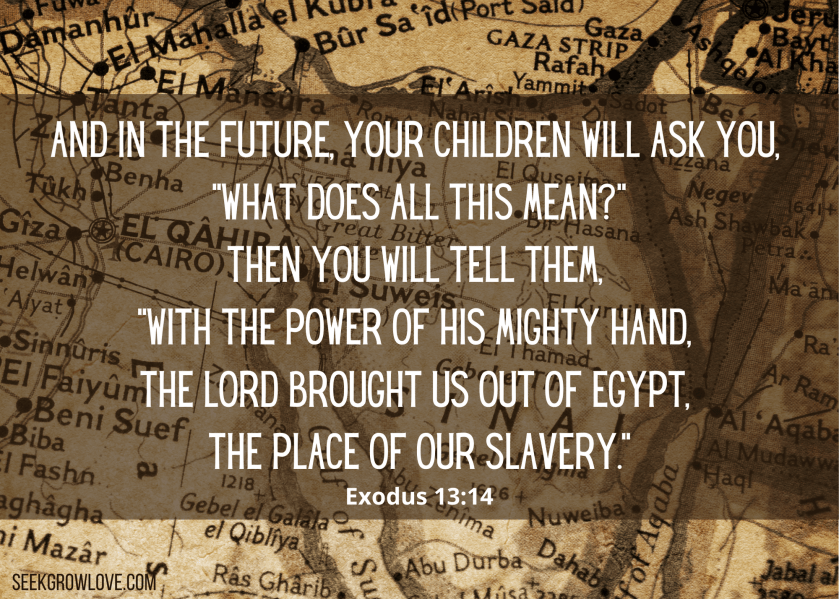
The Israelites have JUST left behind their lives as slaves. And God says – let’s remember this event, every year, in fact, for 7 days every year let’s celebrate my power and goodness and these events unfolding now. And why? So you and your future generations can be reminded “that the law of the Lord is to be on your lips; for with a powerful hand the Lord brought you out of…” (Exodus 13:9)?  What reminders and signs and symbols do you have on your calendar and in your home and in your life that remind you and the future generations to speak of God’s power and rescue and goodness? 

Do you ever get frustrated when the GPS sends you the long way around when you know the area just well enough to know there is a shorter way which is generally quicker? Or, maybe you can relate to when God doesn’t send the quick and easy answer you had in mind, but sends you on a completely different path in life, perhaps even through the desert. God did the same for the Israelites – for a very good reason. We don’t always get to see, hear or understand WHY the GPS sent us this way instead of that. Perhaps there was an accident ahead or a bridge out and so a better route was selected. Similarly, we don’t always get to see, hear and understand God’s reasoning on why He chooses which path to send us on. But in this particular case Moses writes that God knew the quickest route to the promised land would be through the Philistine country. But, he also knew they weren’t ready for war and if they faced war now they might get scared and return to Egypt. ”So God led the people around by the desert road toward the Red Sea.” (Exodus 13:18). Can we trust that God knows best, even better than our GPS? He knows which road is best for you, too.

Even when it seems to end at the Sea.

Because, at the edge of the water God does some pretty amazing things! Well, actually, He doesn’t wait til we get to the edge. He was sending a pillar of cloud to guide them during the day and a pillar of fire to guide by night – that sounds like a pretty cool night light to follow. God was showing His protection and guidance, but can you imagine the fear they must have felt when they looked up and saw the Egyptians coming after them, as they were at the edge of the Sea. Terrifying fear that leads to anger and outrage directed toward Moses and the Lord. But Moses says, “Do not fear! Stand firm and see the salvation of the Lord that he will provide for you today; for the Egyptians that you see today you will never, ever see again. The Lord will fight for you, and you can be still.” (Exodus 14:13,14 NET). What fearful situations have we found ourselves in where our fear turns to anger toward God and men? Could it be God is telling us to stand firm to see how He will deliver us, save us, and fight for us? 

I love how it says the angel of God and the pillar of cloud which had been leading the way now moved to the rear, positioning themselves between the scared Israelites and the powerful Egyptians and all night the cloud brought darkness to the Egyptians and light to the Israelites. 

Now the stage is set and God acts – again – in a mighty way! He sends a strong east wind all night long. We’ve all seen some amazing and terrifying things wind has done. But this beats them all. A wind strong and long enough to drive the sea back and turn it into dry land, with a wall of water on the right and a wall of water on the left. Typically people don’t survive well in hurricane force winds that create walls of water. But on this miraculous night, the people, young and old as well as all their flocks and herds all walk across the sea on that dry land! Can you imagine the amazement and awe and dream-like experience that must have been! I wonder if it was difficult to walk upright? I wonder how wide the dry path was for the 600,000 men (and women and children)? I wonder if there were children on the edge of the dry path trying to run their fingers through the wall of water while their mothers were urging them ahead. I wonder what the Egyptians thought as they followed in their chariots, still in the dark. 

Exodus 14:24 says, “During the last watch of the night the Lord looked down from the pillar of fire and cloud at the Egyptian army and threw it into confusion.” Some versions say He made the wheels come off the chariots, others translate it that He jammed their wheels so driving the chariots was difficult. Either way, it seems to me a bit humorous – as long as I am not an Egyptian. We love to remember the God who saves His people – as long as we are one of His people. It would be wise for us to also remember He can and has and will frustrate and confuse the way of His enemies, and make sure we are not in that category. 

Don’t find yourself still in the dark – walking on the wrong side of His cloud of protection and guidance. God is providing light on the other side. Seek Him and what pleases Him. And Stand Firm and watch His salvation. 

-Marcia Railton

Reflection Questions

  1. In what ways have you seen God provide favor, protection, guidance and sometimes even miraculous intervention to save His people? 
  2. Is there a time God may have led you on the longer, indirect route to save you from an unknown pain on a shorter more direct route? 
  3. How will you seek to remember and share with future generations what God has done – both during the time of the Israelites and in your life as well? 

Stop! And Just Listen to Him…

Old Testament: Genesis 49 & 50

Poetry: Psalm 22

New Testament: Matthew 17

We live in a very busy culture in America. For those that are students, you are expected to fill your schedule with 8-hour school days, additional homework when you get home, some extracurricular activity after school, and then sometimes a part-time job on the side. Then, you are also expected to have some time on Wednesdays and Sundays to give to God at the church. For adults, if you aren’t spending at least 40 hours at work, plus some additional overtime, you feel like you didn’t accomplish much. Although, you also have to prioritize keeping up on your house, caring for your family, finding some sort of hobby to enjoy yourself, and also dedicating some time to serving at your church. If we have any “dead time” in our schedule, we feel like we wasted our day.

Did Jesus intend for us to be this busy as disciples? Did he want us constantly running, even when it comes to serving him?

In our passage today in Matthew 17, Peter acts very much like we do. On the top of a high mountain, as Jesus is transfigured before him, James, and John, and they are witnessing a glimpse of what the kingdom of God will be like with Moses and Elijah, Peter immediately wants to jump into action by building some shelters for these great heroes of the faith. At that moment, God speaks up (which is VERY rare in the Bible) and says to simply listen to Jesus, His beloved son. God stops Peter from acting too quickly and slows him down so that he can truly embrace what is happening in front of his eyes: He didn’t want Peter missing the moment by doing something about it.

We are encouraged today that discipleship with Christ isn’t only “doing” something for him: sometimes it is simply “being” in Jesus’ presence and listening to his voice (does this sound like Mary and Martha in Luke 10?) One of my “life-verses” right now has been Mark 3:14, which I used to read over without really reading it. It states, “And Jesus appointed twelve, so that they would be with him and that he could send them out to preach.” Did you catch that? The first thing that a disciple is supposed to do is “be with Jesus”, even before we “do” anything for him. We need to understand that time spent “with” Jesus fuels everything else we “do” for him. We need to re-learn Jesus’ words in John 15: “I am the vine, you are the branches; he who abides in me and I in him, he bears much fruit, for apart from me you can do nothing… abide in my love.” (John 15:5, 9)

Brothers and sisters, break away from the rat-race of life today and do what Jesus commanded us to do first: sit and listen to his voice. Spend some time today simply “being” with Jesus, realizing that you can do nothing without this dedicated time with your Savior. He loves you as you are, not for what you do for him: abide in his love today.

Talon Paul

Reflection Questions

  1. Is being with Jesus and listening to him important to you? Why or why not? 
  2. If it is, how can you make time to be with Jesus and listen? What can you rearrange (or eliminate) in your day to make a better space of time to listen?

What is the Gospel?

Old Testament: Genesis 47 & 48

Poetry: Psalm 21

New Testament: Matthew 16

If you were asked what the gospel is, what would you say?

Most Christians today would tell us that the gospel is primarily about Jesus dying for our sins and rising from the dead. While that is certainly good news, and necessary for our salvation (see 1 Corinthians 15:3-4), is that the entire story? Our passage today tells us something different, in a verse that is usually “skipped over”: it is Matthew 16:21, which states that “from that time Jesus began to show his disciples that he must go to Jerusalem, and suffer many things from the elders and chief priests and scribes, and be killed, and be raised up on the third day.” If Jesus only started talking about his death and resurrection in chapter 16, what has he been talking about the previous 15? We are already halfway through Matthew: are we missing something important that Jesus meant to share with us?

If we return to the beginning of Jesus’ ministry in Matthew, we read that after his baptism and temptations in the wilderness, Jesus began preaching about the kingdom of God/heaven: “From that time Jesus began to preach and say, ‘Repent, for the kingdom of heaven is at hand.’” If you look back throughout Matthew, almost everything that Jesus talked about revolved around the kingdom of God. In another book, the Gospel of Luke, Jesus clearly tells us that his primary purpose in ministry was to teach about the kingdom of God: “I must preach the kingdom of God to the other cities also, for I was sent for this purpose.” (Luke 4:43)

It is an unfortunate reality that many Christians today are completely unaware of what Jesus taught concerning the kingdom of God: they have only been introduced to his death and resurrection. A friend of mine was at a pastor’s conference and asked a group of pastors what the gospel was. Of course, they answered as most people would, that the gospel is about Jesus dying and rising for our sins. Then my friend directed them to Luke 4:43 that we just read, and they were stumped. Remember, these were PASTORS, and they had no clue about Jesus’ kingdom message…

Brothers and sisters, Jesus’ death and resurrection are crucial parts of our salvation: we have no hope of being saved without it. However, we shouldn’t neglect the largest message of Jesus’ entire ministry: the kingdom of God. I want to encourage you today to skim through Matthew and find out what Jesus says about the kingdom of heaven/God. You may be surprised at how often it shows up and how important this kingdom is.

So I’ll ask you again, what is the gospel? May you find the truth that Jesus revealed to us today.

Talon Paul

REflection Questions

  1. What do you find Jesus teaching about throughout Matthew? 
  2. What is the danger in missing what Jesus taught?
  3. If you were asked what the gospel is, what would you say?

Additional Requirements

Old Testament: Genesis 45 & 46

Poetry: Psalm 20

*New Testament: Matthew 15

I have been involved in many food service jobs over the years, including food delivery. There was one particular food delivery job that I will never forget because of the absurdity involved with my employer. I had signed up to simply deliver food from restaurants for a company that was like a local GrubHub or UberEats. Things went along smoothly for the first month, until my employer got a wild idea: he wanted to deliver the local newspaper as well (he was nervous about losing business because of larger companies coming into town). For the second month, I was taking on a newspaper delivery route, as well as taking food orders when I could (sometimes working 12-hour days). It didn’t take long before I left that job because it wasn’t what I signed up for: my employer was adding requirements to the job that were not agreed upon from the beginning.


Does this happen in church too? When it comes to eternal life and being saved, do we add requirements that were not originally stated by Jesus or the apostles? Jesus encountered this in our passage today with the Pharisees and scribes. They were teaching that one must wash their hands before eating in order to be “pure” before God, something that is called the tradition of the elders. While washing your hands is still a good practice, there was nothing in the Old
Testament that ever stated this as a requirement: God was not requiring this to be in His presence, but men were. They were seeking control over the people and adding requirements that were not original.


Unfortunately, the Church today oftentimes does the same thing: adding requirements for salvation that were not original. For example, the Nicene Creed (325 AD) that is recited at many churches today states that Christians must believe that Jesus is “true God from true God, begotten, not made, consubstantial with the Father…” There isn’t a single verse in Scripture that
describes Jesus in this way, but it is a required belief for salvation in many churches today. Not only that, but there are usually cultural expectations in many churches that are required for fellowship, such as the clothing you wear or the way you have your hair put up.


What does Scripture say about salvation? “If you confess with your mouth Jesus as Lord, and believe in your heart that God raised him from the dead, you will be saved.” (Romans 10:9) Many might call me a minimalist, but I don’t believe Jesus intended salvation to be complicated: it’s difficult to make him the Lord of our lives and do what he says, but it’s not complicated. It is supposed to be simple enough for a child to understand (Matthew 18:3).

Reflection Questions

  1. What church traditions are alive around you that are beyond Scripture?
  2. What have you been taught is required, even if it’s not found on the lips of Jesus or the apostles?


Talon Paul

An Appetizer

Old Testament: Genesis 43 & 44

Poetry: Psalm 19

*New Testament: Matthew 14

If you’ve ever been to the Texas Roadhouse restaurant, there is one thing you can always count on: bread and cinnamon butter. This is provided before every meal as a free appetizer, and on more than one occasion, we’ve had enough to be full by the time our actual meal arrived (the same can be said of the breadsticks at Olive Garden). Those rolls were not the meal, and were never intended to be the only thing you enjoyed: however, it gave you a taste of what was to come later, and whet your appetite for more (if you had enough room left in your stomach).

Our passage in Matthew 14 reminds me of our experiences at Texas Roadhouse: it offers us a “taste of what’s to come” in the kingdom of God. There were many people following Jesus at the time, and they were hungry from their journey of traveling after him: so Jesus miraculously offers them enough bread and fish to feed 5,000 men (probably about 10,000 people when you include women and children). What Jesus was doing was showing them what the kingdom of God was going to be like, as he was talking to them about its splendor. In Isaiah 25:6-9, we learn that the kingdom of God will be a time of tremendous feasting and the end of hunger forever: Jesus gives the crowd a foretaste of what this incredible moment will be like by doing this miracle for them.

There are two cautions that all Christians should be aware of when it comes to the kingdom of God. First, there are some Christians who are only focused on the kingdom of God in the future. While we still wait for the kingdom to come fully, we are able to presently experience some of it NOW and offer that to others (notice that Jesus invited his disciples to perform this miracle first). We are able to enjoy some of the kingdom of God’s blessings now, through the power of the Holy Spirit in our lives, as we anxiously await to experience it fully in the end when Jesus comes. We should never neglect the fact that “the kingdom of God is in our midst” when we have Christ dwelling inside of us (Luke 17:20-21).

The second caution for Christians is living too much in this life without having a hope for the future reign of God’s kingdom. Jesus is very clear: the kingdom of God will not come fully until he returns (Matthew 25:31-40). While we can experience an “appetizer” now, it’s not the full meal: never fill up completely on the blessings of this age, but look forward with hope towards the future when Jesus returns. We should LOVE his appearing in the clouds, longing for that day to come soon (2 Timothy 4:8). We need a balance of now and then: living for the future kingdom today, with hope that it is coming soon.

Do you look forward to Jesus’ return and the kingdom of God? How can you enjoy it today?

Talon Paul

Reflection Questions

  1. Do you look forward to Jesus’ return and the kingdom of God?
  2. How can you enjoy it today?
  3. How can you help feed (spiritually and/or physically) those who are hungry for more of Jesus and those in need of an appetizer of the coming glorious feast in the kingdom of God?