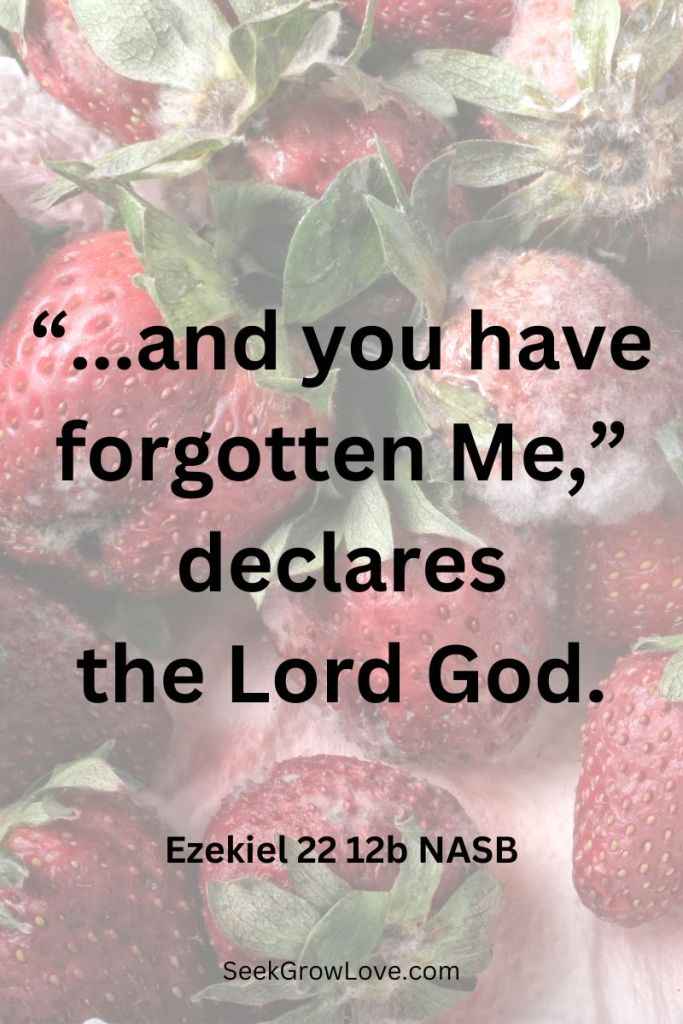
It seems as though fresh strawberries go bad so quickly. You get a package at the grocery and then sometimes by the next day they already start to expire. Maybe that morning you are in a rush when you see that one moldy spot. You know it’s not good, but you will get rid of that bad strawberry later. But, then you forget and by the time you check back in on them, half the package is moldy. And worse yet, this isn’t the first batch you have lost in such a manner. You knew better from previous experiences and yet you managed to find yourself in the same exact trouble.
This happened to me this week. I was reminded of these bad strawberries when reading Ezekiel 22. Time and time again, we see the Israelites in the hot seat after continuous rebellion against God. They should know better from previous experience, but they do not use that knowledge to do better.
I think it is interesting in verses 6-13 God declares the vile things that Israel had within itself. These things were not all immediately there. Rather, I imagine the Israelites allowed one bad thing in at a time until eventually almost the whole batch became rotten. Just as we do not always discard that moldy strawberry when we should, the Israelites did not turn to God and rid themselves of the sin when they noticed it. Rather they turned their heads and allowed more to sneak in and take hold.
In doing these terrible things, they forgot God. They turned their heads from Him and, to stay with the strawberry analogy, allowed the mold to consume them. These things that they did hurt one another and were against the very principles of their creator. These were against the very principles of loving God with all our heart, soul and mind and loving our neighbors as ourselves.
So with that I want to challenge you and myself with the following question. Are there any moldy strawberries in our life right now that we are ignoring? If so, let us, with God’s help, throw that strawberry out so that the mold from it will not spread further in our heart.
-Hannah Deane
Reflection Questions
Just like Hannah asked, “Are there any moldy strawberries in our life right now that we are ignoring? If so, let us, with God’s help, throw that strawberry out so that the mold from it will not spread further in our heart.”
When have you seen the progression of sin overpower and block out a desire to serve and follow God?
Have you ever been hiking in the mountains? Have you heard the crisp cool breeze filtering through the branches of the towering evergreens? The sweet melodies of birds and the rushing mountain stream?
I appreciate that in this Psalm the beauty of God’s creation is intertwined with praising the creator. The psalmist paints a picture for us of the mountains and the rivers singing together for joy. From the creation we can observe the majesty and power of its creator.
This past spring I had the opportunity to hike in the Carpathian mountains of Romania. I did not know that this grueling 12 hour hike was something I was embarking on until the morning of. It was cold, the hike was steep and in some places slick from the packed snow melt. I didn’t know when this hike was going to end as that was a secret my group’s leaders kept a mystery. And all we had to drink was warm sparkling water. At times it felt as though my legs would give out and that I was going to lose strength. But I had to just keep trusting my leaders and asking God for the strength to keep going. It was difficult.
But then we reached the summit. The snow capped peaks and majestic towering mountains surrounded us on almost every side. It was beautiful. From the heights I saw a new perspective than what I had seen prior to the hike. I could see new parts of God’s creation and praise him for the opportunity to explore it.
This is what this Psalm reminds me of. Sometimes after we go through those difficult times in life, we see why we had to climb steep mountain sides. For, without the difficult climb we would not now see the beauty of God’s handiwork. Because of this blessing to see the wonderful things that God has done, we can, as the psalmist writes, “sing to the LORD a new song”.
-Hannah Deane
Reflection Questions
What do you love about God’s creation?
What helps keep you going through the difficult “climbs” and times?
What difficult “climbs” have you gone through that now allow you to “Sing a new song”? How was the new song different from the old song?
Ezekiel 18 describes three generations of men in a family, the first generation is righteous and follows God, the second generation is evil and does everything that God detests, and the third generation is Godly just like the grandpa. According to the thinking of the Jews of that time each person inherits God’s blessings from their parents, so the evil man would be blessed by God and live a happy and fruitful life because of the righteousness of his father, while the son of the evil man will have a miserable and cursed life because of the evil of his father. God is going to make it very clear to them that their thinking is fundamentally faulty, because obviously a person who goes around robbing the poor, sleeping with his friends’ wives, and worshiping false gods is going to have a miserable life. He won’t have friends, and will never be trusted, no matter how great his father was. How is that a blessed life?
The opposite is also true, if the evil man has a son and that man lives a Godly life and helps the poor, and gives money to the needy, and keeps all of God’s laws he will have a full and blessed life. People might remember how horrible his father is, but his own actions will speak for themselves, and God will also see his actions and bless him.
This is summed up perfectly in Ezekiel 18:30-32.
“30 “Therefore, you Israelites, I will judge each of you according to your own ways, declares the Sovereign Lord. Repent! Turn away from all your offenses; then sin will not be your downfall. 31 Rid yourselves of all the offenses you have committed, and get a new heart and a new spirit. Why will you die, people of Israel? 32 For I take no pleasure in the death of anyone, declares the Sovereign Lord. Repent and live!”
This verse is a great blessing, but also a warning. It is a blessing if you or your family has a past that is full of sin and brokenness and you want to break the cycle, repent and live! It doesn’t matter what your parents did, good or bad, God will judge you for your own actions. This makes it very important to make our faith our own, because even though my Mom had and Dad has faith that can move mountains, that does not make me a Christian by default, I still have to work hard at it and build my own faith up. Just like how knowledge will never transfer from your textbook to your brain when you use the textbook as a pillow, righteousness will not transfer from your parents to you when you sit next to them at church, you have to open the book and read for yourself.
Chris and Katie-Beth Mattison
(originally posted August 31, 2020 for SeekGrowLove)
Reflection Questions
How are you like your parents and grandparents? How are you different?
When have a seen an individual completely different (in regards to righteousness and wickedness) than his or her parents or offspring? What does God’s righteousness and justice mean to you?
Ezekiel 18:29 says, “But the house of Israel says, ‘The way of the Lord is not right.’ Are My ways not right, house of Israel? Is it not your ways that are not right?” Like the house of Israel, have you ever accused the Lord of having a way that is ‘not right’? Who was right and who was not right?
Following our strange detail about John eating the Scroll that God gave to him, we are finally going to learn about what the Scroll says through what John tells us! Unfortunately, it is very detailed, also strange in some ways, and has been the cause of many interpretations over the past 2,000 years. However, we are going to do our best to humbly try and understand what John says in this passage, while focusing on his main point. I don’t assume that my interpretation is 100% correct, so I invite all of you to critique it by looking at the text itself and speaking with other Christian teachers that you trust.
We are introduced to two Witnesses, or two Martyrs, who are proclaiming to people “their testimony”. Now, throughout Revelation, we see that John testified to “the testimony of Jesus Christ” (1:2, 9) and that the Christian martyrs from chapter six also had a “testimony” that they proclaimed (6:9). We will learn later that Christians are able to overcome Satan using “their testimony” as well (12:11). Narratively speaking, it is likely that these two Witnesses have the same testimony as John and the Christians. That testimony is the gospel message about Jesus’ death, resurrection and eventual return to establish God’s kingdom, as can be seen throughout the whole letter. In other words, the two Witnesses are two individuals that are faithfully preaching the gospel to those around them.
There has been speculation as to whether these are literally two individual people that are to come in the future, or whether they represent what the churches are supposed to be doing, since they are described as lampstands like the churches (compare 1:20 and 11:4). I assume that these are representatives for what the churches, and us, are supposed to be doing, but also don’t believe that John’s main point is in their identity; John’s main point to this vision is what is produced by their faithful preaching of the gospel.
After the two Witnesses are killed, resurrected, and exalted to God’s space, the people actually repent of their evils! In 11:13, it states that people “gave glory to the God of heaven”, which is repentance language. As we saw in the previous seven seals and seven trumpets, and will see in the later seven bowls, God’s judgment actions are not enough to bring about repentance; but the faithful preaching of the gospel message is enough, even if Christians die for it!
My encouragement to you today is to behave like these two Witnesses; faithfully preach the gospel, even at the expense of your own life. Whatever the cost may be for you, the reward is going to be more than you ever imagined! And just like the story of Revelation states, that reward is coming soon, after the Church does her job of faithfully preaching to the nations. Are you ready for that day to come?
Talon Paul
(originally posted for SeekGrowLove on Nov 13, 2019)
Reflection Questions
As Talon asked, “Are you ready for that day to come?” That’s the most important question.
Whatever your age or occupation, how can you help preach the gospel?
What is your testimony of Jesus Christ and his Father and God? Who needs to hear it?
In Ezekiel 14, we’re told that some of the elders of Israel came to Ezekiel. God told Ezekiel in 14:3-6, “Son of man, these men have set up idols in their hearts and put wicked stumbling blocks before their faces. Should I let them inquire of me at all? Therefore speak to them and tell them, ‘This is what the Sovereign Lord says: When any of the Israelites set up idols in their hearts and put a wicked stumbling block before their faces and then go to a prophet, I the Lord will answer them myself in keeping with their great idolatry. I will do this to recapture the hearts of the people of Israel, who have all deserted me for their idols.’
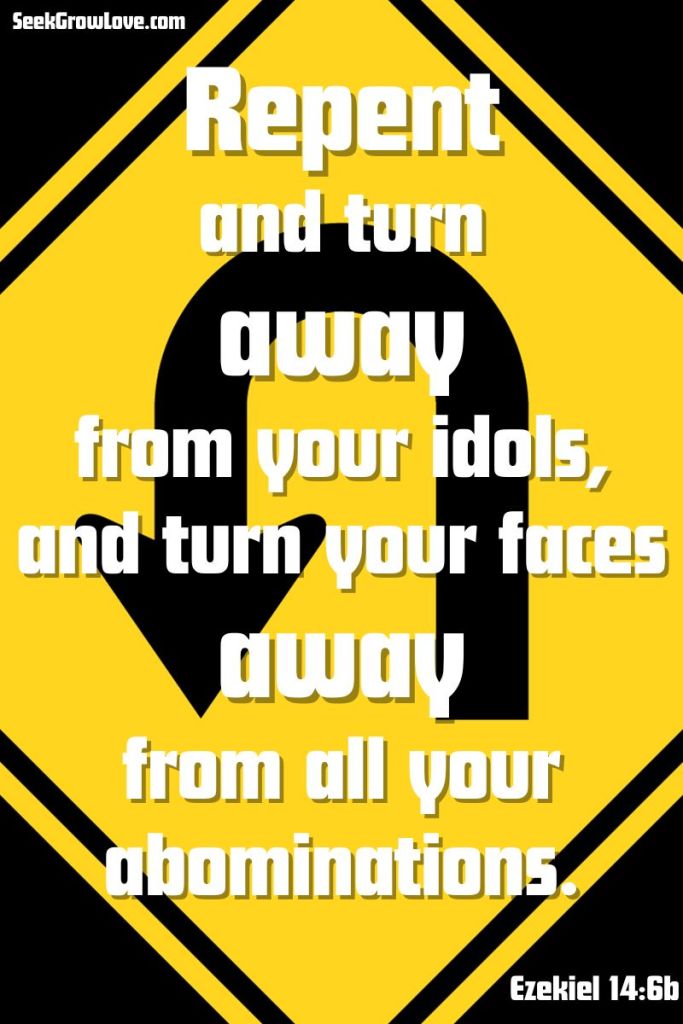
“Therefore say to the people of Israel, ‘This is what the Sovereign Lord says: Repent! Turn from your idols and renounce all your detestable practices!’”
I see two attributes of God at work here: justice and mercy. For those claiming to follow God, but not really following Him, there will be justice (i.e. punishment). They will be made an example so others will see and turn to God. This is a scary concept, and should cause us to repent and turn completely back to God so this doesn’t happen to us.
We see God’s mercy as he says to those not following him, “Repent!” and “Renounce all your detestable practices!”. This too should cause us to repent and turn completely to God.
It doesn’t matter whether we respond better to a carrot or to a stick, since we’re given both. The simple fact remains that we need to repent, renounce all our detestable practices, and turn completely to God.
And once that happens, we’re told in 14:11, “Then the people of Israel will no longer stray from me, nor will they defile themselves anymore with all their sins. They will be my people, and I will be their God, declares the Sovereign Lord.”
May this be said of us too. But it is conditional upon repenting and turning completely to God. The choice is yours.
Steve Mattison
Reflection Questions
What idols and abominations (many of which the world says are okay – or even championed) are in front of you? What will it look like to turn away from them and turn completely to God?
What is God waiting for you to repent of? How long do you think He will wait? What is dangerous about waiting to repent?
What do we learn about God in the Bible passages today? What do you think of his justice and mercy?
Today I want to focus on Ezekiel 8. So in this chapter, there is a description of the second vision Ezekiel had. This vision is all about the idolatry going on amongst the Israelites. God takes Ezekiel to Jerusalem. This is where the temple is, so it is where people come to worship God. But instead of that, Ezekiel sees people worshiping idols, not God. I want to focus on the idols that Ezekiel sees, and see how they could potentially be present in our lives.
The first idol mentioned is in verse 5. It is called the “idol of jealousy.” It is important to focus on what this means, and to start to understand that, we need to know what it means to be jealous. To be jealous is to look at other things and want them more than what you have. It’s like if your neighbor gets this awesome new car, maybe a brand new corvette, and you see that, and start to feel like you just have to have that car. He looks so cool driving it, and you just need that in your life, too. We try to satisfy ourselves by trying to be like the people around us. We want what they have and maybe, just maybe, more than they have. This is something that we can put before God very quickly. We can focus on the next best thing instead of God. God says in verse 6 “the utterly detestable things the house of Israel is doing here, things that will drive me far from my sanctuary.” We are pushing God away when we start looking for “things” rather than looking for God.
The second idol that Ezekiel sees is the worship of images of animals and creatures. The elders were burning incense to these images as a form of worship. In verse 12 the elders say, “the LORD does not see us; the LORD has forsaken the land.” They did not feel like God was there. So what do they do? They replace God with something else. We do this all of the time. Something doesn’t go the way we want it, we feel like God has abandoned us, and we instantly start to put something else before God. We turn to something else that makes us “happy.” Whatever that is, is different for each person, whether it’s work, hobbies, sports, school, friends, alcohol, or other things of this world. Instead of turning to these things, we need to put God first.
The last idol that Ezekiel sees is men in the temple with their “backs towards the temple of the LORD” and bowing down to the sun. The men here have completely turned away from God and are worshiping something other than God. We are sometimes guilty of this as well. We turn our backs to God and worship what is right in front of us. We see the visible thing that is right there and think that that thing is worthy of our full heart. Sometimes we need to do a full 180 and turn our worship back to the amazing, all powerful, loving God.
Every time God shows Ezekiel one of these idols He calls them “detestable” things. They aren’t just bad or an “issue”, they are detestable in the eyes of God. Having idols is very serious to God. Just read verse 18. It is very important to evaluate our lives and identify if there is anything we put before our relationship with God. And if there is, to either reprioritize our life with God at the head, or get rid of whatever we put before God.
-Camden Bormes
Reflection Questions
When have you experienced the idol of jealousy? Have you overcome it (for now) or are you currently struggling with it?
How have you seen people (including yourself) try to replace God?
In what ways might idol worship creep into a culture – or into a church – or into the life of a believer – or into your life? What makes it detestable to God?
What makes God and God alone worthy of all your worship and first place in your life and heart?
My apologies, I messed up the schedule and talked about Revelation 5 rather than 6 yesterday, so today we’ll get a lot of Revelation! I am writing this from somewhere in the middle of Indiana with about 27 of my brothers and sisters in Christ. Please pray for all those going to ReFuel South. Please pray for our safety and great blessings to those hosting it! I also pray the worship and preaching will glorify God and encourage the walk of faith for all attendees!
Most little girls love horses. Horses are beautiful, graceful, and strong. I, however, have a healthy fear/respect for horses. A long time ago, I volunteered with a program that matched horses with kids with disabilities. I loved the kids. However, I spent most of the time grooming a horse that knew I feared him and took every advantage of that… including releasing some methane every single time I brushed his backside. Ugh. So you can imagine I find the visions of the four horses of the apocalypse especially disturbing. In fact, most of yesterday and today’s reading was pretty gruesome. Ezekiel starts out eating scrolls that taste like honey but ends the reading with foretelling about the great destruction of Israel. One third is killed by fire, one third is killed by the sword, and one third will be saved but scattered across the nations. Keep this in mind for tomorrow’s reading in Revelation. Revelation starts with the horses representing the conqueror, death, famine, and war along with the seals representing the martyrs and terror.
Thankfully, we move on to the 144.000 chosen from the tribes of Israel. But then, THEN, WE are mentioned!!! Starting in verse 9, WE are “ the every nation, tribe and tongue,” wearing white robes shouting, “Salvation to our God who sits on the throne, and to the Lamb!”
When the reading of the Old Testament and Revelation gets a little frightening, It is these promises of God to which I cling… Much like on the few occasions I ride a retired horse on a worn park trail!
-Maria Knowlton
And the editor apologizes for yesterday missing that we are starting Ezekiel with 3 chapters for the first few days in order to get the rest of the Old Testament to squeeze into the rest of the year. So you might need to play a little catch-up to get in Ezekiel 3. Sorry. But, while we are talking schedules, I am starting to put together the Bible reading plan for next year. If you have a preference on what that might look like (chronological, 1-3 readings a day, etc…), leave a comment or let Marcia know. Thank you for Seeking, Growing & Loving with us!
Reflection Questions
Are you prepared for your role in Revelation? Do you know and confess the ones who hold Salvation?
How can you practice for your part today?
Why do you think God gave both Ezekiel and Revelation to the audiences they were originally written for, as well as saved for you and I?
There are so many reasons I am so thankful for the Holy Word of God. I don’t really have enough time to tell you all about them right now but there was one I just thought of while reading today’s scriptures…
Revelation describes some fairly scary creatures and situations. I am very glad that I get to read about it and know what is going to happen first!
Both Ezekiel and Revelation reveal visions that are wild, brilliant, and fascinating….. But lead to very different ramifications for the people to whom God revealed it.
Ezekiel was given the vision because of the oncoming punishment He would send to the rebellious people of Israel (thankfully God gave them hope for the future as well but that is in a future reading).
Revelation is very different… the visions and prophecies are for those who love the Lord and follow the teachings of Christ. Revelation 5 is a beautiful vision of introducing the only one who is worthy of opening the seals of the scrolls, Jesus Christ, the lamb who was slain.
I’ve been a little too busy this week, working my job and preparing to go to ReFuel South (Whoo Hoo) so I didn’t do a lot of research on the meanings of all the visions I read about today. I cannot even pretend to understand it all, but I do know this one thing. I want to be on the receiving end of the Revelation vision… not the Ezekiel vision. Sadly, there is a vision of the future for those who do not want to be with Jesus in the coming kingdom. There is no coming back from the second death. Not only do I not want to die that second death, I want to be with Christ! I hope to see you there!
-Maria Knowlton
Reflection Questions
What similarities and differences do you find between Ezekiel and Revelation?
What hope do you find in God’s Word for the future?
Have you ever had a time in your life where you just feel lost? Like it could be a major thing that happened to you, or just a time where it felt like nothing was falling into place. Where you just wander around, with no end goal in mind, going through the motions. I know in my life there have been plenty of times where I’ve felt that way. One time that I can really think of was my senior year of high school. Going into that year I had no clue what I was going to do in just a few short months. I knew what I wanted sometime in the future, but not right after I graduated. I felt like everything was working out perfectly for all of my friends around me, and that they knew exactly what was ahead for them. But for me, I had no clue. I was lost and just didn’t know what my plan was going to look like.
Another wandering story is the Israelites in the desert. They disobeyed God, and they wandered around for 40 years! Think about that! They were told that their generation would not enter the promised land, so they just moved around. That is a long time to just move from place to place without an end goal in sight. Now, Psalms 90 is written by Moses, most likely around the time that the Israelites are wandering in the desert. So with that context in mind, let’s dive into what the Psalm is talking about.
The first four verses here Moses is praising God for how great He is. Moses is trying to show just how big and powerful God is. He says in verse 2 “from everlasting to everlasting you are God.” Moses then contrasts God’s foreverness with man in verses 5-12. In this section, he talks about how man’s life is short. And beyond that, he says “yet their span is but trouble and sorrow.” (verse 10) Moses is saying that not only is man’s life short, yet in that short life there are a lot of bad things that can happen as well. Remember, Moses is wandering through the desert right now, there are not a lot of great things going on for him. Every time he turns around the people are disobeying him and God. They are just moving from place to place. Knowing that they are not going to get to see the land that God promised them. Yet after all this he moves back into prayer. In verses 13-17, Moses asks God to show His love. In verse 14 he says “satisfy us in the morning with your unfailing love.”
When we are “wandering” and lost, we should take a lesson from Moses. Even when nothing was going right for him, he still asked God to make him glad. (verse 15) Moses asked God for His favor to rest on him. It is easy when things are going poorly to forget how everlasting God is. Moses reminds us that when things aren’t going right, and you’re just “wandering” to not forget about what God has done and what He can do.
-Camden Bormes
Reflection Questions
When have you felt lost and wandering, with no clear goal in mind?
What can we learn from Moses in his time of wandering?
How do you refocus on God’s unfailing love? Have you ever tried asked Him to satisfy you with His unfailing love (which doesn’t mean making your life perfect or giving you everything you want)?
What can we learn about God from Psalm 90?
Ezekiel Introduction
The Book of Ezekiel was written by the prophet Ezekiel while he was in Babylon during the Babylonian captivity. (Ezekiel was among the first of the exiles to Babylon, and prophesied to Israel for 7 years before the fall of Jerusalem, and for about 13 years after.)
Thirteen of Ezekiel’s messages are dated in relation to King Jehoiachin’s exile, and you’ll notice, while reading the book, that the messages aren’t recorded strictly chronologically, but are recorded by theme (e.g. 27:1, 29:17, 30:20).
Many times, God called Ezekiel “son of man” – a title Jesus used for himself multiple times in the Gospels. God also called Ezekiel a watchman, who had to give a warning to sinful people, as we see in 33:7-9, “Son of man, I have made you a watchman for the house of Israel; so hear the word I speak and give them warning from me. When I say to the wicked, ‘O wicked man, you will surely die, and you do not speak out to dissuade him from his ways, that wicked man will die for his sin, and I will hold you accountable for his blood. But if you do warn the wicked man to turn from his ways and he does not do so, he will die for his sin, but you will have saved yourself.’ ”
The book is full of visions and prophecies. It starts with Ezekiel’s awesome vision of God and God’s calling Ezekiel. It includes prophecies of judgment on Judah and Jerusalem; prophecies against the nations surrounding Israel; and finishes with visions of the future restoration of the land and [millennial] temple, and the glory of God returning to the temple.
Some of the most well-known visions include Chapter 37 (The Valley of Dry Bones) and Chapters 38 and 39 (prophecies against Gog and Magog).
Disclaimer: I know Proverbs 27:2 says not to brag about yourself, but I’m about to brag about my kids so it’s ok!
Today my husband, daughter and I met our son at a car dealership where my son wanted to purchase a car. He wanted our opinion on the car and it was a great excuse to meet him halfway between our home and his college. He had done quite a bit of research on the car and made all the financial arrangements himself. Between watching his interactions with the sales people and his new haircut, it just hit me how much he looks and acts like…an adult! Our daughter also seems to make a habit of making good choices. She always helps me around the house, is a leader on her cheer squad, and is very kind.. Both of my kids are the light of my life and I am so proud of them.
I would love to say that they are doing well because Dan and I are such awesome parents, but they have always been just easy to parent with teachable hearts. Even the times that I reprimanded them for a mistake or something I didn’t agree with, they made corrections and that was, usually, the end of that issue. Now, just because we haven’t had to be strict does not mean we forewent discipline. We spent a lot of time educating our kids on proper behavior, respect, and morality based on the Word of God.
I like how the Message translates Proverbs 29:15. “Wise discipline imparts wisdom: spoiled adolescents embarrass their parents.” Now I don’t worry too much that my kids’ behavior will embarrass me, I worry that misbehavior will bring pain to them… which brings pain to me.
The entire book of Lamentations is a statement about this effect. The sins of Israel affected Jeremiah mentally and physically. He suffered right along with them even though he listened to God. God, of course, listens to him, and eases his suffering. However, I do think this points out the pain a parent/teacher/mentor feels when they have tried to disciple someone in the Lord and that person decides to reject it. When that person faces a consequence of a bad choice, it hurts the one who tried to help them.
Revelation 2 is a chapter full of both praise and discipline for the 4 churches mentioned. Jesus, through John, praises the churches for their good works but also disciplines the churches against some of their current practices to save them from destruction. The church at Thyatira was warned about a woman teaching “cross-denying, self indulging religion”(The Message). In my previous devotion, I mentioned a modern day “preacher” who is doing this and I am sure she is not alone, preaching a gospel of “your truth.” Later, I was reading through the comments of this Not the Bee article about this preacher. One gentleman wrote the best response to those who teach the power of self over the power of Christ:
“This is why you never flip the order of the First and Second Commands of Christ. Love the Lord your God first. Then love your neighbor as yourself. This heretic probably didn’t set out to blasphemy like this. She just saw Christianity as a means to care for people. But that’s not the primary end of Christianity. It’s to love, glorify and obey God. Loving people rest within that directive, but never above it. Cut enough corners to “love” people and soon you’re affirming sinful behavior. Before you know it, you’re a blasphemous heretic, parading your own made-up religion, never having understood Christ in the first place. The irony is that none of this was ever loving at all. These false doctrines literally hurt and kill people. So far from what Christ ever wanted.” Andy Sheehan – Random guy on the internet
All of our readings today relay the importance of discipline amongst our children, ourselves, our nation, and our churches. Pray we will identify the opportunities to educate and discipline in the name of the Lord.
-Maria Knowlton
Reflection Questions
In keeping loving God first, what ought our response be to someone who is living outside of God’s laws? When have you seen this order (love God first, and secondly, love your neighbor as yourself) disrupted? What is the result?
What should the first goal of Christian parenting be?
Lamentations Introduction
The book of Lamentations was almost certainly written by the prophet Jeremiah shortly after the fall of Jerusalem to Babylon in 586 BC. The title, “lamentations”, means “loud cries”. The historical record of the fall of Jerusalem is detailed in Jeremiah 39, 2 Kings 24-25, and 2 Chronicles 36. The book of Lamentations contains the author’s grief over the fall of Jerusalem because of her sins.
The book of Lamentations reminds us that sin always brings sorrow, grief, and pain; no matter how alluring and exciting the sin looks initially – it is never worth it.
Despite the overwhelming grief expressed, there is also hope, as we see in 3:19-24, “I remember my affliction and my wandering, the bitterness, and the gall. I well remember them, and my soul is downcast within me. Yet this I call to mind and therefore I have hope: Because of the Lord’s great love we are not consumed, for his compassions never fail. They are new every morning; great is your faithfulness. I say to myself, ‘The Lord is my portion; therefore I will wait for him.’ ”
An interesting point of historical trivia, according to this website, according to Jewish tradition, the original temple was destroyed on the 9th of Av 586 BC. The second temple (Herod’s temple) was also destroyed on the 9th of Av 70 AD.






 Seek Grow Love