
2 Kings 18:9-19:37
Psalm 46, 80
Have you ever noticed that when you’re in familiar surroundings, you don’t require all of your senses to function? For example, if you wake up in the middle of the night, can you make your way into the bathroom without turning on a light? Or have you ever found yourself “watching” something on the television while simultaneously scrolling on your phone. You look up to watch the television when you hear the music swell because you know something important is about to happen?
But in unfamiliar environments, you require most of your senses, even if it doesn’t make sense? Am I the only one who turns down the volume of the radio while I’m driving when I am looking for a specific street sign? It’s like the brainpower used to listen to music needs to be redirected towards my sense of sight. Or when I am about to enjoy the first taste of something delicious, I don’t want any distractions; all I want is to savor the flavors in my mouth. Don’t talk to me, don’t have me look or study something, just let me appreciate what’s happening with my tastebuds.
In today’s Psalm, the author is appealing to God in a time of national territorial struggle. Outside enemy forces are making their presence known and the nation of Israel is seeking God’s protection and restoration.
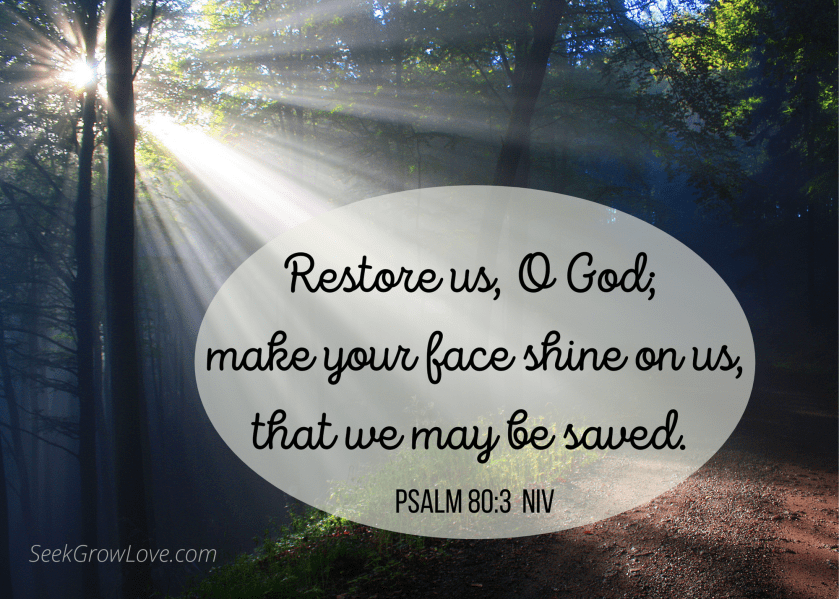
Three of the nineteen verses are identical. Verses three, seven, and nineteen all say, “Restore us, O God; make your face shine upon us, that we may be saved.” Let’s break this repeated appeal down.
Restore us, O God – make us right, heal us, put us back to where we were. Because of the disobedience of the people, their relationship with God has been broken or gotten off track. The petition to God for restoration acknowledges this.
Make your face shine upon us – this phrase calls back to the Priestly blessing that is recorded in Numbers 6:24-26. When God’s face is shining upon His people, His blessings, His approval, His favor makes life more peaceful. But this can only be experienced when we are in right standing with God. When we are not in right standing with God, it’s like His face is hidden from us. It’s like the lights in the room are on, but we still cannot see; the volume on the television is turned up high, but we still cannot hear; we can add all the seasoning to food, but we still cannot taste it. We walk through our daily lives like it’s unfamiliar territory. We’re seeking for something to make sense and may even turn to external (and ungodly) sources for relief. But nothing can substitute the experience of God’s face shining upon those He loves and who are in right standing with Him.
That we may be saved – When God’s people have been restored and are in right standing with Him, and His favor is among the people, salvation from threats of the enemy is at hand.
The next time you find yourself in an especially challenging trial, mimic King Hezekiah who literally laid his problem out before God and made his appeal that God take action against the enemy. Ask God if there is anything that needs restoration in your life. Request God to make His face shine upon you. And then believe with all of your heart that God will act on your behalf. The course of action that God may take may not make sense and His timing could be very different than what you would like, but know that God sees those who love him and are committed to remain in right standing with Him. And even in the midst of the hard times, you can find peace to enjoy with all your senses the life God has planned out for you.
Reflection Questions
Describe a time when you felt God’s favor, peace, or presence in a tangible way. What was happening in your heart and life during that season?
What distractions – mental, emotional, digital, or physical – are keeping me from noticing or experiencing God’s presence fully?
How might I align myself with God today so that I am in ‘right standing’ with Him?
-Bethany Ligon
 Seek Grow Love