
Your Life is Not Meaningless

But it is Fleeting – so Live Wisely!

Ecclesiastes 12 13 NIV sgl

Ecclesiastes 7-12

In Ecclesiastes 7-12 the author, the Teacher, continues to discuss things that are “havel”, vain, futile, fleeting and temporary. (If you haven’t yet, go ahead and read yesterday’s devotion on Ecclesiastes 1-6 for a deeper understanding of “havel”.)
The author accepts that death is the end of every person and it is important to accept that fate and live with one’s face toward death. Much of the last half of this book is the reality righteous and wise people suffer the same fate as those who are wicked and foolish. However, we must not let this reality change how we read the entire book of Ecclesiastes. The author writes in 8:12-13 “Although a sinner does evil a hundred times and may lengthen his life, still I know that it will be well for those who fear God, who fear Him openly. But it will not be well for the evil man and he will not lengthen his days like a shadow, because he does not fear God.” While it is TRUE that the wicked and the righteous both end their lives in death, the author holds that there is good for a righteous person. Still, seek righteousness and wisdom because even a little foolishness can ruin one’s life. (10:1)
For you younger readers, the author commends that you seek out wisdom and that you remember God today! At this point in your life (12:1) There will be days of difficulty as life goes on, but in our days of joy, remember God. God is the one who gives comfort, joy, happiness, and strength on the days when the world is dark, the clouds are gray, and the pains of life are crowding in. Because the childhood and the prime of life are fleeting, temporary and transitory, enjoy them now. (11:10)
We are nearing the end of the book. We have been asking the question : “what lasts? What do people REALLY gain for all they do?” The last two verses of the book tell us what lasts : How we have lived, whether we kept the commands of God and feared him. All this in our life will be judged. Of course, this has been hinted before; now it is explicitly and clearly stated. If we believe, as some have, that the Teacher is a cynical, morose, or even godless man, then the last two verses are a radical departure. However, if this is a man who loves God and understands the futility, vanity, temporariness, FLEETING nature of life, then the final verses in Ecclesiastes are an understandable conclusion.
This of course effects how we read many passages. The author says “eat, drink, enjoy your labor, be merry!” (5:18, 8:15, 9:7) These passage show us that our labor, what we do, are not meaningless, but they are precious because of their very fleeting nature. The teacher says in 9:9, “Enjoy life with the woman you love all the days of your fleeting life…” You know you are precious to God. Your life is not meaningless, but it is havel, transitory, temporary. What we have in this life is not meaningless drudgery of existence, but the temporary good things are to be enjoyed, and to seek the eternal good things, doing the will of God and fearing him.
In the short time of our discussion we missed many interesting passages, some that are difficult (about death and sorrow) and some that are encouraging (about enjoying pleasure on the earth). But, my friends, remember : The entire duty for all people is to do the commands of God. We know that since Christ has come into the world “This is His commandment, that we believe in the name of His Son Jesus Christ, and love one another, just as He commanded us.” (1 John 3:23) As you continue to believe in the name of Jesus, may you love one another as you seek how to live wisely today!
Jake Ballard
Today’s Bible passage can be read or listened to at https://www.biblegateway.com/passage/?search=Ecclesiastes+7-12&version=NIV
Tomorrow’s reading will be 1 Kings 10-11 and 2 Chronicles 9 as we continue the 2020 Chronological Bible Reading Plan
Ecclesiastes gets a bad wrap. 

Ecclesiastes 1 3 NIV sgl
It shouldn’t but it does. Most people think it is a depressed Old Man Solomon sitting down at the end of his life saying “EVERYTHING IS MEANINGLESS.” Therefore, most of the book is about how everything is meaningless, life is not valuable, and it would be better to be dead.
But that’s a bad interpretation.
First, let’s look at 1:2. This is the key phrase of the book. Everything hinges on understanding this phrase correctly. And most of our translations do a poor job. That may seem arrogant, but let’s look at the word in Hebrew. The word, (transliterated) is “havel” or “habel”. Literally, it means “mist” or “vapor.” Very rarely is it used in this sense. Many more times it is used of idols, which are “mists” as opposed to God’s “concreteness.”  In its more poetic context, which the passage warrants, it means “temporary”, “fleeting”, “transitory”. The author is declaring “Passing! Fleeting! Un-lasting! Everything changes and nothing remains!” See how VASTLY different that sounds from the usual “eVeRyThInG iS mEaNiNgLeSs!” we normally read?
We need to understand that the central call of the book is about how nothing lasts because it makes the question in 1:3 make SO MUCH MORE SENSE! The author (Qohelet, the teacher, most likely meant to be Solomon, but not for sure) is not simply lamenting that work is hard and not much can be gained. Instead, the author is asking a very pointed question : “In everything I do, WHAT DO I HAVE THAT LASTS? What remains? What is not ‘havel’, not a temporary, fleeting, striving after the wind?”
Now THAT is a question we want an answer to!
This isn’t a depressed teacher moaning about how everything is terrible and nothing matters and that all the stuff we do is unimportant. He is asking (and implicitly promising to answer), “What will be the thing that will last when all the other futilities of life fade?”
He goes on in these first 6 chapters and tells us that it’s not wisdom (1:12-18)[though it is better than folly (2:12-17)], it’s not pleasure (2:1-3) or possessions (2:4-11), it’s not labor (2:18-23) [though labor is a good thing (2:24-26, 3:12-15)]. The justice and oppression of men is havel, those who seek after money will realize it is havel.
Look at what the author says in 3:14 “I know that everything God does will remain forever; there is nothing to add to it and there is nothing to take from it.” The eternal, so far as we know now, the thing that is not havel, temporary, fleeting or futile, is the work of God.
We leave this section of Ecclesiastes without the answer. There are some depressing things the author says, but once we have the answer for “what does a man gain? what LASTS?” we can reevaluate those passages in light of the answer.
Jake Ballard
Tomorrow we will finish the book of Ecclesiastes to find yet another wise answer to the questions of life on our walk through God’s powerful word – 2020 Chronological Bible Reading Plan
Counterintuitive Wisdom

Proverbs 27-29

Proverbs 27 6 NIV sgl

The Proverbs are, in many cases, fairly self explanatory. Don’t be lazy, don’t be a wicked ruler, don’t be foolish but be wise, be a righteous ruler, be diligent in your work. Each Proverb has it’s own meaning but they go along those lines. But some are not so self explanatory. They are counterintuitive.
A short example is found in 28:27. If you want to be prosperous and blessed, to never be in want, then we give our money to the poor. The world, our own sinful heads, and many economists believe that the way to grow our wealth and not be in want is to hoard our money. But that’s not the way God works. It is only in generosity and giving that we will be blessed. This comes from the fact that God will bless and many times he blesses us through the care of others in our time of struggle and hardship.
Also, 27:5-6 doesn’t seem to be true in the moment. I don’t like to be rebuked. I don’t like it when a friend calls me out on the garbage way I am acting. But the Proverb teaches us that we should delight when a friend rebukes us because their correction comes form a place of love and they want our life to be one of wisdom and righteousness. This is especially true for  our brothers and sisters in our local church. Many times, we may feel judged by the people of our church, but more often than not, they are wanting the BEST for us. The “wounds” they give are better than any kisses of those who tell us we have nothing wrong with us. There could be people who act like a friend and hurt you in terrible ways, but here we mean TRUE friendship, TRUE companionship, TRUE love from a brother or sister in Christ. That true love is shown in forgiveness and compassion, especially in our moments of weakness and humility. Many times, when we are sinning and are fearing the rebuke of those people, we hide our sin away, like 28:13 says. But counterintuitively, by hiding our sins, we only hurt ourselves more when they are brought to light in some other way. We need to confess our sins and turn away from them. When we do, compassion and forgiveness are waiting for us from the people of God and from God himself.
Jake Ballard
Today’s Bible reading can be read or listened to at https://www.biblegateway.com/passage/?search=proverbs+27-29&version=NIV
Tomorrow’s reading will be Ecclesiastes 1-6 as we continue on our 2020 Chronological Bible Reading Plan

To Answer a Fool – or Not?

Disagree – Wisely

Proverbs 26 4 5 NIV

Proverbs 25 & 26
Proverbs is hard to write ONE devotion about. From chapter 10 forward, nearly the entire book is a collection of pithy quick sayings that were meant to produce wisdom in those who learned them. (Only chapter 31 is different, but that will be for another author to work through!) Today, for chapters 25 and 26, I want to focus on just one set of verses.
There are two authors to every word of the Bible. The first is the human author, a person who lived in a specific place and time, thought and wrote in a specific language and who was fallible and failing just like the rest of humanity. Also, Christians believe the Bible is inspired by God. This means that God directed the author so that the words, ideas, and stories are those by which God wanted people to live and that everything in the Bible is true. Short and simple, the Bible is not full of lies and misinformation, and it doesn’t contradict itself. (1)
That seems like a hard standard to hold when we read Proverbs 26:4 and 26:5.
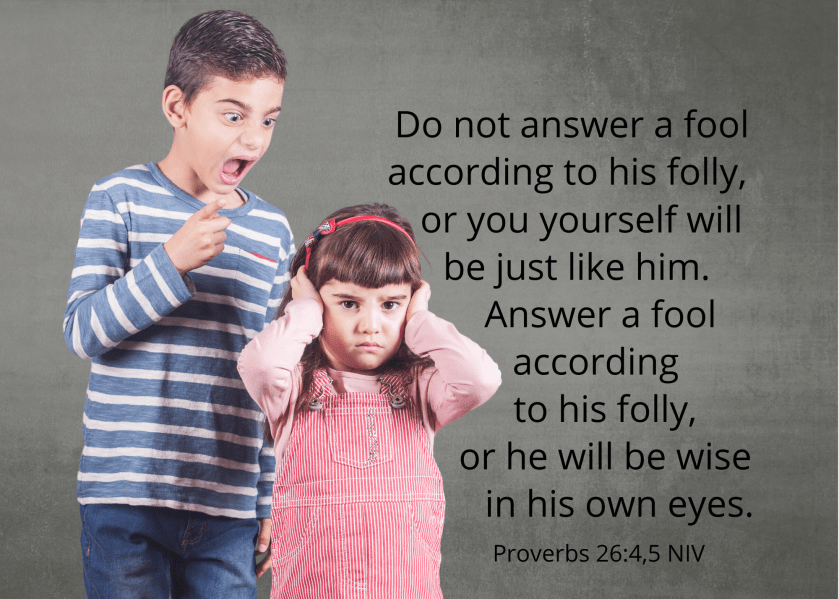
26:4 Do not answer a fool according to his folly,
Or you will also be like him.
5 Answer a fool as his folly deserves,
That he not be wise in his own eyes.
DO NOT X & DO X. That is a pretty clear contradiction, right?
Well, yes and no; let me explain. It is clearly contradiction if we believe that all the Proverbs must be followed all the time, like the laws of the Torah. But this is not how the Proverbs were intended to be used.
Proverbs were meant to make people wise, and therefore were to build wisdom AND BE USED WITH WISDOM. Every Proverb doesn’t always give what must be done in every situation always, but instead tells you a general way of living that should guide you in the moment to make a wise decision.
The question we are hard-wired to ask is : Is it right or wrong to answer a fool? But,  THAT’S A BAD QUESTION! Instead we should be asking : Is it wise or foolish to answer this fool right now? Sometimes you debate with a person in private who will never change his or her mind, and you have to throw up your hands and say, “Not worth it” or you could be dragged into the mud and muck of folly and error. Sometimes, you need to correct someone for the foolish thing he or she has said or done, or they go on being foolish forever. Either approach could be wise or foolish; it is the wisdom of God that will sort out which way we should go.
Thus, God’s word is kept from our bad interpretation and we recognize that there is no contradiction!
Jake Ballard
(1) Rarely, if ever, is something truly “short and simple.” There are lots of implications and theological, historical and scientific questions that come up, but sadly, we don’t have time for that at the moment.
Today’s Bible reading can be read or listened to at

Tomorrow’s reading will be Proverbs 27-29 as we continue the 2020 Chronological Bible Reading Plan

Strong-Willed for God

Proverbs 22-24

Proverbs 22 6 NIV sgl

If you are just jumping in now, I have been pulling out a few lines in Proverbs that stand out to me, but I encourage you to do the same – you will likely find different ones!

22:6 Start children off on the way they should go, and even when they are old they will not turn from it.

My mom always tells these horror stories from when I was a young child about how I was a nightmare to deal with (I’m sure she exaggerates…), but that didn’t mean that she just accepted it.  She tells me she prayed and asked that God would turn my stubborn, strong-willed self to be stubborn and strong-willed for God.  I can’t say that I have done a perfect job, but I know I am thankful for the prayers my mom said.  I don’t hit people in anger anymore (or throw whatever is in my hand across the room when I get mad).  Though I sometimes struggle to stay on fire for God, I am trying to do what I can to stay faithful through it.  The attribute of being strong-willed has been put to use in staying steadfast even when I go through times of struggle.   If you are the child who was raised in the faith and is still in it, thank your parents!  If you are someone who has children or plans to someday, keep this in mind.  It starts young.

23:4-5 Saying 8

4 Do not wear yourself out to get rich;
do not trust your own cleverness.
5 Cast but a glance at riches, and they are gone,
for they will surely sprout wings
and fly off to the sky like an eagle.

Finding a balance between providing for life and accumulating wealth can be difficult.  Most of us want to have nice things in life, but it can consume us.  That first line stands out to me – “Do not wear yourself out to get rich;” If I am so focused on work that I am worn out everyday, or don’t have time to spend with my family, I don’t think that is right.  Don’t get me wrong – there are plenty of other places in the Bible that tell us we should be hard workers and not to be lazy (see next section), but overworking yourself just to gain wealth doesn’t feel right.  You might not be able to get everything you want, but learning to be content with what you have is for the better.  Contentedness is something I have been working on the last few months. What I have is enough.

24:30-34

30 I went past the field of a sluggard,
past the vineyard of someone who has no sense;
31 thorns had come up everywhere,
the ground was covered with weeds,
and the stone wall was in ruins.
32 I applied my heart to what I observed
and learned a lesson from what I saw:
33 A little sleep, a little slumber,
a little folding of the hands to rest—
34 and poverty will come on you like a thief
and scarcity like an armed man.

Being lazy leads to an inability to thrive.  We have to find that balance of hard work, but not letting it consume us to where gaining possessions becomes our sole focus.  How are your priorities?  Where is God on that list?

We are moving out of Proverbs tomorrow, so enjoy these little bits of wisdom!


~Stephanie Fletcher


Today’s Bible passage can be read or listened to at https://www.biblegateway.com/passage/?search=Proverbs+22-24&version=NIV


Tomorrow we jump from Proverbs (many of Solomon’s writings) to 1 Kings 5-6 and 2 Chronicles 2-3 to read some of the events of King Solomon’s life and reign.  We return to the rest of Proverbs next week on our 2020 Chronological Bible Reading Plan.

God’s Way Wins

Proverbs 19-21

Proverbs 21 30 NIV sgl

I encourage you to read these chapters focusing again on what stands out to you.  Depending on where you are at in life right now, different words of wisdom might stick.  Here are some that stuck out to me:

19:11 – A person’s wisdom yields patience; it is to one’s glory to overlook an offense.

I’m someone who tends to hold grudges.  Especially if I wasn’t asked for forgiveness.  When someone asks, I am usually willing to offer it, but the thing is, people don’t always ask.  And sometimes I perceived I was wronged when the other person doesn’t see it that way.  This proverb reminds me that it is better to forgive and move past an offense than to let it sit and weigh me down.

19:20 Listen to advice and accept discipline, and at the end you will be counted among the wise.

Accepting correction isn’t easy.  I tend to bristle at it (especially when I know it is something I did wrong, or need to change).  It puts my defenses up, and I imagine many others feel the same.  But when we accept proper discipline, we come out better.  We learn and grow, and don’t continue to make the same mistakes.  It is an important part of life to heed Godly advice and discipline, even when we don’t like it.

21:30 There is no wisdom, no insight, no plan that can succeed against the Lord.

This one is an encouraging one to end today’s thoughts.  Sometimes it can feel like in this world, evil is winning.  That people have made their plans, and they are succeeding despite it being contrary to God’s ways.  So here is your reminder: they won’t win out in the end.  Nothing can succeed if it is against the LORD.  We might feel weighed down and defeated when we see evil prevail, but we know how it ends.  We know who wins.  And it isn’t evil.

I’m writing this while life is weird.  We are stuck at home, not going to church (I don’t think I have ever not been to church on Easter Sunday), many people not going to jobs, not having dinner with families, not enjoying a dinner out.  But we can have peace when we remember that no matter what is happening now, God has a plan, it will come to be, and we can look forward to eternal life.

~Stephanie Fletcher


Today’s Bible passage can be read or listened to at https://www.biblegateway.com/passage/?search=Proverbs+19-21&version=NIV

Tomorrow’s reading will be Proverbs 22-24 as we continue seeking and growing in God’s way during our 2020 Chronological Bible Reading Plan


Follow Your Heart – or Not?

Proverbs 16-18

Proverbs 16 3 4 NIV

For those of you that don’t know, I love Disney.  Like, a lot.  But one thing that often bothers me about many of the movies is the message to follow your heart.  It sounds nice, but I know if I always followed my heart, I would not be in a good place.  The beginning of Proverbs 16 reminds me of this.

If we just follow our hearts, we are likely to go the wrong way.  We need to seek the LORD, and He will establish our steps (16:9).  When we set our hearts on the LORD, then we become the wise.  When we are the wise, then we become the discerning (16:21), the ones who say what is right (16:23).  There are examples of many kinds of people in these chapters, but one thing is clear – all of the good things come from God.

A couple other of the lines of these proverbs stood out to me:

17:6 Children’s children are a crown to the aged, and parents are the pride of their children.

I have a daughter, and I know how much she is loved by her grandparents.  I may have even heard them say something like grandkids are better than kids.  What really struck me in this one is that parents are the pride of their children.  Am I living a life that my child would be proud of?  I mean, she is almost 2 right now – she loves everything I do.  But give it a few years – are my actions worthy of her pride?  Maybe some of you reading are parents and can ask yourselves this.  Maybe some of you are younger – direct yourselves to that first part – are you living a life that makes you a crown to your grandparents?

18:21 The tongue has the power of life and death, and those who love it will eat its fruit.

When we talk, do we think about this big of an impact in what we say?  The power of life and death.  Sometimes we (or at least I) say the first thing that comes to my mind, and it is not always the best thing.  If I could remember this proverb, would it make me take the time to think about what I am going to say before I say it?  I hope so.

As you read through these chapters, spend some time focusing on the lines that stand out to you.  Take time to examine the parts of your life that might be calling out as you read these Proverbs.


~Stephanie Fletcher


Today’s Bible reading can be read or listened to at https://www.biblegateway.com/passage/?search=Proverbs+16-18&version=NIV

Tomorrow’s reading will be Proverbs 19-21 as we continue the 2020 Chronological Bible Reading Plan
Heavyweight Battle:  The Brain Versus the Heart

Proverbs 7-9

Proverbs 7 25 NIV sgl

We have already covered the first six chapters of Proverbs and they all center around wisdom.  We are now moving on to chapters 7 through 9, which focus on……..drum roll please…….wisdom.  Wisdom must be really really important.  Proverbs 8:19 says wisdom is better than pure gold and Proverbs 8:35 says those that find wisdom find life and obtain favor from the Lord.  Wisdom is clearly something everyone should have and use, but why do so many people come up short in this area?

Where is wisdom stored?  In the brain.  Wisdom is the ability to process information correctly and that is all done in the brain.  Many people actually have a pretty good brain that correctly tells them the difference between right and wrong, but they do not always follow the right path because of the brain’s nemesis, the heart.  We have many sinful desires in our hearts because we are selfish beings.

There are some people that have evil desires in their heart and their brain is lacking wisdom, so they are going to struggle in life until they search out some wisdom.  They will always do the wrong thing because their brain and heart are in agreement and working together.  They can accomplish a lot together, but none of it is good.

The rest of us are in another group that are wise enough to know something is right or wrong, but struggle to always do what is right because of our heart’s selfish desires.  That is called temptation and we all have it.  When temptation arises, our heart and mind go in to battle.  Our heart has two main tactics in this fight.  First, it may try to get us to ignore what our brain might say about the sin.  Second, it sometimes engages the brain and tries to convince the brain that the sin is ok.  This is called justifying the behavior.  The heart is very strong and can be very persuasive.  In order to do the right thing, the brain must be stronger, which is where wisdom comes into play.

The brain must know the difference between right and wrong to stand any chance of beating the heart (don’t be confused here – we still want the heart to keep beating).  That wisdom is found in the Bible and it needs to be searched out, but that is just the start.  If you want to make sure your brain is strong enough to defeat the heart, you can’t just “know” what is right and wrong, you need to “understand” why it is right or wrong.  Understanding comes with a lot of reading, thinking, learning from others, and praying.

Proverbs 7 tells of a story where a man is seduced by a married woman who was not his wife.  He gave in to the temptation because he lacked enough wisdom to fight it.  He probably knew it was wrong, but he didn’t understand all the consequences.  The lost trust and ruined reputation that he may never get back, the pain he caused his family, sexually transmitted diseases, getting the woman pregnant, a broken nose from the husband when he finds out, and the guilt he will feel because he let God down are just some of the reasons why God tells us not to have sex outside of marriage.  Once you take the time to understand why something is right or wrong, the brain will be much more powerful and most likely will win the fight against the heart.

But wait, it gets even better.  When a brain has enough wisdom and understanding, the brain can convince the heart to change its desires.  The heart can be trained to agree with and follow the brain!  This is the ultimate goal, and this is why wisdom is so important.  James 4:2-3 says that you do not have because you do not ask God.  It goes on to say that you do not receive when you ask because you ask with the wrong motives, that you may spend what you get on your pleasures.  Simply put, your heart is not right.  So, it stands to reason that if your brain convinces your heart using Godly wisdom, you will get what you ask for because your desires will line up with God’s desires.  In this case, when the brain and heart are in agreement and working together, they can accomplish a lot together, and it is all good.

Rick McClain


Today’s Bible reading can be read or listened to at https://www.biblegateway.com/passage/?search=Proverbs+7-9&version=NIV

Tomorrow’s reading will be Proverbs 10-12 as we continue seeking God’s wisdom on our 2020 Chronological Bible Reading Plan

Status:  In a Relationship

Proverbs 4-6

Proverbs 4 6 NIV sgl

This is going to get a little weird since I am happily married.  I am also in a relationship with another woman.  I love her, I prize her, I embrace her, and I guard her because she is my life.  She watches over me, exalts me, honors me, places a garland of grace on my head, and has presented me with a crown of beauty.  We are truly in love.  Her name is…Wisdom.

Proverbs says wisdom is a lady and chapter 4 describes the relationship you should have with her.  When a man falls in love, he usually falls pretty hard.  He can’t stop thinking about her and will do anything for her.  He wants to be with her and just can’t get enough of her.  I suspect the same is true for women, but I don’t have any experience with that.  I suspect this analogy was written to make us understand how important wisdom is and how it should be an integral part of our life.  We need to search out wisdom, especially in the Bible, and not forget about the wise teachings from our parents growing up.  We need to be in love with wisdom as much as that guy was in love with that girl in “The Notebook”.

Why is wisdom so important?  It is because it will lead us on the straight path and keep us away from evil.  Chapter 5 tells us to beware of the sweet lips of the adulteress and her words that are smoother than oil.  If you are married, you should rejoice in the wife of your youth.  In verse 19, it talks about your wife’s breasts.  I can say that because it is in the Bible.  If you think the Bible is too boring to read, you haven’t read far enough yet.  Verse 19 is not boring.

I love the book of Proverbs because there is so much “quick-hitting” wisdom that gets right to the point.  In chapter 6, out of nowhere, it lists six things the Lord hates, seven that are detestable to Him.  I admit that the wording is a bit confusing here.  Is one of the things detestable to Him, but He doesn’t hate it?  If so, which one?  Anyways, if you are wise, you will pay attention to the list of things God thinks is detestable:

  • Haughty eyes (proud, snobbish, or arrogant)
  • A lying tongue
  • Hands that shed innocent blood
  • A heart that devises wicked schemes
  • Feet that are quick to rush into evil
  • A false witness who pours out lies
  • A person who stirs up conflict in the community

Maybe the confusion between the list being 6 or 7 is that #2 and #6 seem to be quite similar – I dunno.  You can quickly read this list and move on to the next verses; however, if you are in a relationship with Wisdom, you will slow down, study this list, and put it in your heart and mind.  This is your chance to see into the mind of God.  I am fascinated to learn what God thinks!  When you embrace the wisdom that is found in scripture, you are embracing the wisdom of our all-knowing Father.  He knows everything – and that is a lot of stuff to know.  I am extremely grateful that He has put so much wisdom in a book for us to read.  The opportunity we have to become wise is right there for the taking.  You just need to take the time to search it out.

Rick McClain


Today’s Bible passage can be read or listened to at https://www.biblegateway.com/passage/?search=Proverbs+4-6&version=NIV

Tomorrow’s Bible reading will be Proverbs 7-9 as we continue to seek the things of God’s mind on our 2020 Chronological Bible Reading Plan

How to Become Smart

Proverbs 1-3

Proverbs 1 7 NIV (1)

How do you become smart?  Are you just born that way?  Do you have to go to school to get smart?  Proverbs 1:7 says that the beginning of knowledge is to fear the Lord.  You will start down a path of intelligence as soon as you fear the Lord.  You might be a great doctor or an impressive lawyer that studied a long time to get where you are, but if you don’t fear God, you aren’t that smart.  Fear seems like a very odd first step in becoming intelligent, but let’s talk for a second about why that is true.

Why should we fear God?  Well, He knows everything, has the power to do anything He wants, has been around forever, made everything, is in control of the whole world, and could squish you like an ant if He wanted to.  That is really intimidating!  If you are not fearful of someone with that kind of power and control over your life, you probably don’t really believe He exists.  If you don’t believe He exists, you’re not very smart.  The fear of the Lord is the beginning of knowledge.

The first step in becoming smart is to fear God, but what are the next steps?  You may think that certain people are born intelligent, that some people are just naturally smarter than others.  That may be true to an extent, but wisdom is not going to just automatically happen for you.  Proverbs 2:4 says that you need to search for wisdom and understanding like it is a hidden treasure.  It takes the action of searching on your part to become wise.  Proverbs 2:2 mentions that you need to make your ear attentive to wisdom and incline your heart to understanding.  You need to study the Bible and listen to what it has to say and listen to what wise Christians may also be telling you.  You need to open your heart and mind to the possibility of changing your mind and learning from the Bible and others.  You may think you already have all the answers and can handle everything on your own, but you don’t and you can’t.  Verse 3 goes on to say that you need to cry for discernment and lift your voice for understanding.  You should take the time to ask God for wisdom, and not be scared to ask others you can trust for their help or advice.

On a side note, in Proverbs 1:20 it mentions that wisdom is a “she”.  Gentlemen, take note of that.  I don’t think it is just a coincidence that the author says wisdom is female.

There are many benefits of wisdom mentioned in today’s chapters:

  • God will protect those with integrity and discretion will guard you.
  • It will deliver you from the way of evil and from evil men and women.
  • Days and years will be added to your life.
  • Peace will be added to your life.
  • You will find favor and have a good reputation with God and man.
  • Trust in God with all your heart and He will make your paths straight.
  • It will be healing to your body and refreshment to your bones if you fear God and turn away from evil.
  • It will give you riches and honor.
  • All her (wisdom’s) paths are peace.
  • Happiness to all who hold her (wisdom) fast.
  • You will not be afraid and your sleep will be sweet.
  • Confidence will come from the Lord.

Fear God, search for wisdom, study the Bible, listen to wise Christians, be open to different viewpoints, and ask God for wisdom.  That is how you become smart.  And once you become smart, you will live longer, have special protection, be at peace, have riches, have honor, and be happy.  Seems like the smart thing to do.

Rick McClain


Today’s Bible passage can be read or listened to at https://www.biblegateway.com/passage/?search=Proverbs+1-3&version=NIV

Tomorrow’s reading will be Proverbs 4-6 as we learn more about wisdom on our 2020 Chronological Bible Reading Plan