

The Key

numb 2&4 cain

Over the last four years I have done a lot of moving. I’ve moved from an apartment, to a house, to a trailer, back to a house, to my in-laws, and now to my home. Not to mention, I have helped plenty of others move during this time. Despite my many moving back aches and cardboard box forts, I’ve experienced nothing in the moving department compared to the Levites in chapter 3-4 of Numbers. These chapters are dedicated instructions for the Levites about how to live around and move the Tabernacle.

A portion of the third chapter is dedicated to uncomplicated, yet purposeful counting of all the male sons of the Levites a month or older.  Remember the Passover in Egypt where God spared the first born sons of Israel while passing judgement over the rest of Egypt’s first born sons? In Numbers 3, we see God take the first born of Israel not to death, but to holiness. Numbers 3:13 says that God is making the Levites “sanctified” to Himself. This word sanctified means to make holy. Instead of killing the first born sons of Israel, God uses them to be mediators between Him and the Israelites. Does this sound like any other first born son to you? Jesus is now the first born son that acts as a mediator between us and God. It is so cool to me that the number of Levite males a month or older and the number of first born sons in Israel are almost the exact same number. God sees the males of the Levites being the ransom in place of the first born sons of Israel. In Numbers 3:39, the number of Levite males comes out to 22,00 and in 3:43 the number of first born males is 22,273. I will draw your attention to the extra 273 first born sons which aren’t covered by the ransom of the sons of Levi. Instead of taking their lives, which is what they would deserve, God only requires the small price of 5 shekels per person. That comes out to a total of 1,365 shekels in exchange for the lives of 273 first born sons. I guess I was wrong in my last post when I joked about Numbers being a math text book. But really, the math should be done from this point on. The point is this: God would rather redeem people than kill people; God opts for mercy instead of judgment. This is just one of the great things about Him that makes Him a God worth worshiping.

Moving on to chapter 4 we again see the detailed and intentional nature of God through instructions He gives the Levites for the Tabernacle. Remember holiness is one of God’s main priorities when it comes to the Tabernacle. We are blissfully reading along in chapter 4, hearing about the job of the sons of Aaron….then we get to verse 15. Things get serious in verse 15. It becomes clear to us that the sons of Aaron took so much caution in covering all the holy objects in the Tabernacle so that when the sons of Kohath come to move the stuff they don’t die! Remember God’s holiness is serious. All it would take for an unclean person to die is to touch a holy object. It doesn’t sound like a simple list of instructions anymore; this is a life or death situation. I thought I had it rough when I had to take the legs off my couch to fit it through the door but at least I wouldn’t die if I accidentally touched it! I like to look at verses 5-20 as the “how not to die when moving the Tabernacle” verses. If you were a son of Kohath, in charge of carrying one of the holy objects, you would be thankful that one of the sons of Aaron did their job well.

Reading though chapter 4 and hearing how the jobs of these different people are broken down reminds me of the body of Christ. We have different positions and skills which allow us to come together and work for God. Moving the Tabernacle in a holy and dignified way was no easy task, so too is serving God and His son, Jesus. It takes a team effort with everyone pitching in to make it a success.

Reading this also gave me another idea. Maybe we should only ask people between the ages of 30-50 to help us move. I should have quoted Numbers 4:3 to all the people who have asked me to move over the years. But in all seriousness, there is one big take away that I see from Numbers chapter 4; it is a lesson taught all over the Old Testament. Keeping God’s holiness and His people being holy are top priorities. We need to be holy as God is holy (Lev. 19:2). That is a direct command from God to us. We see this in how God treats even the moving of the Tabernacle. Holiness is key. When God was setting up the nation of Israel He wanted to make sure that they were going to stay separate from the world, separate from their idol worshiping neighbors. All the laws and rules are supposed to help them stay righteous and holy. Of course, we know that this is an impossible task for us to do on our own. Thankfully, we have a God who understands us and knows that we need help. This is why all of history, all of God’s plans, even back in Numbers with the counting of some Jewish men, was leading to the revealing of Jesus. Don’t think for a second that we are redeemed by accident. God was working out the world to be in such a way that you now, reading this post, have the option to be redeemed and righteous. We might be tempted to skip these boring chapters of the Bible where all we do is read about how many 30-50 year olds were in the household of Gershon, but we would miss out on watching God reveal his plans. Seeing God act with such intentional detail reminds me that God is not too big to deal with our everyday highs and lows. God works in the details of our lives today, just as He did in the lives of the Levites moving the tabernacle.

Josiah & Amber Cain


Today’s passage can be read or listened to at https://www.biblegateway.com/passage/?search=Numbers+3-4&version=NIV

Tomorrow’s passage will be Numbers 5-6 as we continue our 2020 Chronological Bible Reading Plan


Counting in the Wilderness


Numbers 1 & 2 Cain

Do you ever feel like you’re in your high school math class reading through the book of Numbers like a timeworn Algebra 2 book? Rest assured there’s no Pythagorean theorem in this book of Numbers! The name ‘Numbers’ actually comes from an old Greek translation of the Old Testament called the Septuagint. The Septuagint translators gave the book that title because of the listing of the numbers of the tribes of Israel in the first four chapters. It is a shame that the title of this great book is defined by only a small portion of its contents. The Hebrew name given to the book is much more accurate to its true contents, בְּמִדְבַּר (bemindbar). The Hebrew word bemindbar actually means “in the wilderness” which is exactly what the book of Numbers covers. After a long-awaited return to the land, which was promised to their fathers, the Israelites can finally take the journey through the desert back to Israel. The trip from Egypt to Israel shouldn’t have taken more than a couple of weeks on foot, but somehow the Israelites found a way to make the journey last 40 years. There is a lot that happens in these 40 years.  This book is filled with rich history that is very dear to the Israelite people and events that would shape their faith and ours forever. If anyone has ever told you that Numbers is a boring book, I stand opposed. As we spend some time traveling though the beginning of this book I hope you see the importance that God has placed in its words.

The first words of the book are its name sake. “Then the LORD spoke to Moses in the wilderness of Sinai, in the tent of meeting.”  There you have it, these words literally are the title of the book. I want to point out something that can easily be over looked by long-time Christians, and that is the phrase “the LORD spoke to Moses”. When was the last time that God chatted you up to give you direct commands? It’s not every day that the Creator of the universe talks directly to people. Only a few times in the Bible do we see God in direct communication with people in this way. I think as Christians we become numb to the stories we read as if everything is a normal day occurrence when it isn’t. For the first time in history there is a place that God has designated to dwell among His people. For the first time in history God is setting up a nation to call His own. God literally creates the nation of Israel before our eyes in the book of Numbers. When you stop to think about it, what is happening here is a monumental shift in history, setting the world on a course for God’s redemption plan to take place.

We find the book of Numbers picking up the story of God’s people two years into their time in the wilderness. During this time God has made a covenant with His people and they have built the tabernacle. Then we find that God wants Moses to count the number of able bodied men that could fight. These are the numbers that we find in the first chapter. Remember these are just the men 20 years of age and up who can fight; this doesn’t include all the men unable to fight, women, and younger people. Just the fighting men numbered 603,550! No one knows the exact number of the Israelites, but many estimates put the total number of people at around 2-4 million. As we read all the numbers of the first chapter we might be tempted to drift off to sleep, but an interesting point to realize is just how accurate the numbers are. The accuracy and attention to detail, to me at least, is evidence towards the validity of the scriptures. These aren’t details that someone would make up. If you look at any mythology or creation story, you don’t frequently see detailed accounts with genealogies such as we do here in Numbers. The detailed records of the Old Testament are proof to God’s care and intent for truth. Even with counting, our God is faithful and true.

As we move into the second chapter we see a rehashing of the numbers of the tribes and explicit directions from God as to how the Israelites are to set up camp. Imagine a square with the tabernacle at the center.  Directly around the tabernacle are the Levites. On each side of the square we find three tribes. I think there are two things we can glean from Chapter 2 about how God chose to design the camp. First, I think we can see how orderly and intentional God is with His people. I think no small part of having the Levites around the center was to help maintain a health boundary around the tabernacle to keep it holy. Holiness is one of the most important things to God. We can see how seriously God treats His holiness when He strikes now Nadab and Abihu, Aaron’s sons, in Leviticus 10. I think another reason God laid out the camp like He did was so that not one tribe was favored by being closer to the Tabernacle than another tribe. Imagine the fights that could have started if the tribes were allowed to camp wherever they wanted. If Dan claimed a spot right next to the Tabernacle, Judah might have started a fight because they were closer to God that day. Although these might not be the most glamorous chapters of the Bible, they do show us that God set up a very good system for His people. The first two chapters of Numbers show us a glimpse into God’s intentionality and love for His people.

I’ll admit, the first few chapters of this book aren’t the most exciting.  However, the book of Numbers holds many interesting stories and important lessons for us to learn as followers of God.  Many of the greatest teaching points for the prophets and apostles come from the stories in this book.  It is through the miracle of the exodus and the hardships of the wilderness that the nation of Israel is birthed.  I can’t wait to explore more of this book with you in the coming days!

Josiah & Amber Cain


Today’s Bible reading can be read or listened to at https://www.biblegateway.com/passage/?search=Numbers+1-2&version=NIV

Tomorrow’s Bible reading will be Numbers 3&4 as we continue our 2020 Chronological Bible Reading Plan


Making a Different People : Blessings and Curses

Leviticus 26-27

Leviticus 26 12 NIV
Chapters 26 and 27 of Leviticus makes it seem like the book ends twice. While the valuations of 27 help us understand tithes and how giving to the Lord means more than money, indeed EVERYTHING we have, it seems like 26 was the “original” ending. The author, editors, and priests who God inspired to write and work in this text ended, first, with a powerful section on blessing and curses.(See note below)
The narrative of the Exodus, that is, God crushing the Egyptians and their gods, leading his people out to worship him, and then bringing them into the promised land, is the climax of the Torah, and arguably the CENTRAL NARRATIVE of the Old Testament. That is why God has repeated something over and over and over again. I hope you caught it, as I noted that when something is repeated, God wants you to pay attention. Here it is in 26:13 “I am the LORD your God, who brought you out of the land of Egypt so that you would not be their slaves, and I broke the bars of your yoke and made you walk erect.” Think about how many times you have heard something like this in the commands of Leviticus. God keeps grounding his commands in the beautiful reality that he has brought this people, the children of Abraham, Isaac and Jacob, out of the land of Egypt. He has redeemed them from slavery. Because he has done that, he wants them to walk in a way that is different and better than the nations around them. If they don’t walk that way but turn away, then he will allow the trouble of this world to overtake them, in order that they might cry out to him. However, if they do obey, then he will give them unending blessings and he promises, “I will also walk among you and be your God, and you shall be My people.” (26:12)
I hope you see the parallel to our lives as we follow Christ. The CENTRAL NARRATIVE of creation is the Exodus led by Jesus, who broke us all out of the bondage and slavery to sin and has set us free. As Jesus brings us into the Canaan of the Kingdom of God, not just the future Kingdom on the Earth, but the present rule and reign of God, he looks to us and says, “there is a better way to live.” He gives us a holy way of life, grounded in his love and his sacrifice. But, better than before, we are able to become changed from the inside out because of the power of God flowing through us. No longer must we simply keep outward laws and regulations, but our hearts can become pure. God can change our desires and our destiny.  We are able to become children of Abraham, Isaac, and Jacob and heirs according to the promise of God. If we follow the way of God, through the power of the Spirit of God, all the while redeemed through the Son of God, then one day we will see God. The metaphor of Leviticus, God saying “I will also walk among you” will become reality. We will be in the full, unmitigated glorious presence of God, in the Land of Promise, His Kingdom.
May you, my brothers and sisters, become a different people.
May the principles and practices of Leviticus shape you into a holy people.
May the mercy and justice of God be made evident to you in all of scripture, and especially in Leviticus.
May the blood of Jesus, a perfect lamb, without spot or blemish, cover you, redeem you, cleanse you of all sins.
May God, my brothers and sisters, bless you!
Jake Ballard
————————————
Note : To be fair, this is a hunch, not a statement of fact or even a solid belief. If you disagree and believe that Moses, or whoever authored this book, wrote it this way on purpose as directed by God, then that is certainly an acceptable view. I just want to point out the fun, interesting quirks of books. This is similar to how John 20:30-31 is a good ending to the book, as well as John 21:24-25. Just some fun food for thought, but not the focus of the devotion. Keep reading above.
————————————
(Jake Ballard is Pastor at Timberland Bible Church in South Bend, IN. He lives in the Michiana Area with his wife, daughter, and in the summer, two more little ones. If you’d like to say hi you can find him on Facebook at https://www.facebook.com/jacob.ballard.336  You can also hear more teachings at https://www.youtube.com/channel/UCs_awyI1LyPZ4QEZVN7HqKQ  If you want to have an interesting conversation with him, just say “I don’t like the ninth guy in a blue police box.” God bless!)
Today’s Bible reading can be read or listened to at https://www.biblegateway.com/passage/?search=Leviticus+26-27&version=NIV
We made it through the book of Leviticus and learned about God on the way.
Keep reading!  Tomorrow we begin the book of Numbers (chapters 1 & 2) as we continue on our 2020 Chronological Bible Reading Plan

Making a Differing People : Lex Talionis and the God of Justice.

Leviticus 24-25

Leviticus 25 55 NIV
Depending on your source, Mahatma Ghandi and Martin Luther King, Jr. both believed that “an eye for an eye leaves the whole world blind.”
While we know from our reading and devotions that Jesus completes the laws of the Old Testament, and specifically changes the interaction of Lex Talionis, or the Law of Retribution, in Matthew 5:38-42, we must also not pass over the laws given in Leviticus 24 and 25 too quickly.
For example, the year of jubilee is fascinating, not least because we don’t have any concrete evidence ANYONE EVER practiced it! The idea was that the poor who sold themselves into slavery should be freed. I want to be very clear : SLAVERY IS WRONG. Morally, it is repugnant, and praise God it is outlawed around the world and being fought against by many organizations. However, in the time of the Israelites, slavery was practiced, especially as a way to pay off massive debts owed for any and all reasons. While we should be rightfully repulsed, in Leviticus 25, God drags humanity forward in the midst of their issues by giving some fascinating commands : If your countryman becomes so poor and has to sell himself, treat him as a hired man. (25:39-40) And no matter what is sold or bought, it all goes back in the year of Jubilee, (25:13) so you may all be equal, and in that year the slave must be set free. (25:54)


God takes a terrible institution, and begins to create boundaries around it. Remember, if this law had not been given, ALL slavery would be morally justifiable and ALL treatment of slaves would be unimpeded. But starting in Leviticus, God begins to prune this terrible human sin, begins to eradicate it among his people. God is taking barbarous humanity and forcing it to be graceful and merciful, to a degree.
Add to that the law of ‘an eye for an eye’ and we begin to see where God directly challenges the law codes of other nations.
In Leviticus 24:19-20, we read, “If a man injures his neighbor, just as he has done, so it shall be done to him: fracture for fracture, eye for eye, tooth for tooth; just as he has injured a man, so it shall be inflicted upon him.” Of course, Christ changes this law, but in the day it was given this was REVOLUTIONARY.
First, God is trying to stop something: exactly what happens in the life of Samson, specifically in chapter 15. Samson wants to go to his wife, but her father gave her to another man. Samson, in a rage, ties 300 foxes together in pairs, puts torches on their tails, and they burn the crops. Then the Philistines learn who Samson’s family is and burn his family. And then he slaughters the Philistines… OK, so God wasn’t trying to stop EXACTLY that scenario, but trying to stop the PRINCIPLE of that scenario. In our world, before the Law of God or without Law, violence is cyclical and escalating. Samson gets ticked off, so he burns crops, so the Philistines burn his wife, so he slaughters Philistines. It’s not pretty but it is the pattern of humanity. You attack my tribe and kill one person, we attack back and kill five people and you attack back… until we are all dead. Among the Israelites, God was saying, “when someone harms you, you only get to harm them back to a certain degree; namely, the way in which they harmed you.” This is a massive leap forward in our cultural and social interactions.
Of course, other national law codes were doing this at the time of the Jews, such as the ancient Babylonians (and possibly the Ancient Egyptians). But, while they may have grasped a portion of God’s truth, the Babylonians specifically missed a small but crucial detail. Leviticus 24:22 says, “there shall be one standard for you; it shall be for the stranger as well as the native.” In the Babylonian Law code, punishment was meted out based on the different classes of people involved. Men who owned land were above free men who were above slaves. If a man who owned land harmed a slave, financial compensation may have been owed, but if a slave harmed a landed man, then the slave could lose his hands or his life.
Not so with the people of God. Men were respected across socio-economic lines or boundaries. If a priest killed a peasant, the priest would die. In a law about punishment, God actually gives one of the strongest cases for the equality of all men (and women!) in Old Testament scripture. Whether or not the law was followed perfectly is quite beside the point; in principle, all people were equal.
This is why taking our time with the texts of Leviticus is so important. As you have seen this week, instead of getting stuck in “boring” and “confusing” laws, we are seeing God create a different people, a better people, a holy people. Praise God that we don’t have to follow all the Old Testament codes, but praise God even more that in these laws, he began to create a people who were BETTER, who were more CIVILIZED, more mature, more conscious of their place before each other and before God.
In Leviticus, God creates a people who are differentequal and free. As all people should be.
Jake Ballard
Today’s Bible reading can be read or listened to at https://www.biblegateway.com/passage/?search=Leviticus+24-25&version=NIV
Tomorrow’s Bible reading will be the final two chapters of the book of Leviticus as we progress through the 2020 Chronological Bible Reading Plan
Making A Different People: A Male Lamb, Without Defect

Leviticus 22-23

Leviticus 22 19 NIV
Today in our readings, we have many opportunities open to us to discuss. I would encourage you to go back and think through the significance of each of the festivals in Leviticus 23. Many we can see celebrated by Jesus in his life (Sukkot/Booths/Tabernacles in John 7) or were key to his death (Passover). It’s an interesting connection to see how the festivals of God played a role in the life of Christ.
But, I want to direct your attention to some words repeated again and again. The sacrifices that the Jews were to give were, from 22:17-25, a male without defect. This is interesting. Why specifically this requirement. There are a number of reasons.
First, this was a costly requirement. A sacrifice of a male without defect was costly because you wanted to keep those males. Strong male goats, sheep and cows produced good babies. If an animal doesn’t have a flaw but is a physically perfect specimen, you want to make sure those genes are passed along. You don’t have to know all about genetics to know this. In the ancient world, the better the bull, the better the calf. And God was demanding that these great bulls, billies and rams be given in sacrifice to show our allegiance to him, to prove that we are willing to both give our best and trust him to provide.
Second, the words in Hebrew are interesting. “Without defect” is from the Hebrew word “tamim” (tah-meem). The word for “defect” is from the Hebrew “mum” (moom). Both of these words are interesting because they DO mean, many times, physical perfection. The Law specifies no scabs, oozing sores, broken bones, engorged or crushed parts of the animal. Tamim notes completeness and wholeness of an animal in this way; mum denotes physical imperfection. HOWEVER, both of these words also were figuratively extended to speak about the way a person acted and lived. To live a tamim life was to live a life of integrity and innocence (in Psalm 18, the psalmist calls God’s ways blameless 5 times). However, when someone lives a mum life, they are not able to look to God for help because they are morally imperfect (Zophar believes Job has a MORAL defect in Job 11:15, NASB especially).
This leads to the third reason God would command male without defect : he was preparing the way for the lamb slain from the foundation of the world. God was preparing the world for the Messiah. God chose to give the world his Son, and to redeem us from our sins “with precious blood, as of a lamb unblemished and spotless, the blood of Christ.”(1 Peter 1:19). When God sacrificed Jesus as the “male lamb without defect”, he was purchasing us with the most costly gift, spilling out his own blood, the blood of his one and only Son, as Paul says in Acts 20:28.
The perfect Messiah, blameless, sinless, complete, and whole, was sacrificed and died to pay for our redemption. Praise God that we stand in him redeemed.
Jake Ballard
Today’s Bible reading can be read or listened to at https://www.biblegateway.com/passage/?search=Leviticus+22-23&version=NIV
Tomorrow’s reading will be Leviticus 24-25 on our 2020 Chronological Bible Reading Plan

Making A Different People : Repeated, Enhanced, and Focused

Leviticus 19-21

Leviticus 19 18 NIV
Today, let’s start with a quick rundown of the laws of each section and chapter, and then go back and focus on some important points.
Leviticus 19 has a lot of different laws covering many topics. You may notice some repetition between Leviticus and Exodus (and even other parts of Leviticus). Leviticus 19:3 is very similar in the command about honoring mothers and fathers in Exodus 20:12, for example. Moreover, certain laws are enhanced, like how the peace offering of Leviticus 3 is to be eaten. Leviticus 19 goes through topics like lying, going to psychics and mediums, and being honorable and above board in business.
Leviticus  20 contains laws that are about being faithful : being faithful to God over other Gods, being faithful to God over mediums, being faithful to your spouse over adultery, and being faithful to family over sexual gratification. God warns that being faithful is a prerequisite to possessing the promised land, and if the Jews act unfaithfully, the land will “spew you out!”
Leviticus 21 enhances all the laws so far and talks about how a priest must act and what priesthood requires. The life of a priest was a holy and blessed honor, but not everyone could be a priest, only a select group of people.
I know it’s a lot. But let’s break it down to three key elements:
Repeated : When God repeats something, he wants you to pay attention. For example, he gave us four gospels. Obviously, the story of Jesus was important enough to get four testimonies. So, when we see a law get repeated, we need to take inventory of that law. As noted above, some of the laws in this section are repeated from Exodus in the twelve commandments, some are repeated from Leviticus 18, and some will be repeated again in Deuteronomy. Look for repetition and see if you should follow that command in practice (how to be pure sexually) or if you should follow it in principle (how to sacrifice well).
Enhanced : Be careful that you are paying attention to commands and to whom they are addressed. When we look at the commands of Leviticus 21, we can see that there are additional regulations put on priests, not just any old Tom, Dick or Harry… or even Theophilus, Dan or Hananiah. Today, because of Christ, all believers comprise a royal priesthood.(1 Peter 2:9) But, even in that royal priesthood, those who are leaders, teachers, pastors, elders and deacons are held to stricter standards, and must be above reproach in their leadership. (For more on these requirements, see James 3:1(teacher); 1 Timothy 3(qualifications for overseer and deacon); Titus 1 (qualifications for elders) ; 1 Peter 5:1-4 (elder=pastor=overseer[all words refer to the same office]).)
Focused : Jesus gave many commands, but when asked what is the greatest commandment, he did something both completely expected and completely unexpected. First, he quotes the Shema, the ultimate Creed of Judaism : “Hear O Israel, YHWH is our God! YHWH Alone!” And he follows this quote up with the command that follows, “Love God with all your heart, soul, mind, and strength.” This comes out of Deuteronomy 6:4ff. BUT, then he does something completely not expected. He FOCUSES in on a second answer, a commandment that was so important to Jesus it was LIKE “Love God with everything you have.” That command is found in Leviticus 19:18b: “Love your neighbor as yourself.” Jesus took a small phrase in the middle of Leviticus and said “according to God, this is the second most important commandment in all scripture!” According to Jesus, “Love God, Love People” summarized the whole law and the prophets (Matthew 22:40), which is another way to say the entire Old Testament. Quite a lot of focus given to something in the middle of a bunch of laws, related to not bearing a grudge!
If you ever wonder WHY reading Leviticus is important, remember, Jesus used Leviticus 19:18b to give us the SECOND GREATEST COMMANDMENT. That’s pretty important.
Jake Ballard
Today’s Bible reading passage can be read or listened to at https://www.biblegateway.com/passage/?search=Leviticus+19-21&version=NIV
Tomorrow’s passage will be Leviticus 22-23 as we continue on the 2020 Chronological Bible Reading Plan

Making A Different People : Atonement, Sacrifice, Sexual Relations

Leviticus 16-18

Leviticus 18 3 4 NIV
As we move through Leviticus, it’s important to remember two things.
— First, for the Israelites, God was and is creating a different kind of people; a people who stand out in the world. They were to look different than the nations around them. We will see this more clearly today.
— Second, for us, God is showing us what he likes and wants from his people in principle and practice. We need to see what God likes and wants, and what commands are required from the principles found in the text. Christ covers the commands, and yet reinstates certain patterns of holy behavior.
Having these ideas in mind with help make sense of Leviticus 16, 17 and 18.
Starting at the end, the laws of Leviticus 18 are all about sexual relations. In our Victorian and yet hyper-sexualized society, each of these commands are important. No one command had precedent in the ancient Jewish community. For example, Leviticus 18:22 was just as bad in the eyes of God as Leviticus 18:23. It wasn’t that 22 was LESS serious or MORE serious, all of these actions would bring defilement on those who practiced them.
But it’s neither of these passages that we are focusing on today. Read Leviticus 18:1-5, or go back and read it again. God, when giving these commands to Israel, is trying to make a people that are different than the Egyptians and the Canaanites. He want a people who will walk in his commands and his statutes. God has unending, infinite wisdom; therefore, God’s ways of living are better than mere human ways. Therefore, when he is saying “Live my way, not the Egyptian way or the Canaanite way”, he is saying “Live the best way possible.”
God doesn’t want you to settle for a second class life. All the sexual gratification in the world doesn’t hold a candle to the joy of living life in accord with God’s commands. All these ancient prohibitions for sex are teaching us that we need to be careful to not allow sex to control our lives. Our sexual orientation, our gender identity, our gender expression, are all to be in accord with God’s commands throughout scripture and must be submitted to God. God wants you to be righteous in your sexual life because it is better for you and everyone around you.
The way you can become holy has also changed from the time of Leviticus 16. God’s best life for us is no longer in animal sacrifices, but in allowing Christ to be our atonement. The blood of Christ cleanses us from sin. Christ brings us before the mercy seat in his sacrifice, and he also goes out from the community as the scapegoat, carrying our sin far away.
Today can become your day of atonement. If you trust in the sacrifice of Jesus and call him your savior and lord then you can read Leviticus 16:30 in a powerful new way : “for it is on this day that atonement shall be made for you to cleanse you; you will be clean from all your sins before the Lord.” This day can be today, and Christ can make you clean from all your sins.
Jake Ballard
Today’s Bible reading can be read or listened to at https://www.biblegateway.com/passage/?search=Leviticus+16-18&version=NIV
Tomorrow’s Bible reading will be Leviticus 19-21 on our 2020 Chronological Bible Reading Plan

Making a Different People: Healing and Uncleanness

Leviticus 14-15

Leviticus 14 2 NIV
Leviticus 14 and 15 have many rules about how to stay ritually clean and become clean, even after something that would make a person ritually unclean, like leprosy or bodily discharges. While this is, again, good but weird, we get the REASON for all these rules in Leviticus 15:31.  “Thus you shall keep the sons of Israel separated from their uncleanness, so that they will not die in their uncleanness by their defiling My tabernacle that is among them.”(NASB) Another paraphrase, the Easy-to-Read Version, puts it this way: “So you must warn the Israelites about being unclean. If you don’t warn the people, they might make my Holy Tent unclean. And then they would have to die!” God didn’t want disease, discharge, sickness, and other things that could be damaging to the community to come into the tabernacle or the temple, where everyone would gather. The community was being protected by God by keeping these rules. If someone ignored these rules and put the community in jeopardy, they would have to die.
But there was also MERCY in these rules. Though the leper may be called unclean, there was a process where they could be made clean again. Though these bodily discharges COULD be bad, there was a process for being made clean again. A person was not neglected by the community forever; there was always a way back in.
Today, that way back into the community of God, to become clean before him, is Jesus. And Jesus is better than the rules of the law. Here, the sickness had to end, the disease had to stop; only then could one be made clean and come before God in honor and with sacrifices. However, Jesus himself takes away the diseases, he makes us clean. This is why the story in Luke 8:42-48 is so powerful. A woman, who was ritually unclean because of her bleeding, believed Jesus could heal her. She risked everything to simply touch his coat. Every person in that crowd, and Jesus himself, became ritually unclean because of the law in this part of Leviticus. But Jesus was not concerned about his cleanness, but about the woman’s healing. Praise God that we have a healer, a priest, who can not only make us clean and allow us into the community, but can take away our diseases and give life to our bodies!
Jake Ballard
Today’s Bible reading can be read or listened to at https://www.biblegateway.com/passage/?search=Leviticus+14-15&version=NIV
Tomorrow’s reading will be Leviticus 16-18 as we continue on our 2020 Chronological Bible Reading Plan

Making A Different People: Food, Leprosy, And Caring for our Bodies

Leviticus 11-13

Leviticus 11 45 NIV

So far in the book of Leviticus, we have been reading laws that are about sacrifices and how to remove guilt, show thanksgiving, or just sacrifice to sacrifice. These laws and the story of forgiveness have been weird but good. (You were thinking the Bible was weird, I’m giving you permission to say it. Still, God’s word is good.)
In chapters 11-13, we move into different kinds of laws. As John said in his recent posts, Christ has covered these laws. We don’t have to think about sacrifices or food laws or laws of uncleanness. Why worry about them? I will always remember what Bob Jones shared with me at the Bible College: the Old Testament shows us what God likes. By giving these law, God was making a different people, a people who would do what he liked. We are not required to keep the laws, but something in them, in principle or practice, is a thing God wanted his people to know at the time. When we read these texts, the principles and practices we see should effect our own walk today. So let’s see if a principle can lead us to a practice today.
The Principle : Our bodies are important and we MUST CARE for them.
In Leviticus 11, we see what constitutes clean versus unclean food. There are many theories as to why God labelled some food clean or unclean. Many point to the potential serious food borne illnesses that could be found in uncooked pork, or how vultures and lobsters (both prohibited animals) are scavengers and may become infected through infected food they eat. But I think more importantly, God wanted to make a population of people who understood that their bodies were important and not everything should go in it. They don’t eat just any kind of food, they don’t drink just any kind of drink, they don’t allow just anything to enter their bodies. Connect this to the discussion to disease in Leviticus 13, and we begin to see the principle emerge: we are given one body, and it is serious enough that to protect the most bodies, some may have to be put outside the camp. Though we could talk about the heartbreaking situation it is to have a serious skin disease and to become unclean, it is also true that the bodies we are given are not replaceable. These bodies are IMPORTANT and we MUST care for them. We must make sure our diseases are treated. We must make sure what goes in them is thoughtfully considered. Anything less is missing the fact that we are only given one body.
The Practice : Take Care of yourself in food and health
Though today you can eat shrimp, crab, and lobster (and boy are they good), the question we must ask is, “Is this going into my body to help me?” We are allowed to eat shrimp scampi; is it wise to consume a diet rich in fatty foods? We are allowed to drink soda; is sugar water the best way to care for our own body? This is not a condemnation of any, and far be it from me to fat shame. In America, we are over-blessed, and that means we have TOO much food, TOO many good things. In our diets we need to ask, “Is this food caring for my body?” Beyond food, this is true of alcohol. Whether you believe any alcohol is acceptable or not (and there are good arguments for and against consumption), over consumption is always wrong. Illicit drugs are always detrimental to our health. Ignoring the signs of illness and avoiding the doctor based on some misplaced pride also avoids caring for the body in which you have been placed.
God was and is teaching his people that our bodies are important and we must care for them. In doing so, God was and is creating a different kind of people; a people who stand out in the world.
Jake Ballard
Today’s Bible reading can be read or listened to at https://www.biblegateway.com/passage/?search=Leviticus+11-13&version=NIV
Tomorrow’s Bible reading will be Leviticus 14-15 as we continue the 2020 Chronological Bible Reading Plan
The Blessing of Your Priesthood

Leviticus 8-10

Leviticus 8 23 NIV

The next couple chapters we see the ordination of Aaron and his sons. They are anointed to become the first priests of Israel. They are cleansed, had anointing oil placed on them and then also the blood of a ram sacrifice.

Once we get past how awkward this seems, I was interested in 8:23-24.

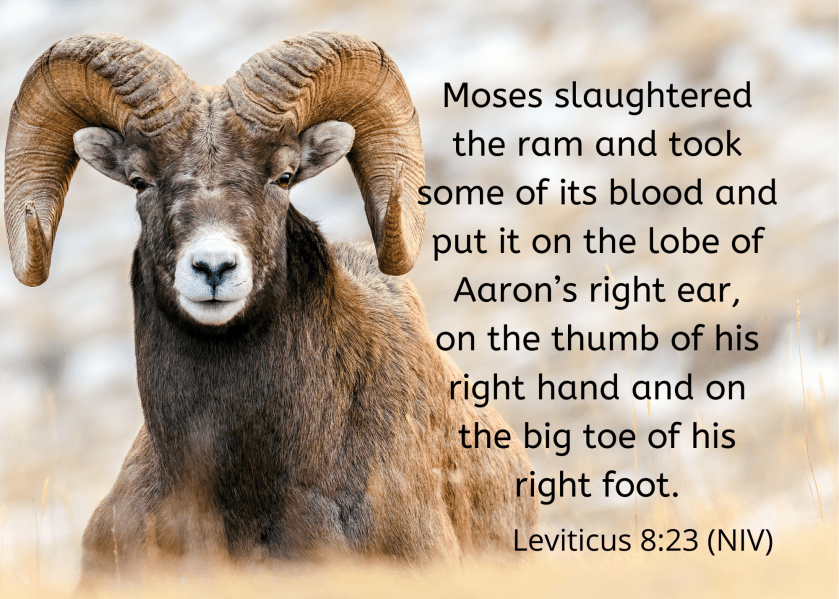
23 Moses slaughtered the ram and took some of its blood and put it on the lobe of Aaron’s right ear, on the thumb of his right hand and on the big toe of his right foot. 24 Moses also brought Aaron’s sons forward and put some of the blood on the lobes of their right ears, on the thumbs of their right hands and on the big toes of their right feet.

He took some of the blood and placed it in 3 specific areas on both Aaron and his sons; the ear, thumb and big toe. Each seems to have a pretty obvious connection.

The ear: Listen – They needed to listen to God’s commands so that they would be careful not to disobey Him.

Thumb/hand – Actions – We use our hands to carry out most of our actions. I think God was telling Aaron and his sons that they were not merely to listen, but to act on God’s commands. (Kind of like James 1:22 – be doers of the word)

The Big toe/foot – Our walk and where we go – I have read that the big toe carries the most weight and gives the foot balance when walking. Without big toes we could not run or even walk straight.

Possibly God is reminding them to walk straight and stay committed to the path God has set before them.

1 Peter 2:5 – you also, like living stones, are being built into a spiritual house[a] to be a holy priesthood, offering spiritual sacrifices acceptable to God through Jesus Christ.

We are all called into a similar service.

So may your ears be blessed to hear the command of God for your life. Bless your hands to act upon that calling and command. Bless your feet so that wherever you are and wherever you may go you stay committed to the path the Lord has for you.

You are blessed so that you can be a blessing!

John Wincapaw


Today’s Bible reading can be read or listened to at https://www.biblegateway.com/passage/?search=Leviticus+8-10&version=NIV

Tomorrow’s reading will be Leviticus 11-13 on our 2020 Chronological Bible Reading Plan