Trust

Numbers 23-25

Numbers 23 19 NIV
Numbers 23:19 describes a foundational aspect of God’s character, his faithfulness. Scripture says, “God is not man, that he should lie, or a son of man, that he should change his mind. Has he said, and will he not do it? Or has he spoken, and will he not fulfill it?” As believers, we need a revelation of God’s faithfulness. Being able to fully trust God is the beginning of living an abundant life. If you don’t fully believe that God is faithful to lead you into the best possible life you could live, then you won’t seek out his will, trust him with your possessions, or be able to fully enjoy his presence.
God’s word promises us in Numbers 23:19 that God is perfectly faithful, steadfast, and true. Philippians 1:6 says, “And I am sure of this, that he who began a good work in you will bring it to completion at the day of Jesus Christ.” Romans 8:28 promises, “We know that for those who love God all things work together for good, for those who are called according to his purpose.” Your God is faithful to you. No matter what you do, he will be there for you. His faithfulness isn’t dependent upon your works. All he requires is a willing heart to bring about the fruit of the Spirit in your life.
You aren’t meant to live life apart from the knowledge of God’s faithfulness. You aren’t meant to live with the weight of doing life on your own. Man may fail you, but your God will not. Family and friends may not be there when you need them, but your God will always be there for you.
Where do you feel on your own? In what ways do you need a fresh revelation of God’s faithfulness? He promises to be true to you. He promises to see you through any situation you find yourself in. Isaiah 54:10 says, “‘For the mountains may depart and the hills be removed, but my steadfast love shall not depart from you, and my covenant of peace shall not be removed,’ says the Lord, who has compassion on you.” Faithfulness is foundational to the very character of God.
Respond to God’s faithfulness today. Let His promises calm the parts of your life that feel unsure. Think about the things you’ve put your trust in. Remember, God promises that His faithfulness will outlast anything you see. May your affections for him be more today. May you respond to his faithfulness with your own. And may you experience the love and joy of a Father who loves you perfectly and completely.
Andy Cisneros
Today’s Bible reading can be read or listened to at https://www.biblegateway.com/passage/?search=Numbers+23-25&version=NIV
Tomorrow’s reading will be Numbers 26-27 as we continue the 2020 Chronological Bible Reading Plan

Formula

Numbers 21-22

Numbers 21 7 NIV

In today’s reading, the Israelites needed a spiritual “blood transfusion.” Their sinful and rebellious attitude had shown itself in impatience, complaints about hardships, ingratitude for manna, and a lack of faith in God’s leader, Moses. This faithlessness resulted in a deadly plague of snakes that were killing the people.
The Israelites repented and asked Moses to intercede for them. God’s response required them to show their repentance by a simple act of faith. Moses made a bronze serpent and lifted it up on a pole. To be healed, people had to look at the serpent. If they didn’t believe God’s words, they wouldn’t look up and would therefore die. Only through faith could they be saved.
Homeopathic medicine is the practice of curing likes with likes. The patient receives diluted doses of substances that, at full strength, cause the same symptoms the patient already has.
This type of medicine is used in many parts of the world, though it remains controversial among medical experts. In this instance, God prescribed a similar remedy for Israel, treating snake bites with a replica of a snake. Going a step further, God undid the effects of the plague through an image of the curse itself.
Today’s story begins with the people grumbling … again. It was the same old story: we’re dying, we’re starving, we don’t like the miraculous food, and we’re sorry we ever left Egypt. But this incident is unique; this time, the people repented.
In past events, Moses had asked God for mercy on behalf of the Israelites, but on this occasion, his prayers were prompted by a recognition of their sin that Israel hadn’t shown before. They realized on their own why the snakes were sent, and they confessed their sin. In that way, this was a spiritual breakthrough for Israel!
If God had followed the formula we’ve seen so far, we might expect Him to demand a sacrifice of some kind, like a lamb without defect. But the Lord told Moses to put a bronze snake, a picture of judgment, on a pole for all to see. He directed the people’s eyes, not to an image of purity, but to a symbol of wrath.
For healing to take place, the people had to close the loop of repentance. They sinned, confessed, and asked for mercy. The last step was to accept God’s remedy by faith and follow His instructions.
We often picture Christ as the perfect sacrifice, and that he is. But He also took upon Himself the shame of sin and the full penalty of wrath. In His conversation with Nicodemus, Jesus compared His upcoming crucifixion to the lifting up of the serpent in the desert. Let’s confess our sins, seek His mercy and turn our eyes to him, who not only gave his life but also received our punishment. Thank Him in word and in deed today.
Andy Cisneros
Today’s Bible passage can be read or listened to at https://www.biblegateway.com/passage/?search=Numbers+21-22&version=NIV
Tomorrow’s reading will be Numbers 23-25 as we continue the 2020 Chronological Bible Reading Plan

Satisfaction and Sin

Numbers 18 29 NIV

Numbers 18

Everything in Israel that is devoted to the Lord is yours. – Numbers 18:14
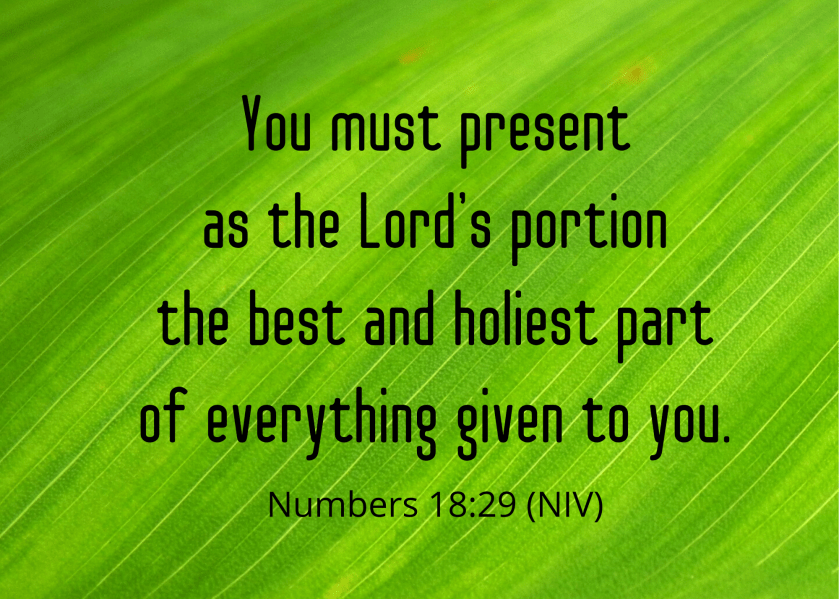
The old saying to “save the best for last” might be our natural inclination as people, but when it comes to giving to God, the best should always come first. That was what God demanded of Israel. As the chosen servants of God, the Levites received that offering, the very best, as their own.
1st of all, the Levites enjoyed a distinguished role. They were God’s gift to Aaron. There should have been no confusion about Aaron’s authority over them; instead, they should have appreciated the fact that God had wanted them for His service.
That service was part of its unique responsibility. No one else in Israel could come so close to the Lord’s dwelling as the Levites. They were given the opportunity to care for and handle the holiest dwelling in the whole land. They were employed in the service of the Almighty.
God blessed them with material gifts as well. In exchange for their service to God, the Levites received the tithe offered by the entire community, the best that Israel had to offer.
For any among the Levites to have been unhappy, they must have been deceived or deluded about their stance with God. The proper response to all that He had given them was to give Him a tenth of what they received—not just any part of it, but the very best of the best. Instead, they demanded more. People who are not satisfied with the best, can never really be satisfied. Do you recognize what God has blessed you with?

Numbers 19

If a [unclean] person does not purify himself, he must be cut off from the community, because he has defiled the sanctuary of the Lord. – Numbers 19:20
It was very easy to become unclean without realizing it. To touch a corpse, to be in the same room as the dead, to stumble over a grave, was enough to defile the Israelite, and excommunicate him from the Tabernacle with its holy rites. Could anything more graphic give us a clear picture of sin? We cannot be in contact with people who are blatantly sinning, or using foul language, or watching movies or tv that express the evil of this world.
This is the reason why, at the end of the day, we often feel unable to pray, or hold fellowship with God: we are excluded from the Most Holy Place, because of this defilement. There is only one way of escaping it, and that is in being covered, sealed, by the Spirit of God. “In whom you were sealed until the day of redemption.”
Andy Cisneros
Today’s Bible reading, Numbers 18-20 can be read or listened to at https://www.biblegateway.com/passage/?search=Numbers+18-20&version=NIV
Tomorrow’s reading will be Numbers 21-22 as we continue the 2020 Chronological Bible Reading Plan

Rebel to Righteousness

Numbers 16 38 ESV

Numbers 16

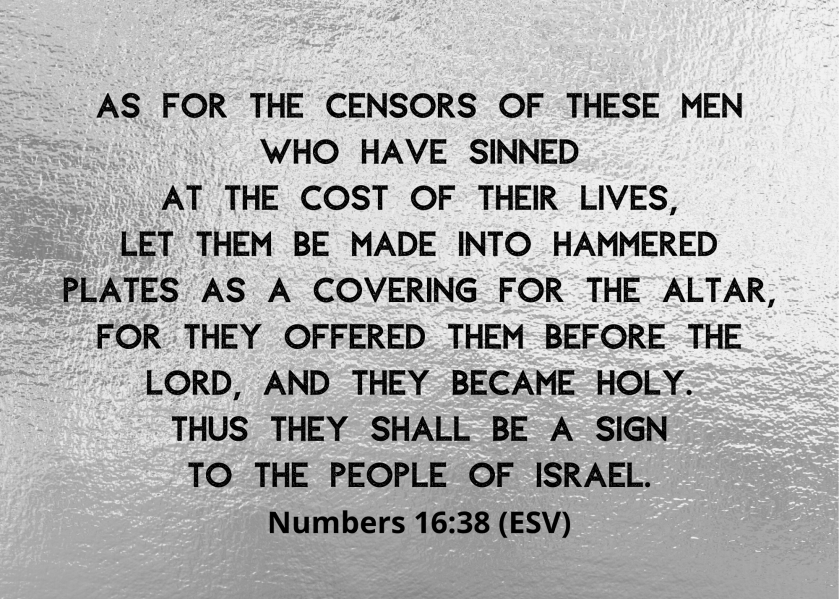
There was a man named Korah who led a rebellion against Moses’ leadership (Numbers 16:2-3). Moses instructed them to put fire and incense in censors before the Lord to let God decide what man would be in charge. Of course, God stayed faithful to Moses and made it clear that Korah and his men were sinning.
God, to punish the rebels’ sin and rid Israel of false leadership, caused the earth to open up and swallow Korah, his household, and his rebellion. Next, God redeemed the sinful situation into a holy one by turning the censors the men used to sin with into a covering for the altar that was holy.
This is a large part of what makes the Christian faith different than other beliefs. In order to be justified, or have right standing, with the gods of many religions, one must work their way into the god or goddesses’ approval; they need to pray enough, give enough, fast enough, and do enough good all with the hope of making the cut. Our God doesn’t work like that. Instead of accepting the good or holy, he seeks the sinful and makes them holy (Mark 2:17), having exchanged our sin with Jesus’ perfection (2 Corinthians 5:21). That is a fundamental difference, that he takes the sinful and makes him holy, instead of expecting the sinful to clean himself up and work his way into his favor which is impossible for man (Rom. 3:10-12). We serve a wonderful God who can turn rebels to righteous before God.

The God of Second Chances – Numbers 17

The story of the rod of Aaron.
The rod was like a stick and these twelve men carved their names on them, out of the twelve one of them sprouted. The one that sprouted was Aaron’s rod and he became the priest. God worked this miracle to prove to the children of Israel that they had been wrong in questioning whom the priesthood rightfully belonged to. God mercifully gave Israel another evidence of his will, to correct their judgment. The miracle was sufficient to silence the complaints of the Israelites. After they realized what they had done, they were terrified and said: “Behold, we perish, we are dying, we are all dying!” God asked Moses to place the rod in front of the alter so that it served as a reminder that they were wrong in questioning God’s authority.
How many times has God given us a second chance? If you haven’t noticed, every morning is an opportunity to serve Him, love Him, give yourself to Him, reconcile with Him, reconcile with your brother, love those around you, enjoy nature, be kind, serve others. My point is, God is merciful and loving, “The Lord, the Lord God, merciful and gracious, longsuffering, and abounding in goodness and truth, keeping mercies for thousands..”(Exodus 34:6-7). In His great love, he gives us second chances. However, there will come a day when we will have no more second opportunities.
Andy Cisneros
Today’s Bible reading can be read or listened to https://www.biblegateway.com/passage/?search=Numbers+16-17&version=NLT
Tomorrow’s reading will be Numbers 18-20 as we continue the 2020 Chronological Bible Reading Plan

Seek

Numbers14-15 cain

No matter how many times I read the story, it is hard for me to digest the betrayal of the Israelites in chapter 14. After they saw the land that He promised them, they wanted to return to being slaves in Egypt? What shocks me even more is that we do the same thing today. What do you think Jesus meant when he said this in Luke 9:62, “No one, after putting his hand to the plow and looking back, is fit for the kingdom of God”? This is alluding to a plow man tilling the ground to prepare it for planting. If the plow man were to look back behind him the rows would be crooked and off course. Jesus is saying that we are like plow men and if we look back and do a poor job then we aren’t fit for the kingdom. What does this have to do with Numbers 14? We can look back today the same way the Israelites did in Numbers 14. They were liberated from slavery in Egypt and given the promise of a new land that was “exceedingly good”. We were liberated from slavery under sin and given the promise of a perfect new earth. The Israelites looked back at their life in slavery and wanted its comforts once again, even knowing they would return to slavery. We can look back at our life of sin and wish we could go back to it, even if we know it will kill us in the end. Sometimes our desires can turn from God and pull us towards a life of sin.

The last two verses of chapter 15 tell us exactly what God desires from us. “Remember to do all My commandments and be holy to your God. I am the Lord your God who brought you out from the land of Egypt to be your God; I am the Lord your God.” Replace the phrase “land of Egypt” with “sin” and apply this to our lives today. Let’s not miss out on our promises because we want to look back to our old life of sin and return to slavery. Let’s keep our eyes on the goal of the kingdom and remember the God who saved us from sin and is bringing us to an “exceedingly good land.” I enjoy looking at the big picture in scripture and seeing how God works on a grand scale. Like how we see God working out the same goal for us and for the ancient Israelites.

Psalm 90 is a chapter that gives us a big picture view of the world and plainly relays potentially complex ideas into understandable language. When I read Psalm 90, a few things are clear to me. God is eternal. He views time differently than us. He sees our sin and He loves us despite our sin. Sometimes we need reminding of these big picture ideas because they help us understand the world and make us realize what is actually important. We can easily get lost in our everyday activities and bury our minds in worry, but in reality, God is still in control and willing to show us His favor.

Thank you for reading our devotions on Numbers this week. Hopefully we walked away with a renewed respect for God’s holiness, an awe for the awesome work He did in the people of Israel, and a reassurance that He is leading us towards a promise that is better than anything we can imagine. Numbers may sound like a boring math book, but in reality it is a rich record of God’s dealings with His people. As you continue to read through the book of Numbers, see how God deals with His people and make a connection to your life. Where God’s word and application meet, there is life change and understanding.

Josiah Cain


Today’s Bible reading can be read or listened to at https://www.biblegateway.com/passage/?search=Numbers+14-15%2C+Psalm+90&version=NIV

Tomorrow’s reading will be Numbers 16-17 as we continue the 2020 Chronological Bible Reading Plan

Follow

Numbers 11 13 Cain

These next three chapters are where things start to heat up in the book of Numbers…literally. In verse 1, we see the Israelites start to complain. After all that God has done for them, I understand why He would be upset. When it says the “fire of the LORD burned among them,” this isn’t a metaphor, but instead literal fire burned throughout the outskirts of the camp. The people obviously didn’t like this fire, so they complained to Moses and Moses prayed to stop the fire. God stopped the fire, but apparently, this wasn’t enough to teach the Israelites their lesson. In verses 4-6, they complain about not having meat and nice food like they did in Egypt; all they had to eat was manna. In verses 11-15 Moses honestly lays out his heart to God to the point where he asks God to kill him. Now, to me, there is an important lesson that we can learn from this outpouring. Even the greatest among us can reach a point where we have had enough. However, we can always bring our troubles and anxieties to God. Even if the problem seems impossible, like feeding millions of people meat in the middle of the desert. God wants to deal with us in a personal way. He doesn’t want the perfect fake versions of ourselves where we have all the answers and are always composed. We can be honest with Him and show Him our true heart. God dealt faithfully with Moses when Moses came to Him with a huge problem and He will deal faithfully with us when we bring our problems to Him.

This interesting incident happens in 11:24-30. The Spirit of God comes upon the leaders of Israel much like what we see in the New Testament on the day of Pentecost. We usually think about the Spirit being a New Testament power, but it is also present in the Old Testament. After the spirit comes on the elders, two of the elders prophesy in the camp. A young man thought this was a problem, so he told Moses. Little did Moses know, God’s big plan was to give His Spirit to each of His followers in the new covenant that was coming. The elders prophesying was just a taste of what God had in mind for His people. I like how Moses doesn’t get jealous about God giving His Spirit to others, but instead trusts and respects God enough to allow Him to deal as He sees fit. I think we too should have this same attitude of trust in God.

In verse 34, Kibroth-hattaavah literally means “the graves of greediness”. They named the place after exactly what happened in that place. The names of places serve as reminders. Imagine going down the interstate and passing the exit to Graves of the Greedy Town. Chapter 11 serves as a good reminder to us about our selfishness and greediness. Do you feel like God owes you something? Are you complaining to God about the things you want? Let’s take chapter 11 as a good lesson for us today. God truly has our best interest at heart and has already rescued us from death and slavery. Let’s not be like the Israelites who are so quick to forget where God has brought them from and so quickly turn to our own desires.

In chapter 12 we read another story of disobedience. Aaron and Miriam get mad about Moses’s wife being a Cushite. This may be because she wasn’t a Jew and in the law people were only supposed to marry Jews. Regardless of the reason for their anger, they think they are justified in thinking they are better than Moses. They say, “’has the LORD indeed spoken only through Moses? Has he not spoken through us as well?’” (11:2). Almost as to say Moses married a Cushite women and God has spoken through us as well, what makes him think He is better than us? In the way that verses 2-4 talk about the situation, I can imagine Aaron and Miriam colluding in the corner of the Tabernacle, whispering to each other about how they are better than Moses. God sets them straight in verses 5-10, even giving leprosy to Miriam for her disobedience. Even the leaders of Israel were making big mistakes and being divisive. The scope of these happenings highlight the sin nature of man. Even after God has liberated the Israelites from Egypt, with all the miracles that went into that event, they still sin and disobey God. No matter the circumstances, people can’t stay away from sin very long. The only way we can be purified and righteous before God is through Jesus. When God looks at us, He doesn’t see all the mistakes we’ve made today. He sees His perfect son who covers our sin. When I read the Old Testament, it makes me very thankful for Jesus and the role that he plays in my life.

Even though the people have continued to fight and disobey God, He still leads them to the Promise Land. In chapter 13, we see the beginnings of God’s plan to move His people into the Promise Land. God wants the people to spy out the land.  However, things don’t go smoothly, even the spies are disobedient and give a bad report about the land. The only spies to come back and give a good report are Caleb and Joshua. It’s like the spies forgot what they just went through with the Exodus. Did they not see the plagues that God sent on Egypt? Did they not see God defeat the entire Egyptian army in one stroke? Did they not see the manna and quail that God provided? How can they go to the land of Canaan after experiencing all these things and not think God can take care of these people too? Where is their faith? More importantly and real to our lives, are we the same way? We know the stories about what God did. We know who God is and have seen Him work. We know that even death has no power, yet we let our faith fail when we are confronted by hard things. Are we different than the spies of Israel who gave a bad report about the land of Canaan out of fear? Is there a land in which God is leading you? We have seen how He works and He is faithful to follow through. He is powerful to complete any task which He undertakes. I want our faith to be strengthened by chapter 13 and I want us to learn a lesson from the Israelites. Let’s not forget and let’s have faith. Let’s be people who follow God through the wilderness, faithfully, so that we can walk into the place He has prepared for us.

Josiah Cain


Our God

Numbers 8-10 cain

Have you ever thought about your life as a sacrifice to God? When I see how the Levites were cleansed and given before God as a wave offering in verse 13, it makes me want to be the same way before God. Imagine being born into the tribe of Levi and knowing what your purpose is. Your purpose was to grow up, study the job of your calling, study the scriptures, live a righteous life, and eventually serve God for 25 years. But really, how different are any of our lives from that? Can we not have the same basic path? Can we not come to faith, prepare ourselves through study, serve God in our lives, and present ourselves as offerings before God? People give their lives to all sorts of things. Many people choose to make their lives about the pursuit of a career, the growing of a family, the building of a legacy, etc. As the book of Ecclesiastes teaches, life’s meaning comes from following God and keeping His commandments. There is nothing else that we can pursue which gives us meaning and when I read how the Levites were given into the service of God I am reminded of this. I’m not saying everyone must be a pastor or anything like that because serving the LORD comes in many fashions, but we all need to put our life before God as a wave offering. Nothing sounds more appealing to me than being purified before the LORD and serving Him as we see in 8:21. Through Christ, we can all be purified and serve God with the entirety of our lives.

As we move into chapter 9, there is a question that comes up about observing Passover and being unclean. We find the answer in verse 9:10-14.  To me, there is a personal aspect that comes out of the beginning of this chapter. I see real people seeking to live out God’s word. These people wanted so badly to correctly follow God that they asked questions about seeking the desire of God. I think there is a lesson to be learned from the attitude of these followers: be open and real with God in all things. Open up and ask questions, seek His desire, and listen to His response. Today, I think we should learn to posture ourselves more like this before God. He is real and willing to interact with His people and give us wisdom. Sometimes we think that the time for God to interact with His people has passed, even if we don’t believe that, sometimes we act like that is the truth.

Verses 15-16 are an awesome manifestation of God among His people. His presence was continuous around the Tabernacle. Try to imagine the scene in your head. Imagine you are camping with the Israelites. In the middle of the night you walk out of your tent and in the distance, there is the warm glow, looking like fire, surrounding the Tabernacle in the distance. Have you ever seen a big fire from a distance? The warm glow that casts against the clouds in the sky. Imagine that scene every night, knowing that God is here, living among you, watching over you, and showing you His power. Don’t be so fast to read over verses, use your imagination and try to put yourself in the landscape. Imagine the smells, sights, and sounds that would have been observed by the people in the book. This practice brings the Bible to life for us, especially in the book of Numbers, where there are a lot of mind blowing events that take place. Numbers is a hot bed for God’s power manifested like no other time in history. Take your time reading these words and putting yourself in the shoes of the people. It would have been an awesome time to be alive and to witness God working in miraculous ways.

Another point we see in chapter 9 is just how literally God leads His people through the wilderness. When He moved, they moved. God still wants to lead His people today. It might not be a cloud of smoke or fire, literally leading us to the place we need to go, but through prayer and faith He can lead us to great places He has prepared for us. We should be people like those in 9:23. “At the command of the LORD they camped, and at the command of the LORD they set out; they kept the LORD’s charge, according to the command of the LORD through Moses.” When God moves, we should move. When God stays, we should stay. He is leading us to things prepared for us that we can’t see or imagine, but if we follow faithfully, we will be glad we did.

Here’s an intriguing thought. Let’s say you had no modern-day technology – how would you communicate and organize roughly 2.5 million people? Seems like an overwhelming task to me. The system that God put into place at the beginning of chapter 10 is genius. I’m not surprised God came up with such a good system, but none the less, I’m impressed by the simplicity and effectiveness. Now that all the pieces are in place, the tabernacle, the camp organization, the communication system, and the leading system, it is the time to set out for the promise land. The first move was from Sinai to Paran and took three days (10:11-13, 33). We see the organization it took to move millions of people across the desert in verses 14-28. Then come some of the coolest words in the book of Numbers “35 Then it came about when the ark set out that Moses said, ‘Rise up, O Lord! And let Your enemies be scattered, and let those who hate You flee before You.’ 36 When it came to rest, he said, ‘Return, O Lord, To the myriad thousands of Israel.’” The protection of the LORD went before them and watched over them in their journey, clearing the path of any obstacles that would stop them from reaching the promise land. God is for His people. I can’t explain how these verses make me feel, but I know that it’s awesome. I love seeing how God extends His arm to deal in the lives of His people. Even though seeing a cloud move might be more obvious, God still extends His arm to deal in the lives of His people today. Take some time to think about the prayers you have prayed. How have they been answered? This is God working in your life. I have seen people changed and situations work out in unusual ways. At some point, you have to stop saying things are coincidence and say that God is working in His people. The same powerful God we see in Numbers is the same God who deals with us today. Don’t forget, the God who liberated millions of people from Egypt is the same God who seeks your heart.

Josiah Cain


Today’s Bible reading can be read or listened to at https://www.biblegateway.com/passage/?search=Numbers+8-10&version=NIV

Tomorrow’s reading will be Numbers 11-13 as we continue on the 2020 Chronological Bible Reading Plan

 

His Tabernacle

Numbers 7 cain

During the building of the tabernacle, the tools and utensils were not holy. Everything was normal cloth or gold material until they were consecrated. Once Moses anointed and consecrated the tabernacle and the things that went in it, they were no longer normal objects.  Instead, they were objects of God. If God can turn a simple lamp stand into a holy object, then what can He do with us? We can be made holy and set apart by God to serve a great purpose. As we have said many times, through the book of Numbers God seeks holiness for Himself and His people. This desire didn’t disappear when Jesus came into the world. God desires for us to be holy. Although we sin, God can redeem us just like He did with the tabernacle in Numbers 7.

There is a moment after the tabernacle is consecrated that the people of Israel begin to bring sacrifices and gifts.  Among the gifts are six carts and 12 oxen that are going to be given to the Levites. Carts and oxen make moving things easier.  This would be a pretty handy gift during the time of the wilderness as they move everything they have across the desert by hand! In verse 9, we see the sons of Kohath weren’t given any of the oxen and carts – what kind of rotten deal is that? Why didn’t any of the carts go to the sons of Kohath? The sons of Kohath were in charge of carrying the holy objects on their shoulders. Each heavy object in the tabernacle, including the Ark of the Covenant, was built with places for poles to slide into so that they could be carried by pole on the shoulders of the sons of Kohath. You may remember the story of Uzzah in 2 Samuel 6 when the Ark was going to be moved back into the city of Jerusalem after being gone for a long time. Notice in 2 Samuel 6:3 they placed the Ark, “on a new cart”. This was a big no-no. The Ark was not supposed to be put on a cart, but instead carried on poles like we see in the law. Then what happens? The Ark begins to fall off the cart on the way into the city and Uzzah, who was just trying to help by catching the Ark, died right as he touched it. God’s holiness can’t be infringed upon. Albeit easier, you don’t put the Ark on a cart. This is why no carts where given to the sons of Kohath. They didn’t need carts to assist in the moving of the holy objects of the tabernacle. Isn’t it interesting how the Bible connects in such unique places? Who knew that around 400 years after God gave the command to not move the holy objects on carts that Uzzah would learn the severity of breaking the command.

The rest of chapter 7 sound maybe like Pete and Repeat wrote it. These aren’t particularly exciting verses and the gifts of each tribe are the same. Between verse 10 and 83, the tribes, their gifts and their offerings are listed. After 12 days of offerings the total was: 12 silver dishes, 12 silver bowls (a total of 2,400 shekels of silver), 12 gold pans (a total of 120 shekels of gold), 12 bulls, 12 rams, 12 male lambs 1year old, 12 grain offerings, 12 male goats, 24 bulls for peace offerings, 60 rams, & 60 male goats for peace offerings (a total of 192 animals). The Israelites would have given a total of around $16,000 in silver and around $71,500 in gold. What a great out pouring from the sons of Israel to God in celebration and honor of the new tabernacle.

After the anointing of the tabernacle and 12 days of offerings, one of the coolest things I can imagine happened to Moses in verse 89. God spoke to Moses from above the Ark of the Covenant. Finally, after all the effort that has gone into getting the Israelites out of Egypt, God now has a place to dwell with His people. The time has come when God speaks to Moses from among His people. No longer does Moses have to travel to the top of a mountain to speak to God. God has moved even closer to His people today. We don’t have to travel to a temple in Jerusalem to be with God because, as we see in the New Testament, we are God’s temple (1 Corinthians 6:19). God can now dwell among us in a more personal way; He has moved into the hearts of His people. We have been anointed and sanctified by the blood of Jesus to become the new temple that God dwells in. We see an ever moving forward march by God to be closer to His people. It started with the tabernacle, then into the hearts of men in the time of the New Testament and now. In the future, we have the hope of God dwelling with us in person in the kingdom! He is with us now in the power of the Spirit that moves among us but, at the time of the restoration of all things, God is going to be with us like it was in the garden of Eden. Revelation 21 says that God is going to dwell among men. There is no part of the Bible without significance. All of it is connected because all of it is the word of God. God’s desires don’t change and He desires to be with us. The creator of the universe, the creator of the estimated 1,000,000,000,000,000,000,000 stars wants to be with you. To me, the realization of this fact is humbling and inspiring.  Thank you, God!

Josiah Cain


Today’s Bible reading can be read or listened to at https://www.biblegateway.com/passage/?search=Numbers+7&version=NIV

Tomorrow’s Bible reading will be Numbers 8-10 as we continue the 2020 Chronological Bible Reading Plan

His Law & Love

Numb 5-6 CainPicture1

Right at the beginning of chapter 5 we continue the theme of supreme holiness.  This helps me remember that chapter and verse separations are not part of the original scriptures. For me, sometimes using verse and chapter markings can hinder my Bible study because I can see them as walls dividing different ideas or topics instead of a continuation of an idea.  That being said, we see God’s holiness carry over from chapter 4 to chapter 5. He wants His people to be so holy that He doesn’t even want unclean people in the camp. Of course, this could have medical benefits as well, which I think is another reason God instructed His people to leave the camp if they are unclean (verses 1-4).

In verse 6 there is something that grabs my attention. The NASB translation says, “Speak to the sons of Israel, ‘When a man or woman commits any of the sins of mankind, acting unfaithfully against the LORD, and that person is guilty”. The word unfaithful is מַעַל (maal) in Hebrew. It is the same word that is used to talk about unfaithfulness in marriage. You will notice that the rest of the chapter deals with unfaithfulness in marriage. I think it is intriguing how God sees sin and idolatry as unfaithfulness in the same way that people see unfaithfulness within marriage. In fact, this is the premise of the entire book of Hosea. God uses the authentic metaphor of an adulteress wife to show how Israel acts towards Him. In God’s eyes, sin and marital unfaithfulness are one and the same.

Speaking of marital unfaithfulness, the majority of chapter 5 deals with an interesting situation that may arise in the lives of the Israelites. We are presented with a situation where there is a jealous man who thinks that his wife might have been unfaithful in their marriage, but there is no proof. No one saw her with another man; there is just suspicion. Now I think it is important to understand the world in which the Israelites live. Surrounding the time the law was given to the Israelites, there were other nations with other laws to deal with similar situations. Here is what the code of Hammurabi says about a woman accused of adultery, “If a man’s wife should have a finger pointed against her in accusation involving another male, although she has not been seized lying with another male, she shall submit to the divine River god for her husband.” This divine River god test pretty much consisted of her husband making her jump into a raging river and if she survived then the “god” ruled that she was innocent and if she died then she was guilty and her judgment was given to her. Keep this in mind as we go through Numbers 5.

If a Jewish man had suspicion that his wife was unfaithful, he didn’t throw her in a river to see what happened. Instead, he had to go to the tabernacle and see a priest. The couple would bring barley meal as a memorial offering and then the priest would set out the rules for the test that was to come. Essentially, the woman agreed to drink some water mixed with a little bit of dust and ink. A little bit of dust and ink isn’t going to have major adverse health effects unless there actually is some divine judgment involved in the situation. However, jumping in a raging river has been known to kill people even if they weren’t unfaithful in their marriage. This test takes the judgment out of man’s hands and squarely puts it in the hands of God to make the call. I know it doesn’t look like it at first, but this dust and ink water test is a major step forward for women in ancient history. No longer can a man choose to beat his wife or throw her in a river based on his suspicion. He must do the very public act of taking her to the tabernacle and allowing God to make a judgment. If you notice in verse 28, she is free if the judgment doesn’t come over her. This means the man can no longer bring this charge against her. Women weren’t treated this well in any other society on earth during this time in history. The Bible puts men and women on equal playing fields in value. God makes sure that His people cannot take advantage of women the same way other nations do.

Many people want to point a finger at the Bible and say that it’s misogynistic and oppressive to women. However, God’s law ensured that women were taken care of and given the same value as men. God doesn’t hate women; He made both men and women in His image. I think there are two major points we can pull out of Numbers 5. First, God sees sin as a spouse sees marital unfaithfulness and second, God values both men and women the same. God put into effect laws that protected both His holiness and the holiness of His people and He made sure the men of His people couldn’t abuse the women who are also made in His image. This is a true gift of the Bible. In every page, in every sentence, we see the heart of God coming alive to us. Even in obscure laws about obscure situations, we see God’s heart for His people.

Now let’s take a look at Chapter 6. The majority of this chapter is dedicated to explaining the Nazarite vow. A Nazarite vow is a special vow that a person can take to dedicate themselves to God. Notably, Samson partook in a Nazarite vow which is why he lost his strength after his hair was cut. A part of the promise to Samson was to keep his vow with God and once he broke that vow, his strength left him. If you wish to take a Nazarite vow, remember the wise words of Ecclesiastes 5:5, “It is better not to vow than to make a vow and not fulfill it.” The Nazarite vow is so intense it even bars contact with dead relatives which would make a person unclean. Yes, if you were in a Nazarite vow and a close relative died, you wouldn’t be allowed to attend their funeral without breaking your vow. This is how serious the Nazarite vow is.

The last few verses of chapter 6 are an interesting section usually referred to as the Aaronic blessing (Aaronic referring to Aaron, the brother of Moses). The words of the Aaronic blessing are beautiful and tender. God asks for Aaron to make known how much God cares for His people.  In these words we see God’s heart. Later, there is a great promise that proclaims “they shall invoke my name on the sons of Israel, and I then will bless them”. Ultimately, God wants us to call out to Him in all seasons. When we see Israel go off track in the Old Testament, God desires for them to return to Him so that He can return to blessing them. We see this in Matthew 7:11 as we are reminded that God is our Father.  “So if you who are evil know how to give good gifts to your children, how much more will your Father in heaven give good things to those who ask Him!” Don’t these words resonate so well with what we see in Numbers 6?! Our God doesn’t change – He still loves us and wants to bless us. If God didn’t change in the 1,400 years between the writing of Numbers and the words of Jesus, then surely He hasn’t changed between the time of Jesus and our time now. If you are a child of God today, God wants to bless you and wants to take care of you. Take peace and find rest in this truth.


Josiah Cain


Today’s Bible reading can be read or listened to at https://www.biblegateway.com/passage/?search=Numbers+5-6&version=NIV

Tomorrow’s Bible reading will be Numbers 7 as we continue the 2020 Chronological Bible Reading Plan (1) (1)
The Key

numb 2&4 cain

Over the last four years I have done a lot of moving. I’ve moved from an apartment, to a house, to a trailer, back to a house, to my in-laws, and now to my home. Not to mention, I have helped plenty of others move during this time. Despite my many moving back aches and cardboard box forts, I’ve experienced nothing in the moving department compared to the Levites in chapter 3-4 of Numbers. These chapters are dedicated instructions for the Levites about how to live around and move the Tabernacle.

A portion of the third chapter is dedicated to uncomplicated, yet purposeful counting of all the male sons of the Levites a month or older.  Remember the Passover in Egypt where God spared the first born sons of Israel while passing judgement over the rest of Egypt’s first born sons? In Numbers 3, we see God take the first born of Israel not to death, but to holiness. Numbers 3:13 says that God is making the Levites “sanctified” to Himself. This word sanctified means to make holy. Instead of killing the first born sons of Israel, God uses them to be mediators between Him and the Israelites. Does this sound like any other first born son to you? Jesus is now the first born son that acts as a mediator between us and God. It is so cool to me that the number of Levite males a month or older and the number of first born sons in Israel are almost the exact same number. God sees the males of the Levites being the ransom in place of the first born sons of Israel. In Numbers 3:39, the number of Levite males comes out to 22,00 and in 3:43 the number of first born males is 22,273. I will draw your attention to the extra 273 first born sons which aren’t covered by the ransom of the sons of Levi. Instead of taking their lives, which is what they would deserve, God only requires the small price of 5 shekels per person. That comes out to a total of 1,365 shekels in exchange for the lives of 273 first born sons. I guess I was wrong in my last post when I joked about Numbers being a math text book. But really, the math should be done from this point on. The point is this: God would rather redeem people than kill people; God opts for mercy instead of judgment. This is just one of the great things about Him that makes Him a God worth worshiping.

Moving on to chapter 4 we again see the detailed and intentional nature of God through instructions He gives the Levites for the Tabernacle. Remember holiness is one of God’s main priorities when it comes to the Tabernacle. We are blissfully reading along in chapter 4, hearing about the job of the sons of Aaron….then we get to verse 15. Things get serious in verse 15. It becomes clear to us that the sons of Aaron took so much caution in covering all the holy objects in the Tabernacle so that when the sons of Kohath come to move the stuff they don’t die! Remember God’s holiness is serious. All it would take for an unclean person to die is to touch a holy object. It doesn’t sound like a simple list of instructions anymore; this is a life or death situation. I thought I had it rough when I had to take the legs off my couch to fit it through the door but at least I wouldn’t die if I accidentally touched it! I like to look at verses 5-20 as the “how not to die when moving the Tabernacle” verses. If you were a son of Kohath, in charge of carrying one of the holy objects, you would be thankful that one of the sons of Aaron did their job well.

Reading though chapter 4 and hearing how the jobs of these different people are broken down reminds me of the body of Christ. We have different positions and skills which allow us to come together and work for God. Moving the Tabernacle in a holy and dignified way was no easy task, so too is serving God and His son, Jesus. It takes a team effort with everyone pitching in to make it a success.

Reading this also gave me another idea. Maybe we should only ask people between the ages of 30-50 to help us move. I should have quoted Numbers 4:3 to all the people who have asked me to move over the years. But in all seriousness, there is one big take away that I see from Numbers chapter 4; it is a lesson taught all over the Old Testament. Keeping God’s holiness and His people being holy are top priorities. We need to be holy as God is holy (Lev. 19:2). That is a direct command from God to us. We see this in how God treats even the moving of the Tabernacle. Holiness is key. When God was setting up the nation of Israel He wanted to make sure that they were going to stay separate from the world, separate from their idol worshiping neighbors. All the laws and rules are supposed to help them stay righteous and holy. Of course, we know that this is an impossible task for us to do on our own. Thankfully, we have a God who understands us and knows that we need help. This is why all of history, all of God’s plans, even back in Numbers with the counting of some Jewish men, was leading to the revealing of Jesus. Don’t think for a second that we are redeemed by accident. God was working out the world to be in such a way that you now, reading this post, have the option to be redeemed and righteous. We might be tempted to skip these boring chapters of the Bible where all we do is read about how many 30-50 year olds were in the household of Gershon, but we would miss out on watching God reveal his plans. Seeing God act with such intentional detail reminds me that God is not too big to deal with our everyday highs and lows. God works in the details of our lives today, just as He did in the lives of the Levites moving the tabernacle.

Josiah & Amber Cain


Today’s passage can be read or listened to at https://www.biblegateway.com/passage/?search=Numbers+3-4&version=NIV

Tomorrow’s passage will be Numbers 5-6 as we continue our 2020 Chronological Bible Reading Plan