Why Should We Pray?

Monday, October 2, 2017

Luke 18-1

I don’t want to spend any time talking about what prayer is or how we should go about it before I even convince you that we should be praying.

So why should we pray?

I think this is a pretty easy question to answer. Jesus commands it. There are a few verses that explicitly command prayer: Matthew 6:5-15, Matthew 26:41, Ephesians 6:18 and Luke 18:1. I want to look a little closer at the verse in Luke today.

”Then Jesus told his disciples a parable to show them that they should always pray and not give up” (Luke 18:1).  If we strive to be disciples of Jesus, then we should always pray. Being a disciple is essential to being “in Jesus,” just like our memory verse says. If we commit ourselves to constant prayer, than we can become a new creation.

Seems like a pretty easy step right? All we have to do is pray! Tomorrow we’ll talk about what that looks like.

-Nathaniel Johnson


Transformation!

Sunday, October 1st, 2017

2 Corinthians 5-17

Weekly Introduction by Nathaniel Johnson

If any of you have known me for very long, you know just how awful of a child I was. I was a little fireball of emotion. I would kick and scream when I didn’t get my way and I would hurt anyone that got in my way. Thank God for the transformation that occurred when I decided to be baptized! However, baptism wasn’t the only thing that changed me. A life filled with Bible study and prayer is what changed me. Paul described my situation perfectly in his letter to the Corinthians when he said, “If anyone is in Christ, the new creation has come: The old has gone, the new is here!”


Our memory verse for the week will be one that I have always felt very close to, 2 Corinthians 5:17. Throughout the rest of the week, I look forward to spending some time talking about prayer and how it is intimately related to this verse in 2 Corinthians.

God’s Will

Friday’s devotion

Romans 8-26

Romans 8:26–27 tells us, “And the Holy Spirit helps us in our distress. For we don’t even know what we should pray for, nor how we should pray. But the Holy Spirit prays for us with groanings that cannot be expressed in words. And the Father who knows all hearts knows what the Spirit is saying, for the Spirit pleads for us believers in harmony with God’s own will”

What is God’s will?

As humans, we are always interested in the here and now—what will benefit us temporarily.

God, however, sees things a bit differently. He is also interested in the long term and the eternal.

In other words, God has a bigger plan than my personal happiness in the given moment. He desires my holiness as I am conformed into the image of Jesus Christ.

It’s my prayer that we would be conformed into the image of Christ! 

-Jennie Montgomery

Who Can Be Against Us?

Thursday, September 28

Romans 8-31b


“What then shall we say to these things? If God is for us, who can be against us? He who did not spare his own Son but gave him up for us all, how will he not also with him graciously give us all things? Who shall bring any charge against God’s elect? It is God who justifies. Who is to condemn? Christ Jesus is the one who died — more than that, who was raised — who is at the right hand of God, who indeed is interceding for us.” (Romans 8:31–34)

There is nothing that we can be accused of or any shame we can ever bear that Jesus has not interceded for on our behalf. Jesus was condemned in my place, and my only hope is to plead his righteousness. Jesus himself is my one defense.

In the gospel, I have found the beautiful, glorious, freedom that comes with knowing that my righteousness is settled. I have freedom to confess any sin, accept forgiveness, and deepen my love for the One who forgives. I don’t have to fear condemnation or shame because of Jesus Christ who took on the punishment of sin. We serve a God who loves us and who is for us. Who can be against us?

-Jennie Montgomery


Separation

What can separate us


Romans 8:35-39         Who can separate us from the love of Christ? Can affliction or distress or persecution or famine or nakedness or danger or sword? As it is written: Because of you we are being put to death all day long; we are counted as sheep to be slaughtered. No, in all these things we are more than conquerors through him who loved us. For I am persuaded that neither death nor life, nor angels nor rulers, nor things present nor things to come, nor powers, nor height nor depth, nor any other created thing will be able to separate us from the love of God that is in Christ Jesus our Lord.

What can separate me from the love of God in Christ? Romans 8 says, “nothing,” but I have my doubts.

I bet I prayed “The Sinner’s Prayer” twenty times growing up. I was always so afraid I’d missed something, or paranoid I’d somehow nullified my salvation since the last time I said the magic words. After walking with Jesus, I now know: there is nothing magical about it.

My words don’t save me. Jesus saves me. My response is to repent of my sins and believe He saves me.

We focus on the exact words we said, the exact time and place we knelt. We make our coming to Christ about our circumstances rather than our Savior. It was never about what I was doing. It was always about what He did for me.

The depth of our need for Jesus is so vast that even our act of coming to Him is flawed, but He is never surprised by this. He knows us fully and loves us still. He came to make everything right, including our half-heartedness and our ill intentions.

Come as you are and bare your soul. Cry out like David cried out in Psalm 51, confessing honestly and openly before the God who made you and promises to make you new, who loves you and stands ready to save. Then come back day after day. Walk daily in the grace you first received, knowing there is nothing you can do or not do to reverse the rescue the cross secured.

-Jennie Montgomery

Learn a Lesson from the Lions

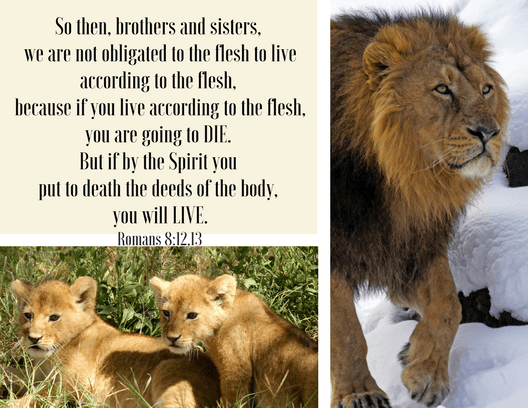
Romans 8 12,13

Tuesday – Romans 8


When I was a kid, I saw adorable baby lion cubs at the zoo and ever since, I have tried to convince my parents to let me get a pet lion. Because my house was not suited for a large dog, much less a 500 pound cat, my parents of course said no, but many people have actually gone about raising an exotic animal like a lion cub. However, many times, they become national news after their precious baby lion cub ends up attacking them. Surprised, they question why something that they played with, dressed up, and nurtured one day attacked them out of the blue? You know why? BECAUSE IT’S A LION. It is in its nature to grow up, get big, and attack no matter what setting it is raised in. A lion is TRAINED to kill.


I can’t help but think this is true about sin in my life. I start by thinking that small sins, like a lion cub, are harmless and cute and then I play with it and nurture it and one day it eventually attacks me. I buy into the lie that some sins are okay and will not do much harm, but soon enough they turn on me like sin is created to do. Sin is created to DESTROY.


So in turn, we must be diligent about destroying our sin. Paul speaks on this idea of killing sin in Romans 8:12-13 as it reads, “So then, brothers and sisters, we are not obligated to the flesh to live according to the flesh, because if you live according to the flesh, you are going to die. But if by the Spirit you put to death the deeds of the body, you will live.” Paul calls us to live by the Spirit and put to death our fleshly desires.


John Piper, in “How to Kill Sin,” Pt. 1, on DesiringGod.org explains, “Putting to death the deeds of the body by the Spirit – the daily practice of killing sin in your life – is the result of being justified and the evidence that you are justified by faith alone apart from works of the law.” He adds, “If you are not at odds with sin, you are not at home with Jesus, not because being at odds with sin makes you at home with Jesus, but because being at home with Jesus makes you at odds with sin.” The idea is this: the more we delight ourselves in the Lord, the more diligent we will be about killing our sins. We must starve the flesh, but at the same time we must also feed the Spirit.


So rather than making our walk with God about the “don’t”s, we should make it about the “do”s. Do spend time in the Word. Do spend time in prayer. Do surround yourself with Biblical community. Do get plugged into a church. And when we grow in doing these things, we will be so delighted in the Lord, we will have no appetite for sin. The more we walk by the Spirit, the less we will live in sin.


My prayer today is that the Lord would be our ultimate delight. As we spend time in scripture and in prayer, let’s ask the Lord to feed our Spirit and starve our flesh.


-Jennie Montgomery



Freedom IN CHRIST

Monday, September 25, 2017

Romans 8-1-2

Romans has always been one of my favorite books of the Bible. God speaks through Paul so powerfully and his words paint such a beautiful portrait of the Gospel. Romans 1-7 seems to just lay it all out and to sum it up, he shares the Gospel story like this: holy God, sinful man, coming wrath, perfect Savior, Jesus Christ crucified and risen, justification by faith, sanctification by faith.

Paul drives home his message in Romans 8:1-2.

“Therefore there is now no condemnation for those in Christ Jesus, because the law of the Spirit of life in Christ Jesus has set you free from the law of sin in death.”

That’s it. That’s the central, foundational message of God to the world. The message that we preach. The message that we take to the nations and to our neighbors. The message that we lay down our lives for: there is no condemnation for those who are in Christ Jesus because Christ has set us free.

If you have grown up in church like me, we can sometimes get used to this message. We hear over and over again the message of “freedom in Christ” and too often discount the weight of that phrase. Freedom in Christ– this message should never grow stale! Every day that we walk this Earth, we should be reminded of our freedom found only in Christ. We are free. We are free from death. We are free from finding our satisfaction in this world. We are free from the weight of sin, just as we are free from the eternal consequences of sin. And it’s only because of Jesus Christ that we are we are free.

And although we strive to obey God and walk in the Spirit, we will constantly find ourselves falling short. It is at these times that we must remember the beginning of Romans 8:1 that “there is no condemnation for those who are in Christ Jesus.” But because of Jesus’s great victory, there is now no condemnation for believers. Our sins and failures do not cause the Lord to give up on us or to love us any less, because we are secure in Christ.  In this security found in Christ, we live a life of faith and repentance, continually serving the Lord and putting sin to death.

Tomorrow, we will continue to dive into Romans 8, talking about what it means to put sin to death. It is my prayer that today we will rejoice in our freedom that is found only in Christ.

-Jennie Montgomery


And, in case you missed Jennie’s Sunday intro video (sorry for that techie glitch) …

Here it is – enjoy!

Diving into Romans 8

Romans 8-5

Happy Sunday Everyone!

My name is Jennie Montgomery and I am SO excited to study Romans 8 with you guys this week. Here’s a quick video introducing myself and telling you a little bit more about our study this week.

I can’t wait to grow alongside you as we dive into God’s word!

Rom 8-6a.pngRomans 8-6 b

From Jennie…

A Vibrant Conversation with the Living God

Jeremiah 29-13

Closing (Saturday)


It’s been another fun week of digging through scripture to hear the word that God is speaking to us today. When we dive into the Word and start investigating the trail of inspiration and hope that it has left throughout the years, we are engaging in a vibrant conversation with the living God. We are engaging the One who is alive and active still. This week, our look at Mark 9-16 has brought out a number of themes that I’d like to just tie together quickly for us.

First, the gospels are texts that were written to be heard and to be engaged with as a whole – much like a novel. Like any good author, Mark is weaving together numerous strands of thought and repeating patterns for us to pick up on as we engage with the story of Jesus’s life. Knowing this, we can bring together the various things that Mark is trying to teach us.

In Mark 9, we are encouraged to acknowledge and embrace the places where we question and have doubt. It’s a part of the life of faith. We are pushed to not just accept our unbelief, but to express it and call out for a grace that will see us through it. In Mark 10, the request for help is answered. With the end of the messianic secret, Jesus restores sight and illuminates the darkness (the darkness of unbelief). In Mark 11 & 12, Jesus starts turning over tables. He challenges injustice and urges us to do the same. We are called to use our new sight to break the cycles of brokenness in the world and give all that we have to aid those who are in need. In Mark 13 & 14, we are urged to be on the alert. To remain vigilant in our new sight and be prepared for the suffering that will come our way. In Mark 16, Mark urges us to new life beyond suffering and tells us to go out into the world to find where Jesus has already gone and is currently waiting.

Mark’s gospel lays out a call to life that is tangible, realistic, and filled with hope for believers. My hope for you is that your life is filled with as much grace and love as this gospel commands.

-Graysen Pack

Searching for Jesus

Mark 16:1-8 (Friday)

Mark 16-6

On the Sunday after Jesus was crucified, Mary Magdalene and Mary the mother of James & Salome went to the tomb to anoint Jesus’ body.  They went first thing, right as the sun was rising (as early as they could and still respect the Sabbath).  When they reach the tomb, they find the stone rolled away and a young man in white telling them Jesus was raised from the dead and was no longer here.  He tells them go and tell Jesus’s disciples and Peter that “He is going ahead of you to Galilee to meet you there.”  So the two women fled from the tomb in astonishment and trembling, saying nothing.

And that is how the oldest versions of Mark end.  That’s it.  All the rest of chapter 16 (verses 9 – 20) were added afterwards.  No appearances of the risen Jesus.  No commission to the world.  No ascending up to heaven.  Just an empty tomb and silence.

What in the world is Mark doing?!  If this were a movie, it would easily be one of the worst movie endings of all time.  And that includes some pretty unsatisfying movie endings (Inception, X-Men 3, Matrix Reloaded…).  BUT, as we’ve seen, Mark isn’t a crummy writer.  Remember his artful use of “stay alert” and his plot timings in the Temple?  Mark knew how to craft a remarkable story and to tell it with purpose.  I believe that Mark was up to something here that makes me like this older ending more than the extended one (it’s like the original vs the extended edition).  Here’s my take on Mark’s original ending.

First, we – as the reader/audience – are in the know.  From the very beginning we know that Jesus has been raised and that the church emerged as his followers continued his work.  So we know what happened.  Because we know that the church exists and that the disciples continued the work, we know that Mary & Mary weren’t silent forever.  The word spread and the gospel message grew.  I think that Mark is using our knowledge of this as a way to emphasize the irony of this moment and as a challenge for the audience to do what they know wasn’t done: DON’T BE SILENT!  Spread the good news!  From the first verses, Mark is preparing us to speak out; to be the voice in the wilderness shouting out.  We are meant to take the message forth to take up the responsibility we know we have but that is left unfulfilled in the text.

Second, the audience is meant to experience the suffering and despair of the crucifixion – not just for Jesus but for his followers as well.  Mark leaves us unsatisfied as a tool for helping us step into the shoes of those who were living this out in real time.  We experience the uncertainty and trepidation that comes with uncertainty.  BUT we still must move in light of that uncertainty.  Which then becomes faith.  Faith is belief in things unseen.  In Mark’s gospel, that faith is put into the text literally with the absence of the risen Christ.  If Mark wasn’t written until the disciples and witnesses of Jesus were all dying, then it was for an audience that would have never seen Jesus face to face.  Their faith isn’t based on some encounter with a man but an encounter with his love in the community he started.  Mark’s original ending helps us feel the void of uncertainty (what happens in our lives all the time) but also move us to a faith that is open to uncertainty and still demands that we act anyways.

Finally, I think that Mark is leaving the story in our hands.  The man in the tomb says, “Jesus is going ahead of you; there you will see him.”  Jesus isn’t in heaven in this story.  Jesus is out there – in the world.  Waiting for us.  We have to go find him.  We have to search for him.  We have to take this story and find Jesus in the love and grace and truth of a community that is searching together in the world.  This is my favorite idea in Mark; that this ending calls us to go forth and live a life for Christ so that we might find him.  But where can we find Christ?  We’ll find him in the orphan we adopt, the prisoner we visit, the poor we protect, the immigrant we give refuge, the sick we heal, the hungry we feed, and the oppressed we redeem.  I know that Jesus is in heaven now, and I can’t see heaven.  But I can see the Kingdom of God – the good news he came to spread – break into this world bit by bit when I live out the life I was created to live.  Jesus is out there, waiting for us to come and serve and find him.

Now Mark says, what are you going to do?  Will you remain here, quiet?  Or will you go and be a part of the work God is doing?

-Graysen Pack