A Wake-Up Call

Judges 17-19

Judges 17-19 begins to paint the picture of how bad things had become amongst the Israelites. Each chapter contains many actions that break God’s commands to His chosen people. Chapter 17 begins with Micah and his mother. He steals from his mother, tells her that he stole from her (only after finding out that his mother had cursed it), his mother blesses him for returning it, and she makes him an idol with it!? What an outlandish way to handle the situation. If Micah was my brother and had stolen from my parents or someone and my parents would’ve found out, things would’ve been very different for Micah. 

As a child, my parents and I thrifted numerous times. We would find lots of fun, cool, odd, and quirky things to look at, touch, or buy (if we had the money). One day, we went shopping and I went to the toy section while my parents shopped elsewhere. I found a Yu-Gi-Oh card lying on a shelf with no price tag and thought it looked awesome. So, I showed it to my parents and brother and they told me something like, “Go and ask the people at the register if you can have it or see what they would charge you for it.” I, being scared to do something so profound (or at least it felt that way to little ol’ me), decided to just slip it in my pocket and take it with us (hoping my parents and brother would forget about it). Unfortunately for me (or fortunately for me now looking back at it), my parents saw me holding and looking at the card and boy did they discipline me for it. Not only did they not “spare the rod” but I was also told I had to take it back to the store, apologize to the staff there, and I was informed about the various biblical methods they could’ve used instead. I learned that day that stealing was not worth the pain it caused me or my family.

Micah, his mother, and the nation of Israel had strayed so far away from God that this kind of behavior (stealing, lying, and idolatry) was deemed to be acceptable behavior in their eyes. Micah would later continue in this foolishness as he had a shrine, made an ephod, household gods, and made one of his sons a priest. The Danites in chapter 18 weren’t doing any better. They burned down a peaceful city, attacked the people of Laish, and decided to set up Micah’s idol they took from him. Yet, if you thought these things were bad, reading chapter 19 we find more repulsive, vile, and cruel actions. A Levite who took for himself a concubine (v.1), a stop in a not-so-god-like place named Gibeah in Benjamin that wouldn’t take them in (v.15, 22), a horrible decision to give the Levite’s concubine over to be raped (v.25), a rude/cold response from the Levite the next morning (v.27, 28), and a brutal yet seemingly necessary decision to send 12 parts of the concubine to all the areas of Israel (v.29). My parents gave me a wake-up call when I needed one, and fortunately for me it didn’t result in death of any kind (though maybe a departure from or “death” to bad habits). All of the Israelites needed a wake-up call to return to God and they received one that spoke volumes (v.30).

-Jeffrey Seiders

REFLECTION Q’s

  1. Micah stole, lied, and practiced idolatry. In what ways have you stolen, lied, and departed from God’s law? How can you use what has happened to glorify God now?
  2. Too often we see the people of this world “doing what they think is right in their own eyes.” How can we speak into their lives without “preaching at them” and bring them into a relationship with God and His son Jesus Christ? Is there anyone in your life you could discuss this with?
  3. Though the Levite did some horrific things, he elicited a response or call to action from the people of Israel. How can we, without acting like the Levite, bring the people around us into a place where they can “imagine” and feel the need to “do something” about their spiritual life?
Samson

Judges 13-16

Judges 13-16 contains the story of Samson, who led Israel for twenty years. I was raised knowing of Samson and his story, but little me didn’t know all the “extra” information these chapters contained. In fact, we had a black lab german shepherd mixed dog that we named Samson (which suited him the more he destroyed the things he “played with” and the stronger he became). Since I was younger, I don’t remember my parents ever needing to trim/cut his hair, but now I wonder if they ever did. Regardless of my lack of memory, Samson taught my brother and me a good lesson about being responsible and caring for something that might run away (though it took awhile to actually learn these things because we were both hard-headed or “strong-willed”). And here’s a fun fact: he did run away. To me, it felt like I had been betrayed by the dog I loved, and although in Samson’s case Delilah betrayed him (16:18), God worked through his betrayal. 

Samson, my dog, eventually returned home after our neighbors found him playing with their animals. But, in the time between not knowing what happened to him and reappearing, I learned how it felt to miss the dog I once had. I’m sure Samson missed the God-given strength he once had when he tried to break free from his bondage and had his eyes gouged out. The phrase, “You don’t know what you’ve got till it’s gone,” certainly comes to my mind for both scenarios (and I’m more grateful that I can still see). In Job 1:21 we find a very similar concept, “And he said, “Naked I came from my mother’s womb, and naked shall I return. The LORD gave, and the LORD has taken away; blessed be the name of the LORD.”

God filled Samson with His spirit many times in these chapters, and even though it led to the deaths of many people, God used him to lead, judge, and preserve the nation of Israel. Philippians 2:13 states, “for it is God who works in you to will and to act in order to fulfill His good purpose.” The Spirit of the LORD in Samson (and in us as Christians) is an extension of YAHWEH’s power and authority. Hill & Walton’s A Survey of the Old Testament states, “the Spirit gave people the ability or authority to do what they normally could not have done.”  And in Matthew 19:26 we read about Jesus telling his disciples that with man some things aren’t possible (in proper context he was discussing being born again), but with God all things are possible (and we, with God, can be an extension of Him and born again too). Our story, like Samson’s, will likely conclude with death (though I pray that ours doesn’t end by bringing down a building over top of us). However, God, through His son Jesus Christ, has made a way for us to be saved by grace through faith, not of ourselves or our works, but through Him and His son to soon be in His presence for eternity. Samson prayed to the LORD and the LORD answered. And we too should pray to the LORD and await His instructions and directions.

-Jeffrey Seiders

REFLECTION Q’s

  1. In times when you felt betrayed, how did you react? How did God eventually work it out for your good? If God hasn’t worked it out yet, reflect on ways God can use your betrayal for your good.
  2. What are some things in your life that make life easier for you? Is there something that you use daily and overlook that you could be grateful to God for?
  3. In what ways are you letting God and His spirit enter your life? Are there places in your life that you don’t let God and His spirit work in your life? How can you work on these areas?
  4. How often do you take time to pray for the LORD’s instruction and direction?

Power of Words

Judges 9-12

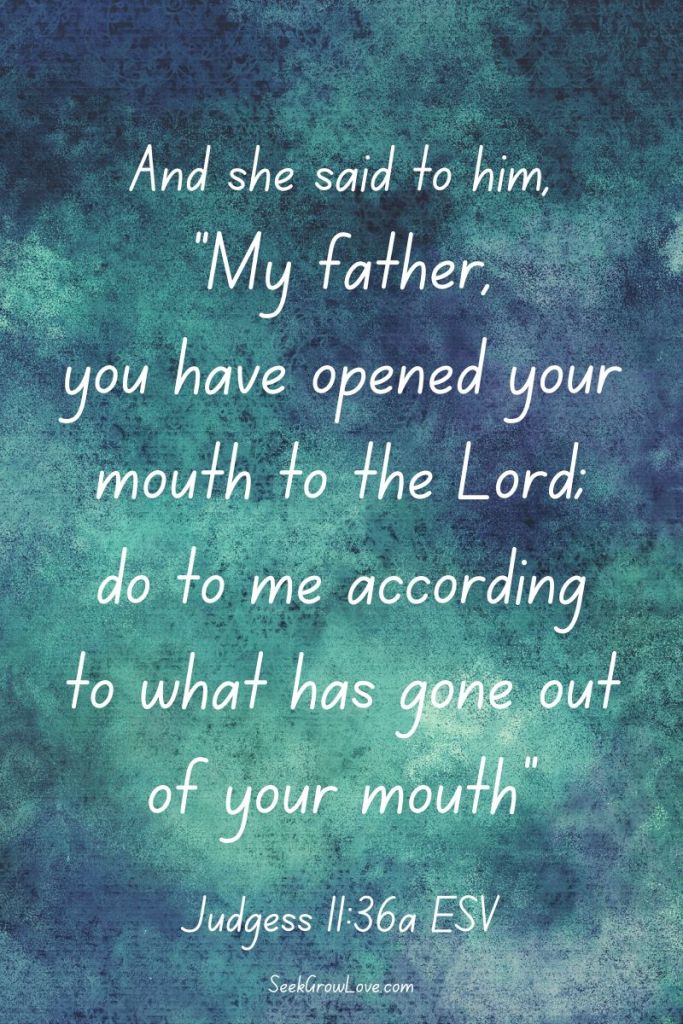
Key verse: Judges 11:36 

In the chapters for today’s devotion, we read about many stories of men who led Israel and those who opposed Israel. Nobody was perfect, some did notable things, and others did very little. One of the themes of the book of Judges according to Hill & Walton’s A Survey of the Old Testament is “The nature of charismatic leadership.” 

Recently, a few people who knew my dad had mentioned how charismatic he was. I, as his son, didn’t know whether or not they were pulling my leg. But as I talked with some of my friends and looked back on my life, I realized that my dad had a gift in charismatic leadership. Though there were times I knew he simply didn’t want to be in a position of leadership, he always found a healthy way to speak into other people’s lives without being pushy or bossy. I had always thought that every father/parent had a similar ability to do so, but I’m pretty sure I was wrong to believe that. Some people are not very good, or to be quite frank, terrible at positively influencing others. And I think we find that to be the case with Abimelek.

Abimelek, though outnumbered by a ratio of 1 to 70, secured a position of leadership by posing a simple question that “inclined” the leaders of Shechem to follow him. However, though he was charismatic, he was corrupt. He hired men to follow him and he killed almost all of his brothers (a classic example of another theme of Judges that “every man did what he thought was right in his own eyes”). Jotham, though not in a direct leadership role, spoke out against this corruption wonderfully through a parable, and God eventually dealt with Abimelek. However, before Abimelek is killed, we see Gaal son of Ebed speaking against Abimelek. 1 Peter 3:10 states, “Whoever would love life and see good days must keep their tongue from evil and their lips from deceitful speech.” Gaal either didn’t consider someone might be listening to him or maybe he didn’t care. Regardless, his words led to a battle (which might have scared some sense into him) that God used in order to repay the people for their wickedness.

Our words and actions can have powerful and large consequences! Later in Chapter 11 of our readings we find that this is most certainly the case with Jephthah and his daughter. Jephthah, a man heavily committed to the LORD, left the LORD to decide and judge the dispute between the Israelites and the Ammonites. However, the King of Ammon didn’t care much for that idea. Soon after, Jephthah was blessed with the Spirit of the LORD to go and fight the Ammonites. Yet, Jephthah vows to give whatever comes out of the door of his house when he returns home in exchange for triumph over the Ammonites. Unfortunately, this resulted in the dedication/sacrifice of his daughter in exchange for a mere victory (if you are interested in the different views of what happened to Jephthah’s daughter, I recommend looking at a few commentaries). In chapter 12, the Gileadites struck down the Ephraimites simply because of what they said and killed forty-two thousand. Be careful of what you say and how you say it. Proverbs 13:3 says, “Those who guard their lips preserve their lives, but those who speak rashly will come to ruin.” 

-Jeffrey Seiders

REFLECTION Q’s

  1. When someone tells you to do something that doesn’t align with God, what do you do? Do you address them with grace and truth (as Jotham did)?
  2. When you speak, have you considered whether your words align with what God wants? How can you align the words you speak with God’s word?
  3. When you make a vow to the LORD, do you keep it? In what ways can you dedicate a part of your life to the LORD?

Fear-O

Judges 6-8

Can anyone guess what Piglet from Winnie the Pooh, the Lion from The Wizard of Oz, and Gideon from the Bible all have in common? Think as you scroll for the answer…

.

.

.

.

.

.

.

.

.

They are all famous for being fearful. What a fantastic claim to fame.

(…But honestly, that trio of cowards reminds me a lot of myself. How about you?)

In Judges 6, we find that the Israelites turned away from God again (no surprise there!) and were being severely oppressed by the Midianites. Their behavior kind of reminds me of school bullies times a thousand – school bullies steal your lunch; Midianites crushed their crops. School bullies force you to hide in lockers; Midianites drove the Israelites off their land to hide in caves. Starving, homeless, and desperate, the Israelites again cried out to God for someone to save them. So, God sent his angel to the most unlikely warrior: Gideon, the self-proclaimed least member of the weakest family in his clan.

The chapter opens to the scene of Gideon hiding in a winepress while threshing the wheat (to keep it away from the Midianite bullies, of course). Ironically, the first words the angel of the LORD said to Gideon were, “The LORD is with you, Mighty Warrior!” 

I’m sure Gideon looked around to see if the angel was talking to someone else. Gideon, a mighty warrior? Gideon was full of questions, concerns, and doubts, asking for verification that he understood correctly that God had called him to defeat the Midianites. His first assignment was to tear down the idols (which Gideon did under the cover of night, of course, because he was afraid). Through sign after sign after tiring sign, God reassured Gideon that He really had called him to conquer Midian. Finally Gideon gained the courage to attack when he overheard a conversation among Midianites about their premonition that Gideon was going to conquer them. So Gideon’s miniscule militia, armed with (oddly enough) trumpets, jars, and torches, conquered the Midianites. There is a bit more conflict and idolatry in chapter 8, but overall, God’s people experienced 40 years of peace. 

Gideon was not afraid to question God and ask for reassurance. God knows what we are feeling, and He wants us to bring our questions before Him. God was faithful and patient with his servant, encouraging Gideon with inexplicable reminders of His plan. “But you, O Lord, are a God merciful and gracious, slow to anger and abounding in steadfast love and faithfulness.” Psalm 86:15

I doubt that anyone would have labeled Gideon a warrior at the beginning of this story; he was a most unlikely hero. But that’s one of the beautiful things about our God: He has a way of ordaining the underdogs to do His most important work and calling them for it even before they look the part. God saw Gideon not for the milksop he was, but for the mighty warrior he would be with God’s power. God sees the potential in us, too, and he loves to use us through our weaknesses to demonstrate his power (I Corinthians 1:26-31). As the angel in this story advised, just “go in the strength that you have” (Judges 6:14). 

-Rachel Cain

Reflections:

What are some ways that God has worked through your weaknesses for His glory?

Bring your doubts and questions before God, and ask Him to reveal Himself to you. He wants you to seek Him! 

Be encouraged to seek God even in your doubts by listening to this song

Mustering Up Moxie

Judges 4-5 – Deborah and Jael 


Whenever I think of girl power, I envision caricatures of Deborah and Jael posing Rosie-the-Riveter-style in front of a tent, bloody peg in fist. Though this Bible story is a bit morbid, it is also bold and counter-cultural evidence of the power of God and his desire to use everyone for His glory. 

After Ehud died, the Israelites turned away from God, and they were oppressed by Jabin, the king of Canaan, for 20 years. Deborah became the Israelite leader during a time period in which not many women held high positions; she was not only a female judge in the same way other men in this book, like Othniel and Ehud, were judges/leaders, but she was also a prophetess and a judicial expert. God gave Deborah a message for military general Barak, guaranteeing him a victory against Sisera, the Canaanite army commander. Barak refused to go without Deborah, which could be a tribute to his faith in Deborah, a testimony to his lack of faith in God, and/or a confirmation of his general cowardice. Whichever it may be, Deborah agreed to go with the army, warning Barak that the victory for this battle in the historical record would forever be credited to a woman. 

Barak’s army managed to fatally defeat every one of Sisera’s troops – except Sisera himself, who fled on foot to the home of Heber and Jael of the Kenite tribe (which was supposedly a neutral party, friendly to both Israelites and Canaanites). Jael greeted Sisera with exceptionally devious hospitality: when Sisera asked for water, she instead gave him a skin of comforting milk to help him rest well. Once Sisera was fast asleep, she sneaked in as stealthily as a prowling cat and drove a tent peg through his head into the ground, thus practically emancipating the Israelite people from King Jabin. 

But really though, shouldn’t Jael have just stayed in her lane? Why would she rock the boat when her tribe was at peace with both sides? I mean, it was probably common knowledge that the Canaanites were oppressing the Israelites, but since she was neither, it didn’t really affect her, right? Why should she do anything to help one side or hurt the other? 

Perhaps Jael had heard rumors of the power of the Israelites’ God and didn’t want to be on their bad side. Or maybe she just had a sense that the Israelite/Canaanite relationship wasn’t right, and if she were in the position of the Israelites, she would hope that someone would come to the rescue, too. 

We aren’t privy to Jael’s thoughts, but when Sisera sought refuge in her abode, Jael was thrust into a rather precarious position that forced her to choose sides. She was granted a unique opportunity to impact great change, an opportunity that literally fell into her tent. The stakes were high (pun intended)! So Jael chose to be brave, even though it could have repercussions for her family and tribe once Jabin got wind of her actions. She had witnessed injustice and chose not to turn a blind eye when it was within her power to do something. Jael deceptively entertained the tyrannical army leader in order to gain an advantage and help the Israelites. 

Would I be like Jael, always ready to stand for what’s right even if I’m standing alone, even if it would cost me something? Or would I just mind my own beeswax and not get involved in things that don’t directly concern me, even though others are being hurt? As Christians in a first-world country, often we would rather spend energy complaining about minor inconveniences like Starbucks messing up our overpriced coffee than about serious issues that are going on in the world. Did you know that there are still people in the world suffering from starvation, lack of clean water or medical care, poverty further worsened by illiteracy, and political unrest that makes even simple daily living dangerous? Did you know that today there are more slaves than ever before? We envision all of that as happening across the ocean, but so much of it is right here under our noses. I live about 20 minutes from the intersection of two significant US highways, rendering it a major drug- and sex-trafficking hub. So much of this slavery and injustice is happening in our own backyards, and we all have a duty to do something about it. (I’m speaking to myself here too; I’ve been considering how I can get involved in the local movement to help this trafficking injustice.) We as collective Christians have neglected this duty to be involved in the world around us and contribute to change. It is so easy for us to stay in our comfy little church bubbles. But think back to the gospels for a minute… who did Jesus criticize the most – the biggest sinners or the religious leaders? Pharisees. Sadducees. The “most religious” people who ultimately cared more about their image than the One in Whose image they were created. Being Christians doesn’t give us permission to “look up at God” and away from the needs; it gives us all the more reason to see the world through “Jesus goggles” and intervene in practical ways (which James calls us to do). We can’t do everything, but we can do something. 

In Deborah’s song of praise after this victory that led to 40 years of peace for her people, she sang a line that I have adopted as a personal mantra: “March on, my soul, with courage!” (Judges 5:21). Another term for courage and determination is moxie. Deborah and Jael were definitely women of moxie! I long to become a person of righteous moxie who fights the battles God calls me to fight, always depending on His strength. 

“Deborah, the mother of Israel, and Jael, most blessed of tent-dwelling women. Did they ever even meet? Would they have been friends? This is beside the point, but still, I wonder. Living in a world where it seems like no one with any differences can get along, I wonder how two women, from such different worlds, ever came together to accomplish the same goal…. God uses the unlikely, the unexpected, and sometimes even the unsavory to deliver us and to crush the heads of his enemies. While his means of rescue may change, his promises remain permanent. So whether it’s by means of tent pegs through the head of an oppressor or nails through the hands of his son, we see yet again that we serve a God who never ceases to defeat his enemies so that his people, just like the sun, may rise in his might (Judg. 5:31).” (source)

-Rachel Cain

Reflections:

Listen to this song about being brave for God and consider how He might be calling you to be brave for Him. 


Would you, like Jael, have risked everything to stand up to an oppressor? What are some situations today in which God might be calling you to be brave and stand up for someone else?

Look for opportunities to get involved with local organizations to help with needs in your area and with the work of our international missions organization, Lord’s Harvest International, at lhicog.com. 

Pray for God to help you muster up moxie to initiate change with the injustices in the world. 

Genetic Edge

Judges 1-3

The study of genetics is fascinating. I remember being rather annoyed by punnett square assignments in my sophomore Biology class, but as an expectant parent it was fun to guess the likelihood of our children bearing unique characteristics of my husband and myself (…and it is ironic that four children from the same DNA can be so drastically different!). One of our four children looks like my mini-me, while the other three possess more of my husband’s physical traits. Though two children seem to be a mix of our personalities, one child definitely inherited my introverted and cautious personality while another one is every bit as ornery as I hear his father was at that age. Unfortunately, I did not provide our children with the recessive gene needed to match my husband’s red hair, and I don’t think he’ll ever forgive me for it. Ha! 

While some traits can be considered rare, one with which we are all probably familiar is the concept of dominant hand usage. Today, about 90% of the population demonstrates right-hand dominance, while 9% prefer to use their left hand and 1% are ambidextrous. This likely-inherited recessive trait of left handedness allowed our protagonist in today’s Bible reading to execute a most epic assassination to free the Israelites from oppression. 

Yesterday, we read Joshua’s monologue in which he recited a battle cry for his people to remember the Lord and continually choose to follow Him; today, we read about how, after Joshua died, the next generation didn’t know about God and started worshipping the gods of their neighbors. Even after all the miracles that God had performed for his people, the collective generation dropped the ball big time and failed to teach their children about God. So… God got their attention by turning them over to their enemies. 

The Lord selected leaders (“judges”) to help guide the people in His ways, but the Israelites ignored the judges and continued worshipping gods, doing evil even more so after each judge died. So, the Lord gave the people over to their enemies. In Judges 3:14, we find the Israelites being ruled by Eglon, the Moabite king, for almost two decades. The people finally called out to the Lord to save them, and He sent them Ehud as their leader/judge. 

The following verse specifically notes that Ehud was left-handed; God had a unique purpose for Ehud’s special trait. Ehud hand-delivered the Israelites’ tribute to the king, which was more or less a tax that the people had to pay as subjugates. In the days before metal detectors, the king’s security would check a visitor’s left side for weapons, since right handed people would sheathe a sword on their left side for ease of draw. Because Ehud was left handed, he would have hidden his sword on his right side, allowing him to pass inspection as an assumedly unarmed visitor. As he delivered the tribute to King Eglon, Ehud told the king that he had a secret message to share. The king, falling right into his trap, dismissed all the guards. Ehud seized his opportunity. Leaning in with a “secret message from God,” Ehud drew his clandestine sword and plunged it, hilt and all, into the belly of the obese ruler. (You can read all the gory details in the text.) Then Ehud locked the doors and escaped through the porch. The king’s attendants assumed that the king was “relieving himself,” so they “waited to the point of embarrassment” (a very long time!) before they finally unlocked the room to discover their gullible king dead on the floor. Their polite delay provided Ehud a nice buffer of time in which to abscond. Then the tables turned as the Israelites conquered Moab and enjoyed eighty years of peace. 

The left handed trait might have been viewed as a peculiar weakness, but God used Ehud’s uniqueness to accomplish something great for His people!

-Rachel Cain

Reflections:

Do you have any traits that you thought were a flaw, but that God used for His glory? 

Praise or Platitudes

Joshua 22-24

In these final chapters of Joshua, we read his deathbed advice to his people. Filled with nuggets of wisdom, Joshua calls the people to remember their history and God’s faithfulness, and he encourages them to continue following God. Joshua reminds the people that there is only One True God, YHWH, and that the household idols and the gods of the people around them are not truly going to save them. Yet still Joshua asks them to make a conscious decision, to declare their devotion one way or the other: “Choose this day whom you will serve… but as for me and my house, we will serve the LORD!” What a powerful charge to the people! If anyone had been unclear about Joshua’s position, there was no doubt after this profound declaration. Of course, the people agree that they will follow God, and of course, it wouldn’t be long before they would turn away yet again.

Joshua, famous among his people as a devoted follower of the One True God, knew humanity’s tendency to have idolatrous hearts. As he closed out his life, he wanted to remind the people to focus on what – WHO – is truly the most important. If you’re anything like me, you probably scoff at the ways in which the Israelites kept turning from God in spite of all His miraculous provisions, but in reality, all of humanity worships something; the idols are just different for each of us. We have an innate desire to worship, and that should be directed toward our Creator. However, our flesh can often lead us to worship the things of this world – money, entertainment, sex, identity, work, comfort, power, nature, and self – more than we worship our God. We must be alert to the things of this world that are vying for our devotion, keeping our eyes attuned and faithful to our God above all else. 

Don’t let Joshua’s words be just an empty platitude on your dining room wall, but really take it to heart. Whom will you serve? Will you follow the empty gods of this age, or will you wake up every day willing to follow the One True God? 

-Rachel Cain

Reflections:


What does it mean to really serve the Lord? What idols do you need to cast aside to really seek and serve Him? 

Research the ways in which Joshua is a foreshadowing of Jesus. There are many interesting parallels! 

Safe Cities

Joshua 19-21

After studying the Underground Railroad, my family and I toured a local church that played a major role in helping escaped slaves reach freedom. Though the dismal, subterranean tunnel boasted no modern amenities, its hidden passage beneath the church’s sanctuary had served as a refuge for countless escapees on their way to freedom. How I wished the walls could talk! There are no written records of the tunnel’s guests from that time period, probably to protect the identities of the escaped slaves (and besides, most local records were destroyed in the 1913 flood that ravaged this region), but shards of pottery and discarded animal bones from choice cuts of meat provide evidence of the meals that were smuggled in to nourish the “fugitives.” I was speechless while envisioning the grueling journey a desperate, sweet soul must have endured to arrive this far north – more than 60 miles beyond the Ohio River – weighed down by the well-preserved foot chains that had been found in that very tunnel. 

The escaped slaves were hungry for safety. “Safety” is a concept that we often take for granted in this twenty-first century, first-world country; in many countries, simply proclaiming Christianity could cost one’s life. I find it interesting that God designated several cities of safety for his people in the Promised Land. These were cities to which anyone could escape who had accidentally killed someone, in which they would safely await trial without threat of the victim’s family avenging the (potentially innocent) murderer. 

Though we no longer have similar cities of refuge, this concept is a foreshadowing of sorts to Jesus: in him, we sinners find refuge from our enemy. “We run to Christ to escape the danger we are in from the curse and condemnation of the law, from the wrath of God, and from an eternity in hell. Only Christ provides refuge from these things, and it is to Him alone that we must run. Just as the cities were open to all who fled to them for safety, it is Christ who provides safety to all who come to Him for refuge from sin and its punishment.” (quote source). 

“He is our refuge and strength, an ever-present help in trouble.” Psalm 46:1

“Therefore, we who have fled to him for refuge can have great confidence as we hold to the hope that lies before us. This hope is a strong and trustworthy anchor for our souls.” (Hebrews 6:18, NLT)

I am so grateful for the hope that lies before us! Aren’t you?!

-Rachel Cain

Reflection: 

Look up synonyms for the word “refuge.” Which one stands out most to you in your journey of faith? 

“He kept every promise he had made to the Israelites; each one came true.” (Joshua 21:45) What a powerful verse! God is always faithful. Reflect on his faithfulness in your life by writing a memoir or journal about how he has moved in your life, and share it with those close to you. 

Burn the Ships

Hesitant Hebrews

Joshua 16-18

It was so close they could almost taste the milk and honey on their lips – their Promised Land! After centuries of oppression and slavery under Pharaoh followed by 40 more years wandering free in the wilderness, the Israelites finally possessed the metaphorical keys to their inheritance. Many of the tribes ventured out right away for their assigned territories, ready to explore, conquer, and settle at last, but several tribes remained behind. Why wouldn’t they ropedrop this momentous occasion and charge with abandon straight to their inheritance?

Though I cannot speak for all the Israelites since I have not walked in their sandals, this is my speculation based on what I’ve read: they desired the path of least resistance. Though they were promised that the land would be theirs, they had to go in and take it. There were still other people living on those properties; it would require a lot of effort to drive them out. Yes, God had guaranteed that this land would be theirs, but that didn’t mean their possession of it would be effortless. In the beginning of their nomadic desert life, remember how they had longed to return to the familiarity of slavery and oppression in Egypt? Now, well accustomed to desert dwelling, they didn’t want to expend the energy to settle into the cities, which would still require them (albeit with the promise of success!) to conquer it. It was more comfortable to stay in their crummy environment than to embrace the best land that God had for them.

I am reminded of Spanish conquistador Hernan Cortes who was determined to conquer the interior of Mexico, including the Aztec empire and a vast swath of land from the Caribbean to the Pacific. This fierce leader and fighter, frustrated that his men were too focused on the possibility of going home and too scared to invade this new territory, took away their temptation to retreat by doing what any extreme leader would do: he burnt the ships. Now, there was no turning back, no reason to not forge ahead and claim this land. 

Perhaps the seven tribes had become so lazy or complacent in their faith that they didn’t even care that God had something infinitely better in store for them. As C.S. Lewis said, “It would seem that Our Lord finds our desires not too strong, but too weak. We are half-hearted creatures, fooling about with drink and sex and ambition when infinite joy is offered us, like an ignorant child who wants to go on making mud pies in a slum because he cannot imagine what is meant by the offer of a holiday at the sea. We are far too easily pleased.”

Ultimately, in part because the Israelites did not fully drive out the inhabitants of their Promised Land, God’s people became immersed in the culture, false gods, child sacrifice, and overall moral corruption of the people around them, which perpetuated the spiral of falling away from God and then begging Him to save them. Though written much later, Romans 12:2 would have been good advice for the Israelites (who were called to be set apart for God), and it is still wise for us as present-day believers to heed its wisdom: “Don’t become so well-adjusted to your culture that you fit into it without even thinking. Instead, fix your attention on God. You’ll be changed from the inside out. Readily recognize what he wants from you, and quickly respond to it. Unlike the culture around you, always dragging you down to its level of immaturity, God brings the best out of you, develops well-formed maturity in you.”

So, what ships are holding you back? What comfort, familiarity, or apathy is keeping you from fully following God? Sometimes I am a lot like the 7 tribes and Cortes’ crew. While I claim to desire God’s calling on my life, I often let the comforts of the present and anxieties about the future hold me back from fully embracing His plan for my life. Let us pray for God’s strength to follow wherever He may lead us. 

-Rachel Cain

Reflection: 

Watch this powerful music video about “burning the ships” and charging ahead into God’s will for our lives. 

Priestly Portion

Joshua 12-15

I’ve heard sad stories of siblings living hostilely toward one another for decades because of arguments regarding the inheritance from a late parent. I wonder if the Israelites assumed God picked favorites as he doled out their assigned territories in the Promised Land. 

Remember Caleb? At eighty-five years old, Caleb finally realized his dream of inheriting Hebron four decades after he had first explored it. He and Joshua were the only two of the dozen spies who had encouraged the nation to take their Promised Land; the ten other agents involved in the espionage had invoked great fear in their people. As a result of their collective lack of faith, the Israelite nation would wander for 40 more years in the wilderness while most of that unfaithful generation died off. Caleb, now an octogenarian, was very eager to finally claim the territory that had been promised to him two scores ago. He and Joshua had kept the faith, remained true to God, and waited patiently to receive their inheritance, just like we must wait patiently for our Promised Land, the Kingdom (Romans 8:25). 

Perhaps the Levites, the tribe designated to serve as priests, initially felt slighted when they learned that they would inherit no land at all; rather, God promised to be their portion and take care of their needs as they served as religious leaders for His people. Though it might seem like they had received nothing tangible, they actually received the best gift: a closeness with and dependence on God that most would never experience. 

We, too, are beneficiaries of a similar priestly portion:  “But you are a chosen people, a royal priesthood, a holy nation, God’s special possession, that you may declare the praises of him who called you out of darkness into his wonderful light.” 1 Peter 2:9 

Unfortunately, we tend to chase temporary things in this life, like fortune and fame, rather than keeping our eyes on the eternal prize. None of this truly satisfies, and we can’t take it with us when we die – you’ll never see a hearse pulling a U-Haul, after all! Jesus reminds us to “store up treasures in heaven… for where your treasure is, there your heart will be also” (Matthew 6:20-21). As followers of Jesus, we have a much greater inheritance promised to us, far better than all the riches of this world. 

I leave you with the priestly blessing from Numbers 6:24-26: 

The Lord bless you and keep you;

the Lord make his face shine on you and be gracious to you;

the Lord turn his face toward you and give you peace.

-Rachel Cain

Reflection: 


What does it mean personally to you that God is your portion? How does that impact your soul?

Meditate on these scriptures as you thank God for being your portion! 

  • My flesh and my heart may fail,but God is the strength of my heart and my portion forever. Psalm 73:26
  • Because of the Lord’s great love we are not consumed, for his compassions never fail. They are new every morning; great is your faithfulness. I say to myself, “The Lord is my portion; therefore I will wait for him.” Lamentations 3:22-24
  • And this is God’s plan: Both Gentiles and Jews who believe the Good News share equally in the riches inherited by God’s children. Both are part of the same body, and both enjoy the promise of blessings because they belong to Christ Jesus. Ephesians 3:6