The Cure for Complaining?

Numbers 21-22 

Shalom from Tennessee! This is Stephanie Schlegel writing this week as we continue through the Bible. We lived in Israel for 25+ years where our five children were born and raised. So I’ll be adding in some extra thoughts and pictures from and about Israel. 🙂   

The first verse of Numbers 21 caught my attention as it still relates to today! The king of Arad fought against Israel and took some captives! :0 I’ve been reading the news of the current captives slowly being released and talk of what to do with Gaza. Surprisingly, three times in chapter 21 Israel fought against their enemies and destroyed their cities and took possession of them. For a LONG time Israel has had to contend with those against them, including up to today!

In their travels they got thirsty, hungry, and cursed the manna God provided for them! It also says they spoke against God and Moses, their leaders. Thus, God sent fiery serpents among them, in which many were bitten and killed. So they asked forgiveness, and that Moses would pray to God to remove them. 
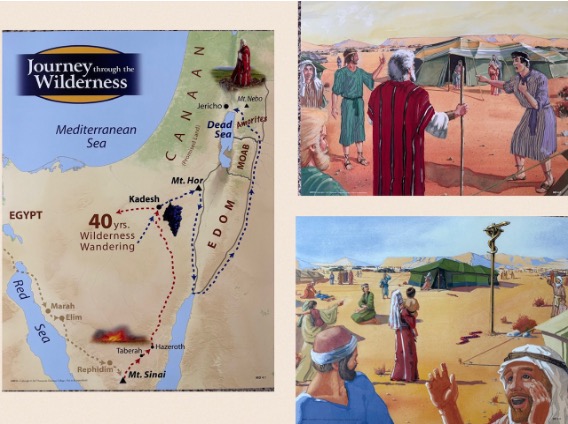
Included is a picture from the ABEKA Bible Flash-a-Card Series 3 of the life of Moses. These sets have many great pictures of Bible stories not normally seen in children’s books. We used them in our congregation’s children classes in Israel as they were taught in Hebrew. They’re great for home use as well for children and grandchildren. 

Complaining about what one eats is a good lesson for all ages! Bites from deadly snakes is a rough punishment in the desert. There was a period of time while raising our children that if they complained about the food I made for dinner then they’d be doing the dishes afterwards! The complaining stopped quickly! Actually, I wasn’t even sure if they liked what I made or not as they ate it with no comments. Haha! Occasionally, after a new recipe I’d let them vote after dinner on the count of three with a thumbs up or down (or sometimes in the middle), so I could get some feedback. 🙂

One of the teachers/moms in our children’s class in Israel made a “bronze serpent” on an upside down mop with paper twisted around the top of it and then covered with duct tape and spray painted it bronze.  It was a good visual aid for the kids! (I couldn’t find a picture of it since it was before the days of cell phones).

Jesus recalled this incident in John 3:14,15, “And as Moses lifted up the serpent in the wilderness, so must the Son of Man be lifted up,that whoever believes in him may have eternal life.” Thankfully, we can look to Jesus during troubled times and after we’ve failed and need forgiveness. May God help us not to complain but to repent and give thanks.

“So, whether you eat or drink, or whatever you do, do all to the glory of God.” 1 Cor. 10:31

-Stephanie Schlegel

REFLECTION QUESTIONS

1. What was the Israelites punishment for complaining? Did the punishment seem just or too harsh? What are some things that you’re complaining about that perhaps need to be addressed?

2. How does complaining against God, leaders, and food hurt us? What’s something we can do to change that?

3. The bronze serpent that they looked at to be saved eventually became an idol! Is there something in your life that has helped you that now has turned into a negative effect that maybe you should break away from? We can pray and ask God to show us and help us to turn from it.

Clean, Holy, Set Apart

Numbers 18-20


Back in 1847 a doctor named Ignaz Semmelweis noticed that, through several events, women who had died of postnatal fever had been attended during the birth by doctors who had just done autopsies. Semmelweis came up with the idea that doctors should wash their hands between autopsies and births. And all of us collectively think… well yeah! Of course! But this was not part of the course of a doctor’s day at the time. In fact, many doctors were offended at the suggestion they weren’t clean. Semmelweis was absolutely ridiculed and eventually driven mad. He was placed in an asylum where he died within two weeks, ironically from an infection, after being beaten by prison guards.
Perhaps these doctors should have referred to today’s reading. After discussing the duties of the Levites in Numbers 18, Numbers 19 discusses being “unclean” for 7 days after touching a corpse for any reason. Definitely something these doctors should have taken note of.


Much is said about what is clean and unclean in the Pentateuch. The Israelites certainly benefited physically from not touching dead bodies or eating pork. Some issues of cleanliness could not be helped, such as touching the dead or having a monthly period. In these cases, people were unclean for a time and then had to wash themselves in special ceremonies and offer sacrifices.
But God did not delineate what was clean and unclean just for hygiene’s sake. God also wanted the Israelites to be set apart, different than the rest of the world, holy.


We are to come before Him with clean hands and pure hearts (Psalm 24: 4). But there are times when we become unclean and need someone who can wash us white as snow. Praise God for providing the sacrifice that completely cleans us, His Son, Jesus Christ.


We’ve come a long way since 1847. Hand washing is the first skill nurses have to demonstrate before moving on to other skills. As you wash your hands today, keep in mind the One who cleans you completely!

-Maria Knowlton

Reflection Questions

  1. What can we learn from Ignaz? What can we learn from the doctors who ridiculed Ignaz, believing that they themselves were clean?
  2. Does God still want His people today, the church, to be clean, holy and set apart? What does that look like? What does it look like to have a church that is dirty/stained, unholy and blending in with the world?
  3. Are there any common practices today that you think might be making many Christians unclean before the Lord?
  4. What is the only way you can come before God clean? If you accept Jesus as Lord of your life, are there still things you do that make you clean and unclean? How might Numbers have been preparing God’s people for Jesus?

God’s Chosen Leaders

Numbers 15-17

So things are not going well for the Israelites. In yesterday’s reading, we see that distrust in God led to the destruction of many and the curse of roaming around the desert – which would eventually lead to the death of everyone over 20 years old when they grumbled against the Lord. In today’s reading, God first curses the people by demanding offerings brought in fractions.  Frankly, I would have found this worse than being stuck in the desert. 2/10, ⅓, 3/10, ¼ , WOW! This would definitely be a sacrifice of praise for me! 

Now you would think that having seen God’s miracles and blessings, people would accept Moses as their human leader and do what was required of them. But in Numbers 16, a man named Korah, a Levite,  decides he’s had enough. I don’t know if he blames Moses for the things that have gone wrong on this journey or he just liked picking fights with those in leadership. But long story short, God decides He’s not even going to mess around and swallows Korah, along with his cronies who sided with him and all their households and all that they owned. 

In Numbers 17 God uses the familiar rod (the same rod He turned into a snake, sent a few plagues and split the Red Sea)  to prove that Moses and Aaron are the leaders He anointed. God had Moses collect a rod from each of the 12 tribes of Israel, and write the name of each tribe on the rods, Aaron representing the Levites. He would then cause one to bloom and the one that blooms was the rightful leader.  I don’t think it’s a spoiler to tell you which one bloomed… to the point of producing almonds! I would think that seeing the ground opening up and swallowing a lot of people who had been complaining against Moses and Aaron would have been enough for me to keep my thoughts to myself. However, apparently, there was still some complaining but after the budding of the rod, no one questioned Aaron’s position after that,  Yeah…I kind of think that’s weird too!

Today’s reading ends with, “Behold, we parish, we are dying, we are all dying! Everyone who comes near the tabernacle of the LORD, must die. Are we to perish completely?” Cheery. Even cheerier… WE are all dying. The people of Israel (at that moment) finally realized they were one mistake away from death. They needed a savior. WE need a savior.  I am so grateful this is not the end of the story.

-Maria Knowlton

Reflection Questions

  1. What was Korah’s (and those who aligned with him) sin, or sins?
  2. How did Moses handle this rebellion?
  3. How do you tell who God has chosen as Christian leaders?

Fear or Faith? Panic or Peace?

Numbers 13 & 14 and Psalm 90

Some of you may be old enough to remember the old Sunday School song, “12 Men Went to Canaan Land” and you held up your ten fingers and then gave the double thumbs down when you sang “10 were bad.” Then you held up two fingers and gave two thumbs up while you sang “and 2 were good!


In today’s reading we see the stark difference between fear and faith and why 10 were bad and two were good.


In chapter 13, twelve spies, one from each tribe in Israel, came to scope out the land of Canaan, the land flowing with milk and honey, the land God had promised.


In his commentary, David Guzik, reminds readers that there was no need for this reconnaissance mission. According to Ezekiel 20:6, God had already searched this land and promised it to them. So some people were already distrusting God from the beginning.


Some saw giants big and strong,” 10 of the Israelite spies came back with scary accounts of many giants in the land that made the spy’s look like grasshoppers. One theologian stated that “fear performed the miracle of adding a cubit to the stature.” 😉 and on top of that, the city is heavily guarded! Obviously, there was NO way to defeat them!


Some saw grapes in clusters long.” All of the spies agreed that the land was made of fertile soil and it would be easy to grow wonderful food there. This was definitely the place God had promised them!


Some saw God was in it all,” But only two spies, Joshua and Caleb, had unshakable faith that God would deliver what He had promised and bring them into this land.


I love how F.B. Meyer put it, “ They saw the same spectacles in their survey of the land; but the result in one case was panic, in the other confidence and peace. What made the difference? It lay in this, that the 10 spies compared themselves with the giants, whilst the two compared the giants with God.” WOW! Did that statement convict you?!? It sure convicted me!


It’s easy for us to figure out who was good and bad back in the Old Testament. Hindsight from over 3000 years ago is 20/20. But what about you? When troubles come your way, which spy describes your response? Are you comparing you to your troubles, or your troubles to God?


10 Were Bad and 2 Were Good!” Which one are you?

-Maria Knowlton

Reflection Questions

  1. How is Caleb described in Numbers 14:24? is there anyone you know today who could also wear that description well?
  2. 10 Were Bad and 2 Were Good!” Which one are you? Do you generally compare yourself to your troubles and experience fear and panic? Or, do you more often compare your troubles to your God and rest in faith and peace?
  3. What was the reward for Caleb and Joshua? What was the punishment for the 10 spies? What was the punishment for all those who listened to and trusted the report of the spies? Who are you listening to today? How does who you listen to today determine whether you will receive a reward or punishment?

Lead Us in the Ways of the Lord

Numbers 10-12

The first time I ever set up a tent without my husband was when I took my  just about to be 10 year old son to Cub Scout camp.  Unfortunately, both of us were a little too short to reach all the parts we needed to secure the tent. BUT! Luckily, another parent came over and helped us out. He also gave us some tips about tent camping.  However, he forgot one small detail, or maybe he thought it was common sense. He didn’t mention that we should sweep the ground before setting up the tent so there would be no rocks underneath.  The first night was very uncomfortable (the next few nights we were so exhausted that we didn’t care)!

I suspect that the people of Israel were getting pretty good at setting up tents by the end of Numbers 10.  This chapter lays out the order in which the tribes of Israel were to move when God would lift the cloud. It is interesting to note that Moses asks his brother-in-law for assistance since he was from around those parts.  My Bible footnote states that “Divine guidance does not exclude using human help.” I think that could apply to so many areas of our life! God often puts just the right person into our lives at just the right time to carry out His will! 

But sometimes the people in our lives can bring us down. In chapters 11 and 12, we find that the people are complaining, a lot, so much that some of them want to go back to Egypt! I don’t know for sure but I think it’s reasonable to guess that it probably started with a few people and soon others followed. Of course, this caused God to get a bit aggravated, sending fire and plagues against those who complained. Even Miriam, Moses’s sister, got a plague of her own, developing an acute case of leprosy. Fortunately for her, God forgave her and healed her. 

Today’s reading really reminds me that while God does send people into our lives to better us and for His glory, there are those who will pull us away from God. When deciding who is who, look at the overall life of the person. What does their life look like? What does their relationship with God look like? If they are a mess and far from God, I guess you could learn what NOT to do! However, we would be wise to listen to the ones who will lead us in the ways of the LORD (and will remind you to sweep before setting up a tent)! 

-Maria Knowlton

Reflection Questions

  1. Does your circle of influencers include more helpful people who will help lead you in the way of the Lord, or more complainers who will arouse the Lord’s anger? Who specifically do you know who could be beneficial to spend more time with?
  2. What would others say about you? Are you more known for your complaining or for leading in the way of the Lord?
  3. When you do complain, what are you more likely to be complaining about? and to whom? Would there be a better use of your time and words?

On the Move

Numbers 7-9

Ok quizzers and especially National Quizzing Director, Jacob Ballard, hear me out! Numbers 7 should be part of the quizzing materials next year! I mean, while it is the longest chapter in Numbers, you really would only need to memorize 5 verses! 

Numbers 7 is very repetitive because all 12 tribes of Israel come to present their gifts to the Tabernacle, and they all give almost exactly the same thing (apparently there was no Tabernacle gift registry 😉). But that was actually on purpose as God wanted all of the people to praise and participate in the rights and responsibilities equally. He wanted every tribe to be fully devoted to Him no matter the size of the tribe. That is a reminder to us that even if we are all of different socio-economic statuses, we all bring the same thing to God, our hearts and our devotion. 

Numbers 8 describes how God set the descendants of Levi apart as royal priests. Whenever I have read about the jobs of the Levites, I’ve been glad that was not my calling. These guys were not standing around praying all day. They were working hard as they had to do a LOT of butchering. Like. All. Day. Long! My husband used to work in the meat department at our local grocery store. It is a lot of bloody, messy work. Ugh… and don’t get me started on cleaning all the tools! But these priests understood the importance of their jobs, helping God’s people atone for their sins through the sacrifice of the animals they raised. And it wasn’t a one-time thing for each person; it was continual for all of each person’s life.  This reminds me of how thankful I am that we don’t have to do that anymore because of what Christ did for us (Hebrews 10). Besides eternal salvation, we also don’t have to spend a great deal of our time butchering animals and barbequing them! 

Numbers 9 discusses God’s decrees on celebrating the Passover and then their “moving” protocol. Growing up in the Air Force, I think I can understand never knowing how long you would be in any given spot.  Sometimes God would have the Israelites stay for a few days, sometimes for a few years. I don’t know if this is the reason, but I suspect God did not want them to become too comfortable where they were and wanted them to remember their current position was not their home.  We too would be wise to remember that where we are now is not our permanent home and we should not become too comfortable within the world. 

-Maria Knowlton

Reflection Questions

  1. Have you ever moved at God’s command – or stayed put at His command?
  2. How do we tell today when and where He wants us to go – or stay?
  3. What are you learning about God in Numbers so far?

May the Lord’s Face Shine On You

Number 4-6 

While Numbers 4 still involves some counting, it becomes much more interesting with a little Holy interior decorating! I fell down a little Google rabbit hole reading about what kind of leather was used in the temple.  NIV says sea cow, NASB says porpoise, theologians have theorised other interpretations. But I think the point is, it was valuable and special. All of the designs and decor of the tabernacle were both God instructed and enabled. I have always wondered how the people building the tabernacle could build what they were told to build. I then heard from someone, that they were able to do this work because they were given the gift of the Holy Spirit (Exodus 31:1-6 and 35:30-36:2). I think this makes a lot of sense! 

Also, and part of the importance of this passage is God was very clear who could touch what and when. Death comes to those who did not heed God’s commands, no matter how small they may seem. God will not be mocked nor disobeyed. 

Numbers 5 and 6 are kind of a wild mix of blessings and curses. First Numbers 5 speaks of the sanctification of anyone who was ceremonially unclean or guilty of sin. Moses then writes of a “grain offering for jealousy.” I looked at several commentaries and still cannot quite understand why it was included in scripture and what it all means.  One commentary reminds readers that this was a time of many rituals for many issues and this would not have been that odd to the people of that time. My own thought is that this was another situation where it was very important to obey God. I believe that God protected women who were innocent of adultery and they were not affected by this curse. 

In Numbers 6, we learn what one needs to do to become a Nazirite. Reading this reminds me of the sacrifices my Catholic nun friends had to make to become a nun.  It is very honorable to dedicate your life to God. However, it is not necessary to become a Nazirite or a nun/monk to dedicate your life to God.  Because of Christ, through baptism, we can be sons and daughters of God. And we can receive the Aaronic Blessing: 

The Lord bless you and keep you,

The Lord make his face shine upon you,

And be gracious to you;

The Lord turn his face toward you and give you peace.  (Numbers 6:24-26)

God bless you this week as you obey His word! 

-Maria Knowlton

Reflection Questions

  1. What do you find in Numbers that reminds you of the importance of obeying God?
  2. What do we learn about God so far in the book of Numbers?
  3. Have you ever experienced the Lord making His face shine upon you? When? How does it feel? What do you think the Lord likes to make His face shine upon?

Tabernacle Parking

Numbers 1-3

Once upon a time, I had to take a statistics class.  It was awful! I am not a numbers person at all and the professor was dry and would trail off while he was talking. Every class was an exercise in trying to stay awake for an hour and 15 minutes! But I do think he could have spiced things up a bit if he had thrown in some fun or shocking stories in between the equations.  For example: “So in this case p is equal to the sum of the number of participants in the study, which was looking at the correlation between owning a machete and a ninja outfit and ending up in the emergency room.” 

So when I was reading the first two chapters, I was getting flashbacks of that statistics class. They are purely numbers and logistics. The 12 tribes of Israel had left Egypt about a year before and God was now “parking” the tabernacle in the desert, with the 12 tribes in specific stations around the tabernacle.

God had Moses and Aaron count all the men in the tribe. Boring! I like how Chuck Swindoll put it in his commentary, “Numbers takes the reader on a long and winding path through a desert of excruciating detail.”  But then I hit chapter 3 and Aaron’s two eldest sons, Nadab and Abihu fall dead because they offer God an “unauthorized fire” and they had no children, WHAT??? That got my attention! Why was the fire “unauthorized”? Why did God strike them dead? So many questions??? But the biggest question the story starts to answer is WHY Numbers is included in our Bible. 

Besides its historical significance, Numbers speaks of the importance of obedience to God and God’s intolerance of sin. Leviticus 10:1-2 gives a little more detail on what happened to Nadab and Abihu, but it was basically just straight up disobedience to God. We may think this was a pretty minor issue, but it points to the fact that God does not tolerate sin of any kind. No matter how “good” you are, you will not live a life of perfection and will at some point deserve the punishment Nadab and Abihu received. Goodness, do we need a savior! THANK GOD for JESUS! 

So, yes, much of this book is boring, especially today’s reading, but unlike that statistics class, you will find application for your own life in this book.

-Maria Knowlton

Reflection Questions

  1. God has a plan for His people, even for where each tribe was to park around the tabernacle. How might He share His plans today?
  2. Why is God looking for, and expecting, obedience from His people during the time of Numbers? What does God’s desire and expectations look like today? Does the sacrifice of Jesus mean obedience isn’t required any more?
  3. What application can you find for your life from Numbers 1-3?

If You Want His Blessings…

Obey!

Leviticus 26-27

We have finally come to the end of Leviticus and I hope that you’ve gained an appreciation for this “skipped-over” book: there is much we can learn about our God and how to serve Him within these pages, even if some of the specific details are different now under the new covenant with Jesus. One thing that will never change about our heavenly Father is something described in chapter 26: He blesses obedience and punishes disobedience.

Like most kids, I disobeyed my parents often when I was younger. If I was told not to do something, that’s immediately where my mind gravitated towards, even if there was the threat of punishment. I was also stubborn (and still am sometimes), and continued my disobedience even if the punishment was dealt out, until the punishment grew to a severity that wasn’t worth it anymore. A time-out from television didn’t mean much to me: neither did the extra chores that I was given. However, when those things didn’t work out and I was grounded from seeing my friends, I began to shape up and ask for forgiveness. My parents weren’t thrilled about punishing me, like most parents: they just needed to do something to get my attention and create an obedient spirit within me (probably the hardest job of a parent).

God as our heavenly Father is much the same way, and it is shown in Leviticus 26: He will punish the disobedience of His children until they shape up and realize the error of their ways. In this chapter, He gives the Israelite nation FIVE chances to change their ways and start listening to Him again, with increasing punishments: they unfortunately proved to be very stubborn and continued their disobedience until their nation was completely driven away from the Promised Land (which did happen). Although God warned them ahead of time, and gave them multiple chances to change, they kept acting out and disobeying until God had to go to extreme measures to get their attention.

However, despite all the disobedience and the punishments in this chapter, God says that if they will confess their sins and repent of their ways, He will forgive them (just like a good parent). He promises to bring them back to the Promised Land, restore the covenant that He made with their forefathers, love them again, and even dwell with them again: all they have to do is repent and start obeying Him again, because He knows what’s best for them.

We would do well to remember this lesson above all else: God blesses obedience, not disobedience. Far too often Christians have chosen to disobey God’s instructions and immediately expect His forgiveness because Jesus died for us. However, we cannot miss the most important part of receiving forgiveness: repentance.

It is not those who are well who need a physician, but those who are sick. I have not come to call the righteous but sinners to repentance.” – Luke 5:31-32 NASB1995

Do you want to live a good life full of blessings? Then obey God’s instructions.

Have you disobeyed God’s instructions and are suffering for it? Ask for forgiveness and repent.

God is willing to work with us and forgive our sins, but we must do something about it. Like a good Father, He is expecting obedience and a change of heart. We cannot simply “skate by” in our Christian walk, expecting forgiveness when we have no change in our lives. We have to obey Him if we want His blessings.

-Talon Paul

Reflection Questions

  1. How is God similar to your parents? How is God different from your parents?
  2. What blessings does He give that make you want to obey Him? What punishments does He give that make you want to not disobey Him? If you want to obey God how do you learn what His instructions are?
  3. What have you learned from Leviticus?

Days Off!

Leviticus 23-25

In the United States, there are many holidays to celebrate and enjoy. At the federal government level, they recognize eleven holidays per year: there are even more if you include religious ones like Easter. Not only that, but we have laws that force us to take time off work every week and periodically throughout the year. Although you are allowed to work all seven days in a week, most employers are expected to pay even more money in overtime and usually prefer for their employees to simply take their days off.

These times of rest and celebration are often taken for granted: all of us have grown up in this environment of expected time-off and have never had to live in a world where we are expected to work every single day without relief. Yet, that was the world that the Israelites were coming out of when they left Egypt: there were no Human Relations department or Workers’ Union to argue against Pharaoh for their paid time off. They were slaves, and slaves were expected to work every day in extreme conditions without any sympathy. Once Moses helped free them from this oppressive world, God granted the Israelites the amazing gift of days free from work and yearly celebrations.

In Leviticus 23, we learn about all the blessed time that the Israelites were expected to rest and enjoy their lives under YHWH’s rulership. On a weekly basis, they were expected to take the seventh day off from any work (sabbath): if you were used to slavery and working every single day, how would you respond to that? What a gift from an amazing, caring God! Although there are warnings about being “cut off” if they choose to work that day, we should not get lost in the punishments and miss what a wonderful opportunity this was for the Israelites!

Not only do they receive a day of rest every week, but there are seven annual festivals that they get to enjoy: the great festivals and feasts of Passover, Unleavened Bread, First Fruits, Weeks, Trumpets, Atonement, and Tabernacles were to be celebrated every single year. Some of those celebrations are seven straight days of celebration and feasting! Can you imagine the shock and appreciation that the Israelites must have had for this generous and loving God, having come from their background in Egypt?

What stands out to me from this chapter is that, through everything God is commanding the people to do, He still is a caring Father that wants His children to enjoy the gifts He has for them. Yes, He needs them to obey His instructions (for their own good), but there can be great joy in serving Him with the right mindset. If they can see His laws as blessings, rather than restrictions, they will rejoice at the wonderful gifts that YHWH has for them. He is a God of joy and blessing, and we would do well to remember that as well when we faithfully serve Him.

… the joy of the LORD is your strength.” – Nehemiah 8:10 NASB1995

-Talon Paul

Reflection Questions

  1. What do you think God wanted His people to remember at each of the annual festivals and feasts He created? What was the point of each one? Which do you think would be your favorite and why?
  2. Do you take regular days off (weekly and annually)? What is good to do on days off, according to God? How can you do more of that?
  3. Do you see God as just a God of laws or a God of joy and blessings, too? What joy and blessings has He given you? How can you remember and celebrate these?