
What to Eliminate & What to Survive On

Job 32-33

Psalm 100

*1 Peter 2

-Devotion by J.J. Fletcher – J.J. Fletcher is a 2009 graduate of Atlanta Bible College and has been pastoring Pine Grove Bible Church  (Brooklyn Park, MN) since 2017. He has been married to Hope (Kirkpatrick) for 18 years and has 4 children.

Yesterday we looked at Peter’s exhortation to be prepared and self-controlled. Chapter 1 ends with the following words: “Having purified your souls by your obedience to the truth for a sincere brotherly love, love one another earnestly from a pure heart, since you have been born again, not of perishable seed but of imperishable, through the living and abiding word of God; for ‘All flesh is like grass and all its glory like the flower of grass. The grass withers, and the flower falls, but the word of the Lord remains forever.’ And this word is the good news that was preached to you.” (1 Peter 1:22-25 ESV)

As we prepare ourselves for self-controlled lives of holiness, Peter mentions that we should love our brothers and sisters earnestly from a pure heart. 

Sometimes we may love someone but not treat them well. There’s an old saying, “familiarity breeds contempt.” As we become more intimately involved in the lives of others, we become more acutely aware of their strengths and faults. We typically know our shortcomings, and we may try to hide or compartmentalize them, but someone may have the same shortcomings, and we can easily hold those things against them in a way that we would never hold them against ourselves. This can be anything from personal sin/temptation issues to lack of social awareness. If someone is transparent with their struggles or confesses sin, it can be easy to look upon them with judgment; it can color the way that we view them or our respect for them. On the flipside, sometimes people carry themselves in a certain way or have mannerisms that put us off. I once shared in a sermon illustration that everyone annoys me… if I let them. If I want to be annoyed, I’ll find a reason. If I am set on people behaving in a certain way, it can be very easy to let irritation or resentment take over my perception of a person. 

Peter’s words at the beginning of chapter 2 are important to understand in a relational sense. Malice can be interpreted as having a “mean-spirited or vicious attitude.” Deceit is “taking advantage through craft or underhanded methods.” Hypocrisy is “to create a public impression that is at odds with one’s real purposes or motivations, play-acting, pretense, outward show.” Envy is wanting what others have, and slander is speaking ill or evil about another. Peter does not address gossip in this section, but all of these things can play into the sin of gossip, which can tear apart people on both an individual and relational level. (Quoted definitions from BDAG Greek Lexicon).

Allowing room for these attitudes or behaviors in our lives will destroy the way that the church is meant to relate to one another; it reminds me of these words from the book of Hebrews: 

Strive for peace with everyone, and for the holiness without which no one will see the Lord. See to it that no one fails to obtain the grace of God; that no “root of bitterness” springs up and causes trouble, and by it many become defiled

(Hebrews 12:14-15 ESV)

So we should not allow ourselves to be caught up with these attitudes and behaviors. We should be willing to receive correction if we are behaving in a way that is detrimental to ourselves and the church, and also we need to be willing to confront those who harm the church by their conduct.

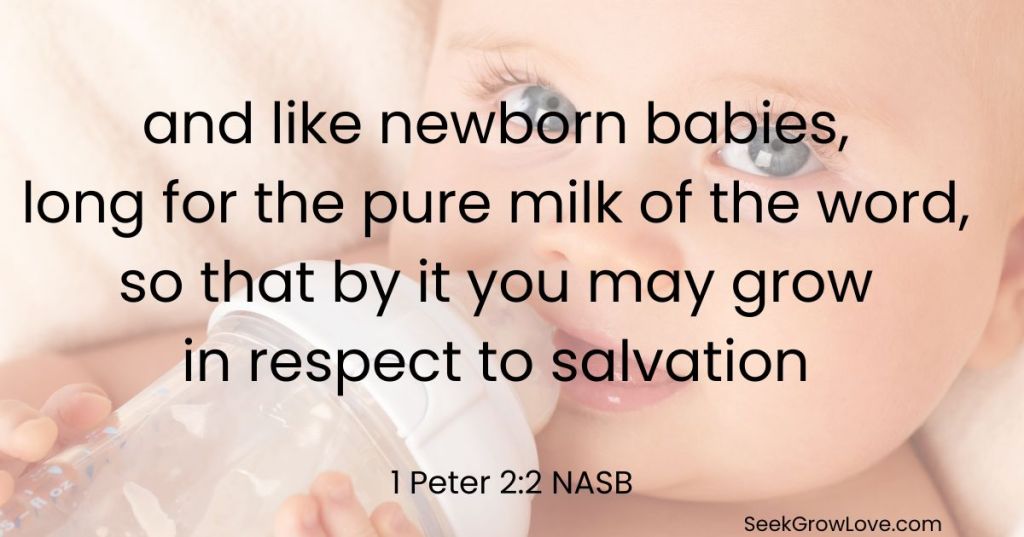
These problems stem from not being focused on what Peter calls “pure spiritual milk.” If our priorities and focus are not on the life that God wants us to lead, but rather on what we want for ourselves, we open ourselves up to relating to others in a selfish or prideful way that opens us up to these types of destructive conduct.

We’ll close out with this excerpt from the NIV Application Commentary:

“Pure spiritual milk” refers to the very things that nourish the Christian community in its growth: knowledge of God, prayer, instruction in the gospel, faithful obedience, and hearing God’s preached word. The desire for spiritual nourishment is the desire of any church that wants to know the Lord and live in light of his will.”

Reflection Questions

  1. Who do you love that you can work on treating better? What will that look like?
  2. Do you allow yourself to be annoyed by others? What are your options? How can you view others instead?
  3. Malice, deceit, hypocrisy, envy, slander, and gossip. Stop and examine yourself. What can you get rid of in your own life? What will you replace it with?
  4. How do you get spiritual nourishment? How does it help you grow in respect to salvation? If you have been feeling spiritually malnourished recently what can you do to crave – and consume – more pure spiritual milk?

Prayer

Dear Father – I give you praise and worship for You are a great God. Thank You for Your faithfulness and love and the gift of Your Son. Help me to get rid of all bad attitudes and evil thoughts, words and actions towards others. I want to love others well, as You and Your Son have loved me. Thank You for Your perfect Word that lives forever and supplies all we need to grow in You. Help me crave it, learn from it and pass it on until Your Son returns. In his name we pray, Amen.
God’s People and His Clay

OLD TESTAMENT: Isaiah 63 & 64

POETRY: Psalm 113

NEW TESTAMENT: 1 Peter 2

Isaiah 63:7 (LEB):

“I will make known the loyal love of Yahweh,

the praises of Yahweh,

according to all that Yahweh has done for us,

and the great goodness to the house of Israel

that he has done for them according to his compassion

and according to the abundance of his loyal love.”

Isaiah 64:8-9 (LEB):

“Yet, Yahweh, you are our father;

we are the clay, and you are our potter,

and we all are the work of your hand.

Do not be exceedingly angry, O Yahweh,

and do not remember iniquity forever!

Look! Behold, we all are your people.”

Psalm 113:3 (LEB):

“From the rising of the sun to its setting,

the name of Yahweh is to be praised.”

1 Peter 2:9-10 (LEB):

“But you are a chosen race, a royal priesthood, a holy nation, a people for his possession,

so that you may proclaim the virtues of the one who called you out of darkness into his marvelous light,

who once were not a people, but now are the people of God,

the ones who were not shown mercy, but now are shown mercy.”

Isaiah 63 begins with a reflection on God’s loyal love and compassion. Despite Israel’s history of rebellion, the prophet praises God for His great goodness and mercy. This loyal love is not based on Israel’s worthiness but on God’s steadfast character. The passage recounts how God delivered His people, bore their suffering, and worked for their redemption throughout history.

However, Isaiah 64 shifts to a cry for mercy and forgiveness. The people of Israel acknowledge their sin and unworthiness, likening themselves to clay in the hands of a divine potter. They plead with God not to remember their iniquity forever and ask for Him to show mercy once again. This chapter reminds us that no matter how broken or far from God we may feel, He remains our loving Father, and we are the work of His hands. He is able to mold us, forgive us, and restore us according to His mercy.

Psalm 113 calls all creation to praise the name of Yahweh from the rising of the sun to its setting. This psalm exalts God’s sovereignty, lifting Him high above all the nations. Yet, despite His greatness, the Lord cares deeply for the lowly. He raises the poor from the dust and lifts the needy from their affliction. God’s majesty and compassion are held together in perfect harmony, and His name is worthy to be praised at all times and in all circumstances.

This psalm challenges us to recognize God’s goodness, even in the midst of difficulty. From the moment the sun rises until it sets, His name deserves our praise. Whether in times of blessing or struggle, God’s compassion remains steadfast, and our response should be one of continuous worship and gratitude.

In 1 Peter 2, we are reminded of the incredible transformation we experience through Jesus Christ. We, who were once in darkness, have been called into God’s marvelous light. Peter describes believers as a “chosen race, a royal priesthood, a holy nation, a people for His possession.” These titles reflect our new identity in Christ and the purpose for which we were called—to proclaim the virtues of the One who saved us.

Peter contrasts our former state of not being a people with our new reality of being God’s people. Once, we were outside of mercy, but now we have received mercy. This passage is a powerful reminder that our identity is not defined by our past or our failures, but by God’s choosing and grace. As His chosen people, we are called to live in holiness, reflecting His light to the world.

This week, reflect on God’s mercy in Isaiah 63-64 and His greatness in Psalm 113. Let these truths shape your understanding of your identity in Christ, as Peter describes. As God’s chosen people, live in His light, praising His name, and proclaiming His goodness to the world around you.

-Jeff Ransom

Reflection Questions:

How does the imagery of God as a potter and us as clay in Isaiah 64 speak to your relationship with Him? In what areas of your life do you need to submit to His molding?

How can you live out the call to praise God from the rising to the setting of the sun, even when circumstances are difficult?

Reflect on your new identity as described in 1 Peter 2:9-10. How can understanding that you are a chosen and holy person shape the way you live and share your faith with others?

In what ways can you proclaim the virtues of the One who has called you out of darkness into His marvelous light in your daily life?

Stone Collector

1 Peter 2

Saturday, October 8, 2022

Let’s pretend I’m going to build a house with stones. 

First, I’d need a bunch of stones dumped in my yard. Then I would need to expertly stack them, making sure to pick the right stones that fit together and that don’t fall over in the breeze. I’d also need some kind of mortar or clay to hold them together. I can imagine some of the stones would be a bit too big to be lifting and moving around, so I’d need a tractor with a bucket, or even better, a crane. There’s a lot that would go into this. 

Now let’s pretend I actually completed my stone house. I still have a giant pile of rocks that I didn’t use. Some are just weird shapes, or cracked, or plain ugly. There is one stone in particular that was my least favorite because I kept tripping over it. I don’t want anything to do with these stones anymore.

Now I throw a little stone house-warming party, and my neighbor comes over. He says, “Hey, I want to build a stone house, too. Can I use the stones you didn’t want? I’ve got just the spot for each of them, especially that one you kept tripping over.”

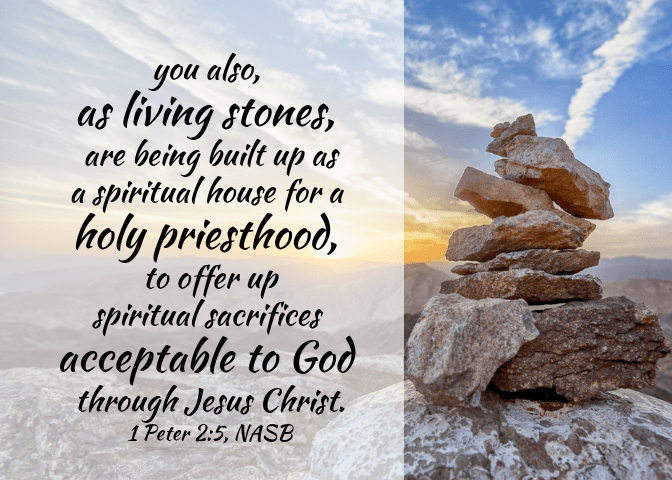
“Come to him, a living stone, though rejected by mortals yet chosen and precious in God’s sight, and like living stones, let yourselves be built into a spiritual house, to be a holy priesthood, to offer spiritual sacrifices acceptable to God through Jesus Christ.” (1 Peter 2:4-5 NRSV)

Now that we’ve heard and accepted the good news (remember yesterday’s reading?), we’ve become “living stones” to God. The world will look at us and scoff because we’re weirdly shaped and of no use to them, but God has a special use for all of us. He especially chose each of us for his project.

God is building us together into what Peter calls a “spiritual house” to be a “royal priesthood” to “offer spiritual sacrifices.” Peter is using this imagery to prompt us to imagine ourselves as the temple of God. The temple is a sacred space where the divine lives, just as we are to be sacred spaces where God’s spirit dwells. 

The priests are like mediators between the divine realm and the world, helping to make connections between the two. For us to be a royal priesthood means that we have access to God that we are to share with others. We are to connect God and people. We are to bring people into the experience of who God is.

The last part of that is that we are to make “spiritual sacrifices.” Naturally, when we think of sacrifices in the context of a temple, images of bloody animals appear in our head. If not, then I just made you think of bloody animals, and you’re welcome. Peter’s not suggesting that we do the kind of sacrifice that requires killing animals, but the kind that requires doing the right thing even if (or especially if) it costs us something.

The perfect example we have of this, of course, is Jesus. In the face of suffering and rejection, he chose to do the right thing and offer his life on our behalf. Doing the right thing didn’t just cost him something—it cost him everything. God notices and responds to our sacrifices. In Jesus’ case, he was resurrected and exalted to God’s right hand. He was rejected by the world but made into the stone holding the whole house together.

We’re to follow Jesus’ example and be willing to put ourselves in God’s hands as we do the right things, knowing we could very well lose something in the process. Just as God saw Jesus’ sacrifices, he will acknowledge and respond to ours. That doesn’t mean that we should do good things expecting a reward, but that God is just, and will remember the trouble we went through while pursuing His purposes.

We know the world is going to be skeptical of our stone house. One hope is that through being God’s servants and living blamelessly (doing the right thing), the world may look at us and see honor in what we do. We are witnesses and priests to them, representing God to them as Christ did to us. We can hope that the fruit of our sacrifice is that God can gather even more living stones to make the stone house bigger and stronger.

Thanks for coming along with me this week on our journey through the book of James and the beginning of 1 Peter.

-Jay Laurent

Internal Inquiries

1. How does it make you feel knowing that God chose you to be one of his living stones?

2. What kinds of spiritual sacrifices have you made? What did it cost you?

Living Stones

1 Peter 2

1 Peter 2 5 NASB

Often, we think of our life as our own; and it is to a point. We think we just go and do what we want, when we want and no one else has any right to say anything about it. The thing we need to remember as Christians is that we have given our lives to another. We have devoted ourselves to service. As such the master to which we are devoted is constantly guiding us … Are we following?

Peter tells us to put aside ALL malice, guile, hypocrisy, envy, and slander. He suggests this will come naturally as we long for the pure word of God. This will cause us to grow in salvation and kindness. One of the best ways we can show love to one another is to show kindness to others. He says that as we have seen the kindness of God we will show kindness to others.

As His servants we are constantly being built up into a priesthood for Him. That does not mean we are going around in black shirts with white collars but it does mean we are to be serving Him with our entire being. We are called to offer sacrifices to God. Verse five of this chapter reminds me of Romans 12:1

Therefore I urge you, brethren, by the mercies of God, to present your bodies a living and holy sacrifice, acceptable to God, which is your spiritual service of worship. Romans 12:1 (NASB)

The sacrifice we offer is one of ourselves, not merely something of value to us but our entirety. We are chosen to serve Him as capable in His power, we are His possessions to serve as His people, for His glory and purposes. Peter continues to tell us that as we do what is right we may turn others to serve God as they see our actions. Also in doing right we will silence false accusations as all have seen us doing right by Him.

We are also called to respond differently than those around us. Many people are vicious toward others, especially when wronged. God is calling us, through Peter, to a better way. He has called us to be true to Him and to turn the other cheek as Jesus gave example. He reminds us that sin is no longer our master but we are now servants of Christ and his Father, our Father.

-Bill Dunn