
Set an Example

Old Testament: 2 Chronicles 21

Poetry: Psalm 100

New Testament: 1 Timothy 4

My name is Philip Kirkpatrick.  I’m 17, live in Minnesota, and attend Pine Grove Bible Church.  Some of you may have met me before and some of you may have no idea who I am.  I share this for two reasons, the first is to give those who don’t know me a little bit of background on who’s writing, and the second is because it relates to what I’m writing about.  As I was reading 1 Timothy 4, one of the verses stuck out to me.  That is verse 12,  the NIV version states:

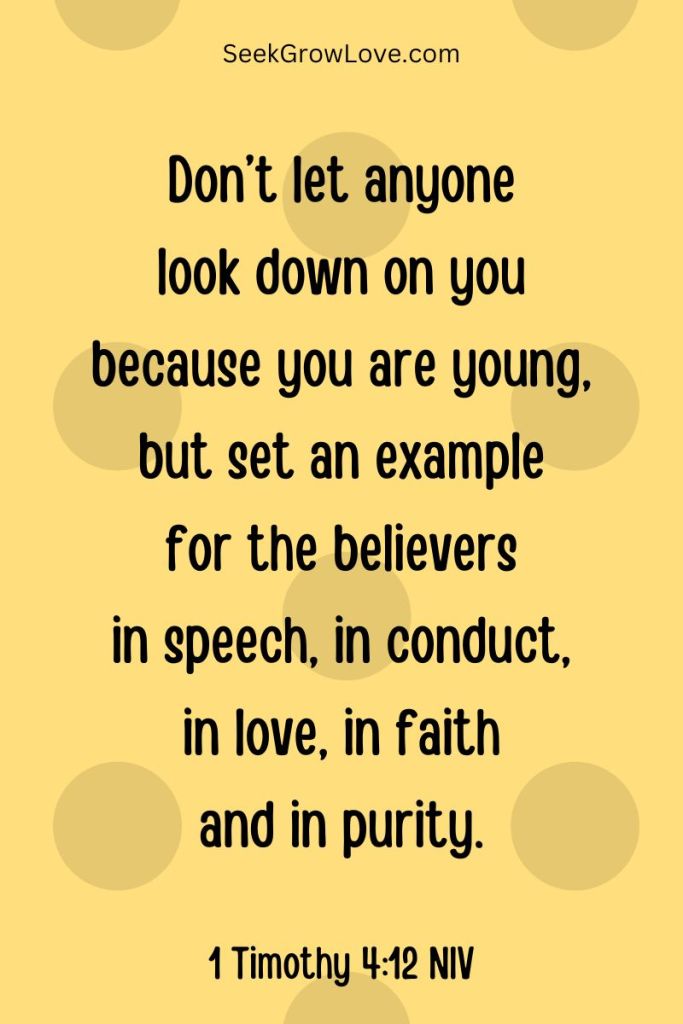
‘Don’t let anyone look down on you because you are young, but set an example for the believers in speech, in conduct, in love, in faith and in purity.’

Considering my age and youthfulness, this verse stuck out to me.  Reading it over, it seems pretty straightforward to me.  I’m going to break this up into two parts.  The first part simply states that just because of someone’s young age, it doesn’t mean they should be looked down on.  Looking back now, I can think of times that I surprised my parents by having an answer they didn’t expect me to get, or knowing a big word and casually dropping it in the middle of a sentence.  Even today I find myself surprised at times by those younger than me when they find answers I didn’t expect or know things that I don’t.  Something to keep in mind here is that just because someone is young doesn’t mean that person doesn’t have good ideas. 

This also plays into something called a logical fallacy.  A logical fallacy is an illogical argument in its simplest form.  In this case, it’s an Ad Hominem fallacy.  This logical fallacy can be used to state that someone who may typically not have good ideas, someone young and inexperienced in this case, can’t come up with good ideas. The Ad Hominem Fallacy in other words; it is an attack against the person, not the argument or idea they are proposing.  So in the case of someone young, it’s saying you can’t dismiss it simply due to age.

The second part of this verse here tells us that we should set an example for others in 5 ways: speech, conduct, love, faith, and purity.  I’m not going to dig into all those and explain them all.  Overall it can be defined by how we act.  We should act in a manner befitting a Christian.   

To the younger: set an example to the older on how to act. 

To the older: set an example to the younger on how to act. 

And to all, don’t look down on someone because of their age, listen, and consider what they have to say. 

-Philip Kirkpatrick

Reflection Questions

  1. When have you taken notice of a good example set by someone young? Have you ever been guilty of looking down on someone just because of their age?
  2. Consider each of the ways we are to set an example for believers: in speech, in conduct, in love, in faith and in purity. Think of times when you set an example in each of these areas. Are you strongest in one of those areas? Which ones could you work on more this week?
Church

matt 18 20

We hear all the time that church attendance is down. It is. We could share the statistics, but we don’t need to. If you haven’t heard that, look around you. Church buildings, once central to communities, now stand empty or are used for other purposes. Restaurants, stores, and even more annoyingly, community and kids’ events are now regularly open/held on Sunday mornings without thought. But, why shouldn’t they be if attendance or business doesn’t decrease? And if you aren’t sure from observation alone, there are plenty of statistics out there to satisfy the most analytical of researcher. Home churches have increased in recent years, but even this increase doesn’t begin to make up for the decrease in overall church attendance. This certainly brings several questions such as “Why don’t people attend church?” or “Why have people left the church?”. . .but also. . . “What is the church?”

In our English language and contemporary society, the word “church” generally conjures up ideas of a building. Maybe a white building with a steeple and an organ. Maybe a cathedral, centuries-old with beautiful stained glass. Maybe a megachurch with full band, coffee shop, and million-dollar electronic equipment. Whatever the picture in our minds. . .it is generally far different from the meaning of the Biblical “church” and its references to the church family.

 “Remember those who led you, who spoke the word of God to you; and considering the result of their conduct, imitate their faith.” (Hebrews 13:7)

Be on guard for yourselves and for all the flock, among which the Holy Spirit has made you overseers, to shepherd the church of God which He purchased with His own blood.” (Acts 20:28)

Let the word of Christ richly dwell within you, with all wisdom teaching and admonishing one another with psalms and hymns and spiritual songs, singing with thankfulness in your hearts to God. (Colossians 3:16)

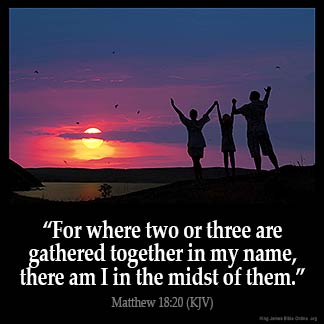
“For where two or three have gathered together in My name, I am there in their midst.” Matthew 18:20)

“. . .let us consider how to stimulate one another to love and good deeds, 25 not forsaking our own assembling together, as is the habit of some, but encouraging one another; and all the more as you see the day drawing near.” (Hebrews 10:24-25)

“These all with one mind were continually devoting themselves to prayer. . .” (Acts 1:14)

“They devoted themselves to the apostles’ teaching and to fellowship. . .All the believers were together and had everything in common. They sold property and possessions to give to anyone who had need. Every day they continued to meet together in the temple courts. They broke bread in their homes and ate together with glad and sincere hearts, praising God and enjoying the favor of all the people. And the Lord added to their number daily those who were being saved.” (Acts 2:42-47)

In scripture, the Greek word “ecclesia” refers to the group of believers. . .and clearly the content of scripture indicates that it doesn’t matter where that group meets, but who that group is. We are God’s children united in one church, one body.  We may “attend” a wedding or funeral, but we ARE the church. If we separate from the church, the body is injured. And if we think that church is something we “do” or somewhere we “go”, then we injure the body and minimize its potential. Our church family is our most important family and within it is the way we are called to seek the kingdom and spread the gospel.  If we wonder why people don’t attend church, or don’t do more than show up for a “service” and leave, perhaps we need to look at ourselves and encourage one another to amp it up a bit with a few of these things. Actions can speak louder than words sometimes, and it doesn’t help anyone to simply bemoan the state of society and the lack of church attendance and tell someone they should “come to church”. Instead, let us share it by remembering those who led us and imitate, be on guard, be thankful, teach, admonish, forgive, share, stimulate, encourage, persevere, and prioritize. We love our church, and we love even more the hope of one day being in the kingdom in a perfect, Christ-led body together. That day is ever-approaching. Let us not give it up now.

–Brian and Jennifer Hall

Increasing Fellowship with Other Christians

1 Corinth 12 19,20 revised

Has your faith or walk with God ever felt like it has fallen in a rut? Have you ever questioned whether God is listening? Have you ever questioned your faith in general? I will be completely honest; I can say yes to all of these things, but I have moved on from them, and I know God is listening, I am strong in my faith and I feel like my faith is constantly growing. You might ask what got me to this point, and truly it is my fellowship with other Christians. Being surrounded by other people who believe in what I believe and know how to comfort me and support me in my faith is so incredibly important for me, but why does God say fellowship is important, and why should it be added to your list of resolutions?

Todays’ verses are Ephesians 5:19-21 and 1 Corinthians 12:14-31

Ephesians 5:19-21 tells us to share psalms and hymns, sing together and give thanks for everything God has done for us. These verses tell us to worship God together, not only because it will bring joy to God, but because it will bring joy to me and to those believers around us.

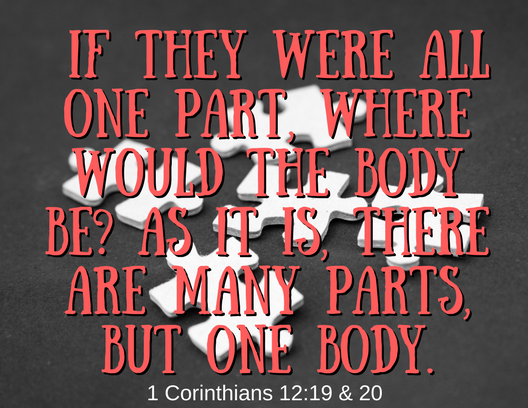
1 Corinthians 12:14-31. These verses talk about the body of Christ; we as believers and followers of Christ are the body of Christ and we are all a part of his church. We are all important and we all have a purpose. These verses say that no one part of the body can say that there is no need for another. Each piece has a specific purpose, and this was done intentionally. We are given spiritual gifts from God, and these verses also touch on that. Some people are teachers, some are apostles, some are prophets, some do miracles, some know many languages, some are good at administration and planning. None of these are more important than the other, they are just different and they are necessary for a fully functioning body. This is fellowship. When we spend time with other believers we begin to see their strengths and their gifts, when we spend more time with them, our own faith and relationship with God can be strengthened. When we spend more time with each other we are supported in our faith and our walk. We work as a team in many different aspects, and we know that we are not alone. Fellowship with each other is incredible important.

Now that you know the importance of fellowship and working together, you may be wondering how you can be more intentional in this area of your life. My suggestions are to attend church if you do not already. If you do, see if your church has a weekly bible study or youth group. If they do not have these ministries already, talk to your pastor about how to start one and how to organize one, you may not be the only person interested in creating more fellowship opportunities amongst the people in your community. I truly hope you have a supportive community, and if not I pray that one is given to you soon. Thank you for reading today, and I hope you’ll come back tomorrow.

-Jana Swanson

Boldly Be His

Saturday –

Boldly Be His & Who He Made YOU to Be!

Let’s recap who you are.

You are a new creation in Christ, created with a purpose.

You are God’s masterpiece, His poem.

You are an overcomer!

Once we begin to see who God had in mind when He created us, and we agree with Him to lean in to that (as opposed to running from it), we are then able to start living boldly for Him.

One of the dominant themes of the book of Acts is the boldness of the believers.

A short aside here:  Boldness does not mean crazy, irrational, illogical, or rude behavior.

Boldness is when we truly know something and our actions are determined by that belief.  The Greek word translated as ‘boldness’ in Acts is “parrhesia” and it conveys the idea of confidence, assurance, courage and acting without fear.

Remember Peter, who we talked about the other day.  The early Peter was characterized by bold intentions followed by timid actions.  (Example, “Hey Jesus, everyone else may abandon you but not this guy, not me.”…..Proceeds to deny knowing Jesus repeatedly).  Yeah, that guy.

BUT, not long after that, Peter preached one of the boldest messages in history and said things like, “You are a corrupt generation.  Turn from your sin, repent and get baptized!”  (Acts 3-4)

When they saw the courage of Peter and John and realized that they were unschooled, ordinary men, they were astonished and they took note that these men had been with Jesus. (Acts 4:13)

The word that’s translated ‘ordinary’ is the Greek word “idiotas.”

Any guesses what that means?

Yup, Peter and John were idiots.  Idiots for Christ.  So we could give the book of Acts the subtitle, “The Idiots Guide to Boldness.”

When’s the last time someone was amazed at your boldness?

I think we often put the cart before the horse when it comes to boldness.  We want so badly to be used by God, to serve, to be bold…that we run ahead.  The key is that boldness that accomplishes something, boldness that matters, comes from knowing who we were created to be.  It comes from everything we’ve been talking about this week.

Your boldness won’t mean anything if you don’t know who you are…or should I say, whose you are.

And if I can offer one bit of advice from someone a bit further down the road…this process is not quick.  As we seek Him, God reveals bits to us.  It’s a lifelong pursuit, not an assignment to check off of our to-do list.

But that’s also kind of cool.  That there’s always more to know, more ways to grow.

Praying for you to see yourself through His eyes.

-Susan Landry


Note:  These lessons this week were drawn from Craig Groeschel’s book, “Altar Ego”.  If you’re looking to read more on the subject, I highly recommend it.


Let’s Talk About Temptation

1 Corinthians 10-13

verse-of-the-day (1)

Tuesday, June 20

No temptation has overtaken you that is not common to man. God is faithful, and he will not let you be tempted beyond your ability, but with the temptation he will also provide the way of escape, that you may be able to endure it.  1 Corinthians 10:13


Let’s talk about temptation. Everyone is tempted, and everyone has succumbed to temptation at some point in their life, and probably numerous times. I will be the first to admit that fact in my own life. The first thing Paul does is acknowledge the universality of temptation—temptation is ubiquitous. Temptation is a common experience for all humankind. Some people might think that they are experiencing a unique type or degree of temptation, but Paul overwrites that attitude by confirming that no one is alone in experiencing any form of temptation, for every possible sort of temptation has been shared by other individuals.


We all struggle with temptation, that is the common thread that unites the human race. But unlike individuals who do not trust in God, the experience of temptation for believers can be different. Those who believe in God are not in a position of helplessness.


Some people have told me about their experience facing temptation, “I couldn’t help it. It was too appealing. I got tired of resisting. I just couldn’t stop myself.” The idea that there was nothing that could have been done to prevent sin is calling God a LIAR.


Paul says, “God is faithful!” What is God faithful for? He is faithful to: 1) limit the power of the temptation in your life, and 2) provide strength to endure or a possibility to remove the temptation. These are two promises of God when it comes to facing temptation. Either they are true or God is a liar. The problem many people face is that they doubt God is able to actually help them overcome temptation. They feel like it is all a matter of the will to resist temptation, and when their will weakens (as everyone’s does at some point), they feel like they just couldn’t continue to stand against the temptation and decide to just give in.


Satan is constantly battling for our mind and to entice our flesh. Elsewhere, Paul describes this battle in terms of “the schemes of the devil” and the “flaming darts of the evil one” (Eph. 6:11, 16). To combat these threats, Paul encourages believers to equip themselves with the “armor of God” (Eph. 6:11-17) in order to stand firm against the devil and his tactics and influence. While Paul describes a set of defensive armaments to be prepared to engage in spiritual warfare with the devil in Ephesians 6, his point in 1 Corinthians 10:13 is that of trust and reliance upon God to keep one’s foot from slipping and falling into sin.


It takes a resolved heart and mind to build the confidence that God will come through and be there in your time of need. Furthermore, there are two practices that can be of great help in overcoming temptation: 1) knowing Scripture (like verse 13) can turn the tables in the struggle against temptation, and 2) prayer.


If you are able to bring to mind what God has revealed about a particular temptation, it has the power to release the grip of the temptation to the point that you can endure it or eliminate the cause of the temptation altogether. That is the reason Paul calls Scripture the “sword of the spirit” (Eph. 6:17). It has the ability to defeat thoughts, attitudes, and desire that contend against the knowledge and will of God and to free a person from feeling like there is no other way out.


Secondly, prayer is always helpful and necessary when facing temptation. Temptations can come from our own desires or as a spiritual attack from the devil. Whichever it is, we can go to God in prayer asking for strength and wisdom to allow his will to prevail and to help us bring our body into subjection to what is godly and be led by the spirit away from the temptation. James writes in his letter, “If any of you lacks wisdom, let him ask God, who gives generously to all without reproach, and it will be given him” (Jas. 1:5).


If you struggle with a certain temptation, ask God for wisdom, and he will give it to you. And remember that we all have temptations, and nothing is new that we might encounter. God has seen it all before, and he has helped people through it all before. He promises to help you too, if you will but trust him and look to him for deliverance from it.


God is faithful, but do we have the courage to let him prove it?


-Jerry Wierwille


(Photo Credit: https://biblia.com/bible/niv/1%20Corinthians%2010.13)