
Eye-Witnesses and Proof of Life

Theme Week – Celebrating Jesus: Acts 1

Old Testament: Malachi 1 & 2

Poetry: Psalm 149

            Have you ever been a witness and had to testify in court?  I have.  I once witnessed a crime while I was on vacation at the beach.  I was called to come back and testify at the trial.  I didn’t mind, it was a free trip back to the beach.

            There are different kinds of witnesses.  If you ever watch television shows that feature courtrooms like Law and Order or CSI you know that different people are called to witness different things.  You can have a character witness who tells about the defendant as a person.  You can have forensic witnesses to talk about evidence.  Maybe the most important is the eye-witness, who talks about what they saw with their own eyes.  If you get two or three eye-witnesses who testify the same thing, there’s a good chance the defendant will be found guilty.

            In today’s reading from Acts, we get a small glimpse of what Jesus was up to during the first 40 days after he was raised from the dead.  He went around showing his disciples that he was still alive.  Luke, who wrote Acts, says that Jesus gave “many convincing proofs” that he was alive. 

Most of my adult children live a good distance from me, in another state, and one lives in another country.  If I haven’t heard from one of them for a while I will text them and ask for “proof of life” which means- “send me a text, call or Facetime with me so I know you’re doing okay.”  Fun fact: Dads are happier when they can see proof that their kids are okay (even if their kids are in their 20’s and 30’s and have kids of their own.).  A phone call, text, or Facetime is pretty low level proof of life, but I doubt that anyone is kidnapping my kids and doing a deepfake proof of life.  If I can see their face or hear their voice, I’m good. 

For the disciples in the first century, they had proof of life right in front of them.  Jesus was there, in his newly resurrected body, still bearing the scars from his crucifixion.  They were eyewitnesses of the risen Jesus.  But it wasn’t enough for them to just see for themselves that Jesus was risen, he told them that they had an important mission.  They were to be his witnesses.  They were to take the story of his life, teaching and resurrection to the whole world.  And they did.  That is why, 2000 years later there are people all over the world who follow Jesus Christ.

The disciples also witnessed Jesus ascend up from the earth through the clouds to heaven where he now sits at the right hand of God.  As they were eyewitnesses to Jesus ascending, they also witnessed the angels who assured them that Jesus would return in the same way that he left, visibly, in the clouds.  For 2000 years the church has kept alive this testimony from the eyewitnesses: Jesus died on the cross for our sins, God raised Jesus from the dead and many people saw him in his risen body, Jesus ascended to heaven and we heard the promise that he would one day return in the same way.  Each generation of Jesus’ followers have kept this message alive and spread it.  Now you have received it, it’s up to you and your generation to continue keeping this eye witness testimony alive, until Jesus returns.

-Jeff Fletcher

Reflection Questions

  1. If you were called up as a character witness for Jesus how would you describe him? What do you know about Jesus as a person? 
  2. If you were called up as a forensic witness testifying to the evidence of Jesus what would you say? What convincing proofs do you have that Jesus is alive?
  3. If you were called up as an eye-witness for what Jesus has done for you what would you say? How is your life different because of Jesus?
  4. Who needs to know what you know about Jesus, about the evidence surrounding his life, death, resurrection, ascension and coming return, and about how you have experienced Jesus and what he has done for you? How will you share? 
The Action Story

Old Testament: Zechariah 9-10

Poetry: Psalm 146

*Theme Week – Celebrating Jesus: Mark 1

            Every writer, speaker, film-maker has their own particular style for telling a story or giving a presentation.  When I preach a sermon I usually choose one particular theme.  I often start with a story that I have personally experienced and then try to help the listener make a connection to that same kind of story/situation and then connect the Bible story/text to that same theme.  It’s a slow build up to the main theme.  That’s one way to do it.

            Some choose to jump right in and focus on the action.  If you’ve ever seen a James Bond movie or a Tom Cruise Mission Impossible movie, you notice that almost always it begins right in the midst of the action.. very little warm up, just a kind of… boom! You’re right in the middle of the action- jumping out of an airplane, skiing down a mountain, climbing up the outside of a skyscraper, whatever.

            When it comes to the four Gospels, each one is different in how they begin.  Matthew goes back to the Old Testament and give a genealogy for Jesus, showing how his is connected to some of Israel’s great people like Abraham, Isaac, Jacob and King David and then he tells the story of Jesus’s birth in Bethlehem and how Mary’s betrothed, Joseph, was a good and honorable man.  Luke starts with the announcements of the pregnancies of John the Baptist and Jesus followed by their birth stories.  John’s Gospel follows the pattern of Genesis one and goes back to the beginning with God’s word, his promise and plan and then showing that Jesus fulfills that plan.  All three of those Gospels give back stories and slow roll outs.  Then there’s Mark.  Mark starts out… Boom!  John the Baptist is an adult and doing his ministry of preaching and baptizing.  Then Jesus appears as a grown adult and gets baptized by John and God’s voice descends upon Jesus proclaiming that he is God’s son and that God is pleased with him.

            Mark’s Gospel is an action story.  We know nothing about Jesus as a baby, how he came to be conceived of a virgin or in a manger.  Mark doesn’t mention wise men.  What matters to Mark is:  “What’s Jesus doing now that his mission is getting ready to start?”  We still know from Mark that Jesus is the son of God, because God announces it from heaven.  Mark doesn’t feel the need to share how Jesus happened to be the son of God, God just tells us.  Boom! Action!

            Mark’s favorite word seems to be “immediately”.  Jesus comes out of the water and “immediately” the heavens are torn open and God’s speaks.  Then “immediately” the spirit sends Jesus out to the wilderness to be tempted by Satan.  Compared to the other Gospels not a lot of detail.  We don’t hear from Mark how Jesus was tempted by Satan or how he responded, just that it happened.  Then Jesus is suddenly back in Galilee announcing- “It’s time! The kingdom of God is coming right away”.  Can you feel the urgency in Mark’s storytelling? 

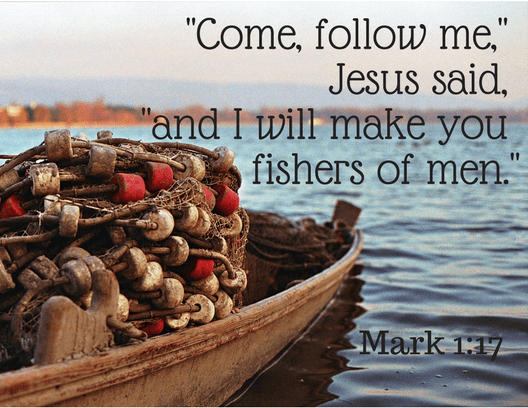
            Next, Jesus is by the sea calling the fishermen to follow him and “immediately they follow him.” He moves on down and finds two more fishermen and “immediately” he calls them.  He goes to Capernaum and “immediately” enters the synagogue and starts teaching.  Then he “immediately” casts out an unclean spirit from a young man. Then he “immediately” leaves the synagogue and goes to the home of Simon and Andrew where Simon’s mother in law is sick and “immediately” they tell Jesus about her illness and he heals her.  From there every sick person in town is being brought to him to be healed.

            Next, Jesus is getting up very early in the morning to go pray and the disciples come looking for him.  There is urgency- “everyone is looking for you.”  Jesus then leads them from town to town preaching and casting out demons.  He meets a leper and touches him and “immediately” the leper is healed.

            Each of the four gospels tell the story of Jesus but do it in different styles.  Luke spends over 19,000 words telling the story, Matthew is right behind at over 18,000 words, John uses just over 15,000 words, and Mark, you guessed it- it is by far the shortest, telling the story of Jesus at just over 11,000 words- in just a little over half the words that Luke uses.  Mark probably had his own reasons for telling the story with so much action and so few words.  It’s still the story of Jesus, told from Mark’s perspective and it still touches on the main points- Jesus is the son of God, Jesus was baptized and tempted, Jesus preached the good news and healed people, and Jesus was on the move.  Mark goes on to show that Jesus was crucified and that God raised him from the dead.

            Isn’t it great that God allows us to keep our own personality and style as we serve him?  The story of Jesus has never and will never change, but how we present Jesus to others may depend on all kinds of factors including our own personality and style as well as the needs of our conversation partners.  God doesn’t make cookie cutter disciples.  God tells the story of Jesus through many different people.  How is he using you to tell the story of Jesus?

-Jeff Fletcher

Reflection Questions

  1. Why do you think God chose four different writers to tell the story of Jesus? 
  2. What do you appreciate about Mark chapter 1?
  3. God tells the story of Jesus through many different people.  How is he using you to tell the story of Jesus?

Let it Be to Me

Old Testament: Zechariah 3 & 4

Poetry: Psalm 143

*Theme Week – Celebrating Jesus: Luke 1

            ’Twas the Night Before Christmas….  Originally published 200 years ago, in 1823, as A Visit from St. Nicolas authorship credited to and later claimed by Clement Clarke Moore.  Moore was a theology professor- a Bible teacher.  He originally wrote the poem for fun, he said, for his children.  This story helped to shape the way many began to celebrate Christmas and has had a lasting cultural impact.  I find it interesting that a Bible teacher is responsible for the way most Americans celebrate Christmas with its focus on Santa Claus, gift-giving, and all the rest of the things that tend to draw attention away from the original meaning of Christmas, the birth of Jesus.  Now Bible teachers and preachers are trying to remind us that “Jesus is the reason for the season” but more often that plea has fallen on deaf ears.  More people are interested in getting the latest iPhone or other coveted goodies.  On this Christmas Eve day, we take a quick pause from our parties, food and gift-buying and wrapping and consider the first part of the Christmas story. 

            In today’s reading from Luke one, we see the announcement of two unlikely births, two cousins to be born named John and Jesus.  Israel’s story in the Old Testament has a giant pause and collective waiting.  Israel was waiting for the arrival of their promised king or messiah.  Several hundred years BC God promised David, the King, that he would have a son who would reign as king over a kingdom that would be unending.  At first, people thought Solomon was the fulfillment of that promise.  Solomon started well, sought God’s wisdom above all else and the Kingdom of Israel prospered.  But Solomon’s heart turned away from faithfulness to God, he was not to be the true Messiah.  His son, Rehoboam ruled after him and things went from bad to worse.  Eventually, civil war caused his kingdom to split.  Eventually, God punished a succession of unfaithful kings with the destruction of the temple, the fall of the capital Jerusalem, and the end of the heirs of David ruling as kings.  For hundreds of years, there was no heir of David.  The hope for the messiah remained a longed-for and unfulfilled expectation. 

            The last of the historical/prophetic books of the Old Testament is Malachi.  Malachi ends with the hopeful promise that an Elijah-type prophet will come and get people ready for the final day of the Lord that was to come. 

            Fast forward about 400 years, and Israel is still waiting for the 2 anticipated births- of the Elijah-type prophet, and the Messiah-King, heir of David’s throne.  Out of this 400 years of waiting comes Luke 1 with the announcements of two unlikely births.  Unlikely because one was promised to an older childless couple, and the second to a young, engaged couple where the young woman was still a virgin.  In both cases, God would perform a miracle to bring forth these two baby boys, John and Jesus.

            It’s important to note in the story that when the Angel comes to Mary announcing God’s plan for her, Mary offers her consent “Let it be to me according to your word.”  This makes perfect sense.  We know that in human relationships consent is morally required before union.  Anything less than consent is unacceptable and morally reprehensible.  It stands to reason that before God placed his son Jesus in her womb she would give consent.  “Let it be” or “I agree to allow your word, your promise, your plan for your son, the Messiah to be formed in me.”

            The same is true for all of us.  God wants to place His word in us and for us to bear the fruits of Jesus.  In Galatians 4:19 Paul uses this metaphor of birth: “My dear children, for whom I am again in the pains of childbirth until Christ is formed in you…”. God wants Christ to be formed in us.  Christ was formed in the womb of Mary uniquely, but God wants all of us to be spiritually transformed, to become like Jesus in our character, in our singular commitment to bring glory to God and to seek first God’s Kingdom (Matthew 6:33) and righteousness (right living in covenant relationship with God).

            Sorry this is getting kind of technical, but the bottom line is, for Mary to give birth to Jesus, she first had to give God her consent “Let it be”.  For Christ to be formed in us, we must also give our consent.  God will not force us to receive His word and be transformed, to have Christ formed in us, we must receive it.

            So on this night before Christmas, as you watch the lights on the tree and listen to Christmas music, play games with your family, wrap presents and drink egg nog, or go to Church and any combination of the above, listen for God’s invitation.  He wants to plant His word in you so that Jesus Christ might be fully formed in you.  Will you give your consent?  Will you say as Mary did “Let it be to me according to your word?”

-Jeff Fletcher

Reflection Questions

  1. How will you celebrate Jesus today and tomorrow and the rest of the week and in 2024?
  2. Have you given your consent and received God’s word and spiritual transformation? 
  3. What might it look like and feel like to have Jesus Christ fully formed in you?